
Tax Debt by Amount
I Owe the IRS $250,000: What Actually Happens and What to Do (2026)
The short answer: if you owe the IRS $250,000, you're far above every streamlined threshold. Expect a federal tax lien, likely revenue officer assignment, and passport certification (the 2026 threshold is $66,000). Resolution is still possible — a financials-based payment plan, partial-pay agreement, hardship status, or Offer in Compromise — but every path runs through Form 433-A.
You logged into your IRS account, added up the years, and the number came out to a quarter of a million dollars. If you've been thinking "I owe the IRS $250,000 and I have no idea how that's even possible" — for a 1099 earner it's more common than you'd guess: several strong years with no withholding, quarterlies skipped, a return or two filed late, and penalties plus daily-compounding interest doing the rest.
Here's the part that matters: at $250,000 you are outside the IRS's self-service lane, but not outside its programs. The person who owes $15,000 clicks through an online payment plan. You will negotiate based on your finances — which means the numbers on your Form 433-A, not the size of the debt, decide what you actually end up paying.
⏱ The clock at $250,000: there's no single printed deadline at this level — the cost is monthly. The failure-to-pay penalty alone adds roughly $1,250 per month on a $250,000 balance (0.5% × $250,000), and federal interest compounds daily on top of that. Every month of waiting is a four-figure decision.
Why a $250,000 IRS debt is different
A $250,000 IRS balance sits five times above the $50,000 streamlined payment-plan ceiling and nearly four times above the $66,000 passport-certification threshold. Almost every convenience the IRS offers smaller balances — online setup, no financial disclosure, no lien — has already fallen away by the time you reach this number.
Three specific things change at this level. First, no payment plan gets approved without a full Collection Information Statement — Form 433-A — documenting your income, allowable expenses, and asset equity. Second, your file is a strong candidate for assignment to a human IRS revenue officer rather than the automated collection system. Third, because $250,000 is well past $66,000, your debt qualifies as "seriously delinquent," which lets the IRS certify it to the State Department and put your passport at risk.
If you're self-employed on 1099s, add a fourth: the IRS's levy power over contractor income works differently — and worse — than a paycheck garnishment. More on that below.
| Balance band | What the IRS offers | What changes against you |
|---|---|---|
| Under $10,000 | Guaranteed installment agreement — approval is essentially automatic if you're filed and compliant | Little enforcement pressure if you engage |
| $10,000–$25,000 | Streamlined plan, no financial disclosure | Lien filing becomes possible if ignored |
| $25,000–$50,000 | Streamlined online plan up to 72 months (direct debit usually required above $25k) | Refund offsets; lien risk grows |
| $50,000–$100,000 | Payment plan with financial disclosure — see I owe the IRS $100,000 | Passport certification once past $66,000 |
| $100,000–$250,000 | Financials-based agreements only — see I owe the IRS $150,000 | Revenue officer likely; lien near-certain; 10-business-day pay window on first notice |
| $250,000+ (you) | Full Form 433-A review, manager-level approval on agreements | Deep asset scrutiny, including whether you could borrow against equity — above this, see owe IRS 1 million |
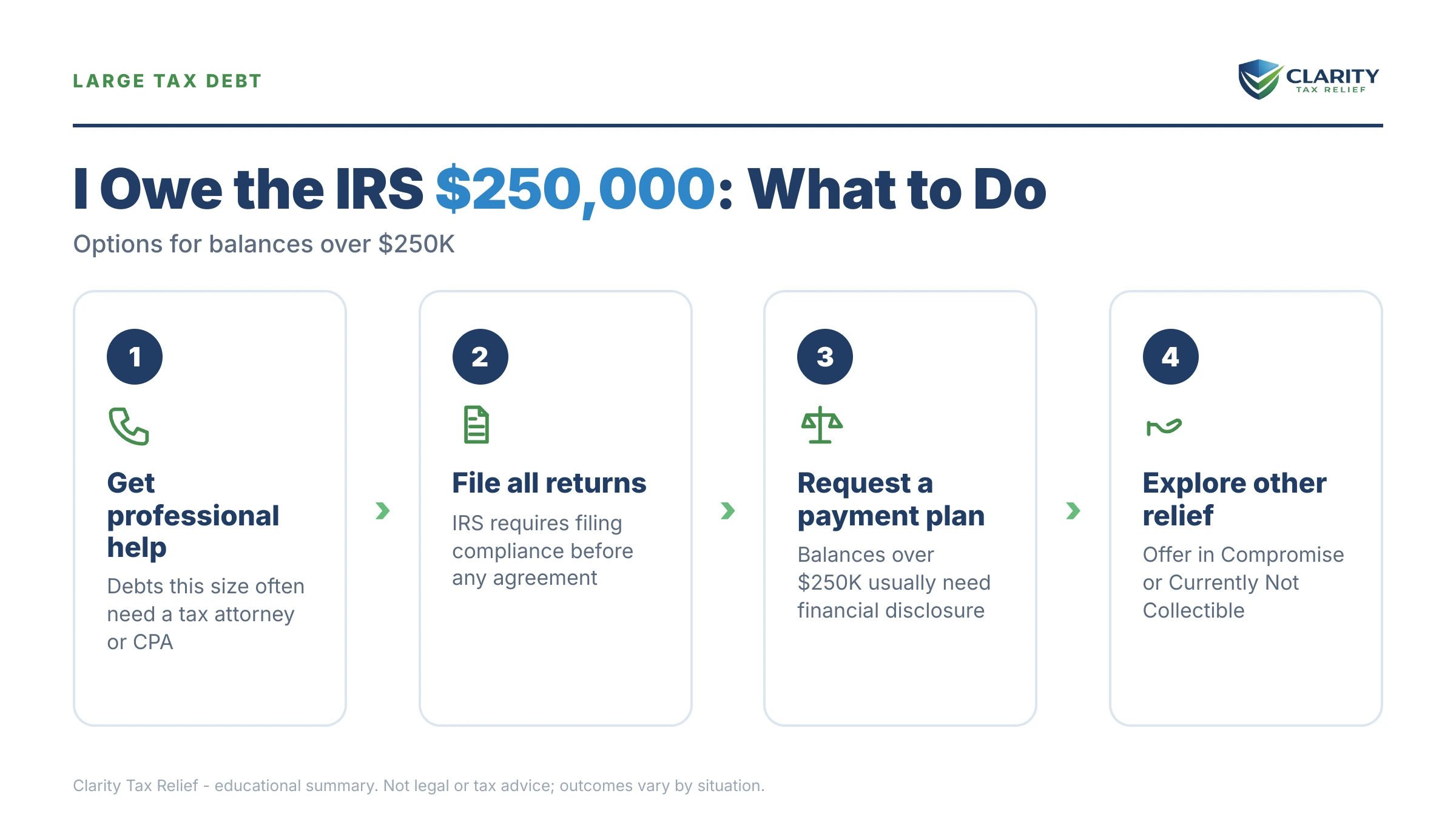
What happens if you ignore a $250,000 tax debt
At $250,000, ignoring the IRS ends with a revenue officer and levies — not just more letters. The sequence is automated at the start and human at the end, and each stage takes options off the table:
- CP14 — the first bill for each year, typically giving about 21 days to pay (balances of $100,000+ get an even shorter pay-by window).
- CP501 / CP503 — reminder bills. Still no enforcement, but the balance grows every month.
- CP504 — Notice of Intent to Levy under IRC §6331(d). The IRS can now seize your state tax refund, and lien filing is imminent if it hasn't happened.
- Notice of Federal Tax Lien (Letter 3172) — a public claim against everything you own, including receivables and property you acquire later.
- LT11 / Letter 1058 — the final notice of intent to levy. A 30-day clock starts; requesting a Collection Due Process hearing (Form 12153) inside that window blocks levy while your case is heard.
- CP508C — passport certification. At $250,000 you are almost four times over the 2026 threshold, so this can arrive at any point once collection notices go unanswered.
- Enforcement — bank levies (funds are held 21 days before they're sent to the IRS), levies served on your clients, and, on high-balance accounts, a revenue officer working the case in person.
For a 1099 contractor, the levy stage carries a specific danger: a levy served on a client captures 100% of what that client owes you at that moment — there's no exempt amount the way there is with W-2 wages. The IRS finds your clients through the 1099s they filed. Our guide on whether the IRS can garnish 1099 income covers how those levies work and how they're released.
One 2026 reality worth naming: the IRS workforce shrank roughly 27% in 2025, so reaching a human is harder than ever — but the notices, liens, certifications, and levies are generated by systems that never stopped running. Silence from the IRS is not the same as safety.
| Notice | Your window | What's at stake |
|---|---|---|
| CP14 (first bill) | Typically ~21 days; shorter at $100,000+ | Cheapest moment to act — no enforcement yet |
| CP504 (intent to levy) | Date printed on the notice | State refund seizure; lien filing likely |
| LT11 / Letter 1058 (final notice) | 30 days | Miss it and you lose your pre-levy CDP hearing — the IRS can then levy banks, clients, and wages |
| Letter 3172 (lien filed) | Hearing-request window printed on the letter | Right to challenge the lien filing through Appeals |
| CP508C (passport certification) | Ongoing until resolved | Passport denial or revocation until you enter an agreement |
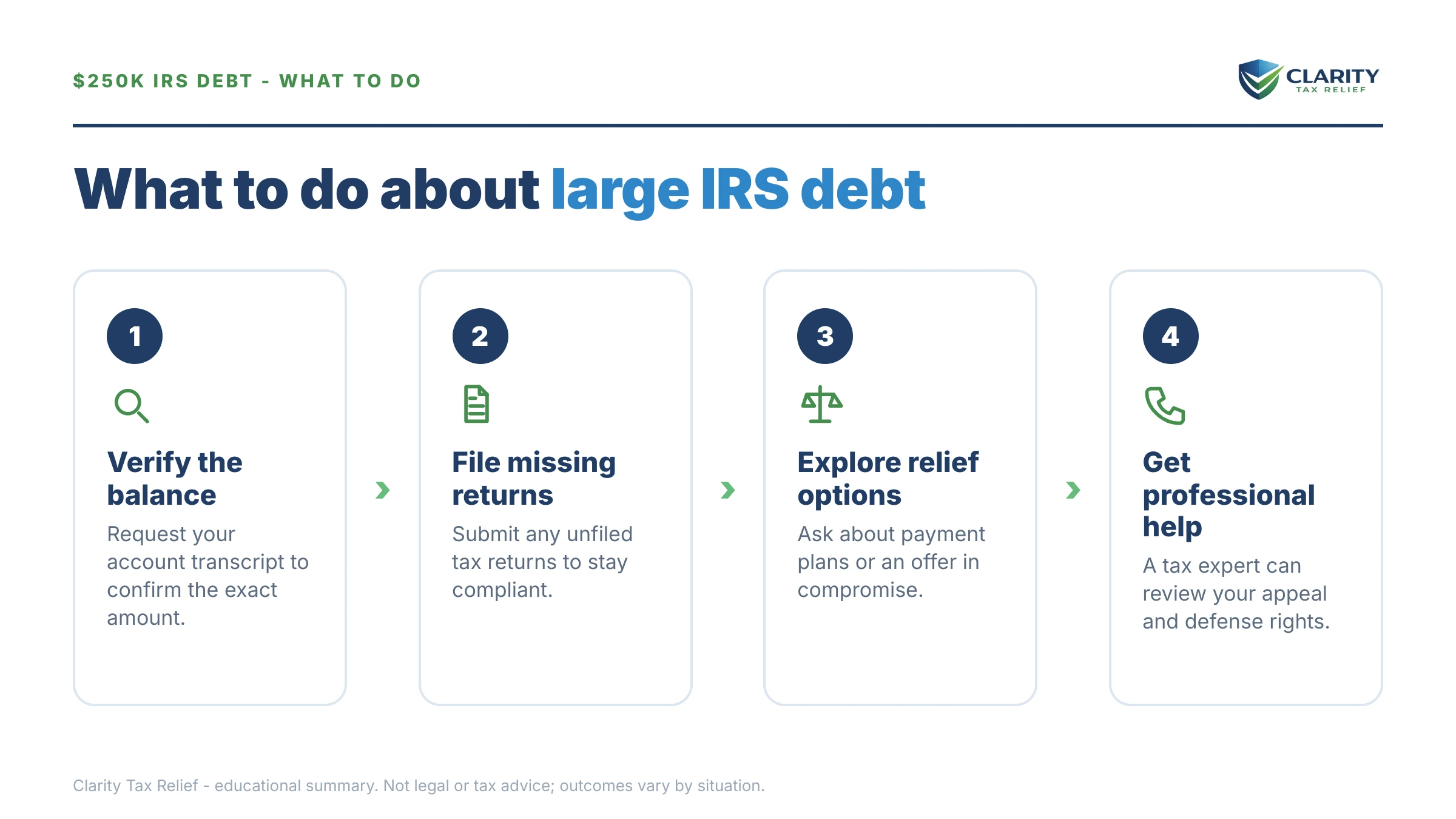
Facing a $250,000 IRS balance right now?
Every month adds roughly $1,250 in failure-to-pay penalty alone, plus daily interest — and each unanswered notice removes an option. Get your account and transcripts reviewed free by an experienced tax professional before the next stage starts.
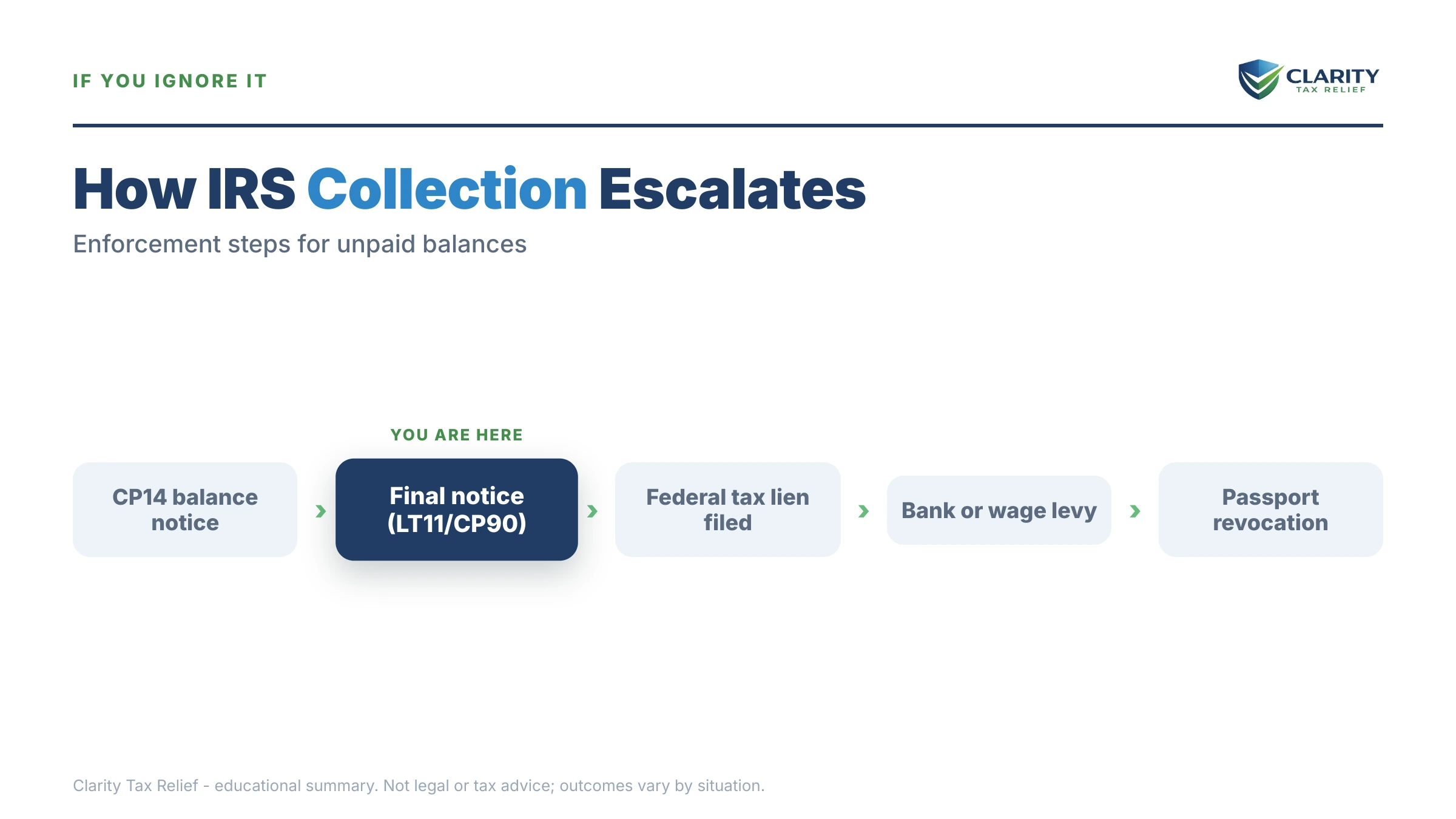
What to do if you owe the IRS $250,000: your realistic options
Every resolution option for a $250,000 IRS debt runs through the same gate: your documented finances. The IRS compares your income against its allowable living expense standards and your asset equity, then approves whichever program that math supports. The general do-it-yourself playbook lives in our guide to how to settle tax debt yourself; here's how each option behaves at this specific balance.
| Option | What it takes at $250,000 | Cost & cautions |
|---|---|---|
| Full-pay installment agreement | Form 433-A showing you can pay the balance before the collection statute expires; a payment plan over $100k typically needs manager or RO approval | Setup fee applies; interest and the 0.5%/month penalty keep accruing, so the true total paid exceeds $250,000 |
| Partial-pay installment agreement (PPIA) | Financials proving you can't full-pay by the CSED; payment set at your actual disposable income | Remaining balance expires at the statute date; IRS re-reviews your finances roughly every two years and can raise the payment |
| Offer in Compromise | Forms 656 + 433-A(OIC); acceptance depends on Reasonable Collection Potential, not the balance | $205 fee plus 20% down on lump-sum offers (waived with low-income certification); roughly 1 in 5 offers accepted in FY2024 — never a sure thing |
| Currently Not Collectible | Financials showing any payment would prevent basic living expenses | Collection pauses but the debt, lien, and interest remain; refunds are offset; status is reviewed when income rises |
| Penalty abatement | First-Time Abate if the prior 3 years were clean; reasonable cause (illness, disaster) otherwise | Removes penalties, not tax or interest on tax; starting summer 2026, Automatic Exemption from Penalty (AEP) begins replacing FTA with no request needed |
| Bankruptcy (narrow cases) | Income tax old enough to pass the timing tests, with returns filed | Recent-year tax and trust-fund debt generally survive; liens can outlast the discharge — get case-specific advice first |
On the payment-plan track, the key question is whether your disposable income times the months left on your collection statute reaches $250,000. If yes, expect the IRS to push for full pay. If no, a partial-pay agreement lets you pay what the math supports and lets the rest expire — a legitimate outcome the IRS itself administers, not a loophole.
On the settlement track, the Offer in Compromise formula is Reasonable Collection Potential: your net asset equity plus a multiple of your monthly disposable income (12 months' worth for a lump-sum offer). If RCP comes out well below $250,000, an offer is worth pricing seriously; you can estimate your own numbers with our Offer in Compromise Calculator before spending anything. Be skeptical of anyone who quotes a settlement percentage before seeing your financials — the "pennies on the dollar" pitch is a sales script, not how the formula works.
On the hardship track, Currently Not Collectible status exists even at $250,000 — the balance doesn't disqualify you, only your budget does. For a contractor with collapsed income, CNC can stop levies while you rebuild, though the lien stays and interest keeps running.
The math on $250,000: a worked example
Say you're a 1099 contractor who grossed strong six figures for three years, paid no quarterlies, and filed two returns late. The underlying income and self-employment tax ran about $180,000 — and failure-to-file penalties, failure-to-pay penalties, and daily-compounding interest pushed the total to $250,000. Here's how the three main paths price out (all figures hypothetical):
- Full-pay plan: with roughly 8 years (96 months) left on the collection statute, $250,000 ÷ 96 ≈ $2,604/month — and because interest keeps compounding, the real payment to actually retire the debt runs higher.
- Partial-pay plan: if your Form 433-A shows $2,058/month of disposable income after IRS allowable expenses, a PPIA at $2,058 × 96 months collects about $197,600; the remaining balance expires at the statute date, subject to periodic financial reviews.
- Offer in Compromise: suppose your net realizable equity is $68,000 and disposable income is that same $2,058/month. RCP for a lump-sum offer ≈ $68,000 + (12 × $2,058) = $92,700. That $92,700 — not a percentage of $250,000 — is the number the IRS's own formula supports, and it would require the $205 fee plus a 20% down payment of about $18,540 with the application.
Notice what drives the answer: the same person, three very different outcomes, all determined by equity and monthly cash flow. That's why the work at this level is building the 433-A correctly — every allowable expense you document changes the result by thousands of dollars.
How to respond if you owe the IRS $250,000, step by step
- Pull your IRS account transcripts. Confirm the exact balance, which tax years it covers, and each year's assessment date — that's what your 10-year collection clock runs from.
- File every missing return. The IRS won't approve any payment plan, offer, or hardship status while a required return is unfiled — and filing stops the 5%-per-month failure-to-file penalty.
- Start current-year estimated payments. Every agreement requires current compliance; as a 1099 earner, that means quarterly estimated payments from today forward, or the agreement defaults.
- Build your Form 433-A before the IRS asks. Your income, allowable expenses, and asset equity decide every option at this level — assembling the numbers first lets you propose terms instead of reacting to theirs.
- Propose the resolution that fits your math. Full-pay installment agreement, partial-pay agreement, Offer in Compromise, or Currently Not Collectible — pick based on your 433-A numbers, not hope.
- Answer every notice and protect your hearing rights. If an LT11 arrives, file Form 12153 within 30 days to get a Collection Due Process hearing before any levy.
When you can handle this yourself — and when you shouldn't
Honestly: some parts of a $250,000 case are do-it-yourself territory. You can pull your own transcripts, file back returns, start quarterly payments, and make voluntary payments at IRS.gov/payments without paying anyone. If your finances are simple — steady income, no business entities, no equity questions — and the IRS hasn't assigned a revenue officer, you can even negotiate a financials-based plan yourself using the official IRS payment plan rules. If a levy is causing immediate hardship and you can't get traction, the Taxpayer Advocate Service is a free, independent option.
Where experienced help genuinely changes outcomes at this level: when a revenue officer is assigned (everything you say goes in the file, and the RO's first proposal is rarely the best available), when multiple years are unfiled and the order of filing affects penalties, when the full-pay-versus-PPIA-versus-OIC math is close, when a client-receivable levy is already in motion, and when business or payroll tax is mixed into the balance. The difference between a well-built 433-A and a sloppy one on a $250,000 case is routinely tens of thousands of dollars — that's the honest case for representation, not fear.
Terms you'll see at this debt level, decoded
- Revenue officer (RO): a human IRS collection agent assigned to high-balance accounts, with power to summon records, levy, and approve agreements.
- NFTL (Notice of Federal Tax Lien): the public filing that stakes the government's claim against everything you own and later acquire.
- CSED: the Collection Statute Expiration Date — generally 10 years from assessment, pausable by appeals, offers, and bankruptcy; see how long the IRS can collect back taxes.
- RCP (Reasonable Collection Potential): the equity-plus-future-income formula the IRS uses to price an Offer in Compromise.
- PPIA: a partial-pay installment agreement — a monthly payment below what full payoff requires, with the remainder expiring at the CSED.
- Seriously delinquent tax debt: the passport-certification category; the 2026 threshold is $66,000, which a $250,000 balance clears nearly four times over.
Owe the IRS $250,000? Questions, answered
Can I get an IRS payment plan if I owe $250,000?
Yes — but not the streamlined kind. Above $50,000 the IRS requires a Collection Information Statement (Form 433-A or 433-F) documenting your income, expenses, and assets before approving a monthly payment. If your finances can't full-pay before the collection statute expires, a partial-pay installment agreement can set the payment at what you can actually afford. Expect the IRS to also ask about equity you could borrow against.
Can I settle $250,000 in tax debt for less?
Possibly, through an Offer in Compromise — but acceptance depends on your Reasonable Collection Potential, not the size of the balance. The IRS accepted roughly 1 in 5 offers in FY2024, and a $205 application fee plus a 20% down payment apply to lump-sum offers. If your equity and future income genuinely can't cover $250,000, the math can work; if you have significant assets, it won't.
Will the IRS take my passport if I owe $250,000?
It can certify your debt to the State Department. The 2026 threshold for seriously delinquent tax debt is $66,000, so a $250,000 balance is nearly four times over it. Certification (notice CP508C) lets the State Department deny or revoke your passport. Entering an installment agreement, an accepted Offer in Compromise, or pending CDP hearing status reverses certification — usually the fastest fix if you travel for work.
Will the IRS file a tax lien on a $250,000 debt?
Almost certainly, if it hasn't already. A Notice of Federal Tax Lien is standard at this balance and attaches to everything you own, including business receivables and property you acquire later. The lien no longer appears on consumer credit reports, but it is a public record that lenders and title companies find. Paying down the balance, an accepted offer, or lien subordination or discharge are the main paths around it.
Can the IRS garnish my 1099 contractor income?
Yes. A levy served on one of your clients takes 100% of whatever that client owes you at that moment — unlike a W-2 garnishment, there is no exempt amount for contractor pay. Each levy is one-time, but the IRS can serve levies on every client it finds through your 1099 filings. For a contractor, receivable levies are usually the most damaging enforcement tool, which is why acting before the LT11 window closes matters.
Can you go to jail for owing the IRS $250,000?
No — owing tax, even $250,000, is a civil matter, not a crime. Criminal exposure comes from willful evasion, hiding income or assets, or filing false returns, not from an honest debt you can't pay. Keep filing accurate returns on time even when you can't pay; the failure-to-file penalty is ten times the failure-to-pay penalty (though in months where both apply, the failure-to-file portion drops to 4.5%, for 5% combined), and non-filing is what creates real legal risk.
Does IRS debt of $250,000 expire after 10 years?
The collection statute (CSED) generally runs 10 years from each assessment — but it pauses for bankruptcy, a pending Offer in Compromise, CDP appeals, and extended time outside the country. On a $250,000 debt, the IRS actively works the account rather than letting it quietly expire, and a revenue officer may push for payment or lien enforcement well before the deadline. Waiting out the clock is rarely a strategy at this level.
What does a revenue officer do when you owe $250,000?
A revenue officer is a local IRS collection agent assigned to high-balance accounts. They can summon financial records, interview you, inspect assets, and recommend levies and seizures — but they also have authority to approve payment plans and hardship status that the automated system can't. An RO visit is civil, not criminal. Everything you tell an RO goes into the file, which is why many people bring representation to that first meeting.
Your next 24 hours
- Confirm the real number. Log into your IRS online account or pull your account transcripts and write down the balance by tax year and each assessment date — your options depend on those dates, not just the total.
- Gather your file. Your last filed return, every 1099 from the years involved, any IRS notices you've received, and a month of income and expense records — that's the raw material for the Form 433-A that drives everything.
- Get the numbers priced. Request a free case review at the 2-minute form or call (888) 825-7779 — an experienced tax professional can run the full-pay, partial-pay, and offer math on your actual figures before another month of penalties and interest posts.
This guide is general information, not tax or legal advice for your specific situation. Eligibility for IRS programs depends on individual facts and circumstances; no outcome is guaranteed.