
Tax Debt by Amount
I Owe the IRS $500,000: Your Options and Strategy for 2026
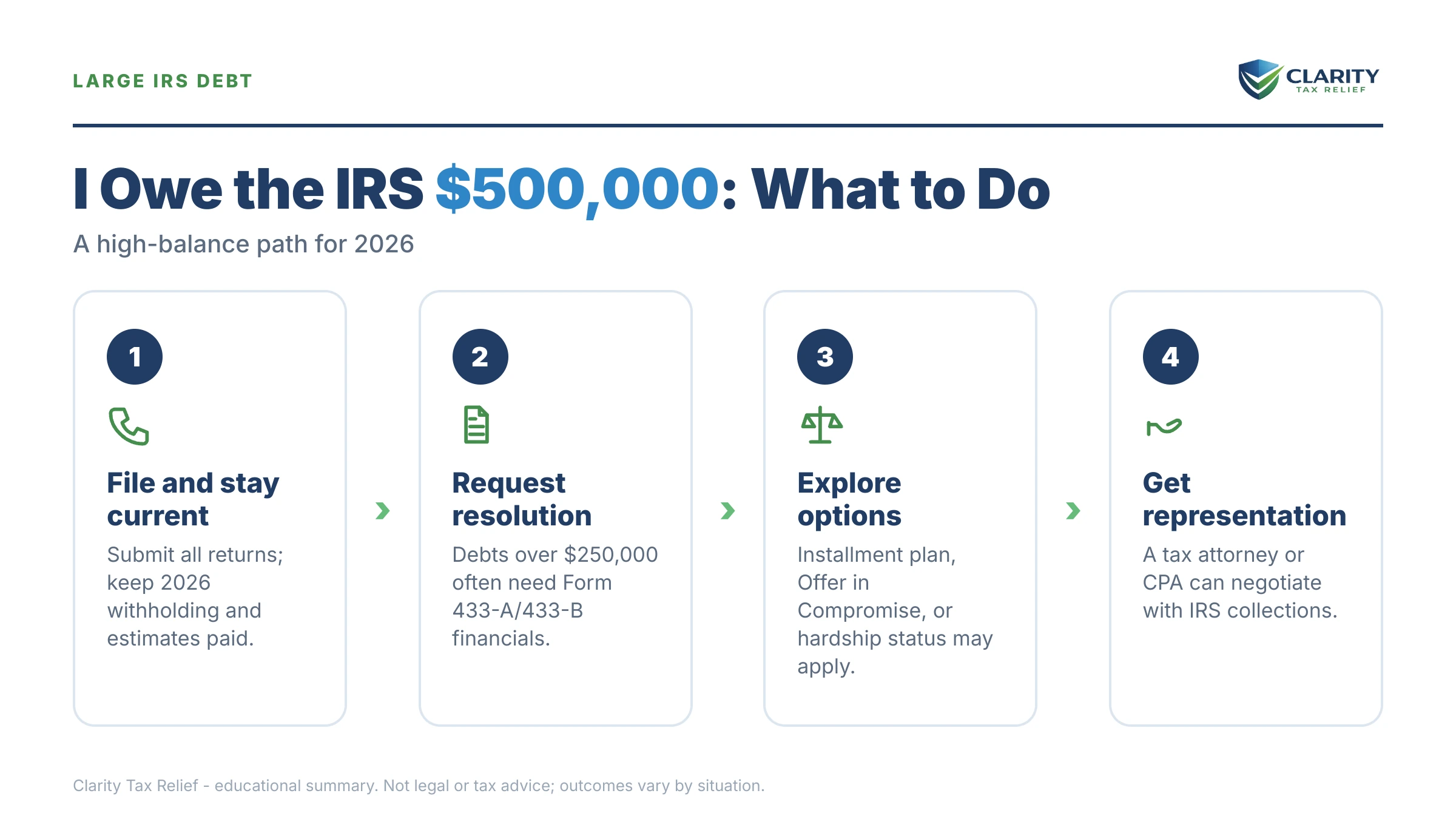
The short answer: if you owe the IRS $500,000, you're above every streamlined payment-plan threshold. Expect full financial disclosure on Form 433-A, a likely revenue officer, a near-certain federal tax lien, and passport certification (the 2026 threshold is $66,000). Your realistic paths: a negotiated installment agreement, a partial-pay agreement, an Offer in Compromise, or hardship status.
If you've typed "I owe the IRS $500,000" into a search bar, the number probably didn't appear overnight. For most people at this level it built over several 1099 years with nothing withheld, a business that grew faster than its tax planning, or an audit that landed all at once. The number is frightening — but a half-million-dollar balance is resolved through math, not mercy, and the math has more exits than you'd guess.
This guide walks the whole board: what makes $500,000 legally different from $50,000, what the IRS does at each stage if you wait, and the four resolution paths with real arithmetic on each. The options table below is where most readers find their lane — but read the escalation section first, because at this dollar level the sequence moves toward a human enforcer, not just more letters.
⏱ Your clock: there's no single deadline printed on a $500,000 balance — the clock runs monthly. The failure-to-pay penalty alone adds $2,500 a month (0.5% of $500,000) until it reaches its 25% cap, and interest compounds daily on top. Every month without a resolution is a more expensive month.
Why owing the IRS $500,000 changes the rules
A $500,000 IRS debt is ten times the $50,000 streamlined installment agreement ceiling, so every resolution runs through full financial disclosure. There is no online plan, no "just set up payments" button, and no agreement without the IRS examining your income, assets, and spending line by line on Form 433-A.
Three other things switch on at this level that smaller balances rarely trigger:
- Field assignment. Balances this size are commonly routed out of the automated system to a local revenue officer — a human collector with the power to summons records, file liens, and levy without waiting for the mail cycle. First contact often arrives as a Letter 725-B revenue officer visit appointment.
- Lien filing. A Notice of Federal Tax Lien is close to automatic at $500,000. It attaches to everything you own — home equity, business assets, receivables — and becomes public record.
- Passport certification. The 2026 "seriously delinquent" threshold is $66,000. At $500,000 you're nearly eight times over it, and once the debt is assessed with a lien filed or levy issued, certification to the State Department is essentially a formality. See passport revoked for tax debt for how certification and reversal work.
None of this means the situation is hopeless. It means the IRS treats a half-million-dollar case as worth individual attention — and you should treat your response the same way.
What happens if you do nothing when you owe the IRS $500,000
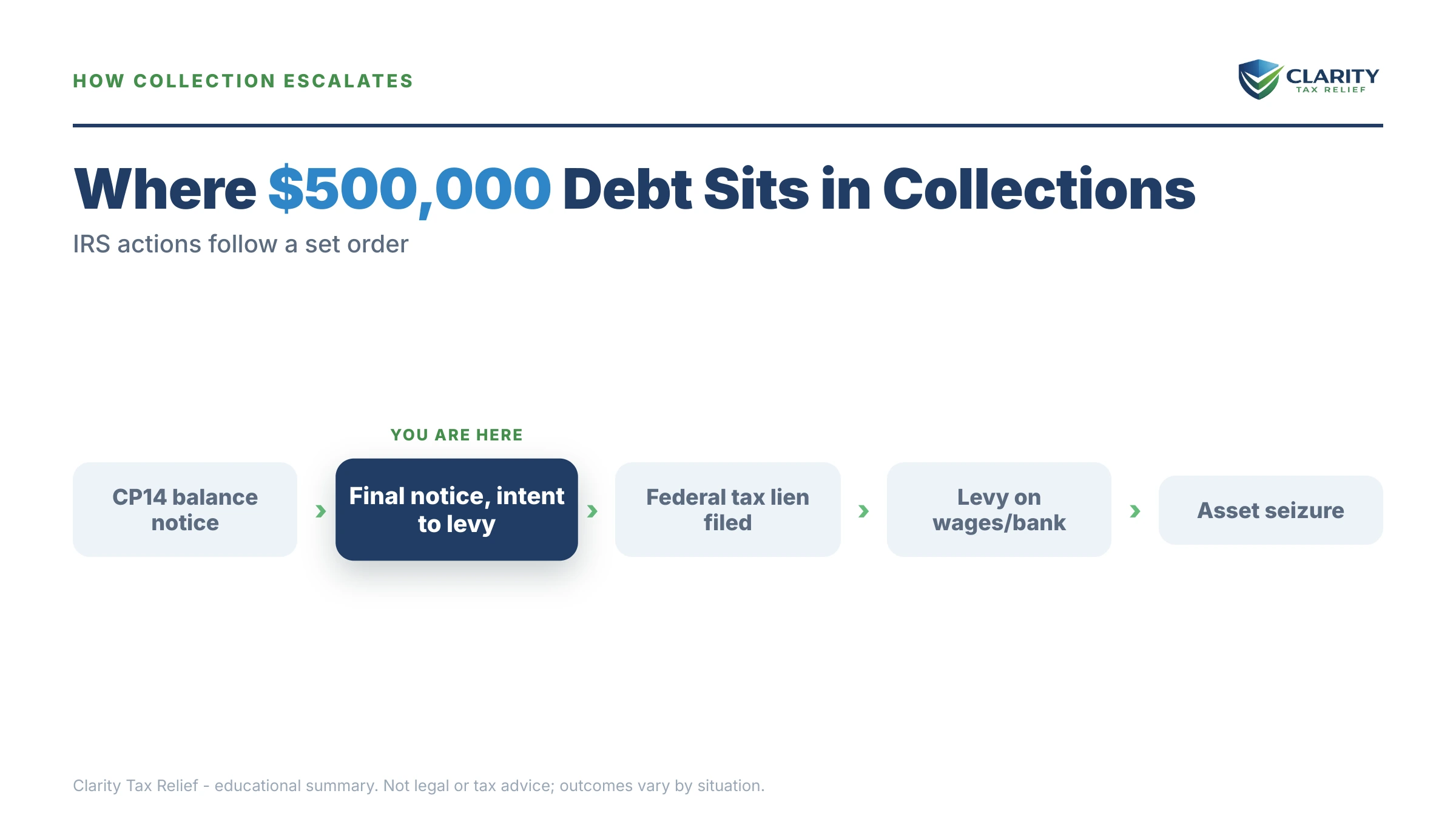
On a $500,000 balance, ignoring the IRS doesn't stall the case — it hands the sequence to a collector with levy power. The stages run in a fixed order, and each one closes an option you have today:
- The bill and reminders — CP14 and its follow-ups state the balance. Penalties and interest are already compounding, but nothing is being seized yet.
- CP504 — the IRS announces it intends to levy your state tax refund. At your balance, this notice rarely travels alone for long.
- Notice of Federal Tax Lien (Letter 3172) — the lien goes on public record against your home, business assets, and receivables. You get 30 days to request a Collection Due Process hearing on the filing.
- LT11 / Letter 1058, the final notice — a 30-day clock starts. Request a CDP hearing on Form 12153 inside that window and levies stop while your case is heard; miss it and the IRS may levy without another warning.
- Levies begin — a bank levy freezes funds with a 21-day hold before the money leaves; a wage levy is continuous until released; as a contractor, the IRS can levy your clients directly and intercept receivables.
- Passport certification (CP508C) — the State Department can deny your renewal or a new passport until the debt is resolved or in an approved arrangement.
- Endgame enforcement — on very large balances, the government can sue to reduce the debt to judgment, extending collection well past the normal 10-year statute, and a revenue officer can pursue asset seizures.
One 2026 reality check: the IRS workforce shrank roughly 27% in 2025, so reaching a human is harder than ever — but the notices, liens, and levies above are generated by automated systems that never stopped running. Silence from the IRS is not safety.
Facing a half-million-dollar IRS balance right now?
A $500,000 debt grows by $2,500 in failure-to-pay penalties every month, plus daily-compounding interest, until a resolution is in place. An experienced tax professional will review your transcripts, your CSED dates, and your realistic options — free, confidential, no pressure.
Your realistic options at $500,000
Every $500,000 resolution starts from the same place: what the Form 433-A financial analysis says you can pay. The general mechanics of each program are covered in our guide to how to settle tax debt yourself — here's how each one behaves specifically at this dollar level. First, see where half a million sits on the IRS's own ladder:
| Balance owed | Standard IRS path | What it requires |
|---|---|---|
| Under $10,000 | Guaranteed installment agreement | No financial disclosure; approval if filing and payment conditions are met |
| $10,000–$25,000 | Streamlined agreement | No financial disclosure; up to 72 months |
| $25,001–$50,000 | Streamlined agreement, online setup | Direct debit generally required at the top of the band |
| $50,001–$250,000 | Negotiated agreement through the automated collection system | Form 433 financial disclosure and documentation |
| $250,000+ (you) | Revenue-officer-managed resolution | Full Form 433-A, likely lien filing, passport certification review |
Option 1: A negotiated full-pay installment agreement
If your income and assets can retire $500,000 before the collection statute runs out, the IRS will want a plan that does exactly that. There's no fixed monthly formula — the payment comes from your disclosed financials, and the IRS may also expect you to borrow against or liquidate reachable assets first. Our guide to an IRS payment plan over 100k covers how these negotiations differ from the streamlined tiers. Interest and the 0.5% monthly penalty continue during the plan, so faster is always cheaper.
Option 2: A partial-pay installment agreement (PPIA)
When the math shows you cannot full-pay before the statute expires, a partial payment installment agreement sets your monthly payment at what the allowable-expense analysis supports — and whatever remains when the 10-year clock runs out can expire uncollected. The trade-offs: the lien stays in place, the IRS re-reviews your finances roughly every two years, and a jump in income raises your payment. For many high-balance, moderate-income taxpayers, this is the workhorse resolution.
Option 3: An Offer in Compromise
An OIC settles the debt for your Reasonable Collection Potential — the equity in what you own plus a multiple of your monthly ability to pay — when that number is genuinely below $500,000. You can estimate your own number with our Offer in Compromise Calculator before spending anything. Know the mechanics going in: a $205 application fee, a 20% down payment on lump-sum offers, an acceptance rate of roughly 1 in 5 in FY2024, and automatic acceptance only if the IRS fails to decide within 2 years, with narrow exceptions — a returned or rejected offer stops the clock, and time during court disputes does not count. At contractor income levels the low-income waiver (AGI at or below 250% of the poverty line) rarely applies. A large balance neither helps nor hurts an offer — only the collection math matters.
Option 4: Currently Not Collectible status
If your income has collapsed — a contract dried up, illness, a business failure — CNC pauses active collection while paying anything would prevent you from covering basic living expenses. The debt remains, interest keeps accruing, the lien still gets filed, and the IRS revisits your finances when income recovers. It's a shelter, not a solution, but it stops levies while you rebuild.
Don't skip: penalty relief and the bankruptcy question
On a debt this size, penalties alone can run to six figures — which makes abatement real money. First-time penalty abatement can clear penalties for one year if the prior three were clean, and starting in summer 2026 the new Automatic Exemption from Penalty (AEP) applies similar relief automatically, with no request needed. Reasonable-cause relief can reach further when illness, disaster, or events outside your control caused the noncompliance. Separately, some older income-tax debts can be discharged in bankruptcy under strict age-and-filing tests — worth a conversation with a bankruptcy attorney before committing to a decade-long payment plan.
The math on a hypothetical $500,000 case
Say you're a 1099 contractor who owes $500,000 across four tax years — self-employment tax, income tax, penalties, and interest that stacked while you kept working. After applying the IRS's allowable living expense standards, your Form 433-A shows $4,800 a month in remaining ability to pay, plus about $95,000 in reachable equity (home and accounts). Roughly 70 months remain on the earliest year's CSED. Here's how the options compare:
- Full pay fails on its face: even ignoring ongoing accrual, $500,000 over 70 months is about $7,150 a month — well above the $4,800 the analysis supports. The IRS can't get blood from a documented stone.
- PPIA: $4,800 × 70 months ≈ $336,000 collected before the statute runs, leaving roughly $164,000 that can expire at the CSED — if nothing pauses the clock along the way.
- Lump-sum OIC: RCP = $95,000 equity + ($4,800 × 12 = $57,600) = about $152,600 offered to settle everything — but it requires the $205 fee, a 20% down payment (about $30,520) with the offer, and it survives the IRS's scrutiny only if the financials hold up. Volatile contractor income cuts both ways here: a strong recent year inflates the future-income number.
Same person, three legitimate paths, a swing of hundreds of thousands of dollars. That swing is why the 433-A analysis — not the notice in your hand — is the real battlefield at $500,000.
Situations that change the strategy
Two people who each owe $500,000 can have completely different best moves depending on how the debt arose. The variables that matter most:
Married and jointly liable. If the balance sits on joint returns, the IRS can collect the full amount from either spouse. Filing separately going forward protects new refunds, and if the debt traces to one spouse's unreported income, innocent spouse relief may remove the other from liability entirely.
Business or payroll debt. If part of the $500,000 is unpaid employment tax, the trust-fund portion is treated far more harshly: it can be assessed against you personally, it survives a business closure, and the IRS almost never compromises it on ordinary terms. That slice needs its own defense before you negotiate the rest.
You dispute the amount. If the balance came from an audit you never answered or a substitute return the IRS filed for you, don't negotiate a number you don't actually owe. Audit reconsideration, an amended return, or a doubt-as-to-liability offer can shrink the debt before any payment plan is set.
Multiple years. Each year carries its own assessment date and its own 10-year clock. Strategy often means treating the years differently — letting an old year ride toward its CSED under the 10-year collection statute while resolving the newer ones.
Deadlines and rights you can't afford to miss
At $500,000, missing a 30-day response window doesn't cost you a letter — it costs you a legal right. These are the documents most likely to hit your mailbox and what each one puts at stake:
| Notice or event | Your window | What's at stake if it passes |
|---|---|---|
| CP504 (intent to levy state refund) | The date printed on the notice | Your state tax refund can be seized; the final notice is next |
| Letter 3172 (federal tax lien filed) | 30 days | Your CDP hearing to challenge the lien filing |
| LT11 / Letter 1058 (final notice of intent to levy) | 30 days | Your CDP hearing (Form 12153) — the right to stop a levy before it starts |
| Letter 725-B (revenue officer appointment) | The meeting date on the letter | Control of first contact — the officer proceeds without your side of the story |
| Bank levy served | 21-day hold | The frozen funds leave your account unless the levy is released in time |
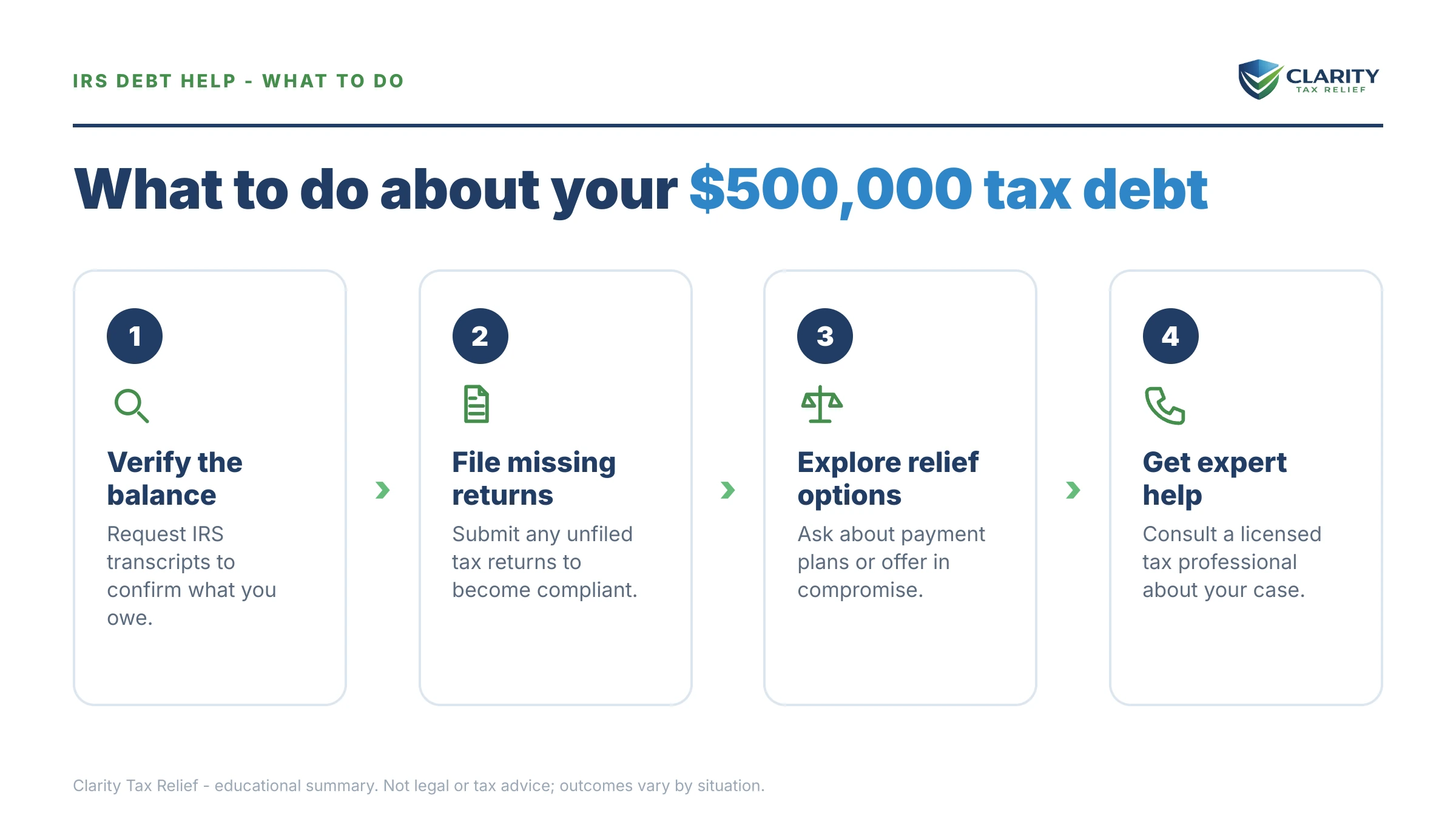
How to respond when you owe the IRS $500,000, step by step
- Pull your account transcripts — confirm the exact total, which years it spans, and each year's CSED before you negotiate anything.
- File every missing return — the IRS will not approve any agreement while required returns are outstanding.
- Start current-year estimated payments — new balances default any deal you make, so stop the debt from growing forward.
- Build your Form 433-A honestly — the allowable-expense math on that form decides every option, so get it right once.
- Match the math to a resolution — full-pay plan, partial-pay agreement, Offer in Compromise, or hardship status — and propose it before enforcement starts.
- Respond to every notice inside its window — the 30-day Collection Due Process deadlines are the only brakes on a levy.
When you can handle this yourself — and when you shouldn't
Honest answer: at $500,000, the preparation is DIY-friendly, but the negotiation usually isn't. You can and should do the groundwork yourself — pull your transcripts, gather your last return and income records, file missing years, and set up your IRS online account. If your only issue is a disputed assessment you can document, you may resolve that with paperwork alone.
Where experienced help changes outcomes at this level: the Form 433-A allowable-expense analysis (every line moves the payment or the offer by real money), managing a revenue officer relationship, defending a levy already in motion, separating trust-fund payroll debt from the rest, and choosing between a PPIA and an OIC when both are viable — as in the worked example above, where the difference was roughly $180,000. The IRS publishes its program terms at its payment plans page and Offer in Compromise page; what those pages can't do is tell you which door is cheapest for your specific numbers. If you're facing enforcement and can't get traction, the independent Taxpayer Advocate Service can also intervene when IRS action is causing hardship.
For context on how the strategy shifts at nearby balances, see what changes when you owe the IRS $150,000, at $100,000, and when a case crosses into owing the IRS $1 million.
Terms you'll hear at this level, decoded
- Revenue officer (RO): a field IRS collector assigned to high-dollar cases, with authority to summons records, file liens, and levy.
- CSED: the Collection Statute Expiration Date — the end of the IRS's 10-year window to collect each year's assessment, pausable by appeals, offers, and bankruptcy.
- RCP: Reasonable Collection Potential — the IRS's formula (asset equity plus future income) that sets the minimum acceptable Offer in Compromise.
- PPIA: a partial-pay installment agreement — monthly payments below full repayment, with the remainder eligible to expire at the CSED.
- Notice of Federal Tax Lien: the public filing that attaches the government's claim to everything you own; different from a levy, which actually takes property.
- CDP hearing: a Collection Due Process appeal (Form 12153) that pauses levy action while an independent officer reviews your case — available for 30 days after a final notice or lien filing.
$500,000 tax debt questions, answered
Can I settle a $500,000 IRS debt with an Offer in Compromise?
Sometimes — but only when the math works, not because the balance is big. An offer is accepted when your Reasonable Collection Potential (asset equity plus future monthly income) is genuinely less than $500,000, and the IRS accepted roughly 1 in 5 offers in FY2024. The application costs $205 plus a 20% down payment on lump-sum offers, so run the RCP math honestly before filing Form 656.
Will the IRS take my house for a $500,000 tax debt?
A federal tax lien against your home is nearly certain at this level, but actual seizure of a primary residence is rare and requires court approval. The lien attaches to your equity and complicates any sale or refinance until it is addressed. The realistic near-term risks are different: bank levies, a continuous wage levy, and levies on your 1099 receivables.
Will I lose my passport if I owe the IRS $500,000?
Very likely, unless you get into a resolution. The 2026 seriously-delinquent threshold is $66,000, and a $500,000 assessed debt with a lien filed or levy issued qualifies many times over. Once the IRS certifies the debt on notice CP508C, the State Department can deny a renewal or new passport. Entering an installment agreement, an accepted OIC, or a timely CDP hearing reverses the certification.
Can you go to jail for owing the IRS $500,000?
No — owing tax, even half a million dollars, is a civil matter, not a crime. Criminal exposure comes from conduct: filing fraudulent returns, willfully evading assessment, or hiding assets during collection. If you filed honest returns and simply cannot pay, the worst case is enforced collection, not prosecution. Any unfiled years should be filed before the IRS files substitute returns for you.
What would a monthly payment plan on $500,000 look like?
There is no fixed formula — above $50,000 the payment comes from your Form 433-A financial analysis, not a chart. If your income supports paying in full before the 10-year collection statute expires, the IRS will push for that. If it doesn't, a partial-pay installment agreement sets the payment at what the allowable-expense math shows you can afford, and the remainder can expire at the CSED. Interest and the 0.5% monthly late-payment penalty keep accruing during any plan.
Does a $500,000 IRS debt go away after 10 years?
Legally, yes — the IRS has 10 years from each assessment to collect (the CSED) — but don't plan on quietly running out the clock. Bankruptcy, a pending OIC, a CDP hearing, and certain other events pause the clock, and the IRS enforces large balances aggressively in the final years, sometimes suing to reduce the debt to judgment. The CSED matters most as leverage inside a partial-pay agreement, not as an escape plan.
Will a revenue officer be assigned to a $500,000 case?
At $500,000, it's likely. Balances this large are typically routed out of the automated collection system to a local field revenue officer, who can summons your records, file the lien, and issue levies. Despite the roughly 27% workforce cut in 2025, high-dollar cases are exactly where the remaining officers focus. First contact usually comes by Letter 725-B scheduling a meeting — never ignore it.
Your next 24 hours
- Find your real number. Log into your IRS online account or pull your account transcripts and write down the balance for each year — plus the assessment dates, which set each year's 10-year clock.
- Gather your financial picture. Your last filed return, any IRS letters you've received (especially anything mentioning a levy, a lien, or a meeting date), and three months of income and expense records — the raw material for the Form 433-A analysis that decides everything.
- Get the math run before you propose anything. A free case review with an experienced tax professional will show whether your numbers point to a full-pay plan, a partial-pay agreement, or an offer — before the penalty meter adds another $2,500 to the balance this month. Call (888) 825-7779 or use the 2-minute form.
This guide is general information, not tax or legal advice for your specific situation. Eligibility for IRS programs depends on individual facts and circumstances; no outcome is guaranteed.