
Tax Debt by Amount
I Owe the IRS $1 Million: What Happens Next and Every Real Option (2026)
The short answer: if you owe the IRS $1 million, expect a revenue officer, a filed federal tax lien, and passport certification — online payment plans stop at $50,000. Resolution runs through full financial disclosure on Form 433-A: a negotiated installment agreement, a partial-pay agreement, an Offer in Compromise, or hardship status.
Maybe a business unwound faster than the payroll deposits did. Maybe a stock or property sale landed with no withholding behind it, or several unfiled years finally got assessed at once. However the number got to seven figures, staring at it feels less like a bill and more like a verdict.
It isn't one. A $1 million tax debt is a solvable negotiation with known rules — but the rules that apply to you are different from the ones in most "owe the IRS" advice, which is written for balances under $50,000. This guide covers the version that applies at your size.
⏱ The clock that's actually running: the failure-to-pay penalty is 0.5% of the unpaid tax per month — roughly $5,000 a month on $1 million of tax — until it caps at 25%, with interest compounding on top the entire time. There is no single statutory deadline on a balance itself; the deadlines arrive with each notice, and the dates printed on those notices control.
Why a $1 million IRS debt plays by different rules
A $1 million IRS debt is typically worked by a human revenue officer, not the automated system that handles most tax debt. Four things change at this size, and they change your strategy:
- Field collection. Balances this large are routed out of the automated collection stream to a specific IRS revenue officer — a person with a caseload, a name, and the authority to summon financial records, recommend levies, and approve agreements a computer never could.
- The lien is close to automatic. At seven figures, a Notice of Federal Tax Lien is a near-certainty if it hasn't been filed already. It attaches to everything you own — including the home you may be planning to refinance.
- Passport certification applies many times over. The 2026 threshold for "seriously delinquent tax debt" is $66,000 — you are more than fifteen times past it, so a CP508C certification to the State Department is on the table.
- No shortcuts exist. The online payment plan tool ends at $50,000. Everything at your level is negotiated through Form 433-A, the collection information statement that documents your income, assets, and expenses.
One more distinction matters before anything else: what kind of $1 million it is. Personal income tax behaves one way. Payroll or trust-fund tax from a business behaves very differently — it can be assessed against you personally, it survives a closed company, and it is never dischargeable in bankruptcy. And if part of the balance is disputed — a bad assessment, a substitute return the IRS filed for you — fighting the number can matter more than financing it.
What happens if you ignore a $1 million tax debt
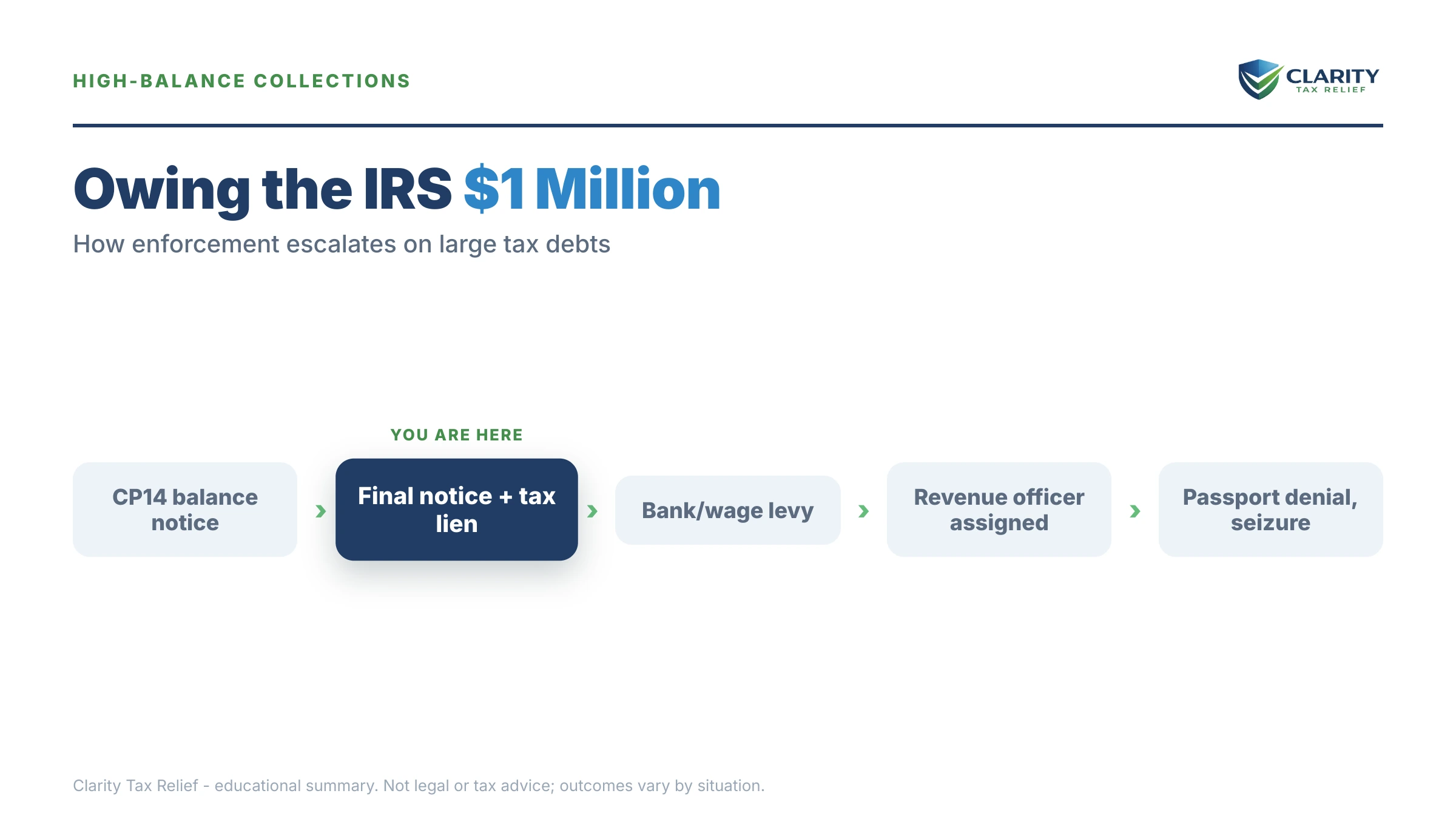
Ignoring a $1 million tax debt leads to a filed federal tax lien, passport certification, and levies on wages, bank accounts, and business receivables. The sequence is a machine — IRS staffing fell roughly 27% in 2025, but automated notices, lien filings, and levies never paused. Here is the stage order:
- CP14 — the first bill. Typically about 21 days before the cycle advances. No enforcement yet, but the meter described above is already running.
- CP501 / CP503 — reminders. No new powers, just a growing balance and a shrinking menu.
- Letter 3172 — Notice of Federal Tax Lien filed. Now public record, attached to your home and any other property, and visible to every lender you approach.
- CP504 — intent to levy your state tax refund under IRC §6331(d). Serious, but not yet the final notice.
- LT11 / Letter 1058 — final notice of intent to levy. This starts a 30-day clock and your Collection Due Process rights (requested on Form 12153). Miss it, and levies can begin without another warning.
- CP508C — passport certification. The State Department can deny a renewal or new passport while the debt stays certified.
- Revenue officer contact (often Letter 725-B). The case leaves the machine. From here, deadlines are set by a person — and so are levy recommendations.
- Levies. A bank levy freezes funds for a 21-day hold before they're sent to the IRS; a wage levy is continuous until released; if you run a business, levies can reach accounts receivable and choke cash flow directly.
Here's how the notice stages line up with the rights each one carries:
| Notice / stage | What it does | Your window or right |
|---|---|---|
| CP14 | First bill for the assessed balance | Typically ~21 days before the next notice cycle |
| CP501 / CP503 | Automated reminders | No new rights; penalties and interest keep compounding |
| Letter 3172 | Federal tax lien filed — public record | Hearing rights on the deadline printed on the letter |
| CP504 | IRS can seize your state tax refund | Act by the date printed on the notice |
| LT11 / Letter 1058 | Final notice of intent to levy | 30 days to request a CDP hearing (Form 12153) |
| CP508C | Passport certification (debt ≥ $66,000 in 2026) | Reversed by entering an agreement or pending OIC |
| RO assignment / levy | Field collection; bank, wage, and receivable levies | Deadlines set case-by-case by the revenue officer |
Facing a seven-figure IRS balance right now?
At $1 million, the order of moves — returns first, penalties next, then the balance — can change the outcome by six figures, and the debt is growing by thousands of dollars every month either way. Get an experienced tax professional's read on your transcripts and options, free and confidential.
How the playbook changes as the balance grows
The IRS runs completely different processes at different debt sizes, which is why advice written for a $20,000 balance fails at $1 million. Here is where you sit on the ladder:
| What you owe | How the IRS handles it | Realistic setup path |
|---|---|---|
| Under $50,000 | Fully automated; lien often avoidable | Streamlined online plan up to 72 months, no financial disclosure |
| $50,000–$250,000 | Financial disclosure required; lien likely | Negotiated agreement — see I owe the IRS $100,000 and I owe the IRS $150,000 |
| $250,000–$1,000,000 | Routed to field collection; RO probable | 433-A-based agreement — see I owe the IRS $500,000 |
| $1,000,000+ | RO nearly certain; lien filed; passport certified | Negotiated full-pay or partial-pay IA, OIC, or CNC — all through Form 433-A |
Your options when you owe the IRS $1 million
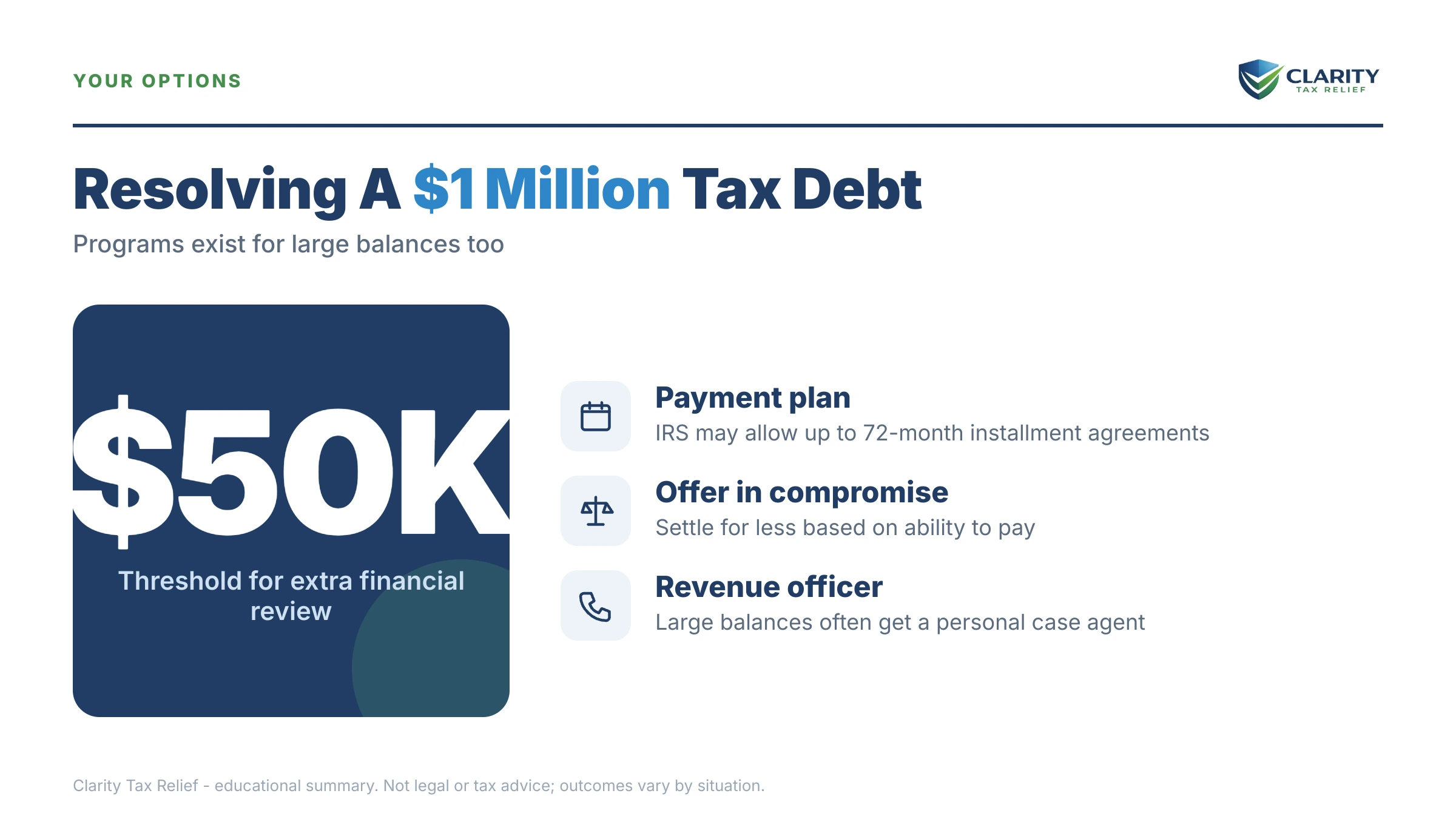
Every resolution path for a $1 million IRS debt runs through Form 433-A — the disclosure the IRS uses to measure what it can actually collect from you. That measurement, not the size of the debt, decides which of these you'll be offered. (For the general mechanics of each program, our guide to how to settle tax debt yourself covers the basics; below is how each one behaves at your size.)
| Option | Realistic when… | Cost & catch |
|---|---|---|
| Negotiated full-pay agreement | Income and assets support paying before the 10-year statute runs | Setup fee; interest and the 0.5%/mo penalty continue; RO verifies financials |
| Partial-pay installment agreement | Your 433-A shows you can't full-pay by the CSED | Financial re-review roughly every two years; payment can rise; lien stays |
| Offer in Compromise | Equity + future income genuinely fall below the balance | $205 fee, 20% down on lump-sum offers; ~1 in 5 accepted in FY2024 |
| Currently Not Collectible | Allowable expenses consume your entire income | Collection pauses but the balance grows; lien filed; refunds offset |
| Penalty abatement | Clean prior compliance or documented reasonable cause | Can remove six-figure penalties; doesn't touch the tax or interest |
| Bankruptcy (narrow) | Older income-tax years meeting the timing tests | Trust-fund/payroll portions never discharge; a filed lien can survive |
The negotiated installment agreement. Above the streamlined thresholds there's no formula plan — the payment is whatever your documented income minus IRS allowable living expenses supports. Our guide to the IRS payment plan over $100k covers the disclosure process; at $1 million, expect the revenue officer to also ask why available equity (a brokerage account, a second property) shouldn't be tapped first.
The partial-pay installment agreement (PPIA) is often the most important option nobody tells seven-figure debtors about. If your finances can't full-pay the debt before the collection statute expires, the IRS can accept monthly payments that add up to less than the balance — and whatever remains when the statute runs simply expires. A partial-pay installment agreement comes with financial re-reviews roughly every two years, and payments can rise if your income does.
The Offer in Compromise is real at any balance, including this one — but acceptance turns entirely on Reasonable Collection Potential: your net equity in everything you own, plus a multiple of your monthly ability to pay. If RCP comes in genuinely below $1 million, the IRS can accept the RCP figure. If you want a first read on your own numbers, you can estimate an offer with our Offer in Compromise Calculator. Be clear-eyed: the IRS accepted roughly 1 in 5 offers in FY2024, and high earners with home equity are the profile most often priced out. One quirk favors you, though — if the IRS doesn't decide within 2 years, the offer is accepted automatically, with narrow exceptions - a returned or rejected offer stops the clock, and time during court disputes does not count.
Currently Not Collectible exists even at $1 million. If a documented 433-A shows allowable expenses consuming your income — a collapsed business, illness, retirement on fixed income — collection pauses. The lien stays, refunds are offset, and the balance keeps growing, but levies stop while you rebuild.
Penalty abatement is worth real money at this size. Failure-to-file and failure-to-pay penalties can each reach 25% of the tax — on a seven-figure balance, penalty relief can be worth six figures by itself. First-Time Abate applies with a clean prior three years, reasonable cause applies for events outside your control, and starting summer 2026 the IRS's new Automatic Exemption from Penalty (AEP) grants some relief automatically, with no request needed.
Bankruptcy is a narrow tool, not an escape hatch. Older personal income-tax years that meet strict timing tests can be dischargeable; trust-fund payroll tax never is, and a lien already filed can survive against your property. It belongs in the analysis — usually alongside, not instead of, the options above.
A worked example: the $8,900-a-month question
Say — purely hypothetically — you owe $1,000,000 in assessed tax, you own your home, and roughly 8 years (96 months) remain on the collection statute. Full payment before the statute runs would take about $1,000,000 ÷ 96 ≈ $10,400 a month, before the interest still accruing.
Your Form 433-A, measured against IRS allowable-expense standards, shows $8,900 a month left after necessary living expenses. Over the remaining 96 months, $8,900 × 96 = $854,400 — less than the full balance. That gap is exactly what a partial-pay installment agreement is built for: the IRS takes $8,900 a month, and whatever is still unpaid when the statute expires falls away (subject to those two-year reviews).
Now run the Offer in Compromise math on the same facts. Suppose you also have $300,000 of home equity. A lump-sum offer is roughly equity plus about 12 months of that monthly capacity: $300,000 + ($8,900 × 12) = $406,800 — payable up front, with 20% down when you apply. Cheaper on paper than the PPIA, but it requires actually producing $400,000+, and the home equity is the reason. Which path wins depends on whether that equity can be reached — which brings us to the refinance.
Refinancing your home when you owe the IRS $1 million
A filed federal tax lien attaches to your home, but it does not automatically kill a refinance — Form 14134 lien subordination can let the loan close anyway. Subordination moves the IRS behind the new lender in priority, and the IRS routinely agrees when the refinance puts money in its hands: proceeds paid toward the debt, or a lower payment that increases what you can send monthly.
If you're the homeowner in the example above, this is the pivot point of the whole case. Pulling equity through a refinance can fund an Offer in Compromise or a large paydown that shrinks the negotiated payment — but the sequencing is delicate, because the lien must be addressed before closing, and the IRS's processing time has to be built into the lender's timeline. Start with our guides to tax lien subordination and refinancing with an IRS lien, and raise the refinance with the revenue officer early — it is usually leverage, not a liability.
How to respond to a $1 million IRS debt, step by step
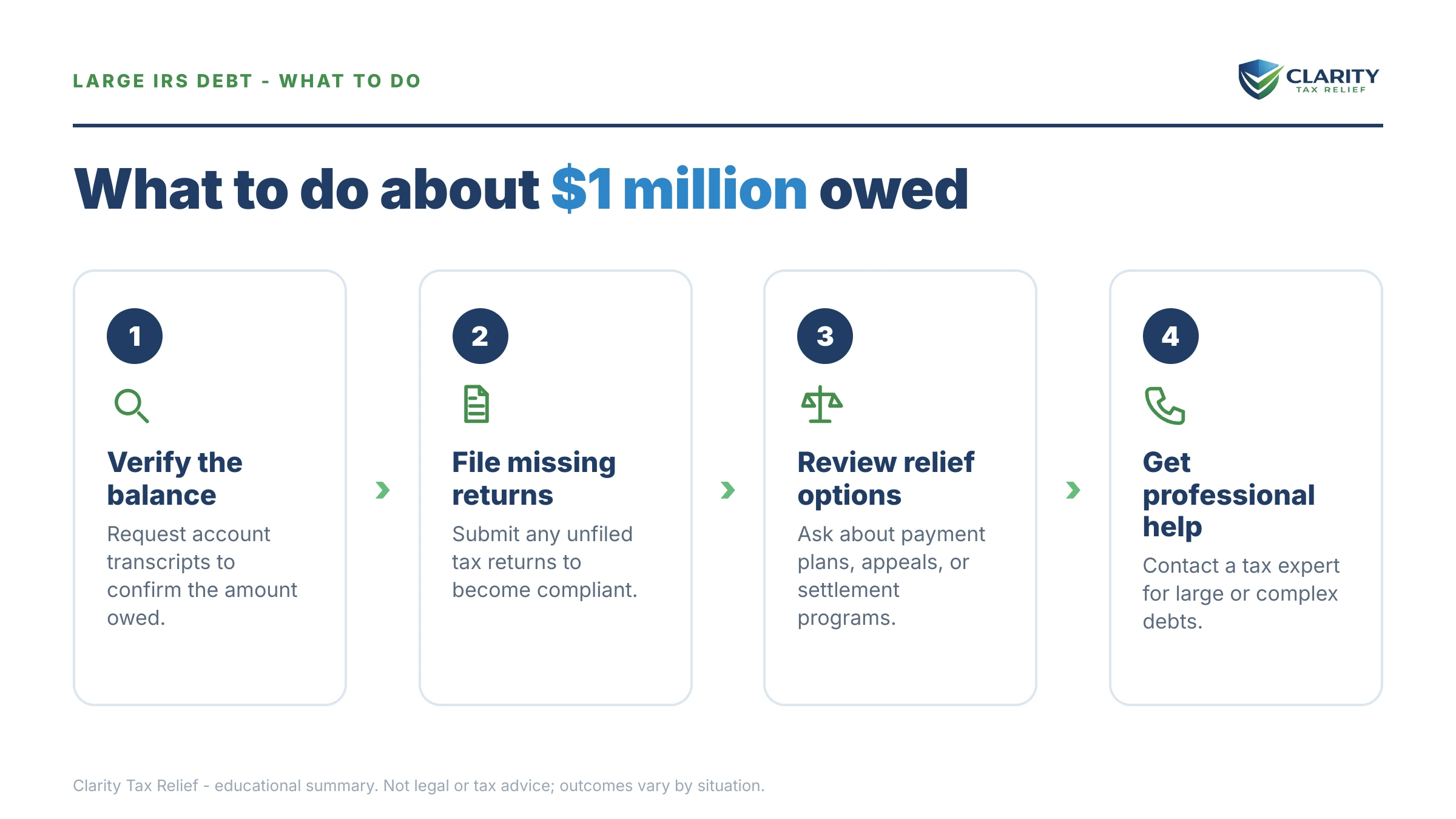
- Pull your IRS account transcripts. Confirm the balance year by year, the assessment dates that start each 10-year collection clock, and which notices have already been issued.
- File every missing return. No agreement, offer, or hardship status is possible while required returns are unfiled — and filing stops the 5%-per-month failure-to-file penalty.
- Put representation in place before the revenue officer contact. A signed Form 2848 means the RO's calls, deadlines, and financial interviews go through your representative, not you.
- Build Form 433-A deliberately. Your disclosed income, assets, and expenses — measured against IRS allowable-expense standards — determine every option you'll be offered, so accuracy and presentation both matter.
- Negotiate the track that fits the math. Full-pay agreement, partial-pay agreement, Offer in Compromise, or Currently Not Collectible — and pair it with penalty abatement and lien subordination where they apply.
When you can handle this yourself — and when you shouldn't
Honestly: a $1 million case is not a do-it-yourself project, but parts of it are. You can pull your own transcripts, set up your IRS online account, get missing returns prepared and filed, and gather the bank statements, pay records, and asset documents the 433-A will need. Doing that groundwork yourself saves money and speeds everything up.
Where experienced help genuinely changes outcomes at this size: the revenue officer relationship (what you say in a financial interview is evidence), the presentation of the 433-A (the difference between a $10,400 demand and an $8,900 agreement lives in the allowable-expense math), the full-pay-vs-PPIA-vs-OIC decision (a six-figure fork), lien subordination timed against a loan closing, and any payroll or trust-fund component, where personal liability is being decided. If a levy is already in motion or an LT11 30-day window is open, get help the same week — those rights don't come back.
Terms you'll hear at this level, decoded
- Revenue officer (RO): the IRS field collection employee personally assigned to large-balance cases, with authority to investigate, levy, and approve agreements.
- Notice of Federal Tax Lien (NFTL): the public filing that attaches the IRS's claim to everything you own, including real estate.
- CSED: the Collection Statute Expiration Date — 10 years from each assessment, after which that debt expires; paused by offers, certain appeals, and bankruptcy. See how long the IRS can collect back taxes.
- RCP (Reasonable Collection Potential): the IRS's formula — net asset equity plus future income — that sets the minimum acceptable Offer in Compromise.
- PPIA: a partial-pay installment agreement — monthly payments that total less than the debt before the CSED, with periodic financial reviews.
- Seriously delinquent tax debt / CP508C: certification of debts over $66,000 (2026) to the State Department, which can block passport issuance until you're in an agreement. Details in our guide to passport revocation for tax debt.
$1 million tax debt questions, answered
Will the IRS settle a $1 million tax debt for less than I owe?
Sometimes — but only when the math supports it. An Offer in Compromise is accepted when your equity plus future income (your reasonable collection potential) is genuinely less than the balance, and the IRS accepted roughly 1 in 5 offers in FY2024. A strong income or substantial home equity usually pushes your number too high, in which case a partial-pay installment agreement is the more realistic path to paying less than the full balance.
Does a $1 million IRS debt go away after 10 years?
The debt does expire at the Collection Statute Expiration Date — 10 years after each assessment — but the clock pauses during an Offer in Compromise, certain appeals, and bankruptcy. With a revenue officer actively working a seven-figure case, quietly running out the clock rarely works; the IRS uses liens and levies to collect before the statute runs. A partial-pay agreement is the legitimate way to use the CSED to your advantage.
Can I go to jail for owing the IRS $1 million?
No — owing tax, even seven figures, is a civil matter, not a crime. Criminal exposure comes from conduct: willfully evading tax, filing fraudulent returns, or refusing to file at all. If you filed honest returns and simply cannot pay, the consequences are financial — liens, levies, penalties, and interest — not criminal. Unfiled years are the one thing to fix quickly, because non-filing is where civil problems can turn into worse ones.
Will a revenue officer be assigned to my case?
Very likely. Balances this large are typically routed out of the automated collection system to field collection, where a specific revenue officer works the case — reviewing your financials, setting deadlines, and recommending liens or levies. That is a double-edged sword: an RO has more enforcement power than a computer, but also the authority to approve a negotiated agreement a computer never could. A signed Form 2848 lets a representative handle that contact for you.
Can I keep my passport if I owe the IRS $1 million?
Not without acting — at $1 million you are more than 15 times over the 2026 certification threshold of $66,000, so the IRS can certify your debt to the State Department (notice CP508C), which can deny a passport renewal or new application. Getting into an installment agreement, having an Offer in Compromise pending, or requesting a timely Collection Due Process hearing takes the debt out of certified status.
Can the IRS take my house over a $1 million debt?
A federal tax lien will almost certainly attach to your home, but actual seizure of a primary residence is rare and requires federal court approval. The IRS collects far more often through bank levies, wage levies, and levies on business receivables. The lien's real-world bite is at closing: it must be dealt with before a sale or refinance funds, which is where lien subordination and discharge come in.
How fast does a $1 million tax debt grow?
Fast. The failure-to-pay penalty runs 0.5% of the unpaid tax per month — roughly $5,000 a month on $1 million of tax — until it caps at 25%, and interest compounds on top of tax and penalties the entire time. If any year was filed late, the failure-to-file penalty is 10 times larger at 5% per month, up to its own 25% cap. Every month of delay is a real, calculable cost at this size.
Can I set up an IRS payment plan online for $1 million?
No. The IRS's online payment plan tool stops at $50,000 for long-term agreements. Above that, agreements require financial disclosure, and at seven figures the case is typically in a revenue officer's hands — every agreement is negotiated person to person, built on a documented Form 433-A. That is slower than clicking a button, but it also means terms are genuinely negotiable.
Your next 24 hours
- Find your most recent IRS letter and check which stage you're at — if an LT11, Letter 1058, or Letter 3172 is in the stack, a 30-day rights window may already be running from the date printed on it.
- Gather three things: your last filed return, every IRS notice you've received, and a rough snapshot of income, mortgage balance, and home equity — the raw material of the Form 433-A that decides your options.
- Get a free case review. A seven-figure balance grows by thousands of dollars a month while it sits, and the full-pay vs. partial-pay vs. offer decision is a six-figure fork. Call (888) 825-7779 or use the 2-minute form — an experienced tax professional will map your transcripts to your realistic paths, free and confidential.
Primary sources: the IRS's official pages on payment plans and installment agreements and the Offer in Compromise program; if the IRS process itself is causing you harm, the independent Taxpayer Advocate Service can intervene.
This guide is general information, not tax or legal advice for your specific situation. Eligibility for IRS programs depends on individual facts and circumstances; no outcome is guaranteed.