
Tax Debt by Amount
I Owe the IRS $150,000: What Happens Now and Every Way Out (2026)
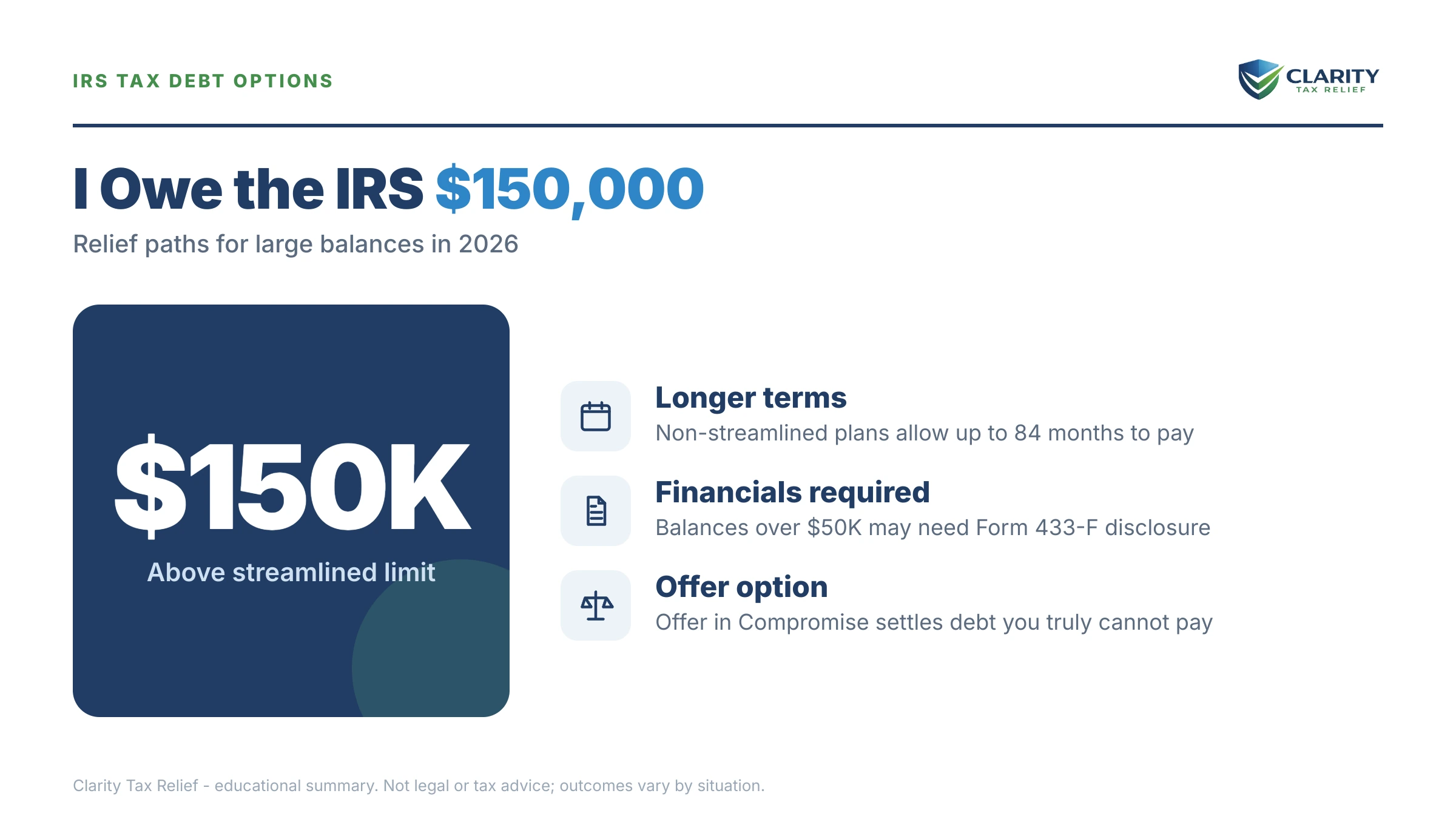
The short answer: if you owe the IRS $150,000, you're above every streamlined threshold. Expect a filed federal tax lien, passport certification risk (the 2026 threshold is $66,000), and a required financial disclosure before any deal. Your realistic paths: a negotiated installment agreement, a partial-payment plan, an Offer in Compromise, or hardship status.
You're a 1099 contractor. The work never stopped — but the quarterly payments did, and now the balances stacked across your IRS online account add up to $150,000. The number feels unpayable, and the panic is real. It's also misplaced: the IRS resolves six-figure debts on formulas, not feelings, and this guide walks you through the exact math the IRS will run on you — before it runs it.
⏱ The real clock: there's no single deadline printed on a $150,000 balance. Instead, the failure-to-pay penalty adds roughly $750 every month (0.5% of $150,000) until it caps, interest compounds daily on top, and — because you're more than double the $66,000 passport threshold — certification to the State Department can follow once final notices go out.
Why you're staring at a $150,000 tax bill
Most $150,000 IRS balances are built from several years of untaxed 1099 income, not one catastrophic return. If you're a contractor, nobody withheld anything from your checks. That means you owed income tax plus roughly 15.3% self-employment tax on your net profit — due in quarterly installments you may never have made.
Miss the quarterlies for two or three good earning years and the tax alone can reach five figures per year. Then the multipliers kick in: a late-filing penalty of 5% per month (capped at 25% of the tax), a late-payment penalty of 0.5% per month, and interest that compounds daily on all of it. A meaningful slice of your $150,000 was probably never tax at all — a point that matters, because penalties can sometimes be removed.
Other common builders at this level: an early 401(k) cash-out during a lean year, a CP2000 assessment from unreported income, or a substitute return the IRS filed for you with zero deductions. Your first job is knowing exactly which years and which assessments make up your $150,000 — that's what your transcripts are for, covered below.
What happens if you ignore a $150,000 IRS balance
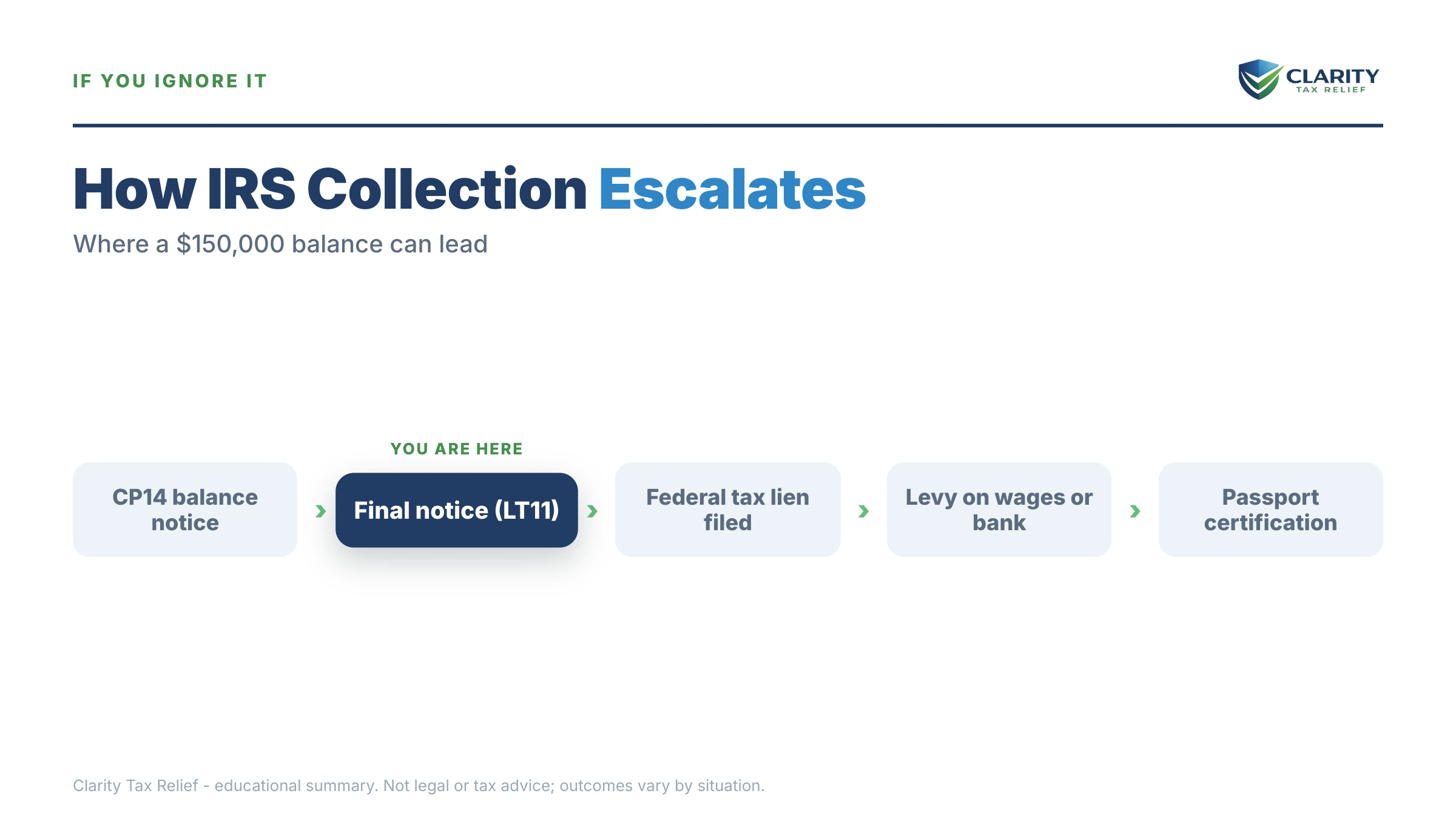
At $150,000, ignoring the IRS leads to a filed federal tax lien, passport certification, and levies — the only real question is the order. The sequence is automated, and it runs in stages:
- Balance-due notices (CP14, then CP501/CP503). Bills, not enforcement — but the balance grows every month you wait, and this is the cheapest stage to act.
- CP504 — intent to levy your state refund. The IRS can now take your state tax refund, and the file is moving toward enforced collection.
- Notice of Federal Tax Lien. At six figures, a filed lien is close to certain. It's a public claim against everything you own — it clouds the title on your home, complicates financing, and can spook business clients who run checks.
- CP508C — passport certification. Once your debt is "seriously delinquent" (over $66,000 in 2026 with a lien filed or levy issued), the IRS can certify it to the State Department, which can deny your renewal or a new passport. Details in our guide to passport revoked for tax debt.
- LT11 / Letter 1058 — final notice of intent to levy. This starts a 30-day clock and your Collection Due Process rights. After it expires, levies are legal.
- Levies. A bank levy freezes funds for 21 days before they're sent to the Treasury. And here's the part that hits contractors hardest: a levy served on your client takes 100% of the payment they owe you — there's no paycheck exemption for 1099 income. See can the IRS garnish 1099 income.
- Possible revenue officer assignment. Six-figure balances are the cases most likely to leave the automated system and land on a human revenue officer's desk — someone who can visit your home or business and demand financials on a deadline.
One 2026 reality worth knowing: the IRS workforce shrank about 27% in 2025, so reaching a human is harder than ever — but the notice, lien, certification, and levy systems are automated and never stopped. Silence from the IRS is not safety.
Owe the IRS $150,000 and not sure which track fits?
Before the lien and passport certification land, have an experienced tax professional run your numbers — the same 433-A math the IRS will use — and tell you exactly which resolution the formulas support. Free, confidential, no pressure, while your balance is growing by roughly $750 a month in penalties alone.
Your options when you owe the IRS $150,000
A $150,000 tax debt is above every streamlined IRS threshold, so every option runs through a financial disclosure the IRS verifies. The general playbook for negotiating with the IRS on your own lives in our guide to how to settle tax debt yourself — here's how each option actually behaves at this specific balance.
| Option | Who it fits at $150,000 | Cost & terms |
|---|---|---|
| Full-pay installment agreement | Disposable income can pay the balance before the 10-year collection statute runs out | Setup fee (reduced with direct debit); interest and the 0.5%/month penalty keep accruing; lien often stays until paid down |
| Partial-payment installment agreement (PPIA) | You can pay something monthly, but the math can't full-pay before the statute expires | Full Form 433 disclosure; the IRS re-reviews your finances every couple of years; unpaid remainder expires at the CSED |
| Offer in Compromise (OIC) | Asset equity + future income are provably less than $150,000 | $205 fee + 20% down on lump-sum offers (both waived with low-income certification); roughly 1 in 5 offers accepted in FY2024 |
| Currently Not Collectible (CNC) | Paying anything would leave you unable to cover basic living expenses | No payment required; levies stop; interest still accrues and a lien is likely; IRS re-reviews when income rises |
| Penalty abatement (stackable with any option) | First slip after a clean 3-year history, or a documented reasonable cause (illness, disaster) | Free to request; removes penalties and their related interest — meaningful when tens of thousands of your balance is penalties |
| Bankruptcy (edge case) | Older income-tax years that meet the discharge timing tests, often alongside other debts | Requires bankruptcy counsel; recent tax years and any lien already filed complicate it |
The installment agreement route. Above $50,000, there's no online streamlined plan — you're in IRS payment plan over $100k territory, where the IRS reviews your income, allowable expenses, and assets before agreeing to a number. If your monthly capacity can't retire the debt before the statute expires, the fallback is a partial payment installment agreement — you pay what the math supports, and whatever remains legally expires at the 10-year collection statute (CSED).
The Offer in Compromise route. The IRS doesn't settle based on hardship stories — it computes your reasonable collection potential: the quick-sale value of your assets plus a multiple of your monthly disposable income. If that figure is genuinely below $150,000, an offer near that figure can be accepted. You can estimate your own numbers with our Offer in Compromise Calculator before spending anything on the process.
The penalty layer. Whatever track you choose, check penalties first. First-time penalty abatement can wipe a year's penalties if your prior three years were clean — and starting summer 2026, the IRS's new Automatic Exemption from Penalty (AEP) applies similar relief automatically, no request needed. On a $150,000 balance where $30,000–$40,000 may be penalties, this is real money, not fine print.
What resolving $150,000 actually looks like: the math
The same $150,000 balance can resolve anywhere from roughly $26,000 to $164,000 depending entirely on your financials. Here's a clearly hypothetical example that shows why.
Say your actual unpaid tax across 2021–2023 was $83,100 — a 1099 contractor with strong gross income, no withholding, and no quarterly payments, who filed late. Watch it become $150,000:
- Failure-to-file penalty: 5% per month, capped at 25% of the tax → about $20,775.
- Failure-to-pay penalty: 0.5% per month, building toward its own 25% cap → up to another $20,775.
- Interest, compounding daily on tax and penalties at a rate that adjusts quarterly → roughly $25,000 and climbing over four-plus years.
Total: right around $150,000 — of which nearly $67,000 was never tax. Now the resolution math, in two versions of the same life:
Scenario A — strong income. After IRS allowable living expense standards, your disposable income is $2,100/month, and about 78 months remain before the earliest CSED. $2,100 × 78 = $163,800 — more than the balance, so the IRS sees full-pay ability. Expect a negotiated installment agreement around $2,100/month, an OIC rejection if you try one, and your leverage coming from penalty abatement instead: knocking out even one year's penalties trims the balance and shortens the payoff.
Scenario B — thin margins. Disposable income is $900/month and your total asset equity (used truck, modest bank balance) is $15,000. $900 × 78 = $70,200, plus $15,000 = $85,200 — the math can't reach $150,000. Two doors open: a PPIA at $900/month (about $70,200 paid over the remaining statute, the rest expiring), or a lump-sum OIC where reasonable collection potential = $15,000 + ($900 × 12) = $25,800. The offer requires the $205 fee plus 20% down (about $5,160) unless you qualify for low-income certification — and it pauses the collection statute while it's reviewed.
Same debt. One taxpayer pays $163,800; the other may legitimately resolve for $25,800. The difference isn't negotiation skill — it's what the Form 433 math shows. That's why running your numbers accurately, before the IRS runs them, is the single highest-leverage move at this balance.
Is owing $150,000 different from owing $50,000 — or $500,000?
Every jump in balance changes which IRS programs you can use and how much scrutiny you get. Here's where $150,000 sits on the ladder:
| What you owe | Typical resolution path | What changes at this level |
|---|---|---|
| Under $10,000 | Guaranteed installment agreement | Approval is essentially automatic if you're filed up and can pay within the statute |
| $10,000–$25,000 | Streamlined plan, set up online | No financial disclosure; see I owe the IRS $25,000 |
| $25,000–$50,000 | Streamlined, up to 72 months online | Direct debit generally expected at the top of the band |
| $50,000–$100,000 | Non-streamlined agreement with financials | Lien filing becomes likely; see I owe the IRS $100,000 |
| $100,000–$250,000 — you are here | Negotiated IA, PPIA, or OIC after full 433-A review | Passport certification, near-certain lien, possible revenue officer assignment |
| $250,000 and up | Revenue-officer-managed resolution | Asset-by-asset scrutiny; see what changes if you owe the IRS $1 million |
The practical takeaway: at $150,000 you've lost the self-service shortcuts but haven't yet hit the full asset-investigation treatment of the top bands. Acting before a revenue officer is assigned keeps the process on paper — and keeps more options on the table.
How to respond to a $150,000 IRS debt, step by step
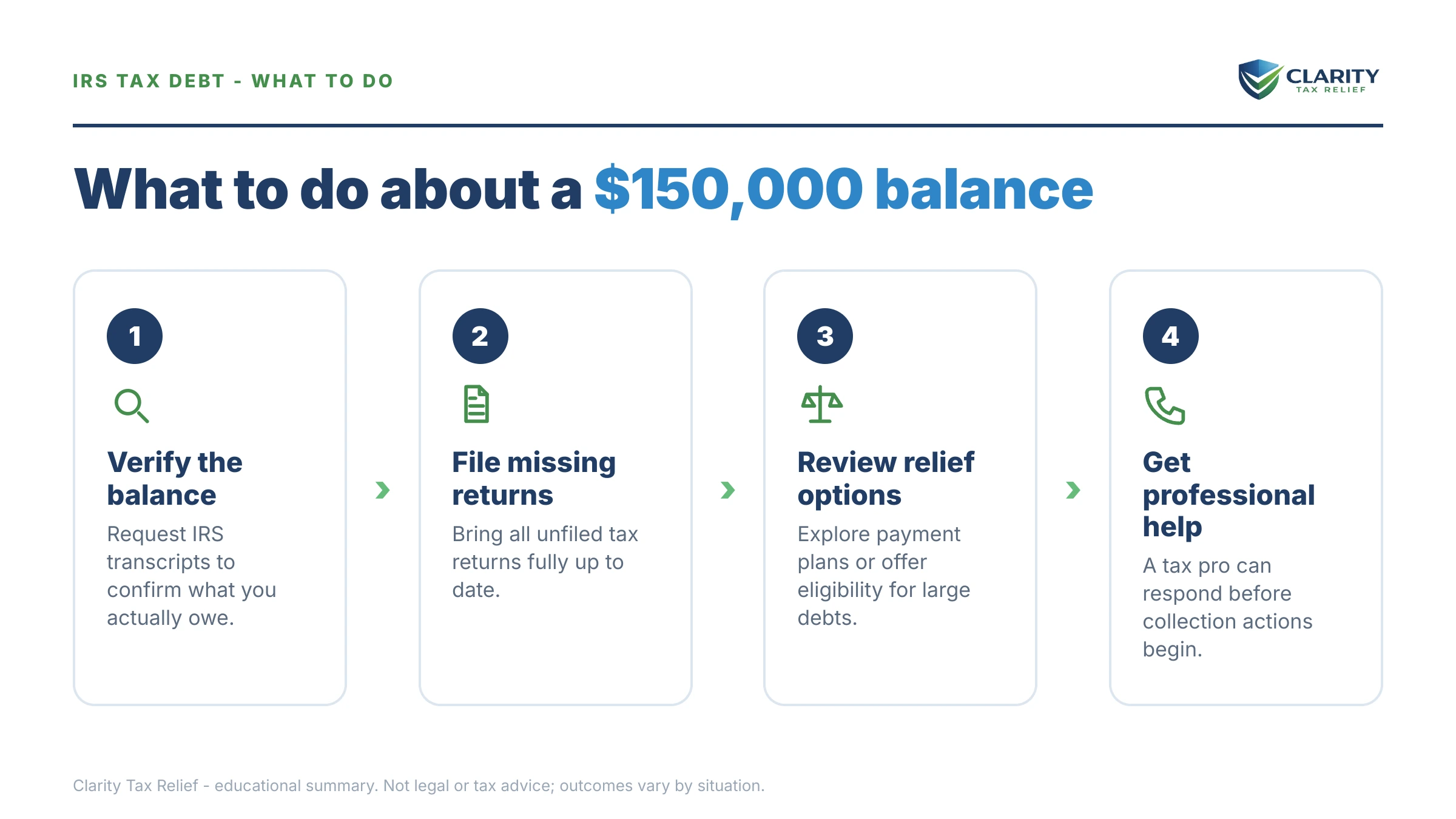
- Pull your account transcripts and confirm the real total. Log into your IRS online account or request account transcripts for every year with a balance. Verify the total, which years it comes from, and whether a lien (code 582) or final notices have already posted.
- File every missing return. The IRS will not approve any agreement — installment, OIC, or hardship — while required returns are unfiled. Filing also replaces inflated substitute-for-return assessments with your real numbers.
- Run your Form 433-A numbers before the IRS does. Build your income, allowable-expense, and asset figures the way the IRS will. This single worksheet determines whether your track is a full-pay plan, a partial-payment plan, an offer, or hardship status.
- Choose the track the math supports and apply. If your disposable income full-pays $150,000 before the collection statute expires, negotiate the installment agreement. If it doesn't, pursue a partial-payment agreement or an Offer in Compromise instead.
- Fix your quarterly estimates so the balance stops growing. Every agreement defaults if you rack up new tax debt. Set aside 25–30% of your 1099 income and pay quarterly estimates on time from here forward.
Step 3 deserves the most care — our Form 433-A walkthrough covers the allowable-expense standards line by line, because the difference between claiming your actual expenses and the IRS's capped standards is often the difference between Scenario A and Scenario B above.
Transcript codes you'll see on a six-figure balance
Your IRS account transcript tells you where a $150,000 case stands before any letter arrives. These are the codes that matter most at this balance:
| Code | What it means | What to do |
|---|---|---|
| 150 | Tax assessed from a filed return | Confirm each year's base tax — this is what penalties and interest are built on |
| 276 | Failure-to-pay penalty posted | Flag every 276 for an abatement review; removed penalties take their interest with them |
| 196 | Interest assessed | Expect it to recalculate as the balance changes; it can't be waived on its own, but shrinks when penalties are removed |
| 971 | Notice issued | Match the date to the letter in hand — final notices start 30-day appeal clocks |
| 582 | Federal tax lien filed | The lien is public record; release or withdrawal options depend on which agreement you land |
| 530 | Currently Not Collectible | Collection is paused for hardship — but interest still accrues and the IRS re-reviews your income |
| 480 | Offer in Compromise pending | Levies are generally on hold during review — and the collection statute is paused too |
When you can handle $150,000 yourself — and when help changes the outcome
You can resolve a $150,000 IRS debt yourself if your situation is genuinely simple: every return is filed, you agree with the balance, and you have the income (or an asset you're willing to sell) to full-pay or set up a straightforward agreement. The IRS's own pages on payment plans and installment agreements and the Offer in Compromise are the primary sources, and if you're being harmed by IRS delay or error, the Taxpayer Advocate Service is free.
Experienced help tends to change the outcome in five specific situations: a revenue officer has been assigned, a levy is already in motion against a client or bank account, you have multiple unfiled years, the debt involves a business or payroll taxes, or you're a genuine OIC candidate — where how the 433-A(OIC) is prepared can swing the accepted amount by tens of thousands. And a 2026 practical note: with IRS phone service gutted, a professional's practitioner access lines and e-filed authorizations often move a case in weeks that a taxpayer alone can't move in months.
What no one can honestly do: guarantee a settlement, promise a specific percentage, or "qualify" you before seeing your financials. Anyone who does is selling, not advising.
Terms you'll keep seeing, decoded
- CSED (Collection Statute Expiration Date): the date the IRS legally loses the right to collect a given year's assessment — 10 years from assessment, though offers, bankruptcy, and certain appeals pause the clock.
- Reasonable Collection Potential (RCP): the IRS formula behind every OIC decision — your asset equity plus a multiple of your monthly disposable income.
- Notice of Federal Tax Lien: a public claim against everything you own. It secures the debt; it doesn't seize anything.
- Levy: the actual seizure — bank funds (21-day hold first), contractor payments, or up to 15% of Social Security.
- Partial-Payment Installment Agreement (PPIA): a monthly plan that deliberately doesn't full-pay before the CSED; the remainder expires.
- Seriously delinquent tax debt: the label — over $66,000 in 2026 — that lets the IRS certify your debt to the State Department against your passport.
$150,000 tax debt questions, answered
Can I get an IRS payment plan if I owe $150,000?
Yes, but not through the simple online application — that caps out at $50,000. At $150,000 you'll submit financial disclosure (usually Form 433-A or 433-F) showing your income, expenses, and assets, and the IRS sets the payment based on what the math supports. Direct debit is usually required, and expect a filed tax lien as a condition of most agreements at this level.
Will the IRS settle $150,000 for less than I owe?
Only if your finances prove you can't pay it back before the collection statute expires. The IRS runs a formula called reasonable collection potential — your asset equity plus a multiple of your monthly disposable income — and accepted roughly 1 in 5 offers in FY2024. If your income could full-pay $150,000 over the remaining collection years, expect a rejection no matter what an ad promised you.
Will I lose my passport if I owe the IRS $150,000?
You're at real risk. At $150,000 you're more than double the $66,000 seriously-delinquent-debt threshold for 2026, so the IRS can certify your debt to the State Department, which can deny a renewal or new passport. Getting into an installment agreement, an accepted OIC, or a pending Collection Due Process hearing generally blocks or reverses certification.
Will a revenue officer be assigned to my $150,000 case?
Possibly. Six-figure balances are exactly the cases the IRS routes from its automated collection system to a human revenue officer, especially when there are unfiled returns or business income. An RO can show up at your door, issue summonses, and move to levy faster than the automated system — but an RO can also approve agreements the computer can't.
Can the IRS garnish my 1099 income?
Yes — and it's harsher than a wage garnishment. When the IRS levies a company that pays you as a contractor, there is no paycheck exemption: the levy takes 100% of the payment owed to you at that moment. Each levy grabs one payment, but the IRS can send new levies to every client it finds on your 1099s.
Does $150,000 in IRS debt expire after 10 years?
The IRS generally has 10 years from each assessment to collect, and balances do expire at the CSED. But the clock pauses while an OIC, bankruptcy, or certain appeals are pending, and the IRS collects aggressively in the final years of a large balance. Waiting out $150,000 usually means a decade of liens and levy exposure — it's a math input, not a strategy.
Can I go to jail for owing the IRS $150,000?
No — owing tax, even six figures, is a civil matter, not a crime. Criminal exposure comes from willful conduct like filing false returns, hiding income, or refusing to file at all. That's one reason filing every required return matters even when you can't pay a dime: it keeps you clearly on the civil side of the line.
How fast does a $150,000 IRS balance grow?
The failure-to-pay penalty alone adds 0.5% per month — about $750 on $150,000 — until it caps at 25% of the tax. On top of that, interest compounds daily at a rate that adjusts quarterly. Combined, an unaddressed $150,000 balance typically grows by well over $1,000 a month in the early years.
Your next 24 hours
- Log into your IRS online account and write down three things: the exact total, which tax years it comes from, and whether a lien (code 582) or a final levy notice has already posted.
- Gather your file: your last filed return, every IRS notice you've received, your 1099s, and three months of bank statements — the raw material for the 433-A math that decides your track.
- Get the numbers run free. Call (888) 825-7779 or use the 2-minute form and an experienced tax professional will tell you whether your $150,000 case is a full-pay, partial-pay, offer, or hardship case — before another month of penalties and interest stacks on.
This guide is general information, not tax or legal advice for your specific situation. Eligibility for IRS programs depends on individual facts and circumstances; no outcome is guaranteed.