
State Back Taxes
New Hampshire Back Taxes: Who Collects, What You Owe, and How to Fix It (2026)
The short answer: New Hampshire back taxes come from four sources: the repealed-but-still-collectible Interest & Dividends Tax (2024 and earlier), business taxes owed to the NH DRA (BPT, BET, Meals & Rooms), local property taxes owed to your town, and federal IRS debt. Each has a different collector, different rules, and a different fix.
You live in "the state with no taxes" — and yet there's a bill on your kitchen table from the New Hampshire Department of Revenue Administration, or from your town's tax collector, or from the IRS. That contradiction is exactly why New Hampshire tax debt catches people off guard: the state's reputation makes residents assume there's nothing to file, right up until an assessment arrives with penalties already attached.
Here's the good news: every one of these debts has a defined resolution path, and figuring out which collector you're dealing with is half the work. This guide maps all four — and the image below shows you exactly how New Hampshire's tax debts split between the DRA, your municipality, and the IRS, so you can find your situation at a glance.
⏱ The clocks that are running: there is no single statutory deadline on New Hampshire back taxes — but three clocks never stop. Interest and penalties accrue monthly on a federal balance, DRA interest compounds on the state side at a rate set annually, and an unpaid property tax bill starts your town's lien-and-deed timeline. Every month of waiting raises the price of every option.
Why you owe New Hampshire back taxes: four debts, three collectors
New Hampshire has no wage income tax and no general sales tax — yet four separate tax debts can still follow a New Hampshire resident: old Interest & Dividends Tax, state business taxes, municipal property taxes, and federal IRS debt. Each one belongs to a different office, and paying the wrong one first can cost you real money.
The "tax-free New Hampshire" reputation is the root of most of the debt we see from Granite State readers. Retirees never realized brokerage dividends were taxable here through 2024. Business owners assumed "no income tax" meant no business tax. And homeowners underestimated how fast a town's property tax process moves compared to a state agency's.
Three different collectors — the NH DRA, your city or town, and the IRS — each run their own enforcement track, and none of them coordinates with the others. Here's the map:
| Tax | Who collects it | Status in 2026 |
|---|---|---|
| Wage income tax | Nobody | Never existed in New Hampshire — W-2 earnings were never state-taxed |
| Interest & Dividends (I&D) Tax | NH DRA | Repealed for periods beginning after Dec. 31, 2024 — but 2024-and-earlier balances remain fully collectible |
| Business Profits Tax (BPT) | NH DRA | Active — 7.5% on business profits above the filing threshold |
| Business Enterprise Tax (BET) | NH DRA | Active — 0.55% on the enterprise value tax base (compensation, interest, and dividends paid) |
| Meals & Rooms (Rentals) Tax | NH DRA | Active — 8.5% collected from customers and held in trust by the operator |
| Property tax | Your city or town tax collector | Active — the largest tax most NH households pay; delinquency leads to a municipal lien and eventually a tax deed |
| Federal income & payroll tax | IRS | Active — the biggest balance most "New Hampshire back taxes" searchers actually owe |
The I&D Tax is repealed — your old balance isn't
New Hampshire's Interest & Dividends Tax was repealed for tax periods beginning after December 31, 2024 — but every dollar owed for 2024 and earlier remains fully collectible by the DRA. Repeal is not amnesty. The agency did not close its collection files when the tax ended.
In its final years the rate stepped down — 5% through 2022, 4% for 2023, and 3% for 2024 — and it generally applied once interest and dividend income crossed the exemption (roughly $2,400 for a single filer, $4,800 for a joint return). If you sold a business, inherited a brokerage account, or held dividend-paying funds in those years and never filed Form DP-10, the DRA can still assess those years now.
This is the most common New Hampshire-specific surprise we see in 2026: a household that correctly owes nothing going forward still gets a Notice of Assessment for 2022, 2023, or 2024. Two things matter here. First, an unfiled year has no ticking assessment protection — the DRA's window to assess generally stays open until you file. Second, interest and late-filing penalties keep compounding on the unpaid balance until the return is in and the debt is addressed.
The fix is unglamorous but effective: file the missing DP-10 returns, verify the DRA's numbers against your 1099-DIV and 1099-INT forms, and then arrange payment. Do not assume the repeal made the filing obligation disappear — it changed nothing about prior years.
Business back taxes: BPT, BET, and the Meals & Rooms trap
For current periods, New Hampshire's Business Profits Tax runs 7.5% and the Business Enterprise Tax runs 0.55% — both owed to the DRA, and both routinely missed by owners who moved here for the "no taxes" branding. BPT applies to business profits once gross receipts exceed an inflation-adjusted filing threshold; BET applies to a base built from compensation, interest, and dividends the business pays. Check the DRA's current thresholds before assuming you're under them — they adjust, and the DRA assesses unfiled years aggressively once it matches federal data against missing state returns.
The sharpest edge for NH business owners is the Meals & Rooms (Rentals) Tax: 8.5% collected from customers that never belonged to the business. A restaurant, inn, or short-term rental operator who collects it and spends it is holding trust money — and like other trust taxes, that exposure can follow the people who ran the business, not just the entity. If your M&R filings are behind, treat that balance as the state debt to address first.
Two more notes for owners. If your business also fell behind on federal payroll deposits, that's a separate and more dangerous problem — see our guide to 941 back taxes, because the IRS can assess trust-fund payroll debt against owners personally. And if you're winding down or selling, resolve DRA balances before the transaction; open state assessments complicate closings in ways buyers' attorneys will find.
Property tax debt: the only New Hampshire clock that ends with a deed
Unpaid New Hampshire property taxes can cost you the property itself: your town can execute a tax lien, and if the debt isn't redeemed, the tax collector can issue a tax deed transferring ownership of your home to the municipality. No other New Hampshire tax debt carries that outcome. The redemption window is generally about two years after the lien is executed — confirm the exact dates with your town's tax collector, because the timeline is driven by recorded local events, not a statewide notice cycle.
Because New Hampshire funds so much through property taxes, bills here are among the highest in the country — and delinquency interest jumps once a lien is executed, so the balance grows faster after the lien than before it. The practical hierarchy is simple: when money is short, the town gets paid or gets a written arrangement before the DRA or the IRS does, because the town's endpoint is your deed while theirs is a levy.
Towns are not unreachable bureaucracies. Most collectors will accept partial payments, and New Hampshire law allows municipalities to abate property taxes for good cause — hardship abatement requests are real and worth filing when circumstances justify them. If you're elderly, disabled, or on fixed income, ask your town about statutory exemptions and deferral options before the lien stage.
What happens if you ignore New Hampshire back taxes
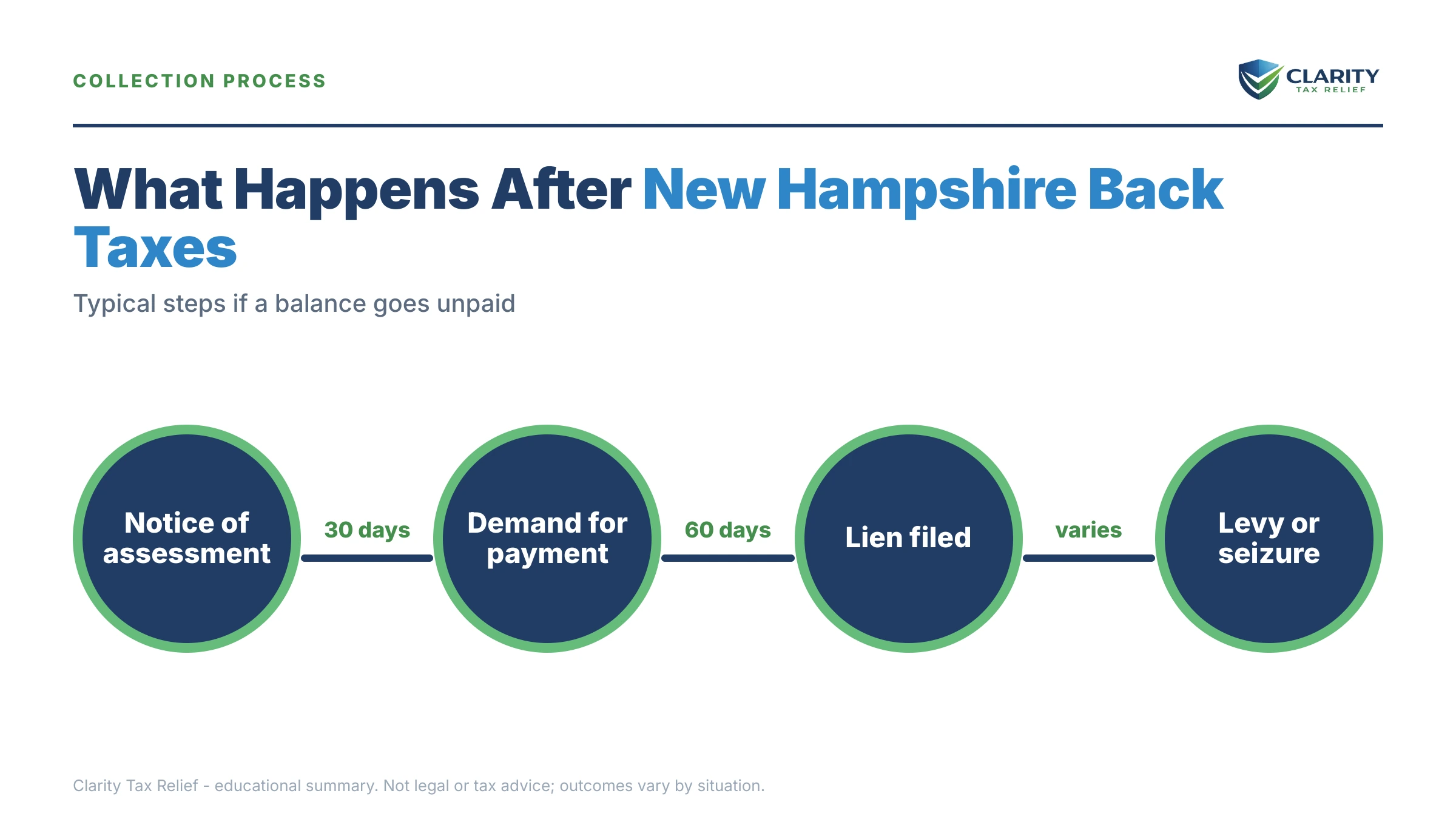
Ignoring New Hampshire back taxes triggers up to three separate escalation tracks — DRA, municipal, and federal — and none of them waits for the others. On the state side, the DRA moves from a Notice of Assessment to formal demand, and it can pursue liens and levies under state law once a balance is final; the appeal window printed on your assessment notice is the cheapest exit, and it closes fast. On the municipal side, the sequence is bill → lien execution → redemption period → tax deed, as covered above.
The federal track is the most automated of the three, and for most households it's also the largest balance. It runs in this order:
- CP14 — the first bill. No enforcement yet, but penalties and interest are already accruing monthly.
- CP501 / CP503 — automated reminders. The balance grows; nothing else changes yet.
- CP504 notice — intent to levy your state tax refund under IRC §6331(d). Here's the New Hampshire twist: with no state income tax refund to grab, this notice takes little from NH residents — so the system simply proceeds to the step that does.
- LT11 / Letter 1058 — the final notice. A 30-day clock starts, along with your Collection Due Process rights (requested on Form 12153). After it runs, the IRS can levy wages and bank accounts.
- Levy and lien — a bank levy freezes funds for 21 days before they're sent to Treasury; a wage levy is continuous until released; a federal tax lien can attach to your New Hampshire home. Once a federal balance crosses $66,000 in 2026, passport certification enters the picture too.
One 2026 reality check: the IRS workforce was cut roughly 27% in 2025, which makes the agency harder to reach — but this notice sequence is generated by automated systems that never stopped running. Fewer humans means slower fixes, not slower enforcement. The same is true in miniature at the DRA: a small agency's automation still records liens on time.
Owing more than one New Hampshire collector?
Whether it's old I&D Tax, a DRA business assessment, a town lien warning, or an IRS balance — get every notice reviewed free before another month of interest compounds. An experienced tax professional will map which debt to move on first.
Your options to resolve New Hampshire back taxes
Every New Hampshire back-tax debt has a resolution path — but the IRS publishes its programs and thresholds, while the DRA and your town decide case by case. That asymmetry shapes strategy: you can often set the federal side on autopilot and spend your negotiating effort where discretion matters.
On the federal side, the menu is well-defined. A short-term plan gives up to 180 days to pay in full with $0 setup fee. Balances of $50,000 or less qualify for a streamlined plan of up to 72 months set up online — here's how to set up an IRS payment plan online — and balances of $10,000 or less qualify for a guaranteed installment agreement. Above $50,000, the IRS wants financial disclosure on Form 433-F; our guide to an IRS payment plan over $50,000 covers what that review looks like. If paying anything would prevent you from covering basic living expenses, Currently Not Collectible status pauses collection (the debt and interest remain). And when your assets and income genuinely can't cover the debt, an Offer in Compromise can resolve it for less than the full balance — how an offer in compromise works explains the math, and know going in that the IRS accepted roughly 1 in 5 offers in FY2024.
Penalty relief runs on its own track. First-time penalty abatement can remove federal penalties if your prior three years were clean — and starting summer 2026 it's being replaced by the Automatic Exemption from Penalty (AEP), which applies without a request. The DRA has no equivalent automatic program, but it does entertain written penalty abatement requests supported by reasonable cause.
| Option | IRS (federal debt) | NH DRA (state debt) |
|---|---|---|
| Short-term full payment | Up to 180 days, $0 setup fee; interest and penalties continue | Ask directly — short extensions are handled case by case |
| Installment agreement | ≤ $50,000: up to 72 months online; ≤ $10,000: guaranteed; above $50,000: financial disclosure required | Available, but negotiated individually with the collection division; expect to document your finances |
| Settlement for less than owed | Offer in Compromise: $205 fee, 20% down on lump-sum offers (both waived with low-income certification, AGI ≤ 250% of poverty); ~1 in 5 accepted in FY2024 | No published OIC program; reductions considered case by case, mostly on penalties |
| Hardship pause | Currently Not Collectible status — collection stops, debt and interest remain | Discretionary; hardship must be documented and requested in writing |
| Penalty relief | First-Time Abate (clean prior 3 years); AEP makes it automatic starting summer 2026 | Written abatement request with reasonable cause; no automatic program |
Municipal property tax has its own short menu: pay, arrange partial payments with the collector, or file a hardship abatement request with the town. None of the IRS or DRA programs touch a municipal balance.
A worked example: a Nashua couple owing $83,100
Say you and your spouse file jointly in Nashua and owe $83,100 total — a clearly hypothetical but realistic mix: $61,400 to the IRS (two years of underpaid tax after one of you switched to 1099 consulting, plus penalties and interest), $17,300 to the DRA in unfiled 2022–2024 I&D Tax on dividends from an inherited brokerage account, and $4,400 in past-due property taxes to the city. Here's how the math sequences:
- City first ($4,400): pay or arrange it with the tax collector before a lien is executed. It's the smallest balance with the worst endpoint — a deed — and clearing it removes the only debt that threatens the house directly.
- IRS second ($61,400): at this balance you're above the $50,000 streamlined line. Two routes: submit Form 433-F financials for a negotiated plan, or pay the balance down by $11,401 to reach $49,999 and qualify for a streamlined 72-month direct-debit plan. At $50,000 over 72 months, principal alone is about $695/month — actual payoff runs higher because interest and the 0.5%-per-month failure-to-pay penalty keep accruing (you can estimate your own accrual with our Penalty & Interest Calculator). One more reason not to wait: $61,400 sits below the 2026 passport certification threshold of $66,000 — but at current accrual rates, an untouched balance could cross it within roughly a year.
- DRA third ($17,300): file the three missing DP-10 returns, verify the assessment against your 1099s, then negotiate installments with the collection division and request penalty abatement in writing. "Third" means third in sequence, not optional — a finalized DRA assessment can turn into a lien while you're busy with the IRS.
- What about an offer in compromise? Probably not here. A couple with New Hampshire home equity and steady consulting income will usually show the IRS enough collection potential to cover $61,400 — and no OIC touches the DRA or city balances anyway. Payment plans, not settlement, are the honest play for these numbers.
Deadlines and rights: the clocks that actually matter
New Hampshire back taxes don't come with one deadline — they come with five, and each one costs you a specific right when it passes.
| Event | The window | What you lose if it passes |
|---|---|---|
| DRA Notice of Assessment arrives | The appeal deadline printed on your notice | The cheap way to contest the numbers — after it, the balance hardens and collection begins |
| Town executes a property tax lien | Redemption period — generally about two years; confirm with your town | Redemption itself: the collector can issue a tax deed to the municipality |
| IRS LT11 / Letter 1058 arrives | 30 days to request a Collection Due Process hearing on Form 12153 | Your pre-levy hearing rights — the IRS can then levy wages and accounts |
| IRS bank levy lands | 21-day hold before the bank sends funds | The money — after 21 days it goes to Treasury |
| Federal balance reaches $66,000 (2026) | No warning period — certification can follow | Your passport can be denied or revoked; see passport revocation for tax debt |
How to resolve New Hampshire back taxes, step by step
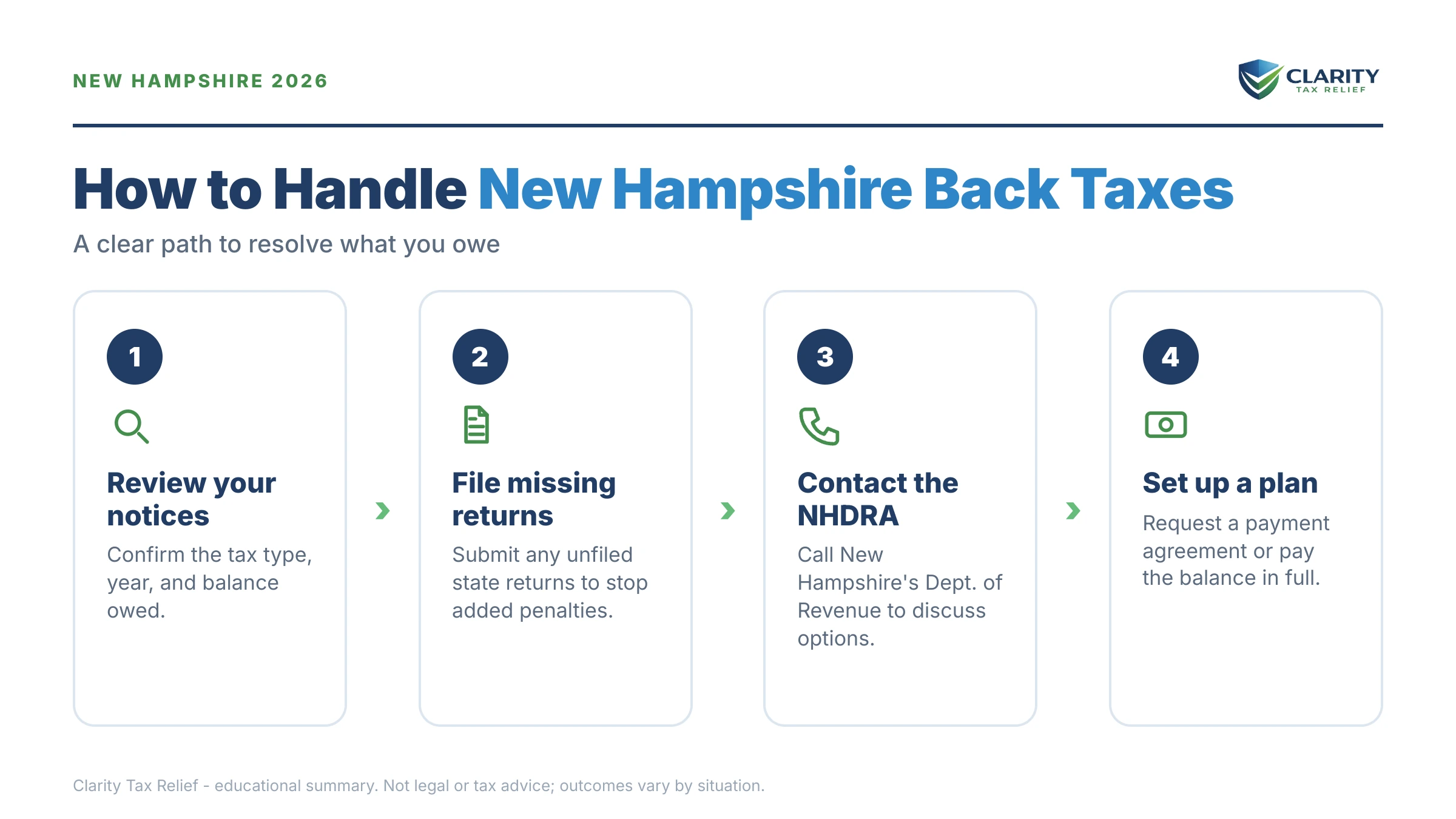
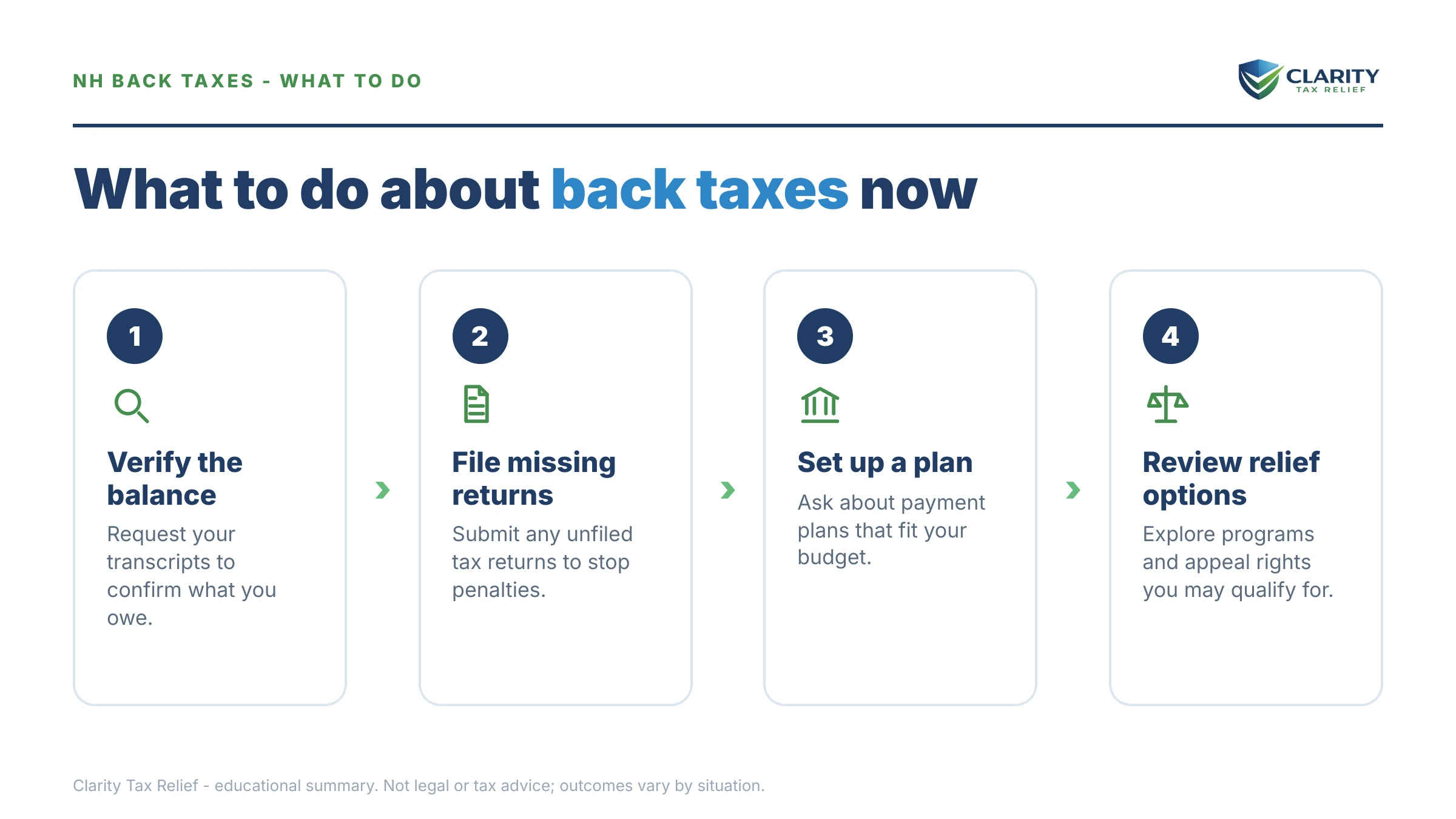
- Sort every balance by collector. Pull your IRS notices or online transcript, every DRA letter, and your town's property tax bill — you can't pick a strategy until you know who holds what.
- File all missing returns first. Unfiled I&D returns for 2024 and earlier, business returns, and federal returns must be in before any agency will finalize a payment arrangement.
- Protect the house. Pay or arrange the municipal property tax balance with your town's tax collector before a lien is executed — that clock ends in a deed, not a levy.
- Resolve the federal side. Set up the IRS payment plan, hardship status, or offer that fits your finances — the IRS has the most published options and the most automated enforcement.
- Negotiate with the DRA. Contact the DRA's collection division at revenue.nh.gov to arrange installments on the state balance and request penalty relief in writing.
- Get experienced help if it's multi-agency. When you owe two or three collectors at once, sequencing decides the total cost — a free case review maps it before you commit to anything.
State vs. federal: which New Hampshire debt to pay first
The general priority for a New Hampshire household is: the town first, then whichever of the DRA or IRS is closest to enforcement. Property tax debt is the only one that ends in a deed; after that, urgency follows the notices — a DRA assessment about to finalize or an IRS final notice both outrank a first bill from the other agency. The full decision framework, including how payment capacity should be split when you can't cover both, is in our guide to state tax debt vs IRS — which to resolve first. And if you're comparing notes with friends in other no-income-tax states, the federal side works the same way there — see Florida residents & IRS debt for the parallel picture.
When you can handle this yourself — and when help changes the outcome
Plenty of New Hampshire back-tax problems don't need professional help. A property tax balance you can pay or spread over a few months? Call your town collector directly — they handle this daily. A single DRA notice you agree with and can pay? Pay it through the DRA and request penalty abatement yourself in writing. A federal balance under $50,000 with steady income? The online streamlined plan takes about 20 minutes to set up, no representative needed.
Experienced help earns its cost in specific situations: a levy or lien already in motion on any of the three tracks; multiple unfiled years (especially final-year I&D returns the DRA can still assess); Meals & Rooms trust-tax exposure that could reach you personally; a federal balance over $50,000 where the Form 433-F presentation determines your monthly payment; or genuine OIC candidacy, where the offer math decides everything. The pattern in all five: discretion and presentation change the outcome, and mistakes are expensive to unwind.
Terms on your New Hampshire notices, decoded
- DRA — the New Hampshire Department of Revenue Administration, the state's tax agency for I&D, BPT, BET, and Meals & Rooms taxes.
- Notice of Assessment — the DRA's formal statement that you owe a specific amount; the appeal window printed on it is your main chance to contest the numbers.
- I&D Tax — the Interest & Dividends Tax on investment income, repealed for periods after December 31, 2024, but collectible for prior years.
- BPT vs. BET — Business Profits Tax (7.5% on profits) and Business Enterprise Tax (0.55% on compensation, interest, and dividends paid); many NH businesses owe one, the other, or both.
- Tax deed — the document by which a town takes ownership of property after an unredeemed municipal tax lien; the end of the property tax escalation track.
- Redemption — paying off a municipal tax lien (with accrued interest and costs) during the window before a tax deed can issue.
- CSED — the IRS's 10-year collection statute expiration date; it applies only to federal debt, not to DRA or municipal balances.
If a DRA assessment, a lien notice, and an IRS letter are all sitting in the same pile, a free review with an experienced tax professional can sequence all three New Hampshire debts in one plan before interest compounds another month.
New Hampshire back taxes: questions people ask
Does New Hampshire have a state income tax I could owe back taxes on?
Not on wages — New Hampshire has never taxed W-2 earnings, and the Interest & Dividends Tax was repealed for tax periods beginning after December 31, 2024. But I&D returns were still required for 2024 and every year before it, so unfiled or unpaid I&D from those years is a live, collectible debt with the NH DRA.
Do I still owe old Interest & Dividends Tax now that it's repealed?
Yes. Repeal ended the tax going forward; it did not forgive balances from 2024 and earlier. The DRA continues to assess, add interest to, and collect unpaid I&D Tax from those years. If you had unreported dividends, interest, or distributions in the final years of the tax, filing those returns now is the only way to stop penalties from growing.
Who actually collects back taxes in New Hampshire?
Three different collectors, depending on the tax. The NH Department of Revenue Administration collects I&D, Business Profits Tax, Business Enterprise Tax, and Meals and Rooms Tax. Your city or town tax collector handles property taxes. And the IRS collects federal income and payroll tax — which is the largest debt most New Hampshire households actually carry.
Does the NH DRA offer payment plans?
Yes. The DRA works out installment arrangements case by case rather than publishing fixed online thresholds the way the IRS does. Expect to disclose your finances, and expect interest to keep accruing while you pay. Contact the DRA's collection division directly — or have a representative do it — before a lien or levy is issued, when you have the most leverage.
Can I lose my house over unpaid New Hampshire property taxes?
Eventually, yes. Your town can execute a tax lien on the property, and if you don't redeem it — generally within about two years, though you should confirm the exact timeline with your municipal tax collector — the collector can issue a tax deed transferring ownership to the town. Property tax debt moves on a completely separate track from DRA and IRS debt, and it's usually the most urgent of the three.
Can New Hampshire settle my tax debt for less, like an IRS offer in compromise?
The IRS Offer in Compromise program applies only to federal debt — it does nothing for a DRA balance. The DRA considers reductions and abatements case by case, and it has more room to move on penalties than on the underlying tax. If your state balance is genuinely uncollectible, that argument has to be documented and made to the DRA directly.
Does the IRS 10-year rule apply to New Hampshire back taxes?
No. The federal 10-year collection statute (CSED) limits only the IRS. New Hampshire sets its own collection timelines, and you shouldn't assume a DRA or municipal property tax debt will simply age off the way federal debt eventually can. Verify any state deadline with the DRA rather than borrowing an IRS rule that doesn't apply.
I live in New Hampshire but work in Massachusetts — who do I owe?
Massachusetts. MA taxes income earned inside its borders, so NH residents who commute (or worked remotely under MA-source rules) file and pay Massachusetts — and the MA DOR pursues them when they don't. That debt is handled under Massachusetts rules, not New Hampshire's. See our guide to Massachusetts back taxes if the DOR is the agency writing to you.
Can the IRS garnish my wages if I live in New Hampshire?
Yes — living in a no-income-tax state does not shield you from federal collection. The IRS can levy New Hampshire wages, bank accounts, and up to 15% of Social Security through the Federal Payment Levy Program, and a wage levy is continuous until it's released. One small difference: with no state income tax refund to intercept, the IRS's state-refund levy program has little to grab from NH residents — so it moves to wages and bank accounts instead.
Your next 24 hours
- Find the sender and the numbers on every notice. On each letter, locate the agency name (DRA, your town, or IRS), the tax year, the amount, and any printed appeal or payment deadline — that one line tells you which track you're on.
- Gather your records. Your last two federal returns, 1099-DIV/1099-INT forms for 2022–2024 (for any I&D years), every DRA and IRS letter, and your town's current property tax statement.
- Get the free case review. Send us what you've gathered through the 2-minute form or call (888) 825-7779. Interest is compounding on every one of these balances monthly — a mapped plan this week costs less than the same plan next quarter.
Primary sources: the New Hampshire Department of Revenue Administration for state taxes, forms, and collection contacts; IRS.gov/payments for federal payment options; and the Taxpayer Advocate Service if a federal collection action is causing hardship the normal channels won't fix.
This guide is general information, not tax or legal advice for your specific situation. Eligibility for IRS programs depends on individual facts and circumstances; no outcome is guaranteed.