
City Tax Relief Guides
Tax Relief Manchester, NH: Your Real Options for IRS and State Tax Debt in 2026
The short answer: tax relief in Manchester, NH almost always means resolving IRS debt — New Hampshire doesn't tax wages, so the state rarely pursues individuals. Your real options are an IRS payment plan (up to 72 months on balances under $50,000), hardship status, penalty abatement, or an Offer in Compromise if your finances genuinely qualify.
You went out on your own in Manchester — the invoices came in all year, nobody withheld a dime, and the return you finally filed says you owe the IRS more than you have in the bank. That's the single most common tax-debt story in this city, and it has a defined, fixable path. Here's the map — every option, what each one costs, and the order to move in.
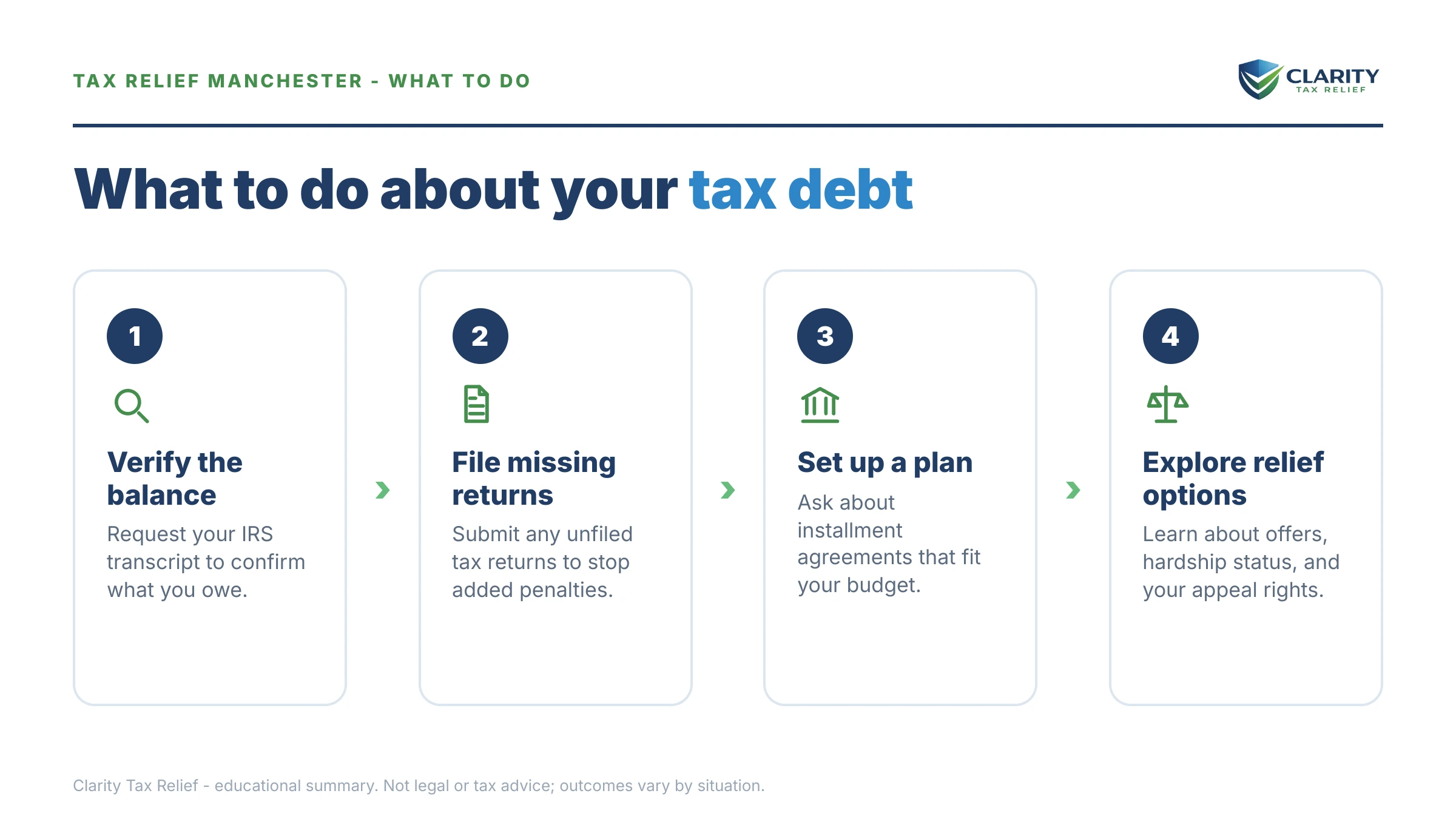
Two facts shape everything on this page. First, most Manchester tax debt is federal, because New Hampshire has no tax on wages and repealed its Interest & Dividends Tax starting with the 2025 tax year. Second, the IRS side runs on an automated notice sequence — and the image below shows you exactly how that escalation ladder is structured and where a payment plan cuts it off.
⏱ The clock that's actually running: there's no single statutory deadline on "getting tax relief" — but the failure-to-pay penalty adds 0.5% of your balance every month, interest compounds daily on top, and each IRS notice you're holding has its own printed response date. That printed date is the one that controls.
Why tax debt in Manchester is almost always an IRS problem
New Hampshire taxes no wages and, as of the 2025 tax year, no interest or dividends — so an individual's back-tax problem in Manchester is nearly always federal. There is no NH income tax return for most workers, no state refund to chase, and no state income-tax collector knocking. When a Manchester resident says "I owe back taxes," the creditor is the IRS.
The typical trigger here is self-employment. Manchester's economy runs heavy on 1099 work — trades, contracting, healthcare staffing, salon booths, delivery, consulting — and 1099 income arrives with zero withholding. Miss the quarterly estimates and the self-employment tax alone (roughly 15.3% before income tax even starts) can turn a decent year into a five-figure balance due.
The other common triggers: a W-2 job plus a side business with no withholding adjustment, an early retirement-account withdrawal, or two or three years of unfiled returns that finally caught up. Business owners have one extra layer — the New Hampshire Department of Revenue Administration (DRA) collects the Business Profits Tax, Business Enterprise Tax, and Meals & Rentals Tax — covered in its own section below.
What happens if you ignore IRS debt: the escalation sequence
IRS collection escalates in a fixed, automated order — and the 2025 workforce cuts of roughly 27% didn't slow it, because notices and levies are issued by computers, not the employees who left. Each stage removes options you have at the stage before it:
- CP14 — the first bill. You typically have about 21 days from the notice date before the system queues the next letter. No enforcement yet; this is the cheapest moment to act.
- CP501 / CP503 — reminders. Still just bills, but penalties and interest are compounding monthly the whole time.
- CP504 — Notice of Intent to Levy. This authorizes the IRS to seize your state tax refund under IRC §6331(d). Here's the Manchester wrinkle: most NH wage earners file no state income tax return, so there's often no state refund to take — but don't relax. The CP504's real function is procedural: it's the last stop before the final notice, and a federal tax lien becomes a live possibility.
- LT11 / Letter 1058 — Final Notice of Intent to Levy. This starts a 30-day clock and your Collection Due Process rights (requested on Form 12153). It is the last exit before enforcement.
- Enforcement. A bank levy freezes funds with a 21-day hold before the money leaves. A wage levy is continuous — it stays on every paycheck until released. Social Security can be levied up to 15% through the Federal Payment Levy Program. And once your assessed federal debt crosses $66,000 (the 2026 threshold), the IRS can certify you for passport denial or revocation.
| Notice | What it means | Your window |
|---|---|---|
| CP14 | First bill for a balance due | Typically 21 days from the notice date |
| CP501 / CP503 | Automated reminders; balance still growing | No fixed window — respond before the CP504 arrives |
| CP504 | Intent to levy your state refund; last step before the final notice | Respond by the date printed on the notice |
| LT11 / Letter 1058 | Final notice of intent to levy + Collection Due Process rights | 30 days to pay, arrange, or file Form 12153 |
| Levy | Bank funds held 21 days, then sent; wage levy continuous until released | Release requires resolving or proving hardship |
Owe the IRS from Manchester and not sure where you sit in that sequence?
Send us your most recent notice. An experienced tax professional will pull your IRS records, decode exactly where your case stands, and map your options — free, confidential, no pressure. Interest and penalties accrue every month you wait, so the review is worth doing this week, not next.
Tax relief in Manchester, NH: every option compared
The IRS runs six real resolution programs, and eligibility for each is set by your numbers — balance, income, and assets — not by anyone's sales pitch. The full do-it-yourself playbook lives in our guide to how to settle tax debt yourself; here's the decision table:
| Option | Who's eligible | Cost & the catch |
|---|---|---|
| Short-term payment plan | Can pay in full within 180 days | $0 setup fee; interest and the 0.5%/month penalty continue until paid |
| Guaranteed installment agreement | Individuals owing $10,000 or less, returns filed | Approval is required by statute when the conditions are met; modest setup fee |
| Streamlined installment agreement | Owe $50,000 or less; up to 72 months | Set up online with no financial disclosure; interest continues, but the penalty rate drops to 0.25%/month while the plan is active |
| Payment plan over $50,000 | Any balance, with Form 433-F financials | IRS reviews income and assets; a lien filing becomes more likely |
| Currently Not Collectible | Paying anything would leave you unable to cover basic living costs | Collection pauses, but the debt, interest, and lien risk remain; IRS re-reviews periodically |
| Offer in Compromise | Assets plus future income can't cover the debt before the collection statute runs | $205 fee plus 20% down on lump-sum offers (both waived with low-income certification); the IRS accepted roughly 1 in 5 offers in FY2024 |
| Penalty abatement (FTA / AEP) | Clean compliance for the prior 3 years; AEP becomes automatic starting summer 2026 | Free to request; removes penalties, not the tax or interest |
One deliberate omission from that table: "settle for pennies on the dollar." That phrase is marketing, not a program. The Offer in Compromise is real, but it's a math test the IRS runs on your finances — not a discount anyone can promise you.
Say you owe $23,800: the math on a Manchester sole proprietor's balance
A $23,800 balance sits comfortably inside the streamlined installment agreement band — under $50,000, no financial disclosure required, set up online in an afternoon. Here's the hypothetical arithmetic for a self-employed Manchester sole proprietor who filed on time but couldn't pay:
- Full 72-month stretch: $23,800 ÷ 72 ≈ $331/month before ongoing interest and penalty — the real payoff runs somewhat higher because both keep accruing on the shrinking balance.
- The penalty clock: with no agreement, the failure-to-pay penalty is 0.5% × $23,800 ≈ $119 every month. Once a payment plan is active, that rate drops by half, to about $60/month and falling — one of the quietest reasons to set the plan up now rather than "when things pick up."
- The filing lesson: if this return had gone unfiled instead, the failure-to-file penalty (5%/month, ten times the failure-to-pay rate — though in months where both penalties apply, the failure-to-file portion drops to 4.5%, for 5% combined) could have stacked up to $5,355 on its own. Filing on time, even broke, saved this taxpayer more than five thousand dollars — the whole case for filing even when you can't pay.
- Why an offer probably isn't the play here: with steady self-employment income that supports $331/month, the Offer in Compromise math usually fails — the IRS only accepts an offer when your assets plus future income genuinely can't cover the debt before the 10-year collection statute expires.
Want to see how the penalty and interest side of your own balance is compounding? Our IRS Penalty & Interest Calculator estimates it in about two minutes.
One more move for this taxpayer: if the prior three years were clean, first-time penalty abatement can strip the failure-to-pay penalties already posted — and starting summer 2026, the IRS's new Automatic Exemption from Penalty (AEP) applies similar relief automatically, no request needed.
Owe New Hampshire itself? The DRA side for Manchester business owners
The New Hampshire Department of Revenue Administration — not the IRS — collects the state's business taxes, and it operates on its own rules, deadlines, and programs. If you run a Manchester business, three DRA taxes can generate debt: the Business Profits Tax (BPT) on business income, the Business Enterprise Tax (BET) on the enterprise value base, and the Meals & Rentals Tax if you operate a restaurant, catering outfit, or short-term rental.
Meals & Rentals deserves special respect: it's tax you collected from customers and hold in trust for the state, and states pursue trust-fund money harder than anything else. Don't assume any IRS figure, timeline, or program on this page applies to a DRA balance — it doesn't. For a DRA notice, your first calls are the DRA itself at revenue.nh.gov and our guide to New Hampshire back taxes, which covers the state side in full.
If you owe both the IRS and the DRA, resolve them in a coordinated order — each agency will want to see the same monthly budget, and committing your whole surplus to one can sink your arrangement with the other.
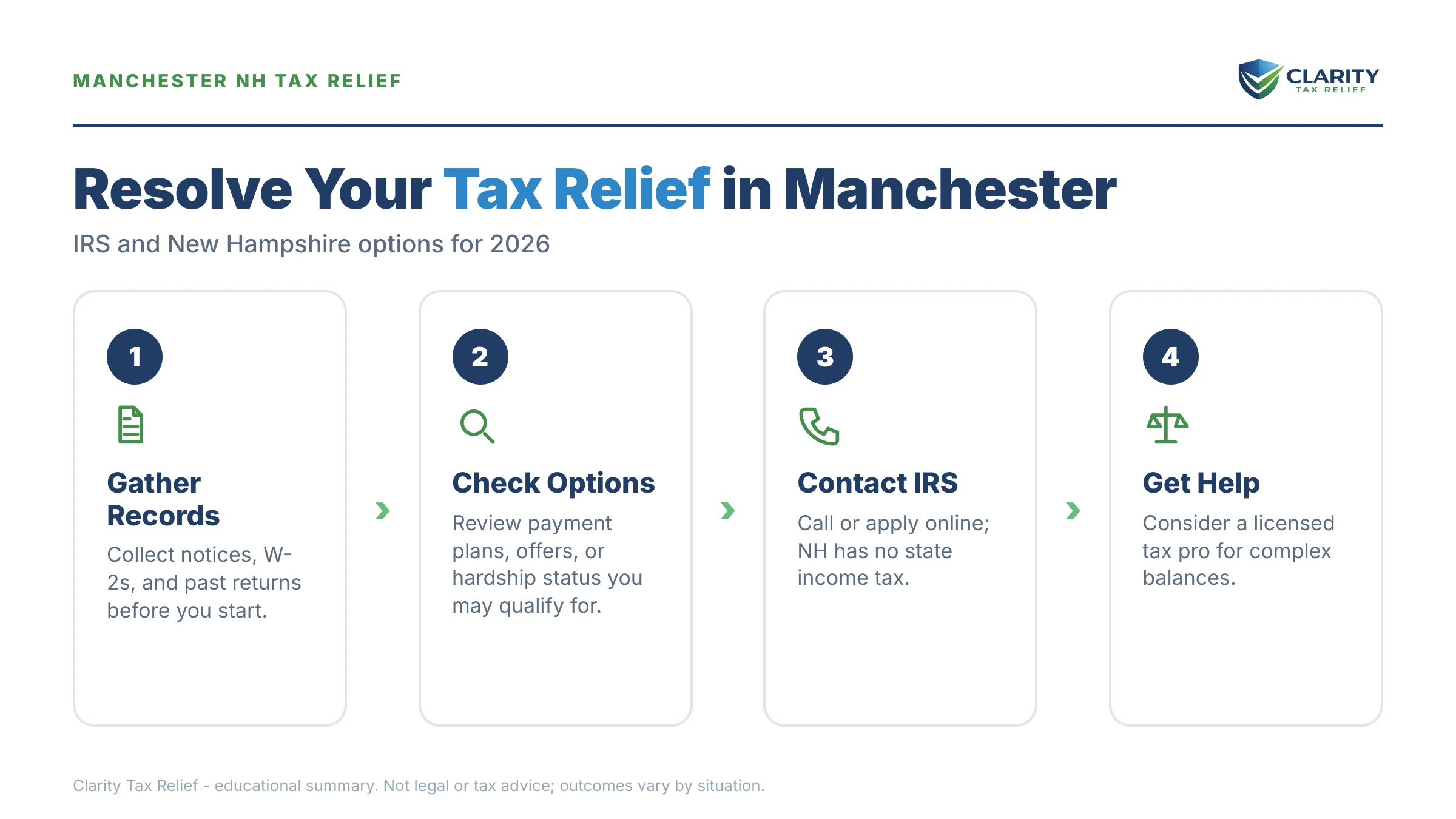
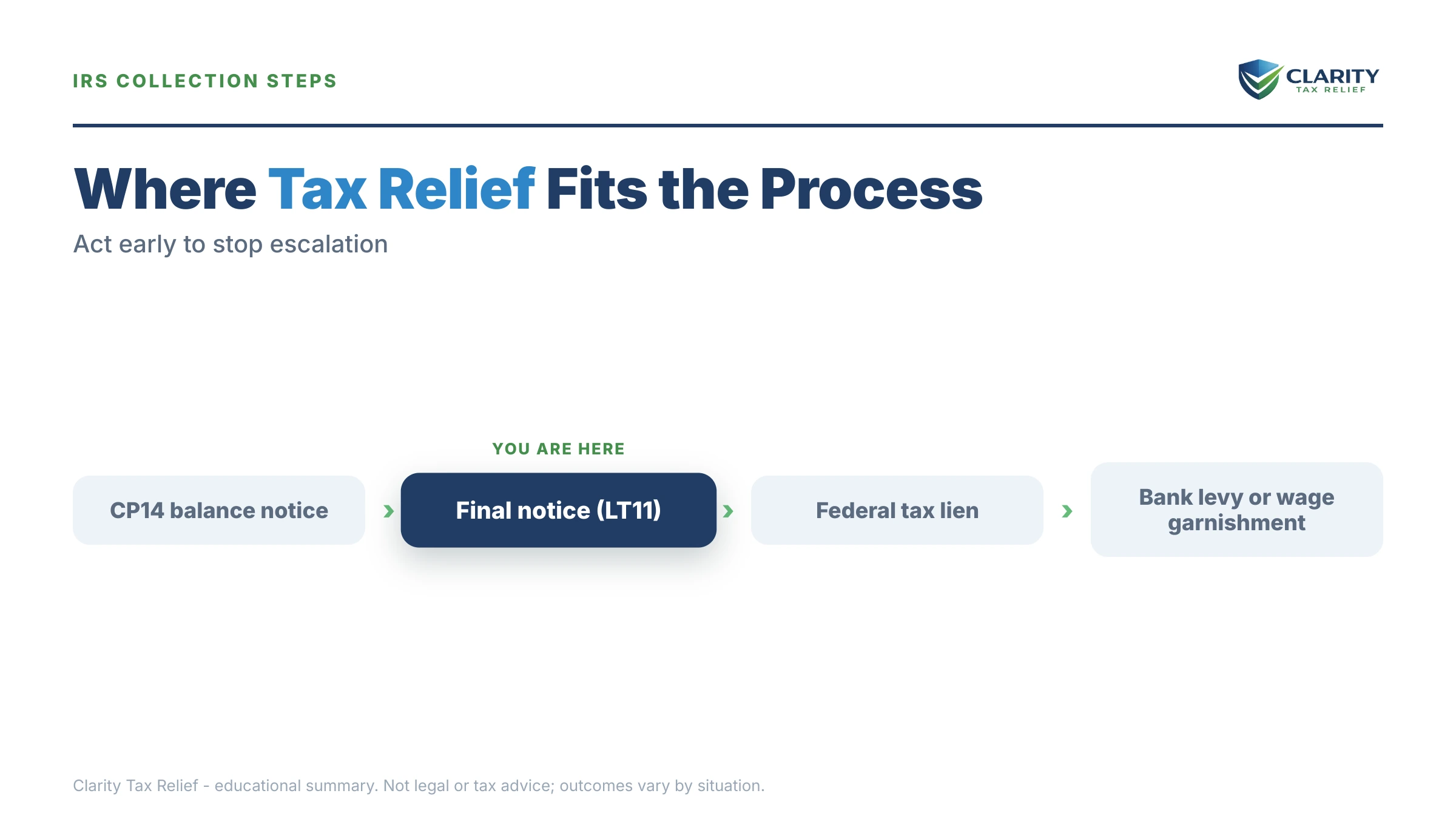
How to get tax relief in Manchester, step by step
The sequence matters: the IRS won't approve any resolution while returns are missing, so compliance comes before negotiation.
- Pull your IRS records. Create or log into your IRS online account and download account transcripts for every year — they show exactly what you owe, which penalties posted, and where you sit in the notice sequence.
- File every missing return. The IRS won't approve a payment plan, hardship status, or an offer while returns are unfiled — and the failure-to-file penalty runs ten times the failure-to-pay penalty (though in months where both apply, the failure-to-file portion drops to 4.5%, for 5% combined).
- Match your numbers to an option. A balance under $50,000 with steady income points to a streamlined installment agreement; a genuine inability to pay points to Currently Not Collectible status or an Offer in Compromise.
- Set it up before the next notice lands. Apply online at IRS.gov or with Form 9465 — an approved agreement stops the escalation sequence for as long as it stays in good standing.
- Request penalty relief. If your prior three years are clean, ask for first-time abatement on the failure-to-pay penalty — and watch for the automatic AEP exemption rolling out in summer 2026.
Local CPA, tax attorney, or national firm: choosing help in Manchester
Any enrolled agent, CPA, or attorney can represent you before the IRS from anywhere in the country — IRS collection is centralized, so "local" matters far less for federal debt than it does for, say, a Superior Court case. What actually matters is resolution experience: a Manchester CPA who's excellent at returns may have handled two collection cases in a career, while a resolution-focused firm handles them daily.
Whoever you consider, apply the same screen: a written flat-fee quote, a specific named strategy after reviewing your transcripts (not before), and zero promised outcomes. Our guide to choosing a tax relief company walks through the full checklist, and if your debt includes business or payroll tax, start with our tax relief for small business buyer's guide instead — business cases are a different discipline. Comparing the big national brands? Our Optima Tax Relief alternatives breakdown shows what to weigh.
The red flags are universal: anyone who quotes a settlement figure on the first phone call, demands the full fee upfront before pulling your IRS records, or leads with "pennies on the dollar" is selling you the marketing, not the math. No one can know what you'll settle for before analyzing your finances — the IRS decides that with a formula, not a negotiation.
When you can handle this yourself — and when help changes the outcome
Plenty of Manchester tax debts don't need professional help, and it would be dishonest to pretend otherwise. Handle it yourself if: you owe under roughly $10,000 and agree with the balance (the guaranteed agreement makes approval nearly mechanical), you can pay in full within 180 days (the $0-fee short-term plan exists for exactly this), or you're setting up a simple streamlined plan under $50,000 with all returns filed. The IRS online tools were built for these cases.
Experienced help earns its fee when the case has moving parts: a levy or garnishment already in motion, multiple unfiled years to reconstruct, self-employment income that makes the Offer in Compromise or CNC financial math genuinely contestable, an LT11 with the 30-day appeal window ticking, or business debt where DRA and IRS obligations have to be sequenced. In those cases, the difference between a well-built financial statement and a sloppy one is often the difference between approval and rejection — and with IRS phone service degraded by the staffing cuts, a representative's practitioner channels also simply get answers faster.
Terms you'll see on IRS letters, decoded
- Lien vs. levy: a lien is a legal claim against your property that protects the government's interest; a levy is the actual taking — wages, bank funds, or assets.
- CSED: the Collection Statute Expiration Date — generally 10 years from assessment, after which the IRS can no longer collect, though offers, bankruptcy, and appeals pause the clock.
- Streamlined installment agreement: a monthly plan on balances of $50,000 or less, up to 72 months, approved without detailed financial disclosure.
- Currently Not Collectible (CNC): a hardship status that pauses IRS collection when paying would prevent you from covering basic living expenses.
- CDP rights: Collection Due Process — the formal 30-day appeal right triggered by a final levy notice, requested on Form 12153.
- BPT / BET: New Hampshire's Business Profits Tax and Business Enterprise Tax — the DRA-collected state taxes a Manchester business can fall behind on.
Tax relief questions Manchester taxpayers ask
Does Manchester, NH have a state income tax I could owe?
No tax on wages — New Hampshire has never taxed W-2 income, and the state's Interest & Dividends Tax was repealed starting with the 2025 tax year. Individuals in Manchester almost never owe state income tax. Business owners are the exception: the NH Department of Revenue Administration collects the Business Profits Tax, Business Enterprise Tax, and Meals & Rentals Tax, and it enforces those debts separately from the IRS.
Can the IRS garnish my wages if I live in New Hampshire?
Yes. Federal levy power doesn't depend on state law, so working in Manchester offers no protection from an IRS wage levy. A wage levy is continuous — it stays on every paycheck until the debt is resolved or the levy is released — and the amount left to you is set by a federal exemption table, not by New Hampshire garnishment rules. Setting up a payment plan before the final notice window closes prevents it entirely.
Is there an IRS office in Manchester I can just walk into?
IRS Taxpayer Assistance Centers in New Hampshire are appointment-only — use the office locator at IRS.gov to book before you go. Keep expectations realistic: a local office can take payments, verify identity, and accept documents, but it does not negotiate settlements or hardship status. With the IRS workforce down roughly 27% since 2025, most resolution work happens online, by mail, or through a representative anyway.
How much does tax relief cost in Manchester, NH?
Setting things up yourself costs little: a short-term IRS payment plan has a $0 setup fee, and an Offer in Compromise carries a $205 application fee (waived with low-income certification). Professional representation typically runs from several hundred dollars for a simple payment-plan setup to several thousand for an Offer in Compromise or levy defense. Get a written flat-fee quote before hiring anyone, and be wary of firms that quote a price before reviewing your IRS records.
Do I qualify for an Offer in Compromise on my IRS debt?
You may qualify if your assets plus your realistic future income can't cover the debt before the collection statute expires — that's the test, not hardship stories. The IRS accepted roughly 1 in 5 offers in FY2024, and most rejections happen because the applicant could afford a monthly plan. If you can pay your balance over 72 months, an offer is usually the wrong tool; if you genuinely can't, it's worth a serious look.
Can the IRS take my house in Manchester?
It's legally possible but genuinely rare — home seizures require special approvals and are a last resort, not a routine collection step. What happens far earlier is a federal tax lien, which attaches to your Manchester property and complicates selling or refinancing it. Bank levies and wage levies come long before any talk of real estate, and every one of those steps can be prevented by getting into a resolution before the final notice deadline passes.
Does IRS tax debt ever expire?
Yes — the IRS generally has 10 years from the date a tax is assessed to collect it, a deadline called the CSED. But the clock pauses while an Offer in Compromise, bankruptcy, or certain appeals are pending, so waiting it out usually takes longer than people hope, and the IRS collects aggressively in the final years. For most Manchester taxpayers with fresh debt, resolving it beats trying to outlast it.
Your next 24 hours
- Find the date and the year on your most recent IRS notice. The notice number (top right) tells you where you sit in the escalation sequence above; the response date printed on it is the only deadline that matters right now.
- Gather three things: your last filed tax return, every IRS letter you've received, and a rough picture of your monthly income and expenses — that's everything a resolution decision needs.
- Get the free case review. Call (888) 825-7779 or use the 2-minute form, and an experienced tax professional will pull your transcripts and map your Manchester case to the right option — before another month of penalties and interest posts to the balance.
Primary sources if you want to go straight to the government: the IRS's payment plans and installment agreements page, the main IRS payments portal, the Taxpayer Advocate Service for cases stuck in the system, and the New Hampshire Department of Revenue Administration for state business taxes.
This guide is general information, not tax or legal advice for your specific situation. Eligibility for IRS programs depends on individual facts and circumstances; no outcome is guaranteed.