
Tax Relief Comparisons
J David Tax Law Alternative: How to Choose the Right Tax Help in 2026
The short answer: the best J David Tax Law alternative is whichever firm — or do-it-yourself path — fits your actual case: a named attorney, CPA, or enrolled agent who reviews your IRS transcripts first, quotes a flat written fee, and builds the plan on real IRS programs, not promised savings. This guide gives you the test.
You've probably already had one consultation — maybe with J David Tax Law itself — and something made you pause before signing: the fee, the pressure, or a plan that felt one-size-fits-all. If you're a 1099 worker with unfiled years and a growing balance, comparing before you commit isn't paranoia. It's exactly the right move, and the comparison takes less time than you think.
This guide isn't a takedown of anyone. J David Tax Law is a real tax-resolution law firm, and for some cases a law firm is the right call. But "law firm" is one variable among four that actually change outcomes — and for a case like three unfiled years and roughly $41,800 in projected debt, the other three usually matter more.
⏱ The real clock: there's no letter-printed deadline on choosing a firm, but every unfiled return keeps accruing a failure-to-file penalty of 5% per month, up to 25% of that year's unpaid tax — and any refund on a return more than 3 years overdue is forfeited permanently. The comparison shopping is smart; open-ended delay is not.
Why people look for a J David Tax Law alternative
Most people comparing tax firms aren't fleeing a bad one — they're checking fit on price, credentials, and approach before signing. The common reasons we hear: the quote felt high for the work described, the reader wants attorney representation only if the case genuinely needs it, the intake felt like a sales call rather than a case review, or they simply want a second written quote to compare against.
All of those are legitimate. The mistake is comparing firms on the wrong axis — brand size, ad polish, or review counts that every company in this industry games to some degree. The next section gives you the four variables that actually predict how your case turns out. (For the full buyer's framework, see our guide on how to choose a tax relief company.)
What actually separates tax relief firms in 2026
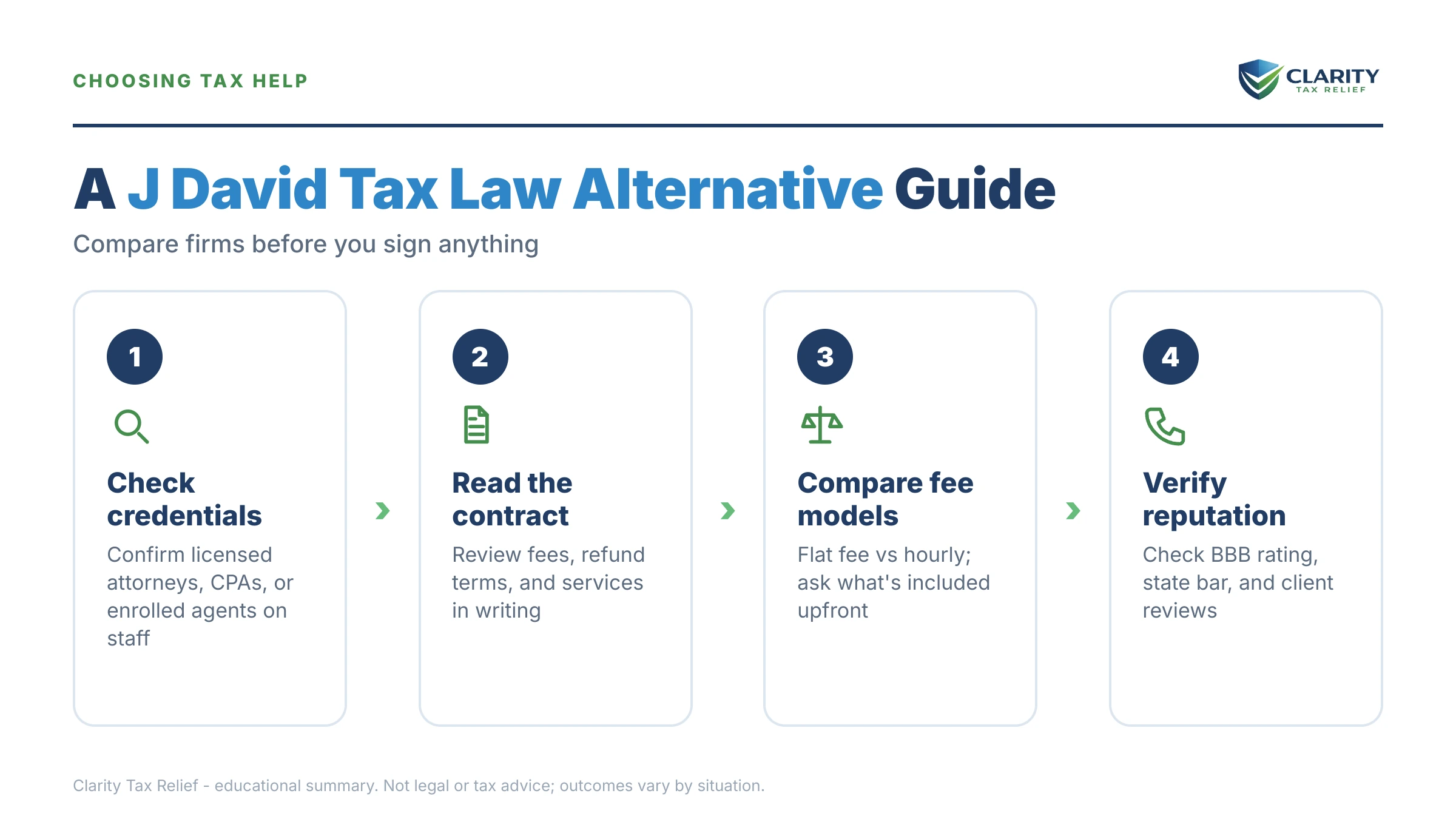
Four things predict your outcome with any firm: who works the file, how the fee is structured, whether they pull transcripts before quoting, and the order they attack the problem in. Everything else is marketing.
1. Who actually works your file. Attorneys, CPAs, and enrolled agents have identical representation rights in IRS collection matters. An attorney adds real value when there's criminal exposure, a Tax Court petition, or a need for privilege — situations most back-tax cases never touch. What you're really vetting is whether a named, credentialed person handles your case or whether you're handed to a rotating "case team." Our comparison of a tax relief attorney vs company breaks down when the law-firm structure earns its premium.
2. Fee structure. A flat, written fee tied to named deliverables ("prepare and file 2023–2025 returns, request penalty abatement, negotiate resolution") protects you. Open-ended phases, surprise "investigation" fees, or quotes given before anyone has seen your IRS file do not. Our breakdown of how much tax relief costs gives realistic ranges by case type so you can spot an inflated quote.
3. Transcripts before promises. No one can honestly quote your case without your IRS account and wage-and-income transcripts. For a gig worker with unfiled years, the transcripts show exactly which 1099s the IRS holds, whether it has already started building returns for you, and where the collection machine stands. A firm that quotes a resolution price before pulling them is pricing a guess.
4. Sequence. With unfiled years, the correct order is nearly always: file accurate returns first, then attack penalties, then resolve the remaining balance. Any pitch that leads with "settlement" before your returns exist has the sequence backwards — the IRS won't even consider most resolution programs until you're filing-compliant.
If you're comparing several companies at once, our side-by-side looks at a Fortress tax relief alternative, a victory tax lawyers alternative, and Anthem Tax Services alternatives apply this same four-variable test to other firms readers frequently shortlist.
What happens if you keep waiting to decide
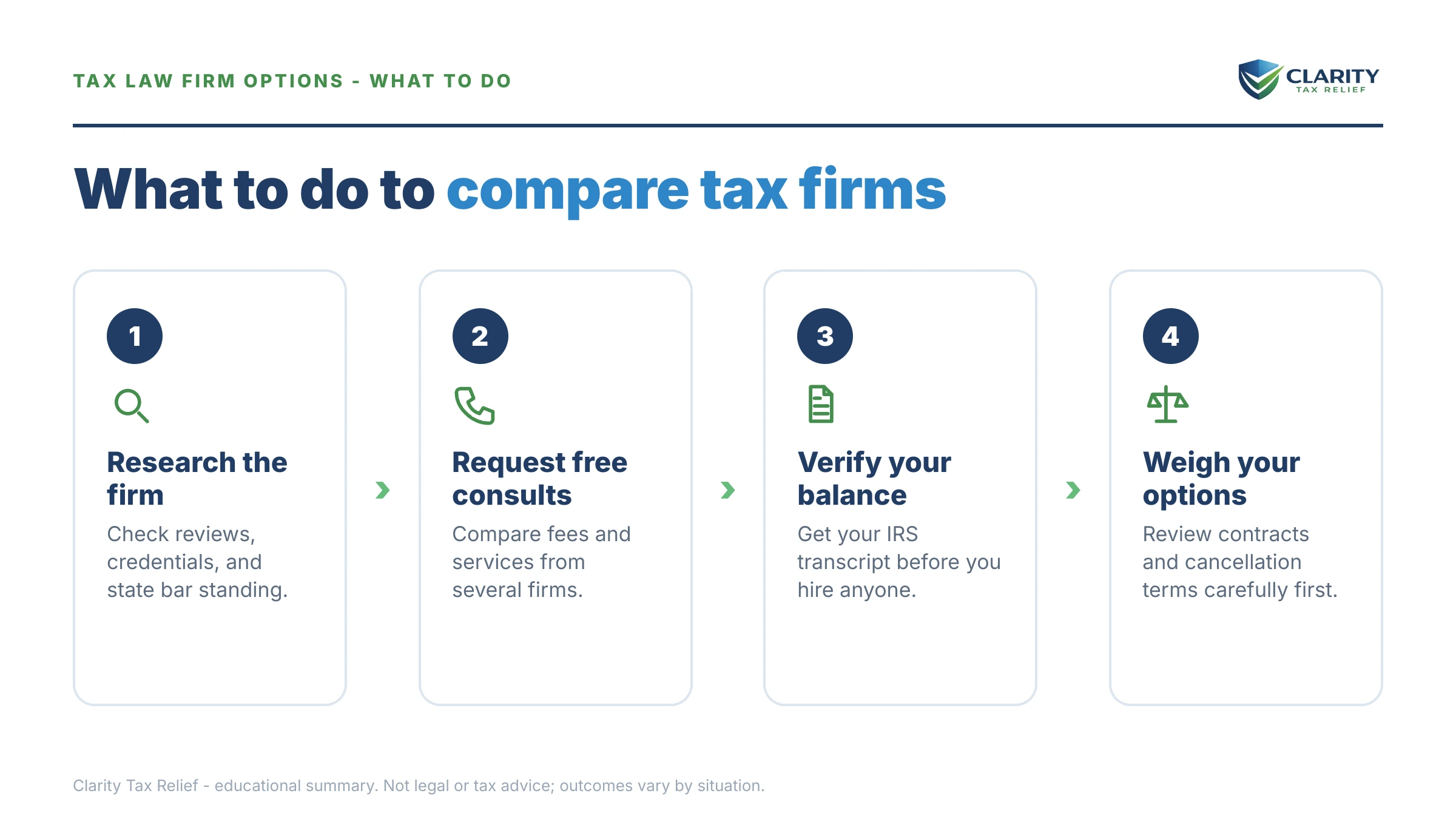
The IRS enforces unfiled returns and unpaid balances on an automated track that runs whether or not you've hired anyone. For someone with three unfiled years, the sequence looks like this:
- Non-filer notices (CP59, CP516, CP518) — the IRS knows returns are missing because it holds your 1099s. These letters escalate in tone and end with a warning that the IRS will act without you.
- Substitute for Return (SFR) — the IRS builds each missing return itself using only reported income: no mileage, no business expenses, no favorable filing status. For a gig worker, an SFR balance is routinely far larger than a real return would show.
- CP3219N Notice of Deficiency — a 90-day window to petition Tax Court or file your own return. Let it pass and the inflated SFR amount becomes a legally assessed debt.
- Balance-due collection (CP14 → CP501/CP503 → CP504) — bills, then a notice letting the IRS seize your state tax refund, with a federal tax lien on the table.
- LT11 final notice → levy — a 30-day clock with Collection Due Process rights (Form 12153), after which the IRS can levy bank accounts and 1099 payments owed to you.
Two other clocks are quietly running while you compare firms. The table below shows what each one costs if it passes:
| Clock | How long | What you lose when it passes |
|---|---|---|
| Refund claim window | 3 years from the original due date | Any refund on that year — withholding and credits are forfeited permanently |
| CP3219N deficiency notice | 90 days | Your right to contest the SFR amount in Tax Court before it's assessed |
| LT11 / Letter 1058 final notice | 30 days | Your Collection Due Process hearing rights before a levy (Form 12153) |
| Failure-to-file penalty accrual | 5% per month per unfiled year | Caps only at 25% of that year's unpaid tax — filing stops it immediately |
| Passport certification | Triggered at $66,000 (2026) | Passport applications and renewals can be denied once your assessed debt crosses the threshold |
One counterintuitive point: the 10-year collection statute hasn't even started on your unfiled years, because it runs from assessment. Waiting doesn't run out any clock in your favor — it only stacks penalties and forfeits rights.
Comparing firms with unfiled years hanging over you?
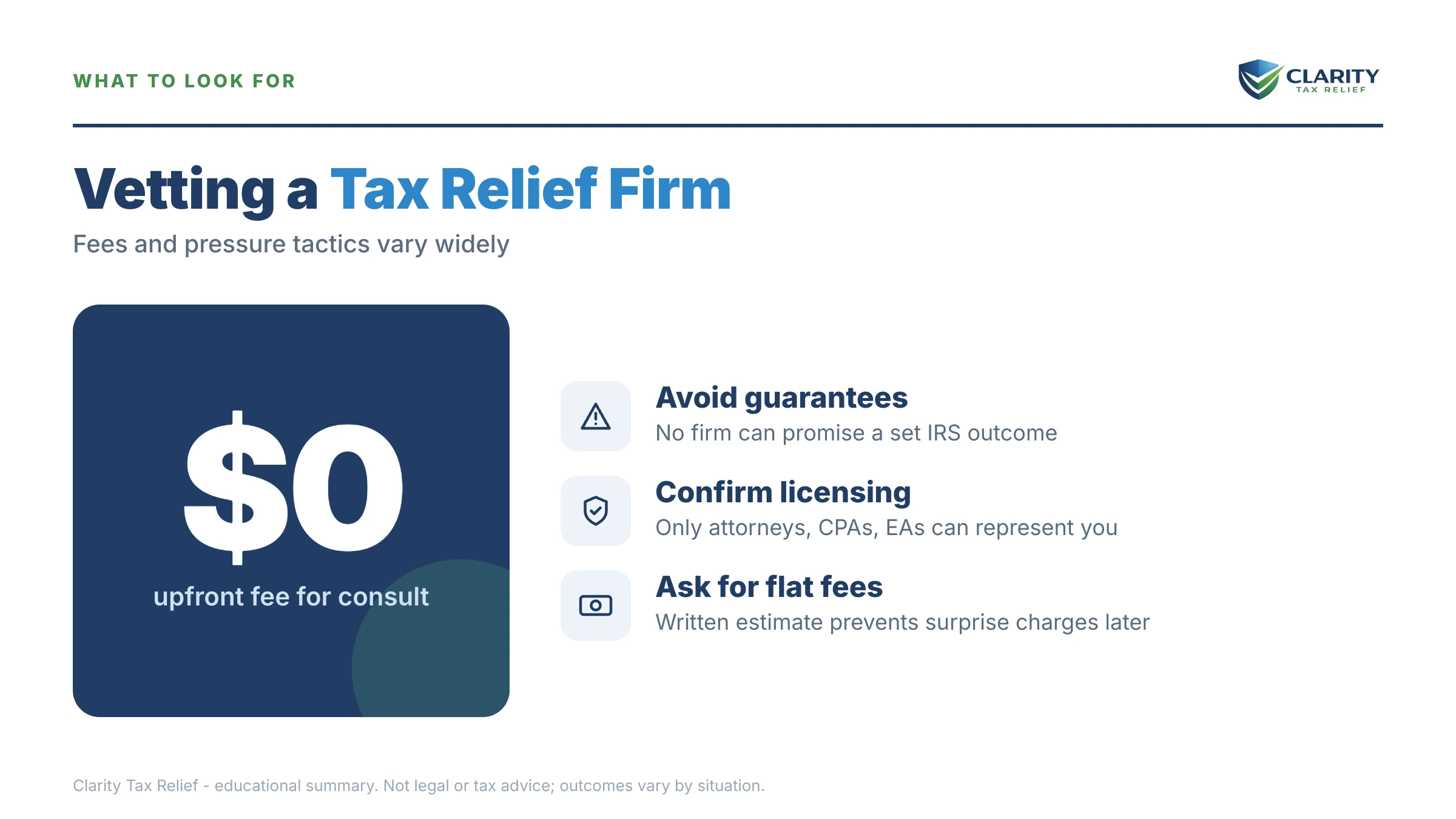
Get a free second opinion before you sign anywhere. An experienced tax professional will pull your case apart — unfiled years, projected balance, realistic options — and put a flat written quote next to whatever you've already been offered. Penalties and interest accrue monthly while you decide, so decide with real numbers.
The IRS options any good firm should walk you through
Every legitimate tax relief firm — J David Tax Law, Clarity, or anyone else — works with the same IRS programs; no firm has special access. What separates good help from bad is matching your finances to the right program honestly:
| Option | Who it typically fits | Cost & key limits |
|---|---|---|
| Short-term payment plan | Can pay in full within 180 days | $0 setup; interest and penalties continue until paid |
| Streamlined installment agreement | Balance ≤ $50,000 with all returns filed | Up to 72 months, set up online, no detailed financial disclosure; setup fee varies |
| Guaranteed installment agreement | Balance ≤ $10,000 (plus other conditions) | IRS must accept if conditions are met — the official program name, not a promise |
| Currently Not Collectible | Paying anything would prevent basic living expenses | Requires financial disclosure; pauses collection but the debt and interest remain |
| Offer in Compromise | Assets + future income genuinely less than the balance | $205 fee and 20% down on lump-sum offers (both waived with low-income certification); roughly 1 in 5 offers accepted in FY2024 |
| Penalty abatement (FTA / AEP) | Clean compliance in the prior 3 years, or reasonable cause | Free to request; AEP begins applying some relief automatically starting summer 2026 |
Two flags to watch during any consultation. First, an Offer in Compromise pitch made before your returns are filed is premature by definition — the IRS returns offers from non-filers unprocessed. Second, "pennies on the dollar" is a marketing phrase, not a program: real offers are accepted or rejected on a financial formula, and most applicants are better served by first-time penalty abatement plus a payment plan than by a long-shot offer.
Worked example: the gig worker with $41,800 and three unfiled years
Say you drove and delivered on 1099s for 2023–2025, never filed, and your real returns — with mileage and expenses deducted — would show about $41,800 in combined tax. Here's the math a competent firm should show you before quoting anything:
- Penalties on top: the failure-to-file penalty caps at 25% of each year's unpaid tax. If all three years have maxed out, that's roughly $10,450 added (25% of $41,800), plus the smaller failure-to-pay penalty and interest still running. You can rough out your own exposure with our Penalty & Interest Calculator — it estimates, it doesn't promise.
- Why filing first shrinks the problem: if the IRS builds SFRs instead, it taxes your gross 1099 income — say $65,000 in a year — with zero business expenses. Real Schedule Cs with mileage and costs deducted can produce a dramatically lower tax per year. For a gig worker, accurate late returns are often worth more than any "relief" program.
- The payment plan: at $41,800 you're under the $50,000 streamlined ceiling, so once returns are filed you can get up to 72 months — about $581/month before the interest and penalties that keep accruing, so the real payment runs somewhat higher.
- The offer question: an Offer in Compromise only beats that plan if your assets plus what the IRS projects it can collect from your future income total less than $41,800. Variable gig income makes that calculation genuinely tricky — it's one place professional math earns its fee.
Notice what's absent: nothing in that math depends on which brand you hire. It depends on filing accurate returns, requesting the penalty relief you're eligible for, and picking the resolution the formula supports.
How to choose a J David Tax Law alternative, step by step
- List what your case actually needs. Write down the pieces before you call anyone: how many years are unfiled, roughly what you owe, whether any IRS notices have arrived, and whether you have 1099 income with deductible expenses. Firms quote against this list — a vague case gets a vague (and usually bigger) quote.
- Verify the person, not the brand. Ask for the name and credential (attorney, CPA, or enrolled agent) of the specific person who will sign your Form 2848 power of attorney and speak to the IRS for you. If the answer is a sales rep or "our team," keep looking.
- Demand a flat, written fee tied to named deliverables. The quote should list exactly what you're buying — for example, three back returns prepared and filed, a penalty-abatement request, and one resolution filing — with the total price in writing before you pay anything.
- Ask the acceptance-math question. Ask how they would calculate your reasonable collection potential before proposing an Offer in Compromise. A real practitioner explains the asset-plus-future-income formula; a sales floor pivots back to how much you could "save."
- Get a second opinion before signing. Free consultations cost nothing. Put two firms' written quotes and proposed plans side by side — including the option of doing the simple parts yourself — and pick the one whose plan starts with your unfiled returns, not with settlement talk.
For a printable version of the vetting questions, see our list of questions to ask a tax relief company.
When you don't need J David Tax Law — or any firm at all
Some cases don't justify a professional fee, and an honest comparison page should say so. You can likely handle it yourself if your returns are already filed and you owe under $50,000 (the streamlined plan sets up online), if you can pay in full within 180 days, or if your only issue is a single penalty and your prior three years are clean — first-time abatement is a phone call. Our hub on how to settle tax debt yourself walks the full DIY path.
Experienced help changes outcomes in a narrower set of situations — and a gig worker with three unfiled years sits squarely in one of them. Reconstructing three years of Schedule C income and expenses without records, heading off or unwinding SFR assessments, stacking penalty relief across multiple years, and running honest offer math on variable income are where professionals routinely recover more than they cost. Levies already in motion, business or payroll debt, and balances that trip the $66,000 passport threshold are the others. If that's you, whoever you hire, hire someone — our guide for people who haven't filed taxes in 3 years explains why the filing piece can't wait for the perfect firm.
J David Tax Law alternative questions, answered
Is J David Tax Law a legitimate firm?
Yes — J David Tax Law is an actual tax-resolution law firm, and searching for an alternative doesn't mean anything is wrong with them. People compare firms for ordinary reasons: fee structure, whether they want attorney-level representation or a lower-cost enrolled agent, responsiveness, and personal fit. The vetting test in this guide applies to them and to every alternative equally.
Do I need a tax attorney, or is an enrolled agent or CPA enough?
For most collection cases — payment plans, Offers in Compromise, penalty abatement, unfiled returns — enrolled agents, CPAs, and attorneys all have identical representation rights before the IRS. An attorney becomes important when there is potential criminal exposure, you need attorney-client privilege, or your case is headed to Tax Court. If your problem is unfiled returns and a balance, credentials matter less than whether that specific person will actually work your file.
How much should a tax relief firm charge for a case like mine?
Fees vary widely, but a straightforward installment-agreement setup commonly runs a few hundred to around $1,500, while preparing several back returns plus an Offer in Compromise often runs several thousand dollars. What matters more than the number is the structure: a flat, written fee tied to named deliverables. Be wary of any firm that quotes a fee before reviewing your IRS transcripts, or that charges a large upfront fee with no defined work product.
Can the IRS really settle my $41,800 for less than I owe?
Only if the math supports it. An Offer in Compromise is accepted when your assets plus future income — what the IRS calls reasonable collection potential — total less than the balance, and the IRS accepted roughly 1 in 5 offers in FY2024. You also can't be considered until all required returns are filed. Any firm that promises a settlement before seeing your finances is guessing, at best.
What happens if I never file my three missing returns?
The IRS can file a substitute for return (SFR) for each year using only the 1099s it received — with no business expenses, no mileage, and the least favorable filing status. That usually produces a far larger balance than a real return would, and it becomes legally collectible after a 90-day deficiency notice. Filing accurate returns, even years late, is almost always the cheapest first move.
Does hiring a tax relief firm stop IRS collections?
Not automatically. Representation alone doesn't pause anything — the automated notice stream keeps running until a resolution is formally in place. What generally holds enforcement is a pending installment agreement, a pending Offer in Compromise, or approved hardship status. A good firm's first priority is getting one of those protections filed, not just signing you up.
How fast can a new firm take over if I already hired someone else?
Quickly — you can revoke an existing power of attorney and sign a new Form 2848 the same day, and the new representative can work your case with the IRS once it's processed. Check your current contract for refund terms on unearned fees first. Switching firms doesn't reset any IRS deadlines, so time the handoff so nothing lapses in between.
Is it cheaper to just set up an IRS payment plan myself?
Often, yes. If your returns are filed and you owe under $50,000, you can set up a streamlined installment agreement online in about 20 minutes with no professional help. Where paid help earns its fee is upstream of the plan: preparing multiple back returns correctly, pursuing penalty abatement, and running the Offer in Compromise math before you commit to 72 months of payments.
The IRS's own pages are worth bookmarking as you compare: payment plans and installment agreements, the official Offer in Compromise program page, and — if your case stalls inside the IRS itself — the independent Taxpayer Advocate Service.
Your next 24 hours
- Pull your IRS transcripts. Log into your IRS online account and download your account transcript and wage-and-income transcripts for the unfiled years — that's the exact file any firm will quote against, and it's free.
- Gather your income records. Collect every 1099-NEC and 1099-K you can find, bank statements for the unfiled years, and whatever mileage or expense records exist — even partial records shrink the reconstructed returns.
- Get your free case review. Bring those documents to the 2-minute form at claritytaxrelief.com/#consult or call (888) 825-7779. You'll leave with a written plan and flat quote to compare against anyone else's — while every month of waiting adds another 5% failure-to-file penalty to any year that hasn't capped out.
This guide is general information, not tax or legal advice for your specific situation. Eligibility for IRS programs depends on individual facts and circumstances; no outcome is guaranteed. Clarity Tax Relief is not affiliated with J David Tax Law; references to other firms are for general comparison education only.