
IRS Levies
IRS Levy on a 401(k) or Retirement Account: What It Can Take and How to Stop It (2026)
The short answer: yes — an IRS levy can reach a 401(k), IRA, or pension, because a federal tax levy overrides ERISA's normal creditor protections. But retirement levies are a documented last resort: the IRS must exhaust other options, get manager approval, and find your conduct "flagrant." You get a final notice and 30 days first.
You've spent years being told your retirement money is untouchable — creditors can't reach it, lawsuits can't reach it. Then an IRS letter arrives mentioning levy, and you're suddenly not sure whether the one account you've protected your whole working life is actually safe. It mostly is — but not from the IRS, and the difference between "reachable" and "actually taken" comes down to a specific process with specific off-ramps.
The IRS uses a dedicated form for this — Form 668-R, Notice of Levy on Retirement Plans — and the image below shows you exactly what that paperwork looks like and where to look for the details that matter on yours. Most people never see one, because the IRS almost always collects from easier sources first. This guide covers when retirement accounts genuinely come into play, and how to keep yours out of it.
⏱ Your deadline: before the IRS can levy any asset — retirement accounts included — it must send a final notice (LT11 or Letter 1058) that starts a 30-day clock. Requesting a Collection Due Process hearing with Form 12153 inside that window generally pauses levy action while your alternatives are reviewed.
Can the IRS levy a 401(k) or retirement account?
The IRS can levy 401(k)s, 403(b)s, IRAs, and pensions — retirement accounts have no special exemption from a federal tax levy under IRC §6331. The ERISA anti-alienation rules that stop ordinary creditors, ex-business partners, and judgment holders at the plan's door do not stop the federal government collecting federal tax.
There is one built-in limit: the IRS can only take what you yourself have a present right to take. The levy attaches to your vested rights in the plan. If you're still employed and your 401(k) doesn't allow in-service withdrawals, the IRS steps into your shoes — and your shoes can't reach the money yet either.
That's why not all retirement accounts are equally exposed. An IRA you could empty tomorrow is far more reachable in practice than a current employer's plan with locked-up funds.
| Account type | Can the IRS levy it? | The rule that matters |
|---|---|---|
| Current employer 401(k)/403(b) | Yes — vested balance only | If the plan blocks in-service withdrawals, the levy attaches but the IRS must wait until you could access the funds |
| Old employer's 401(k) | Yes — often fully | Former employees can usually take a full distribution, so the levy can collect immediately |
| Traditional or Roth IRA | Yes — full balance | You have unrestricted access, so the IRS does too once the levy is served |
| Pension in pay status | Yes | The IRS can attach the payment stream; see can the IRS take my pension |
| Social Security benefits | Partially | Up to 15% through the Federal Payment Levy Program — no flagrant-conduct finding required |
| Unvested employer match | No | You have no present right to unvested money, so a levy can't reach it |
If your worry is specifically an IRA rather than a workplace plan, the mechanics differ enough that we cover it separately in can the IRS take my IRA.
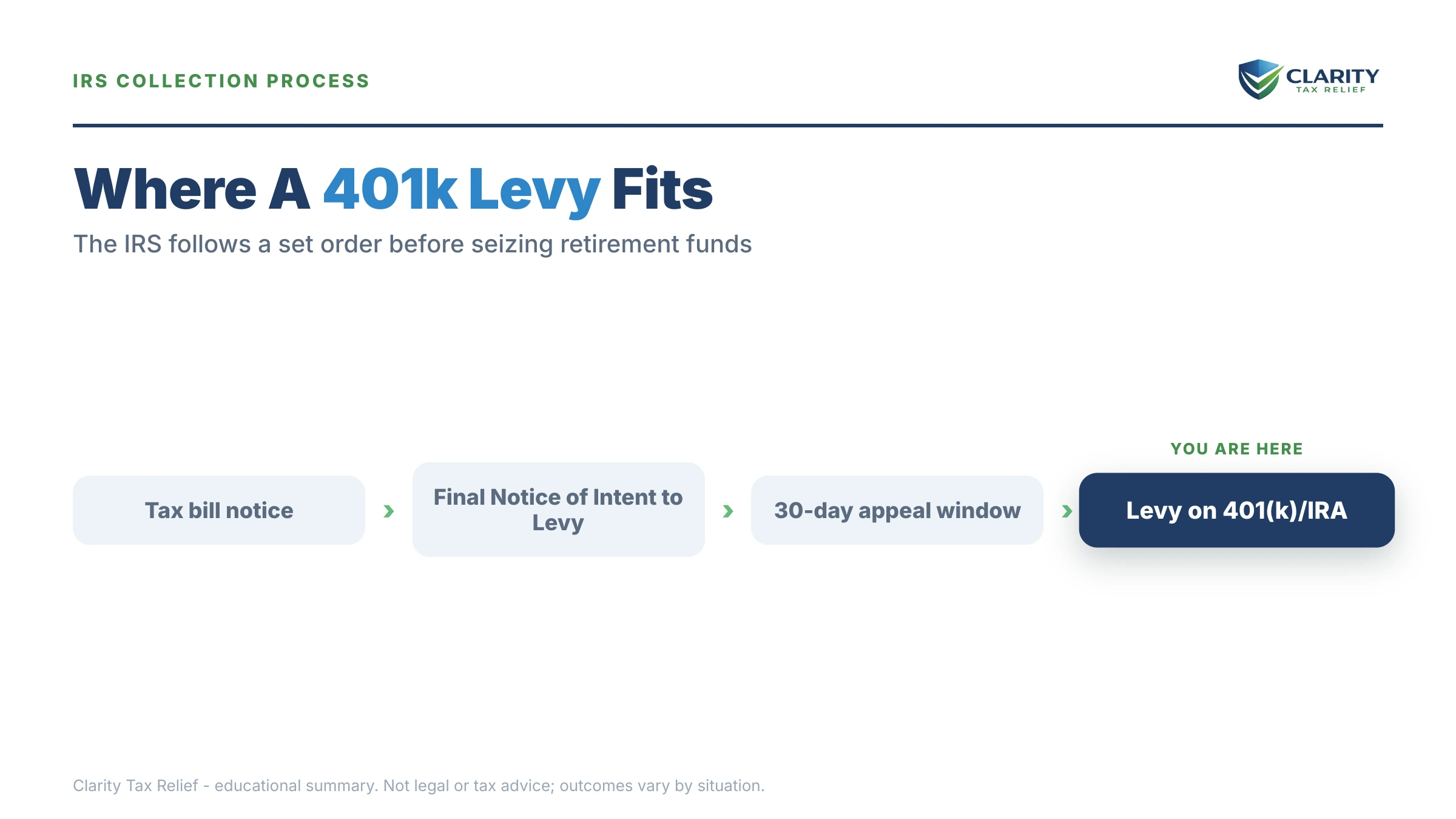
The three findings the IRS must make before levying retirement money
Internal IRS procedure treats a retirement account levy as a last resort that requires manager approval and three documented determinations. This is the part the scary headlines skip, and it's why these levies are genuinely uncommon compared with bank and wage levies.
Before serving Form 668-R on a plan, the IRS must consider:
- Whether other collection alternatives exist. If you have wages, bank accounts, or equity that could satisfy the debt — or you've proposed a realistic payment arrangement — retirement money is supposed to stay off the table.
- Whether your conduct was "flagrant." The IRS looks for deliberate avoidance: continuing to stuff money into the account while ignoring assessed debt, fraud, assets moved out of reach, repeated broken promises. Falling behind and staying in contact is not flagrant.
- Whether you depend on the account for retirement. If taking the funds would leave you unable to cover necessary living expenses in retirement, that weighs directly against the levy.
Read those three factors as a map, not a shield. Every one of them is something you can influence right now: engage with the notices, propose an alternative, and document what you actually live on. The only version of this process that skips the warnings entirely is a jeopardy levy — an emergency measure reserved for cases where the IRS believes collection is at immediate risk.
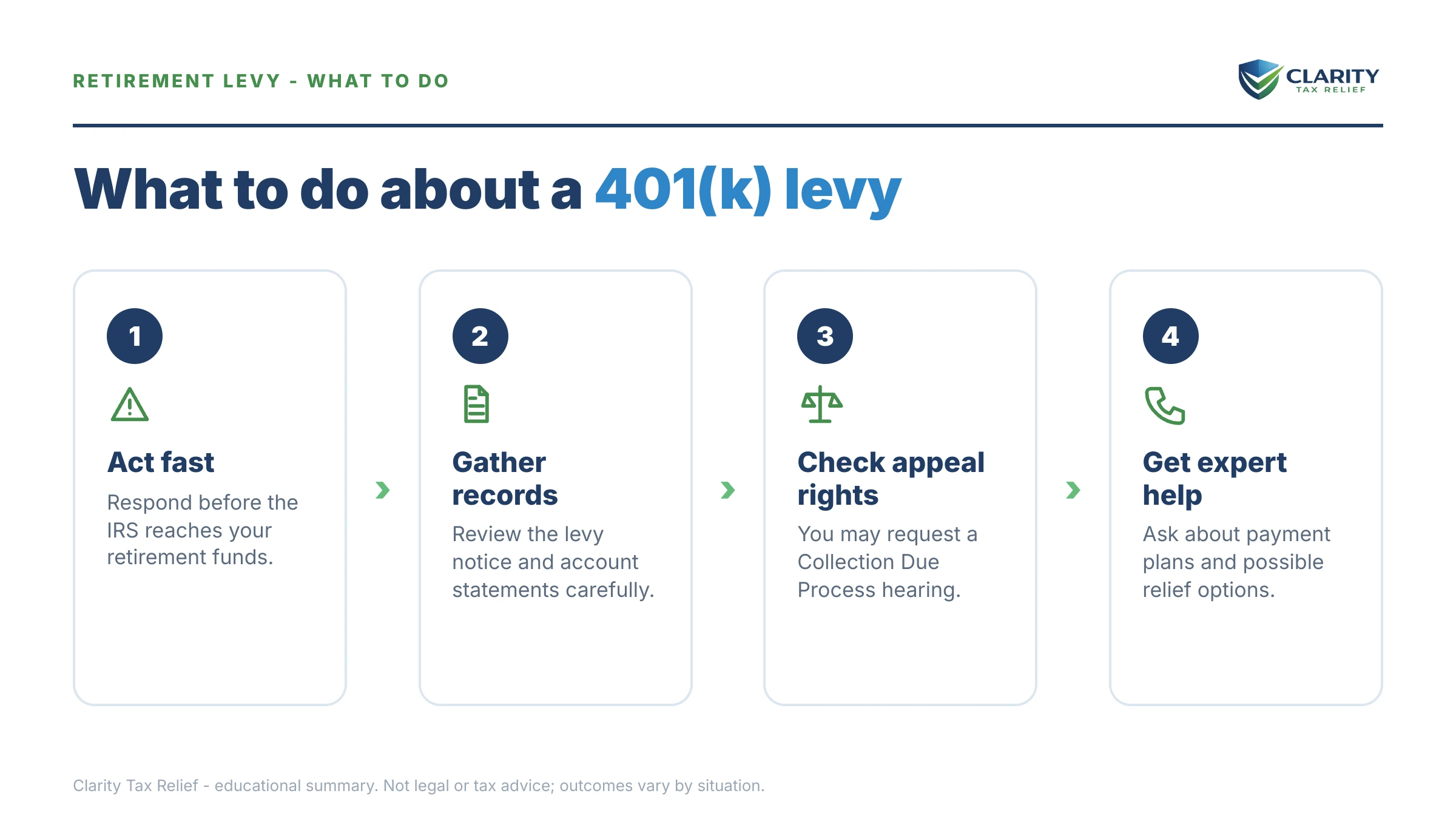
What the IRS must send first — and the right each notice carries
A retirement account levy cannot come out of nowhere; it sits at the end of a mandatory notice sequence, and each notice carries a right that expires with it. The single most valuable right in the sequence is the Collection Due Process hearing attached to the final notice.
| Notice or event | Your window | The right at stake |
|---|---|---|
| CP14 / CP501 / CP503 (bills) | Pay-by date printed on each notice | Resolving here keeps every asset — retirement included — completely out of the conversation |
| CP504 (intent to levy) | Date printed on the notice | After it passes, the IRS can seize your state tax refund; retirement accounts still can't be touched yet |
| LT11 / Letter 1058 (final notice) | 30 days from the notice date | Your Collection Due Process hearing via Form 12153 — a timely request generally pauses levy action while Appeals reviews alternatives |
| Form 668-R served on your plan | Before the plan administrator distributes | You can still request a release — for hardship, a pending agreement, or procedural error — while the money is in the plan |
| Funds distributed to the IRS | Effectively closed | Getting levied retirement money returned is rare and narrow; the fight has to happen before this point |
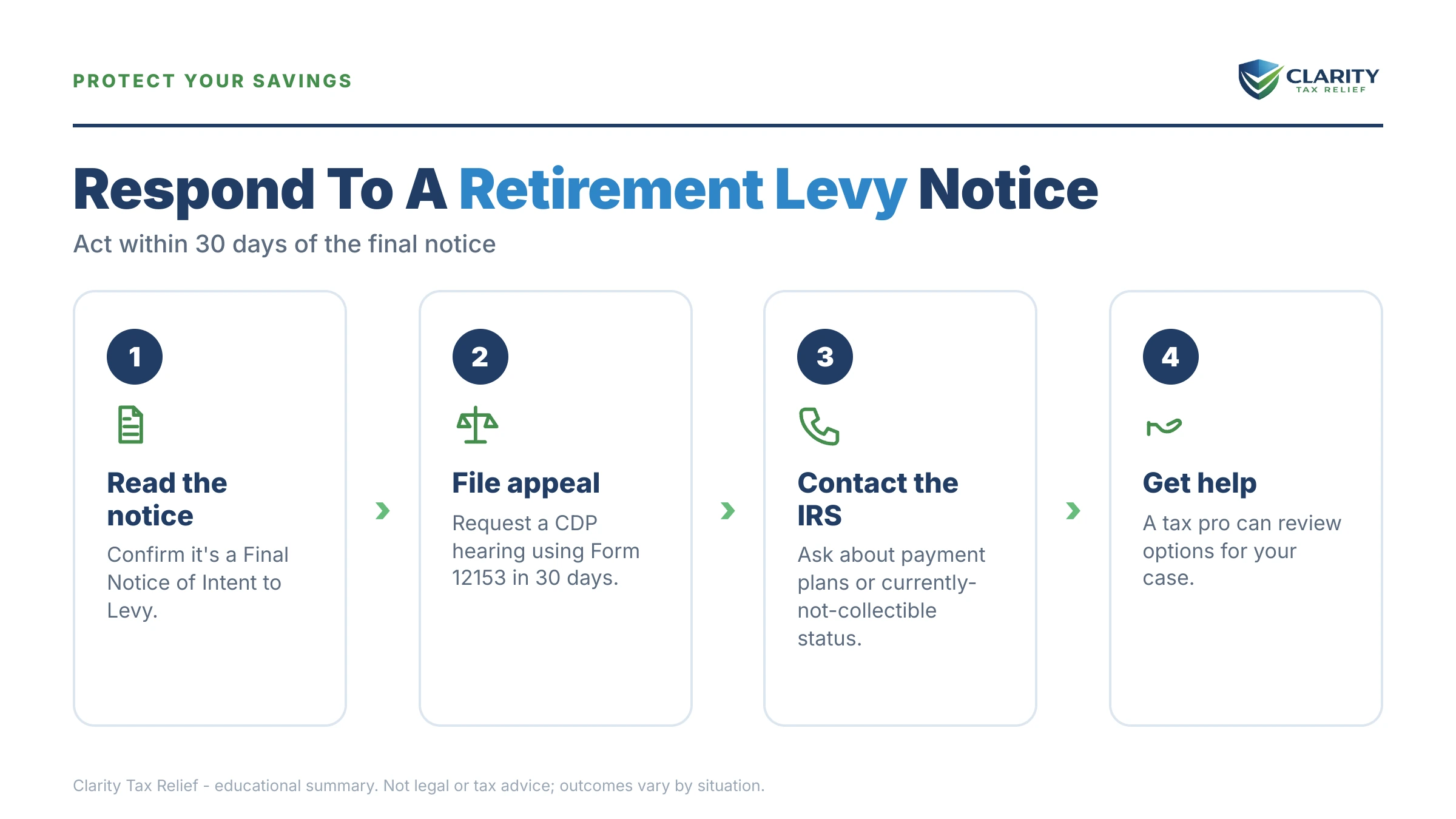
What happens if you ignore the notices
Retirement accounts are typically the last asset the IRS reaches — after your state refund, bank accounts, wages, and federal payments. If you do nothing, the sequence unfolds in this order, each stage harder to unwind than the one before:
- Bills go unanswered — the balance grows monthly with interest and the failure-to-pay penalty, and the automated notice stream escalates.
- CP504 arrives — the IRS can take your state tax refund, and a federal tax lien becomes likely on a balance this size.
- LT11 / Letter 1058 arrives — the 30-day final-notice clock runs. Let it lapse and you lose the CDP hearing that could have paused everything.
- Easier assets go first — an IRS bank levy with its 21-day hold, then a continuous wage levy (our guide on how to stop IRS wage garnishment covers that fight, and you can estimate the paycheck hit with our Wage Garnishment Calculator), plus up to 15% of Social Security through the FPLP if you receive benefits.
- Retirement becomes the remaining target — with other sources exhausted and your silence reading as avoidance, the flagrant-conduct case writes itself. Form 668-R goes to your plan administrator, who is legally required to comply.
- The plan distributes — your balance goes to the Treasury, and the distribution lands on your next tax return as ordinary income, creating a brand-new debt.
One more clock runs quietly in the background: a balance above $66,000 in 2026 can trigger passport certification, and a debt in the low sixties grows past that line on interest alone. See passport revoked for tax debt.
Final notice in hand and retirement savings on the line?
The 30 days on an LT11 or Letter 1058 are when your options are widest — and a levy already served on your plan can sometimes still be released before the money moves. Get your notice reviewed free by an experienced tax professional before the window closes.
The tax trap: a 401(k) levy creates a second tax bill
Money levied from a retirement account is taxed as ordinary income in the year it's distributed — the levy pays the old debt and simultaneously creates a new one. There's one small mercy: levy-forced distributions are exempt from the 10% early-withdrawal penalty under IRC §72(t), even if you're under 59½.
Say you owe $61,200 — a single W-2 employee with $85,000 vested in a 401(k) and no other major assets. Here's how the paths compare, hypothetically:
- The IRS levies your plan for $61,200. No 10% penalty, but the full $61,200 is ordinary income stacked on top of your salary. In the 22–24% brackets that's roughly $13,500–$14,700 in new federal tax (22% × $61,200 ≈ $13,464), plus state tax in most states — a five-figure balance due next April, with your retirement savings down to about $23,800.
- You cash out voluntarily to pay the debt. Worse: a voluntary early distribution gets no levy exception, so add a 10% penalty — about $6,120 — on top of the income tax. Voluntarily draining the account is almost never the right first move.
- You pay the balance down and set up a plan. Paying $11,201 drops the debt to $49,999 — under the $50,000 line for a streamlined installment agreement you can set up online over up to 72 months. That's roughly $695/month on the base balance ($49,999 ÷ 72), with interest and the 0.5% monthly failure-to-pay penalty continuing until it's paid. Your $85,000 keeps compounding untouched.
The arithmetic is the argument: the levy path costs the debt plus a new five-figure tax bill plus decades of lost compounding. Almost any resolution option beats it.
Your options to stop a retirement account levy
Every standard collection alternative takes retirement money off the table, because each one directly defeats the "no other way to collect" finding the IRS must make. For the full landscape of resolution programs, start with the shared playbook in how to stop IRS wage garnishment — here's how each option plays specifically against a retirement levy:
| Option | Upfront cost | Typical timeline | Effect on the levy |
|---|---|---|---|
| Short-term payment plan (up to 180 days) | $0 setup | Same day online | Enforcement stops while you pay in full; interest and penalties continue |
| Streamlined installment agreement (balance ≤ $50,000) | Modest setup fee, reduced with direct debit or low income | Often same day online | IRS generally won't levy while a request is pending or a plan is current |
| Installment agreement over $50,000 | Setup fee + Form 433-F financial disclosure | Weeks to months | Same protection once accepted; a paydown below $50,000 skips the financial disclosure |
| Currently Not Collectible status | $0, financial statement required | Weeks | Collection pauses on genuine hardship; the debt remains and the IRS reviews periodically |
| Offer in Compromise | $205 application fee + 20% down on lump-sum offers (both waived with low-income certification) | Months to 2 years | Levy action generally pauses while the offer is under review; roughly 1 in 5 offers were accepted in FY2024 |
| CDP hearing (Form 12153) | $0 | Must file within 30 days of the final notice | Timely filing generally pauses the levy while Appeals considers your alternatives |
| Hardship levy release (§6343) | $0, proof of hardship required | Days to weeks — can move fast when documented | Levy must be released if it prevents you from meeting basic living expenses |
Two more angles worth knowing. First, a filed bankruptcy triggers an automatic stay that pauses levy action — a real but heavy lever covered in does bankruptcy stop an IRS levy. Second, the 10-year collection statute (CSED) keeps running through most of this; on an older assessment, the smartest strategy sometimes revolves around how much clock is left rather than which program to enter.
How to respond to a retirement account levy, step by step
- Identify which notice you are holding. Check the letter number: an LT11 or Letter 1058 means the levy has not happened yet and your 30-day clock is running; a Form 668-R means the levy has already been served on your plan.
- File Form 12153 if your 30-day window is open. Request a Collection Due Process hearing within 30 days of the final notice date. A timely request generally pauses levy action while Appeals reviews collection alternatives.
- Pull your numbers. Log into your IRS online account for the exact balance, and get your vested balance and withdrawal rules from your plan administrator or summary plan description.
- Propose a collection alternative. Set up an installment agreement, request Currently Not Collectible status, or submit an Offer in Compromise — any credible alternative undercuts the case for taking retirement money.
- Act before the plan distributes if a 668-R was served. Contact the IRS immediately to request a release; once the plan administrator sends the funds, reversing the levy is far harder.
When you can handle this yourself — and when help changes the outcome
If you're still at the bill stage and can manage a payment plan, you don't need to hire anyone. A balance you can pay within 180 days, or one at or under $50,000 (including after a strategic paydown, like the $11,201 move in the example above), can be resolved online in an evening — and doing so ends the retirement-levy question entirely.
Experienced help earns its cost in the harder versions of this situation: a Form 668-R already served and the plan about to distribute, a revenue officer building a flagrant-conduct file, multiple unfiled years complicating any agreement, a debt drifting toward the $66,000 passport threshold, or Offer in Compromise math where the treatment of retirement assets in the IRS's collection-potential formula can swing the result dramatically. In 2026, with IRS phone staffing cut deeply while automated enforcement runs uninterrupted, having someone who knows which fax line and which unit to work is a practical advantage, not a luxury.
Terms on your notice, decoded
- Form 668-R — the specific Notice of Levy the IRS serves on retirement plan administrators; seeing this number means your plan has been formally levied.
- Flagrant conduct — the documented finding of deliberate tax avoidance the IRS must make before levying retirement funds.
- Vested balance — the portion of your plan you own outright; the only portion a levy can reach.
- ERISA anti-alienation — the federal rule shielding retirement plans from most creditors; it does not shield them from a federal tax levy.
- CDP (Collection Due Process) — your right to an Appeals hearing before levy, triggered by filing Form 12153 within 30 days of the final notice.
- CSED — the Collection Statute Expiration Date; the IRS generally has 10 years from assessment to collect, though appeals, offers, and bankruptcy pause the clock.
IRS retirement levy questions, answered
Can the IRS take my entire 401(k)?
The IRS can only levy your vested balance, and only up to the amount you owe plus accruals. Unvested employer contributions are off-limits because you have no right to them yet. If your plan does not let you withdraw funds while employed, the levy attaches to your rights but the IRS generally has to wait until you could access the money.
Do I owe the 10% early-withdrawal penalty if the IRS levies my retirement account?
No. Distributions made because of an IRS levy are exempt from the 10% additional tax under Internal Revenue Code section 72(t), even if you are under 59 and a half. You still owe ordinary income tax on the amount distributed, which shows up as a new balance on your next return. A voluntary early withdrawal to pay the IRS does not get this exception.
Is an IRA easier for the IRS to levy than a 401(k)?
Yes, in practice. You can withdraw from an IRA at any time, so the IRS can reach the full balance once a levy is served. A current employer's 401(k) often restricts in-service withdrawals, which limits what the levy can collect right away. The same manager-approval and flagrant-conduct rules apply to both account types.
Can the IRS take my pension or Social Security too?
Yes, both are reachable. A pension in pay status can be levied, and Social Security benefits can be reduced by up to 15% through the Federal Payment Levy Program. Neither requires the flagrant-conduct finding that a 401(k) or IRA levy does, which is one reason the IRS usually reaches income streams before it reaches retirement savings.
Will setting up a payment plan stop a retirement account levy?
Generally, yes. The IRS does not typically levy while an installment agreement request is pending or while an approved agreement is in good standing. If a levy has already been served on your plan, an accepted payment arrangement is one of the strongest grounds for asking that the levy be released before the money is distributed. Interest and penalties continue to accrue either way.
What counts as flagrant conduct?
The IRS looks for behavior that shows deliberate avoidance: continuing to fund a retirement account while ignoring assessed tax debt, fraud findings, assets moved out of reach, or repeated broken promises to pay. A taxpayer who simply fell behind and stayed in contact rarely meets this standard. The finding must be documented and approved by a manager before a retirement levy is served.
Can the IRS levy an old employer's 401(k) or a Roth IRA?
Yes. An old employer's 401(k) is often more exposed than a current one because former employees can usually take a full distribution, so the levy can collect immediately. Roth IRAs are also levyable; your original contributions come out without income tax, but levied earnings may be taxable. The account type changes the tax bill, not the reachability.
Does bankruptcy protect my 401(k) from an IRS levy?
Filing bankruptcy triggers an automatic stay that pauses IRS levy action while the case is open, and ERISA-qualified retirement funds are generally excluded from the bankruptcy estate. But the stay is temporary, recent tax debt often survives Chapter 7, and the 10-year collection clock is paused while you are in bankruptcy. It is a serious step that deserves professional analysis, not a reflex response to a levy notice.
Your next 24 hours
- Find the letter number and notice date on whatever you received — LT11, Letter 1058, or Form 668-R — and count 30 days from the notice date. That number tells you whether your CDP window is still open.
- Gather three documents: your most recent tax return, the notice itself, and your latest retirement plan statement showing the vested balance. Those three pages determine every option on the table.
- Get a free case review — call (888) 825-7779 or use the 2-minute form. If your 30-day final-notice window is still running, that's the moment your retirement savings are easiest to protect; if a 668-R has already gone to your plan, releases are still possible before the money moves.
For the IRS's own rules, see IRS.gov/payments for paying a balance, the IRS payment plans page for agreement thresholds, and the Taxpayer Advocate Service if a levy is causing hardship and normal channels stall.
This guide is general information, not tax or legal advice for your specific situation. Eligibility for IRS programs depends on individual facts and circumstances; no outcome is guaranteed.