
Unfiled Tax Returns
How Long Can You Go Without Filing Taxes? What Really Happens (2026)
The short answer: how long can you go without filing taxes? Legally, zero — every required return is due when it's due. Practically, the IRS usually demands only your last six years of returns to get back in good standing, refunds expire three years after the due date, and penalties cap at 25% per rule.
You run payroll for other people twice a month, you issue W-2s every January — and somewhere in there, your own returns stopped going in. One year of silence became two, maybe more, and the question you're really asking is how much trouble that silence has bought. Here's the honest map: not filing is never a strategy, but nearly every non-filer who comes forward fixes this civilly — and usually for less than they feared.
If the IRS's non-filer system has already flagged you, its opening move is a letter called a CP59. The visual guide below maps the deadlines, escalation stages, and options — worth knowing before that first non-filer notice lands in your mailbox.
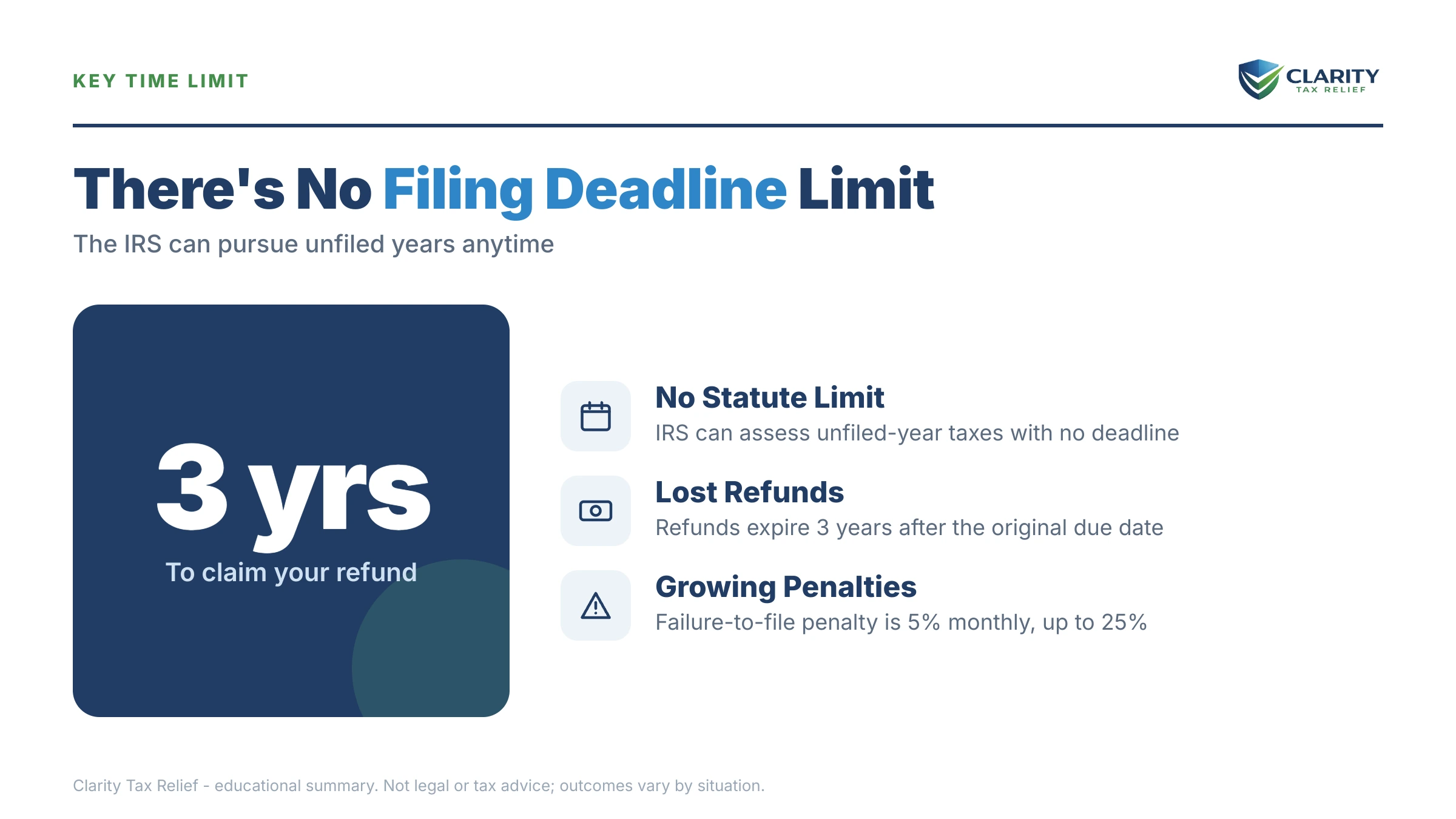
⏱ The one hard clock: there's no fixed IRS deadline to file a late return, but one deadline runs against you the whole time. You have 3 years from a return's original due date to claim its refund. After that, the money is legally gone — and on any balance due, penalties and interest grow every month you wait. See the 3-year refund deadline for the exact cutoffs by year.

How long can you go without filing taxes? The honest answer
There is no legal limit on how long you can go without filing taxes — an unfiled year simply stays open to the IRS forever. That's the part most people get backwards. They assume old unfiled years eventually "age out." The opposite is true: the statute of limitations on assessment never starts running until a return is filed, so an unfiled 2015 is exactly as reachable in 2026 as an unfiled 2024.
Practically, though, the IRS draws a line. Under its own internal rule — Policy Statement 5-133 — the IRS generally requires only your last six years of returns to consider you back in compliance. Older years usually stay closed unless the IRS already assessed them, the income was large, or fraud is in play. Our guide to how many years of back taxes you have to file covers when the six-year rule bends.
Here's the paradox that should change your math: not filing feels like nothing is happening precisely because every clock that protects you is frozen. No filed return means no 3-year audit limit, no 10-year collection countdown, and a refund window quietly closing. Silence costs you deadlines; it never earns you one.
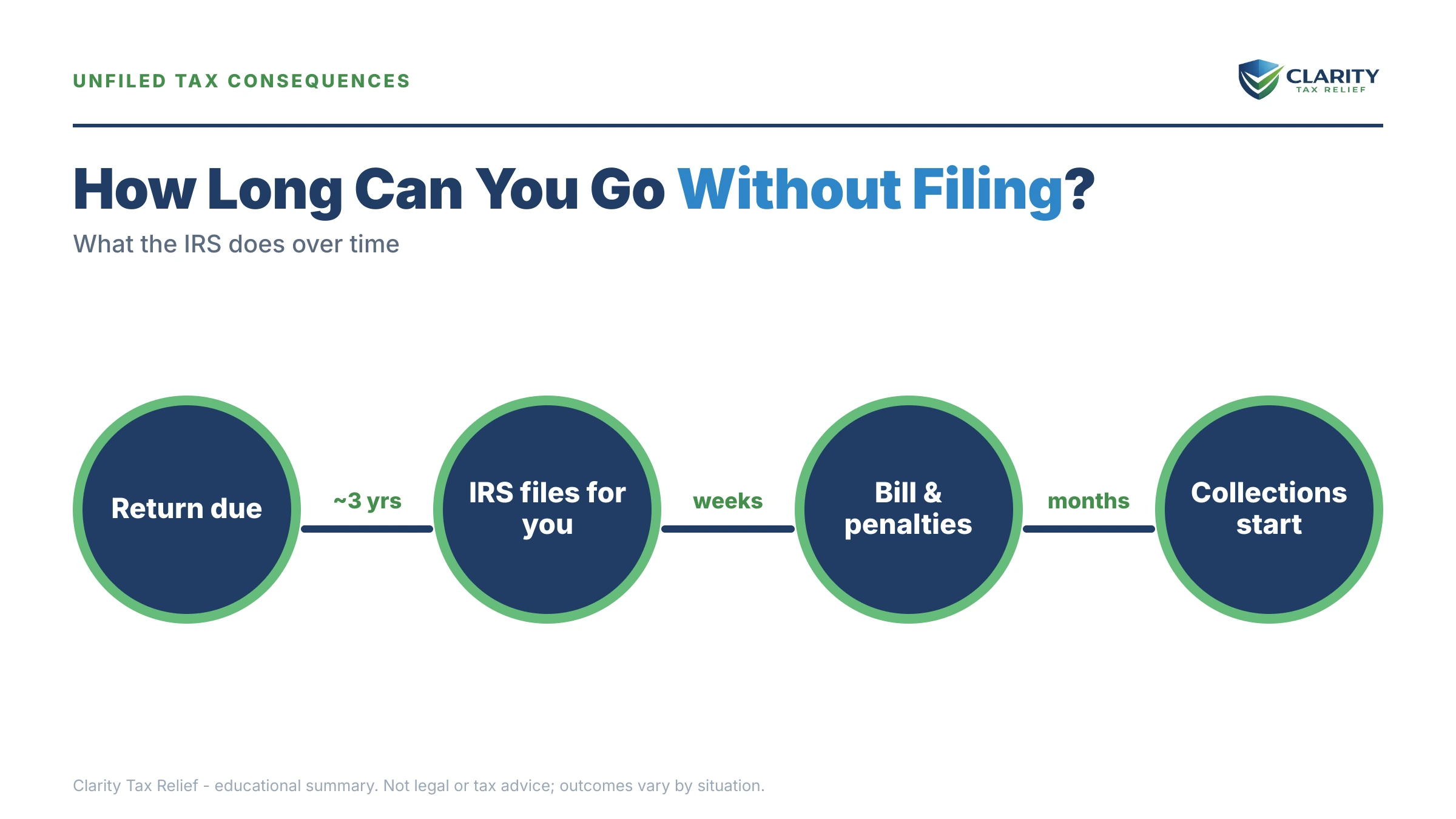
One year vs. three vs. seven: what changes at each stage
What the IRS actually does about a non-filer depends far more on how many years are missing and how much income was reported to it than on any fixed timetable. The bands below reflect how these cases typically unfold — and what the smart move is at each stage.
| Time without filing | What's usually happening | Your realistic move |
|---|---|---|
| Under 1 year | No notices yet, but the failure-to-file penalty accrues fastest here — most of its 25% cap builds in the first five months. | File immediately, even without payment. This is the cheapest exit you will ever have. |
| 1–3 years | The automated non-filer program starts matching your W-2s/1099s to missing returns; CP59 letters begin. Refund windows on the oldest year are closing. | File all missing years now — see haven't filed taxes in 3 years for the exact sequence. |
| 3–6 years | Substitute-for-return risk is real: the IRS may file its own inflated version and assess it. Early refunds are already forfeited. | File before the SFR posts — your accurate return beats fighting an assessed one. |
| 7+ years / never filed | The IRS usually wants only the last six years of 1040s — but every missing payroll return if you had employees. Any SFR-assessed year is in active collection. | Get the required-years list right before filing anything — haven't filed taxes in 10 years maps it. |
What happens if you keep not filing: the escalation sequence
If you never file, the IRS eventually files for you — and its version of your return is the most expensive one legally possible. The sequence below is automated, which matters in 2026: the IRS workforce shrank roughly 27% in 2025, but the automated non-filer program never stopped running. Fewer humans answer the phone; the machine still escalates.
- Silent accrual. Nothing arrives, but on any unpaid balance the penalties and interest are already compounding, and your refund windows are ticking down.
- CP59 — "we have no record of your return." The first non-filer notice. Still just a request; filing now usually ends the sequence.
- CP516, then CP518. Escalating demands; the CP518 is the final unfiled-return notice before the IRS acts on its own.
- Substitute for Return (SFR). The IRS files a return for you using only reported income — no business expenses, no deductions, worst filing status.
- CP3219N — Notice of Deficiency. You get 90 days to petition Tax Court before the SFR numbers are assessed as legally final.
- Assessment and collection. Now it's a debt: a CP14 bill (typically about 21 days to respond — 10 business days if the balance is $100,000 or more), then CP501/CP503, CP504, and a final levy notice. Liens, bank levies, wage levies, and state-refund seizures follow — and once assessed debt tops $66,000 (the 2026 threshold), passport certification is on the table.
- Criminal referral — rare, but real. Willful failure to file is a misdemeanor, reserved for clearly deliberate cases. If you're worried about that line, read can you go to jail for not filing taxes — the answer is more reassuring than you'd expect for people who come forward voluntarily.
Notice what's absent from that list: any point where the problem resolves itself. Every stage is more expensive than the one before it, and the SFR stage is where a fixable filing gap turns into an inflated, assessed debt.
What not filing costs: the penalty math on a $4,800 balance
The failure-to-file penalty runs 5% of the unpaid tax per month — ten times the 0.5% failure-to-pay penalty — which is why filing always comes first, even when you have no money to send. Say you're a small-business owner whose 2023 Form 1040 never went in, with $4,800 of self-employment tax due on it. Here's the arithmetic (when both penalties apply in the same month, the filing penalty drops to 4.5% and the two run together at 5%):
| Time past the due date | Late-filing penalty | Late-payment penalty | Total penalties |
|---|---|---|---|
| 5 months | $1,080 (capped) | $120 | $1,200 |
| 12 months | $1,080 | $288 | $1,368 |
| 3 years | $1,080 | $864 | $1,944 |
| 50+ months | $1,080 | $1,200 (capped) | $2,280 |
Interest is on top of all of it, compounding daily on both the tax and the penalties — after two unfiled years, that hypothetical $4,800 balance is realistically pushing $7,000. A minimum late-filing charge can also raise the early figures once you're more than 60 days late. You can estimate your own numbers with our Penalty & Interest Calculator.
Two things the table proves. First: $1,080 of that damage exists only because the return wasn't filed — had this owner filed on time and simply not paid, two years of late-payment penalty would total $576. That gap is the whole argument in file even if you can't pay. Second: if it turns out you had withholding or estimated payments covering the year, both penalties are $0 — they're percentages of unpaid tax. Plenty of scared non-filers are actually owed refunds they're about to forfeit.
Years unfiled and the balance building?
Tell us how many years are missing. An experienced tax professional will pull your IRS records, confirm exactly which returns the IRS requires, and map your cheapest path back — free and confidential. Penalties and interest accrue every month a return stays unfiled, so the review is worth doing this week, not this quarter.
Your options once the returns are in
Every IRS resolution program has the same entry requirement: your required returns must be filed first. That's why "catch up, then negotiate" is the only order that works. Once the returns post, the balance itself is a solvable problem — the full playbook lives in our guide to how to settle tax debt yourself; here's the map:
| Option | Typical eligibility | Cost | The catch |
|---|---|---|---|
| Short-term payment plan | Can pay in full within 180 days | $0 setup | Interest and the 0.5%/month penalty keep running |
| Guaranteed installment agreement | Owe $10,000 or less, payable in 3 years, filing-compliant | Setup fee (reduced with direct debit) | Must stay current on all future filings |
| Streamlined installment agreement | Owe $50,000 or less — up to 72 months, set up online | Setup fee; interest continues | Missing next year's return defaults the plan |
| Offer in Compromise | Income and assets genuinely can't cover the debt | $205 fee + 20% down on lump-sum offers (both waived if AGI ≤ 250% of the poverty line) | Roughly 1 in 5 offers accepted in FY2024 — means-tested, never automatic |
| Currently Not Collectible | Paying anything would prevent basic living expenses | $0 | Debt keeps growing; the IRS re-reviews your finances |
| Penalty relief (FTA / AEP) | Clean compliance the prior 3 years; AEP becomes automatic starting summer 2026 | $0 | Removes penalties, not the tax or interest |
For our $4,800 owner: after filing, a streamlined plan over even 24 months runs roughly $200–$275 a month depending on accrued penalties and interest — and a first-time abatement request (or the new automatic AEP) could strip $1,000+ of penalty off before the plan is even calculated. An Offer in Compromise almost never fits a balance this size for someone with business income; the payment plan plus penalty relief is the realistic combination.
If your business has payroll: unfiled 941s are a different animal
Unfiled Form 941 payroll returns are treated far more severely than a late 1040, because the withheld taxes were never your money to hold. The six-year comfort of Policy Statement 5-133 generally doesn't apply — expect the IRS to want every missing payroll return, and it can prepare business returns for you under its own authority just as it does with personal SFRs. Our guide to 941 back taxes covers the full business sequence.
The sharpest edge is personal: through the Trust Fund Recovery Penalty, the withheld income tax and employee FICA can be assessed against you personally — owner, officer, even a check-signing bookkeeper — and that assessment survives closing the business and generally can't be discharged in bankruptcy. If both your 1040s and your 941s are behind, the payroll returns come first in any competent catch-up plan.
Going forward, the fix that keeps this from recurring is boring and effective: run your own compensation through the same discipline as your employees' — deposits on schedule and quarterly estimated taxes on your draw or distributions.
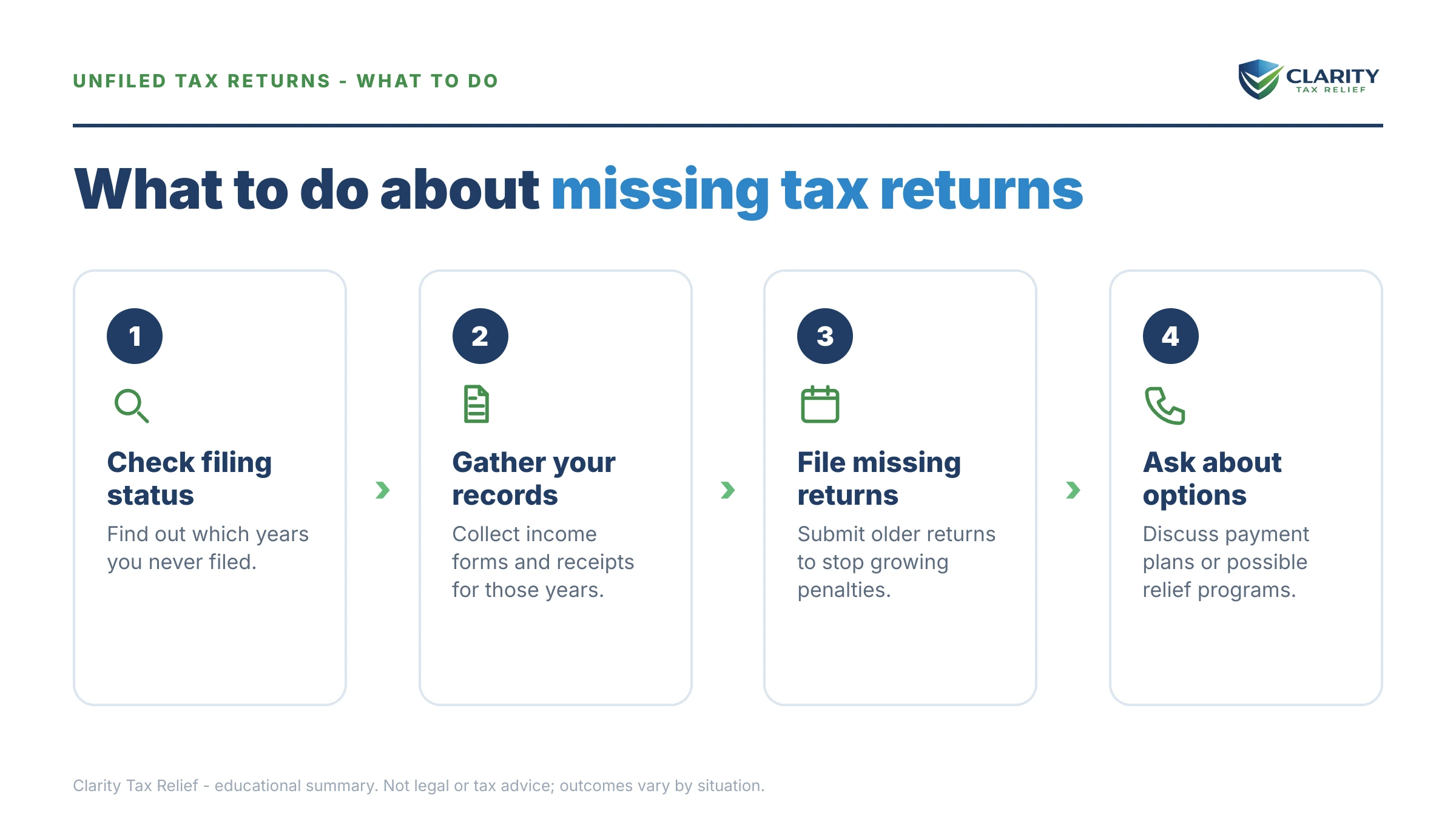
How to catch up on unfiled tax returns, step by step
Catching up is a sequence, not a scramble — done in this order, most multi-year cases resolve without ever meeting a revenue officer.
- Pull your IRS records. Request wage and income transcripts for every missing year through your IRS online account or Form 4506-T — they list every W-2 and 1099 the IRS already has for you.
- Confirm which years the IRS requires. For most taxpayers that's the last six years of personal returns — but expect the IRS to want every missing payroll return if you have employees.
- Prepare the oldest required return first. Work forward in order so carryovers, estimated payments, and refunds land on the right years.
- File all required returns before negotiating. The IRS will not approve a payment plan, hardship status, or offer while required returns are missing.
- Set up your resolution the same week the returns go in. Pick the payment plan, hardship status, or offer that fits your numbers so the assessed balance never reaches enforced collection.
Missing paperwork is the most common stall point, and it's solvable: getting old W-2s for back taxes covers the income side, and filing back taxes with no records covers reconstructing expenses when the shoebox is empty.
When you can catch up yourself — and when help changes the outcome
Plenty of non-filers don't need professional help, and it's worth saying so plainly. If you're missing one or two years, you have your records (or can pull transcripts), and any balance is small enough to pay within 180 days, you can do this yourself: prepare the returns, file them per the IRS's filing past due tax returns page, and set up any plan at the IRS payment plans page.
Experienced help changes outcomes in specific situations: an SFR has already been assessed (replacing inflated numbers on an assessed year is procedural work, not just filing), six or more years are missing, your business has unfiled 941s with Trust Fund Recovery Penalty exposure, a revenue officer has made contact, or the years involve income you deliberately didn't report — where the order and manner of coming forward matters. If the IRS itself is unresponsive or a hardship is being ignored, the Taxpayer Advocate Service is an independent, free channel.
If you're staring at six blank years plus a stack of payroll filings, one free call with an experienced tax professional can set the exact filing order and flag any TFRP exposure before you file a thing — start with the 2-minute form or (888) 825-7779.
Terms you'll see on non-filer notices, decoded
- Substitute for Return (SFR): the return the IRS prepares for you from reported income only — no deductions, no credits, worst filing status.
- Policy Statement 5-133: the internal IRS rule that generally limits required catch-up filing to the last six years.
- ASED (Assessment Statute Expiration Date): the deadline for the IRS to assess tax on a return — it never starts on an unfiled year.
- CSED (Collection Statute Expiration Date): the 10-year limit on collecting an assessed debt — it starts at assessment, not at the year the tax was for.
- Wage and income transcript: the IRS's record of every W-2, 1099, and 1099-K filed under your Social Security number — your raw material for reconstructing old returns.
- Trust Fund Recovery Penalty (TFRP): the mechanism that turns a business's unpaid withheld payroll taxes into a personal debt of the people responsible.
Unfiled tax return questions, answered
Is there a statute of limitations on unfiled tax returns?
No — an unfiled year stays open to the IRS forever. The 3-year audit clock and the 10-year collection clock only start once a return is filed or the tax is assessed, so skipping a return never runs out the clock; it prevents the clock from ever starting. The one deadline that does run is yours: the 3-year window to claim any refund from that year.
How many years of back taxes do I have to file to get compliant?
Usually the last six years. IRS Policy Statement 5-133 directs collection staff to require six years of returns for most taxpayers to be considered in good standing. The IRS can demand more when the facts justify it — large income, business returns, or payroll filings — so a small-business owner with unfiled 941s should expect the IRS to want every missing payroll return, not just six years of 1040s.
Can you go to jail for not filing taxes?
It is legally possible but rare. Willful failure to file is a misdemeanor carrying up to one year in jail per unfiled year, yet the IRS reserves prosecution for clearly willful cases — typically large incomes, repeated years, and ignored warnings. Filing voluntarily before the IRS contacts you almost always keeps the matter civil. Our guide to jail for not filing taxes draws the line in detail.
Do I have to file taxes if I don't owe anything?
You must file if your income exceeds the filing threshold for your status — and self-employed people must file once net self-employment earnings reach $400. If you're owed a refund, there's no failure-to-file penalty, because that penalty is a percentage of unpaid tax. But you forfeit the refund permanently three years after the return's original due date.
What happens if the IRS files a substitute return for me?
The IRS prepares a return using only the income reported to it — no deductions, no business expenses, and the least favorable filing status — then assesses the inflated tax and starts collection. An SFR is not a favor; it almost always overstates what you owe. You can still file your own accurate return afterward to replace the SFR numbers, but by then penalties have been compounding on the inflated balance.
Can I still get refunds from the years I didn't file?
Only within three years of each return's original due date. File inside that window and the refund is paid in full; file after it closes and the money is legally forfeited — the IRS cannot pay it out or even apply it to balances you owe for other years. For a 2023 return that was due April 15, 2024, the window closes April 15, 2027.
How do I file back taxes with no W-2s or records?
Request your wage and income transcripts from the IRS — they show every W-2, 1099, and 1099-K filed under your Social Security number for roughly the last ten years. That gives you the income side; expenses can be reconstructed from bank statements, merchant reports, and mileage records. Our guides to getting old W-2s for back taxes and filing back taxes with no records walk through it.
Will unfiled tax returns stop me from getting a mortgage or business loan?
Very often, yes. Mortgage lenders and SBA lenders verify income by pulling your IRS transcripts, and a missing return shows up as a blank year they can't underwrite around. Unfiled returns also block every IRS resolution program, and — for business owners — many licensing and bonding applications, until the required returns are in.
Does the IRS know if I don't file?
Almost certainly. Every W-2, 1099-NEC, 1099-K, and broker statement issued to you is also filed with the IRS, and its automated matching flags Social Security numbers that show reported income but no return. Business owners are even more visible: payroll filings, the W-2s you issue to employees, and state registrations all signal an operating business that should be filing returns.
Your next 24 hours
- Find out which years are missing. Log into your IRS online account and note every year showing no return filed — and dig out any CP59, CP516, or CP518 letter for the tax year printed on it.
- Gather your raw material. Your last filed return, whatever income records you have, and a transcript request for the gaps — that's everything a catch-up plan needs to start.
- Get the free case review. An experienced tax professional will confirm the exact years the IRS requires, check for SFRs already on file, and price your realistic path — the 2-minute form or (888) 825-7779. The only clocks running are the 3-year refund windows and the monthly penalty accrual — both favor moving now.
This guide is general information, not tax or legal advice for your specific situation. Eligibility for IRS programs depends on individual facts and circumstances; no outcome is guaranteed.