
Back Taxes by Industry
Farmer Back Taxes in 2026: How to Resolve IRS Debt From Schedule F Income, Equipment Sales, and Missed Estimates
The short answer: farmer back taxes usually come from Schedule F self-employment tax, equipment-sale recapture, or a missed March 1 filing — and the IRS can lien farmland, levy grain checks, and take 15% of USDA payments. Every resolution option — payment plans, penalty waivers, hardship status, an Offer in Compromise — remains available to pursue once you engage, though each has its own eligibility requirements (filed returns, staying current on this year's taxes).
The corn check cleared, the operating note renews in the fall, and the envelope you've been avoiding says you owe the IRS for a year you barely broke even on paper. It feels like the farm itself is on the line. It isn't — not yet, and not if you act — because farm tax debt has more exits than almost any other kind, including three relief rules written specifically for farmers.
This guide covers why farm tax debt happens, exactly how the IRS escalates against a farm, every resolution option with its thresholds and costs, and the farmer-only rules — the March 1 rule, Form 2210-F penalty waivers, and Schedule J income averaging — that can shrink the bill before you negotiate it.
⏱ The clock that's already running: there's no single notice deadline on old farm tax debt, but two penalties compound monthly anyway. The failure-to-file penalty runs 5% per month — ten times the 0.5% failure-to-pay penalty — so an unfiled Schedule F year grows faster than an unpaid one. File first, even if you can't pay a dollar today.
Why farmers fall behind on taxes
Farm income is taxed the way it lands — in lumps — while the IRS expects it smooth, and that mismatch is the root of most farm tax debt. A farmer's taxable income can double in a single year without the operation feeling any richer, because on paper the cash all arrived at once.
Nothing is withheld from a grain check, a livestock auction settlement, or a custom-work 1099. Everything you clear on Schedule F is hit with both income tax and 15.3% self-employment tax — the same double bill that catches every 1099 earner, explained in our guide to the self-employment-tax shock. On a farm, SE tax often exceeds the income tax itself.
Then there's the timing trap unique to agriculture. Deferred grain contracts push last year's crop into this year's income. A drought forces a herd sale, stacking three years of animals into one tax year. And the year you finally upgrade the combine, the trade-in itself triggers tax — because since 2018, equipment trades are no longer tax-free like-kind exchanges. The dealer's paperwork calls it a trade; the IRS calls it a sale with depreciation recapture.
The farm income events that create surprise tax bills
Most farm tax debt traces to one of five specific events — each with its own fix, some of which still work after the fact.
| What happened | Why it created tax debt | The fix (or partial fix) |
|---|---|---|
| Sold or traded equipment you'd expensed under Section 179 | Prior depreciation is "recaptured" as ordinary income in the sale year — tax with no cash behind it if the proceeds paid off the equipment loan | Verify the basis math is right; Schedule J income averaging can spread the spike across lower prior-year brackets |
| Drought or disaster forced a herd liquidation or early sale | Multiple years of animals taxed in one year | Weather-related sale deferral elections exist for replacement livestock; income averaging helps on the rest |
| Received crop insurance or disaster payments | Proceeds are taxable in the year received, even though the crop was lost | Cash-basis farmers who normally sell the crop the following year can often elect to defer the proceeds one year |
| Took CCC loans or deferred grain contracts | Election and timing rules moved more income into one year than expected | Review whether the elections were made (or missed) correctly — an amended return can sometimes fix the year |
| Skipped filing in a lean or chaotic year | Failure-to-file penalties at 5%/month, and the IRS may file a substitute return with zero expenses | File the real return now — it replaces the inflated assessment and stops the worst penalty |
If a filed year got the tax wrong — a missed deferral election, recapture computed on the wrong basis, a skipped Schedule J — amending the return to lower the tax debt attacks the balance itself, which beats negotiating payment terms on a number that was never right.
What happens if you ignore farmer back taxes
IRS collection against a farm is automated, sequenced, and doesn't care that it's planting season. In 2026 the IRS workforce is down roughly 27% from 2025 cuts — good luck reaching a human — but the notice stream, lien filings, and levies run on systems that never stopped. Here is the sequence, in order:
- CP14 — the first bill. You typically have about 21 days from the notice date before the system queues the next letter. This is the cheapest moment in the entire sequence.
- CP501 / CP503 — reminders. No enforcement yet, but the 0.5%/month failure-to-pay penalty and daily-compounding interest keep stacking.
- CP504 — intent to levy your state refund. Under IRC §6331(d), the IRS can now take your state tax refund, and a Notice of Federal Tax Lien becomes a live possibility — one that lands in the same county records your ag lender searches at renewal.
- LT11 / Letter 1058 — final notice of intent to levy. This starts a 30-day clock and your Collection Due Process rights (requested on Form 12153). After 30 days, real levies begin.
- Levies — where a farm gets hurt. A bank levy freezes the account holding your harvest deposits (with a 21-day hold before the money leaves). A levy can go straight to the grain elevator, co-op, or custom-work client that owes you money, intercepting the check before it's cut. USDA farm-program payments can be tapped at up to 15% continuously through the Federal Payment Levy Program. And once your combined debt passes $66,000 (the 2026 threshold), the IRS can certify you to the State Department for passport denial or revocation.
Seizing the land itself sits at the very end of that road, requires layers of approval — court approval for a principal residence — and essentially never happens to a farmer who is engaging with any resolution option. The lien attaching to your crops, livestock, and equipment, though, happens quietly and much earlier; see how far that reach extends in our guide to a tax lien on business assets.
Behind on farm taxes and the notices are stacking up?
Farm tax debt compounds monthly, and a lien filing can surface at your lender before you're ready for it. Get your notices and balances reviewed free by an experienced tax professional — before the next letter escalates things.
Your options for resolving farm tax debt
The IRS has five real resolution paths for a farmer, and which one fits depends on two numbers: your equity in land and equipment, and what your cash flow can spare monthly. The full mechanics of setting these up on your own live in our guide to how to settle tax debt yourself — here's how each one plays on a farm:
| Option | Who qualifies | Cost & the farm-specific catch |
|---|---|---|
| Short-term payment plan | Can full-pay within 180 days | $0 setup; interest and penalties continue. Fits a farmer waiting on a marketing check or crop sale. |
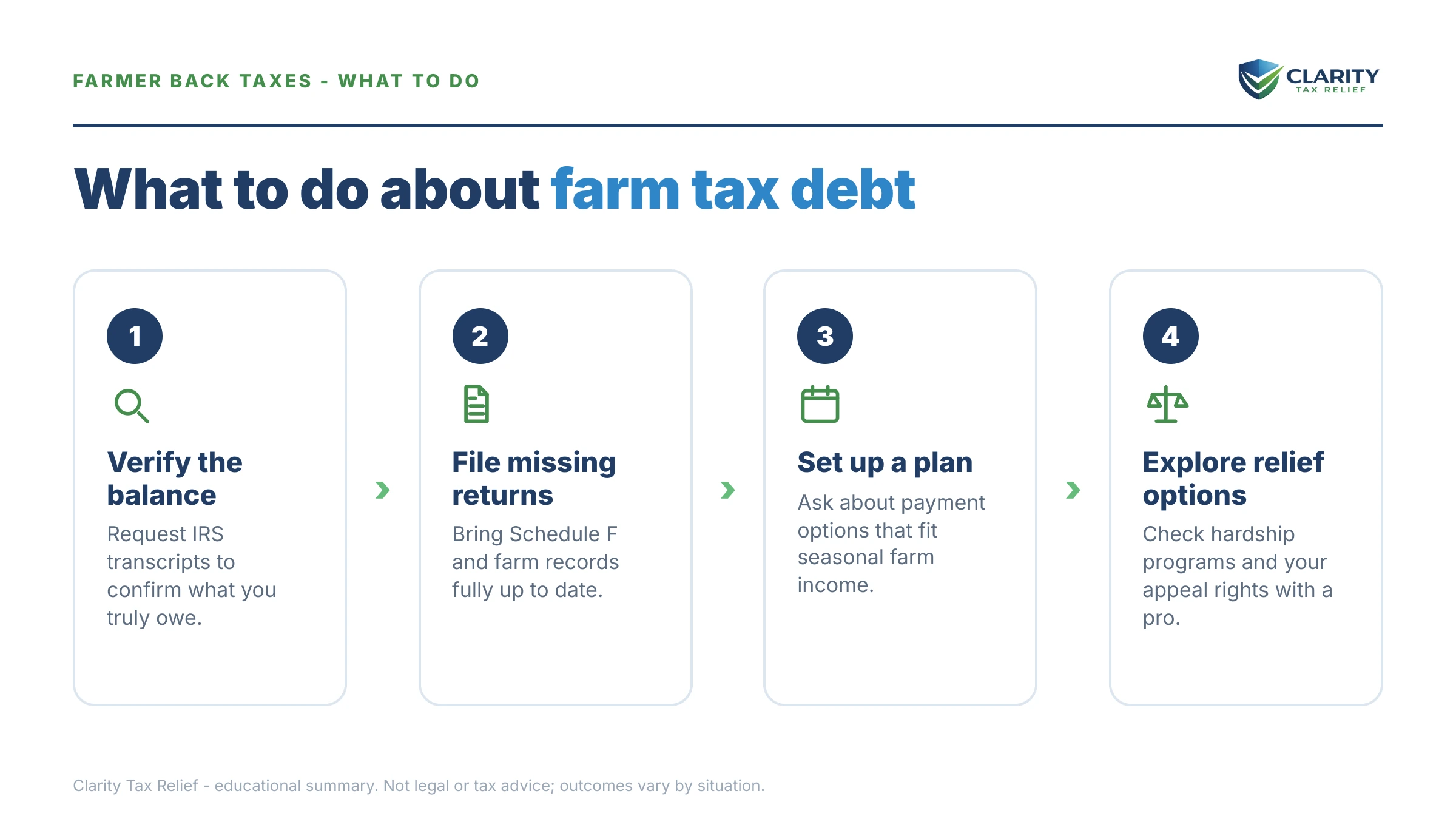
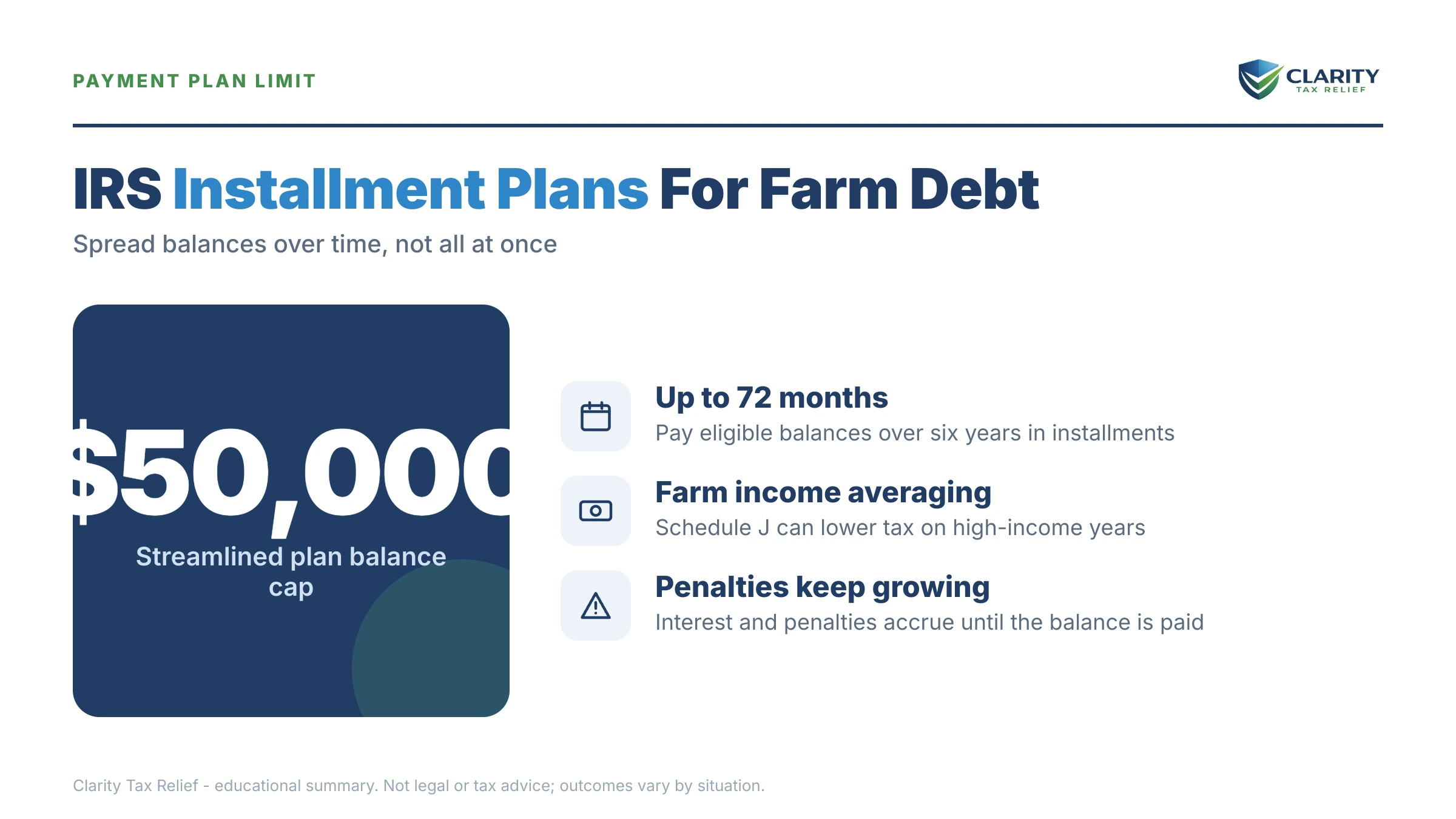
| Installment agreement (up to 72 months) | Balance ≤ $50,000 can be set up online; over $25,000 expect direct debit | Setup fee varies (lower with direct debit); interest and the 0.5%/mo penalty continue. Payments must clear year-round — including the months nothing sells. |
| Partial-pay installment agreement (PPIA) | Finances show you can pay something, but never the full balance before the 10-year collection statute runs | Requires full financial disclosure (Form 433 series) and periodic re-review; the IRS looks hard at land and equipment equity first |
| Currently Not Collectible (CNC) | Paying anything would prevent basic living and operating expenses | $0; collection pauses but interest accrues and refunds are offset. Well-suited to a disaster year — expect re-review when income recovers. |
| Offer in Compromise (OIC) | Assets plus future income genuinely can't cover the debt; roughly 1 in 5 offers accepted in FY2024 | $205 fee plus 20% down on lump-sum offers (both waived with low-income certification at AGI ≤ 250% of poverty). Land equity is what kills most farm offers. |
| Penalty relief | Clean prior 3 years (first-time abatement), reasonable cause, or the farmer-specific 2210-F waiver | $0 to request; removes penalties, not tax. Starting summer 2026, the new Automatic Exemption from Penalty (AEP) applies some relief with no request needed. |
Two comparisons worth reading before you pick: Currently Not Collectible status if this year's numbers are underwater, and the partial-pay installment agreement if you can pay something but the full balance is out of reach before the collection statute expires.
How much you owe changes the path
Below $50,000, most farmers can resolve IRS debt online without disclosing a single financial document. Above it, the IRS starts asking what the farm is worth.
| Balance owed | Realistic options | What changes at this level |
|---|---|---|
| Under $10,000 | Pay in full, 180-day plan, or a guaranteed installment agreement | Approval is essentially automatic if you're filed up; no financial disclosure |
| $10,000–$25,000 | Streamlined installment agreement, set up online in minutes | No Form 433; liens usually avoidable if you set the plan up promptly |
| $25,000–$50,000 | Streamlined agreement up to 72 months — expect direct debit | Still no financial disclosure; direct debit becomes the price of streamlined treatment |
| $50,000–$100,000 | Non-streamlined agreement, PPIA, CNC, or OIC — all with Form 433 financials | The IRS now values your land, machinery, livestock, and stored crops; lien filing is likely; passport certification hits at $66,000 |
| Over $100,000 | Revenue-officer-managed case; negotiated agreement, PPIA, or OIC with full asset review | A human collector may visit the farm; every move should be deliberate — this is where experienced representation earns its fee |
A worked example: $27,500 owed on custom-harvest 1099 income
Say you run a custom harvesting operation, paid on 1099s by the farms you cut for. Between a strong 2024 season and selling an older header, you owe $27,500 across 2023 and 2024 — tax, penalties, and interest combined — and made no estimated payments. Here's the math on each realistic path:
- 72-month installment agreement: $27,500 ÷ 72 ≈ $382/month as the floor — but interest and the 0.5%/month penalty keep accruing, so budgeting roughly $450–$475/month full-pays on schedule. Because $27,500 is over $25,000, expect the IRS to require direct debit. Total cost over the life of the plan: meaningfully more than $27,500, which is why paying it down faster in good months saves real money.
- Offer in Compromise: the IRS totals your equity at quick-sale value plus future disposable income. Say your combine and header carry $18,000 of net equity after loans, and your monthly disposable income works out to $200 — that's roughly $18,000 + ($200 × 12) = $20,400 the IRS believes it could collect. An offer below that gets rejected on the math alone; an offer near it, on a $27,500 debt, saves little after the effort. This is why OICs fit farmers with thin equity — not this scenario.
- Currently Not Collectible: if 2026 turns into a loss year and disposable income goes negative, CNC pauses collection entirely while interest accrues and any refunds are offset. It buys a season, not a solution.
- Penalty relief first: if 2023 was your first late year after a clean prior three, first-time abatement could strip that year's failure-to-pay penalties before you set the plan — shrinking the balance the plan is built on.
Every figure above is hypothetical, but the decision logic is exactly what the IRS applies: equity first, cash flow second, penalties negotiable, tax rarely.
How to respond to farmer back taxes, step by step
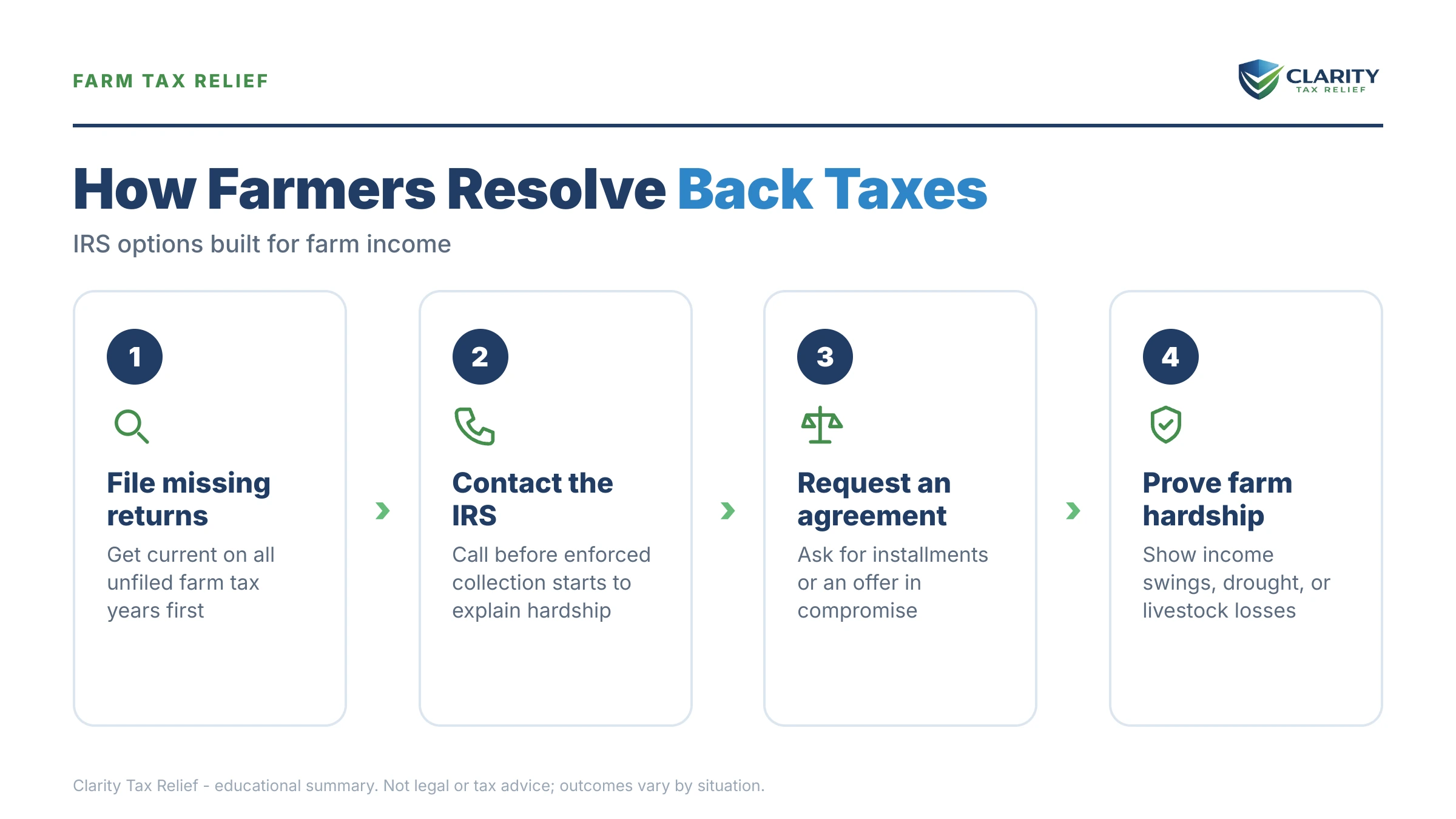
- Pull your IRS transcripts. Confirm every year with a balance, the exact amounts, and whether the IRS filed any substitute returns for years you skipped.
- File every missing Schedule F return. Replace inflated substitute returns with real returns showing your expenses — the balance you negotiate should be the correct one.
- Request penalty relief. Check the Form 2210-F waiver for estimated-tax penalties, first-time abatement for a clean prior three years, and reasonable cause for disaster or illness years.
- Match a resolution to your equity and cash flow. Choose a payment plan, partial-pay agreement, Currently Not Collectible status, or Offer in Compromise based on what your land, equipment, and income actually support.
- Protect the operation while you pay. Time direct-debit payments to marketing checks, and talk to your ag lender before a lien filing surprises them at renewal.
The farmer-only rules that can shrink the bill
Three provisions in the tax code exist specifically for farmers, and back-tax cases routinely miss all three.
The March 1 rule. If at least two-thirds of your gross income comes from farming, you're exempt from the four quarterly estimated-tax deadlines everyone else faces. You can either make a single estimated payment by January 15 or simply file and pay in full by March 1 (pushed to the next business day when it falls on a weekend). Commercial fishing crews get the same treatment — the parallel rules are covered in our guide to commercial fisherman tax debt.
The Form 2210-F waiver. When a farmer does get hit with an underpayment penalty, it's computed on Form 2210-F — and that form carries a waiver request for casualty, disaster, and other unusual circumstances. A drought year that wrecked your cash flow is exactly the fact pattern it was written for; the broader relief landscape is mapped in our estimated tax penalty waiver guide. To see what penalties and interest have added to your own balance so far, you can run rough numbers through our Penalty & Interest Calculator.
Schedule J income averaging. Farmers and fishermen can elect to spread a spike year of farm income back across the prior three years' lower brackets. A herd liquidation or recapture-heavy equipment year — the exact events that create farm tax debt — can often be re-taxed at dramatically lower effective rates, and the election can generally still be made on an amended return while the refund statute is open.
And if you have unfiled years, know what the IRS did in your absence: a Substitute for Return built from your gross 1099s and co-op statements, with zero expenses allowed — no seed, no fuel, no feed, no depreciation, no interest. Filing the real return replaces it, as explained in the IRS filed a substitute return for me. For a farmer, the corrected balance is frequently a fraction of the assessed one.
Farm payroll, entity debt, and the taxes that follow you personally
If you pay farm labor, a second and more dangerous debt may be running alongside your income tax. Agricultural employers file Form 943 annually, and the withheld income tax and FICA in those deposits is trust-fund money — if it goes unpaid, the IRS can assess the Trust Fund Recovery Penalty personally against whoever controlled the checkbook, and no entity structure blocks it. That dynamic works the same way it does for any labor-heavy operation; the mechanics and defenses are laid out in our guide to construction payroll tax debt.
Incorporated operations add one more layer: a farm corporation's 1120 balance is the entity's debt, but payroll trust-fund amounts still pierce through to you. If your operation runs through a corporation, see C corporation tax debt for how entity-level balances get resolved differently from personal ones.
State obligations ride along too. Depending on your state, unpaid state income tax, fuel-tax issues, or sales tax on farm-stand and direct-to-consumer sales are collected by an agency with its own timelines and its own lien powers — never assume IRS deadlines or thresholds apply to a state balance. Resolve them on parallel tracks, not one after the other.
Chapter 12: the bankruptcy chapter built for family farms
Congress built a bankruptcy chapter specifically for family farmers and fishermen with regular income, and it's worth knowing it exists before you assume the IRS options are the whole menu. Chapter 12 allows a repayment plan structured around seasonal cash flow — payments that flex with harvest — subject to debt limits, and gives certain tax claims from selling farm assets in the reorganization more favorable treatment than they'd get elsewhere. It is a serious, specialized step with real costs and consequences, and it should be weighed against a partial-pay agreement or offer with someone who has run both sets of numbers. For how the general bankruptcy chapters treat tax debt, start with Chapter 7 vs 13 tax debt.
When you can handle farmer back taxes yourself
Plenty of farm tax debt needs no professional at all. If you're filed up, the balance is under $25,000, and the amount is right, setting up a streamlined installment agreement online takes an evening. If you can clear the whole thing inside 180 days from a pending grain check, the short-term plan costs nothing to set up. And a first-time abatement request for one late year after a clean history is a phone call or letter you can make yourself.
Experienced help changes the outcome in a narrower set of situations: a levy already sent to your bank, elevator, or the USDA; multiple unfiled years sitting under inflated substitute returns; farm payroll debt with trust-fund exposure; a revenue officer assigned to the case; or OIC math complicated by land equity and seasonal income. In those cases, the order of operations — returns first, penalties second, resolution third — and the valuation arguments on farm assets genuinely move the final number.
If any of those describe your situation — especially a levy already in motion against a harvest check — a free review with an experienced tax professional at Clarity's consultation form or (888) 825-7779 will tell you in one call which path your equity and cash flow actually support.
Farm tax terms, decoded
- Schedule F — the form where farm profit or loss is reported on your 1040; its net profit is what self-employment tax is charged on.
- Self-employment (SE) tax — the 15.3% Social Security and Medicare tax on net farm profit, owed on top of income tax.
- Depreciation recapture — prior equipment write-offs "clawed back" as ordinary income when the equipment is sold or traded.
- Substitute for Return (SFR) — a return the IRS files for you using gross income only, with none of your farm expenses.
- Lien vs. levy — a lien is the IRS's legal claim against your land, crops, and equipment; a levy is the actual taking of money or property.
- FPLP — the Federal Payment Levy Program, which can continuously take up to 15% of covered federal payments, including farm-program payments.
- CSED — the collection statute expiration date: the IRS generally has 10 years from assessment to collect, though appeals, offers, and bankruptcy pause the clock.
Farmer back taxes: your questions answered
Can the IRS take my farmland for back taxes?
A federal tax lien can attach to your farmland automatically once a balance is assessed and unpaid, but actually seizing real estate is rare and heavily restricted — seizing a principal residence generally requires federal court approval. Seizure only happens after you ignore a final notice of intent to levy (LT11), which gives you 30 days and formal appeal rights. Engaging with a resolution option — even a payment plan — generally pauses IRS seizure while your request is pending and the agreement stays in good standing; if the request is rejected or the agreement defaults, enforcement can resume.
Can the IRS seize my tractor or farm equipment?
Yes — farm equipment, livestock, and stored grain are all levyable assets, and the tools-of-the-trade exemption in the tax code protects only a modest, inflation-adjusted amount that is far below what a working farm's iron is worth. In practice, the IRS gets little from equipment carrying dealer or bank loans, because lenders with earlier-filed liens get paid first. Equipment seizure is a last resort used against taxpayers who never respond, not against farmers actively working out a resolution.
Do farmers have to pay quarterly estimated taxes?
No — if at least two-thirds of your gross income comes from farming, you skip the four quarterly deadlines other self-employed people face. You can either make one estimated payment by January 15 or simply file your return and pay everything you owe by March 1. Miss both, and the underpayment penalty is calculated on Form 2210-F — which also carries a waiver request for casualty, disaster, or other unusual circumstances.
Can the IRS levy my USDA or FSA payments?
Yes. Federal farm-program payments can be reached through the Federal Payment Levy Program, which takes up to 15% of covered federal payments continuously until the debt is resolved or the levy is released. Unlike a bank levy, this one repeats with every payment cycle. Setting up an installment agreement or qualifying for hardship status is the standard way to stop it.
Will an IRS tax lien stop my farm operating loan?
It can seriously complicate it. A filed Notice of Federal Tax Lien attaches to crops, livestock, equipment, and land — the same collateral your ag lender relies on — and many lenders will pause or decline renewal once a lien appears in the county records. The IRS can agree to subordinate its lien (Form 14134) so a lender's interest comes first when doing so helps the IRS get paid, but that takes time. If your operating note renews soon, resolve or address the debt before the lien is filed.
Can I settle farmer back taxes with an Offer in Compromise?
Only if the math works — the IRS accepted roughly 1 in 5 offers in FY2024, and equity in land and equipment is what sinks most farm offers. The IRS calculates the most it could ever collect from your assets and future income; if your land equity alone exceeds the balance, an offer is a nonstarter. Farmers with heavily mortgaged assets, thin equity, and modest disposable income can be genuine candidates, and low-income certification (AGI at or below 250% of the poverty level) waives the $205 fee and required down payment.
What if the IRS filed a return for me without my Schedule F expenses?
That is a Substitute for Return, and it is almost always inflated for a farmer — the IRS uses the gross 1099 and co-op figures it received and allows none of your seed, fuel, feed, depreciation, or interest expenses. You can replace it by filing your own original return for that year, and the assessed balance is typically recalculated downward, sometimes dramatically. File the real return before negotiating any payment arrangement, because you want to negotiate on the correct number.
Does farm income averaging help with back taxes?
It can shrink the underlying tax itself. Schedule J lets farmers and fishermen spread a spike year of farm income across the prior three years' lower brackets, which is exactly the pattern behind many farm tax debts — a herd liquidation or bumper-crop year taxed all at once. The election can generally be made on an amended return while the refund statute is open, so a year you already filed without it may still be fixable.
Is there a bankruptcy chapter just for farmers?
Yes — Chapter 12 exists specifically for family farmers and fishermen with regular income, subject to debt limits. It allows a repayment plan built around seasonal farm cash flow, and in a Chapter 12 reorganization certain tax claims arising from selling farm assets can receive more favorable treatment than in other chapters. It is a specialized decision that should be weighed against IRS options like a partial-pay agreement or offer before filing.
Your next 24 hours
- Find your real number. Pull the most recent IRS notice for each year — the balance box on the newest one — or log into your IRS online account and total every year showing a balance due.
- Gather the farm's paper. Your last filed return, every IRS notice, your 1099s and co-op statements, and current payoff balances on equipment and land loans — equity is the number every option turns on.
- Get the free case review. Interest and penalties on farm tax debt compound monthly whether or not you act, so bring what you gathered to the 2-minute form at claritytaxrelief.com/#consult or call (888) 825-7779 — an experienced tax professional will map which resolution your equity and cash flow actually support.
For primary-source reading, the IRS's own farmer guidance lives in Publication 225, the Farmer's Tax Guide, and payment options are set out on the IRS payment plans page. If collection action is causing an economic hardship the normal channels won't address, the Taxpayer Advocate Service is an independent office within the IRS that can intervene.
This guide is general information, not tax or legal advice for your specific situation. Eligibility for IRS programs depends on individual facts and circumstances; no outcome is guaranteed.