
Industry Tax Debt Guides
Commercial Fisherman Tax Debt: Fixing Back Taxes on Crew Shares and Unfiled Seasons (2026)
The short answer: commercial fisherman tax debt almost always starts with crew-share income reported on Form 1099-MISC Box 5 — with zero withholding and 15.3% self-employment tax nobody set aside. The fix: file every missing Schedule C season with real fishing deductions, then resolve the balance through a payment plan, hardship status, or an Offer in Compromise.
The settlement checks cleared, the seasons blurred together, and now three years of settlement sheets sit in a drawer next to unopened IRS envelopes. You weren't hiding anything — you were paid by the share, no one withheld a dime, and no one on the boat ever mentioned quarterly estimates. That gap is fixable, and the order you fix it in decides what you end up paying.
Everything the IRS knows about your income comes from one line on one form: Box 5, "fishing boat proceeds," on Form 1099-MISC — the form boat operators file for every share-paid crew member. The image below shows exactly what that form looks like and where to look for the number the IRS already has for each of your unfiled seasons.
⏱ Your real clock: there's no letter-printed deadline until the notices start, but two clocks are already running. Penalties and interest accrue every month on each unfiled season — the failure-to-file penalty alone builds at 5% per month up to 25%. And any refund or credit from a season expires 3 years after that return's original due date, so the oldest year dies first.
Why commercial fisherman tax debt builds so fast
Crew members on boats that normally carry fewer than 10 crew and pay by a share of the catch are self-employed under federal law — not employees. That single rule explains most fisherman back taxes: no employer withholding ever happens on a crew share, so every dollar of income tax and every dollar of 15.3% self-employment tax lands on you at filing time.
The boat operator reports your share to the IRS on Form 1099-MISC, Box 5. You're expected to file Schedule C (income and expenses), Schedule SE (self-employment tax), and — because fishing income is seasonal and lumpy — either quarterly estimates or the fishermen's special January/March payment rules covered below.
Three things then stack the debt higher than an ordinary 1099 worker's. First, Box 5 is your share of proceeds, which can run larger than what actually hit your bank after gear, food, and trip costs came out of the lay. Second, big-catch years spike you into higher brackets unless you elect income averaging. Third, seasons where you didn't file at all convert a manageable bill into a penalty-loaded one — the failure-to-file penalty runs at 5% per month, ten times the 0.5% failure-to-pay rate. If you're staring at three missing seasons, our guide to haven't filed in 3 years covers the general path; this page covers the fishing-specific version.
Say you owe $92,700 across three unfiled seasons: the math
A hypothetical deckhand with three unfiled seasons can turn about $68,000 of actual tax into a $92,700 IRS balance through penalties and interest alone. Here's how that stack builds — all numbers illustrative:
- Tax on three seasons: say your Box 5 crew shares netted $58,000, $61,000, and $67,000 after expenses. Between income tax and self-employment tax, that's roughly $68,400 across the three years (about $22,800 per season).
- Failure-to-file penalty: 5% per month, capped at 25% of the unpaid tax. All three years are past the cap: roughly +$17,100.
- Failure-to-pay penalty and interest: 0.5% per month (it keeps running even after the filing penalty caps) plus compounding interest at the federal rate: roughly +$7,200 and growing.
- Total: about $92,700 — more than a third above the tax you actually owed.
Two thresholds make that number worse than it looks. It's over $50,000, so the simple online 72-month payment plan is off the table without either paying it down or submitting financials. And it's over the $66,000 seriously-delinquent threshold for 2026, which means the IRS can certify the debt to the State Department and block your passport — a direct problem for crew flying to Dutch Harbor through Canada or working foreign ports. See passport revoked for tax debt for how certification and reversal work. You can estimate your own penalty stack with our IRS penalty and interest calculator.
If a hypothetical 72-month agreement were available on the full balance, it would run about $92,700 ÷ 72 ≈ $1,288 per month, with interest still accruing on the shrinking balance. Filing accurate returns first often shrinks the starting number — which is the entire point of the next two sections.
What happens if you keep ignoring it
The IRS runs a fully automated sequence for non-filers, and its worst move is filing your return for you with zero fishing deductions. That's called a Substitute for Return (SFR): the IRS taxes your gross Box 5 proceeds — no fuel, no gear, no boat share, no expenses at all — and then bills you for the inflated result. Our guide to the IRS filing a substitute return for you covers the mechanics; the sequence below shows where it sits.
- File-demand phase — letters asking for the missing returns. No balance exists yet; this is the cheapest moment you will ever have.
- SFR phase — the IRS builds a return from Box 5 gross proceeds and proposes tax with no deductions.
- Billing phase — the inflated balance is assessed and the standard collection notices begin.
- Enforcement phase — state-refund seizure, federal tax lien against your boat, gear, and permits, then bank and wage levies.
| Notice | What it means | Your window |
|---|---|---|
| CP59 | First "we have no return on file" letter for an unfiled season | No printed deadline — file now, before a balance exists |
| CP516 / CP518 | Escalating demands to file; CP518 is the final request | Weeks apart, typically; still pre-assessment |
| CP2566 / CP3219N | The SFR proposal — tax computed on gross proceeds, no expenses | 90 days to petition Tax Court on a CP3219N |
| CP14 | First bill on the assessed balance | About 21 days before reminders start |
| CP501 / CP503 / CP504 | Reminders, then intent to levy — CP504 lets the IRS take your state refund | Sequence continues automatically if unanswered |
| LT11 / Letter 1058 | Final notice of intent to levy bank accounts and pay | 30 days to request a CDP hearing (Form 12153) |
Don't count on IRS staffing cuts to save you. The workforce shrank roughly 27% in 2025, so reaching a human is harder than ever — but SFRs, liens, and levies are generated by automated systems that never went anywhere.
Behind on fishing seasons and the letters are stacking up?
Get your unfiled seasons and IRS transcripts reviewed free before a substitute return locks in tax on your gross proceeds. We'll map exactly what you'd owe with real deductions — no pressure, no obligation.
Fisherman back taxes at $92,700: your resolution options
Every IRS resolution program is open to fishermen, but a crew share's volatility changes which one fits. The step-by-step mechanics of each program live in our guide to how to settle tax debt yourself — here's how they line up against a $92,700-level fishing debt:
| Option | Eligibility | Cost & terms | Fit at $92,700 |
|---|---|---|---|
| Short-term plan | Can pay in full within 180 days | $0 setup; interest and penalties continue | Only if a big season payout is coming |
| Streamlined installment agreement | Balance ≤ $50,000 (assessed) | Up to 72 months, online setup | Not at $92,700 — unless you pay the balance below $50k first |
| Installment agreement over $50k | Form 433-F financial disclosure | Payment set by income vs. allowable expenses | The most common landing spot — see IRS payment plan over $50,000 |
| Partial-pay agreement | Financials show you can't full-pay before the 10-year collection statute ends | Pays less than the full debt over the remaining statute; reviewed periodically | Strong fit for aging crew with declining seasons |
| Currently Not Collectible | Paying anything creates hardship under IRS expense standards | $0/month; debt remains, lien likely, interest accrues | Fits injury years and closed fisheries — see Currently Not Collectible status |
| Offer in Compromise | Assets + future income genuinely can't cover the debt | $205 fee; 20% down on lump-sum offers (both waived with low-income certification) | Realistic for low-equity crew; hard for owners with boat/permit equity |
| Penalty abatement | Clean 3 prior years (FTA) or reasonable cause | Free to request | Do this first — it shrinks the number every other option works from |
On the offer route, the IRS accepted roughly 1 in 5 offers in FY2024 — it's real, but it's math, not mercy. The IRS totals your equity (vessel, permits, quota shares, gear, truck) plus what it projects it can take from future income; if that covers the debt, the offer is rejected. How that calculation runs is covered in how an offer in compromise actually works — note the volatile-income wrinkle: the IRS tends to average your income, so applying right after a record season inflates the number against you, while applying after a lean one or a fishery closure works in your favor.
On penalties: first-time penalty abatement requires a clean prior three years, so with three seasons unfiled only your earliest year can qualify — but at 25% failure-to-file on ~$22,800 of tax, that one year is worth up to roughly $5,700. Starting summer 2026, the new Automatic Exemption from Penalty (AEP) begins replacing FTA with automatic relief that requires no request, so don't assume a written FTA letter is the only path.
The tax rules built for fishermen (that shrink the bill before you negotiate)
Congress wrote several rules specifically for commercial fishing income, and none of them appear on an IRS substitute return. Filing your own accurate returns — even three years late — is how you claim them, and it's usually the single biggest reduction available:
| Rule | What it does | Where to claim it |
|---|---|---|
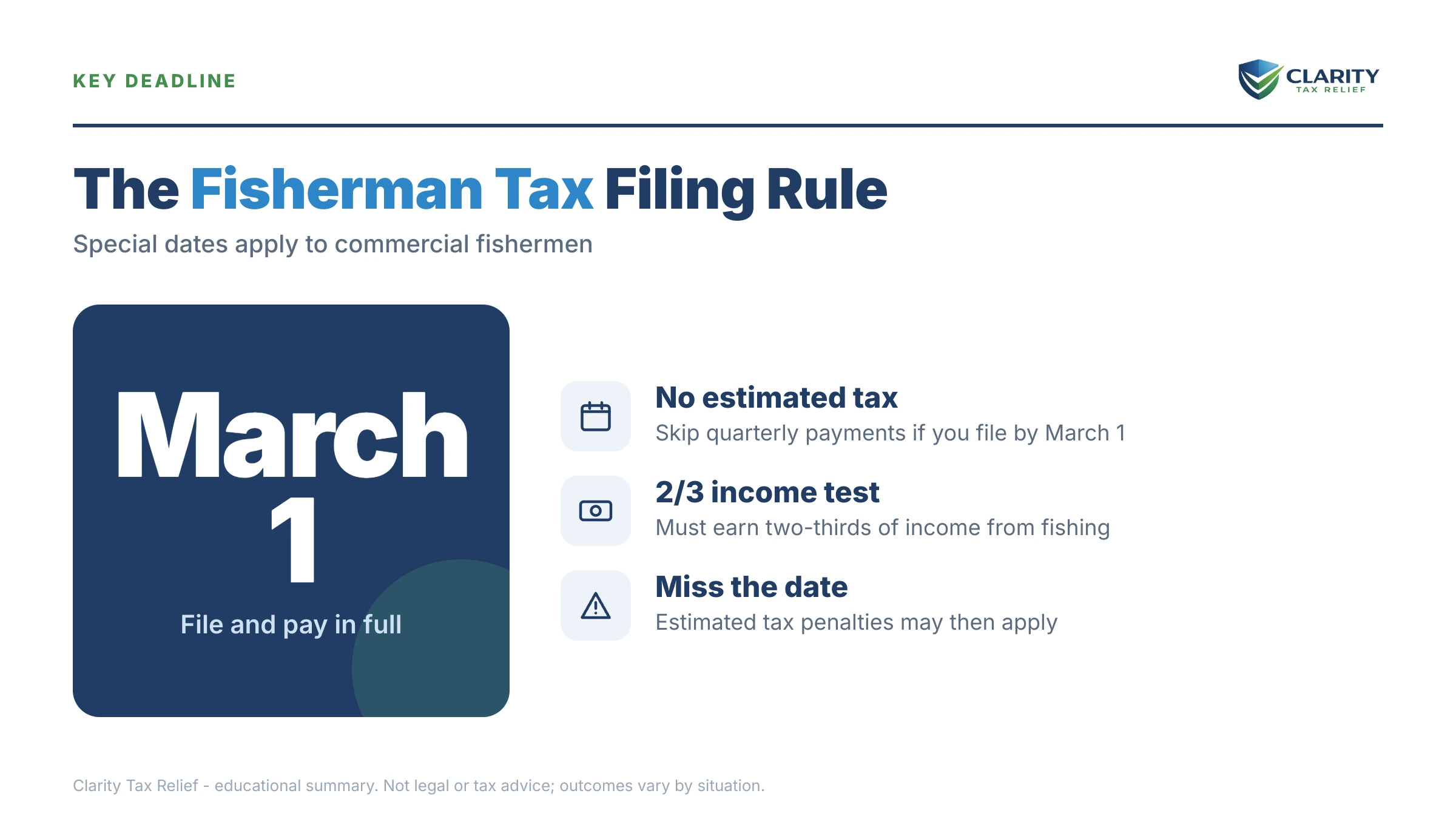
| Fishermen's estimated-tax exception | If two-thirds of gross income is from fishing: make one estimate by January 15, or skip estimates entirely by filing and paying in full by March 1 | Form 2210-F |
| Income averaging | Spreads elected fishing income across the three prior years' brackets — cuts tax in big-catch years | Schedule J |
| Fuel excise credit | May credit back federal excise tax on fuel used in a boat engaged in commercial fishing | Form 4136 |
| Crew-share reporting | Boats normally under 10 crew paying by share = self-employed crew; operator reports each share | Form 1099-MISC, Box 5 |
| Capital Construction Fund | Defers tax on income deposited under a NOAA agreement toward buying or rebuilding a vessel; non-qualified withdrawals trigger recapture | NOAA CCF agreement + your return |
The estimated-tax exception matters twice. Backward: if the IRS assessed underpayment penalties on a season where two-thirds of your income was fishing, Form 2210-F may knock them out. Forward: the March 1 file-and-pay rule is how you keep the current season from rebuilding the debt while you resolve the old one — most crew never learn it exists.
Boat owners, married crew, and other situations that change the answer
You run the boat, not just crew it. The under-10-crew, share-paid rule is what keeps your deckhands off payroll. Pay anyone a fixed cash wage instead of a share, or normally carry 10 or more crew, and those workers can be employees — meaning quarterly Form 941 filings, deposits, and personal exposure through the trust fund recovery penalty if withholding wasn't paid over. That's a different, harsher category of debt; start with 941 back taxes and the 941 vs 940 back taxes breakdown. And if the vessel sits inside an LLC, know what the entity does and doesn't shield: LLC back taxes personal liability.
You're married. A spouse's W-2 withholding on a joint return can absorb part of a season's tax — but joint filing also makes the whole balance both of yours. If your spouse has clean finances and real assets, run the married-filing-separately math for the unfiled years before signing joint returns.
The Box 5 number looks wrong. Operators sometimes report a gross share before trip expenses that came out of your lay. Compare each transcript figure to your settlement sheets; if the 1099 overstates your share, you report the correct amount and document the difference — don't just pay tax on the operator's number.
State taxes. Alaska and Washington have no personal income tax, so many Bering Sea and Puget Sound crews face only the IRS. Fish out of Massachusetts, Maine, Oregon, or Louisiana and the state wants its own returns on its own timelines — state rules differ from everything on this page, so check directly with your state revenue agency before assuming any IRS figure carries over.
When you can handle this yourself
Plenty of fishing tax problems don't need professional help. If you have one unfiled season, your settlement sheets, and a balance you could clear within 180 days, file the return and set up a short-term plan online — done. Same if you're current on filing and just owe under $50,000: the streamlined online agreement takes minutes and needs no financial disclosure. The IRS payment plans page is the direct route, and IRS.gov/payments handles one-time payments. If money is tight, the Taxpayer Advocate Service and Low Income Taxpayer Clinics offer free help.
Experienced help changes the outcome in specific situations: multiple unfiled seasons with an SFR already proposed or assessed (the reconstruction and reversal sequence determines the final number), balances over $50,000 where Form 433-F financials decide your payment, passport certification at the $66,000 line, boat-owner cases with 941 exposure, and any Offer in Compromise involving vessel or permit equity — where a valuation mistake alone can sink the offer. Reconstructing years of expenses with missing records is also where filing back taxes with no records gets technical fast.
If your situation looks more like the second list than the first — three seasons, five figures of penalties, and an SFR clock running — a free case review of your transcripts and settlement sheets will tell you what the balance should actually be before another month of interest posts.
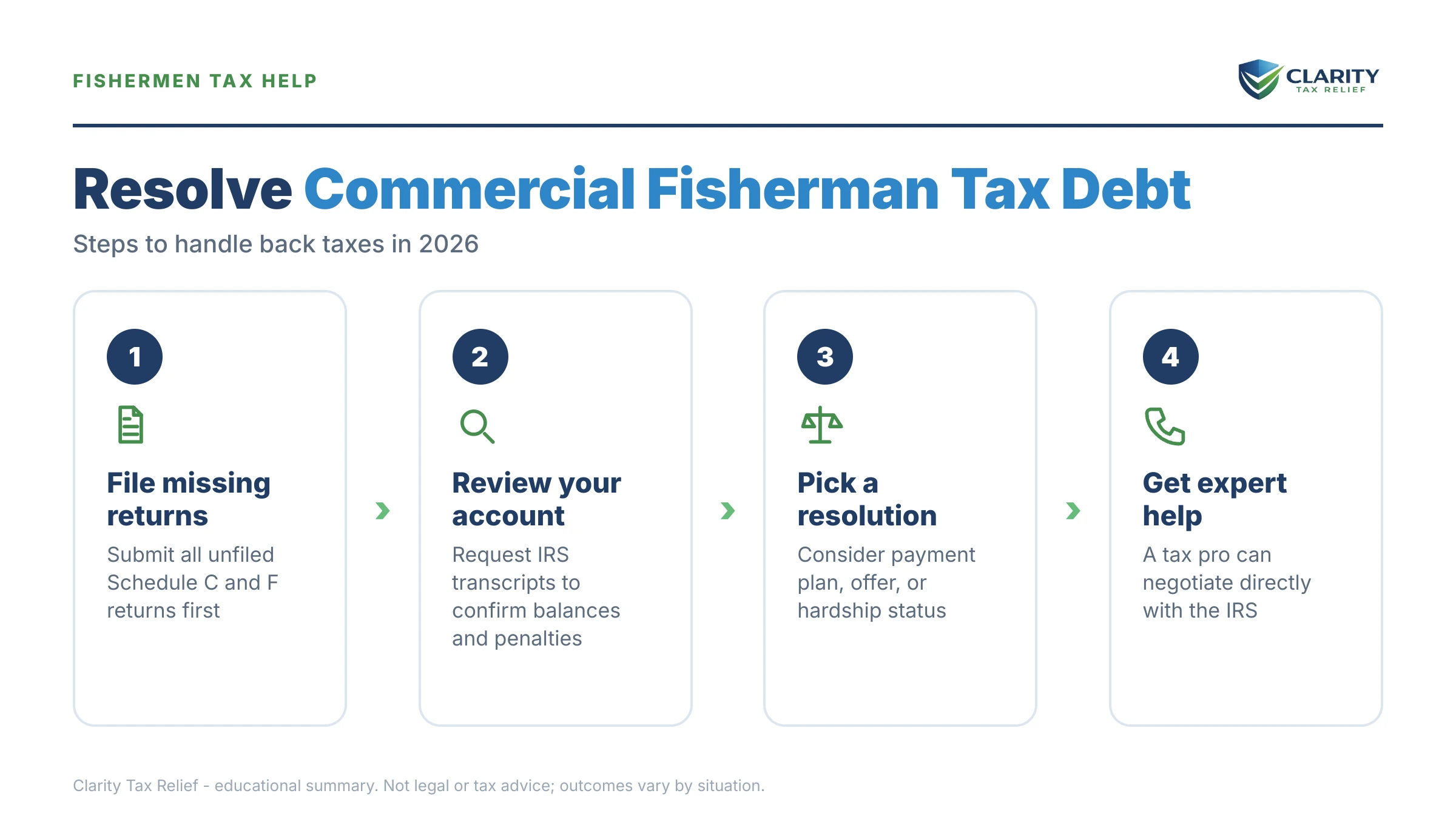
How to respond to commercial fisherman tax debt, step by step
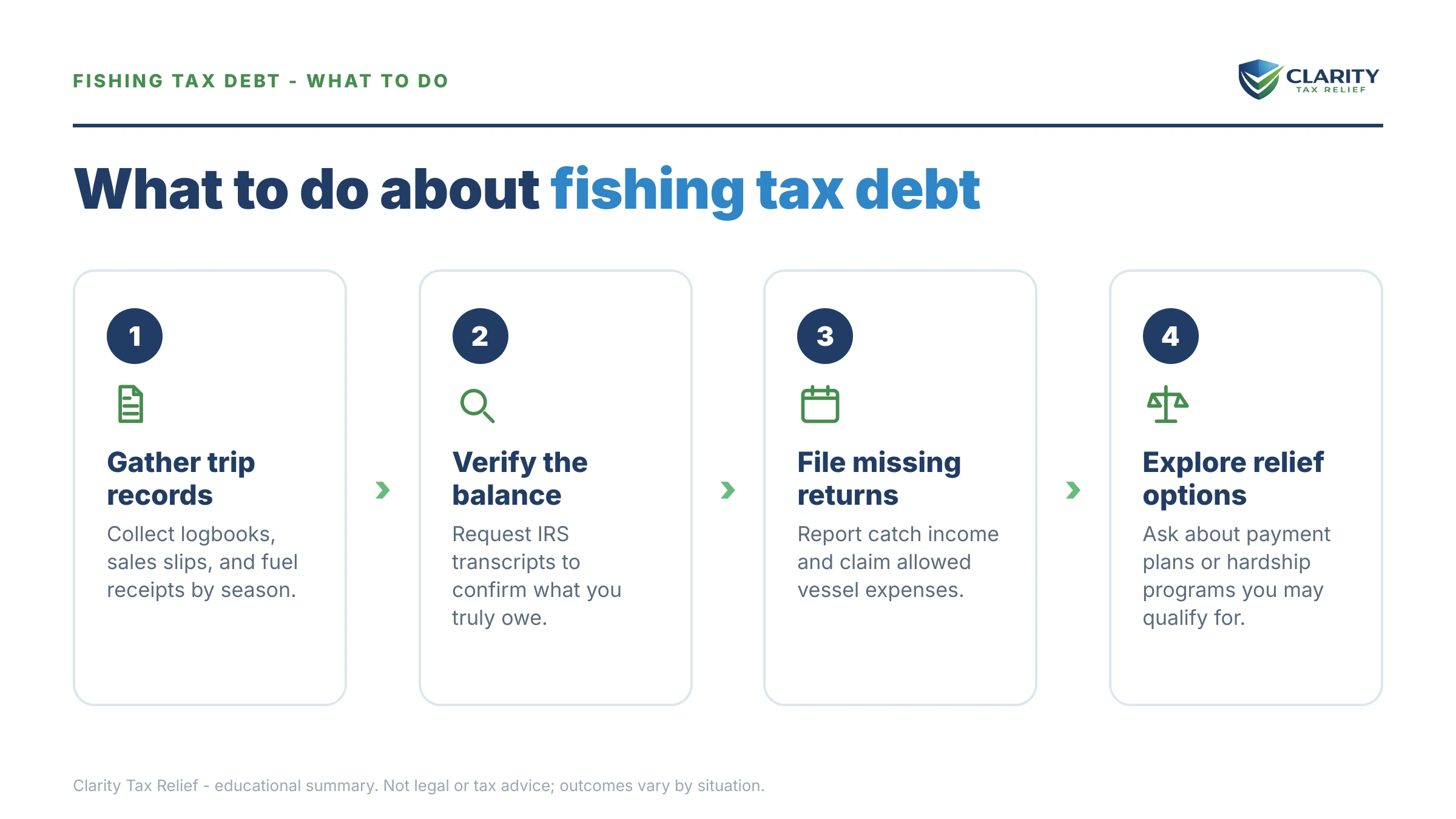
- Pull your wage and income transcripts. Get transcripts for every unfiled season from your IRS online account; they show each 1099-MISC Box 5 figure the IRS already has.
- Reconstruct your fishing expenses. Rebuild fuel, gear, bait, food, licensing, and boat-share costs from bank records, marine-supply accounts, and settlement sheets.
- File every missing Schedule C return. File accurate originals — with deductions, Schedule SE, and Schedule J income averaging where it helps — to replace or prevent any substitute return.
- Request penalty relief. Ask for first-time abatement on the earliest qualifying year and reasonable-cause relief where a wreck, injury, or disaster explains the gap.
- Set up the resolution that fits the balance. At a $92,700-level debt, that means a Form 433-F installment agreement, hardship status, or an Offer in Compromise if the math supports one.
- Fix the current season. Use the January 15 single-payment option or the March 1 file-and-pay rule so next year doesn't rebuild the debt.
Step one matters most: how to order and read those records is covered in our wage and income transcripts walkthrough — it's the difference between guessing at your Box 5 numbers and knowing them.
Terms on your notices and settlement sheets, decoded
- Crew share (the lay): your contracted percentage of the catch or its proceeds — the pay structure that makes you self-employed rather than an employee.
- 1099-MISC Box 5: "fishing boat proceeds" — the crew-share amount the boat operator reports to the IRS under your Social Security number.
- Substitute for Return (SFR): a return the IRS files for you using gross reported income and no deductions — almost always the worst version of your tax year.
- Self-employment tax: the 15.3% Social Security and Medicare tax on net crew-share earnings, owed on top of income tax via Schedule SE.
- CSED: the collection statute expiration date — the IRS generally has 10 years from assessment to collect, though offers, appeals, and bankruptcy pause the clock.
- Lien vs. levy: a lien is a legal claim attaching to your boat, permits, and property; a levy is the actual taking — a bank account swept or a paycheck garnished.
Commercial fishing tax debt questions, answered
Do deckhands pay self-employment tax on crew shares?
Yes. If the boat normally carries fewer than 10 crew and you're paid a share of the catch or its proceeds, federal law treats you as self-employed — so you owe 15.3% self-employment tax on net earnings on top of income tax. Nothing is withheld from your settlement, which is why the April bill blindsides so many crew members.
What is the March 1 rule for fishermen?
If at least two-thirds of your gross income comes from fishing, you can skip all four quarterly estimated payments by filing your return and paying the full balance by March 1. Alternatively, make one estimated payment by January 15 and file by the April deadline. Form 2210-F is how you claim the exception if the IRS charges an underpayment penalty anyway.
How many years of unfiled fishing returns do I need to file?
The IRS's general enforcement policy is six years of returns to get back into compliance, so three unfiled seasons is fully fixable. File all of them — refunds and credits from a year expire three years after that return's original due date, so the oldest year is the most urgent if withholding or credits are on the table.
Can the IRS take my boat or fishing permit?
It can, but it's a last resort. A federal tax lien attaches automatically to everything you own — vessel, permits, and quota shares included — once a balance is assessed and unpaid. Actual seizure of a working boat is rare because the IRS prefers levies on bank accounts and receivables, but permit and vessel equity does count against you in Offer in Compromise math.
Will the IRS take my passport over fishing tax debt?
It can certify your debt to the State Department once it's 'seriously delinquent' — $66,000 or more in 2026, including penalties and interest. The State Department can then deny renewal or revoke the passport. For crew who work foreign ports or fly to Alaska seasons through Canada, getting under the threshold or into a payment agreement removes the certification.
What if I lost my settlement sheets and records?
You can still file. Your IRS wage and income transcript shows every 1099-MISC the fleet filed under your Social Security number, and bank deposits, fuel receipts, and marine-supply statements can reconstruct expenses. A reasonable, documented reconstruction is accepted practice — far better than letting the IRS assess tax on gross proceeds with no deductions at all.
What happens if my captain never sent me a 1099?
You still owe tax on the income — the filing requirement is yours regardless of the paperwork. Check your wage and income transcript: if the boat owner filed the form with the IRS but never mailed your copy, the IRS already has the number. If nothing was filed, use your settlement sheets or deposits to report accurately; unreported crew shares surface in audits of the boat's books.
Can fishermen use income averaging to lower back taxes?
Schedule J lets you elect to spread your fishing income over the three prior years' tax brackets, which can meaningfully cut the bill in a big-catch year. It's claimed on the return itself, so it's available when you file late originals for your missing seasons — one more reason filing real returns beats accepting an IRS substitute return.
Does an Offer in Compromise work if I own a boat?
It can, but the IRS counts your equity in the vessel, permits, and gear toward what it believes it can collect. If that equity plus your future income covers the debt, the offer gets rejected — roughly 1 in 5 offers were accepted in FY2024. Crews with little equity and volatile income are often better candidates than owner-operators with a paid-off boat.
Your next 24 hours
- Find your Box 5 numbers. Dig out any 1099-MISC forms or settlement sheets you still have, and note which seasons are missing entirely.
- Gather your reconstruction sources. Bank statements, fuel and marine-supply receipts, license and permit fees, and your last filed return — everything needed to rebuild each season's expenses.
- Get the free case review. Use the 2-minute form or call (888) 825-7779 — every month those three unfiled seasons sit, interest and the 0.5% monthly late-payment penalty keep compounding on all of them, and the substitute-return machinery keeps moving.
This guide is general information, not tax or legal advice for your specific situation. Eligibility for IRS programs depends on individual facts and circumstances; no outcome is guaranteed.