
IRS Notices
IRS CP180 Notice: The Missing Form or Schedule, and What to Send (2026)
The short answer: a CP180 notice means the IRS received your business tax return but can't finish processing it because a required form or schedule is missing. The notice — addressed to the business's Employer Identification Number (EIN) — names the exact form. Send that completed form to the address on the notice by the printed response date — or the IRS may recalculate the tax without it.
You filed months ago and assumed that tax year was closed. Now the IRS says a whole form never arrived with your return — and until it does, nothing moves: not your refund, not your account, not the finality you thought you had. The good news is that a CP180 is usually fixed with one document and one envelope, and this page shows you exactly how to get it right the first time.
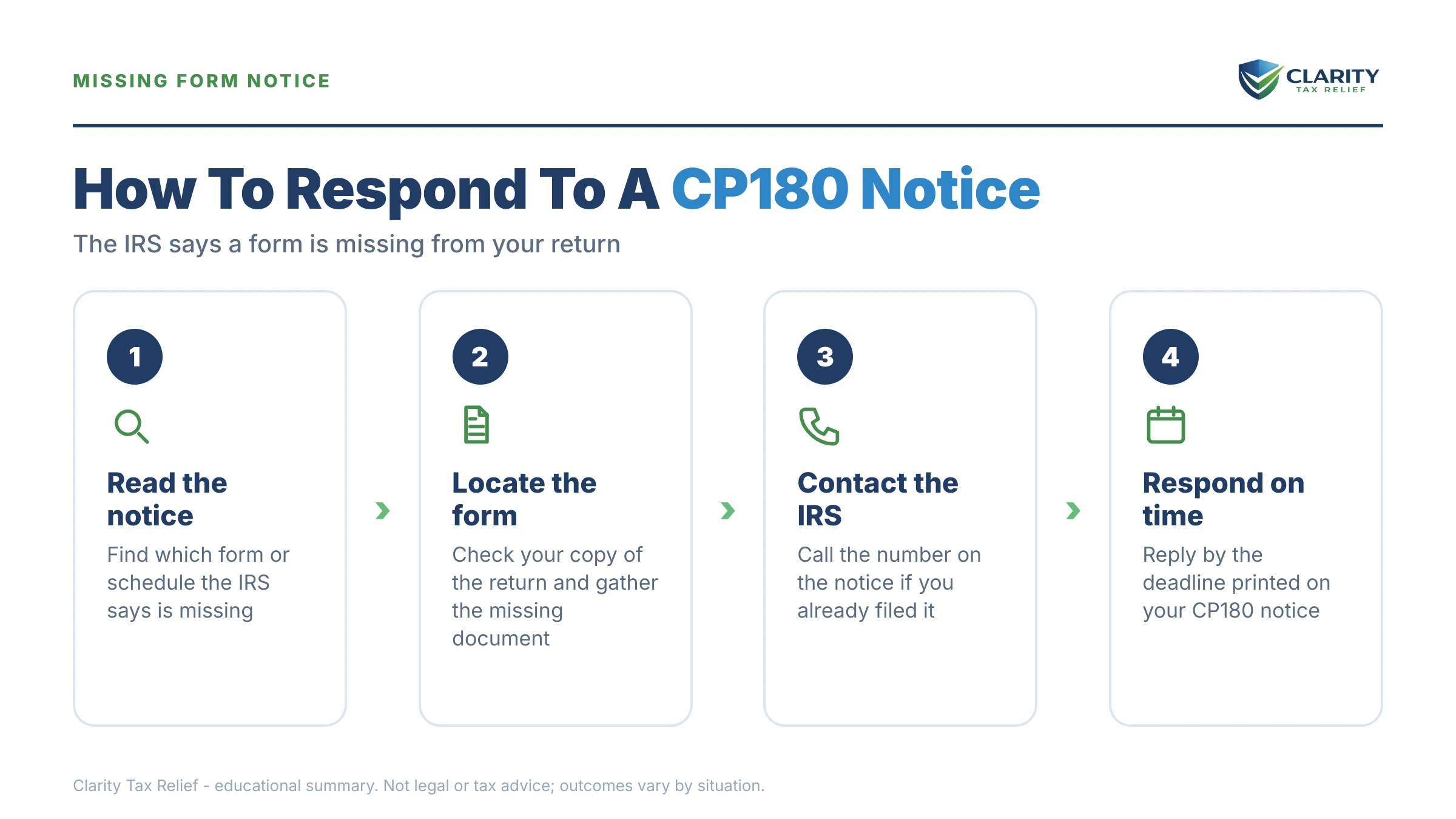
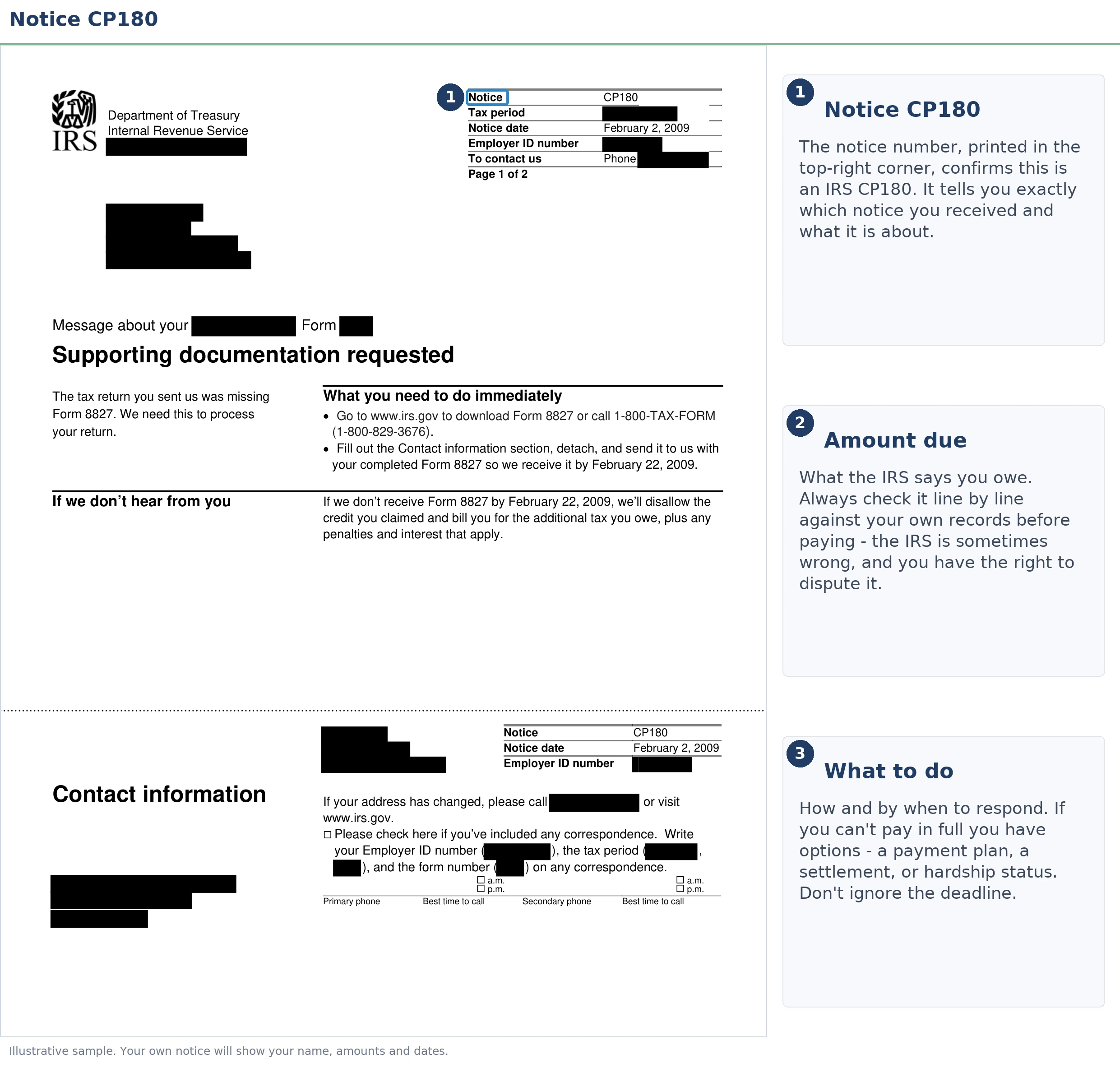
Unlike most IRS mail, a CP180 doesn't demand money and doesn't accuse you of anything — it asks for paperwork. The image below shows what a CP180 looks like and where on the page the IRS names the exact form it's waiting for.
⏱ Your deadline: the response date printed on your CP180 — the IRS sets it notice by notice, so the date on your copy controls. Miss it and the IRS may process your return without the missing form, removing the deduction or credit that form supported and assessing the difference, with interest running from your return's original due date.
Why you got a CP180 or CP181 from the IRS
The IRS sends a CP180 (or its twin, the CP181) when a business return — typically an 1120- or 941-series filing — claims something a specific form is required to support, and that form isn't in the file. These are business-account notices, addressed to the business's Employer Identification Number (EIN) rather than a Social Security number. Something on the return you submitted — a deduction, a credit, a tax calculation — points to an attachment the IRS never received.
How does a form go missing when you know you prepared it? The common causes are mundane: an e-file transmission that dropped an attachment, tax software that generated the form but never included it in the filing, a preparer who overlooked it, or a paper return whose pages separated in the mailroom. It happens to careful filers, which is why the IRS built a notice for it rather than jumping straight to an adjustment. (For the bigger picture of how IRS letters work in general, see why did I get a letter from the IRS — this page stays focused on the CP180.)
The notice names the exact form or schedule the IRS needs in the body of the letter, along with the tax year and the address or fax number for your response. That's what separates a CP180 from its cousins: a Letter 12C asks for missing information on an individual return — if you left a schedule off a personal Form 1040, that's usually the notice you'll receive, not a CP180 — and a CP05A notice asks for proof of income or withholding during a refund review. A CP180 wants one thing — a complete copy of a specific form.
Here are the forms and schedules that most often trigger one:
| Missing form | What it supports | What the IRS may do without it |
|---|---|---|
| Form 8827 | Credit for prior year minimum tax — corporations | Remove the credit, raising the corporation's tax |
| Form 3800 | General business credit | Remove the credit dollar for dollar |
| Form 4562 | Depreciation and Section 179 expensing on a business return | Disallow the deduction, raising taxable income |
| Schedule B (Form 941) | Semiweekly depositor tax liability detail | Hold processing until the deposit figures reconcile |
If the business is a partnership or S corporation, note that the problem doesn't stay contained at the entity level — a form missing from the entity's return can hold up or change items that flow through to the owners' personal returns for that year until it's resolved.
What happens if you ignore a CP180 notice
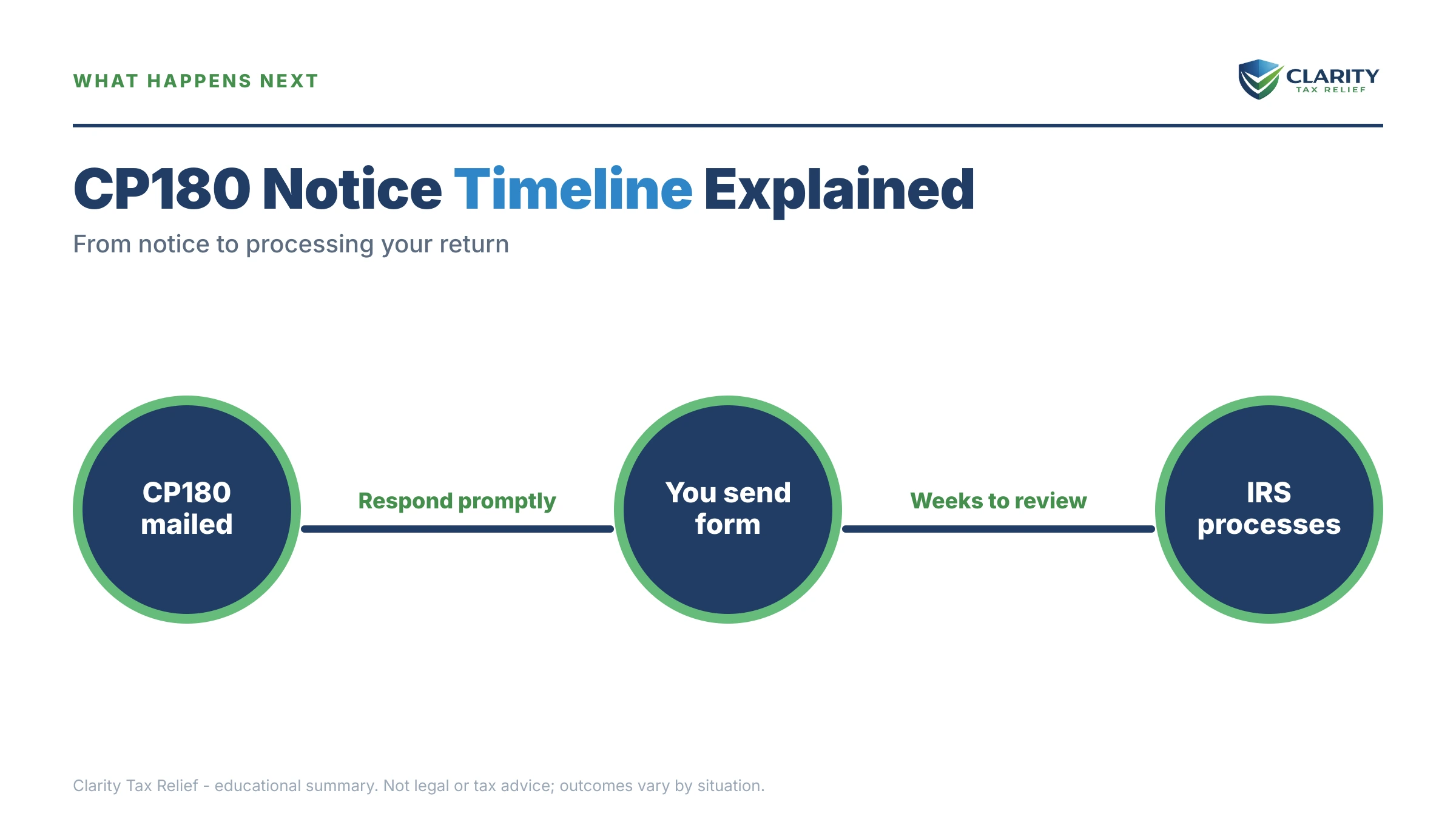
If you never answer a CP180 notice, the IRS can process your return without the missing form and assess the extra tax that results. The system doesn't wait forever, and it doesn't need a human to escalate — the sequence below runs automatically:
- CP180 open — your return sits in processing limbo. Any refund is held. No new tax has been assessed yet, but the response date is running.
- Response date passes — the IRS may process the return without the missing form, reducing or removing whatever that form supported.
- Adjustment notice arrives — a math-error notice like a CP11 notice or an adjustment notice like a CP22A notice tells you the return was changed and a balance is due. For some items, the IRS instead issues a CP3219A Notice of Deficiency, which starts a 90-day clock to petition Tax Court.
- The bill — a CP14 notice demands payment of the new balance, typically with about 21 days before reminders begin (10 business days if the balance is $100,000 or more).
- Collection notices — CP501, CP503, then CP504 (intent to levy your state refund) follow if the bill goes unpaid, with the balance growing monthly.
- Final notice — an LT11 notice or Letter 1058 opens a 30-day window to request a Collection Due Process hearing before wages and bank accounts are exposed.
The detail that surprises people most: once the IRS assesses the adjusted tax, interest runs from your return's original due date — not from the notice date. A CP180 ignored in July can produce a bill in the fall that already carries months of interest.
| Stage | What the IRS does | What it means for you |
|---|---|---|
| CP180 issued | Holds the return in processing | Refund (if any) held; no added tax yet; response date running |
| Response date passes | Processes the return without the missing form | The deduction or credit the form supported may be reduced or removed |
| Adjustment notice | Assesses the recalculated tax | Interest runs from the return's original due date |
| CP14 | Bills the new balance | Typically about 21 days to pay before reminders start (10 business days if the balance is $100,000 or more) |
| CP501 → CP503 → CP504 | Reminder sequence, then intent to levy your state refund | Balance grows monthly; a federal tax lien becomes possible |
| LT11 / Letter 1058 | Final notice of intent to levy | 30 days to request a Collection Due Process hearing (Form 12153) |
In 2026, IRS staffing is down sharply — but this sequence is automated, and the automation didn't get laid off. Reaching a human to unwind an adjustment later is far harder than mailing one form now.
Holding a CP180 with a form you're not sure how to build?
Send us a photo of your CP180 before the response date printed on it passes. An experienced tax professional will identify exactly what the IRS needs, help you assemble it from the records you have, and get it filed right — free, confidential, no pressure.
Your options when a CP180 arrives
Every CP180 resolves down one of four paths: send the form, resend it with proof, reconstruct it, or respond to the adjustment that follows. Which path you're on depends on where the missing form actually is.
- You have the form (or can prepare it): complete it using the same figures you filed, attach a copy of the notice, and send it to the address on the notice. This is the outcome the IRS wants, and it ends the matter — the return processes as filed.
- You already attached it: transmission dropouts and detached pages happen. Send another complete copy anyway, with a short cover note, and keep proof of mailing. Proving you sent it once doesn't process the return — the form in the file does.
- You can't complete it because records are missing: reconstruct before the date. Purchase invoices, loan papers, and bank statements rebuild a depreciation form; prior-year returns and carryforward schedules rebuild credit detail. If you can't finish in time, call the number printed on the notice and ask what your options are.
- The IRS already adjusted your return: you're past the CP180 itself. Read the adjustment notice carefully — if you disagree, respond by its date with the completed form and an explanation (a math-error change like a CP12 notice or CP11 can be reversed if you respond within its window). If you agree but can't pay, you can set up an IRS payment plan online before the collection sequence gains speed.
Each stage on this path comes with a date, and each date protects a specific right. Meeting the CP180's printed date preserves the best right of all: having your return processed exactly as you filed it.
| Deadline | Where it comes from | The right you keep by meeting it |
|---|---|---|
| Response date on the CP180 | Printed on your notice | Having your return processed exactly as you filed it |
| Dispute window on an adjustment notice | Printed on the CP11 / CP12 / CP22A that follows | Reversal of the change without a formal appeal |
| 90 days on a CP3219A (if issued) | Set by statute | Petitioning Tax Court before you pay anything |
| 30 days on an LT11 / Letter 1058 | Set by statute | A Collection Due Process hearing (Form 12153) heard before levy action proceeds |
What ignoring a CP180 can cost: a $54,600 worked example
Say your corporation's Form 1120 claims $54,600 in general business credits — but the Form 3800 supporting the credit dropped out of the e-file, and a CP180 arrives at the business's EIN naming it.
If you mail the completed Form 3800 by the response date, nothing changes: the return processes as filed, at the cost of a stamp. If you don't, and the IRS disallows the credit, the recalculation is stark:
- The credit disappears dollar for dollar: $54,600 of disallowed credit means $54,600 in additional tax — a credit reduces tax directly, so there's no bracket math to soften the blow.
- Then the meter starts: the 0.5%-per-month failure-to-pay penalty and daily-compounding interest begin once the balance is assessed and unpaid — with interest running from the return's original due date.
The figures are simplified — credit ordering rules and carryback or carryforward options shift the exact numbers — but the shape holds: one missing form can turn into a five-figure bill that a single envelope would have prevented. If an adjustment has already landed on you, you can estimate what penalties and interest would add to it with our Penalty & Interest Calculator.
How to respond to a CP180, step by step
Responding to a CP180 takes one completed form, one copy of the notice, and one envelope to the right address.
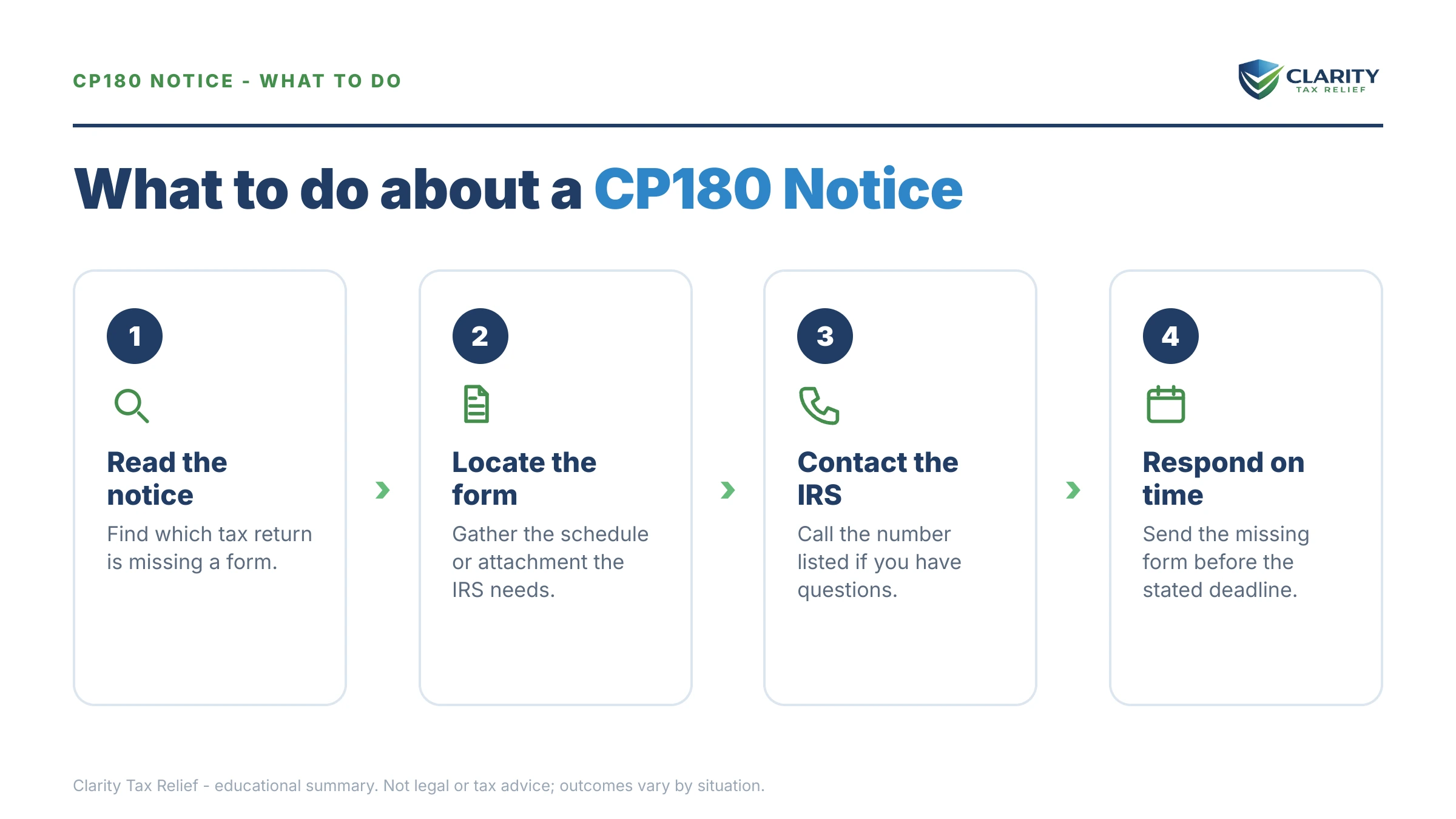
- Find the named form and the response date. The CP180 identifies the exact missing form or schedule in the body of the notice and prints your response date near the top. Those two items drive everything else you do.
- Complete the missing form using your original return's numbers. Pull your filed return (or your preparer's copy) and prepare the form so it supports the figures you already reported. Don't change other entries — this is not an amendment.
- Mail the form with a copy of the CP180 to the address on the notice. Use the exact address (or fax number, if one is printed) on your notice, include a copy of the notice so your response routes to your file, and keep proof of mailing.
- Watch your IRS online account and your mail for confirmation. Once the form posts, the return finishes processing as filed and any held refund can release. If a follow-up notice arrives instead, read it against your records before assuming it's a mistake.
- Respond fast to any adjustment or bill that follows. If the IRS processed the return without your form, dispute the change by the date on that notice — or arrange payment before the collection sequence starts.
When you can handle a CP180 yourself — and when to get help
Most people can resolve a CP180 without professional help — it's one of the few IRS notices where DIY is usually the right call. If your tax software generated the form and simply failed to transmit it, printing it and mailing it with a copy of the notice is the whole job. Same if your preparer has the form on file: ask them to send it.
Experienced help changes the outcome in a narrower set of situations:
- The form was never prepared and the records behind it are thin — reconstructing depreciation schedules, basis, or credit carryforwards badly can trade a processing hold for an audit-grade problem.
- The IRS already adjusted the return and the new balance is large. Reversing an assessment is a different, slower process than answering the original notice, and the dispute windows are unforgiving.
- Credit forms are in play — a disallowed Form 3800 or Form 8827 credit disappears dollar for dollar, and pass-through entities push the damage onto the owners' personal returns.
- More than one year is involved — a form missing from one year (like depreciation) often means the same form is wrong or missing in adjacent years, and the fix should be sequenced, not piecemeal.
If a held refund is causing genuine financial hardship while the CP180 sits in processing, the Taxpayer Advocate Service exists for exactly that squeeze.
Terms on your CP180, decoded
A few phrases on the notice tend to send people searching. Here's what they mean in plain English:
- Schedule vs. form: functionally the same thing here — a numbered attachment the IRS requires to support an entry on your return.
- Processing hold: your return exists in the system but isn't finalized, so refunds don't release and the account shows no settled balance.
- Assessment: the moment a tax amount is formally recorded against you — nothing is owed on a CP180 until an assessment happens.
- Math-error adjustment: the IRS's authority to correct certain items summarily, including some missing-form situations, without a full audit — reversible if you respond within the window on the adjustment notice.
- Notice of Deficiency: the formal letter (CP3219A) that proposes additional tax and opens a 90-day window to challenge it in Tax Court before paying.
The IRS's own summary of this notice lives at Understanding your CP180/CP181 notice, and if an adjustment does leave you with a balance, every payment method runs through IRS.gov/payments.
CP180 notice questions, answered
Is a CP180 notice serious?
A CP180 is a processing request, not a bill or an audit — the IRS simply can't finish your return without the form it names. It becomes serious only if you ignore it: the IRS may process the return without that form, remove the deduction or credit it supported, and assess additional tax with interest running from your return's original due date.
What is the difference between a CP180 and a CP181?
They come from the same notice family, and the IRS's own guidance covers them together. Both mean the same thing — a required form or schedule is missing from your return — and both are answered the same way: complete the named form and send it to the address on the notice by the printed response date. Which version you receive doesn't change your deadline or your options.
Will the IRS still send my refund after a CP180?
Not until the return can be processed. If your return showed a refund, it is generally held while the CP180 is open, because the IRS can't confirm the final numbers without the missing form. Sending the completed form promptly is the fastest way to release it. Keep in mind the refund may also change if the missing form affects a deduction or credit you claimed.
Should I file an amended return instead of responding to the CP180?
No. Your original return hasn't finished processing, so there is nothing final to amend yet. Filing an amended return (such as a Form 1120-X) now can cross paths with the CP180 and slow both down. Send only what the notice asks for — the completed missing form with a copy of the notice — and amend later only if you discover a genuine error unrelated to the missing form.
What if I don't have the records to complete the missing form?
Reconstruct what you can before the response date. For a depreciation form like Form 4562, purchase invoices, loan documents, and bank statements establish cost and the date placed in service; for a credit form, prior-year returns and carryforward schedules fill gaps. If you genuinely can't finish in time, call the number printed on the notice and ask about your options — a documented call beats silence.
I did attach the form — why did I get a CP180?
E-file transmission errors and detached pages on paper returns happen more often than you'd think. Don't argue the point by letter alone: send another completed copy of the form with a copy of the CP180 to the address on the notice, and keep proof of mailing. If your software shows the form in the accepted transmission, say so in a short cover letter — but still include the form itself.
I left a schedule off my personal Form 1040 — will I get a CP180?
Usually not. The CP180 and CP181 are business-account notices sent to an Employer Identification Number, typically about a form missing from an 1120- or 941-series return. If a schedule is missing from an individual Form 1040, the IRS usually sends a Letter 12C asking for the missing information instead. The response is similar either way: send exactly what the notice names to the address printed on it by the response date.
Your next 24 hours
- Find two things on your CP180: the name of the missing form (in the body of the notice) and the response date (near the top). Write both down — the date is your entire deadline picture.
- Gather the source material: your complete filed return, your tax software file or preparer's copy, and the receipts or statements that back up the missing form's numbers.
- Get a free case review before the response date passes: send a photo of your CP180 through the 2-minute form or call (888) 825-7779 — an experienced tax professional will confirm exactly what to send and whether anything else on the account needs attention.
This guide is general information, not tax or legal advice for your specific situation. Eligibility for IRS programs depends on individual facts and circumstances; no outcome is guaranteed.