
IRS Notices
IRS CP166 Notice: Couldn't Process Your Bank Payment — What to Do in 2026
The short answer: a CP166 notice means the IRS tried to withdraw your monthly installment agreement payment from your bank account and the payment couldn't be processed — usually insufficient funds. Your payment plan is still active for now, but you need to make the missed payment and fix the bank issue before the agreement defaults.
You had the payment plan handled — the money just came out automatically every month. Then the IRS debit hit the same week payroll cleared, the bank refused it, and now a CP166 is telling you the payment "could not be processed." One bounced debit did not blow up your agreement. But it did start a clock, and the fix is cheap only if you move now.
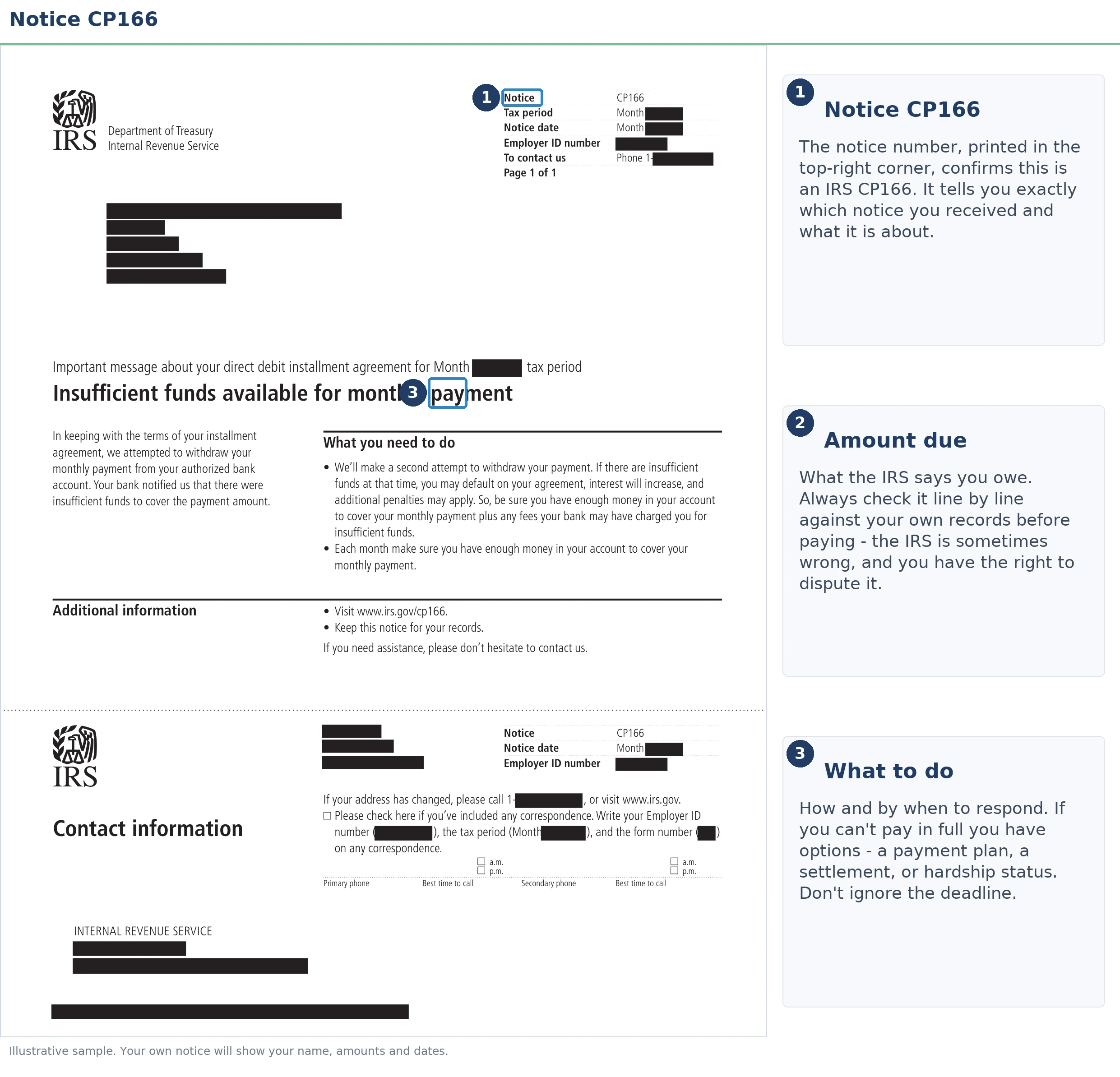
The image below shows exactly what a CP166 looks like and where to find the failed payment amount and the tax year the IRS is referencing — worth checking against your bank statement before you do anything else.
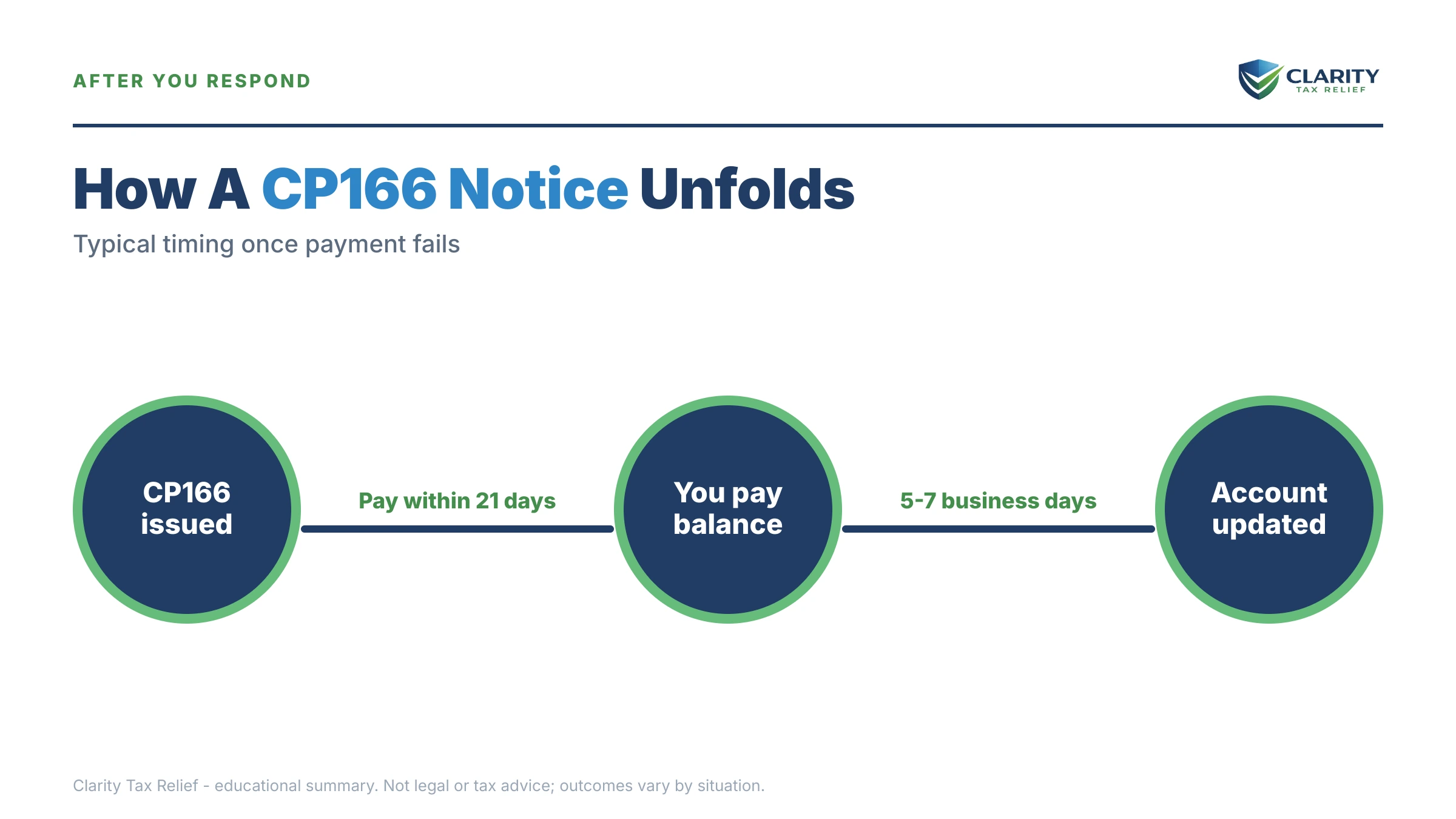
⏱ Your real clock: a CP166 has no fixed statutory deadline — the deadline that matters is your next scheduled debit date. Replace the missed payment and repair the account before that withdrawal runs. A second failure is what typically pushes an agreement into default and triggers a CP523, which sets its own termination date — printed on that notice, typically about 30 days out.
Why you got a CP166 notice
A CP166 notice means the bank withdrawal for your IRS installment agreement payment failed — most often because the account had insufficient funds on the debit date. You're on a direct debit installment agreement, the IRS presented the ACH withdrawal to your bank using the account information you provided, and the bank sent it back unpaid.
Insufficient funds is the usual culprit, but not the only one. The debit also fails when you switched banks or closed the account without updating the IRS, when the routing or account number on file has a typo, or when your bank placed an ACH block or fraud hold on the account — common on business accounts with debit filters.
The account the IRS debits is whatever you put on your Form 433-D or entered in the Online Payment Agreement tool when you set the plan up. If your banking has changed since then, the IRS has no way to know until a withdrawal bounces — which is exactly what just happened. (For how IRS notices work in general, see why did I get a letter from the IRS; this page covers the CP166 specifically.)
One important distinction up front: a CP166 is a warning, not a termination. The notice that actually ends a payment plan is the CP523 — and your job is to make sure this never gets that far.
What happens if you ignore a CP166
One failed direct-debit payment will not terminate your installment agreement by itself — but an uncured missed payment starts the path to default, and every stage costs more than the one before it:
- CP166 — the debit failed. The agreement is generally still active. This is the cheap moment: pay manually, fix the account, and the episode is over.
- Possible CP165 — the IRS can assess a dishonored-payment penalty under IRC §6657 for the returned payment: 2% of the payment if it was $1,250 or more (for smaller payments, $25 or the payment amount, whichever is less). If assessed, it arrives on a separate CP165 notice.
- Uncured or repeated misses — the account gets flagged for default. There is a brief window to cure a missed IRS payment plan payment before the IRS moves to terminate, but don't count on it stretching.
- CP523 — Notice of Intent to Terminate — the formal default notice. The CP523 prints a termination date; miss it and the agreement ends.
- After termination — the full balance is due, collection notices resume, and the IRS regains the path to liens and levies. Your failure-to-pay penalty rate also doubles: it runs at a reduced 0.25% per month while an agreement is in effect (on a timely-filed return) and returns to 0.5% per month once the agreement is gone.
A 2026 reality check: IRS staffing fell roughly 27% in 2025, which makes it harder to reach a human to explain a bounced payment — but the system that flags failed debits and issues CP523s is automated and never went anywhere. The machine doesn't know your payroll ran long that week. It only knows the payment didn't post.
| Stage | What it means | Your window |
|---|---|---|
| CP166 | One debit failed; agreement generally still active | Cure before your next scheduled debit date |
| CP165 (possible) | Dishonored-payment penalty assessed — 2% of payments of $1,250+ | Can be contested or abated for documented reasonable cause |
| Uncured / second miss | Agreement flagged for default | Short and unpredictable — act now, not after the next notice |
| CP523 | Intent to terminate the agreement | Termination date printed on the notice, typically about 30 days out |
| After termination | Full balance due; collection and levy path resume; penalty rate doubles to 0.5%/month | Reinstatement fee plus, on larger balances, fresh financial disclosure |
Your payment bounced and your agreement is on the line
Send us a photo of your CP166. An experienced tax professional will confirm whether your plan is still active, whether a penalty is coming, and exactly how to cure it before the IRS moves toward default — free and confidential.
Your options after a failed direct-debit payment
Every fix for a CP166 comes down to two moves: replace the missed payment and repair whatever made the debit fail. Which repair fits depends on why the withdrawal bounced:
| Option | When it fits | How / cost |
|---|---|---|
| Make the missed payment manually | One-off shortfall; the account is otherwise fine | IRS Direct Pay or EFTPS — free; apply it to the correct tax year and keep the confirmation |
| Update your bank account | You switched or closed accounts, or the numbers on file are wrong | Online Payment Agreement tool, a new Form 433-D, or the phone number on your notice |
| Move the debit date | The withdrawal collides with payroll, rent, or deposit weeks | Revise the agreement online or by phone — a free fix for a timing problem |
| Lower the monthly payment | Cash flow genuinely dropped and the payment no longer fits | Revise the plan (a fee may apply); balances over $50,000 typically require updated financials — see lower my IRS monthly payment |
| Reinstate after default | A CP523 already issued or the agreement terminated | Reinstatement fee (currently $89, reduced for low-income taxpayers) — see reinstate IRS payment plan |
Whatever you do, don't do nothing on the theory that the IRS will simply try the debit again. Your notice states what the IRS will do next — but the missed payment is yours to replace, and a manual payment now is the only version of "fixed" you control.
What a failed debit costs on a $68,500 balance: a worked example
Say your business owes $68,500 in back income tax and you negotiated a direct-debit agreement at $1,425 a month. Because the balance is over $50,000, that plan required financial disclosure to set up — the rules for an IRS payment plan over $50,000 are stiffer than the online-only tiers. One month, the debit lands the same week as payroll and a quarterly insurance premium, and the bank returns it.
If you cure it this week, the damage is roughly: a possible dishonored-payment penalty of 2% × $1,425 = $28.50 (arriving on a CP165, and contestable if the bank erred), plus the $1,425 you still owe for the month. Interest keeps accruing on the full $68,500 either way — that was true before the bounce.
If you let it slide to termination, the math turns against you fast. The failure-to-pay penalty jumps from the in-agreement rate of 0.25% per month (about $171 on $68,500) back to 0.5% (about $342) — an extra ~$171 every month before interest. Add the $89 reinstatement fee, plus a renegotiation that reopens your business financials to the IRS at whatever your bank balances look like that month. Curing costs about $28.50; defaulting costs hundreds a month plus your negotiated terms. You can estimate what continued accrual runs on your own balance with our IRS penalty & interest calculator.
How to respond to a CP166 notice, step by step
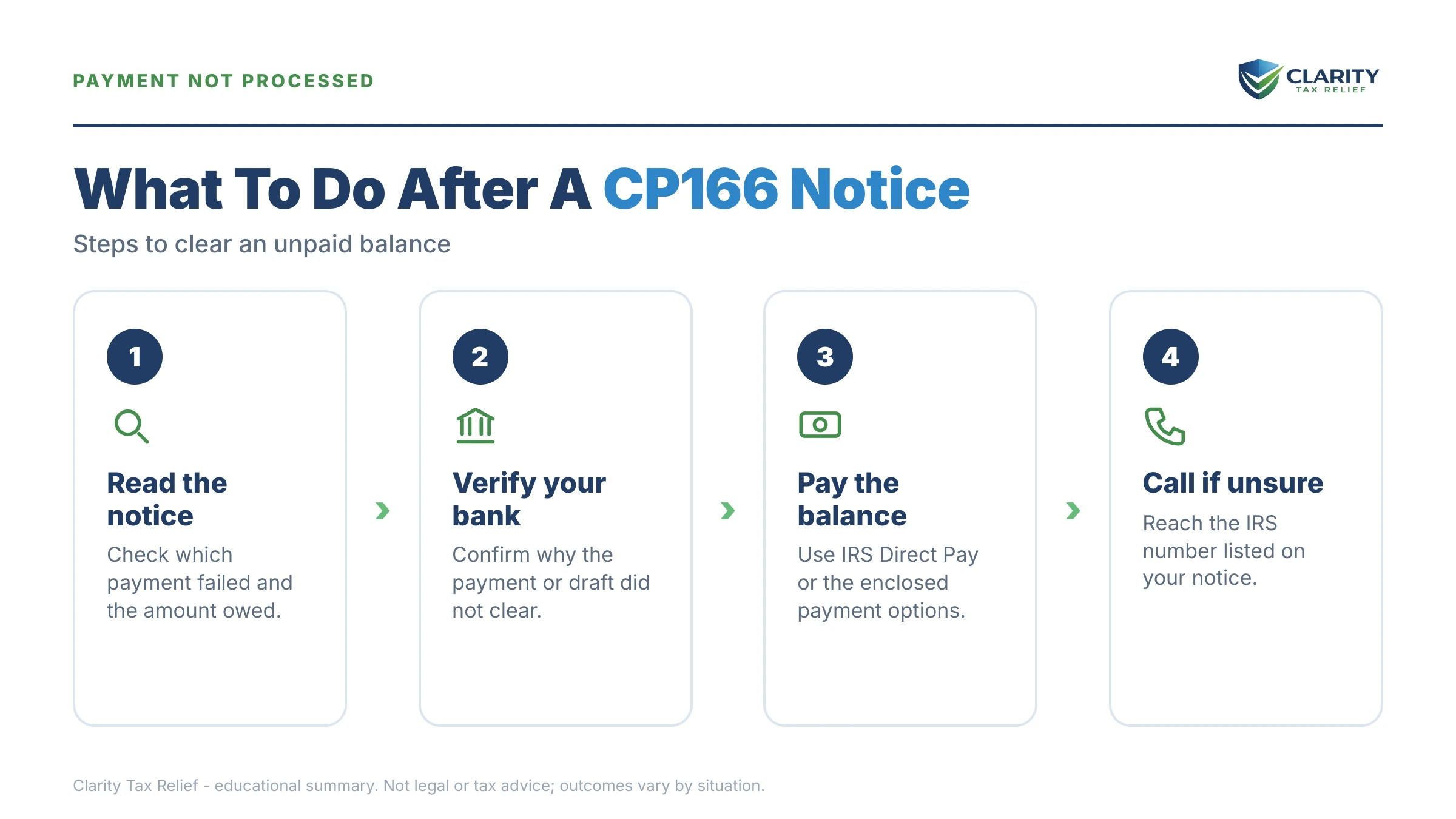
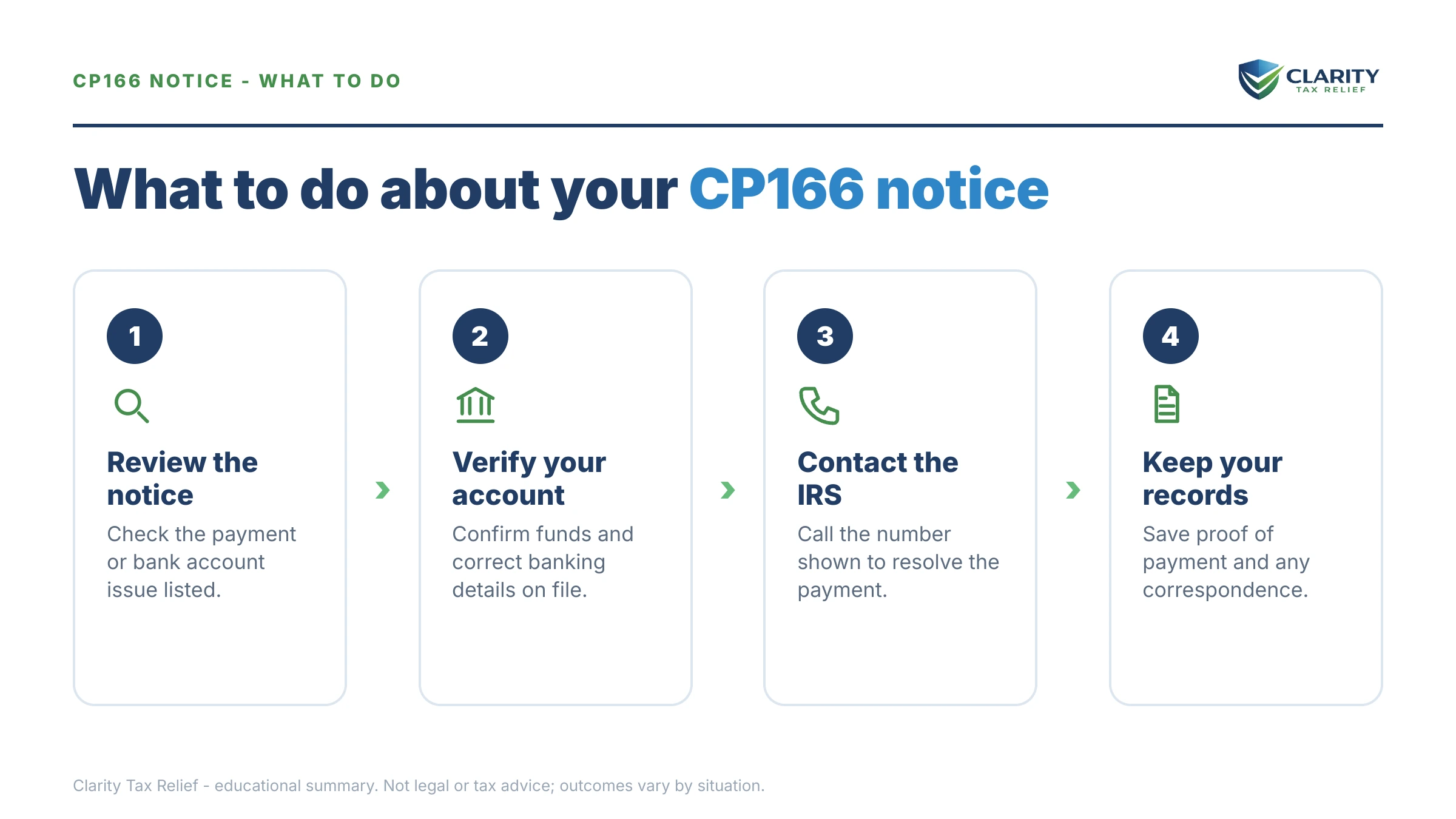
- Read your CP166. Find the failed payment amount, the tax year it covers, and what the notice says the IRS will do next. Check it against your bank statement to confirm which withdrawal was rejected.
- Call your bank. Ask why the debit was refused — insufficient funds, a closed account, or an ACH block — and whether anything will stop the next scheduled withdrawal from clearing.
- Make the missed payment manually. Pay the exact amount through IRS Direct Pay at IRS.gov/payments, applied to the correct tax year, and save the confirmation number.
- Fix the root cause. Update your bank account through the Online Payment Agreement tool or a new Form 433-D, or move your debit date away from payroll week so the next withdrawal clears.
- Confirm the agreement is still active. Check your IRS online account for your payment plan status, and watch the mail — if a CP523 arrives, act before the termination date printed on it.
CP166 vs. CP521, CP165, and CP523: which notice are you holding?
Four IRS notices govern the life of a direct-debit installment agreement, and mixing them up leads people to panic at the wrong one — or shrug at the wrong one:
| Notice | What it means | What to do |
|---|---|---|
| CP521 | Routine monthly reminder that a payment is due | Nothing unusual — confirm the debit is scheduled and funded |
| CP166 | Your bank payment couldn't be processed | This guide: pay manually, fix the account, before the next debit |
| CP165 | Penalty assessed for a dishonored payment | Verify the 2% math; request abatement if a bank error caused it |
| CP523 | Intent to terminate your installment agreement | Act before the date printed on it — cure or renegotiate immediately |
When you can handle a CP166 yourself — and when to get help
A one-time bank hiccup you can cure this week is a do-it-yourself fix. If the money exists, the account is healthy, and the failure was pure timing, you don't need anyone: make the payment at IRS.gov, adjust the debit date, and move on. That's most CP166s.
Experienced help changes the outcome when the bounce is a symptom, not an accident. That looks like: the monthly payment no longer fits your real cash flow (renegotiating before default preserves far better terms than reinstating after one), your balance is over $50,000 so any change reopens financial disclosure, or you're a business owner juggling this agreement alongside payroll tax deposits — where a business IRS installment agreement and trust-fund exposure follow different, harsher rules. And if a CP523 has already arrived, the window is short enough that professional speed genuinely matters.
Terms on your CP166, decoded
- Direct debit installment agreement (DDIA): a payment plan where the IRS pulls the monthly payment from your bank account automatically instead of waiting for you to send it.
- Dishonored payment: any payment your bank refuses to honor — a bounced check or a returned ACH withdrawal — which can trigger a penalty under IRC §6657.
- Default: the status your agreement enters when you break its terms (missed payments, new unpaid balances, unfiled returns) — the step before termination.
- Termination: the formal end of the agreement after a CP523's deadline passes; the full balance becomes collectible again.
- Reinstatement: restarting a defaulted or terminated agreement, for a fee — and sometimes on worse terms than you had.
- Failure-to-pay penalty: the monthly penalty on unpaid tax — reduced to 0.25% per month while an installment agreement is in effect, 0.5% once it isn't.
CP166 questions, answered
Does a CP166 notice mean my installment agreement has been terminated?
No. A CP166 is a warning that one payment failed — your installment agreement is generally still active when it arrives. Termination requires a separate notice, the CP523 Notice of Intent to Terminate, which sets its own deadline before the agreement actually ends. Cure the missed payment and fix the bank issue now, and most agreements continue as if nothing happened.
Will the IRS charge a penalty for the failed bank payment?
It can. Under IRC §6657, a dishonored payment of $1,250 or more triggers a penalty of 2% of the payment; below $1,250, the penalty is $25 or the payment amount, whichever is less. If the IRS assesses it, the penalty arrives on a separate CP165 notice. It can be abated for reasonable cause — for example, a bank error you can document.
Should I make the missed payment myself, or wait for the IRS to try the debit again?
Make it yourself. Your CP166 states what the IRS will do next, but you should never assume a retry is coming or that it will succeed. Pay the missed amount through IRS Direct Pay or EFTPS, applied to the correct tax year, and keep the confirmation. A manual payment now is the cleanest way to keep the agreement in good standing.
How do I change the bank account on my direct-debit installment agreement?
Use the IRS Online Payment Agreement tool to revise your bank routing and account numbers, or submit a new Form 433-D with the updated information — you can also call the number on your notice. Do this before your next scheduled debit date; a second failed withdrawal is what typically pushes an agreement toward default.
What happens if my direct debit fails again next month?
A second failure puts your agreement at real risk of default. The IRS typically issues a CP523 Notice of Intent to Terminate, which gives you a short window — the date is printed on the notice — before the agreement ends. After termination, the failure-to-pay penalty doubles from 0.25% to 0.5% per month, collection notices resume, and reinstating costs a fee plus, on larger balances, fresh financial disclosure.
Can I move my monthly debit date so it doesn't collide with payroll?
Yes. You can change your payment due date by revising the agreement through the Online Payment Agreement tool or by calling the IRS. Many business owners move the debit to the week after their heaviest outflows — payroll, rent, or tax deposits — clear. A small date change is far cheaper than another bounced payment.
Does a CP166 notice affect my credit score?
No. The IRS does not report installment agreements, missed payments, or CP166 notices to credit bureaus, and federal tax liens no longer appear on consumer credit reports. The real financial risk is indirect: if the agreement defaults and collection resumes, a lien filing becomes public record and a levy can hit business bank accounts.
Your next 24 hours
- Find the numbers. Pull the failed payment amount and tax year off your CP166, and match them to the returned debit on your bank statement so you know exactly which payment you're replacing.
- Gather your agreement. Locate your Form 433-D or plan acceptance letter, the CP166, and your last two bank statements — everything you or a professional needs to cure this and fix the account in one pass.
- Get a free review. If the payment no longer fits your cash flow, your balance is large, or a CP523 is already in the mail pile, call (888) 825-7779 or use the 2-minute form — the goal is to cure this bounce before it becomes a default, while penalties and interest are still accruing at the reduced rate.
For the IRS's own explanation of this notice, see Understanding your CP166 notice; the rules for revising a plan are on the IRS payment plans page.
This guide is general information, not tax or legal advice for your specific situation. Eligibility for IRS programs depends on individual facts and circumstances; no outcome is guaranteed.