
IRS Notices
IRS CP165 Notice: The Dishonored Payment Penalty and How to Fix It (2026)
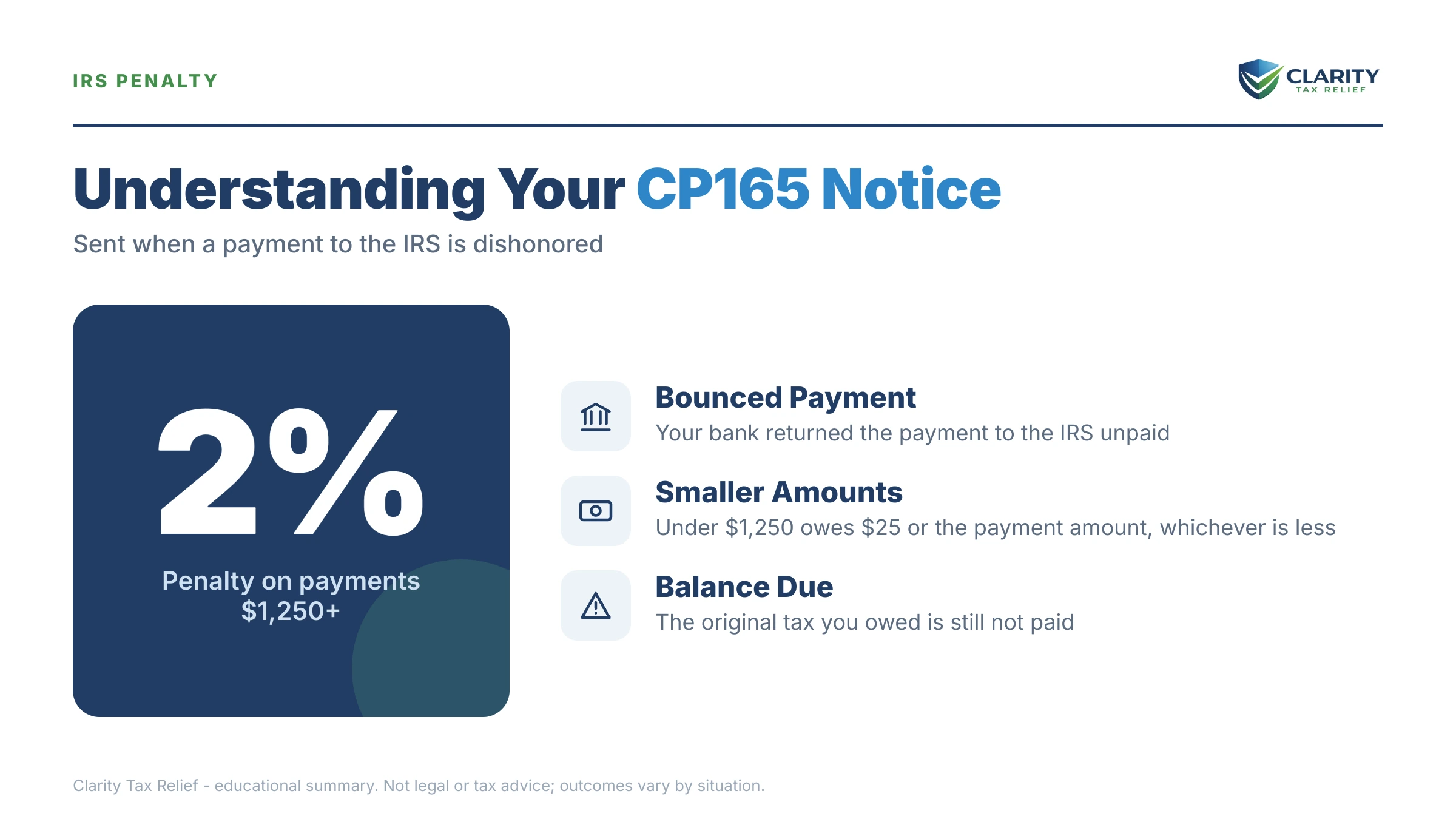
The short answer: a CP165 notice means your bank didn't honor a payment you sent the IRS — a bounced check or failed electronic payment — and the IRS charged a dishonored payment penalty: 2% of the payment if it was $1,250 or more, otherwise $25 or the payment amount. Your original balance is now unpaid again.
You did the hard part — you actually sent the IRS the money. Now a CP165 says the bank sent it back, and the IRS is charging you a penalty for a payment you genuinely tried to make. Frustrating, yes — but this is one of the most mechanical notices the IRS mails, and the fix is usually fast: confirm what happened, re-send the payment, and, if the bank caused the bounce, get the penalty removed.
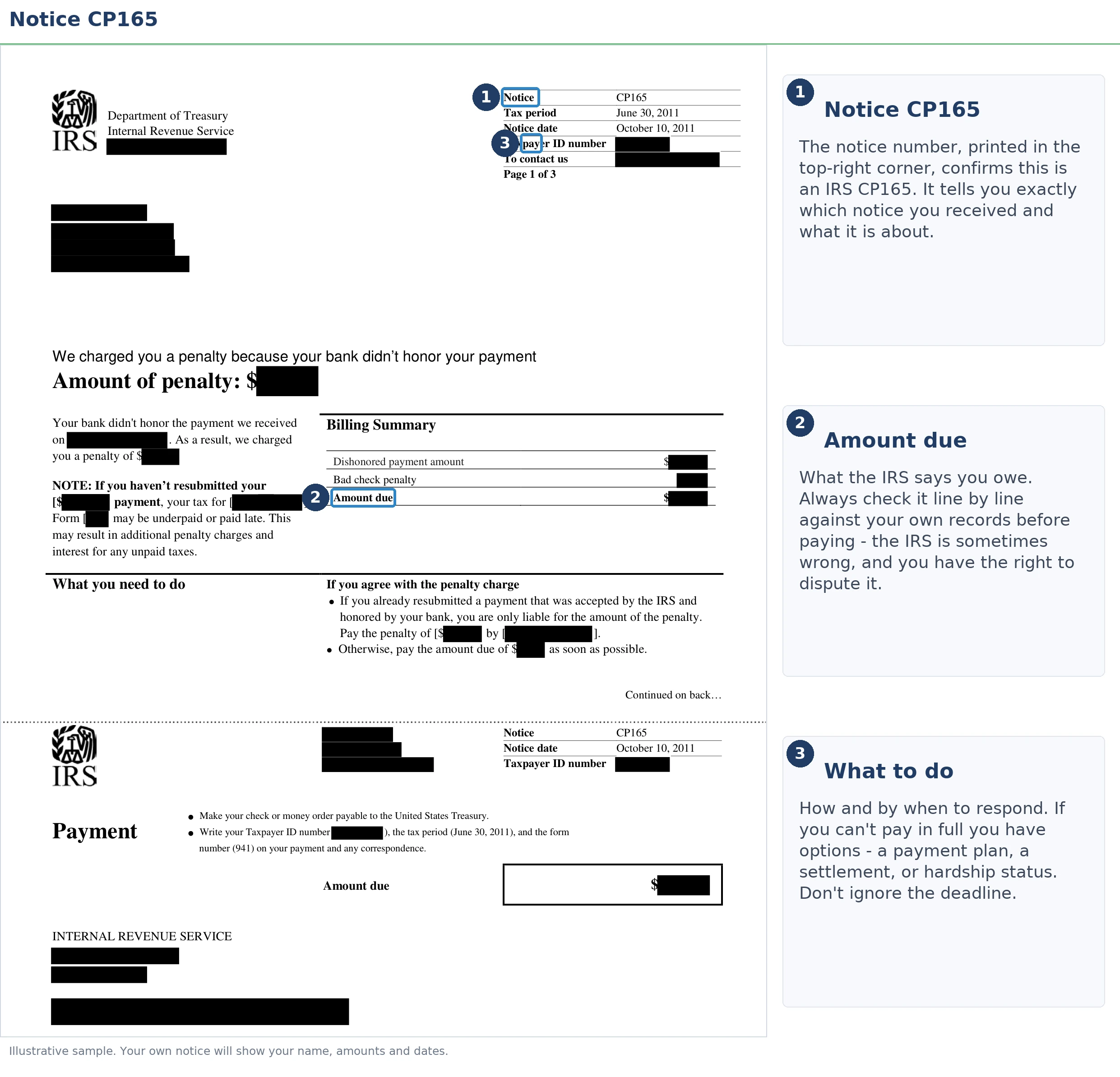
The image below shows you exactly what a CP165 looks like and where the penalty amount, the payment it's tied to, and the due date sit on the notice — find those three items before you do anything else. (If you're not sure why the IRS is writing to you at all, start with why did I get a letter from the IRS — this page covers only the dishonored-payment situation.)
⏱ Your deadline: the due date printed on your CP165. And a second clock is already running: because the payment was reversed, the failure-to-pay penalty (0.5% per month) and daily compounding interest are accruing on the balance you tried to pay — from its original due date, not from the bounce.
Why you got a CP165 notice
The IRS sends a CP165 when your bank returns a tax payment unpaid, and it charges a dishonored payment penalty under IRC §6657 — 2% of any payment of $1,250 or more. It doesn't matter whether the payment was a paper check, a phone payment, or an electronic transfer: if the bank won't release the funds, the IRS treats it as dishonored.
The common causes, roughly in order of how often we see them:
- Insufficient funds. The money wasn't all there on the day the IRS presented the payment — very common for gig workers and other self-employed people whose deposits land unevenly.
- Wrong account or routing number on an electronic payment. One transposed digit and the transfer fails.
- Closed or frozen account. You switched banks after mailing the check, or a fraud hold blocked the debit.
- A stop payment. Deliberately stopping payment doesn't avoid the penalty — the law waives it only when the payment was made in good faith and you had reasonable cause to believe it would clear.
- Bank error. The funds were there and the bank bounced it anyway. This is the scenario where the penalty is most clearly removable — more on that below.
Here's the exact penalty math, straight from the statute:
| Amount of the payment that bounced | Penalty the IRS charges |
|---|---|
| Under $25 | The full amount of the payment |
| $25 up to $1,249.99 | $25 flat |
| $1,250 or more | 2% of the payment |
One more thing worth knowing: the penalty applies per payment. If two separate payments bounce — say, a balance-due check and an estimated tax payment — each one gets its own penalty and, usually, its own notice.
The two problems a CP165 creates
Most people fixate on the penalty. The penalty is the smaller problem. When a payment is dishonored, the IRS reverses it — your account now shows the entire underlying balance as unpaid, as if the payment never happened. That balance accrues the failure-to-pay penalty and daily interest, and it puts you back in the collection pipeline. Fixing a CP165 always means fixing both: the penalty and the reversed payment behind it.
What a bounced $61,200 payment actually costs: a worked example
On a $61,200 dishonored payment, the CP165 penalty alone is $1,224 — and that's the cheapest part of the problem. Say you're a gig worker who just caught up on three years of unfiled returns and mailed one check for the full $61,200 — but your app deposits hadn't cleared when the IRS presented it. Here's the hypothetical math:
- Dishonored payment penalty: 2% × $61,200 = $1,224, due by the date on the CP165.
- Failure-to-pay penalty on the reversed balance: 0.5% × $61,200 = roughly $306 per month until it's paid or a plan caps it.
- Interest: federal interest compounds daily on the balance and on unpaid penalties, on top of the figures above.
There's also a threshold trap at this dollar level. A $61,200 balance sits above the $50,000 line for a streamlined long-term payment plan — so if you can't re-send the full amount, you'd either pay it down below $50,000 (about $11,200 here) to qualify online for up to 72 months, or expect to provide financial information for a larger agreement. At $50,000 spread over 72 months, that's roughly $695 per month before interest. You can estimate your own accruing numbers with our IRS penalty and interest calculator — it estimates, it doesn't promise.
What happens if you ignore a CP165 notice
Ignoring a CP165 doesn't just leave a $25 or 2% penalty unpaid — it leaves your entire reversed balance sitting in the IRS's automated collection sequence, which ends at a levy notice with a 30-day clock. The stages, in order:
- The penalty posts and the payment is reversed. Your account shows the full balance due again. Failure-to-pay penalty and interest run from the return's original due date — not from the day the payment bounced.
- Balance-due notices resume. Reminder notices (CP501, then CP503) arrive, each showing a bigger number than the last as monthly penalties and daily interest stack.
- CP504 — Notice of Intent to Levy. The IRS can now seize your state tax refund, and a federal tax lien becomes a realistic next step.
- LT11 / Letter 1058 — Final Notice of Intent to Levy. This starts a 30-day window with formal appeal rights. After it closes, the IRS can levy bank accounts and garnish income — including 1099 pay.
Two special cases change the sequence. If the bounced payment was an installment-agreement payment, the risk isn't the notice ladder — it's plan default, which arrives as a CP523. And in 2026, don't expect a phone call to sort this out first: IRS staffing fell sharply in 2025, but the notice-and-levy system is automated and never stopped running. Silence from a human is not the same as the file being closed.
Holding a CP165 with a big balance behind it?
The penalty is the small problem — the reversed payment put your whole balance back in play. Get your CP165 and the balance behind it reviewed free before the due date on your notice passes and the collection letters resume. No pressure, no obligation.
Your options after a CP165
Every option after a CP165 starts with the same move: get a valid payment — or a payment arrangement — in place before the balance-due notices resume. What that looks like depends on why the payment bounced and whether you can cover it now:
| Option | What it costs | Timeline | Best when |
|---|---|---|---|
| Re-send payment via IRS Direct Pay (or EFTPS for business) | Free; stops the 0.5%/month clock on the balance | Typically posts within a business day or two | You have the funds now and want the fastest clean fix |
| Reasonable-cause penalty abatement (Form 843) | Free to request | Often several weeks or more for a decision | The bank erred, or funds were available and the return wasn't your fault |
| Short-term payment plan (up to 180 days) | $0 setup; penalties and interest continue | Set up online the same day | You can cover the balance within about six months |
| Long-term installment agreement | Setup fee applies (reduced or waived for lower incomes); interest and 0.5%/month continue | Online approval for balances ≤ $50,000, up to 72 months | You need years, not months — over $50,000 expect to provide financials |
| Currently Not Collectible (hardship) status | Free; balance keeps accruing but enforcement pauses | Requires a financial review | Re-paying anything would leave you unable to cover basic living expenses |
Two notes on penalty relief specific to this notice. First, first-time penalty abatement — and the Automatic Exemption from Penalty rolling out in summer 2026 — apply to late-filing, late-payment, and deposit penalties, not the dishonored payment penalty. Second, that means reasonable-cause penalty abatement is the route that actually works here, and the single best piece of evidence is a letter from your bank confirming funds were available and the return was the bank's mistake.
Before re-paying, decide how you'll pay. If a mailed check just failed you once, don't mail another one — compare the best ways to pay the IRS and use an electronic method you can watch clear in real time. And if you need monthly terms, here's exactly how to set up an IRS payment plan online.
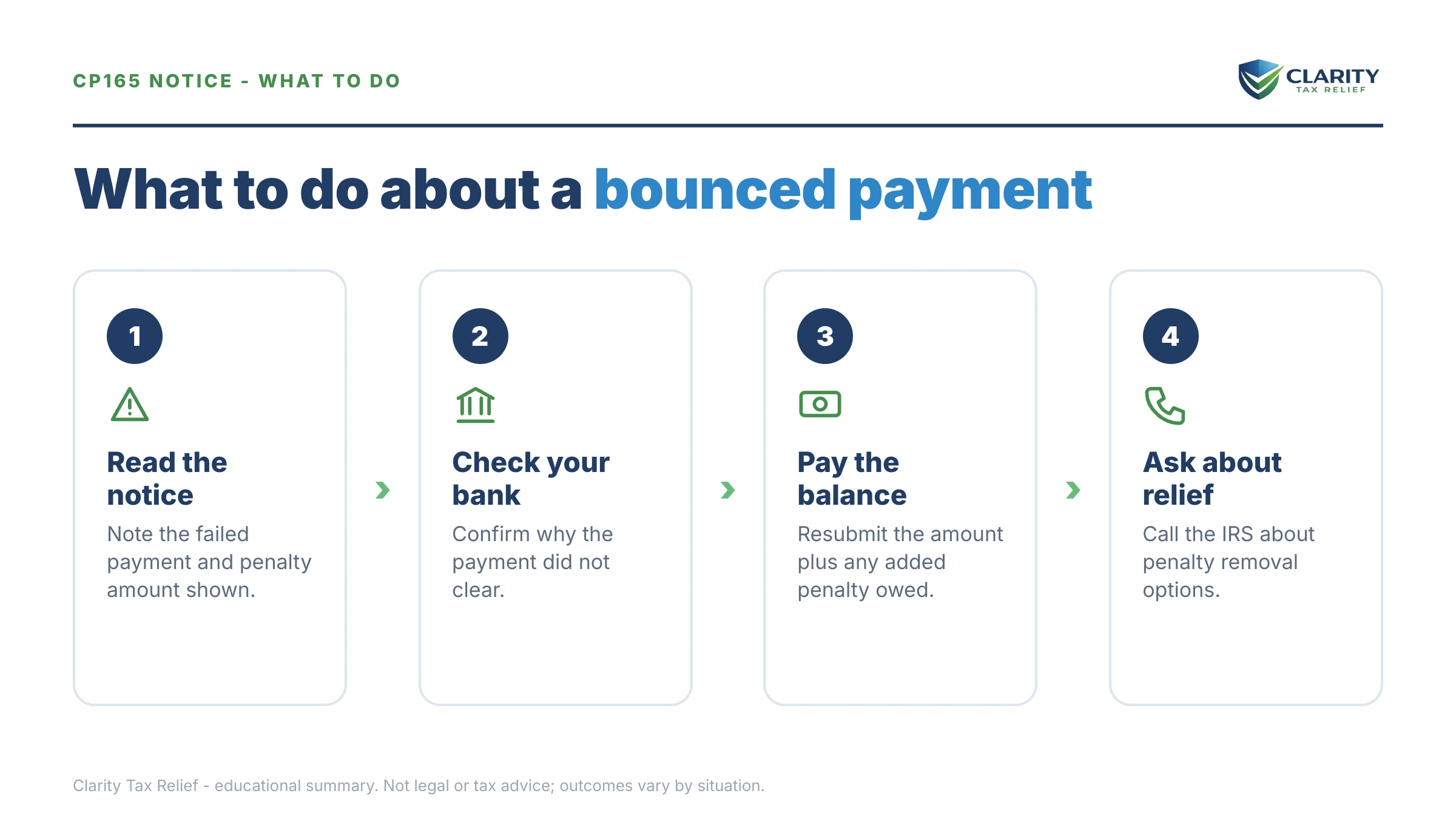
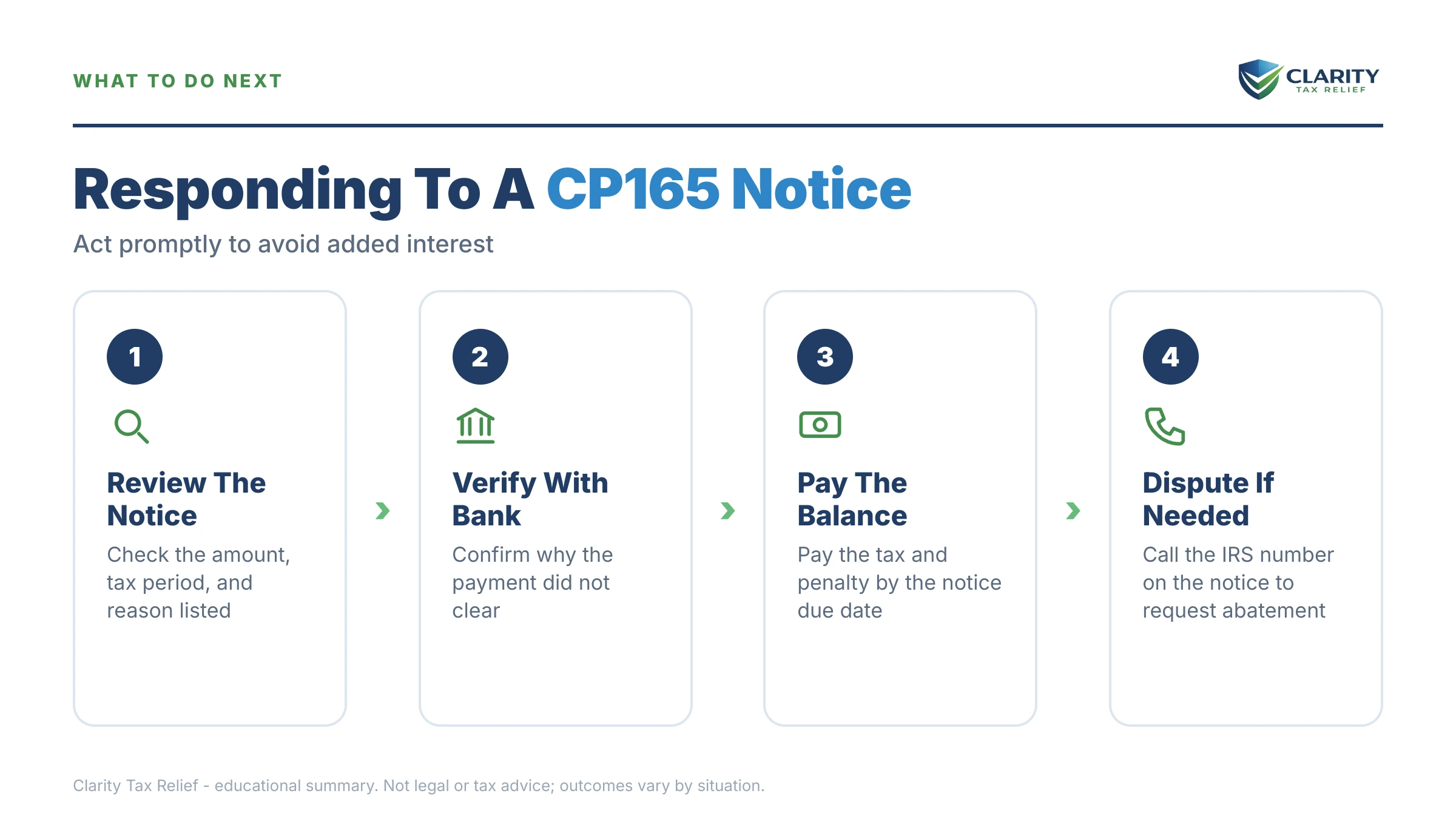
How to respond to a CP165, step by step
- Confirm the reversal. Check your bank statement and your IRS online account to see whether the payment actually failed and whether it was re-presented and cleared later — never pay twice on a guess.
- Find out why it bounced. Ask your bank for the return reason: insufficient funds, closed account, stop payment, or bank error. The reason decides whether you can get the penalty removed.
- Re-send the payment electronically. Use IRS Direct Pay (or EFTPS for business taxes) so the replacement payment posts quickly and can't bounce in the mail — and apply it to the same tax year as the original.
- Request abatement if the bank was at fault. Get a letter from your bank confirming the error and that funds were available, then request reasonable-cause abatement of the penalty, typically with Form 843.
- Set up a payment plan if you can't re-pay in full. A short-term plan (up to 180 days, $0 setup) or a monthly installment agreement stops the collection sequence from resuming while you catch up.
If step 4 applies to you, our Form 843 walkthrough shows line by line how to frame a bank-error abatement request so it doesn't bounce back for missing detail.
When you can handle a CP165 yourself
Most people can fix a CP165 on their own when they know why the payment bounced and can re-send it in full. If the return reason was a simple shortfall or a wrong account number, the penalty is a few hundred dollars or less, and you can replace the payment this week — do it yourself through Direct Pay and move on. This is not a notice that requires representation by itself.
Experienced help changes the outcome in a few specific situations: the balance behind the bounce is large (like a multi-year $61,200 catch-up sitting above the $50,000 streamlined line), the bounced payment was holding an installment agreement together and default is now in motion, payroll or business tax payments are bouncing repeatedly and deposit penalties are stacking, or you're pursuing abatement of this penalty alongside bigger late-filing and late-payment penalties — because the order you resolve those in changes what you end up paying. If a payment on an existing plan is what failed, read what happens after a missed IRS payment plan payment before you call anyone.
Terms on your CP165, decoded
- Dishonored payment: any payment your bank returns unpaid — a paper check or an electronic transfer — for any reason.
- IRC §6657: the tax-code section behind this penalty: 2% of payments of $1,250 or more, with the $25 tier below that.
- Reasonable cause: the legal standard for removing the penalty — you tendered the payment in good faith and reasonably believed it would be honored.
- Form 843: the IRS form used to request abatement or refund of a penalty like this one.
- Failure-to-pay penalty: a separate 0.5%-per-month penalty on unpaid tax — it runs on the reversed balance in addition to the CP165 penalty.
- IRS Direct Pay: the free bank-transfer tool at IRS.gov — the cleanest way to re-send a payment you can verify cleared.
For the primary sources, see the IRS's own pages: Understanding your CP165 notice and the dishonored check or other form of payment penalty. All payment methods live at IRS.gov/payments.
CP165 questions, answered
Why did I get a CP165 notice from the IRS?
You got a CP165 because your bank returned a tax payment unpaid — a bounced check, a closed account, a stop payment, or wrong account numbers on an electronic payment. The IRS charged a dishonored payment penalty and reversed the payment, so the tax you tried to pay is back on your account. Check your bank statement to confirm which payment was returned and why.
How much is the IRS dishonored check penalty?
The penalty is 2% of the payment if it was $1,250 or more. For payments under $1,250, it's $25 or the full amount of the payment, whichever is less. On a $61,200 payment, that's $1,224 — and interest accrues on the penalty and the reversed balance until both are paid.
Will the IRS try to deposit my payment again?
Don't count on it. Banks sometimes re-present a returned check once, but you should verify — check your bank account and your IRS online account to see whether the payment ultimately cleared. If it didn't, send a new payment yourself through IRS Direct Pay rather than waiting; the balance keeps accruing failure-to-pay penalty and daily interest while you wait.
Can the CP165 penalty be removed?
Yes, if you can show reasonable cause — most commonly, a bank error. If you had sufficient funds and the bank returned the payment by mistake, get a letter from the bank saying so and request abatement, typically with Form 843. First-time penalty abatement does not cover the dishonored payment penalty, so reasonable cause is the route that works.
Does a bounced payment default my IRS installment agreement?
One returned payment usually doesn't void the agreement immediately, but it puts the plan at risk — the IRS treats a missed or dishonored installment payment as a default trigger if it isn't cured. Replace the payment quickly and confirm the plan is still active. If your direct debit failed, you may get a CP166 instead of, or along with, a CP165.
Do I still owe the original tax the payment was for?
Yes. When a payment is dishonored, the IRS reverses it, so your account looks as if you never paid. The failure-to-pay penalty (0.5% per month) and daily compounding interest run on that balance from its original due date, not from the date of the CP165. Re-sending the payment is the only thing that stops that clock.
What's the difference between a CP165 and a CP166?
A CP165 charges you a penalty because your bank dishonored a payment you initiated. A CP166 tells you the IRS couldn't process a direct-debit installment payment from your bank account. If you're on a payment plan, read both carefully — the CP166 warns your plan is at risk, while the CP165 adds a penalty on top.
Your next 24 hours
- Find three things on your CP165: the penalty amount, the payment it's tied to, and the due date — then pull the bank statement for the account that payment came from and note the return reason.
- Gather your proof: the notice, the record of the original payment (check image or confirmation number), and — if the funds were there — ask your bank for a letter confirming the error while it's easy to get.
- Get a free case review: if the balance behind the bounce is more than you can re-send this week, have an experienced tax professional map the plan before the balance-due letters resume — the 2-minute form or (888) 825-7779.
This guide is general information, not tax or legal advice for your specific situation. Eligibility for IRS programs depends on individual facts and circumstances; no outcome is guaranteed.