
IRS Notices
IRS CP120 Notice: What It Means and How to Prove Your Tax-Exempt Status (2026)
The short answer: a CP120 notice means the IRS received your organization's Form 990-series return but its records don't show the organization as tax-exempt. You must send proof — usually your IRS determination letter — by the date printed on the notice, or the IRS can require taxable returns (Form 1120 or 1041) instead.
You volunteered to keep the books, filed the 990 on time like you were supposed to — and now the IRS is writing back to say it can't confirm the organization is exempt at all. A CP120 notice isn't an accusation, and it isn't a revocation. It's the IRS asking for one document, on a deadline.
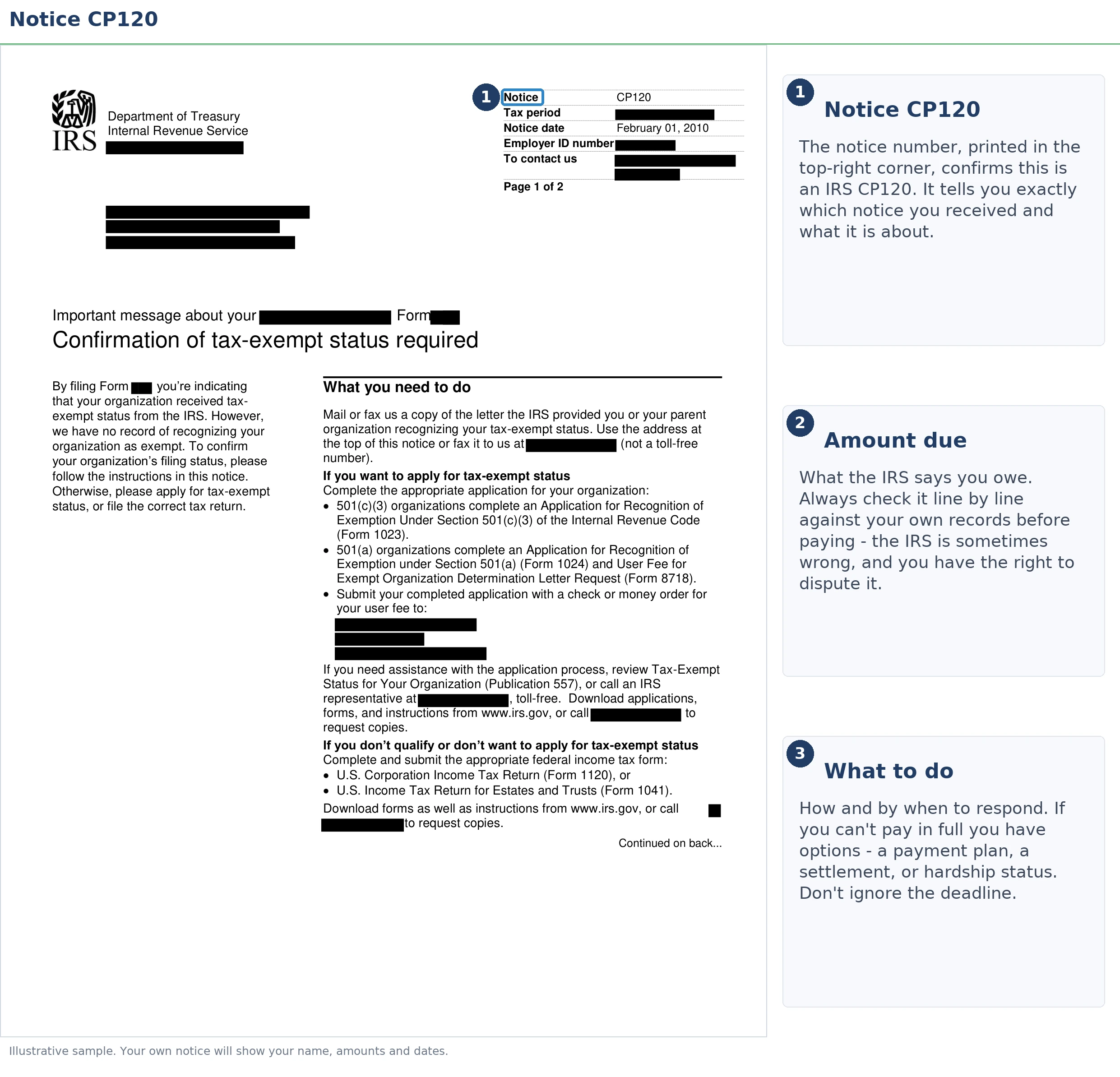
The fix is usually a photocopy and a stamp. The risk is what happens if the deadline passes with no answer: the IRS quietly reclassifies your organization as a taxable business. The image below shows exactly what a CP120 looks like and where the response deadline and tax year appear, so you can pull those two facts off your own notice first.
⏱ Your deadline: the response date printed on your CP120 — the notice gives a specific date to send proof of your exempt status. Miss it and the IRS can change your organization's filing requirement to a taxable Form 1120 or Form 1041, and penalties and interest on any resulting balance accrue monthly from there.
Why you got a CP120 notice
A CP120 is triggered when a Form 990, 990-EZ, or 990-N is filed under an EIN that IRS records don't recognize as tax-exempt. The return arrived; the exemption behind it didn't match. In practice, one of five things happened:
- The organization never applied. Many founders get an EIN, open a bank account, and start filing 990s — without realizing that (outside of churches) exemption requires an approved Form 1023 or 1024. The EIN letter is not a determination letter.
- An application is still pending. Form 1023 processing can run months. If you filed a 990 while the application sat in the queue, the systems can cross.
- You were dropped from a group exemption. Subordinate chapters (PTAs, lodges, league affiliates) are exempt through a central organization's group ruling. If the central org's annual roster didn't include you, the IRS sees no exemption.
- The exemption was automatically revoked. Three consecutive years without a 990-series filing triggers automatic revocation by law. If that already happened, a CP120 response alone won't restore it — more on that below.
- An EIN or name mismatch. The return was filed under a different EIN than the one the determination letter covers — common after incorporations, mergers, or a payroll provider's typo.
The notice shows the tax year and form the IRS is questioning — check that against your records first, because the answer to "which of these five happened" decides everything else on this page. For general background on how IRS notice systems generate letters like this, see why did I get a letter from the IRS; the rest of this guide is specific to the CP120.
CP120 vs. CP120A: has your status already been revoked?
A CP120 asks you to prove your tax-exempt status; a CP120A tells you that status has already been automatically revoked. The distinction matters because the responses are completely different. A CP120 can often be closed with a photocopy of your determination letter. A CP120A means the organization must reapply for exemption — and until it's reinstated, it's legally a taxable entity.
If you're not sure which situation you're in, search your EIN in the IRS Tax Exempt Organization Search (TEOS) tool and check the auto-revocation list before you respond. Ten minutes there tells you whether you're mailing one document or starting a reinstatement application.
What happens if you ignore a CP120 notice
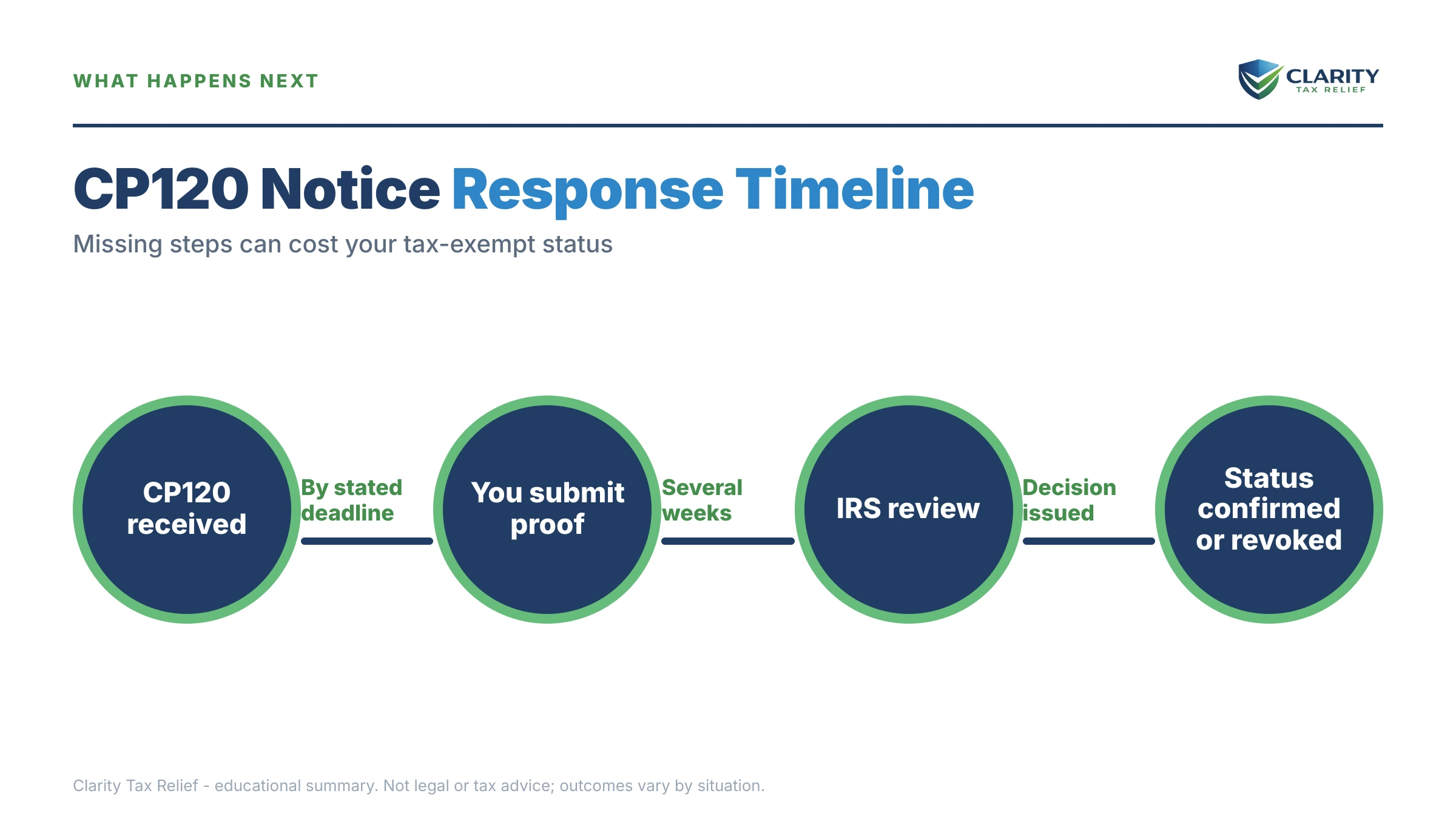
An unanswered CP120 leads the IRS to reclassify your organization as taxable and demand corporate or trust returns. The gaps between stages vary — weeks to months — but the sequence itself is automated, and in 2026, with IRS staffing down roughly 27%, the automated side is the part still running at full speed:
- CP120 unanswered. No proof arrives by the printed date. Nothing dramatic happens yet — but the account is flagged.
- Filing requirement changed. The IRS updates your account to require a taxable return — Form 1120 for a corporation or association, Form 1041 for a trust. This change is often announced on a CP130 notice.
- Demand for the unfiled taxable return. Since no 1120 or 1041 exists, non-filer notices follow — typically a CP259 notice demanding the missing business return.
- Assessment and balance due. Once a taxable return is filed or the IRS assesses on its own, tax, failure-to-file penalties, and interest post to the account, announced on a CP161 notice.
- Standard collection stream. From there the account moves through the same reminder → intent-to-levy → final-notice sequence any business balance faces, ending in liens and levies against the organization's bank account and assets.
Every stage of that sequence is more expensive to unwind than the stage before it. The cheapest moment to fix a CP120 is while it's still just a CP120.
Holding a CP120 right now?
Send us a photo of it. An experienced tax professional will confirm what the IRS is actually missing and exactly what to send back — free, confidential, and before the response date printed on your notice passes.
How to prove your tax-exempt status
The IRS accepts several forms of proof, and the right one depends on how your organization became — or was supposed to become — exempt. Match your situation here:
| Your situation | What to send | Where to get it |
|---|---|---|
| You have your determination letter | A photocopy of the letter (never the original) | Your founding records or the attorney/preparer who filed the application |
| The letter is lost | A replacement copy or affirmation letter | Form 4506-B, or call IRS Tax Exempt customer service at 877-829-5500 |
| You're a chapter under a group ruling | The group exemption letter plus written confirmation of your inclusion | Your central (parent) organization |
| Application still pending | A copy of the filed Form 1023/1024 and submission receipt | Your Pay.gov submission confirmation |
| You're a church | A written statement that the organization is a church, which is automatically exempt | No determination letter is required by law |
| Never applied | A response stating an application is being filed — then actually file it | Form 1023, 1023-EZ, or 1024 (details below) |
| Status auto-revoked | A reinstatement application, not just a CP120 reply | Form 1023/1024 under the retroactive reinstatement procedures |
Whatever you send, include the notice stub (or a copy of page one of the CP120) so it routes to the right file, use the exact address or fax number printed on the notice, and keep proof of mailing. In 2026, follow-up phone confirmation is hard to get — your mailing receipt may be the only evidence the response went in on time.
If you never applied — or your exemption was revoked
Organizations that never obtained a determination letter can't "prove" an exemption that doesn't exist — they have to create one. Most charities apply on Form 1023 ($600 user fee). Smaller charities can use Form 1023-EZ ($275) if gross receipts are projected at $50,000 or less annually and total assets are under $250,000. Most non-charitable nonprofits — social clubs, leagues, business associations — apply on Form 1024. Respond to the CP120 stating that an application is in process, then file it promptly; a stated intention with no follow-through leaves you in the escalation sequence above.
If the status was automatically revoked for three years of nonfiling, reinstatement runs through the same application forms, with one critical timing rule: smaller organizations that apply within 15 months of revocation may qualify for streamlined retroactive reinstatement, which treats the exemption as never having lapsed. Apply later and reinstatement is usually effective only from the application date — leaving a taxable gap the IRS can bill.
Once the status is secure, keeping it is a matter of filing the right 990 every year. The thresholds:
| Annual gross receipts | Required return | Notes |
|---|---|---|
| Normally $50,000 or less | Form 990-N (e-Postcard) | Electronic only; takes minutes; still mandatory even in $0-activity years |
| Under $200,000 (and assets under $500,000) | Form 990-EZ | Short-form information return |
| $200,000 or more (or assets $500,000+) | Form 990 | Full information return |
| Any amount — private foundations | Form 990-PF | Required regardless of size |
The due date is the 15th day of the fifth month after the organization's year ends — May 15 for calendar-year organizations. Three missed years in a row is what turns a paperwork lapse into automatic revocation and, eventually, a notice like this one.
What ignoring a CP120 can cost: a worked example
Here's a hypothetical example: say you're a self-employed contractor who also serves as treasurer of a small youth sports league that brought in $31,200 last year in registration fees and sponsorships, against $26,400 in field rentals, uniforms, and insurance. As an exempt organization, the league's obligation is a free ten-minute 990-N — receipts of $31,200 are comfortably under the $50,000 e-Postcard line — and its tax bill is zero.
Now run the same year with the CP120 ignored. The IRS reclassifies the league as a taxable association filing Form 1120. Net income is $31,200 − $26,400 = $4,800, taxed at the 21% corporate rate: $1,008. Because no 1120 was filed on time, combined failure-to-file and failure-to-pay penalties run 5% per month for up to five months — roughly $252 in this hypothetical example (the failure-to-file portion alone is reduced to 4.5% per month when both apply) — while the 0.5%-per-month failure-to-pay penalty and daily-compounding interest keep running until the balance is resolved. A year of drift turns a $0 obligation into roughly $1,300 and climbing, plus the cost of reinstating the exemption itself. You can rough out penalty and interest growth on a balance like that with our Penalty & Interest Calculator.
One edge case for sole proprietors specifically: if the "organization" was never really separate — the money ran through your personal account and there's no distinct entity behind the EIN — the IRS can treat those receipts as your own Schedule C income. That's a materially worse outcome (self-employment tax applies), and it's the scenario where getting the structure reviewed before responding matters most.
How to respond to a CP120, step by step
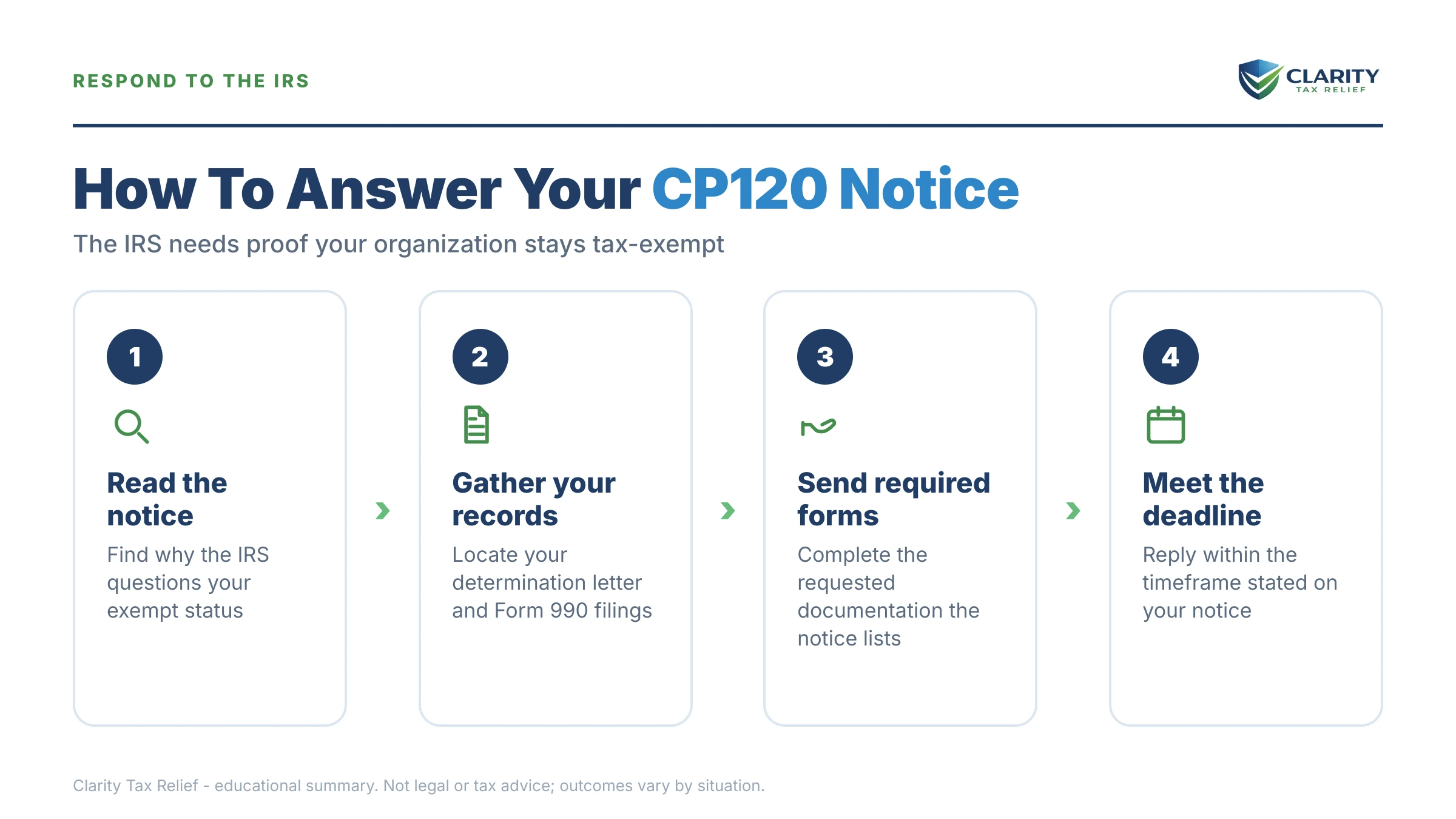
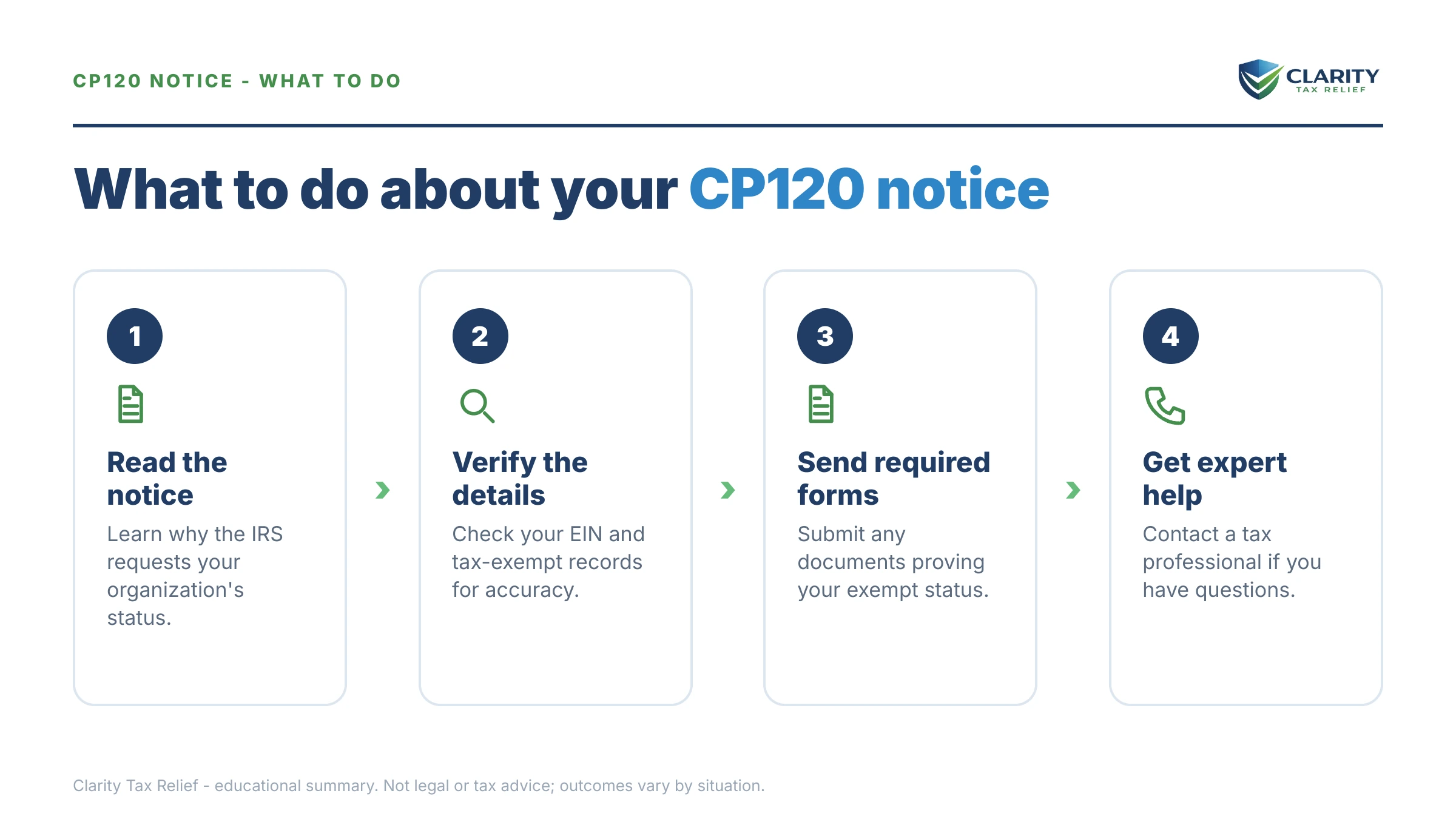
- Confirm the problem. Search the IRS Tax Exempt Organization Search tool for your organization's EIN to see whether the IRS lists it as exempt — and check the auto-revocation list while you're there.
- Gather your proof. Pull your determination letter, group-ruling confirmation, or pending-application receipt — whichever fits your situation in the table above.
- Respond by the date on the notice. Send copies (never originals) with the notice stub to the address or fax number printed on your CP120, and keep proof of mailing.
- Apply if you were never approved. File Form 1023, 1023-EZ, or 1024 to secure exemption, and tell the IRS in your CP120 response that an application is in process.
- Protect the status going forward. Calendar the Form 990 due date — May 15 for calendar-year organizations — and file every year, even a $0-activity 990-N, to avoid automatic revocation.
When you can handle this yourself
If your determination letter is in the file cabinet and your 990s are current, you don't need professional help — photocopy the letter, attach the notice stub, mail it by the printed date, and keep the receipt. That closes most CP120s. The same is true for a group-ruling chapter whose central organization will quickly confirm inclusion in writing.
Experienced help changes the outcome when the underlying status is actually broken: the exemption was auto-revoked and the 15-month retroactive window is in play, the IRS has already converted the account and assessed tax on a Form 1120, there are multiple unfiled years (990s or the taxable returns the IRS now expects), or funds were commingled with a founder's personal accounts. In those cases, the order of operations — reinstatement first, penalty relief second (business penalty abatement and first-time penalty abatement can both apply to assessed balances), balance last — determines what the organization ultimately pays.
Terms on your CP120, decoded
- Determination letter — the IRS's official approval of your exemption application; the single document that resolves most CP120s.
- 990 series — the annual information returns exempt organizations file (990, 990-EZ, 990-N, 990-PF) instead of income tax returns.
- Automatic revocation — the loss of exempt status that happens by law after three consecutive years of unfiled 990-series returns.
- Group exemption — a ruling that covers a central organization and its listed subordinate chapters, so each chapter doesn't need its own determination letter.
- Affirmation letter — an IRS letter confirming an organization's current exempt status; a valid substitute when the original determination letter is lost.
- TEOS — the Tax Exempt Organization Search, the IRS's public database of exempt organizations, determination letters, and the auto-revocation list.
If your letter looks off — odd payment demands, a non-IRS reply address — verify it before responding; here's how to tell if an IRS letter is real. Broader exempt-organization guidance lives on the IRS Charities and Nonprofits pages.
CP120 questions, answered
Why did I get a CP120 notice from the IRS?
The IRS received a Form 990-series return under your organization's EIN, but its records don't show the organization as tax-exempt. The most common causes are never applying for exemption, a determination application still pending, an EIN mismatch, being dropped from a group exemption, or automatic revocation after three years of unfiled returns. The notice lists the tax year in question, so match it against your filing history first.
Is a CP120 the same as losing my tax-exempt status?
No. A CP120 is a verification request — the IRS is asking you to prove exemption, not telling you it's gone. The notice that announces automatic revocation is the CP120A. That said, if you ignore a CP120 and never document your status, the IRS can convert your filing requirement to a taxable return, which has much the same financial effect.
What documents prove tax-exempt status to the IRS?
Your IRS determination letter is the gold standard — the letter the IRS issued when it approved your Form 1023 or 1024. If you can't find it, request a copy with Form 4506-B or ask for an affirmation letter by calling the IRS Tax Exempt division at 877-829-5500. Subordinates covered by a group ruling should instead send proof of inclusion from their central organization.
What happens if I ignore a CP120 notice?
The IRS will treat your organization as taxable. It changes your filing requirement to Form 1120 or 1041, then demands those returns, and any resulting balance is assessed with a failure-to-file penalty of 5% per month (up to 25%) plus interest. Once a balance exists, the notice stream escalates through the same collection sequence any business faces, ending in liens and levies.
What if my organization never applied for tax-exempt status?
You'll need to apply. Most charitable organizations use Form 1023, or Form 1023-EZ ($275 fee) if gross receipts are projected at $50,000 or less and total assets are under $250,000; non-charitable nonprofits generally use Form 1024. Respond to the CP120 explaining that an application is being filed. Churches are the exception — they're automatically exempt without applying, and should say so in their response.
How do I check whether my organization is still tax-exempt?
Search the IRS Tax Exempt Organization Search (TEOS) tool at IRS.gov by name or EIN. It shows organizations eligible to receive deductible contributions, copies of recent determination letters, and — critically — the auto-revocation list. If your organization appears on the auto-revocation list, a CP120 response alone won't fix it; you'll need to apply for reinstatement.
Can my organization get its exemption back after automatic revocation?
Yes, by reapplying on Form 1023 or 1024 and paying the user fee. Smaller organizations that apply within 15 months of revocation may qualify for streamlined retroactive reinstatement, which erases the taxable gap entirely. Apply later than that and reinstatement is usually effective only from the application date, leaving a taxable period in between.
Your next 24 hours
- Find two facts on your CP120: the response deadline and the tax year in question — both are printed on page one of the notice.
- Gather your proof: the determination letter (or your Pay.gov application receipt), your EIN assignment letter, and the 990 the IRS is questioning. If you can't find the letter, print your organization's TEOS listing.
- Get it reviewed free: send a photo of the notice through the 2-minute form or call (888) 825-7779 — an experienced tax professional will confirm the right response before the date on your notice passes.
This guide is general information, not tax or legal advice for your specific situation. Eligibility for IRS programs depends on individual facts and circumstances; no outcome is guaranteed.