
Tax Relief Companies
Wiztax Alternative: How to Choose the Right Tax Relief Help (2026)
The short answer: the best Wiztax alternative depends on what your case needs. Software-guided, flat-fee services fit simple, single-year 1040 balances you could largely handle yourself. If you have payroll (941) debt, an active levy, unfiled years, or a disputed balance, a full-service firm whose experienced tax professional holds Form 2848 power of attorney is the stronger fit.
It's late, you have three review tabs open, and the online questionnaire just asked a question about your business payroll that it clearly wasn't built for. That uneasy feeling is worth listening to. Choosing the wrong type of help costs more than choosing the wrong company — and this guide sorts both in about ten minutes.
⏱ The real clock: there's no deadline for picking a company — but the IRS failure-to-pay penalty adds 0.5% of your balance every month, interest compounds daily, and the automated notice sequence keeps advancing the entire time you compare options. Deciding this week is measurably cheaper than deciding next quarter.
Why you're searching for a Wiztax alternative
Most people searching for a Wiztax alternative fall into one of three groups: their case outgrew a software questionnaire, they want a human negotiating for them, or they're comparison-shopping before spending anything.
Wiztax built its name on a software-first model: you answer an online questionnaire, the system screens you against IRS Fresh Start programs, and it helps you prepare the paperwork yourself at a flat cost well below what traditional firms charge. For the right case — one tax year, personal income tax, straightforward finances — that model is genuinely efficient, and it's fair to say so.
The model's ceiling isn't a flaw in any one company; it's structural. Preparation software cannot represent you. Only a person named on Form 2848 — an EA, CPA, or attorney — can speak to the IRS on your behalf, take the collection calls, negotiate with a revenue officer, or argue an appeal. If your situation involves a business, a levy in motion, or a balance you dispute, the question stops being "which tool?" and becomes "who represents me?"
The rest of this page compares every route — staying DIY, other software-style services, full-service firms like ours, and tax attorneys — with real numbers. If you want the vetting framework in full, see how to choose a tax relief company.
What happens to your tax debt while you compare companies
The IRS adds a 0.5% monthly failure-to-pay penalty plus daily-compounding interest to your balance the entire time you research your options — and its notice machine keeps mailing on schedule.
In 2026 that machine matters more than the people behind it: the IRS workforce shrank roughly 27% in 2025, so reaching a human is harder than ever, but the automated notice-and-levy systems never stopped running. Here's the sequence your file moves through while you deliberate:
- First bill (CP14 for individuals, CP161 for a business) — a demand for payment, typically with about 21 days before the next stage queues up. No enforcement yet.
- Reminder notices (CP501, CP503) — still just bills, but each one arrives with a larger balance attached.
- CP504 — Notice of Intent to Levy — the IRS can now seize your state tax refund, and a federal tax lien becomes realistic.
- LT11 / Letter 1058 — Final Notice — starts a 30-day clock and your Collection Due Process rights (Form 12153). After it runs, wage and bank levies are on the table.
- For payroll debt: Letter 1153 — the Trust Fund Recovery Penalty proposal, with a 60-day window to protest before the withheld portion of unpaid 941s is assessed against you personally.
The practical takeaway: comparison-shopping is smart, but it belongs inside a week, not a season. Every stage you slide down this list removes options and adds cost.
| Notice | What it means | Your window |
|---|---|---|
| CP14 / CP161 | First bill — balance due | Typically 21 days before escalation |
| CP501 / CP503 | Reminder notices, balance growing | Escalates if ignored; no enforcement yet |
| CP504 | Intent to levy your state refund | The date printed on the notice controls |
| LT11 / Letter 1058 | Final notice of intent to levy | 30 days to request a CDP hearing (Form 12153) |
| Letter 1153 (payroll cases) | Trust Fund Recovery Penalty proposal | 60 days to protest |
Not sure if yours is a software case or a representation case?
Send us your notices — or just tell us what you owe and to whom. An experienced tax professional will tell you honestly whether you need us, a cheaper tool, or nothing but 20 minutes on IRS.gov. Free, confidential, and interest keeps accruing while you wait, so don't.
Wiztax alternatives compared: software, full-service, attorney, or DIY
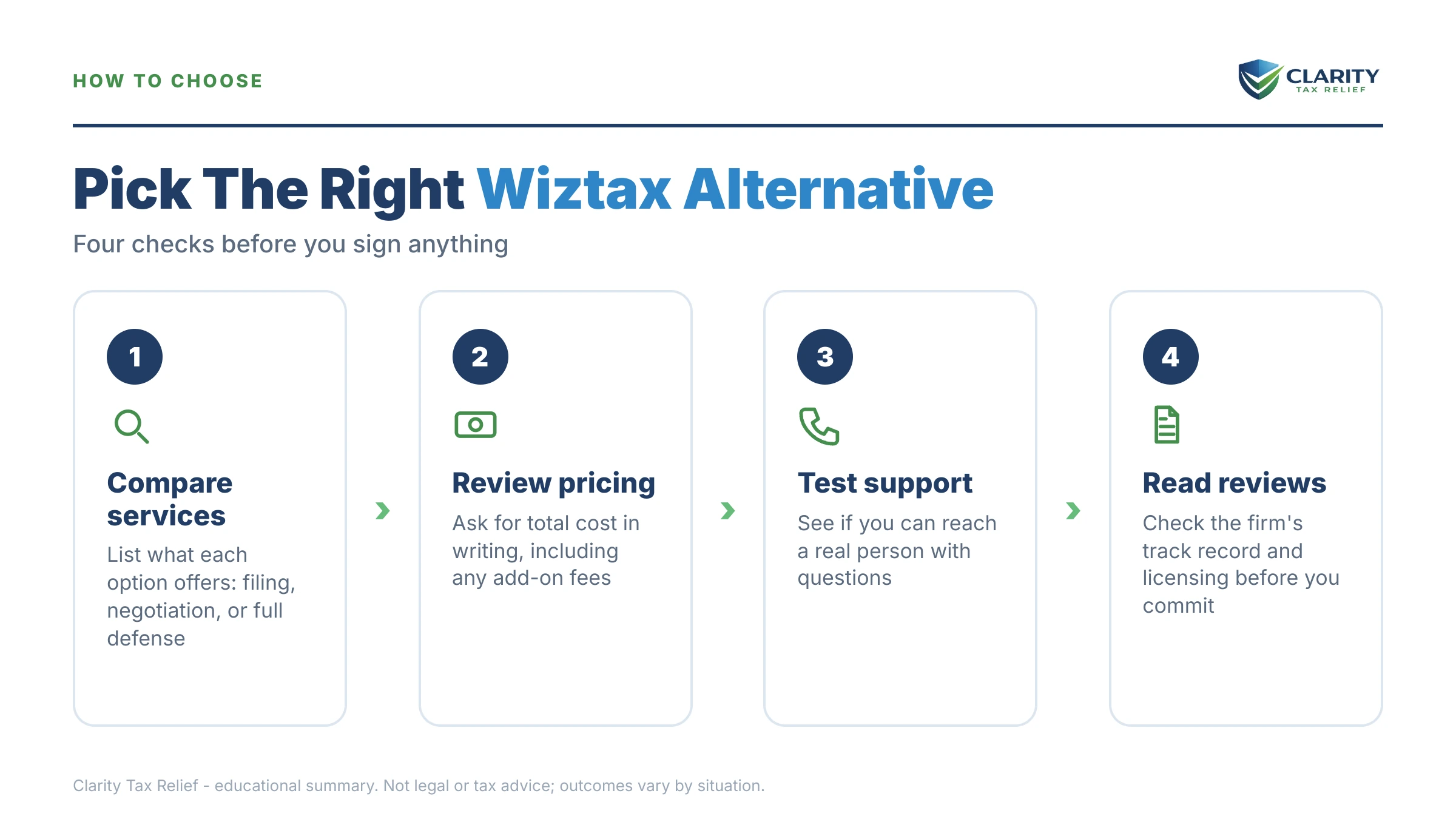
There are only four real routes to resolving a tax debt, and each one trades money for expertise in a different ratio. The single most important line item to compare isn't the price — it's the credential of the person who will hold your power of attorney, because that's who actually stands between you and IRS collections.
| Route | Best fit | Typical cost | Main limitation |
|---|---|---|---|
| Software-guided service (the Wiztax model) | One year of 1040 debt, simple finances, comfortable with forms | Flat fee, often a few hundred dollars | No one represents you before the IRS |
| Full-service tax relief firm | Payroll/business debt, levies, multiple years, disputed balances | Commonly $1,500–$5,000+ flat, by complexity | Higher upfront cost; quality varies widely by firm |
| Tax attorney | Fraud exposure, criminal risk, Tax Court litigation | Often hourly; usually the most expensive route | Overkill for routine collection cases |
| Directly with the IRS (pure DIY) | Balances under $50,000 you can pay monthly | IRS setup fee only; short-term plans are $0 | Your time, and no buffer between you and collections |
Two honest notes on that table. First, "full-service" is a category, not a guarantee of quality — vet any firm (including us) against a tax relief red flags checklist, and get the full fee picture from our guide to how much tax relief costs. Second, if you're comparing several named firms at once, we've written the same honest treatment for others: see our Anthem Tax Services alternative, Community Tax alternative, and Ideal Tax alternative comparisons.
What Clarity specifically does differently from a software model: an experienced tax professional pulls your full IRS transcript history under Form 8821/2848 before quoting anything, quotes a flat fee in writing, and handles every IRS contact from that point on. We turn down cases where DIY is genuinely the better answer — that honesty is the whole point of this page.
Which IRS program does your case actually need?
Every tax relief route — software or human — ends at one of five IRS programs, and eligibility is set by IRS rules, not by whoever you hire. Anyone promising a specific outcome before seeing your finances is selling, not advising.
| Program | Who typically qualifies | Cost / key numbers |
|---|---|---|
| Short-term payment plan | Can pay in full within 180 days | $0 setup; interest and penalties continue |
| Streamlined installment agreement | Individuals owing ≤ $50,000 | Up to 72 months, set up online; a guaranteed installment agreement applies at ≤ $10,000 |
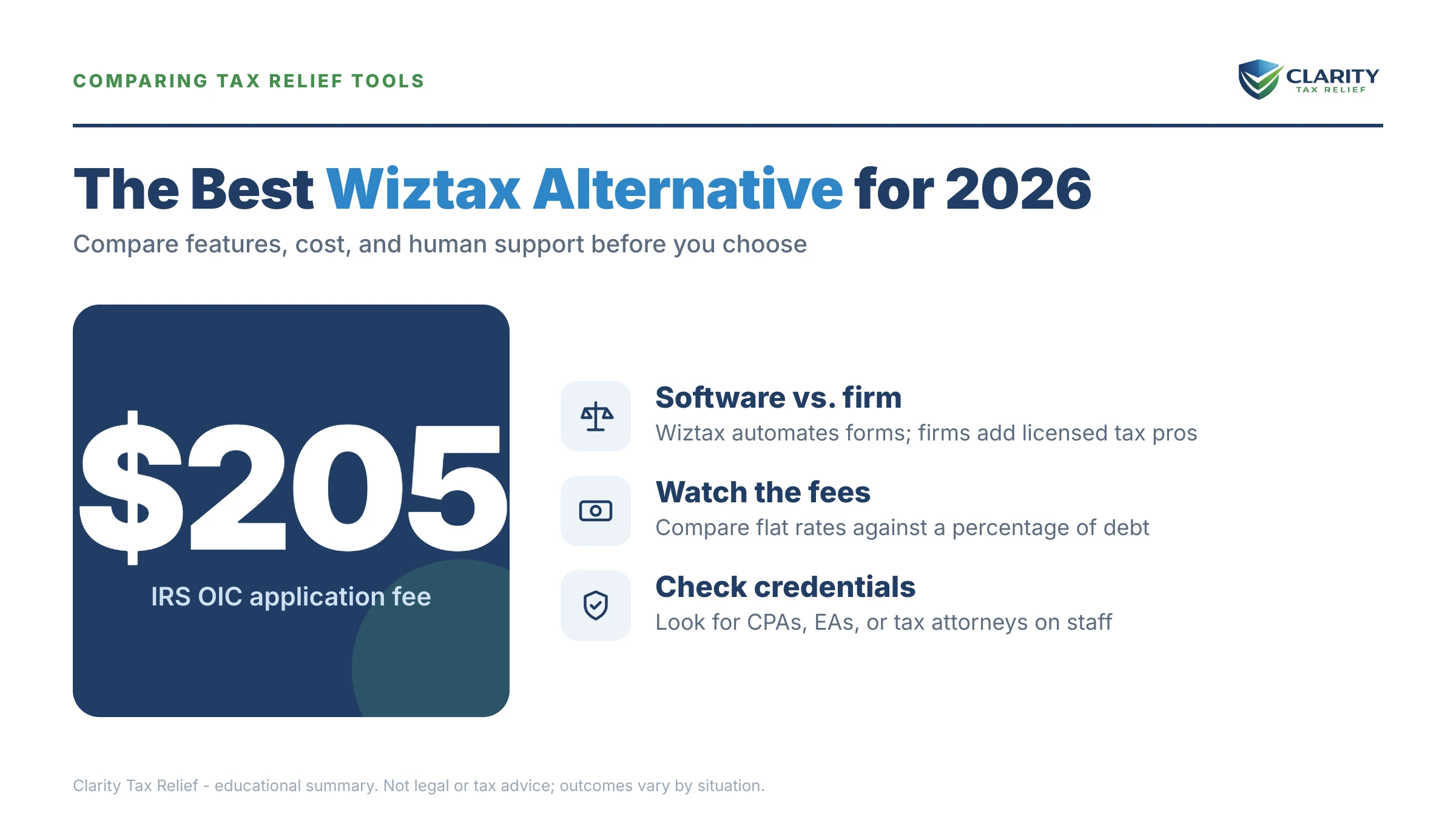
| Offer in Compromise | Reasonable Collection Potential below the balance | $205 fee + 20% down on lump-sum offers; both waived with low-income certification |
| Currently Not Collectible | Paying would leave you unable to cover basic living costs | $0; collection pauses but the debt and interest remain |
| Penalty relief (FTA / AEP) | Clean compliance for the prior 3 years | Free; the new Automatic Exemption from Penalty starts applying automatically in summer 2026 |
The Offer in Compromise deserves one paragraph of straight talk, because it's the program software-first services lean on hardest in their marketing. The IRS computes your Reasonable Collection Potential — roughly your asset equity plus a multiple of your monthly disposable income — and accepts an offer only when that number is below what you owe. The IRS accepted roughly 1 in 5 offers in FY2024, so the pre-filing math matters more than the filing itself. You can sanity-check your own numbers in a few minutes with our Offer in Compromise Calculator, and the mechanics are covered in how an offer in compromise actually works.
If your case is simple enough to run one of these programs yourself, our DIY pillar — how to settle tax debt yourself — walks through each of them without any purchase at all.
A worked example: $16,400 with payroll taxes in the mix
Say you run a four-person shop and owe $16,400 total: $9,900 on your personal 1040 from an under-withheld year, plus $6,500 in unpaid Form 941 payroll taxes from two quarters when cash got tight. This is a clearly hypothetical example — but it's exactly the case where the choice of help changes the outcome.
The personal side is a software case, or even a pure DIY case. $9,900 ÷ 72 months ≈ $138/month as a floor on a streamlined installment agreement — in practice you'd set it somewhat higher, because interest and the 0.5% monthly failure-to-pay penalty keep accruing on the unpaid balance. Under the $10,000 line, this may even fit the guaranteed installment agreement rules. No questionnaire needed.
The payroll side is a different animal. Suppose roughly $4,100 of that $6,500 is the "trust fund" portion — income tax and FICA you withheld from employees' paychecks but didn't deposit. The IRS can assess that $4,100 against you personally through the Trust Fund Recovery Penalty, even if the business later closes, and 941 cases are far more likely to draw an assigned revenue officer than a $9,900 1040 balance ever will. A screening tool built around personal Fresh Start programs won't flag any of that; it will happily quote you a payment plan while the TFRP clock runs. See 941 back taxes and the Trust Fund Recovery Penalty for what's actually at stake.
The right split for this owner: handle or cheaply automate the 1040 side, and put experienced representation on the 941 side — negotiating the business agreement, protecting against (or contesting) the personal TFRP assessment, and sequencing which balance gets paid first. That sequencing alone can change who legally owes the $4,100.
How to choose a Wiztax alternative, step by step
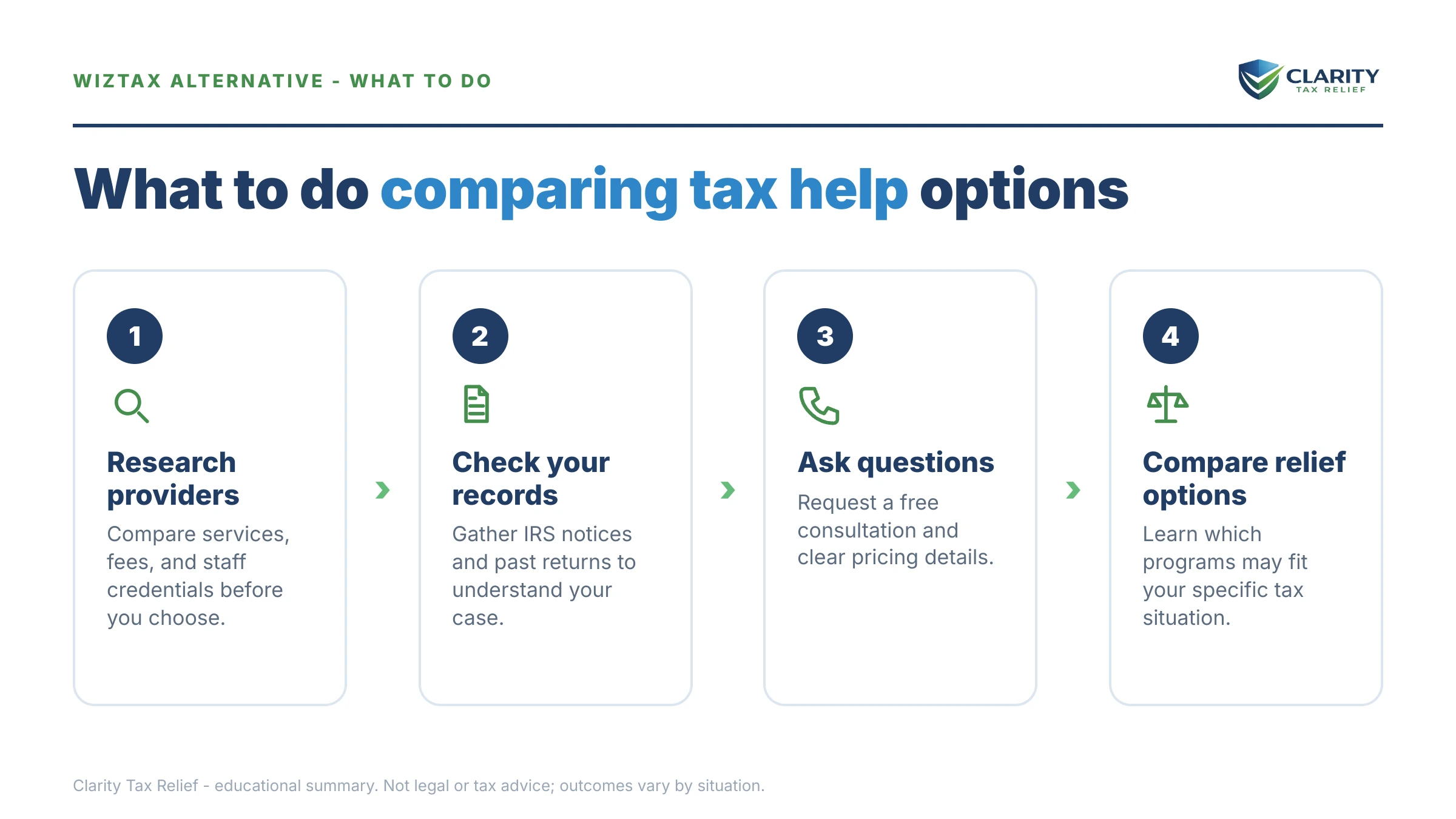
- Pull your IRS records. Log into your IRS online account and list every balance, tax year, and tax type (1040 vs. 941) before talking to anyone.
- Match your case to a program. Use the eligibility table above to see whether you need a payment plan, an Offer in Compromise, hardship status, or penalty relief.
- Decide software vs. representation. A single year of 1040 debt with simple finances favors DIY; payroll debt, levies, or unfiled years favor a firm that files Form 2848.
- Vet the company in writing. Confirm the credential of the person representing you, get a flat fee in writing, and screen against common red flags before paying.
- Act before the next notice. Set up your plan or sign your engagement now — interest and the 0.5% monthly penalty accrue the whole time you deliberate.
When you don't need Wiztax or any alternative
A large share of tax debts need no paid help at all — from a software service, from us, or from anyone else. You can confidently go direct to the IRS when all of the following are true: you agree with the balance, it's personal income tax under $50,000, you're current on filing, and you can afford a monthly payment. The IRS's own payment plan portal sets up a streamlined agreement online, and a short-term plan (up to 180 days) costs nothing to establish. Balances you can pay within 180 days are, frankly, not a tax relief case.
Experienced help changes outcomes in the opposite situations: a levy already in motion, multiple unfiled years the IRS may have estimated for you, any 941 or business trust-fund exposure, a balance you believe is wrong, or Offer in Compromise math close enough that presentation decides it. The IRS publishes its own OIC criteria at IRS.gov's Offer in Compromise page — read it before anyone charges you to pursue one. And if your problem is an IRS processing failure rather than a debt dispute, the free Taxpayer Advocate Service exists for exactly that.
Terms you'll see while comparing, decoded
- Form 2848 (power of attorney): the document that lets a specific EA, CPA, or attorney represent you before the IRS — software services don't file one, which is the core difference in this comparison.
- Reasonable Collection Potential (RCP): the IRS's math for the most it could ever collect from you; an Offer in Compromise is accepted only when your offer meets or beats it.
- Trust Fund Recovery Penalty (TFRP): the rule that makes owners and other responsible people personally liable for payroll taxes withheld from employees but never deposited.
- Currently Not Collectible (CNC): a hardship status that pauses IRS collection while your finances can't support any payment — the debt and interest continue in the background.
- Flat fee vs. open-ended billing: a flat fee is one written price for a defined scope; open-ended or phase-based billing is where tax-relief costs quietly multiply.
Wiztax alternative questions, answered
Is Wiztax legit, or should I avoid software-based tax relief?
Software-guided tax relief is a legitimate category, and searching for an alternative doesn't mean any specific company failed you. The honest question is fit: a questionnaire-driven tool works when your case is a single year of 1040 debt with straightforward finances. It cannot sign Form 2848, speak to the IRS for you, or handle payroll and trust-fund issues — those need a human representative.
What is the difference between tax relief software and a tax relief company?
Software helps you prepare your own IRS filings; a tax relief company represents you. With representation, an experienced tax professional files Form 2848 power of attorney, pulls your IRS transcripts, fields IRS calls, and negotiates directly. The trade-off is cost: full-service work commonly runs $1,500 to $5,000 or more, while software is typically a few hundred dollars. Match the price to the complexity, not the fear.
Can I skip both Wiztax and its alternatives and deal with the IRS myself?
Yes, and for many people that's the right answer. If you owe under $50,000 on personal income tax and can make monthly payments, you can set up a streamlined installment agreement online in about 20 minutes with no financial disclosure. Where DIY breaks down is payroll debt, active levies, multiple unfiled years, and Offer in Compromise math — errors there are expensive.
How much does a Wiztax alternative cost?
It depends on the service model. Software-guided prep typically costs a few hundred dollars; full-service resolution firms commonly charge $1,500 to $5,000 or more depending on complexity; tax attorneys often bill hourly and cost the most. A trustworthy firm quotes a flat fee in writing after reviewing your IRS records — walk away from anyone who quotes a price before seeing your transcripts.
Can tax relief software handle 941 payroll tax debt?
Generally no — and this is the single biggest reason business owners look for an alternative. Payroll debt involves the Trust Fund Recovery Penalty, which can make you personally liable for the withheld portion of unpaid 941s, and it often triggers a revenue officer assignment. Those are negotiation and defense problems, not form-preparation problems, and a questionnaire built around personal Fresh Start programs won't surface them.
Will the IRS accept an Offer in Compromise I prepared with software?
The IRS judges the offer, not the tool that prepared it. Acceptance turns on Reasonable Collection Potential — your equity plus future income — and the IRS accepted roughly 1 in 5 offers in FY2024. Software can assemble Form 656 correctly and still produce a rejected offer if the underlying financial disclosure overstates what you can pay or misses allowable expenses.
How do I know a tax relief company is not a scam?
Verify three things before paying anyone: the name and credential (EA, CPA, or attorney) of the person who will hold your power of attorney, a flat fee in writing, and no promises about outcomes. Any company that guarantees a settlement, advertises 'pennies on the dollar,' or quotes a price before pulling your IRS transcripts is showing you a red flag, not a plan.
Your next 24 hours
- Map what you owe. Log into your IRS online account and write down every balance by tax year and tax type — separating 1040 from 941 balances is the single fact that decides which route you need.
- Gather your paper. Pull your last filed return, every IRS notice you've received, and a rough picture of monthly income and expenses — whichever route you choose starts from these.
- Get one honest read before you buy anything. Call (888) 825-7779 or use the 2-minute form for a free case review — we'll tell you plainly whether your case needs representation, a cheap software tool, or just IRS.gov. Interest and the monthly penalty accrue either way, so get the answer now, not next month.
This guide is general information, not tax or legal advice for your specific situation. Eligibility for IRS programs depends on individual facts and circumstances; no outcome is guaranteed. Clarity Tax Relief is not affiliated with Wiztax, and nothing here is a statement about any specific company's quality or conduct.