
IRS Collections
What Happens If You Never Pay the IRS? The Full 2026 Escalation Timeline
The short answer: if you never pay the IRS, the debt doesn't disappear — it escalates. Notices lead to a federal tax lien, then levies on bank accounts, paychecks, and business income. Penalties climb to 25% of the balance, interest compounds daily, passports can be denied above $66,000, and the IRS has 10 years to collect.
Maybe you're a business owner who has been sliding the IRS envelopes under the payroll folder for two years now, telling yourself you'll deal with them after the next good quarter. Nobody has knocked, so part of you wonders if they ever will. They will — on a schedule so predictable you can map it, and that predictability is your single biggest advantage right now.
This guide walks the whole road: every stage of enforcement, what the IRS can actually take, what a real balance grows into, and every legal way to stop the machine at any point. The image below maps the entire path — each notice in order, from the first bill to an active levy — so you can see exactly where your account sits today.
⏱ The real clock: there is no single deadline when you never pay — the meter just runs. The failure-to-pay penalty adds 0.5% of the balance every month until it reaches 25% of the tax owed, interest compounds daily on top, and each month of silence moves your account one automated notice closer to a levy.

Why an unpaid IRS balance never just goes away
The IRS has 10 years from the date a tax is assessed to collect it, and its collection system runs on automation, not attention. The moment your return posts with a balance due — or the IRS assesses tax for you — a legal debt exists, and a computer begins mailing the collection sequence. No employee decides to pursue you. No employee has to.
That matters more in 2026 than ever. The IRS workforce was cut roughly 27% in 2025, so reaching a human takes longer — but the notices, lien filings, and levies are generated by systems that never stopped. The people who could hear your side got scarcer; the machine that escalates your account did not.
And every year you don't pay, the IRS quietly collects anyway: any federal refund you're ever due is automatically applied to the oldest balance. For a business owner, the reach is wider — the same automated stream that pursues a wage earner's paycheck can pursue your operating account and your customers' payments to you.
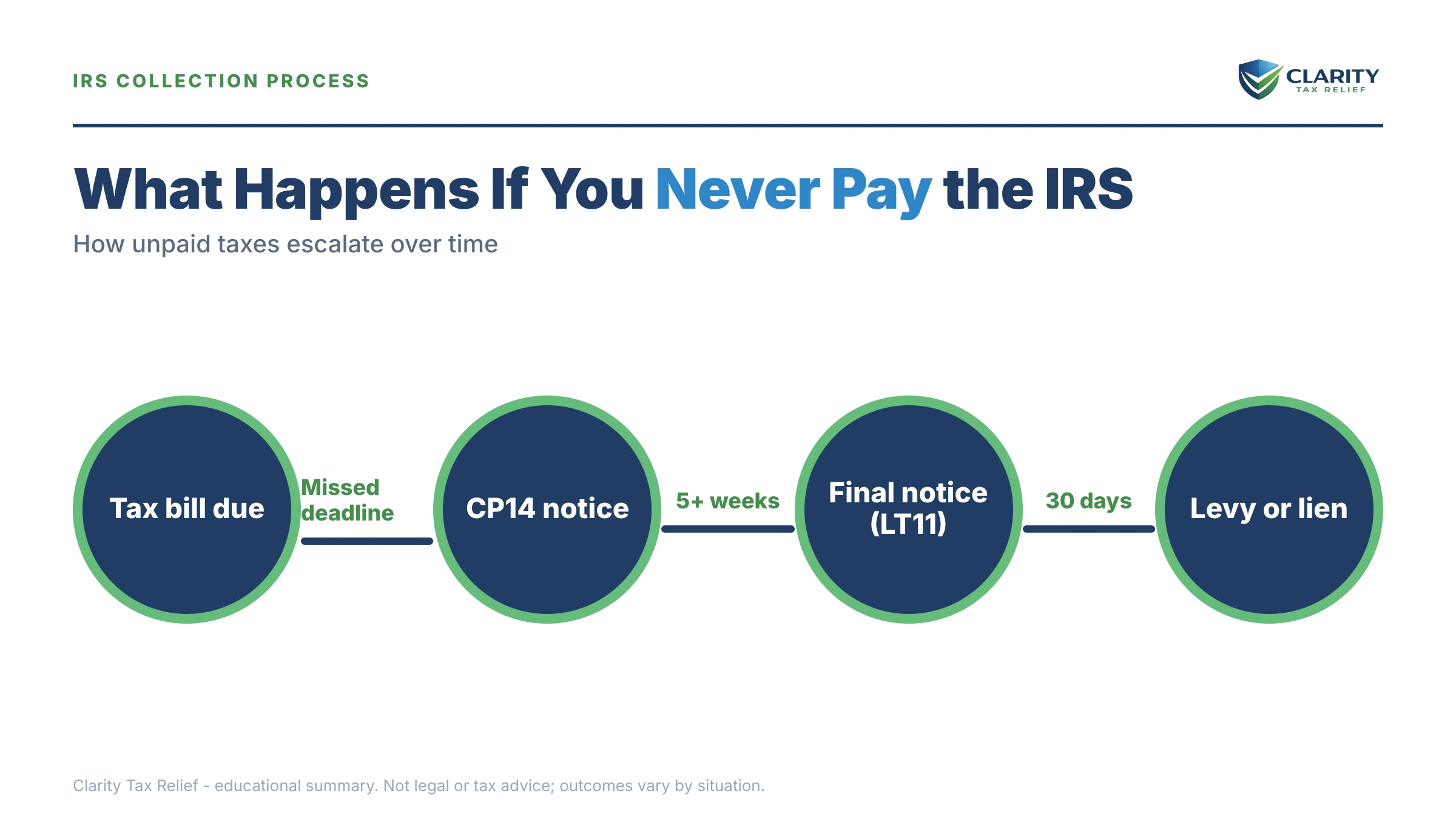
What happens if you never pay the IRS: the escalation sequence
Ignoring an IRS balance triggers a fixed sequence of notices, each carrying more enforcement power than the last. Here's the order, using only the timelines the law actually sets:
- The first bill (CP14 for individuals, CP161 for a business). A plain statement of tax, penalties, and interest, typically giving you about 21 days to pay. No enforcement yet — this is the cheapest moment you will ever have.
- Reminder notices (CP501, then CP503). Still just bills, arriving weeks apart while the balance grows monthly. Most people who "never pay" are living in this stage longer than they realize.
- CP504 notice — Notice of Intent to Levy. The IRS can now seize your state tax refund under IRC §6331(d). It is not the final notice, but it's the first actual taking.
- LT11 notice or Letter 1058 — the final notice. This starts a 30-day clock and your Collection Due Process rights (requested on Form 12153). After the 30 days, the IRS can levy bank accounts and wages without further warning.
- A Notice of Federal Tax Lien is filed. Often around this stage, the IRS records its claim publicly against everything you own — your home, your business assets, your accounts receivable.
- Active levies begin. A bank levy freezes the funds for a 21-day hold before they're sent to the Treasury. A wage levy is continuous — it takes part of every paycheck until released. Social Security can lose up to 15% through the Federal Payment Levy Program.
- Passport certification once the debt tops $66,000 (the 2026 threshold). The IRS certifies you as "seriously delinquent" via CP508C, and the State Department can deny your renewal or revoke your passport.
- A revenue officer, for larger and business cases. Payroll debt and six-figure balances get pulled from the automated stream and assigned to a human collector with authority to summon records, interview you, and seize assets.
- The 10-year statute runs out — eventually. The Collection Statute Expiration Date ends the IRS's right to collect, but it arrives only after a decade of everything above, and several common events pause the clock along the way.
The full stage-by-stage version — with what each letter looks like and how to answer it — lives in our IRS collection process step by step roadmap. Here's the enforcement toolkit in one reference table:
| What the IRS takes | When it can happen | Key detail |
|---|---|---|
| State tax refund | After the CP504 notice | Seized under IRC §6331(d) — the first actual taking in the sequence |
| Federal tax refunds | Every year, automatically | Applied to the oldest balance until it's paid — no notice needed |
| Bank accounts | 30+ days after the LT11 / Letter 1058 | Funds frozen under a 21-day bank levy hold, then sent to the Treasury |
| Paychecks | 30+ days after the final notice | Continuous levy — see how much the IRS can garnish from a paycheck |
| Social Security | Once routed to the Federal Payment Levy Program | Up to 15% of each monthly benefit, ongoing |
| Your passport | Once the debt exceeds $66,000 (2026) | Certified seriously delinquent — renewal denied, revocation possible |
| Business receivables & assets | Typically once a revenue officer is assigned | Levies can reach customer payments owed to you; asset seizure is rarer but real |
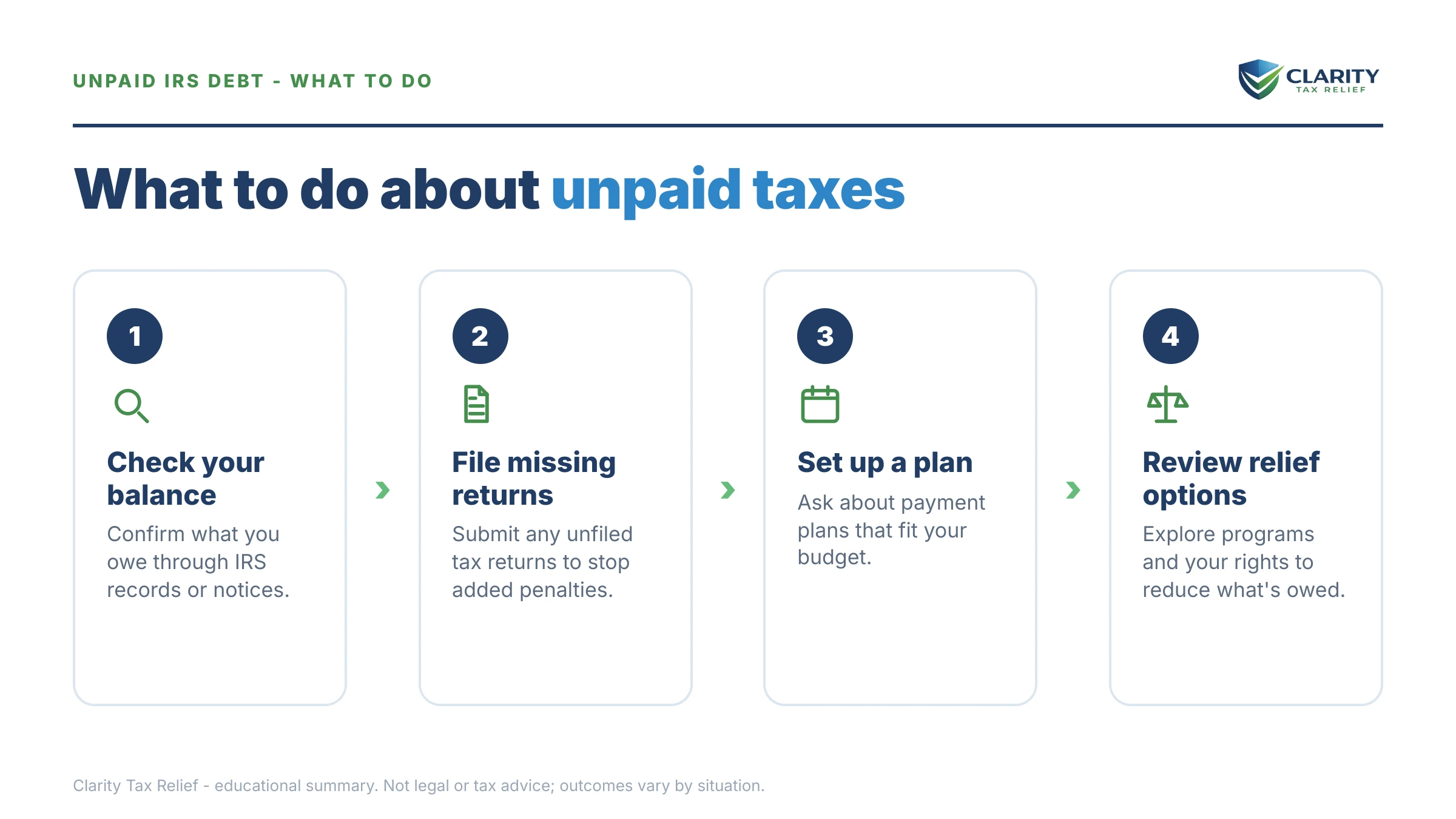
Been ignoring an IRS balance — maybe for years?
Every stage the account moves forward removes options you have today. Get your balance, notices, and transcript reviewed free by an experienced tax professional before the automated system takes the next step — no judgment, no pressure.
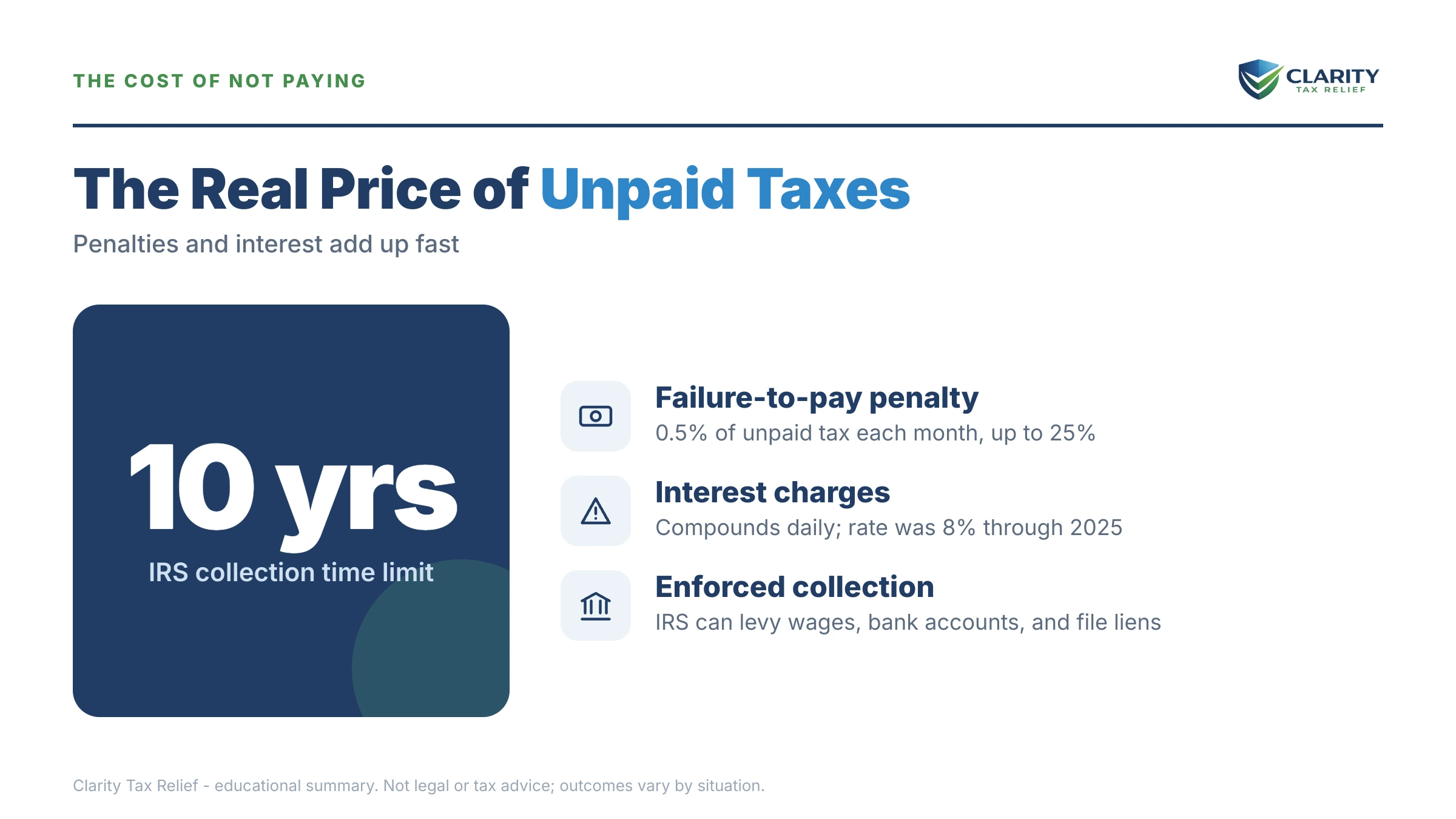
Your options at every stage — and what each one actually costs
Every IRS balance, at every stage of escalation, has at least one legal off-ramp — and most of them can be started even after a levy hits. The general playbook for working these programs on your own is in our guide to how to settle tax debt yourself; here's the eligibility map:
| Option | Who qualifies | Cost & terms |
|---|---|---|
| Short-term payment plan | Can pay in full within 180 days | $0 setup; interest and penalties continue but enforcement stops |
| Guaranteed installment agreement | Individuals only; owe $10,000 or less in income tax (excluding penalties and interest), all returns filed, and timely filing and payment for the past 5 years with no installment agreement in that period | Approval is required by law; full payment within 3 years |
| Streamlined installment agreement | Owe $50,000 or less | Up to 72 months, set up online with no financial disclosure |
| Non-streamlined payment plan | Over $50,000 | Requires Form 433 financials; terms negotiated, asset review possible |
| Currently Not Collectible | Income below IRS allowable living expenses | Collection paused; interest accrues, refunds kept, lien still possible |
| Offer in Compromise | Assets plus future income genuinely below the balance | $205 fee + 20% down on lump-sum offers (both waived for low-income filers); roughly 1 in 5 offers accepted in FY2024 |
| Penalty abatement (FTA / AEP) | Clean compliance in the prior 3 years | Removes penalties, not tax; the new Automatic Exemption from Penalty applies automatically starting summer 2026 |
Two honest notes on that table. First, an Offer in Compromise is real but means-tested — the IRS runs the math on what it could ever collect from you, and only accepted about one offer in five in FY2024. Second, hardship status is genuine relief if a job loss or crisis is why you never paid; see lost my job and can't pay the IRS and Currently Not Collectible status for how that test works. If you can pay something, comparing methods first saves money — our best way to pay the IRS comparison covers fees, processing, and which payments post fastest.
What never paying actually costs: an $83,100 example
A hypothetical makes the arithmetic concrete. Say you own a small business and owe $83,100 — $61,400 in personal income tax from two strong years you didn't set money aside for, plus $21,700 in payroll taxes withheld from employees but never deposited.
- Penalties: the failure-to-pay penalty on the $61,400 runs 0.5% per month — about $307 a month — until it caps at 25%, or roughly $15,350. That's penalty alone, before a dollar of interest.
- Interest: compounds daily on the tax and the penalties, at a rate that resets quarterly. Over years of nonpayment, interest routinely rivals the penalty total.
- Your passport: $83,100 exceeds the $66,000 certification threshold for 2026, so a CP508C and a denied passport renewal are on the table. See passport revoked for tax debt.
- Payment plan math: above $50,000, no streamlined online plan exists — the IRS wants Form 433 financials. If a negotiated plan spread the balance over 72 months, that's $83,100 ÷ 72 ≈ $1,154 a month before accruing interest, so the real payment lands higher.
- The payroll piece is different in kind: the $21,700 in withheld taxes can be assessed against you personally through the Trust Fund Recovery Penalty — it survives closing the business and generally can't be discharged in bankruptcy.
Same balance, two different futures: address it now and it's a structured monthly payment with penalty relief possibly trimming thousands. Let it ride and it's a growing six-figure problem attached to your passport, your bank, and — for the payroll portion — you personally.
How to respond, step by step
- Pull your IRS account records. Log into your IRS online account or request account transcripts to confirm every year with a balance, the total owed, and which notice stage you've reached.
- File every missing return. Unfiled years cost 5% per month in failure-to-file penalties and block every resolution program. File them first, even if you can't pay a dollar.
- Choose a resolution before the final notice. Set up a payment plan, request Currently Not Collectible status, or start an Offer in Compromise — any of these stops the escalation toward levy.
- Assert your appeal rights if an LT11 or Letter 1058 arrived. File Form 12153 within 30 days to request a Collection Due Process hearing, which pauses levy action while your case is heard.
- Get experienced help for large or payroll balances. Above $50,000, with payroll taxes involved, or with a levy already in motion, an experienced tax professional's sequencing of returns, penalties, and resolution changes what you pay.
Payments and plan setup both run through IRS.gov/payments — a payment made there posts to your account directly and stops penalty accrual on whatever it covers.
Does IRS debt expire if you never pay? The 10-year rule, honestly
The IRS's right to collect ends 10 years after assessment — the Collection Statute Expiration Date (CSED) — but the clock pauses for bankruptcy, a pending Offer in Compromise, and certain appeals. Each pause pushes the expiration later, which is why "wait out the ten years" almost never works as cleanly as internet forums suggest. You can estimate your own expiration date with our CSED Calculator, and the full reality — including how the IRS behaves in the final years — is in does IRS debt go away after 10 years.
One more caution for the run-out-the-clock strategy: states don't follow the federal 10-year rule. California's Franchise Tax Board, for example, has 20 years to collect under R&TC §19255, and New York converts unpaid tax into a tax warrant — a civil judgment and public-record lien. Outlasting the IRS doesn't outlast the state.
Never filed vs. never paid: two very different problems
The failure-to-file penalty is 5% per month — ten times the 0.5% failure-to-pay penalty — so not filing is the far more expensive silence. If you filed and simply owe, your problem is civil and financial. If you never filed, three things stack on top: the bigger penalty, the risk that the IRS files a substitute return for you with no deductions (inflating the assessed debt), and — for willful, repeated non-filing — potential criminal exposure that plain nonpayment doesn't carry.
The order of operations is therefore fixed: returns first, always, even with no money to send. Filing converts the expensive problem into the manageable one and unlocks every program in the options table above.
Business owners: unpaid payroll taxes make it personal
Withheld payroll taxes are the one debt the IRS treats as someone else's stolen money — and it pursues the people behind the business, not just the business. Through the Trust Fund Recovery Penalty, the withheld income tax and FICA can be assessed against any "responsible person" — owner, officer, sometimes a bookkeeper or check-signer — personally. Closing or dissolving the company doesn't erase it.
Payroll cases also escape the automated notice stream faster: they're the cases most likely to draw a revenue officer to your door, and the IRS moves on them while balances are smaller. One edge case worth knowing: if a payroll service collected your deposits and never remitted them, you're still liable to the IRS — but there's a specific damage-control path, covered in payroll company didn't pay taxes.
When you can handle this yourself — and when help changes the outcome
Plenty of unpaid-balance situations don't need professional help. If you owe under $10,000 or so, agree with the amount, and can commit to a monthly payment, set up the plan online yourself in twenty minutes — no firm should charge you for that. Same if you can pay in full within 180 days: the short-term plan is free to set up and ends the escalation immediately. If money is the whole problem, the Taxpayer Advocate Service and Low Income Taxpayer Clinics offer free help — start at taxpayeradvocate.irs.gov.
Experienced help earns its cost in specific situations: a levy already in motion, multiple unfiled years plus a balance, anything involving payroll or trust-fund taxes, balances over $50,000 where financial disclosure gets negotiated, and Offer in Compromise math, where the difference between an accepted and rejected offer is usually how the financial statement was built. In those cases, the sequencing — which year to fix first, which penalty to challenge, which program to request — changes the dollar outcome, not just the paperwork.
If your balance is large, involves your business, or has already produced a final notice, get a free review of your exact notices and transcript — or call (888) 825-7779 — before choosing a path on your own.
What your IRS transcript shows while you don't pay
Your account transcript logs every step of the escalation in code, often before the letter reaches your mailbox — which makes it the fastest way to find out where you really stand. These are the codes that appear on a nonpayer's account:
| Code | What it means | What to do |
|---|---|---|
| 150 | Return filed and tax assessed — this date starts the 10-year collection clock | Note the assessment date for each year; it anchors your CSED |
| 276 | Failure-to-pay penalty posted (0.5%/month) | Check whether FTA or the 2026 AEP can remove it |
| 196 | Interest assessed on the balance | Accrues until paid; abatable only for IRS error or delay |
| 971 | A notice was issued | Match the date to the letter you received to identify your stage |
| 582 | Federal tax lien filed — see code 582 transcript | Lien release or withdrawal becomes possible once you resolve the debt |
| 530 | Account placed in Currently Not Collectible status | Protect it — stay filed and current or collection reactivates |
| 480 | Offer in Compromise pending | Levies generally pause while the offer is reviewed |
Terms on your notices, decoded
- Lien vs. levy: a lien is the IRS's legal claim securing the debt against everything you own; a levy is the actual taking of money or property.
- CSED: the Collection Statute Expiration Date — when the IRS's 10-year right to collect a given assessment ends.
- CDP rights: your right to a Collection Due Process hearing before levy, requested on Form 12153 within 30 days of a final notice.
- TFRP: the Trust Fund Recovery Penalty — how a business's withheld payroll taxes become the personal debt of its responsible people.
- FPLP: the Federal Payment Levy Program — the automated system that takes up to 15% of federal payments such as Social Security.
- SFR: a Substitute for Return — the return the IRS files for you, with no deductions or credits, when you never file.
What happens if you never pay the IRS: your questions, answered
Can you go to jail for never paying the IRS?
No — simply owing the IRS and not paying is a civil matter, not a crime. Criminal cases involve willful acts: hiding income, filing false returns, or willfully refusing to file at all. If you filed honest returns and just can't pay, the IRS's tools are financial — liens and levies — not handcuffs. The picture changes for unpaid payroll taxes that were deliberately diverted, which can draw criminal attention.
Does IRS debt go away after 10 years if you never pay?
The IRS generally loses the legal right to collect 10 years after a tax is assessed — the Collection Statute Expiration Date. But the clock pauses during bankruptcy, a pending Offer in Compromise, certain appeals, and time spent outside the U.S., so the real date is often later than year ten. The IRS also tends to collect hardest in the final years, so waiting it out usually means a decade of liens and levies first.
How long before the IRS garnishes your wages if you don't pay?
The IRS cannot garnish wages until it sends a final notice of intent to levy — the LT11 or Letter 1058 — and 30 more days pass. Most accounts sit through several earlier notices first, so garnishment typically arrives many months after the first bill. Once it starts, a wage levy is continuous: it takes a slice of every paycheck until the debt is resolved or the levy is released.
Will the IRS take my house if I never pay?
Almost never — seizing a primary residence requires court approval and is the IRS's last resort, reserved for large debts with obvious equity and no cooperation. What actually happens is a federal tax lien: it attaches to your home automatically, follows the property, and makes selling or refinancing difficult until the debt is addressed. The lien is the practical threat to your house, not a padlock on the door.
What if I genuinely have no money to pay the IRS?
You may qualify for Currently Not Collectible status, which pauses levies and garnishments while your finances stay below the IRS's allowable-expense standards. You prove it with a financial statement, usually Form 433-F. The debt doesn't vanish — interest keeps accruing, refunds are kept, and a lien can still be filed — but active collection stops while you're in hardship.
Does never paying the IRS hurt your credit score?
Not directly — the credit bureaus removed tax liens from credit reports in 2018, so IRS debt doesn't lower your score by itself. But a filed Notice of Federal Tax Lien is a public record that mortgage lenders, landlords, and some employers find in background and title searches. Most home lenders will require the tax debt to be on a payment plan or resolved before closing.
Can the IRS take my Social Security if I never pay?
Yes. Through the Federal Payment Levy Program, the IRS can take up to 15% of your Social Security retirement benefits, continuously, until the debt is resolved. If the levy creates genuine hardship — you can't cover basic living expenses — you can request a release based on your finances, but you have to ask; it doesn't lift on its own.
What happens to unpaid IRS debt when you die?
The debt doesn't transfer to your children, but it doesn't vanish either — the IRS is paid from your estate before heirs receive anything, and a filed lien attaches to estate property. A surviving spouse can be liable for balances from jointly filed returns. Heirs inherit less, not the debt itself.
Is the IRS too understaffed in 2026 to actually collect?
No — the workforce was cut roughly 27% in 2025, which makes humans harder to reach, but the notices, liens, and levies are generated by automated systems that never stopped running. The practical effect is worse for you: enforcement still fires on schedule, while fixing an error or negotiating by phone takes longer. Understaffing is a reason to act early, not to wait.
Your next 24 hours
- Find your most recent IRS letter and check the notice number in its top corner (CP14, CP503, CP504, LT11). That single code tells you exactly which stage of the sequence above you're standing on.
- Gather three things: your last filed return, every IRS notice you've kept (or your IRS online account balance), and a rough picture of your monthly income and expenses — that's everything a resolution decision needs. If you're setting up a plan yourself, the official terms are at the IRS payment plans page.
- Get the free case review. Interest and penalties accrue every month the balance sits — an experienced tax professional can map your fastest stopping point in one call. Use the 2-minute form or call (888) 825-7779.
This guide is general information, not tax or legal advice for your specific situation. Eligibility for IRS programs depends on individual facts and circumstances; no outcome is guaranteed.