
Tax Planning
Prepare for 2027 Tax Season If You Owe the IRS: Your 2026 Game Plan
The short answer: if you owe the IRS heading into the 2027 tax season, do four things before January: confirm your exact balance on your transcript, get the old debt into a payment arrangement, fix your 2026 withholding so a new balance doesn't stack, and plan to file on time even if you can't pay.
The divorce papers are signed, the joint balance from your last married return is still sitting on your IRS account, and April 2027 is coming whether you're ready or not. You're not behind — you're early. This guide shows you exactly how to prepare for 2027 tax season if you owe: what the IRS will do with your next refund, how a mid-year divorce quietly changes your withholding math, and the order to fix things in so one balance doesn't become two.
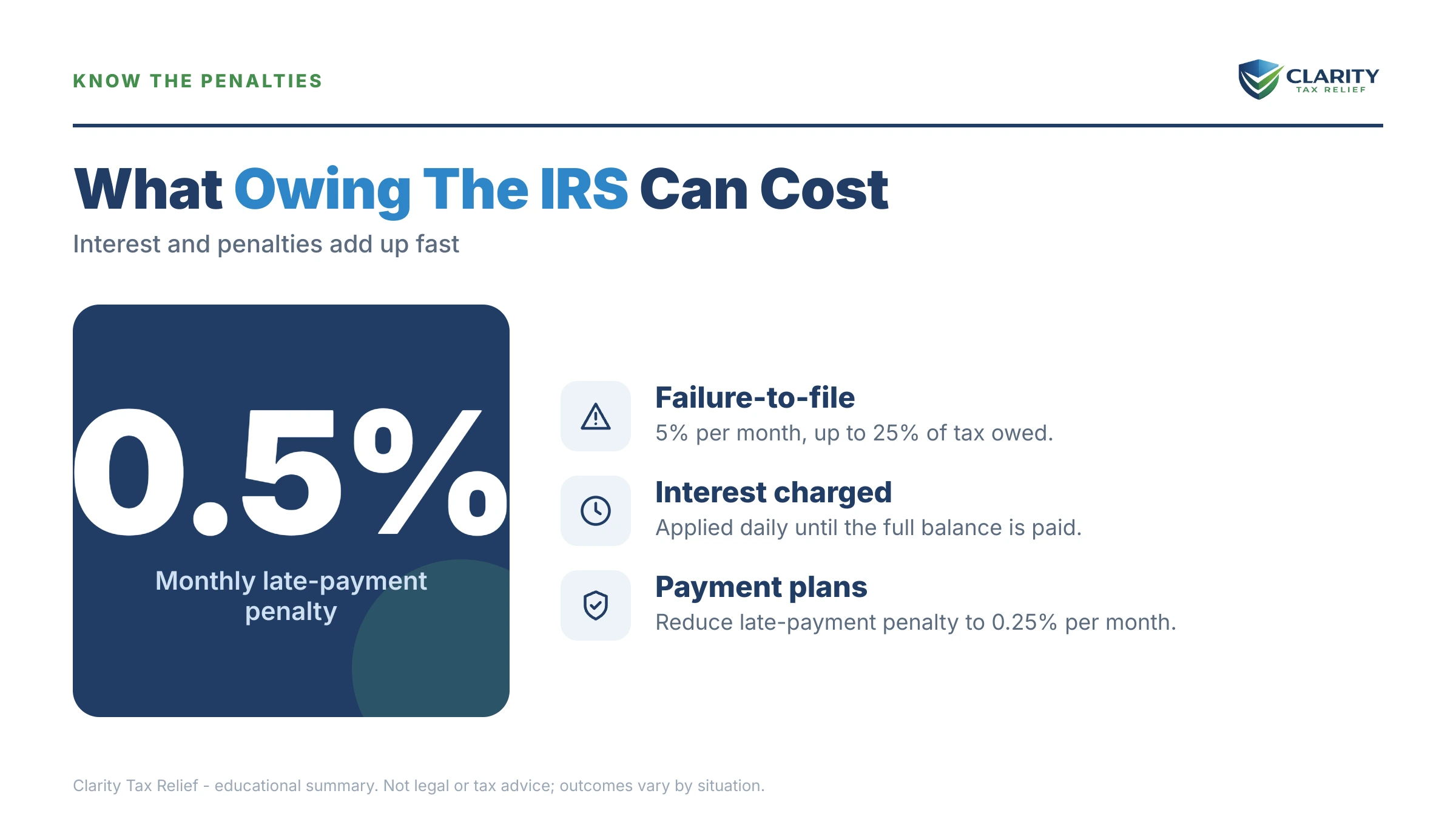
⏱ The clocks that matter: your final 2026 estimated payment is due January 15, 2027, and your 2026 return — with payment — is due April 15, 2027. In the meantime, the failure-to-pay penalty adds 0.5% of your existing balance every month, plus daily-compounding interest, until you act.

Why the 2027 filing season is different when you already owe
Any refund on the 2026 return you file in 2027 will be applied to your back taxes automatically — before you see a dollar of it. That's the first of three collisions between an old balance and a new filing season. If you were counting on a refund to cover rent, a car repair, or attorney fees, you need to know now, not in February. Here's the full picture of whether the IRS will take your refund for back taxes — the short version is yes, automatically.
The second collision is stacking. If your withholding no longer matches your life — and a mid-2026 divorce almost guarantees it doesn't — your 2026 return can produce a new balance on top of the old one. Two open balances mean two penalty streams, a bigger combined number on every notice, and fewer resolution options that fit.
The third collision hits people already on a payment plan: a new assessed balance can default an existing installment agreement. Staying current on future taxes is a condition of nearly every agreement, and a surprise 2026 balance breaks it. If you're on a plan, also know that the IRS keeps your refund while you're on a payment plan — the offset happens even when you've never missed a payment.
Divorce adds one more wrinkle none of your still-married coworkers face: your filing status, your standard deduction, your tax brackets, and possibly who claims the kids all change at once. Your marital status on December 31, 2026 controls your status for the entire year — even if the divorce was final on December 30.
What happens if you walk into the 2027 season unprepared
Nothing about an unresolved balance pauses for filing season — the IRS's automated systems run both tracks at once. Here's the sequence if you file in 2027 without preparing:
- Your refund disappears first. Weeks after your 2026 return processes, any overpayment is applied to your oldest balance. You'll see code 826 on your transcript and a CP49 notice in the mail — after the money has already moved.
- A new balance opens its own collection file. If your return shows tax due you can't pay, that year gets its own bill (a CP14) and starts its own notice sequence, separate from the old debt.
- An existing payment plan can default. The new balance violates the stay-current condition of your agreement, and a CP523 default notice can follow — putting the entire old balance back into active collection.
- The combined debt moves up the ladder. Ignored balances progress through reminder notices to a CP504 (the IRS can then seize your state refund) and eventually an LT11 final notice, which starts a 30-day clock before wages and bank accounts are reachable.
One 2026 reality makes this worse, not better: the IRS workforce shrank roughly 27% in 2025, so reaching a human to untangle a mess takes longer than ever — but the offsets, notices, and levies are automated and never stopped. The system that escalates your case didn't get smaller. The one that answers your call did.
Owe back taxes with the 2027 season approaching?
Every month you wait adds another 0.5% penalty plus interest to the balance — and the season will decide what happens to your refund whether you plan for it or not. An experienced tax professional will map your cleanest path before January, free and confidential.
Your options for the balance you already owe
Every IRS resolution option is easier to set up in the fall of 2026 than in the chaos of filing season. The full playbook for each program lives in our guide on how to settle tax debt yourself — what matters here is matching your balance to the right door before January:
| Option | Who qualifies | Cost to set up | Key trade-off |
|---|---|---|---|
| Pay in full | Anyone with the cash | $0 | Stops penalty and interest growth immediately; drains savings you may need post-divorce |
| Short-term payment plan | Most filers who can pay within 180 days | $0 setup fee | Penalties and interest keep accruing until paid off |
| Guaranteed installment agreement | Owe $10,000 or less and can pay within 3 years, with a clean filing history | Setup fee (lower with direct debit) | The IRS must accept it when you meet the conditions — no negotiation needed |
| Streamlined installment agreement | Balance of $50,000 or less; up to 72 months | Setup fee (reduced or waived for low income) | Set up online with no detailed financial disclosure |
| Currently Not Collectible | Documented hardship — paying would leave you unable to cover basic living costs | $0 | Collection pauses, but the debt remains, grows, and your refunds still get offset |
| Offer in Compromise | Assets plus future income genuinely can't cover the debt | $205 application fee (waived with low-income certification) | The IRS accepted roughly 1 in 5 offers in FY2024 — it's math-based, not negotiable |
For most people carrying a four- or five-figure balance into the 2027 season, the answer is a payment plan — here's how to set up an IRS payment plan online, usually in under an hour. Don't skip the penalty question either: if the last three years were clean before this slip, first-time abatement can remove the failure-to-pay penalty, and starting summer 2026 the IRS is rolling out an automatic exemption from penalty (AEP) that applies qualifying relief without a request. Reducing the penalty layer shrinks the balance your plan has to cover.
Stop the 2027 balance before it exists: withholding and estimated taxes
Your filing status for all of 2026 is set by your marital status on December 31, 2026 — and single-rate tax on the same income runs higher than married-rate tax. If your W-4 still says what it said before the divorce, your paychecks have been under-withholding all year. Published in July, this article catches you at the halfway point: you have roughly six months of paychecks left to close the gap.
The fix takes fifteen minutes. File a new Form W-4 with your employer reflecting single (or head of household, if a qualifying child lives with you more than half the year — it carries better brackets and a bigger standard deduction). Extra withholding in the final months of the year is treated as if paid evenly across all of 2026, which makes a late W-4 correction more powerful than a late estimated payment of the same size.
If part of your income has no withholding at all — alimony from a pre-2019 agreement, freelance work you picked up after the split, investment income from divided assets — quarterly payments on Form 1040-ES fill the gap. The remaining quarterly estimated tax deadlines for 2026 are September 15, 2026 and January 15, 2027. Self-employed after the divorce? The bill is bigger than income tax alone — see how self-employment tax adds up before you set your quarterly amount.
One more divorce-specific trap: pulling money from a 401(k) to fund the settlement, the deposit on a new place, or attorney fees. That withdrawal is taxable income, often with an early-withdrawal penalty on top, and nothing was withheld to cover it. If that's you, read the 401(k) withdrawal tax bill guide before your 2026 return surprises you — a QDRO-based transfer between spouses is treated very differently than a straight cash-out.
A worked example: divorced with $4,800 owed and one season to get ready
Say your divorce was final in March 2026 and you're carrying $4,800 from the last joint return. Here's the arithmetic, from July 2026 through the April 2027 deadline — a hypothetical, but a common one:
- Doing nothing: the failure-to-pay penalty adds 0.5% × $4,800 = $24 per month, plus daily-compounding interest. Over the roughly nine months until April 15, 2027, that's about $216 in penalty alone before interest — and the balance is still there when the season opens. You can estimate your own accrual with our IRS Penalty & Interest Calculator.
- Guaranteed installment agreement: at $4,800, you're under the $10,000 guaranteed-agreement ceiling. Paying within 3 years works out to roughly $4,800 ÷ 36 ≈ $134 per month; setting it closer to $150 helps you outrun the interest that keeps accruing on the shrinking balance.
- The refund side: if your 2026 withholding would normally produce a $1,900 refund, the offset takes it — leaving about $2,900 owed. That's a forced payment, not lost money, but you can't spend it on anything else. Budget as if the refund is already gone.
- The stacking risk: if your W-4 still reflects married rates, that $1,900 refund may not exist at all. Single-rate tax on the same salary could flip it to a balance due — and now you owe for two years instead of one, with the new balance threatening any agreement you set up on the old one.
The takeaway from the math: the plan payment ($134–$150/month) is smaller than most people fear, the refund is spoken for either way, and the W-4 fix is the only move on this list that actually prevents a problem instead of managing one.
Check your transcript before January: the codes that matter
Your IRS account transcript is the only document that shows what the IRS actually believes about your account — the balance, the penalties, and what's queued up next. Pull it now, months before the season, so nothing on it is a surprise in February. The image below shows what this preparation timeline looks like at a glance. These are the entries worth checking:
| Code | What it means | What to do |
|---|---|---|
| 150 | A return posted and tax was assessed for that year | Confirm every year you filed shows a 150 — a missing year means the IRS has no return from you |
| 276 | Failure-to-pay penalty added to the balance | Check whether first-time abatement or the new AEP relief applies before treating it as final |
| 196 | Interest charged on the unpaid balance | Nothing to dispute — but it compounds daily until the balance is resolved |
| 971 | A notice was issued on your account | Match it to the letters you've received — mail sent to a pre-divorce address may never have reached you |
| 826 | A refund was applied to another year's balance | If it happened before, expect it again in 2027 while any balance remains |
| 530 | Account placed in currently-not-collectible status | A 2026 return showing improved income can trigger a review — know that before you file |
| 480 | An offer in compromise is pending | Stay perfectly compliant — filing and paying 2026 on time is a condition of the offer being considered |
The address point deserves emphasis for anyone recently divorced: IRS notices go to the address on your last-filed return. If your ex still lives there, you may be several notices deep without knowing it. File Form 8822 to update your address, or check the notice history in your online account.
Joint debt after divorce: who actually owes it
A joint return makes both spouses liable for 100% of the tax — and your divorce decree does not change that. The decree is a contract between you and your ex, enforceable in family court; the IRS wasn't a party to it and can collect the full $4,800 from whichever of you is easier to reach. If your decree assigns the debt to your ex and the IRS comes to you anyway, your remedy against your ex runs through family court, not the IRS. The full breakdown is in divorce and IRS debt: who pays.
There is one real exception: if the balance traces to your ex-spouse's income, unreported earnings, or errors you didn't know about and had no reason to know about, innocent spouse relief on Form 8857 can move the liability off you entirely. It's a facts-and-circumstances determination, not a checkbox — but a mid-divorce discovery that your ex under-reported side income is exactly the pattern it exists for. Requesting it is time-sensitive, so raise it early rather than after the balance has been offset out of your refunds for two years.
How to prepare for 2027 tax season if you owe: five steps
Everything above compresses into five moves, in this order:
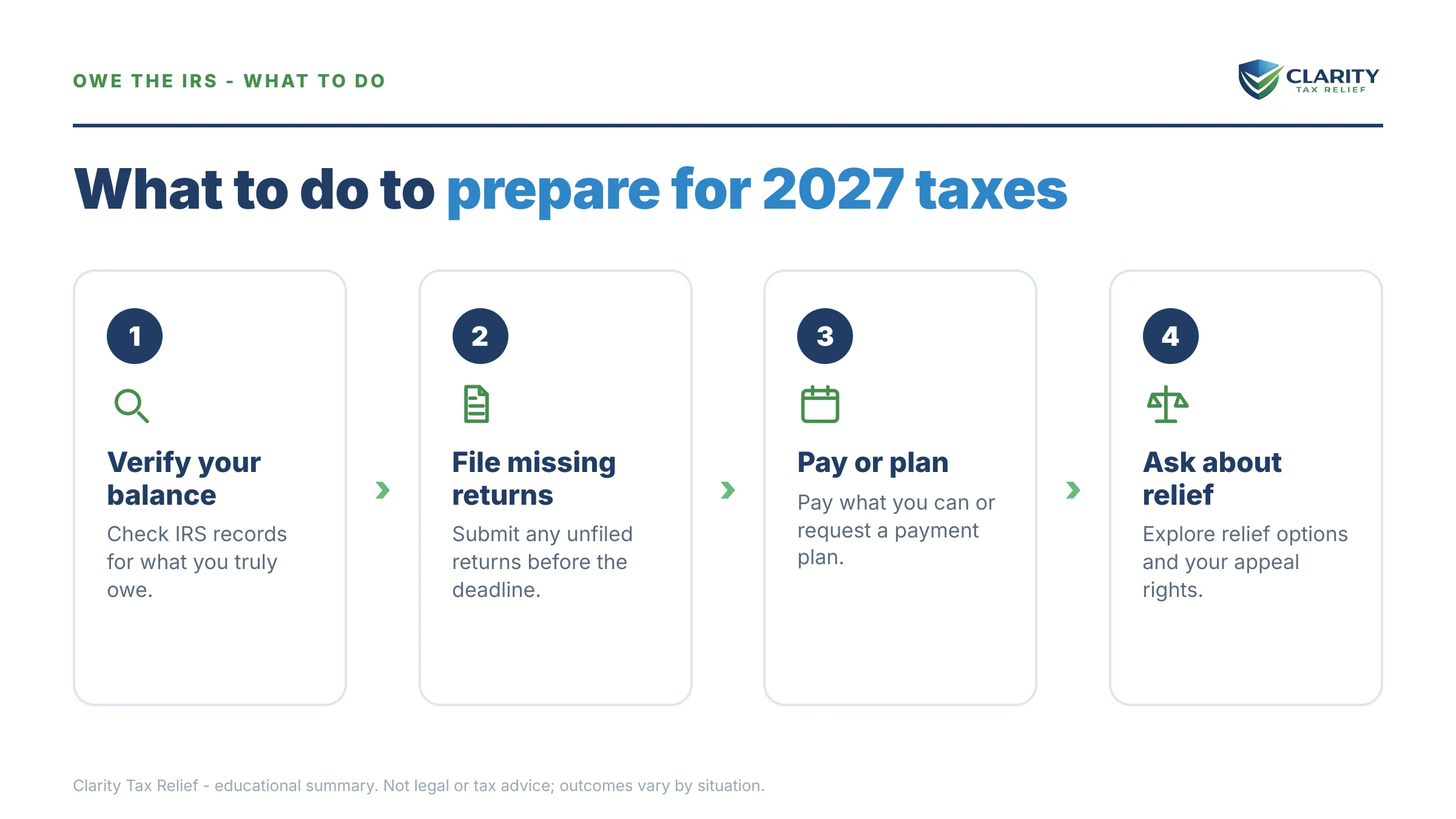
- Pull your records. Log into your IRS online account, note your exact balance by year, and download your account transcript.
- Resolve the old balance. Set up a payment plan, request hardship status, or explore settlement before the filing season opens in January.
- Fix your withholding. Submit a new Form W-4 reflecting your post-divorce filing status, or schedule the January 15, 2027 estimated payment if you have non-wage income.
- Gather your documents early. Collect last year's return, your divorce decree date, W-2s and 1099s as they arrive, and records of every payment you've already made to the IRS.
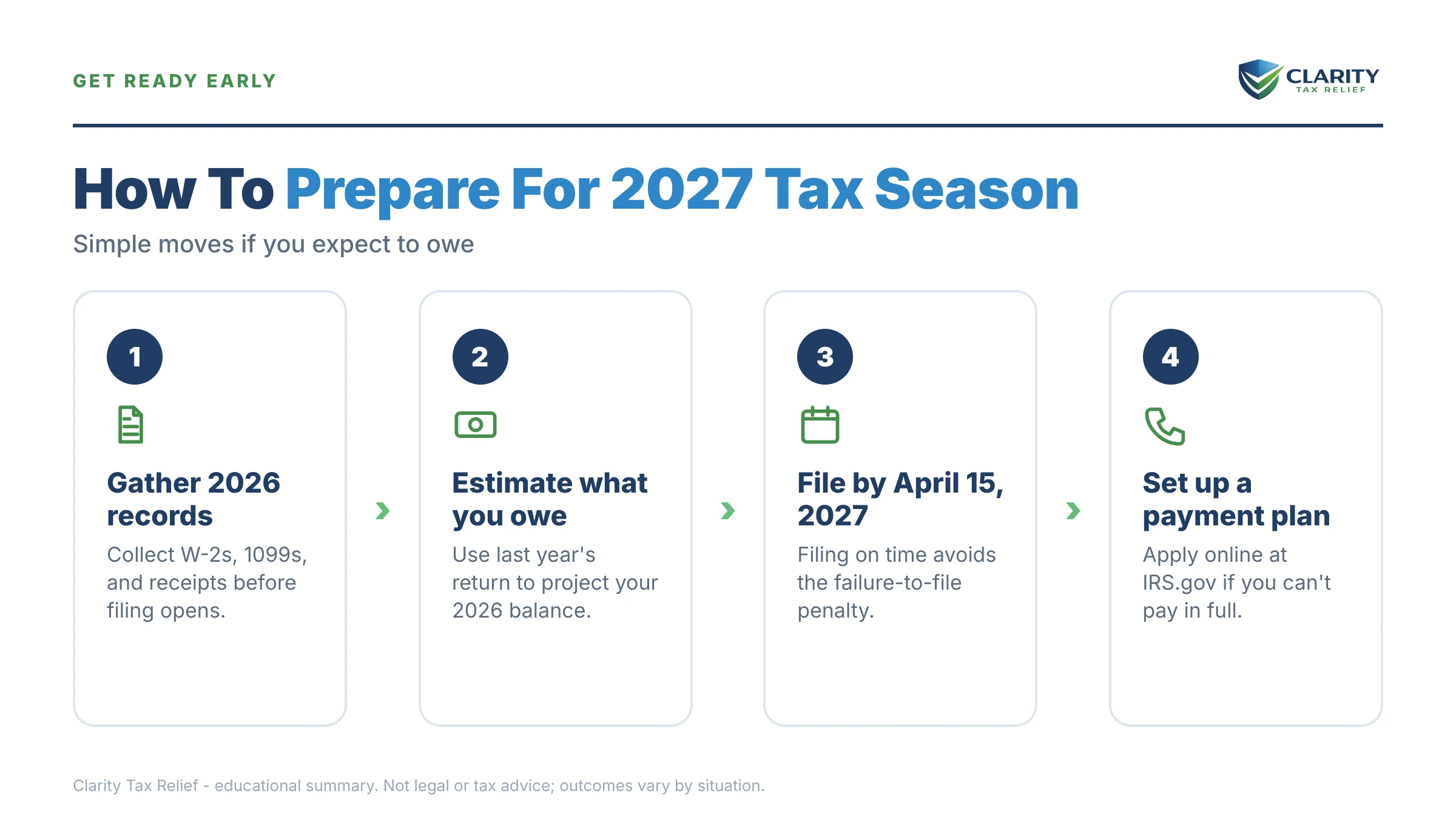
- File on time in 2027 — even if you can't pay. Filing by April 15, 2027 avoids the 5%-per-month failure-to-file penalty; pay what you can and arrange the rest.
Step 3 is the one people skip, and it's the only one that prevents next year's problem. The IRS's own Tax Withholding Estimator takes about ten minutes with a recent paystub and tells you exactly what to put on the new W-4. Step 5 matters more than it sounds: the failure-to-file penalty is ten times the failure-to-pay penalty — and in months where both penalties apply, the failure-to-file portion drops to 4.5% (5% combined) — the math behind filing even when you can't pay is the most lopsided decision in the entire tax code.
When you can handle this yourself — and when help changes the outcome
Most people with a single-year balance under $50,000 can do this preparation without hiring anyone. If you owe one year, agree with the amount, and your income is straightforward, the sequence above — transcript, online payment plan, new W-4, file on time — is genuinely a do-it-yourself project. The online agreement application at IRS.gov's payment plans page exists precisely so you don't need a middleman, and any payment you make goes through IRS.gov/payments directly.
Experienced help earns its cost in specific situations: multiple unfiled years that need to be filed in the right order before any agreement is possible; a balance that traces to your ex and needs an innocent spouse case built properly the first time; a payment plan already in default with enforcement resuming; self-employment income that makes the hardship or offer math genuinely complicated; or an offer in compromise, where the difference between an accepted and rejected offer is usually how the financial disclosure was prepared — not the underlying facts. If none of those describe you, save the money and run the five steps.
Terms you'll keep seeing, decoded
- Refund offset — the automatic application of your current-year refund to a prior-year balance; you learn about it from a CP49 notice after the money has moved.
- Code 826 — the transcript entry recording that your refund was transferred to another tax year's balance.
- Joint and several liability — on a joint return, each spouse owes the full amount, regardless of what a divorce decree says.
- Safe harbor — the prior-year payment threshold that shields you from the estimated-tax underpayment penalty even if you end up owing at filing.
- CP523 — the notice telling you your installment agreement has defaulted and enforcement can resume on the whole balance.
- CSED — the 10-year deadline the IRS has to collect each assessed balance; certain actions, like a pending offer or bankruptcy, pause the clock.
Preparing to file when you owe: your questions answered
Will the IRS take my 2026 refund if I owe back taxes?
Yes — refund offset is automatic, and it happens even if you're on a payment plan in good standing. Your 2026 overpayment is applied to your oldest balance first and shows up as code 826 on your transcript. The main exception is an offset bypass refund, which the IRS grants only for documented severe financial hardship before your refund is processed.
Should I file my 2026 return on time if I can't pay what it shows?
Yes, always. The failure-to-file penalty runs 5% per month while the failure-to-pay penalty runs 0.5% per month — filing on time cuts your penalty exposure by roughly 90% even if you send no money with the return. You can request a payment arrangement for the new balance the same day you file.
Will a new balance for 2026 default my existing IRS payment plan?
It can. Most installment agreements require you to stay current on all future filings and payments, so a new assessed balance can trigger a CP523 default notice. If you see a 2026 balance coming, contact the IRS before you file to ask about adding the new year to your agreement — and fix your withholding so the same thing doesn't happen in 2028.
Am I still responsible for tax debt from a joint return after my divorce?
Yes. Joint returns carry joint and several liability, meaning the IRS can collect the full amount from either spouse regardless of what your divorce decree says. The decree binds your ex, not the IRS. If the debt came from your ex-spouse's income or errors you didn't know about, innocent spouse relief on Form 8857 may shift the liability.
How should I change my withholding after a divorce?
File a new Form W-4 with your employer as soon as the divorce is final, because your filing status for all of 2026 is determined by your marital status on December 31, 2026. Married-rate withholding is lower than single-rate withholding, so leaving an old W-4 in place usually means owing at filing time. If a qualifying child lives with you most of the year, head of household status softens the hit.
Can I set up a payment plan before the 2027 filing season starts?
Yes, and mid-year is the best time to do it. Balances of $50,000 or less can typically be set up online with terms up to 72 months, without submitting detailed financial statements. Getting the old balance into an agreement before January means the only thing you're managing during filing season is the new return.
What happens if I skip filing in 2027 because I know I'll owe?
The debt grows faster and your options shrink. The failure-to-file penalty adds 5% per month up to 25%, the IRS can eventually file a substitute return that ignores your deductions, and any refund you were actually owed is forfeited if you wait more than three years to claim it. Not filing is the single most expensive choice available to you.
Does the IRS penalize me for not making estimated payments in 2026?
It can — the underpayment penalty applies when you haven't paid in enough through withholding or quarterly payments during the year. You're generally protected if your 2026 payments at least equal your total tax from the prior year (higher earners need 110%). Extra paycheck withholding late in 2026 is treated as if paid evenly all year, which makes it the easiest late-year fix.
Your next 24 hours
- Find your real number. Log into (or create) your IRS online account and write down the exact balance for each year — plus the year-to-date federal withholding on your most recent paystub. Those two figures drive every other decision.
- Gather three documents. Your last-filed return, your divorce decree (the final date matters for filing status), and any IRS notices or payment confirmations you have — even the ones that went to your old address.
- Get a free case review. An experienced tax professional will confirm which option fits your balance, whether penalty relief applies, and how to keep a new 2026 balance off the pile — before interest and penalties add another month's growth. Call (888) 825-7779 or use the 2-minute form.
This guide is general information, not tax or legal advice for your specific situation. Eligibility for IRS programs depends on individual facts and circumstances; no outcome is guaranteed.