
City Guides
Tax Relief in San Francisco: Resolving IRS and California Tax Debt (2026)
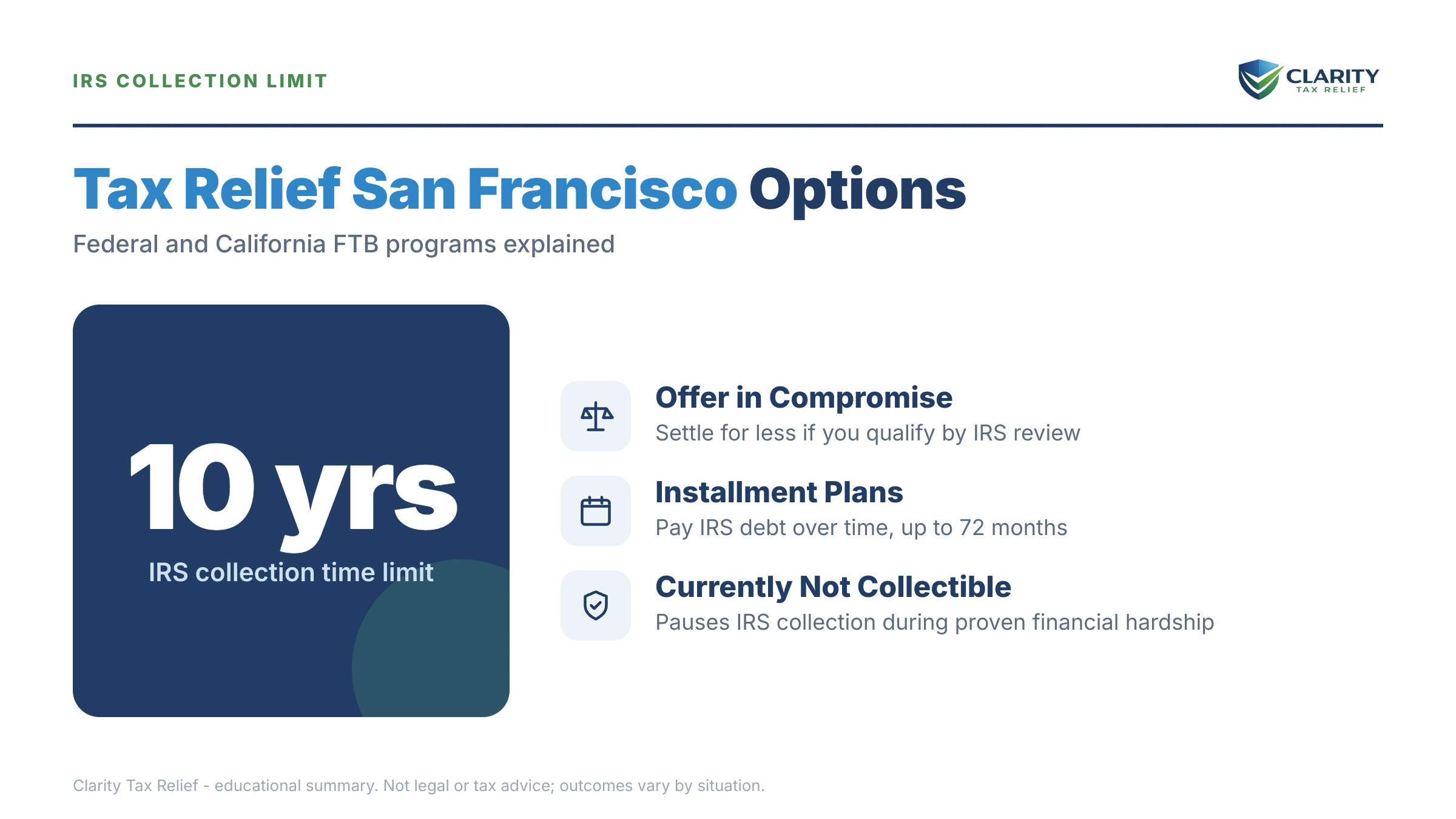
The short answer: tax relief in San Francisco usually means resolving debt with more than one agency — the IRS plus California's FTB, and for business owners, often the CDTFA and EDD too. The IRS has 10 years to collect; the FTB has 20. Real options include payment plans, hardship status, penalty relief, and Offers in Compromise.
If you're searching for tax relief San Francisco taxpayers can actually use, here's the hard truth up front: your mailbox can carry letters from Fresno (IRS), Sacramento (FTB), and — if you run a business — the CDTFA and EDD, all at the same time, each collecting on its own schedule. You're trying to make payroll, keep the doors open in one of the country's most expensive cities, and now the government wants a number you don't have.
The good news is that every one of those agencies has a defined path to resolution, and San Francisco's brutal cost of living actually works in your favor in some of the math. This guide maps all of it.
⏱ The real clock: there's no single deadline on tax debt itself — but the meter never stops. The IRS failure-to-pay penalty adds 0.5% of your balance every month, interest compounds on top, and California stacks its own penalties and interest in parallel. Every month of waiting raises the price of every option below.
Why tax relief in San Francisco means dealing with up to four agencies
A San Francisco taxpayer with back taxes can owe up to four separate collectors — the IRS, the Franchise Tax Board (FTB), the CDTFA, and the EDD — each with its own notices, statutes, and programs. Resolving one does nothing to stop the others.
The one that surprises people most is the state's staying power. The FTB has 20 years to collect a California income tax debt under R&TC §19255 — double the IRS's 10-year window. We cover the details in our guide to California's 20-year collection statute, but the practical takeaway is simple: a state balance won't quietly expire.
If you own a San Francisco business with employees, the map gets wider. Unpaid payroll taxes trigger the federal 941 back taxes track, sales tax belongs to the CDTFA, and state payroll taxes belong to the EDD — which, like the IRS, can assess certain owners and officers personally. Our California EDD payroll tax guide covers that exposure in depth.
Here's the field guide to who's writing you and what each one can do:
| Agency | What it collects | Collection window | First move |
|---|---|---|---|
| IRS | Federal income tax, self-employment tax, 941 payroll tax | 10 years from assessment (CSED), pausable by appeals, offers, bankruptcy | IRS online account; online payment plan if you owe ≤ $50,000 |
| FTB (Franchise Tax Board) | California personal and business income tax | 20 years (R&TC §19255) | MyFTB account; an FTB payment plan |
| CDTFA | Sales and use tax (retail, restaurants, e-commerce) | State-specific; treat as high-priority trust-fund-style debt | A CDTFA payment plan before enforcement starts |
| EDD | State payroll taxes (UI, ETT, SDI, PIT withholding) | State-specific; can assess responsible individuals personally | Respond to any assessment notice immediately; verify the numbers |
One more San Francisco layer: the city itself taxes businesses through its gross receipts tax, administered by the SF Office of the Treasurer & Tax Collector. It's a separate obligation from everything above — if you've fallen behind on it, contact that office directly, because none of the state or federal programs touch it.
What happens if you ignore IRS and California tax debt
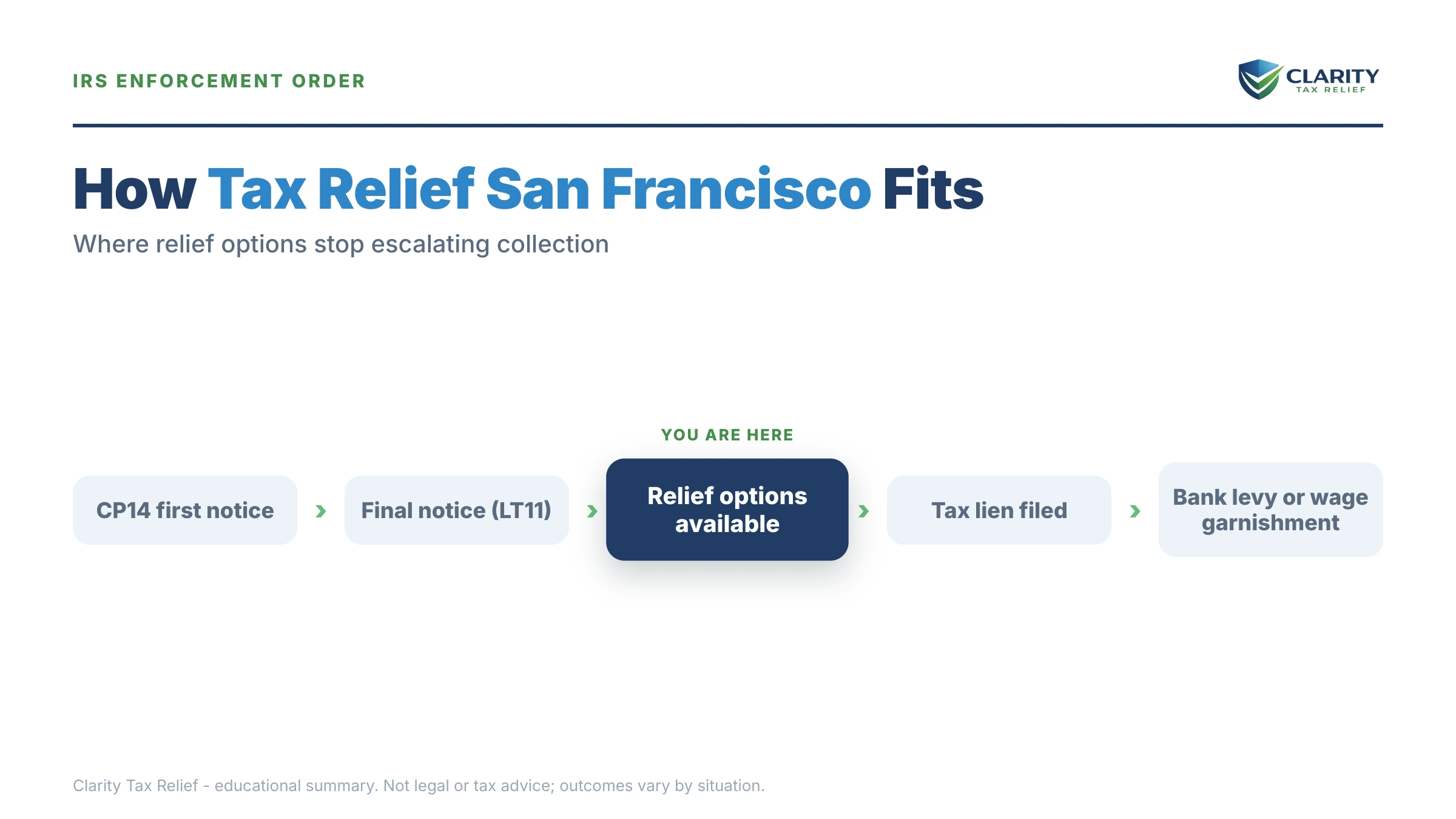
IRS collection runs on an automated notice sequence that escalates whether or not a human ever reviews your file — and California runs its own track alongside it. Here's the federal order of operations:
- CP14 — the first bill. Typically about 21 days to pay before the sequence advances. No enforcement yet, and the cheapest moment to act.
- CP501 / CP503 — reminder notices. Still just bills, but penalties and interest are compounding monthly.
- CP504 — Notice of Intent to Levy. The IRS can now take your state tax refund, and a federal tax lien becomes a live possibility.
- LT11 / Letter 1058 — Final Notice of Intent to Levy. A 30-day clock starts, along with your Collection Due Process appeal rights (Form 12153). After it runs, the IRS can levy.
- Levy stage — a bank levy freezes funds for a 21-day hold before the money leaves; a wage levy is continuous until released. If your combined federal debt grows past $66,000 (the 2026 threshold), the IRS can also certify you to the State Department for passport denial or revocation.
The FTB doesn't wait its turn. It issues its own intent-to-levy notices and moves to bank levies and wage withholding on a faster, less layered track than the IRS — many Bay Area taxpayers feel Sacramento's enforcement before the federal side. Our California FTB back taxes hub walks through the state sequence.
And a note about 2026 specifically: the IRS workforce shrank roughly 27% in 2025, which means longer holds when you call — but the notice and levy systems are automated and never slowed down. Being unable to reach a human does not pause the machine.
Facing the IRS and California at the same time?
Multi-agency debt is exactly where sequencing matters — which balance to resolve first, and how. Get your San Francisco case reviewed free by an experienced tax professional before penalties add another month's cost.
Your tax relief options in San Francisco
Every legitimate resolution program is means-tested — what fits depends on the balance, who's collecting, and what your finances show. For the full mechanics of each program, our guide on how to settle tax debt yourself is the deep dive; here's the San Francisco-specific matrix:
| Option | Who it fits | Key thresholds & costs |
|---|---|---|
| IRS short-term payment plan | Can full-pay within 180 days | $0 setup; interest and penalties continue until paid |
| IRS installment agreement | Steady income, balance ≤ $50,000 | Up to 72 months, applied for online; setup fee varies (lower with direct debit) |
| Offer in Compromise (Form 656) | Collection potential genuinely below the balance | $205 fee + 20% down on lump-sum offers (both waived if AGI ≤ 250% of poverty); ~1 in 5 accepted in FY2024 |
| Currently Not Collectible (Form 433-F) | Allowable living expenses consume your income | $0; collection pauses, but the debt and interest remain |
| Penalty abatement (FTA / AEP) | Clean compliance the prior 3 years, or reasonable cause | $0; removes penalties, not the underlying tax |
| FTB installment agreement | California income tax balances | Separate application from the IRS; the FTB also runs its own OIC and hardship programs |
| CDTFA / EDD arrangements | Business sales-tax or state payroll debt | Stricter terms; personal liability risk for responsible individuals |
Two of these deserve San Francisco-specific notes.
The Offer in Compromise math can favor SF residents. The IRS decides what you can afford using its allowable living expense standards, and the housing and utility allowance is set by county — San Francisco County's is among the highest in the nation. Your offer amount is driven by Reasonable Collection Potential (RCP): roughly, your asset equity plus your monthly remaining income multiplied by a set number of months (12 for lump-sum offers). High allowable expenses shrink that remaining income, which shrinks the offer the IRS will accept. You can estimate your own offer with our Offer in Compromise Calculator before deciding whether it's worth pursuing — but remember the flip side: Bay Area income and home equity push RCP up, and the IRS accepted only about 1 in 5 offers in FY2024.
Payroll debt plays by harsher rules. If your business is behind on 941 deposits, the withheld-from-employees portion is "trust fund" money, and the IRS can assess it against you personally through the Trust Fund Recovery Penalty — an LLC or corporation does not shield you. Payment plans for in-business payroll debt exist but carry tighter thresholds than individual plans, and offers on trust-fund debt are rare. If that's your situation, our tax relief for small business guide is written for you.
On penalties, one 2026 change worth knowing: First-Time Abatement is being replaced by the Automatic Exemption from Penalty (AEP) starting summer 2026, which applies automatically with no request needed. If your penalties predate that, an FTA or reasonable-cause request is still the path — and the FTB runs its own separate abatement process for the state side.
What resolving $31,200 in San Francisco actually looks like: a worked example
A hypothetical makes the trade-offs concrete. Say you own a small Richmond District business with three employees and owe the IRS $31,200 on your personal return — two strong years of pass-through income, no estimated payments. Here's the same debt through four doors:
- Do nothing: the failure-to-pay penalty alone runs 0.5% × $31,200 ≈ $156 the first month, with interest compounding on top — and the notice sequence above marches toward levy.
- Short-term plan (180 days): $31,200 ÷ 6 ≈ $5,200/month. Steep, but $0 setup and the least total interest of any stretched option.
- 72-month installment agreement: $31,200 is under the $50,000 online threshold, so no financial disclosure package is required. The minimum is $31,200 ÷ 72 ≈ $434/month — though interest and penalties keep accruing, so paying faster than the minimum saves real money.
- Offer in Compromise: suppose your business equipment and accounts net $4,000 in reachable equity, and after San Francisco County's housing standard and your other allowable expenses, your remaining monthly income is $200. A lump-sum RCP would be roughly $4,000 + ($200 × 12) = $10,400 — well below $31,200, so an offer is worth analyzing. If your remaining income were $2,500 instead, RCP jumps past the balance and the offer fails; the numbers decide, not the wanting.
Now add the twist most San Francisco owners face: if $10,000 of that were 941 payroll debt instead of income tax, that slice couldn't ride along in a personal offer — it would need its own business-side resolution, and fast, before a Trust Fund Recovery Penalty assessment doubles your exposure.
How to start resolving tax debt in San Francisco, step by step
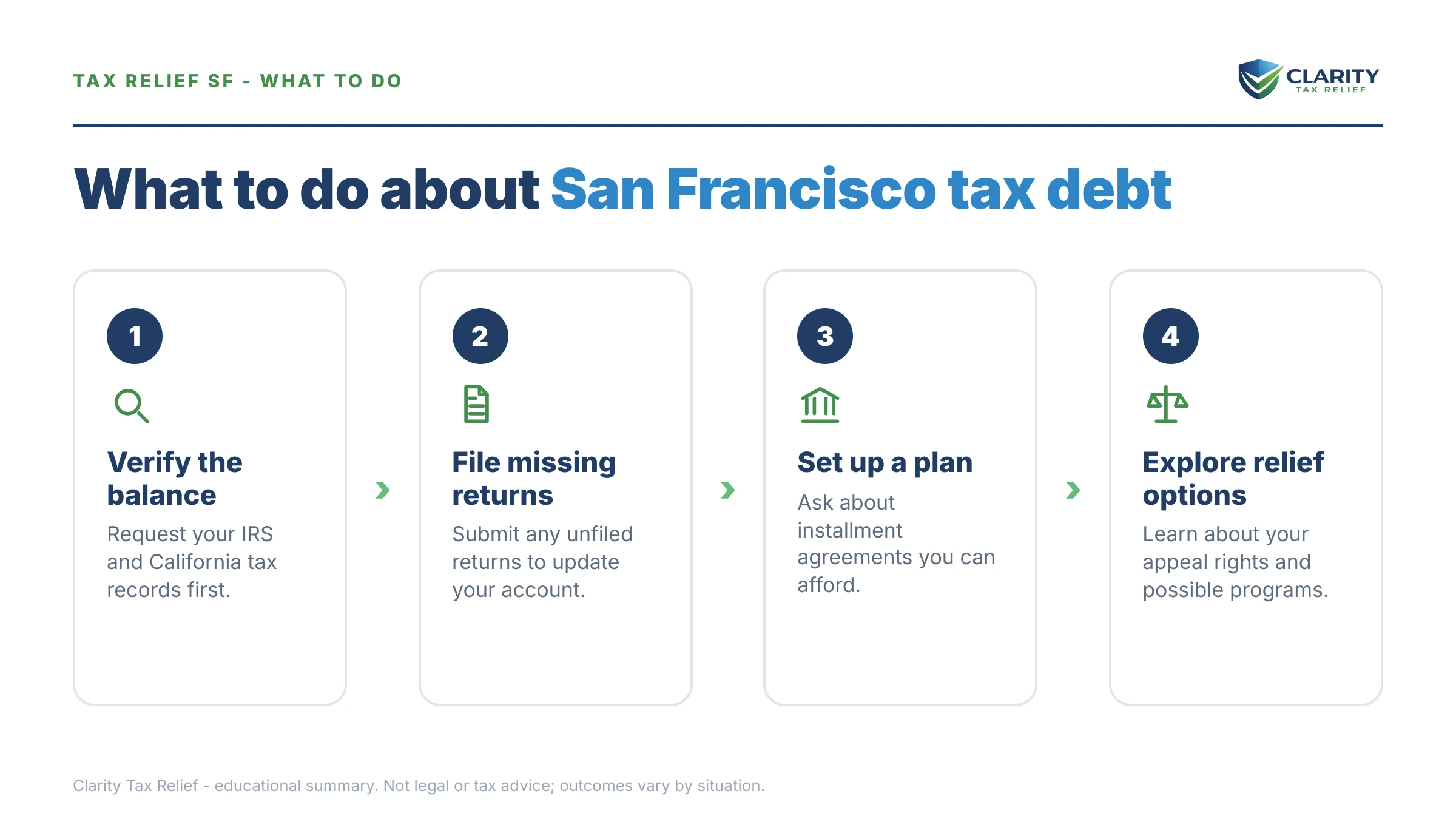
- Pull your records from every agency. Create an IRS online account and a MyFTB account to see exact balances, tax years, and any levy or lien activity — the notices in your mailbox are often weeks behind the system.
- File every missing return. No agency will approve a payment plan, hardship status, or offer while returns are unfiled. Get federal and California filings current first, even if you can't pay a dollar.
- Match each balance to an option. Use the options table above: full-pay within 180 days, a monthly installment agreement, hardship status, penalty relief, or an Offer in Compromise where the math supports it — separately for the IRS and the state.
- Set up the resolution before enforcement starts. Apply online for IRS plans under $50,000; contact the FTB, CDTFA, or EDD directly for state arrangements. An agreement in place stops the escalation sequence.
- Get a professional review if the case is layered. Payroll taxes, multiple agencies, unfiled years, or balances above roughly $25,000 are where an experienced tax professional typically changes the outcome — start with a free case review.
When you can handle this yourself — and when help changes the outcome
Plenty of San Francisco tax problems don't need a professional, and it would be dishonest to pretend otherwise. If you owe one agency, agree with the number, and can pay within 180 days or set up a plan under $50,000 online, do it yourself — it takes an evening, and the setup instructions are free on the agency websites.
Experienced help earns its cost in a narrower set of situations: a levy or garnishment already in motion, payroll or trust-fund debt where personal liability is on the table, multiple unfiled years across both federal and state systems, an EDD or CDTFA assessment you dispute, or Offer in Compromise math where a documentation mistake means a rejected offer and a lost year. Those are the cases where sequencing and presentation genuinely move the result.
If you do hire someone, hire carefully — this industry has real predators. Our checklist on how to choose a tax relief company covers the questions to ask before signing anything, and anyone promising to settle your debt for "pennies on the dollar" before seeing your financials is running the exact pitch federal regulators have shut firms down over.
Terms on your California and IRS notices, decoded
- FTB: the Franchise Tax Board — California's income tax collector, with a 20-year collection window.
- CDTFA: the California Department of Tax and Fee Administration — collects sales and use tax from businesses.
- EDD: the Employment Development Department — collects California payroll taxes and can assess responsible individuals personally.
- CSED: Collection Statute Expiration Date — the end of the IRS's 10-year collection window, pausable by appeals, offers, and bankruptcy.
- TFRP: Trust Fund Recovery Penalty — the IRS's tool for assessing a business's withheld payroll taxes against owners and officers personally.
- RCP: Reasonable Collection Potential — the asset-plus-future-income formula that decides whether an Offer in Compromise can be accepted.
Tax relief San Francisco: your questions, answered
Does the IRS have an office in San Francisco?
Yes — the IRS operates a Taxpayer Assistance Center in San Francisco, but it works by appointment only (call 844-545-5640 to schedule). You rarely need to go in person: payment plans, transcripts, and most resolutions are handled online or by phone, and an experienced tax professional can represent you from anywhere with a signed Form 2848 power of attorney.
Why does California have longer to collect back taxes than the IRS?
State law gives the Franchise Tax Board 20 years from the date a liability becomes due and payable to collect, under Revenue and Taxation Code §19255 — double the IRS's 10-year window. That means a California balance you could theoretically outlast federally will follow you for two decades. Waiting out the FTB is almost never a realistic strategy; resolving the state side directly is.
Does San Francisco's high cost of living help me qualify for an Offer in Compromise?
It can. The IRS measures what you can afford using county-based housing and utility standards, and San Francisco County's allowances are among the highest in the country — higher allowable expenses mean less "remaining income" in the offer math. But it cuts both ways: strong Bay Area income or home equity raises what the IRS believes it can collect. You may qualify only if your total collection potential is genuinely below your balance.
Can I settle payroll taxes my San Francisco business owes?
Rarely, and never easily — the trust-fund portion of 941 debt (the taxes withheld from employees' paychecks) is the debt the IRS protects most aggressively. Owners, officers, and even bookkeepers can be assessed personally through the Trust Fund Recovery Penalty. Payment plans for in-business payroll debt exist, but the thresholds are tighter than individual plans, and acting before a revenue officer is assigned preserves far more options.
Should I resolve my IRS debt or my FTB debt first?
Prioritize whichever agency is closest to levying — a final notice of intent to levy from either one outranks a first bill from the other. All else equal, many taxpayers address the FTB early because it moves to bank levies and wage withholding faster than the IRS's slower, multi-notice sequence. Ideally you set up arrangements with both, since neither agency pauses because you're paying the other.
Do I need a local San Francisco tax attorney, or can any firm help?
IRS representation is federal — an enrolled agent, CPA, or attorney with a signed Form 2848 can represent you before the IRS from anywhere in the country, and the FTB, CDTFA, and EDD all accept remote representation too. Location matters far less than experience with your specific problem. A tax attorney specifically becomes important mainly when there's potential criminal exposure or you're headed to Tax Court.
Can the FTB suspend my LLC or my professional license?
Yes to both, in specific situations. The FTB can suspend a California LLC or corporation that fails to file returns or pay its balance, which voids the entity's ability to legally do business or enforce contracts. Separately, California can suspend the professional and driver's licenses of taxpayers who land on the FTB's Top 500 delinquent list. Both are strong reasons for business owners to resolve state balances before enforcement starts.
Your next 24 hours
- Sort your letters by agency. Find the notice code (top right corner) and date on every letter you've received, and stack them into IRS, FTB, CDTFA, and EDD piles — the pile with an "intent to levy" notice is your front burner.
- Gather your baseline documents. Your last filed federal and California returns, the notices themselves, and — if you have employees — your recent payroll records and 941 filings.
- Get a free case review. Send us what you've got at the 2-minute form or call (888) 825-7779. An experienced tax professional will map every balance to its best-fit program — before another month of penalties and interest gets added to each one.
Primary sources: the IRS's official payment plans and installment agreements page covers federal plan setup; the California Franchise Tax Board handles state income tax balances; and the CDTFA handles sales and use tax accounts.
This guide is general information, not tax or legal advice for your specific situation. Eligibility for IRS programs depends on individual facts and circumstances; no outcome is guaranteed.