
City Guides
Tax Relief in Oakland: Your Real IRS, FTB, and Payroll Tax Options (2026)
The short answer: tax relief in Oakland means resolving debt with up to four agencies — the IRS, California's Franchise Tax Board (FTB), the CDTFA, and the EDD. Real options include IRS payment plans up to 72 months, an Offer in Compromise, hardship status, and penalty relief. The FTB gets 20 years to collect — twice the IRS's 10.
You're running a business off Telegraph or Grand, payroll is due Friday, and the stack of envelopes on your desk isn't just from the IRS — there's one from Sacramento too. That's the part most national "tax relief" articles miss about Oakland: you're not negotiating with one collector. This guide maps all of them, and the fastest way through.
Here's the good news up front: every agency you owe has a formal resolution program, and the order you use them in is the whole game. Fix the order, and a scary stack of letters becomes a monthly payment you can actually budget around.
⏱ The real clock: there's no single deadline on tax debt itself — but the meter never stops. The IRS adds a 0.5% per month failure-to-pay penalty plus daily-compounding interest, and California's FTB has 20 years from assessment to collect (R&TC §19255) versus the IRS's 10. Every month of waiting raises the price of every option below.
Why Oakland tax debt is often a four-agency problem
An Oakland taxpayer with business income can owe four separate tax agencies at the same time — and each one collects on its own track, with its own notices and its own statute. Resolving one does nothing to stop the other three. Here's who's who:
| Agency | What it collects | Key fact for Oakland taxpayers |
|---|---|---|
| IRS (federal) | Income tax, self-employment tax, payroll (Form 941) taxes | 10-year collection statute; automated levy system kept running through the 2025 workforce cuts |
| Franchise Tax Board (FTB) | California personal and business income tax | 20 years to collect under R&TC §19255 — double the IRS window |
| CDTFA | California sales and use tax | Trust-fund sales tax can follow owners personally, even after the business closes |
| EDD | California payroll taxes (UI, SDI, PIT withholding) | Can assess responsible owners and officers personally for unpaid payroll taxes |
If your debt is primarily state-side, start with our California FTB back taxes hub. If you collect sales tax at a shop or restaurant, the CDTFA payment plan process runs separately from everything federal. And if you have employees, California EDD payroll tax debt carries personal-liability exposure that ordinary income tax debt doesn't.
One more Oakland-specific wrinkle: the City of Oakland administers its own business license tax on gross receipts. It's a separate city obligation — falling behind on it won't trigger the IRS, but it can hold up your business license renewal, so keep it on your map even though this guide focuses on the IRS and state agencies.
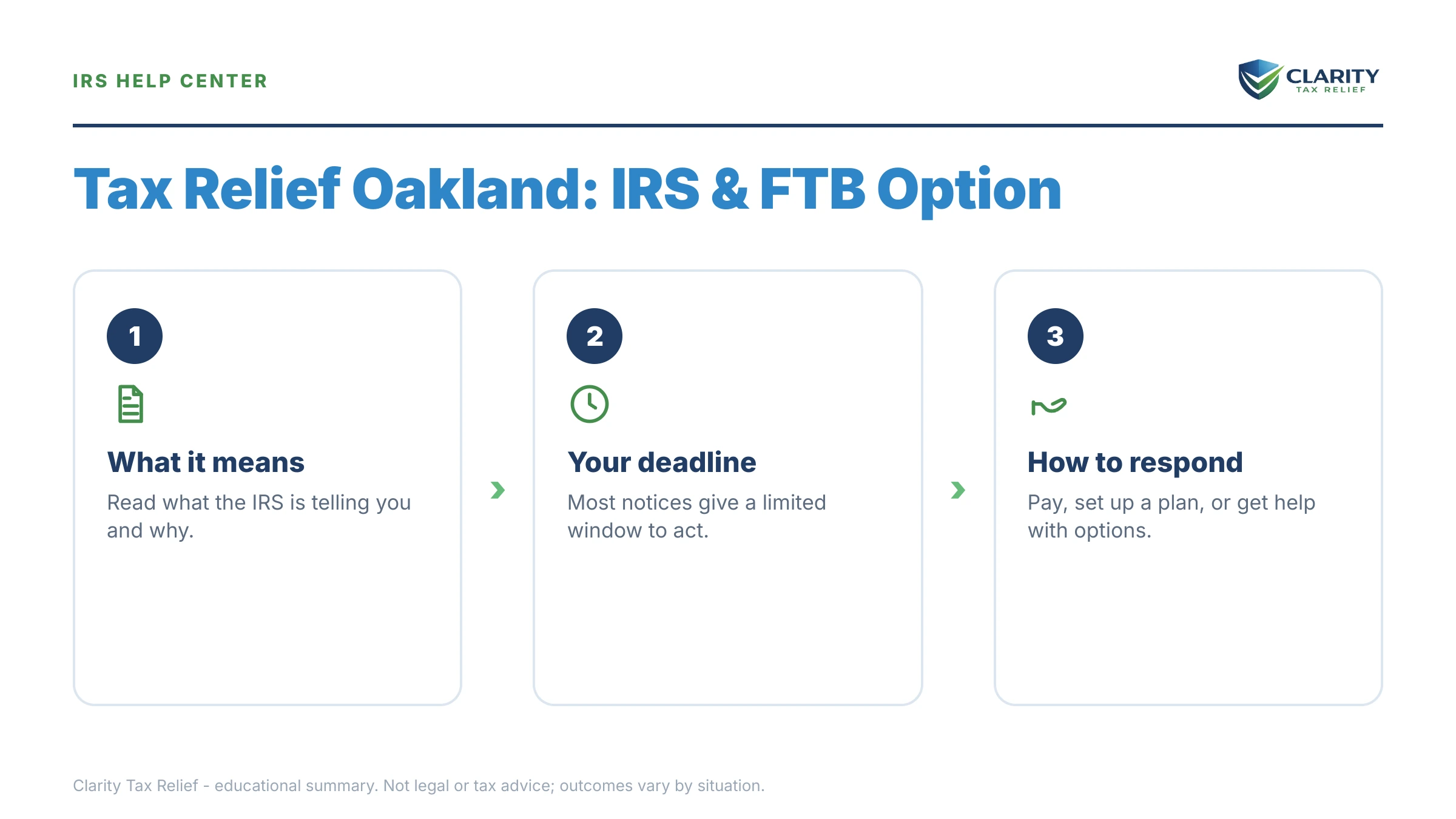
What happens if you ignore tax debt in Oakland
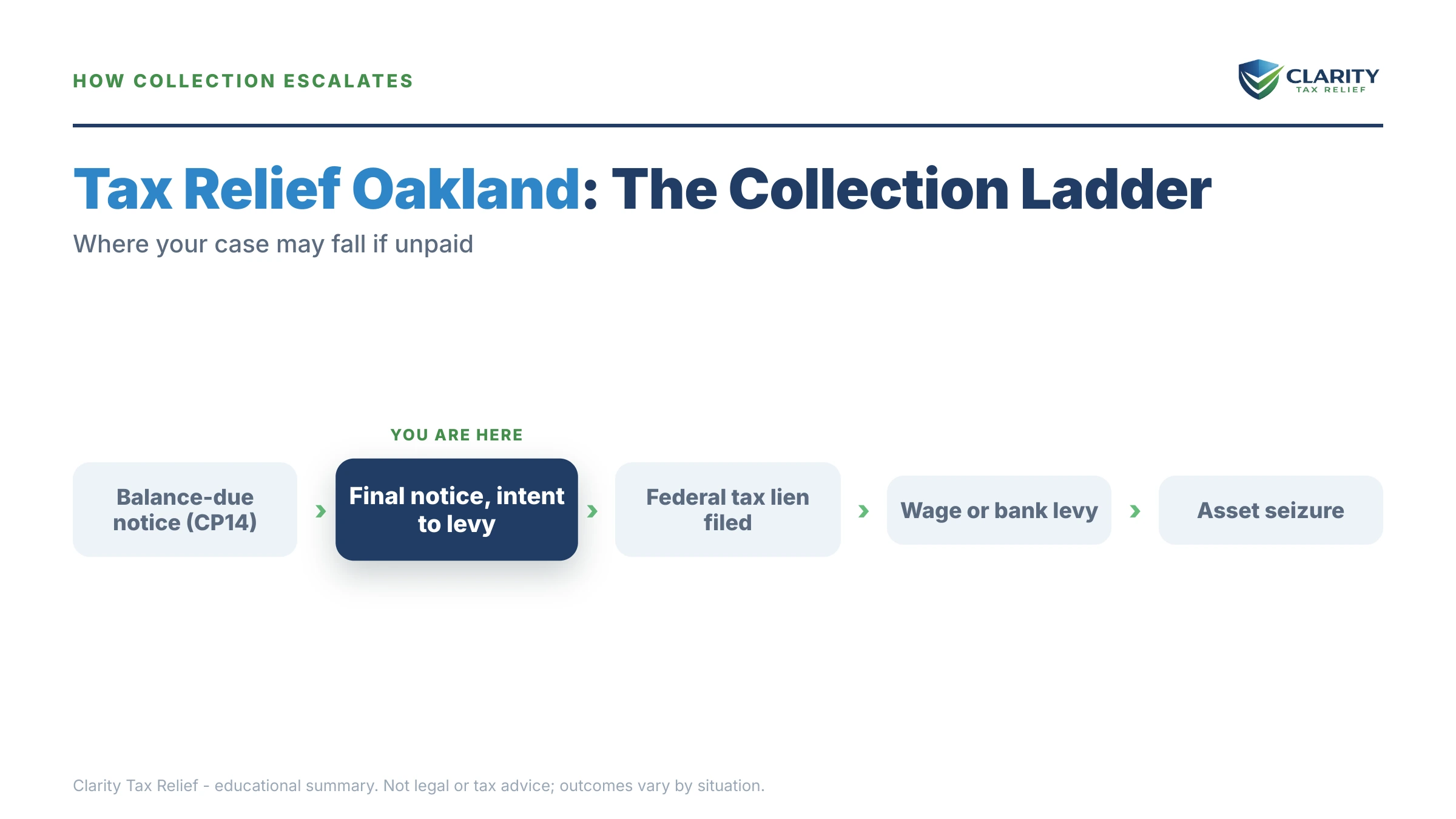
IRS collection runs on an automated escalation sequence that doesn't need a human to pull the trigger — and in 2026, with the IRS workforce down roughly 27% after the 2025 cuts, the notices and levies still go out on schedule even though reaching a person to stop them is harder than ever. The federal track runs like this:
- First bill (CP14) — typically about 21 days to pay before the sequence advances. No enforcement yet; the cheapest moment to act.
- Reminder notices (CP501/CP503) — still just bills, but penalties and interest compound with each one.
- CP504 — intent to levy your state refund — under IRC §6331(d), the IRS can now take your California refund, and a federal tax lien becomes a live risk.
- LT11 / Letter 1058 — final notice — starts a 30-day clock and your Collection Due Process rights (requested on Form 12153). After 30 days, wage and bank levies are legal.
- Levy — a bank levy freezes funds for 21 days before they're sent to the IRS; a wage levy is continuous until released. Debts that reach $66,000 (the 2026 threshold) can also trigger passport certification.
The FTB runs its own separate track on its own clock — its own demand notices, its own intent-to-levy letter, then bank levies and wage garnishment, all backed by California's 20-year collection statute. In practice, many Oakland taxpayers find the FTB reaches their bank account before the IRS does.
The image below shows you how the two collection tracks line up side by side, so you can see at a glance which agency is furthest along against you.
| Notice | What it means | Your window |
|---|---|---|
| CP14 | First bill for a balance due | Typically 21 days from the notice date |
| CP501 / CP503 | Reminder bills; balance growing monthly | Pay-by date printed on each notice |
| CP504 | Intent to levy your California state refund (IRC §6331(d)) | Act now — not yet the final notice, but the last quiet one |
| LT11 / Letter 1058 | Final notice of intent to levy + CDP appeal rights | 30 days to request a hearing on Form 12153 |
| Levy | Bank funds held 21 days, then sent; wage levy continuous | Release requires a resolution or hardship showing |
Owe the IRS or the FTB in Oakland right now?
Send us your notices — federal and state. An experienced tax professional will map which agency is closest to levying and what your options are before the next automated stage hits. Penalties and interest are accruing monthly either way. Free, confidential, no pressure.
Oakland tax relief options for 2026: every program, compared
The IRS offers five real resolution paths, and eligibility for each is set by hard numbers — your balance, your income, and your assets. The general mechanics of each program are covered in our guide to how to settle tax debt yourself; here's the threshold map:
| Option | Who qualifies | Cost / key numbers |
|---|---|---|
| IRS short-term plan | Can full-pay within 180 days | $0 setup; interest and penalties continue |
| Guaranteed installment agreement | Owe $10,000 or less, all returns filed | Approval is required by law when the criteria are met |
| Streamlined / online payment plan | Owe $50,000 or less | Up to 72 months, set up online; streamlined at ≤$25,000, or ≤$50,000 with direct debit |
| Offer in Compromise | Assets + future income genuinely can't cover the debt | $205 fee; 20% down on lump-sum offers (both waived with low-income certification); ~1 in 5 accepted in FY2024 |
| Currently Not Collectible | Paying would create hardship, shown on Form 433-F | Collection pauses; the debt and interest remain |
| Penalty relief (FTA / AEP) | Clean compliance for the prior 3 years | Removes penalties, not tax; AEP becomes automatic starting summer 2026 |
| FTB installment agreement | State balance; FTB's own criteria apply | Separate application — see our FTB payment plan guide |
Two things the table can't show. First, an agreement with one agency doesn't bind the others — an Oakland taxpayer often needs an IRS plan and an FTB plan running side by side, and each affects what the other thinks you can afford. Our guide on state tax debt vs IRS — which to resolve first — walks through that sequencing.
Second, payroll debt plays by harsher rules. If your business is behind on 941 back taxes, the withheld portion is trust-fund money, and the IRS can assess the Trust Fund Recovery Penalty against you personally — that penalty can't be discharged by closing the company. Payroll balances get triaged first, always.
What resolving $16,400 actually looks like: a worked example
A $16,400 IRS balance fits the streamlined payment-plan tier — under $25,000 — which means no financial statement and an online setup. Say you run a small Oakland café with three employees, and underpaid quarterlies left you owing $16,400 on your personal return, while the business is also one quarter behind on 941 deposits. Here's the realistic math, as a purely hypothetical illustration:
- Streamlined plan: $16,400 ÷ 72 months ≈ $228/month on the balance alone. Interest and the failure-to-pay penalty keep accruing on top (the penalty rate typically drops to 0.25% per month once an agreement is in effect), so budgeting closer to $275–$300/month retires it years sooner and cuts the total interest paid. You can estimate your own accrual with our Penalty & Interest Calculator.
- Penalty relief: if the prior three years were clean, first-time abatement could strip the penalties already assessed on that $16,400 — often four figures at this balance level — before you ever agree to a payment.
- Offer in Compromise: probably not the fit here. With an operating café, equipment, and steady revenue, the IRS's collection math will usually show it can recover more than $16,400 over time — and an offer that math rejects costs you months of frozen progress. A plan plus abatement usually beats it at this size.
- The 941 quarter: resolved separately, and first. Getting current on this quarter's deposits before negotiating the old one is what keeps the trust-fund penalty off your personal name.
Notice what drives every line: the balance amount, the payroll exposure, and the clean-compliance history — not negotiation theatrics. That's why an honest review of your transcripts beats any sales pitch.
How to get tax relief in Oakland, step by step
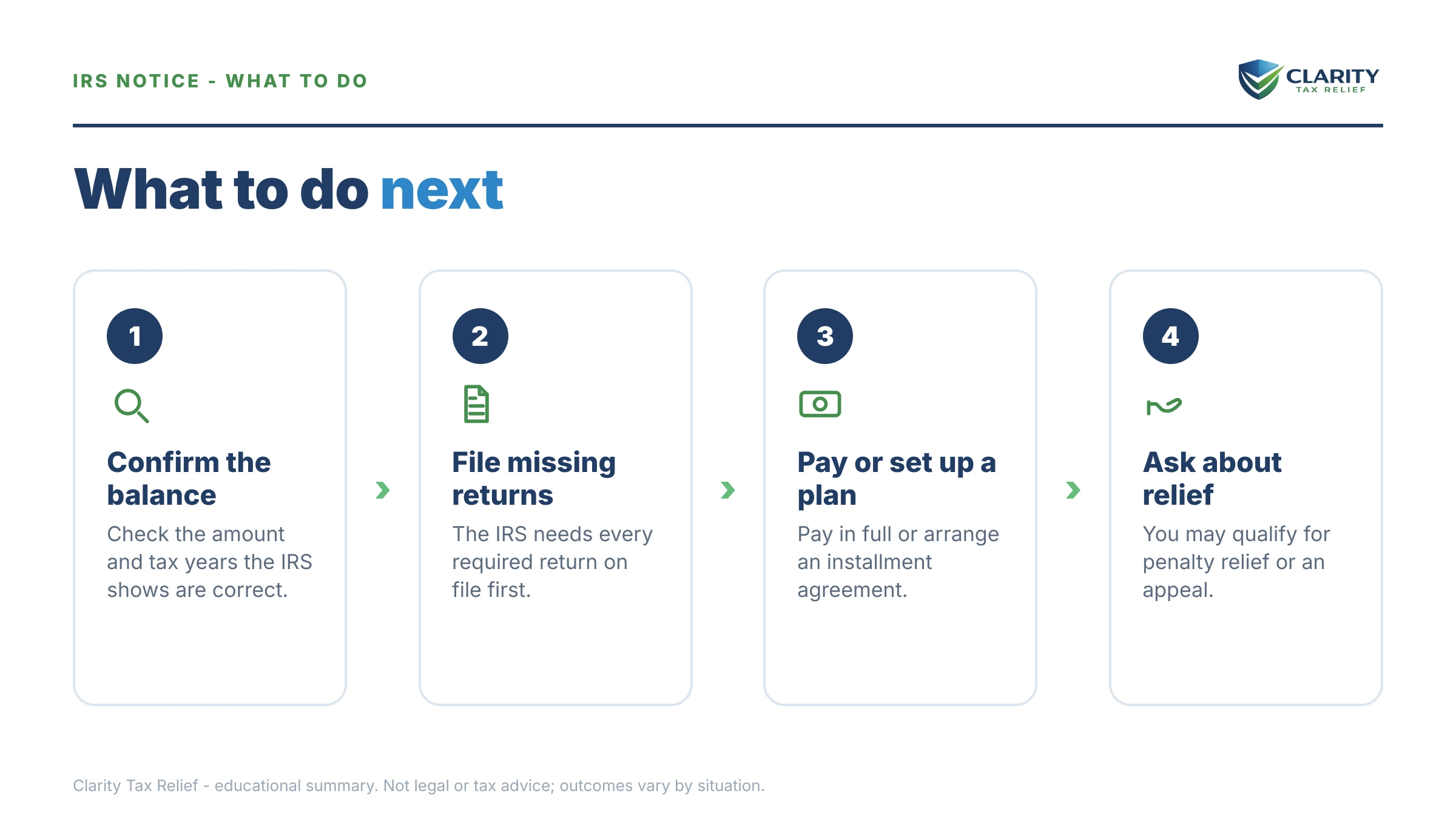
- Map every agency you owe. Log into your IRS online account and MyFTB, and pull any CDTFA or EDD notices from your files. You can't build a plan until you know every balance, every tax year, and which agency is closest to levying.
- File every missing return — federal and California. The IRS won't approve a payment plan or an offer with unfiled returns outstanding, and the failure-to-file penalty (5% per month) is 10 times the failure-to-pay penalty. Filing stops the worst penalty even if you can't pay a dime yet.
- Get current on this quarter's payroll deposits before negotiating old payroll debt. Both the IRS and the EDD treat ongoing compliance as the price of admission to any resolution.
- Match your balance to a program using the eligibility table above. Under $50,000 with the IRS, you can usually set up a plan of up to 72 months online; the FTB requires its own separate agreement.
- Request penalty relief. If your prior three years are clean, first-time abatement can remove IRS penalties — and starting summer 2026, the new Automatic Exemption from Penalty (AEP) applies without a request. The FTB has its own, separate abatement standards.
- Get an experienced review if more than one agency is moving, a levy is in motion, or payroll taxes are involved. The order you resolve things in changes what you end up paying — a free case review maps it before the agencies force the order on you.
When you can handle this yourself — and when help changes the outcome
Plenty of Oakland tax problems don't need professional help, and it would be dishonest to tell you otherwise. Handle it yourself when:
- You owe one agency, under about $25,000, and agree with the amount — the online IRS plan takes 20 minutes, and our DIY settlement guide walks through every screen.
- You can full-pay within 180 days — the short-term plan is free to set up and ends the notice sequence immediately.
- It's a first notice on a single year with clean history — pay or plan, then request first-time abatement yourself.
Experienced help genuinely changes outcomes when:
- Payroll taxes are behind — the trust-fund penalty investigation decides whether the debt attaches to you personally, and what you say in that process matters.
- Two or more agencies are collecting at once — an IRS payment you agree to in isolation can wreck your ability to fund the FTB agreement, and vice versa.
- A levy or garnishment is already in motion — release requires knowing which lever each agency responds to, fast.
- Multiple years are unfiled — the sequence you file in changes penalties, refund offsets, and what balance you ultimately negotiate on.
- You're weighing an Offer in Compromise — the collection-potential math is unforgiving, and a rejected offer costs months.
Choosing tax debt help in Oakland: what to look for
The biggest risk in hiring help isn't the fee — it's paying a sales floor instead of a practitioner. Before you sign with anyone, national or local, run the checklist in our guide on how to choose a tax relief company: verify the credential of the person actually working your case (enrolled agent, CPA, or attorney), get the fee flat and in writing, and refuse any firm that quotes a settlement amount before pulling your IRS and FTB records. Business owners have a few extra questions to ask — our buyer's guide to tax relief for small business covers the payroll- and entity-specific ones.
Two hard rules. Anyone promising to settle your debt for "pennies on the dollar" before analyzing your finances is running a script, not a case — that pitch is the signature of the firms regulators keep shutting down. And any legitimate Oakland-focused representative should be fluent in FTB, EDD, and CDTFA procedure, because for most East Bay business owners the state side is half the problem. (If your debt tilts state-side, our tax relief San Francisco guide covers the same Bay Area agency landscape from the city side of the bridge.)
Terms on your notices, decoded
- FTB — the Franchise Tax Board, California's income tax collector, with a 20-year collection window.
- CDTFA — the California Department of Tax and Fee Administration, which collects sales and use tax.
- EDD — the Employment Development Department, California's payroll tax agency.
- TFRP — the Trust Fund Recovery Penalty, which makes responsible individuals personally liable for withheld payroll taxes.
- CSED — the Collection Statute Expiration Date, the end of the IRS's 10-year window to collect (pausable by appeals, offers, and bankruptcy).
- Offer in Compromise (OIC) — a means-tested program to settle a tax debt for less than the balance when the numbers prove you can't full-pay.
Tax relief in Oakland: your questions, answered
Is there an IRS office in Oakland where I can get help?
Yes — the IRS operates Taxpayer Assistance Centers in the Bay Area, but they are appointment-only, and most collection problems never require an office visit. Payment plans, transcripts, and balance checks are handled online or by phone, and an authorized representative can work your case without you ever standing in line. Check irs.gov for current Bay Area locations before making the trip.
Do I need a local Oakland tax relief company, or can a national firm represent me?
Representation before the IRS is federal, so an enrolled agent, CPA, or tax attorney with a signed Form 2848 power of attorney can represent you from anywhere in the country. What matters for Oakland cases is California experience — your representative should know how the FTB, CDTFA, and EDD operate, because those agencies follow different rules than the IRS. Credentials and state-agency experience beat a local zip code.
Which should I pay first if I owe both the IRS and the FTB?
Usually the agency closest to levying you gets attention first — check which one has sent an intent-to-levy notice. In 2026, the FTB often moves faster than the short-staffed IRS, and it has 20 years to collect versus the IRS's 10. The order also matters financially: what you agree to pay one agency affects what the other believes you can afford, so plan both together rather than one at a time.
Can the FTB really collect a tax debt for 20 years?
Yes. Under California Revenue and Taxation Code §19255, the FTB generally has 20 years from assessment to collect — double the IRS's 10-year statute. That means a California balance you assume will quietly age off can follow you for two decades, with interest accruing the entire time. Waiting out the FTB is almost never a realistic strategy; a payment plan or the FTB's own offer in compromise program usually costs far less than the wait.
Can I settle my tax debt for less than I owe in Oakland?
Sometimes — the IRS Offer in Compromise program is real, but it is means-tested, not a discount for asking. The IRS accepted roughly 1 in 5 offers in FY2024, and acceptance depends on whether your assets and future income genuinely can't cover the debt. California's FTB runs its own separate offer program with its own rules. Be wary of any firm that promises a settlement before analyzing your finances.
What happens if my Oakland business is behind on payroll taxes?
Payroll tax debt is the most dangerous kind, because the withheld portion is treated as trust-fund money. The IRS can assess the Trust Fund Recovery Penalty against owners, officers, and even bookkeepers personally, and California's EDD can pursue responsible individuals for state payroll taxes too. Get current on this quarter's deposits immediately — stopping the bleeding is the first thing both agencies look for before they'll agree to any resolution.
How much does tax relief cost in Oakland?
Legitimate representation is usually a flat fee tied to the complexity of your case — a straightforward payment-plan setup costs far less than defending a payroll tax case across the IRS and EDD. Watch for two red flags: large upfront fees before anyone has reviewed your IRS and FTB records, and quoted 'savings' before anyone has seen your finances. A reputable firm investigates first, quotes second, and puts the fee in writing.
Your next 24 hours
- Sort your envelopes by agency. Make one pile for the IRS, one for the FTB, and one for the EDD/CDTFA — then find the most recent notice in each pile and note its date and the balance printed on it. That tells you who's furthest along.
- Gather three things: your last filed federal and California returns, every notice in those piles, and a rough picture of monthly business and household income. That's everything needed to match you to a program.
- Get the free case review. Call (888) 825-7779 or use the 2-minute form — an experienced tax professional will map all your Oakland balances, federal and state, into one plan. There's no notice-printed deadline forcing today, but interest and penalties compound monthly on every agency's balance, so each month of waiting buys nothing and costs something.
Official resources: pay or set up a federal plan at IRS.gov/payments or the IRS payment plans page; handle California balances through the Franchise Tax Board; and if the IRS system itself is causing you harm, the Taxpayer Advocate Service is a free, independent option.
This guide is general information, not tax or legal advice for your specific situation. Eligibility for IRS programs depends on individual facts and circumstances; no outcome is guaranteed.