
Local Tax Relief Guides
Tax Relief Riverside, CA (2026): Your Real IRS and FTB Options
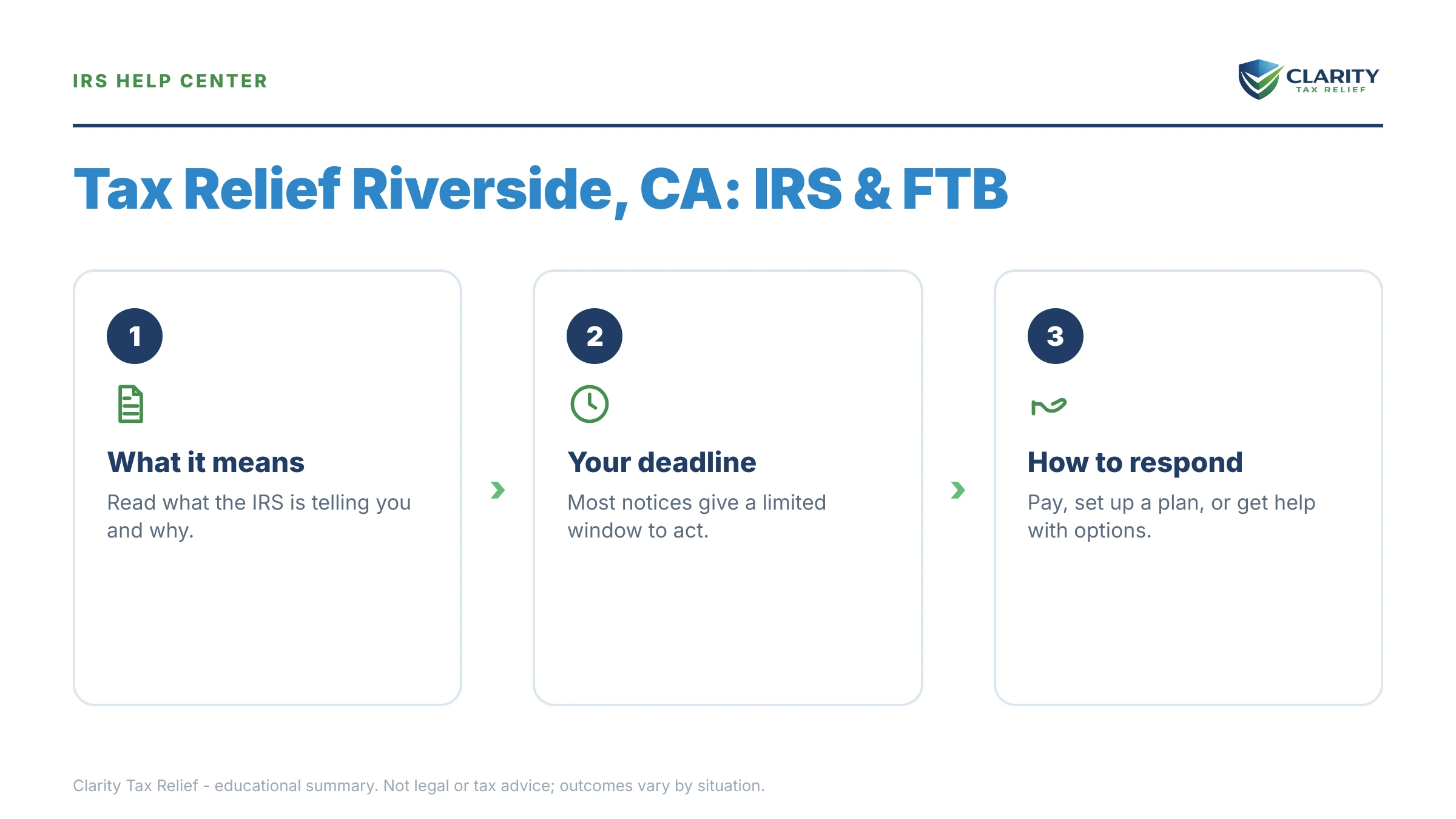
The short answer: tax relief in Riverside means resolving two separate collectors — the IRS and California's Franchise Tax Board. Real 2026 options include IRS payment plans up to 72 months for balances of $50,000 or less, hardship status, penalty abatement, and — for the minority whose finances qualify — an Offer in Compromise. The FTB runs its own versions of each.
If you typed "tax relief Riverside" into a search bar tonight, you're probably holding an IRS bill, an FTB notice, or — like a lot of Inland Empire households — one of each for the same year. The problem is fixable at every stage, but the fix looks different for each agency, and the FTB's clock runs twice as long as the IRS's.
This guide maps both: what each agency can do, which programs you can actually use, what they cost, and the order to fix things in.
⏱ The clock here is monthly, not a single date. The IRS adds a 0.5% failure-to-pay penalty every month plus daily-compounding interest, and the FTB layers its own penalties and interest onto state balances. Every month you wait raises the payoff on both debts and moves each agency one notice closer to enforcement. If a notice in your hand shows a specific response date, that printed date controls.
Why Riverside tax debt usually means two collectors
Riverside taxpayers who owe federal tax almost always owe California too, because both agencies tax the same income — and they collect independently. Paying one does nothing to stop the other. The IRS has 10 years from assessment to collect; the FTB has 20 years under Revenue and Taxation Code §19255 — see our guide to California's 20-year collection statute.
The way that debt got created is often specific to how the Inland Empire works. Warehouse, logistics, and delivery jobs along the 60, 91, and 215 corridors frequently pay some or all workers on 1099 — no withholding, so the tax bill lands in April. Owner-operator truckers, gig drivers, and real estate agents face the same trap. Add commuters juggling two W-2s with under-withholding, and a balance due is one tax season away.
Small businesses in the area carry a third layer — payroll and sales tax exposure through the IRS, the EDD, and the CDTFA. If that's you, start with our tax relief for small business guide, because business debts follow different (and harsher) rules than personal ones.
For the state side of the picture in depth, our California FTB back taxes hub covers the FTB's notices, programs, and enforcement tools in detail. This page focuses on how the two systems fit together for a Riverside household.
What happens if you ignore IRS and FTB debt in Riverside
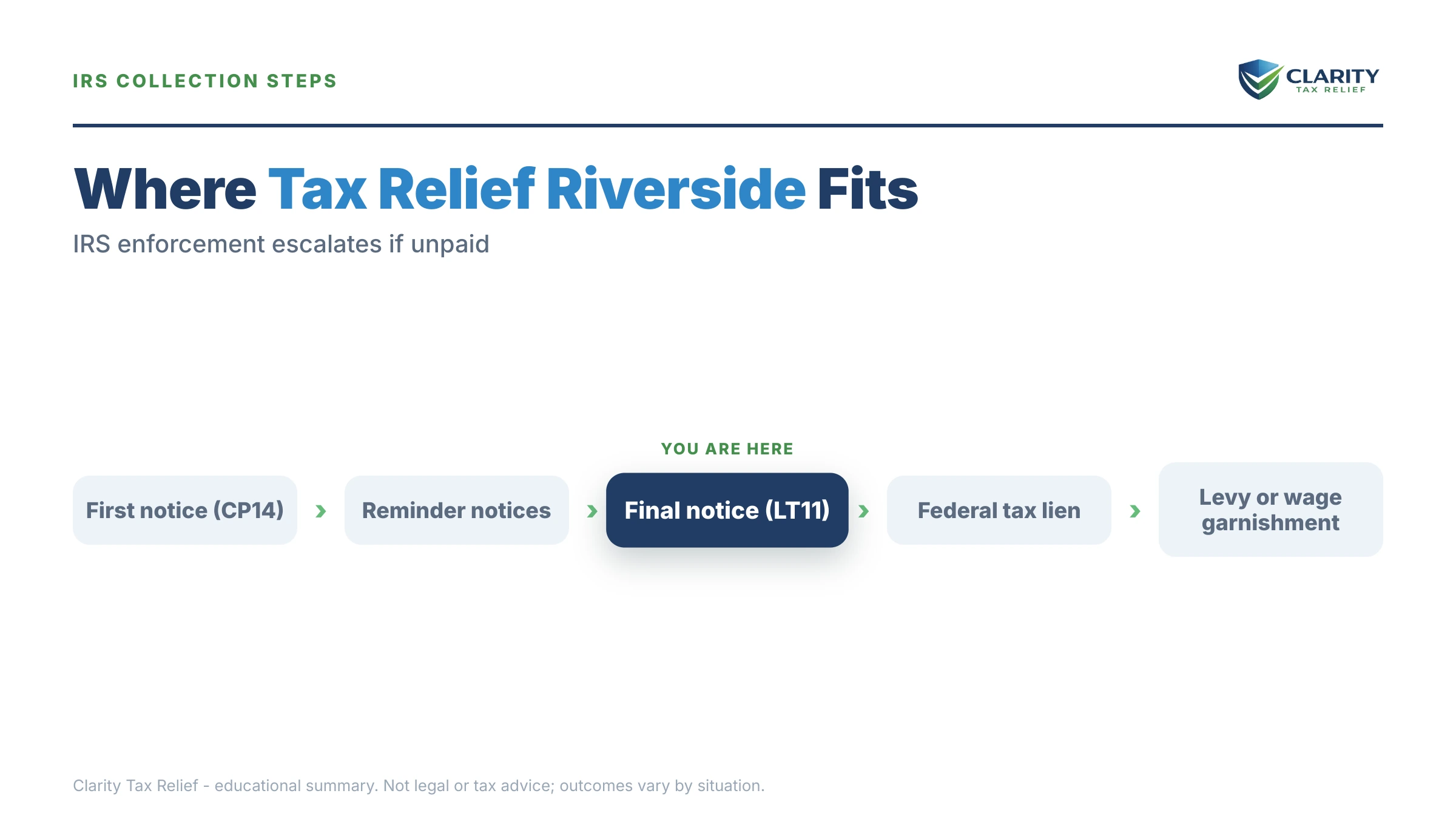
Both agencies escalate unpaid balances automatically — no human decides to garnish you; the system does. On the federal side, the sequence runs in a fixed order:
- CP14 — the first bill. You typically have about 21 days from the notice date before the sequence advances. No enforcement yet.
- CP501 / CP503 — reminder notices. Still bills, but penalties and interest are compounding underneath them.
- CP504 — intent to levy your state tax refund under IRC §6331(d). Your California refund is now reachable, and a federal tax lien becomes a live possibility. This is not the final notice.
- LT11 / Letter 1058 — the final notice of intent to levy. A 30-day clock starts, along with your Collection Due Process appeal rights (requested on Form 12153). After the 30 days, the IRS can levy bank accounts (funds are held 21 days before they leave) and garnish wages — a wage levy is continuous until released.
- Beyond the levy — Social Security can be levied up to 15% through the Federal Payment Levy Program, and once your total federal debt passes $66,000 (the 2026 threshold), the IRS can certify you to the State Department for passport denial or revocation.
The FTB runs a parallel track with fewer warnings. It issues its own intent-to-levy notice, then moves to an earnings withholding order — an FTB wage garnishment — bank levies, and state tax liens. In practice, the FTB often reaches a paycheck before the IRS does, and its 20-year statute means the debt will not quietly age out.
One 2026 reality cuts both ways: the IRS workforce was cut roughly 27% in 2025, so reaching a human is harder than ever — but the notices, liens, and levies are generated by automated systems that never stopped. Slow phones do not mean slow enforcement.
Owe the IRS, the FTB, or both in Riverside?
Send us your notices — federal and state. An experienced tax professional will map exactly where each agency is in its collection sequence and which programs your finances support. Free, confidential, no pressure. Interest and penalties accrue monthly, so sooner genuinely costs less.
Tax relief Riverside residents can actually use in 2026
Every legitimate resolution option is a government program with published eligibility rules — nothing here requires a "special connection" at the IRS. If you want the do-it-yourself version of this whole process, our pillar guide on how to settle tax debt yourself walks through it; this page focuses on which door fits which Riverside situation.
| Option | Who may qualify | Cost / key limit |
|---|---|---|
| Short-term payment plan | Can pay in full within 180 days | $0 setup; interest and the 0.5%/month penalty continue |
| Guaranteed installment agreement | Balance of $10,000 or less, all returns filed | Approval is essentially automatic if you meet the criteria |
| Streamlined installment agreement | ≤ $25,000 (or ≤ $50,000 with direct debit); up to 72 months, set up online | Setup fee applies; no detailed financial statement required |
| Currently Not Collectible (CNC) | Paying would leave you unable to cover basic living costs (shown on Form 433-F) | Collection pauses; the debt and interest remain and the IRS reviews periodically |
| Offer in Compromise (OIC) | Assets plus future income genuinely can't cover the balance | $205 fee + 20% down on lump-sum offers (both waived with low-income certification); ~1 in 5 accepted in FY2024 |
| Penalty abatement (FTA / AEP) | Clean compliance for the prior 3 years, or reasonable cause | Free to request; the new Automatic Exemption from Penalty begins applying automatically in summer 2026 |
The FTB mirrors most of these — a state FTB payment plan, its own hardship status, and a separate, generally stricter FTB offer in compromise — but with its own forms, thresholds, and review standards. Never assume an IRS number applies to the state; check the FTB's own rules or have a professional run both sets.
Here's how the two systems compare side by side:
| What matters | IRS | California FTB |
|---|---|---|
| Collection window | 10 years from assessment (pausable by appeals, an OIC, or bankruptcy) | 20 years from assessment under R&TC §19255 |
| Wage garnishment | Continuous levy after a final notice + 30 days; runs until released | Earnings withholding order; often reaches a paycheck faster |
| Payment plans | Up to 72 months online for balances of $50,000 or less | Separate state program with its own limits — apply through the FTB |
| Settlement | Offer in Compromise; roughly 1 in 5 accepted in FY2024 | Separate FTB Offer in Compromise, generally stricter |
| Hardship pause | Currently Not Collectible status | FTB hardship status exists, reviewed on its own schedule |
| Pre-levy appeal | Collection Due Process hearing via Form 12153 within 30 days of the final notice | Its own protest procedures; the deadline is printed on each FTB notice |
If both agencies are collecting, sequencing matters — our comparison of state tax debt vs IRS covers which to resolve first and why the answer is usually "whichever is closer to a levy."
A worked example: a Riverside couple who owes $23,800
Say you're a married couple filing jointly in Riverside and you owe the IRS $23,800 — one spouse's W-2 withholding covered their share, but the other's 1099 warehouse-logistics income had nothing withheld. Here's the realistic math (this is a hypothetical illustration, not a client case):
- Streamlined installment agreement: $23,800 is under the $25,000 streamlined line, so you can set up a plan online with no financial statement. Spread over the maximum 72 months, the base payment is about $331/month ($23,800 ÷ 72 ≈ $330.56) — but interest and the monthly penalty keep accruing, so budget somewhat higher or pay it off faster.
- The cost of waiting: the failure-to-pay penalty alone starts at roughly $119/month (0.5% × $23,800), before interest. You can estimate your own accrual with our IRS penalty & interest calculator.
- Paying aggressively instead: at $2,000/month the balance clears in roughly 13 months, cutting the total interest and penalties dramatically versus a six-year plan.
- Offer in Compromise reality check: if this couple owns a Riverside home with, say, $110,000 of equity, the IRS's collection math counts that equity — which alone exceeds the $23,800 owed. An offer would almost certainly be rejected. Rising Inland Empire home values disqualify more local OIC candidates than any other single factor.
- Penalty relief: if their prior three years were clean, first-time abatement can strip the failure-to-pay penalties — often worth four figures on a balance this size — and it stacks with a payment plan.
Same couple, same debt, and the difference between the worst path (ignore it) and the best path (fast-pay plan plus abatement) can run to thousands of dollars.
How to respond, step by step
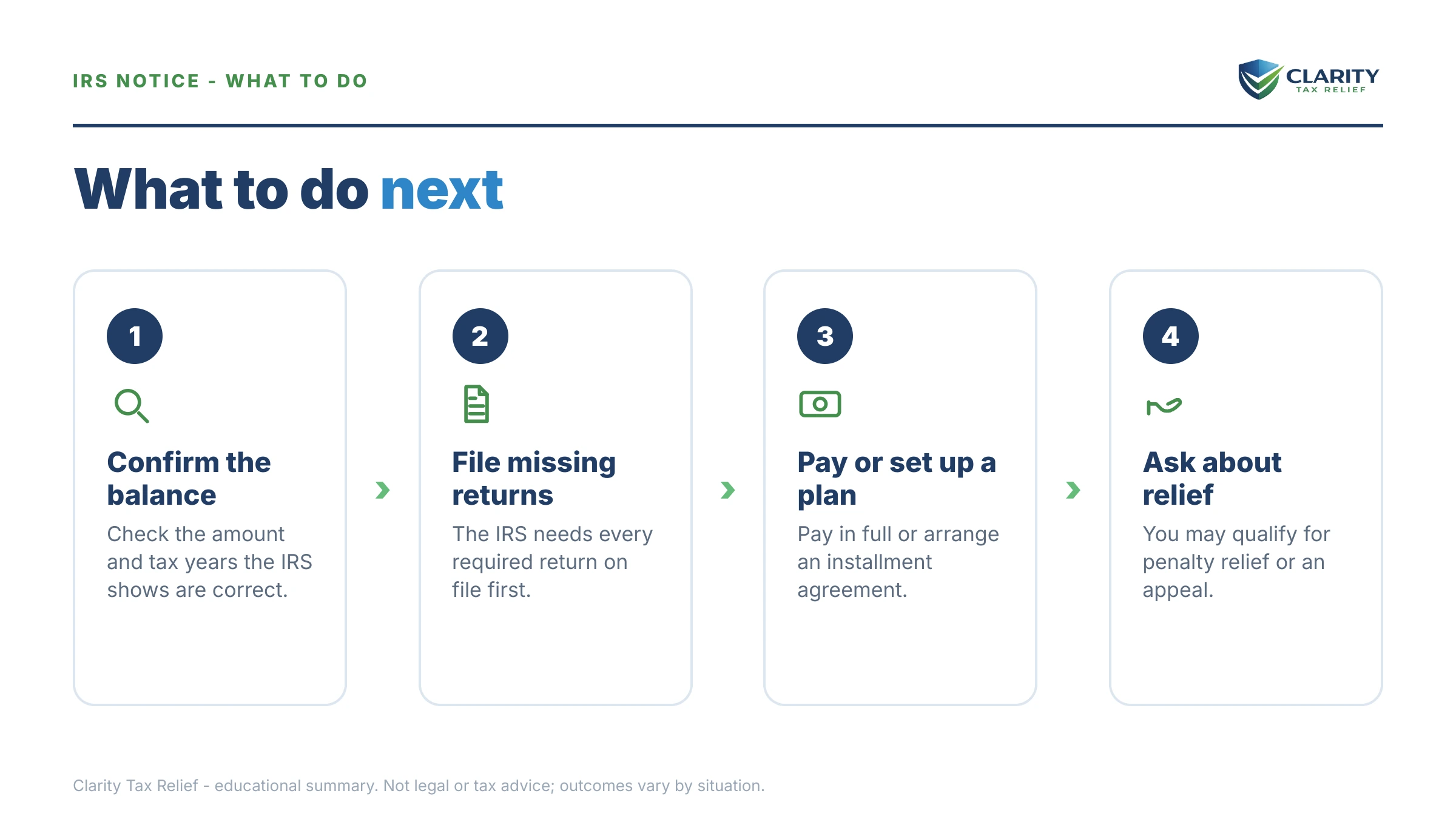
- Verify both balances: log into your IRS online account and register for MyFTB so you can see exactly what each agency claims you owe, year by year.
- File any missing returns: both the IRS and the FTB require filing compliance before they will approve a payment plan, hardship status, or settlement.
- Match each balance to a program: use the options table above — payment plan, Currently Not Collectible, penalty relief, or an offer — and choose separately for the IRS and the FTB.
- Set up agreements before enforcement starts: a plan in place stops the notice sequence; waiting until a final notice of intent to levy arrives shrinks your options and adds deadlines.
- Request penalty relief: ask about first-time abatement on the IRS side once your plan is set — and note the new Automatic Exemption from Penalty rolling out in summer 2026.
- Get a professional review for complex cases: multiple years, business or 1099 income, or both agencies collecting at once — have an experienced tax professional map the order of operations before you commit to anything.
When you can handle this yourself — and when help changes the outcome
Most single-year, under-$25,000 IRS balances can be resolved without paying anyone. If you agree with the amount, your returns are filed, and you can afford a monthly payment, the online agreement (or Form 9465 by mail) takes an evening — no firm needed. The same goes for a balance you can clear within 180 days: the short-term plan is free to set up and stops the escalation cold.
Experienced help earns its fee in specific situations: a wage garnishment or bank levy already in motion, multiple unfiled years for either agency, business payroll or CDTFA sales-tax debt, an FTB and IRS case running simultaneously, or Offer in Compromise math where the difference between a defensible offer and a rejected one is how Form 433-F assets and allowable expenses are presented. Both agencies must approve everything based on published formulas — nobody can negotiate a result your finances don't support.
Riverside gets saturated with tax-resolution advertising — freeway billboards, radio spots, mailers dressed up to look like government notices. Before hiring anyone, read our checklist on how to choose a tax relief company, and if you're comparing the big national advertisers, our Optima Tax Relief alternatives breakdown shows what to compare on. The tells are consistent: a legitimate firm reviews your transcripts and finances before quoting an outcome; a mill quotes the outcome first. And any pitch built on settling for "pennies on the dollar" is describing a program that doesn't work that way — offer acceptance is arithmetic, and roughly four out of five offers are rejected.
Terms you'll hear, decoded
- FTB (Franchise Tax Board): California's income-tax agency — separate from the IRS, with its own debts, notices, and enforcement powers.
- CSED: the Collection Statute Expiration Date — the day the IRS's 10-year collection window closes; appeals, offers, and bankruptcy pause (toll) it.
- Lien vs. levy: a lien is a legal claim against your property (it secures the debt); a levy is the actual taking — wages, bank funds, or your state refund.
- Earnings withholding order: the FTB's version of a wage garnishment, sent directly to your employer.
- Reasonable Collection Potential (RCP): the IRS's formula — asset equity plus future income — that decides whether an Offer in Compromise gets accepted.
Tax relief in Riverside: your questions, answered
Is tax relief in Riverside legit, or is it all a scam?
The programs are legitimate — IRS payment plans, hardship status, penalty abatement, and the Offer in Compromise are written into federal law, and the FTB runs state versions of each. What's often not legitimate is the sales pitch. Any firm that quotes a settlement amount before reviewing your finances, or promises to settle for "pennies on the dollar," is selling an outcome no one can promise.
Do I need a local Riverside tax relief company?
No. Representation before the IRS is federal — enrolled agents, CPAs, and attorneys can represent you from anywhere in the country, and virtually all resolution work happens by phone, mail, and the IRS's online systems. The same is true for FTB cases. What matters is the credential holding the power of attorney and transparent flat pricing, not the office's zip code.
How long can California collect back taxes?
The FTB generally has 20 years from the date of assessment to collect, under Revenue and Taxation Code §19255 — twice the IRS's 10-year window. That long runway is one reason state balances shouldn't be treated as the "smaller problem": the FTB rarely waits long to garnish wages or levy bank accounts, and the debt won't quietly age out.
Can the IRS and the FTB both garnish my wages at the same time?
Yes. They are separate agencies with separate legal authority, and resolving one does nothing to stop the other. An IRS wage levy is continuous until it's released, and the FTB can issue its own earnings withholding order on top of it. If both are collecting, you generally need a resolution in place with each agency.
How much does tax relief cost in Riverside?
Setting up an IRS payment plan yourself costs little — the IRS charges a modest setup fee that drops for direct-debit and low-income taxpayers, and short-term plans up to 180 days have no setup fee at all. Professional representation is priced by complexity: a single-year balance costs far less to resolve than multiple unfiled years or a case involving both the IRS and the FTB. Insist on a flat fee quoted in writing.
Can my tax debt really be settled for less than I owe?
Sometimes — through an Offer in Compromise — but the IRS accepted roughly 1 in 5 offers in FY2024, and acceptance is pure math, not negotiation skill. The IRS looks at what your assets and future income could pay; for many Riverside homeowners, home equity alone pushes that number above the balance owed, which makes an offer unrealistic. California runs a separate, generally stricter FTB offer program.
I owe both the IRS and the FTB — which should I deal with first?
Usually the agency closest to enforcement. If one has issued a final notice of intent to levy and the other is still sending bills, the final notice wins your attention. All else equal, many practitioners address the FTB early, because it tends to move to garnishment faster and its 20-year collection window means waiting solves nothing.
Your next 24 hours
- Find your real totals. Log into (or create) your IRS online account at IRS.gov and your MyFTB account at ftb.ca.gov, and write down what each agency shows for each year — those numbers, not your memory, drive every decision.
- Gather three things: your last filed federal and state returns, every IRS and FTB notice you've received, and a rough monthly income-and-expense picture for your household.
- Get your free case review. Call (888) 825-7779 or use the 2-minute form — an experienced tax professional will map both balances against every program above. Interest and penalties are accruing on both debts monthly; each month you act earlier is money kept.
Detailed program rules are published directly by the IRS on its payment plans and installment agreements page, and if the IRS system itself is causing you harm, the independent Taxpayer Advocate Service is a free resource.
This guide is general information, not tax or legal advice for your specific situation. Eligibility for IRS programs depends on individual facts and circumstances; no outcome is guaranteed.