
City Tax Relief Guides
Tax Relief Providence: Your Real Options in Rhode Island (2026)
The short answer: tax relief Providence residents can actually get comes from matching your IRS or Rhode Island Division of Taxation debt to a real government program — a payment plan (up to 72 months for balances under $50,000), Currently Not Collectible hardship status, penalty abatement, or an Offer in Compromise. Settlement is real but means-tested; no company can promise it before reviewing your finances.
Maybe the trigger was a CP14 for a retirement-account withdrawal you didn't realize was taxable — or a second envelope from the Rhode Island Division of Taxation landing the same week as the IRS one. Owing two tax agencies at once, on income that doesn't stretch, feels like a trap. It isn't. Providence taxpayers have every federal resolution program available anywhere in the country, plus a state process most "tax relief" articles skip entirely — and the order you use them in changes what you pay.
⏱ The real clock: tax debt itself has no single deadline — but the failure-to-pay penalty adds 0.5% of your balance every month (up to a 25% cap) and interest compounds daily on top of it. If an IRS or Rhode Island notice is already in your mailbox, the response date printed on that notice controls. Every month of waiting raises the price of every option below.
Why Providence taxpayers end up owing — usually to two agencies at once
Rhode Island taxes personal income at the state level, so a Providence resident who falls behind federally usually owes the Rhode Island Division of Taxation for the same years. The Division sits at One Capitol Hill in Providence — the state collector is not a distant abstraction here; it's downtown.
The most common triggers we see from Providence and the surrounding towns — Cranston, Warwick, Pawtucket, East Providence — are ordinary, not criminal: a pension or 401(k) distribution with too little withheld, Social Security that became partly taxable once other income stacked on top, a 1099 side income with no withholding at all, or a year that simply didn't get filed after a health crisis or a spouse's death.
Note the pattern: none of these are audits. A balance due means the numbers didn't cover the tax — it does not mean anyone is questioning your honesty. That distinction matters, because bill-collection problems have programmatic fixes; you don't have to argue your way out, you have to enroll your way out.
What happens if you ignore a tax debt in Providence
The IRS collection sequence runs on autopilot — bill, reminders, intent to levy, final notice — and each stage removes an option you have today. In 2026, with the IRS workforce cut roughly 27% last year, humans are harder to reach than ever, but the automated notice-and-levy system never stopped running. Ignoring the mail doesn't slow it down; it just means the next envelope carries more power.
- CP14 — the first bill. Typically about 21 days to respond before the sequence advances. No enforcement yet.
- CP501 / CP503 — automated reminders. Still just bills, but the balance grows every month they sit on the counter.
- CP504 — Notice of Intent to Levy under IRC §6331(d). After 30 days the IRS can seize your Rhode Island state tax refund, and a federal tax lien becomes a live possibility.
- LT11 / Letter 1058 — the final notice. A 30-day clock starts on your Collection Due Process rights (requested with Form 12153). Once it runs, bank accounts, wages, and federal payments are fair game.
- Levy — a bank levy freezes funds with a 21-day hold before the money leaves; a wage levy is continuous until released; and for retirees, the 15% Social Security levy under the Federal Payment Levy Program can attach to every monthly check.
Each stage also has a right attached — and a window in which to use it. This table is the part worth screenshotting:
| Notice | Your window | What's at stake if it passes |
|---|---|---|
| CP14 (first bill) | Typically 21 days from the notice date | Escalation begins; penalties and interest keep compounding on the full balance |
| CP504 (intent to levy) | 30 days | The IRS can seize your Rhode Island state refund and move toward a federal tax lien |
| LT11 / Letter 1058 (final notice) | 30 days to file Form 12153 | You lose the Collection Due Process hearing — the appeal that blocks levies before they start |
| CP91 (Social Security levy warning) | Respond by the date printed on the notice | Up to 15% of each Social Security check goes to the IRS until the levy is released |
| CP508C (passport certification) | Applies once debt reaches $66,000 (2026 threshold) | The State Department can deny or revoke your passport until you're in a qualifying arrangement |
Owe the IRS or Rhode Island and not sure which notice comes next?
Get your Providence tax situation reviewed free — an experienced tax professional will pull your account, map exactly where you are in the collection sequence, and tell you which program fits before interest adds another month to the bill.
Tax relief Providence taxpayers can actually use: every real option
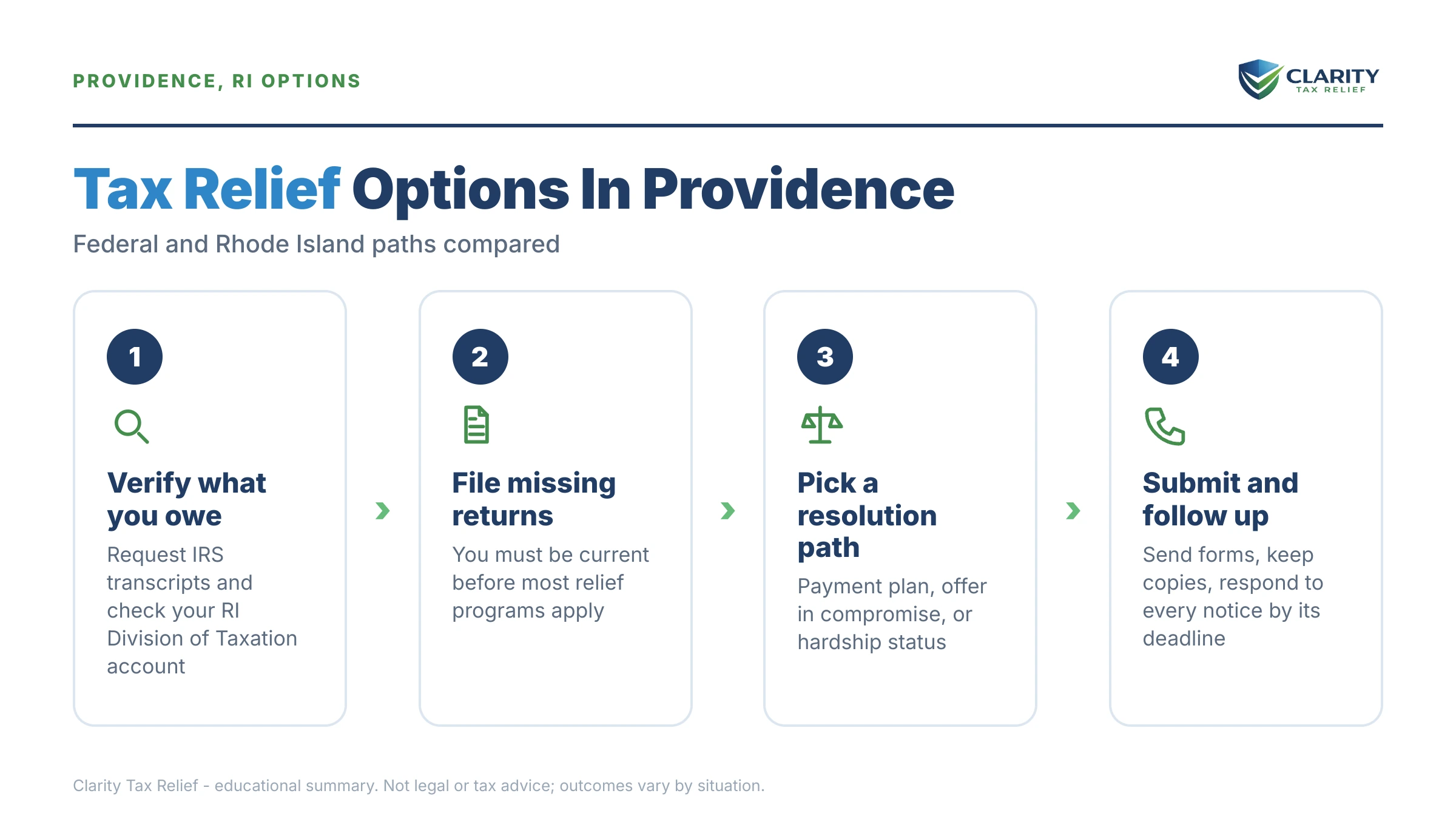
Every legitimate form of tax relief available in Providence is an IRS or Rhode Island program with a name, an eligibility test, and a cost — nothing more secret than that. If you want the full do-it-yourself playbook for the federal side, our guide on how to settle tax debt yourself walks each program end to end; here's the decision-grade summary:
| Program | Who typically qualifies | Cost to apply | What it does |
|---|---|---|---|
| Short-term payment plan | Can pay in full within 180 days | $0 setup | Stops escalation while you pay; interest and penalties continue |
| Guaranteed installment agreement | Owe $10,000 or less with all returns filed | Setup fee (reduced or waived for low-income) | The IRS must accept it — no negotiation needed |
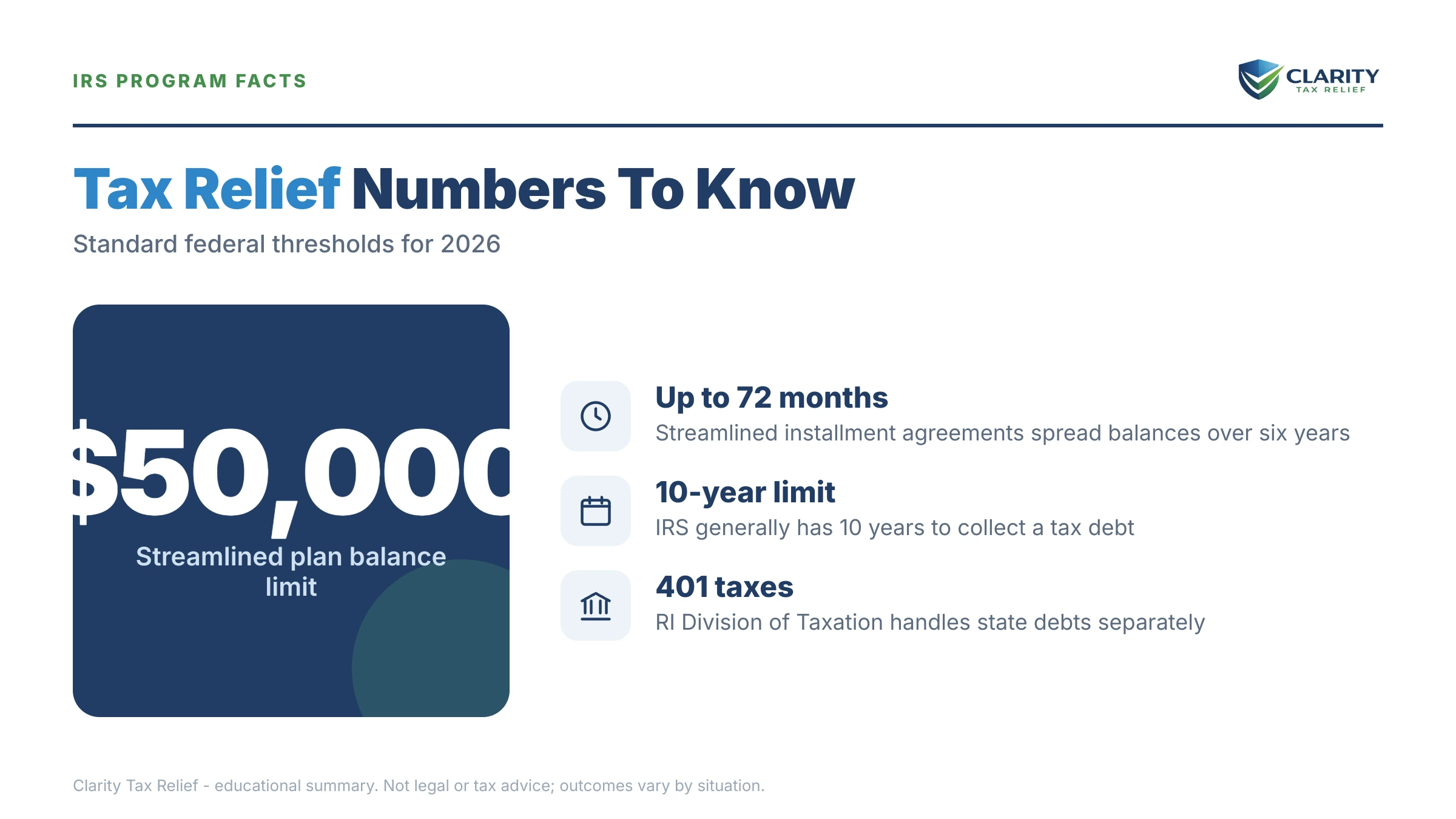
| Streamlined / long-term installment agreement | Owe $50,000 or less — apply online, up to 72 months | Setup fee (reduced or waived for low-income) | Monthly payments; enforcement stops while you stay current |
| Currently Not Collectible (CNC) | Allowable living expenses equal or exceed income (Form 433-F) | $0 | Pauses all collection; debt remains and the 10-year clock keeps running |
| Offer in Compromise (OIC) | Assets plus future income can't cover the debt before it expires | $205 fee + 20% down (both waived if AGI ≤ 250% of poverty) | Settles for less than the full balance; roughly 1 in 5 offers accepted in FY2024 |
| Penalty abatement (FTA / AEP) | Clean compliance the prior 3 years, or reasonable cause | $0 | Removes penalties (not the tax); AEP makes this automatic starting summer 2026 |
Payment plans resolve most Providence cases. If you owe $50,000 or less, a streamlined installment agreement can be set up online without submitting detailed financials, spread over up to 72 months. Interest and the monthly late-payment penalty keep accruing, so pay it faster than the minimum whenever you can.
Currently Not Collectible is the option built for fixed incomes. If Form 433-F shows the IRS's allowable expense standards — housing, utilities, out-of-pocket medical, which run higher for taxpayers 65 and over — consume your income, collection pauses entirely. For retirees this is often better than a payment plan they can't sustain; our guide to IRS hardship while on Social Security covers the fixed-income version in detail.
The Offer in Compromise is real, and it's the program every billboard oversells. The IRS calculates your Reasonable Collection Potential — your net asset equity plus a multiple of your monthly surplus income — and accepts an offer only when that number is less than the balance. It's arithmetic, not persuasion. You can estimate your own offer with our Offer in Compromise Calculator before deciding whether the program is worth pursuing; if your AGI is at or below 250% of the federal poverty level, low-income certification waives the $205 fee, the 20% down payment, and payments during review.
Penalty abatement is the fastest dollar reduction most people qualify for. First-time penalty abatement removes penalties for a year when your prior three years were clean — and starting summer 2026, the IRS's new Automatic Exemption from Penalty (AEP) applies this relief automatically, with no request needed. Reasonable-cause relief covers illness, disaster, and death in the family for years FTA can't reach.
The Rhode Island side: dealing with the Division of Taxation
A federal fix does nothing for a Rhode Island balance — the Division of Taxation collects on its own authority, with its own notices, its own installment process, and its own hardship review. Its rules and thresholds are not the IRS's, so never assume a federal figure (the 10-year statute, the $50,000 online-plan ceiling, the 180-day short-term window) applies to the state. When you're unsure of a Rhode Island-specific number, get it from the source: the Division's site is tax.ri.gov.
Two practical points for anyone who owes both. First, the state can intercept payments the IRS can't reach first — including your state refund — so a Rhode Island balance rarely sits quietly. Second, sequence your budget deliberately: an IRS payment plan that commits every spare dollar leaves nothing to offer the Division, and a defaulted state arrangement creates its own enforcement track. A resolution plan for a Providence taxpayer should be built for both agencies at once, not one at a time.
Worked example: a Providence retiree who owes $23,800
Say you're retired in Providence, you owe the IRS $23,800 from an under-withheld pension rollover two years ago, and your income is $1,980 a month in Social Security plus a $650 monthly pension — $2,630 total. Here's how the real options price out (all numbers hypothetical and rounded):
- Do nothing: once the notice sequence completes, the Federal Payment Levy Program can take 15% of the Social Security check — about $297 a month ($1,980 × 0.15) — indefinitely, while interest keeps the balance growing faster than the levy shrinks it.
- Streamlined installment agreement: $23,800 is under the $50,000 online ceiling. Spread over 72 months, that's roughly $331 a month ($23,800 ÷ 72) before accounting for continuing interest and penalties — affordable for some retirees, crushing for others.
- Currently Not Collectible: if allowable expenses — rent or a Providence property-tax and utility load, Medicare premiums, out-of-pocket prescriptions — meet or exceed $2,630 a month, CNC means $0 a month while the 10-year collection clock keeps running.
- Offer in Compromise: with no home equity, $2,500 in savings, and no monthly surplus, Reasonable Collection Potential could land near $2,500 — far below $23,800, making an offer genuinely worth pricing. With income that low, the fee and down payment would likely be waived under low-income certification. Acceptance is never guaranteed; the IRS accepted roughly 1 in 5 offers in FY2024.
Same debt, four wildly different outcomes — which is why the financial review comes before the program choice, never after. For the broader fixed-income playbook, see retired and owe back taxes.
How to get tax relief in Providence, step by step
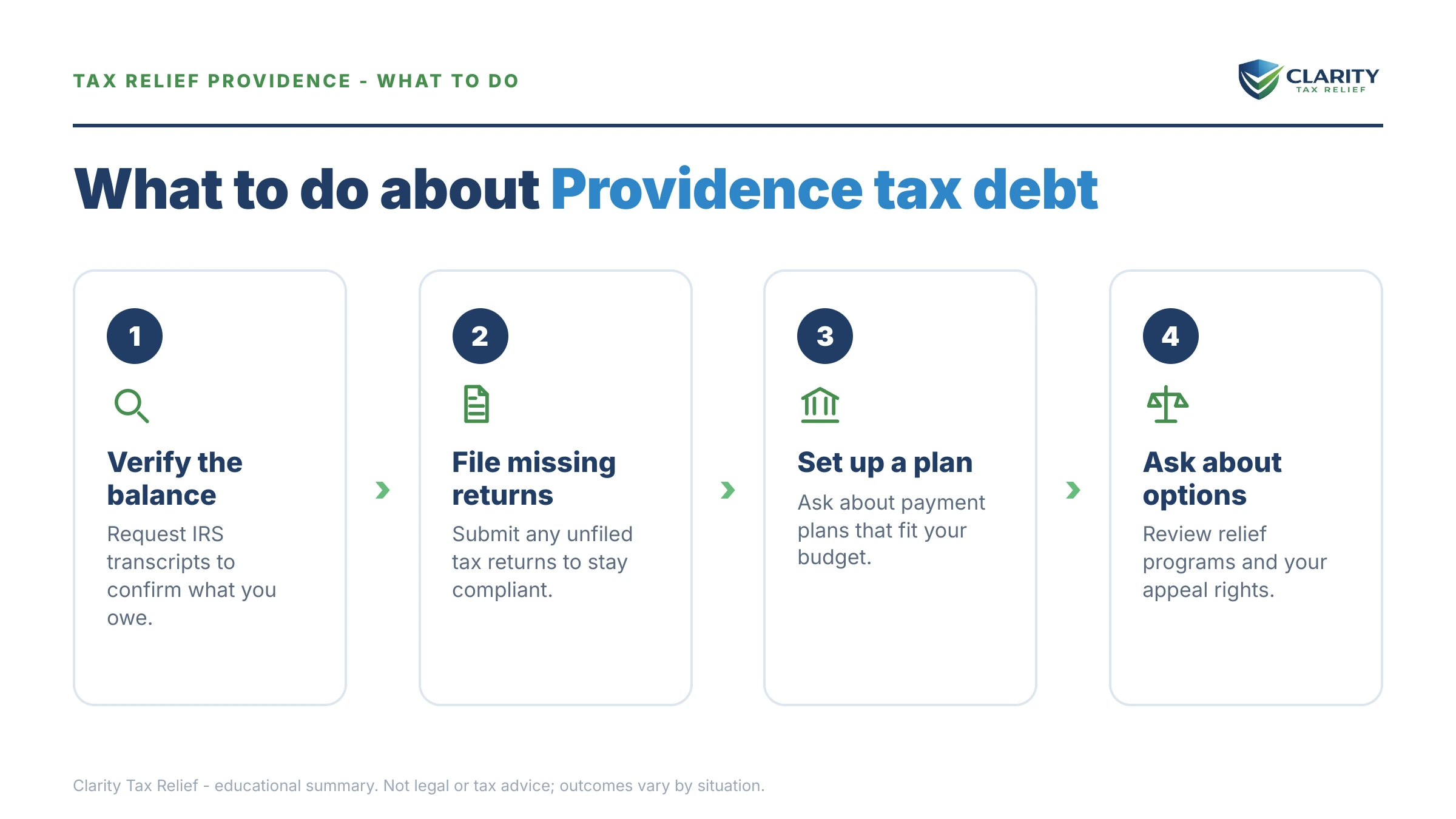
- Pull your IRS records. Create an IRS online account to see your balance by year, then request account transcripts so you know exactly what the IRS has assessed.
- File any missing returns. No IRS payment plan, hardship status, or settlement gets approved while required returns are unfiled — and filing stops the 5%-per-month failure-to-file penalty (capped at 25% after five months).
- Check the Rhode Island side. Contact the Rhode Island Division of Taxation to confirm whether you owe the state too, because a federal fix does nothing for a state balance.
- Match your finances to one program. Use the options table above: if you can pay monthly, a payment plan; if your allowable expenses consume your income, Currently Not Collectible; if you can never realistically pay in full, price an Offer in Compromise.
- Set it up before the next notice. Apply online for a payment plan, or prepare Form 433-F for hardship and offer cases — enforcement generally pauses while an agreement or offer is pending.
- Get experienced help if enforcement has started. A levy already in motion, multiple unfiled years, or debt to both the IRS and Rhode Island are the situations where an experienced tax professional changes the outcome.
When you can handle this yourself — and when help changes the outcome
Plenty of Providence tax problems don't need a professional. If you owe under $10,000, agree with the balance, and can manage a monthly payment, the guaranteed installment agreement takes minutes to set up online at IRS.gov's payment plans page. Same for a first notice you agree with and can pay within 180 days: pay it at IRS.gov/payments and the sequence stops cold. Nobody should charge you thousands for that.
Experienced help earns its fee in specific situations: a Social Security or bank levy already running, several unfiled years that need reconstructing before any program will approve, debt owed to both the IRS and the Division of Taxation, or Offer in Compromise math where one misvalued asset sinks the whole application. In those cases the professional isn't buying you a secret program — they're buying you the right program, correctly documented, the first time.
If money is the barrier, free help exists. Rhode Island is served by a Low Income Taxpayer Clinic that represents qualifying taxpayers in IRS disputes at no charge, and the Taxpayer Advocate Service can intervene when IRS delays or errors are causing hardship.
Vetting Providence tax relief companies (most are national anyway)
Almost every firm advertising tax relief to Providence residents is a national company — which is fine, because IRS representation is federal. What matters is how they charge and what they promise. Before signing anything, read how to choose a tax relief company, and know the two disqualifying behaviors: quoting a settlement amount before pulling your transcripts, and demanding large upfront fees for an "investigation" that never produces a plan. Common tax relief scams follow those two scripts almost exactly.
If you're already comparing the big advertisers, our Optima Tax Relief alternatives and Fortress tax relief alternative comparisons break down how the major firms differ on pricing models, who actually works your case, and what to ask before paying anyone.
Terms you'll hear in tax relief pitches, decoded
- Offer in Compromise (OIC): the IRS program that settles a debt for less than the balance when your finances prove you can't pay in full — means-tested, never automatic.
- Currently Not Collectible (CNC): hardship status that pauses all IRS collection while your allowable expenses consume your income; the debt itself remains.
- Reasonable Collection Potential (RCP): the IRS's formula — asset equity plus future income — that decides whether an offer gets accepted.
- CSED: the Collection Statute Expiration Date — generally 10 years after assessment, extended by offers, bankruptcy, and appeals.
- "Fresh Start": marketing shorthand for the ordinary IRS thresholds above — it is not a separate program you apply to.
- Enrolled Agent (EA): a federally authorized practitioner who can represent you before the IRS from anywhere — no Rhode Island office required.
Providence tax relief questions, answered
Is tax relief legit, or is it a scam?
Legitimate tax relief exists — every real program is run by the IRS or the Rhode Island Division of Taxation, and a reputable firm simply prepares and negotiates your case inside those programs. The scam version is the company that promises a specific settlement before seeing your finances. Any pitch guaranteeing you'll settle for "pennies on the dollar" before reviewing a single document is a red flag, because eligibility for every program is means-tested.
Can the IRS garnish Social Security in Rhode Island?
Yes. Through the Federal Payment Levy Program the IRS can take up to 15% of your monthly Social Security benefit, and living in Rhode Island doesn't shield the payment because it's a federal levy. SSI is exempt, and the levy is typically preceded by a CP91 warning notice. A payment plan, Currently Not Collectible status, or a documented hardship can get the levy released.
Do I need a tax relief company located in Providence?
Not for IRS debt — federal representation works identically from anywhere because everything happens by phone, mail, and IRS e-services once a power of attorney is filed. For a Rhode Island Division of Taxation balance, familiarity with the state's process helps, but the credential that matters is an enrolled agent, CPA, or attorney authorized to represent you — not a Providence zip code.
How much does tax relief cost in Providence?
Professional fees commonly range from several hundred dollars for a straightforward payment-plan setup to several thousand for a full Offer in Compromise case with financial documentation. Ask for flat-fee, phased pricing in writing before you sign anything. A firm that demands thousands upfront before investigating your account — or quotes a settlement before pulling your transcripts — is showing you a warning sign, not a plan.
Does Rhode Island have its own payment plan or settlement program?
The Rhode Island Division of Taxation sets up its own installment agreements and reviews hardship situations, but its rules, timelines, and thresholds are not the IRS's — never assume a federal figure applies to the state. If you owe both agencies, sequence matters: a plan that commits your whole budget to the IRS can leave nothing for Rhode Island, which keeps its own enforcement moving.
How long can the IRS collect back taxes?
Generally 10 years from the date each balance was assessed — the Collection Statute Expiration Date, or CSED. The clock pauses (tolls) during an Offer in Compromise, bankruptcy, and certain appeals, so the real date is often later than ten calendar years. Rhode Island's collection window is separate and set by state law, so don't assume the federal 10-year rule protects you from the Division of Taxation.
What if I genuinely can't afford to pay anything?
Currently Not Collectible status exists for exactly this situation: if Form 433-F shows your allowable living expenses consume your income, the IRS pauses collection — no levies, no required payments. The debt remains, refunds get offset, and interest accrues, but the 10-year collection clock keeps running. If your AGI is at or below 250% of the federal poverty level, the Offer in Compromise fee and down payment are also waived.
Will the IRS take my house in Providence?
Seizing a primary residence is extremely rare and requires federal court approval — it's a last resort, not a routine step. What's far more common is a Notice of Federal Tax Lien, which attaches to your home's equity and complicates selling or refinancing until the debt is resolved. Getting into a payment plan or other agreement is what keeps the lien and levy machinery from advancing.
Your next 24 hours
- Find your total. Pull the most recent IRS notice from the pile and note the tax year, the balance, and any response date printed on it — or log into your IRS online account for the balance by year.
- Gather three things: your last filed return, every IRS and Rhode Island notice you've received, and proof of monthly income (Social Security award letter, pension statement, or pay stubs).
- Get the free case review. Interest and penalties are accruing monthly whether you act or not — send what you gathered through the 2-minute form or call (888) 825-7779 and an experienced tax professional will map your Providence options against the real numbers, free.
This guide is general information, not tax or legal advice for your specific situation. Eligibility for IRS programs depends on individual facts and circumstances; no outcome is guaranteed.