
City Tax Relief Guides
Tax Relief Portland Maine: Every Real Option for IRS & State Tax Debt (2026)
The short answer: tax relief in Portland, Maine means resolving debt with two separate agencies — the IRS and Maine Revenue Services. Owe the IRS $50,000 or less? You can usually set up a payment plan online today. Hardship status, penalty relief, and — in limited cases — an Offer in Compromise can reduce what you pay.
You run your own show in Portland — a one-person contracting outfit, a booth in the Old Port, a boat, a food truck, a freelance desk — and this year's Schedule C left you owing the IRS money that isn't sitting in your checking account. Nobody withheld anything all year, so the whole bill landed at once. That knot in your stomach is normal; the situation itself is one of the most fixable problems the IRS handles, and this page is the map.
⏱ The real clock: there's no single deadline on a tax balance itself — but the failure-to-pay penalty adds 0.5% of what you owe every month, interest compounds on top, and each IRS notice in the collection sequence removes options you have today. The cheapest month to fix this is this one.
Why self-employed Portland taxpayers end up owing
Most tax debt in Portland, Maine starts the same way: self-employment income with no withholding. Portland's economy runs on 1099s and Schedule Cs — restaurants and food trucks, the working waterfront, seasonal tourism trades, contractors, and remote freelancers — and none of that income has taxes taken out before it hits your account.
The trap has two layers. First, self-employment tax adds 15.3% for Social Security and Medicare on top of ordinary income tax — a bill W-2 workers never see in full. Second, Portland's seasonality makes quarterly estimates brutal: if most of your revenue lands between June and October, the April and June estimated payments come due before the money does, and skipping quarterlies quietly builds both a balance and a penalty.
Filing is not the mistake — not filing is. The failure-to-file penalty runs 5% per month, ten times the 0.5% failure-to-pay penalty (in months where both penalties apply, the failure-to-file portion drops to 4.5%, for a 5% combined charge). If you're behind on returns and payments, filing everything is always the first move, even with no check attached. (If you fish commercially out of Portland Harbor, crew shares and settlement sheets add their own wrinkles — our guide to commercial fisherman tax debt covers that specific setup.)
Two agencies can collect from you: the IRS and Maine Revenue Services
Portland taxpayers answer to two separate tax collectors: the IRS and Maine Revenue Services (MRS), the state agency headquartered up the road in Augusta. Maine taxes personal income, so a bad self-employment year usually creates two balances — and resolving one does nothing to stop the other.
Everything in this guide's options section is federal. MRS runs its own billing, its own liens, and its own payment arrangements under its own rules — never assume an IRS figure, threshold, or timeline applies to Maine. For state balances, deal with MRS directly (contact details are in the step-by-step section below). If you owe both and can't cover both, the sequencing decision — which agency to satisfy first — is its own strategy question; our guide to state tax debt vs. IRS debt walks through it.
What happens if you ignore IRS tax debt in Maine
IRS collection escalates in a fixed, automated sequence — and in 2026, with the IRS workforce cut roughly 27%, the notices still go out exactly on schedule because a computer sends them. Humans are harder to reach; the machine never stopped. Here's the order of escalation:
- CP14 — the first bill. A balance-due notice, not an audit. You typically have about 21 days before the sequence advances.
- CP501 / CP503 — reminders. Still just bills, but the balance grows every month they sit in the drawer.
- CP504 — intent to levy your state refund. Under IRC §6331(d), the IRS can now seize the Maine Revenue Services refund you were counting on. A federal tax lien becomes a live possibility here too.
- LT11 / Letter 1058 — the final notice. This starts a 30-day clock and your Collection Due Process rights (requested on Form 12153). After the 30 days, levies are authorized.
- Levy. For a sole proprietor, this looks different than a paycheck garnishment: a bank levy freezes funds for 21 days before they're sent to the IRS, and the IRS can send levy notices directly to your business clients, redirecting your receivables. One levy letter to your biggest account can do more damage than the tax itself.
Two more thresholds worth knowing: if a debt grows to $66,000 or more (the 2026 threshold), the IRS can certify it as seriously delinquent via notice CP508C and the State Department can deny or revoke your passport. And the IRS generally has 10 years from assessment (the CSED) to collect — waiting it out sounds tempting, but appeals, offers, and bankruptcy all pause that clock, and a decade of levie-eligible status is a hard way to live.
Self-employed in Portland and behind with the IRS?
Get your balance, penalties, and options reviewed free before another month of the 0.5% failure-to-pay penalty and compounding interest posts to your account. An experienced tax professional will tell you exactly where you stand — no pressure, no obligation.
Tax relief options for Portland, Maine taxpayers
The IRS has five real resolution paths, and eligibility for each is set by hard numbers — your balance, your income, and your assets — not by anyone's sales pitch. Here's the full menu:
| Option | Who qualifies | Cost & key facts |
|---|---|---|
| Short-term payment plan | Can pay in full within 180 days | $0 setup fee; penalties and interest still accrue, but enforcement stops |
| Guaranteed installment agreement | Owe $10,000 or less; returns filed; pay within 3 years | The IRS must accept it — the one plan you can't be turned down for |
| Streamlined installment agreement | Owe $50,000 or less | Up to 72 months, set up online with no financial disclosure; setup fee reduced for direct debit |
| Currently Not Collectible (CNC) | Paying anything would leave you unable to cover basic living expenses (shown on Form 433-F) | $0; collection pauses but the debt and interest remain, and refunds are kept |
| Offer in Compromise (Form 656) | Assets + future income genuinely can't cover the debt; IRS runs the math | $205 fee + 20% down on lump-sum offers (both waived with low-income certification); roughly 1 in 5 offers accepted in FY2024 |
| Penalty abatement | Clean compliance the prior 3 years (First-Time Abate) or reasonable cause | $0; removes penalties, not tax. Starting summer 2026, Automatic Exemption from Penalty (AEP) applies some relief automatically — no request needed |
| Maine Revenue Services payment arrangement | State income tax balances | Separate application under MRS's own rules — an IRS agreement does not cover Maine |
One honest note on the Offer in Compromise, because it's what every ad in your feed is selling: it's real, but it's means-tested. The IRS accepts an offer only when the numbers show it could never collect the full balance from your assets and future income. Most Portland sole proprietors with steady revenue and equity in a home won't qualify — and shouldn't pay anyone thousands to find that out. A payment plan or penalty relief is the right answer far more often.
A worked example: a Portland sole proprietor who owes $6,200
Say you're a self-employed Portland taxpayer who filed on time and owes $6,200 for last year — a purely hypothetical example, with the math shown:
- Do nothing: the failure-to-pay penalty adds 0.5% per month — about $31/month at first — plus compounding interest, while the notice sequence marches toward levy. Six months of drift costs roughly $186 in penalty alone before interest, and puts you two notices deeper into the sequence.
- Short-term plan (180 days, $0 setup): if the summer season will cover it, this is usually the cheapest fix. Penalties and interest accrue until payoff, but nothing escalates.
- Guaranteed installment agreement: because the balance is under $10,000, the IRS must accept a plan that pays it off within 3 years. Spread over 36 months, that's about $172/month ($6,200 ÷ 36) plus accruing interest and penalty — and paying faster than the minimum cuts the accrual cost.
- Penalty relief: if your prior three years were clean, First-Time Abate can strip the failure-to-pay penalties from the balance before you pay it — and under AEP, some of this relief becomes automatic starting summer 2026.
Want to see what your own balance is really costing per month? You can estimate it with our IRS Penalty & Interest Calculator.
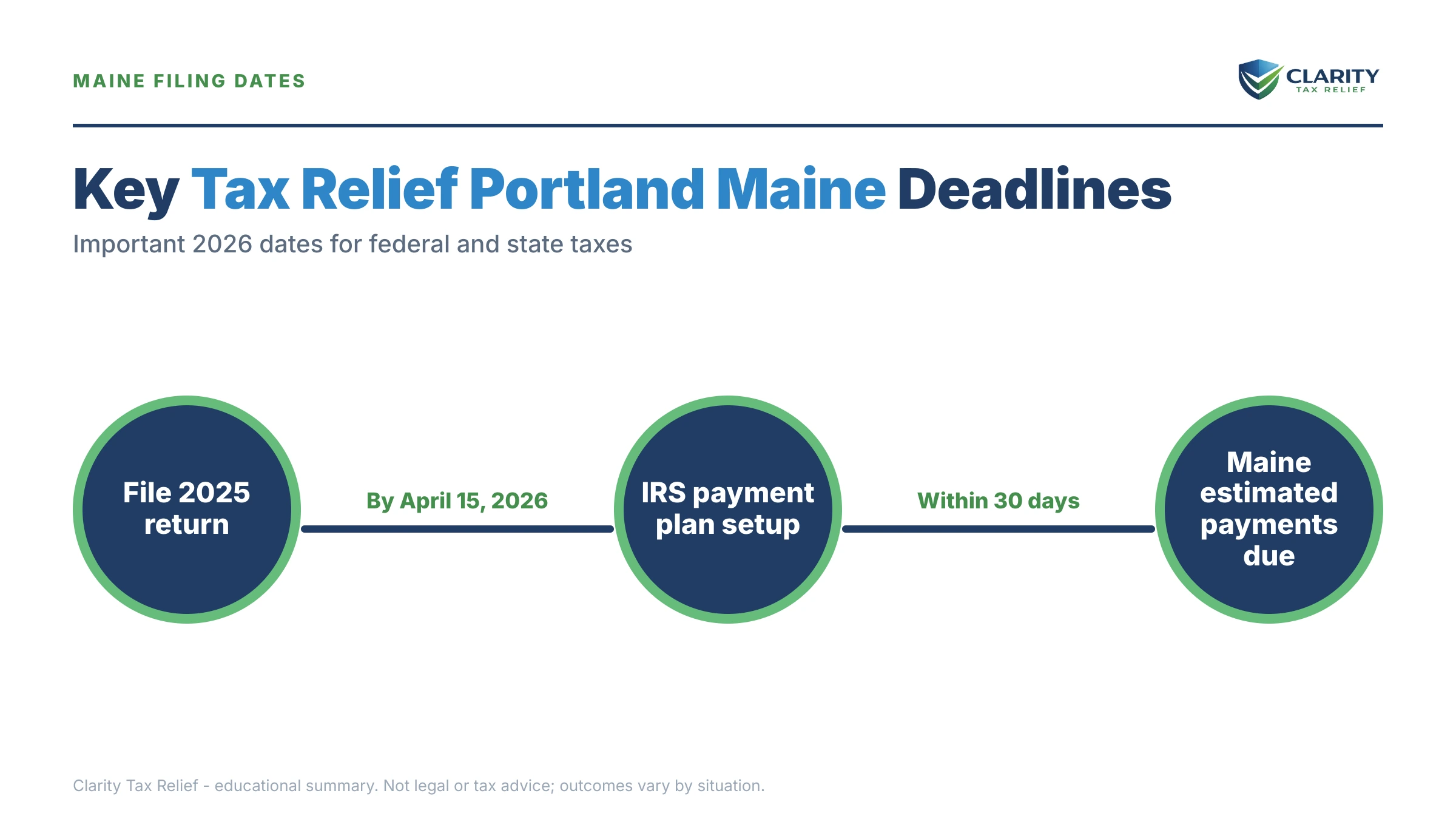
Deadlines and rights: the windows that matter
Every IRS collection notice opens a window, and some windows protect rights you permanently lose when they close. These are the ones Portland taxpayers most often hit:
| Notice or event | Window | What's at stake |
|---|---|---|
| CP14 (first bill) | Typically ~21 days | Cheapest moment to resolve; ignoring it starts the escalation sequence |
| CP504 (intent to levy) | Date printed on the notice | Your Maine state refund becomes seizable; lien filing becomes likely |
| LT11 / Letter 1058 (final notice) | 30 days | Your Collection Due Process hearing rights (Form 12153) — lose the window, lose the strongest appeal |
| Bank levy issued | 21-day hold | Funds are frozen but not yet gone — the release window before money leaves |
| CP508C (passport certification) | Triggered at $66,000+ (2026) | Passport denial or revocation; a payment plan generally prevents certification |
How to get tax relief in Portland, Maine, step by step
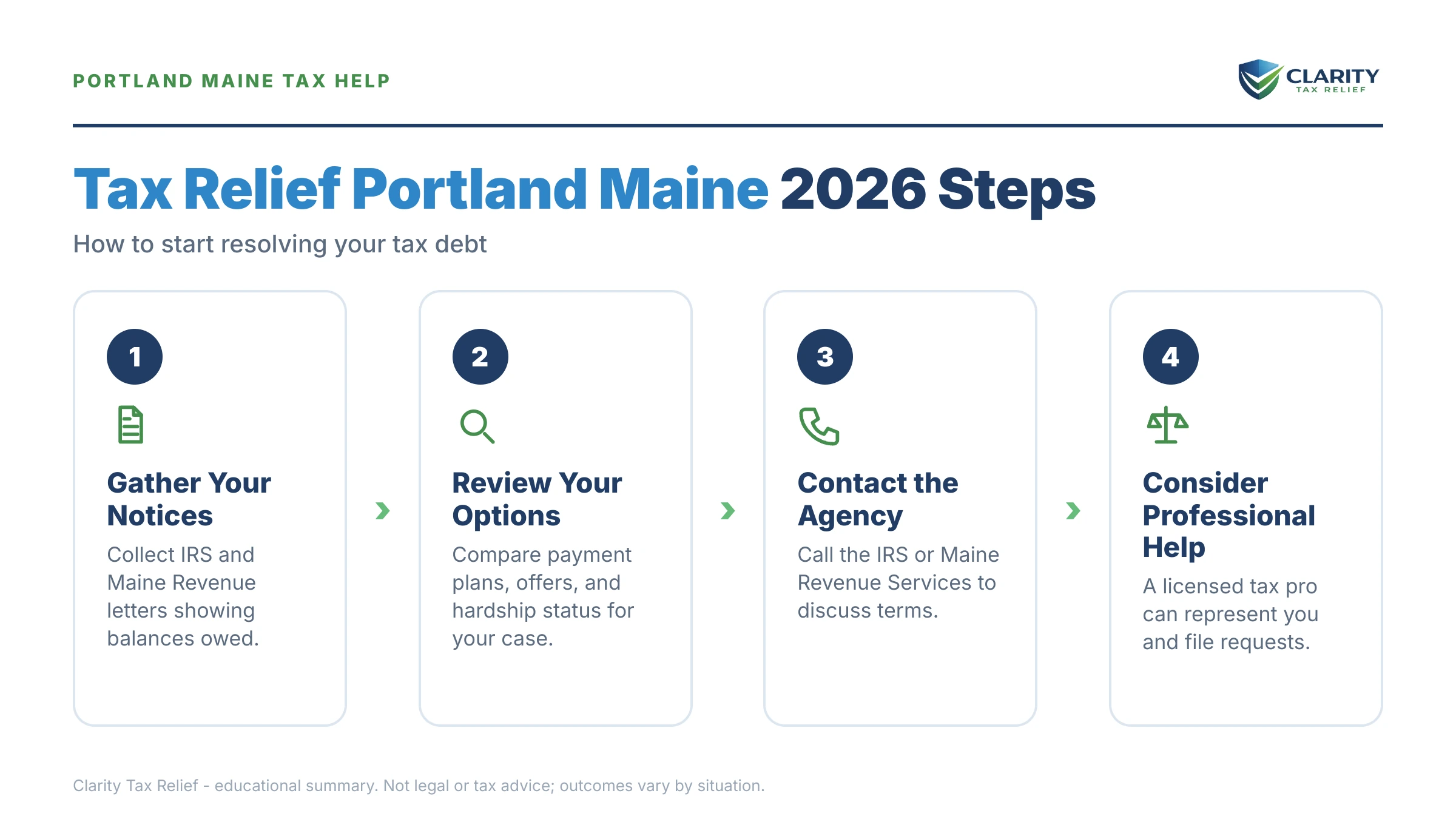
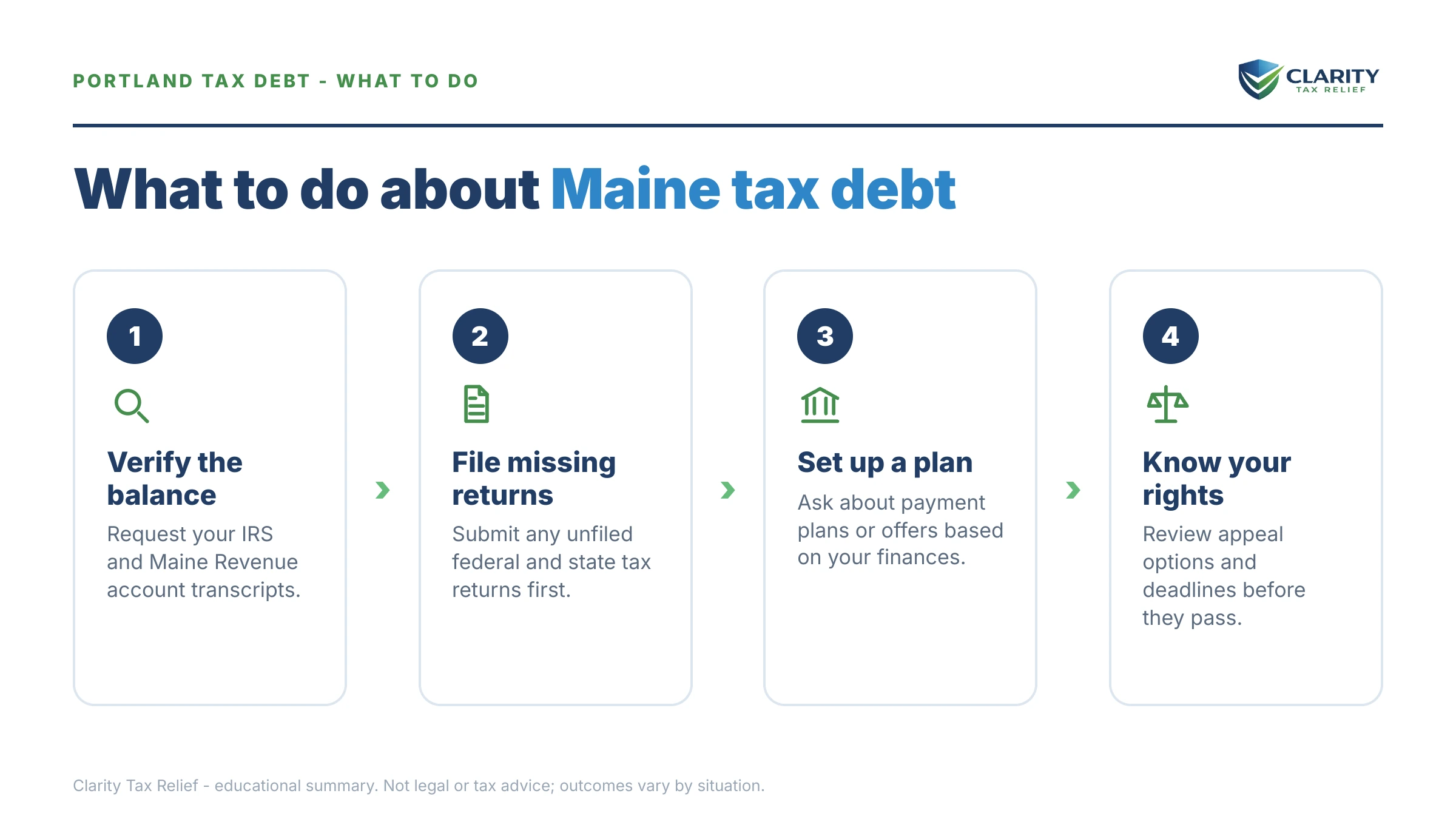
Resolution is a sequence, and doing the steps out of order wastes money. Here's the order that works:
- Pull your IRS records. Log into your IRS online account to see exactly what you owe, for which years, and how much of it is penalties versus tax. Never negotiate from a number you haven't verified.
- File every missing return. The IRS won't approve any payment plan or settlement while returns are unfiled — and Maine Revenue Services applies the same logic to state returns. Filing also stops the failure-to-file penalty, which is ten times the failure-to-pay penalty (in months where both apply, the failure-to-file portion drops to 4.5%, for a 5% combined charge).
- Match your finances to one option. Use the options table above: pay within 180 days if cash is coming, take a payment plan if you have steady margin, pursue hardship status or an Offer in Compromise only if the numbers genuinely support it.
- Set it up before the next notice. Apply online at the IRS payment plans page (or by mailing Form 9465), and contact Maine Revenue Services separately for any state balance. Every stage of escalation you prevent is leverage you keep.
- Fix the leak going forward. Set aside a fixed percentage of every deposit for quarterly estimated taxes so next April doesn't rebuild the same debt on top of your payment plan.
If you'd rather see the online application screens before you start, our walkthrough on setting up an IRS payment plan online covers each one.
When you can handle this yourself — and when help changes the outcome
Most single-year balances under $25,000 can be resolved without hiring anyone. If you agree with the amount, your returns are filed, and a payment plan fits your budget, the online application takes under an hour and costs little — do it yourself and keep your money. Free help also exists: Maine has a Low Income Taxpayer Clinic, and the Taxpayer Advocate Service assists when the IRS process itself is causing hardship.
Experienced help earns its cost in specific situations: a levy already sent to your bank or your business clients (the 21-day bank window rewards someone who's done releases before), multiple unfiled years across both the IRS and Maine Revenue Services, payroll or trust-fund debt from having employees, disputed balances, or genuine Offer in Compromise math where the financial disclosure has to be built correctly the first time. Fee structures vary widely — read our breakdown of how much tax relief costs before signing anything, and walk away from anyone promising a result before they've seen your numbers.
Terms you'll see, decoded
- Levy vs. lien: a levy takes property (bank funds, receivables); a lien is a public legal claim against property you keep — a lien secures, a levy seizes.
- CSED: the Collection Statute Expiration Date — generally 10 years from assessment, though appeals, offers, and bankruptcy pause the clock.
- CDP hearing: the Collection Due Process appeal (Form 12153) available for 30 days after a final levy notice — your strongest formal right in collections.
- MRS: Maine Revenue Services, the state's tax agency in Augusta — a completely separate collector from the IRS.
- Installment agreement: the IRS's formal name for a monthly payment plan; interest and penalties continue while you pay.
Tax relief Portland Maine: your questions answered
Is there a special tax relief program for Maine residents?
No — the IRS runs the same programs in Maine as everywhere else: payment plans, Currently Not Collectible status, penalty abatement, and the Offer in Compromise. What's different in Maine is the second collector: Maine Revenue Services runs its own separate payment arrangements for state balances. Any company advertising a special "Maine forgiveness program" is describing ordinary federal programs with marketing attached.
Can the IRS take my Maine state tax refund?
Yes. Once the IRS issues a CP504 notice, it can seize your state refund under IRC §6331(d) — so a Maine Revenue Services refund you're expecting can be redirected to your federal balance. The reverse also happens: state and federal debts can each intercept the other's refunds. If you're counting on a refund to cover bills, resolve the balance before the CP504 stage.
How much does tax relief cost in Portland, Maine?
The IRS's own fees are modest: $0 for a 180-day short-term plan, a setup fee for installment agreements (reduced or waived at lower incomes), and a $205 application fee for an Offer in Compromise. Professional representation is a separate cost that varies with case complexity — a single-year $6,200 balance costs far less to resolve than multiple unfiled years. See our guide to how much tax relief costs before hiring anyone.
Do I need a local Portland tax attorney, or can any firm help?
Federal tax representation is nationwide — an enrolled agent, CPA, or attorney can represent you before the IRS from any state, so you're not limited to firms with a Congress Street address. A tax attorney specifically matters if your case involves potential criminal exposure or Tax Court litigation. For payment plans, penalty relief, and offers, experienced tax professionals handle everything remotely.
What if I owe both the IRS and Maine Revenue Services?
Both agencies collect independently, so a payment plan with one does nothing to stop the other. Most people prioritize whichever agency is closer to levying, then set up arrangements with both — often weighting payments toward the IRS because federal balances are usually larger. The order matters: resolving them in the wrong sequence can leave you exposed to the faster-moving agency.
Can the IRS garnish my self-employment income?
Yes, but differently than a W-2 paycheck. The IRS can't run a continuous wage garnishment against you as your own boss — instead it levies what's reachable: your bank account (funds are held 21 days before being sent), and payments your business clients owe you through accounts-receivable levies. A levy notice sent to your biggest client is often more damaging than a garnishment, which is why self-employed cases reward acting early.
Will my tax debt affect my passport?
Only above the certification threshold. For 2026, the IRS certifies "seriously delinquent" tax debt of $66,000 or more to the State Department, which can then deny or revoke your passport (you'd get notice CP508C first). A $6,200 balance is nowhere near that line — but penalties and interest compound, and getting into a payment plan generally prevents certification even for larger debts.
Your next 24 hours
- Verify the number. Log into your IRS online account (or pull out your most recent IRS notice) and write down the exact balance, the tax years, and how much is penalty versus tax.
- Gather three things: last year's federal and Maine returns, your 1099s and income records, and a rough monthly budget — that's everything needed to match you to the right option.
- Get a free case review. Call (888) 825-7779 or use the 2-minute form — every month you wait, another 0.5% failure-to-pay penalty plus interest posts to a balance that's cheapest to fix right now.
This guide is general information, not tax or legal advice for your specific situation. Eligibility for IRS programs depends on individual facts and circumstances; no outcome is guaranteed.