
City Tax Relief Guides
Tax Relief in Newark, NJ: Every Real Option for IRS and New Jersey Back Taxes (2026)
The short answer: tax relief in Newark means matching your balance to a real program — an IRS payment plan, hardship status, penalty removal, or (rarely) an Offer in Compromise — plus New Jersey's separate process. Most IRS balances under $50,000 qualify for a plan you can set up online; New Jersey debt runs on its own, faster enforcement track.
If you searched "tax relief Newark," you're likely juggling two collectors at once — the IRS and the New Jersey Division of Taxation — and they don't talk to each other. New Jersey can convert your balance into a docketed Superior Court judgment (a Certificate of Debt) without ever suing you, and the IRS runs its own automated notice machine from the federal side. If you own a home in the Ironbound, Vailsburg, or Forest Hill and a refinance is on your calendar, an unresolved balance on either side is the thing most likely to blow up underwriting.
The good news: both agencies have standing programs that stop enforcement once you're inside one, and most of them don't require a lawyer or a courtroom. This guide maps every option, both escalation timelines, and the exact sequence to follow.
⏱ The real clock: back taxes have no single statutory deadline — but the IRS failure-to-pay penalty adds 0.5% of the balance every month, interest compounds daily, and New Jersey adds its own penalties plus a cost-of-collection fee once your account is referred out. If you're holding a specific notice, the response date printed on it controls.
Why owing back taxes in Newark means two collectors, not one
A Newark taxpayer with back taxes usually answers to two separate agencies — the IRS and the New Jersey Division of Taxation — each with its own balance, penalties, and enforcement track. The same missed year of income (a 1099 side job, an under-withheld second paycheck, a self-employment shortfall) typically creates a federal debt and a state debt at once, because New Jersey piggybacks on your federal return data.
The two tracks behave very differently. The IRS is slower and more standardized: a predictable notice sequence, published payment-plan thresholds, national programs. New Jersey is smaller but blunter — the Division can refer your account to a private collection agency (adding a recovery fee to your balance) and then file a NJ certificate of debt with the Superior Court, instantly creating a public judgment against you. New Jersey never needs to take you to court to get judgment power.
Two Newark-specific wrinkles worth knowing. First, if you commute into Manhattan, you may also owe New York on a nonresident return — a third track entirely. Second, Newark is one of the few New Jersey cities with its own employer payroll tax, so business owners here can owe the city, the state, and the IRS simultaneously; if that's you, start with our guide to tax relief for small business. When you owe both Trenton and the IRS, sequencing matters — our comparison of state tax debt vs IRS covers which to stabilize first.
What happens if you ignore it: the federal and New Jersey escalation paths
Ignored tax debt in Newark escalates on two automated tracks — a federal one that ends in levy power over your wages and bank accounts, and a state one that ends in a docketed judgment attached to your home. Neither track requires a human to decide anything; both run on schedule whether or not anyone at either agency ever reads your file.
On the federal side, the stages arrive in a fixed order:
- First bill (CP14) — the IRS states the balance and gives you roughly 21 days to pay or arrange payment (10 business days if the balance is $100,000 or more). No enforcement yet; this is the cheapest moment to act.
- Reminders (CP501 / CP503) — still just bills, but the 0.5% monthly penalty and daily interest are compounding the whole time.
- Intent to levy (CP504) — the IRS can now seize your New Jersey state refund, and a Notice of Federal Tax Lien becomes a realistic threat to any refinance.
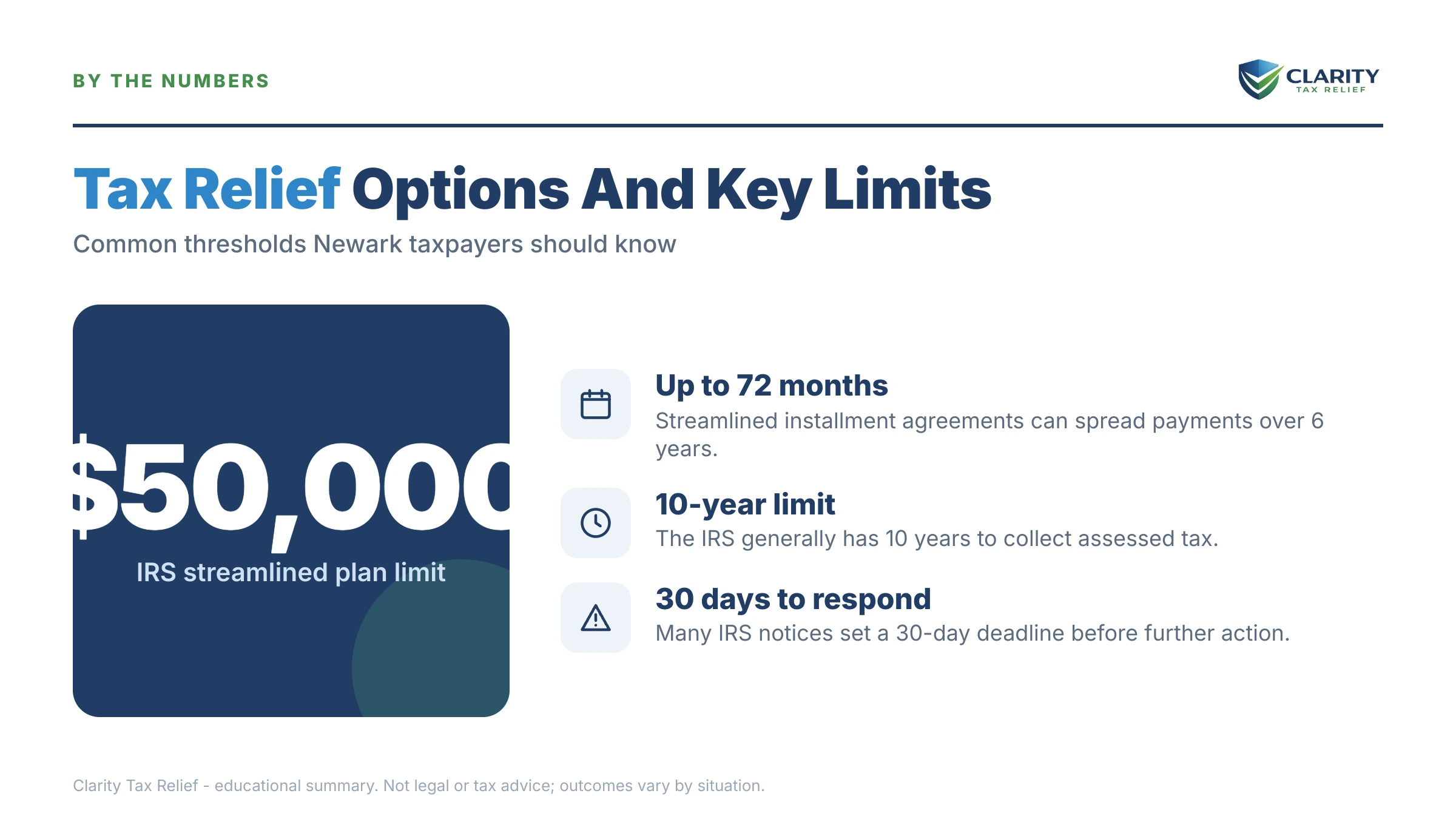
- Final notice (LT11 / Letter 1058) — a 30-day clock starts on your Collection Due Process rights (requested on Form 12153). After it runs, wage garnishment and bank levies are on the table.
- Enforcement — bank levies (with a 21-day hold before funds leave), continuous wage levies, and — above the $66,000 threshold for 2026 — passport certification.
| Notice | What it means | Your window |
|---|---|---|
| CP14 | First bill for the balance due | ~21 days from the notice date (10 business days if the balance is $100,000 or more) |
| CP501 / CP503 | Reminder bills; balance still growing | Date printed on each notice |
| CP504 | Intent to levy your state tax refund | 30 days from the notice date |
| LT11 / Letter 1058 | Final notice of intent to levy; appeal rights attach | 30 days to request a CDP hearing |
| Levy | Bank levy (21-day hold) or continuous wage levy | Release requires a resolution or hardship showing |
The New Jersey track has no published day-count schedule, but the stage order is consistent: a billing notice from the Division, then referral to its contracted collection agency with a recovery fee added on top, then the Certificate of Debt docketed with the Superior Court, then levy and wage-execution power under that judgment. The state can also intercept your NJ refund at any point through the NJ SOIL program. For a homeowner, the Certificate of Debt is the stage that matters most — once docketed, it surfaces in every title search and sits in the way of any refinance or sale.
One 2026 reality check: the IRS workforce shrank roughly 27% in 2025, which makes humans harder to reach — but the notices, liens, and levies are generated by systems that never stopped. Waiting for the agency to "get around to you" is not a strategy on either track.
Owe the IRS or New Jersey in Newark?
Every month you wait, the failure-to-pay penalty and daily interest push the balance higher — and the state moves one stage closer to a docketed judgment. Send us your notices and an experienced tax professional will map both balances and your best-fit program — free, confidential, no pressure.
Tax relief in Newark: your options and eligibility in 2026
Every legitimate tax relief path available in Newark is a standing government program with published eligibility rules — not a negotiation trick a company sells you. The general mechanics of each program are covered in our DIY pillar on how to settle tax debt yourself; here's how they line up against real balances:
| Option | Who may qualify | Setup cost | Key trade-off |
|---|---|---|---|
| IRS short-term plan | Can pay in full within 180 days | $0 | Interest and penalties continue until paid |
| Guaranteed installment agreement | Owe $10,000 or less, filing compliant | Modest fee (lower with direct debit) | Must pay within 3 years |
| Streamlined installment agreement | Owe $50,000 or less; set up online, up to 72 months | Modest fee (lower with direct debit) | Interest accrues; penalty drops to 0.25%/mo while active |
| Currently Not Collectible | Paying anything would prevent basic living expenses | $0 (financial disclosure required) | Debt remains and grows; IRS revisits when income rises |
| Offer in Compromise | Assets + future income genuinely can't cover the debt | $205 fee + 20% down (waived if AGI ≤ 250% of poverty) | ~1 in 5 accepted in FY2024; home equity usually disqualifies |
| Penalty abatement (FTA / AEP) | Clean compliance the prior 3 years; AEP becomes automatic starting summer 2026 | $0 | Removes penalties only, not tax or interest |
| NJ payment plan | Set case-by-case by the Division of Taxation | Varies | State terms are less standardized; get them in writing |
A few notes the table can't hold. Choosing between a monthly plan and a settlement is mostly arithmetic — our breakdown of an IRS payment plan vs offer in compromise walks the math. Penalty relief stacks with any of these: if 2024 or 2025 was your first slip after three clean years, first-time penalty abatement can strip the failure-to-pay penalty from the balance before you even start paying — and beginning summer 2026, the new Automatic Exemption from Penalty (AEP) applies that relief without a request for qualifying taxpayers. New Jersey evaluates its own installment and compromise requests separately — an IRS agreement does nothing for your Trenton balance, and vice versa.
What a $16,400 balance actually costs a Newark homeowner
Say you owe the IRS $16,400 and you're planning to refinance your Newark home this year — a fully worked, hypothetical example. Untouched, that balance grows by about $82 a month in failure-to-pay penalty alone ($16,400 × 0.5%), plus daily compounding interest on top. You can estimate your own accrual with our Penalty & Interest Calculator.
At $16,400 you're under the $50,000 line, so a streamlined installment agreement is available online with no financial disclosure. The minimum payment is roughly the balance divided by 72 months: $16,400 ÷ 72 ≈ $228 a month. Once the agreement is approved, the monthly penalty drops from 0.5% to 0.25% (about $41 instead of $82 at the start), though interest keeps running — paying more than the minimum saves real money.
Now the refinance angle, which changes the strategy. There's no fixed dollar trigger for a Notice of Federal Tax Lien, but filings become far more likely as balances grow past the low five figures and notices go unanswered — and a filed lien sits directly in your title search. Getting into a direct-debit agreement before a lien is filed is usually enough for underwriting: lenders generally want proof of the agreement and a record of on-time payments. If a lien has already been recorded, the deal isn't dead — see refinancing with a tax lien and the tax lien subordination process (Form 14134), which asks the IRS to let the new mortgage jump ahead of its lien so the loan can close.
What about settling instead? Here's the honest math: an Offer in Compromise is priced off what the IRS could collect from you — and for a homeowner, home equity counts. If you're refinancing, you almost certainly have equity well above $16,400, which means the IRS can see a way to collect in full and an offer would be dead on arrival. For this profile, the streamlined plan plus penalty abatement is nearly always the realistic play — not a settlement pitch.
How to resolve tax debt in Newark, step by step
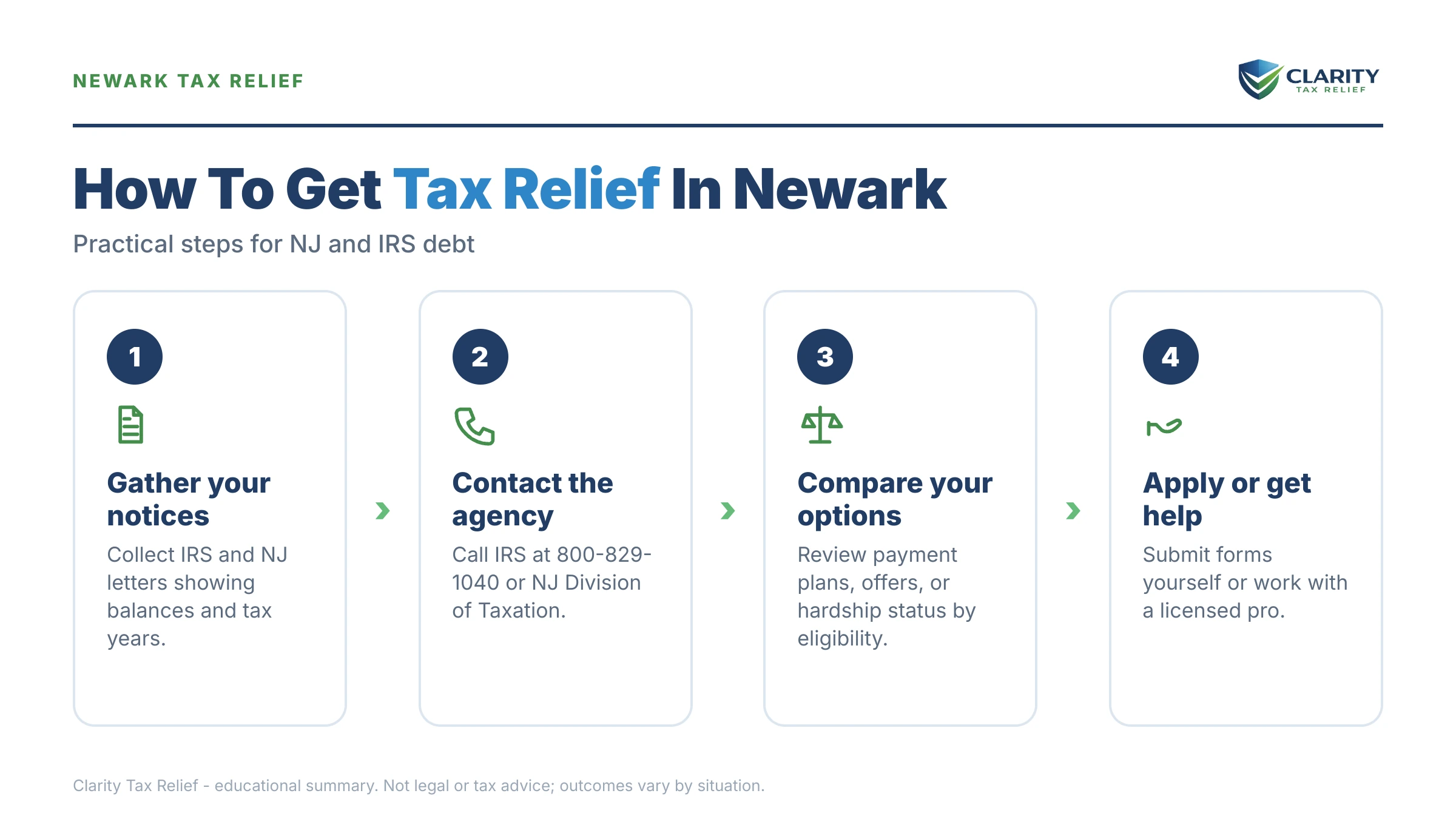
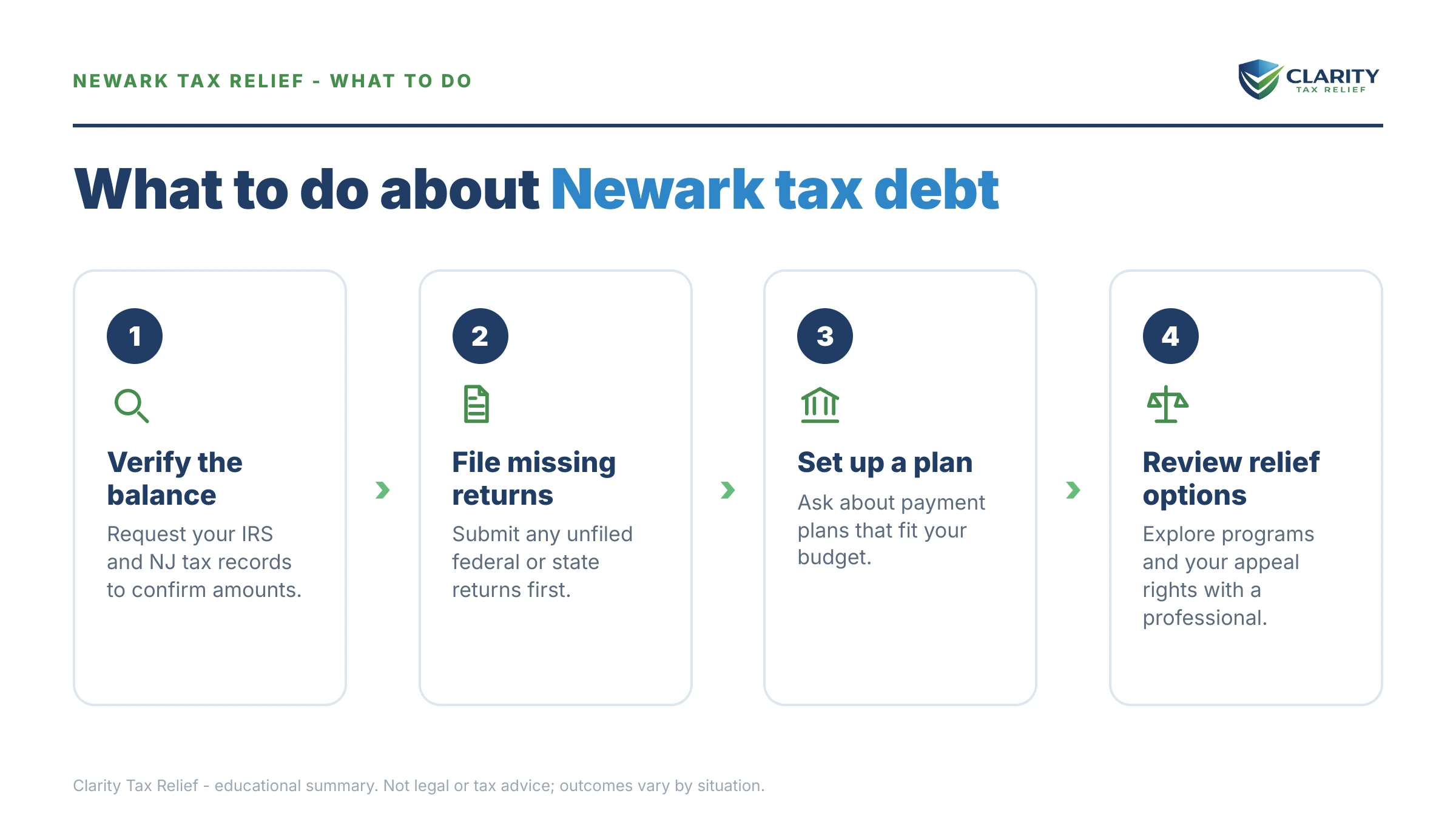
- Pull your federal and state records. Create an IRS online account to see every year's balance and transcripts, then line up your New Jersey notices so you know exactly what each agency claims you owe.
- File any missing returns. Every IRS payment plan and settlement program requires filing compliance first, and unfiled years block New Jersey arrangements too.
- Match your balance to a program. Use the options table above — a balance under $50,000 with returns filed can usually be set up as a streamlined IRS plan online in one sitting.
- Protect the refinance before a lien is filed. Choose direct debit, keep proof of the agreement for your lender, and if a federal lien or Certificate of Debt already exists, start subordination or payoff paperwork now.
- Get everything in writing. Save the IRS agreement confirmation and any New Jersey Division of Taxation payment plan letter, and watch for offsets or annual statements so one missed notice doesn't default the plan.
When you can handle this yourself — and when help changes the outcome
Most single-year IRS balances under $50,000 can be resolved by a Newark taxpayer alone, online, in under an hour — no firm required. If your returns are filed, you agree with the amount, and you just need time to pay, set up the plan yourself and keep the confirmation. The same goes for a single, undisputed New Jersey balance: call the Division, ask for a payment arrangement, and get the terms in writing. If money is the obstacle rather than complexity, the Taxpayer Advocate Service and Rutgers-area low-income taxpayer clinics offer free help for those who qualify.
Experienced help earns its fee in specific situations: a lien or Certificate of Debt already filed while a refinance or sale is in motion; a levy or wage execution already running; multiple unfiled years across both agencies; business or payroll tax debt (where personal liability rules bite); or genuine Offer in Compromise math, where one valuation mistake sinks the application. If you do hire someone, vet them the same way you'd vet a contractor — our checklist on how to choose a tax relief company covers what to ask, and if you've been quoted a big fee by a national brand, compare Optima Tax Relief alternatives before signing anything.
Terms you'll hear in a Newark tax case, decoded
- Certificate of Debt (COD): New Jersey's court-docketed judgment for unpaid tax — a public record that attaches to your property without a hearing.
- SOIL: the state's Set-Off of Individual Liability program, which intercepts NJ refunds and certain benefit payments to cover government debts.
- Notice of Federal Tax Lien: the IRS's public claim against everything you own — the document a refinance underwriter finds in a title search.
- Subordination: the IRS agreeing (via Form 14134) to let a new mortgage take priority over its lien so a refinance can close.
- CSED: the collection statute expiration date — the IRS generally has 10 years from assessment to collect, though appeals, offers, and bankruptcy pause the clock.
- CDP rights: your Collection Due Process appeal rights, triggered by a final levy notice and requested on Form 12153 within 30 days.
Tax relief in Newark: questions people ask
Is there an IRS office in Newark, New Jersey?
Yes — Newark has an IRS Taxpayer Assistance Center downtown, but it works by appointment only: call 844-545-5640 to schedule. The TAC can take payments, verify identity, and answer account questions; it cannot negotiate a settlement or stop enforcement on the spot. For resolving a balance, the online tools at IRS.gov or the phone number printed on your notice usually move faster than waiting for an appointment.
Can New Jersey take my state refund for back taxes?
Yes. Under New Jersey's Set-Off of Individual Liability (SOIL) program, the state can intercept your NJ income tax refund and certain rebate or benefit payments and apply them to back taxes and other government debts. The IRS can also take your state refund through its own levy program once a CP504 has been issued. An intercepted refund does not replace a payment plan — the rest of the balance keeps accruing penalties and interest.
Can I refinance my Newark home if I owe the IRS back taxes?
Often, yes — the cleanest path is resolving or formalizing the debt before underwriting. If no Notice of Federal Tax Lien has been filed, most lenders will proceed with proof of an installment agreement and a payment history. If a lien is already recorded, you can request lien subordination on Form 14134 so the new mortgage takes priority and the refinance can close. Start that paperwork early; subordination requests take time to process.
Should I resolve my IRS debt or my New Jersey debt first?
It depends on which agency is closer to enforcement, but New Jersey often escalates faster because a Certificate of Debt gives it judgment power without a court hearing. Compare where each account stands: if the state is about to docket a Certificate of Debt, or the IRS has issued a final notice of intent to levy, that clock controls. Many Newark taxpayers set up the IRS plan online the same day, then negotiate the state balance, because IRS terms are more standardized.
What is a New Jersey Certificate of Debt and how does it affect me?
A Certificate of Debt is New Jersey's version of a tax lien with teeth: the Division of Taxation files it with the Clerk of the Superior Court, and it becomes a docketed judgment against you — a public record that attaches to your property and shows up in title and background searches. It can block a refinance or sale until it is resolved. Unlike the IRS, New Jersey does not need a court hearing to create it.
How much does professional tax relief cost in Newark?
Reputable firms typically charge flat fees that scale with complexity — a straightforward installment agreement costs far less than an Offer in Compromise or lien subordination work. For a balance in the $15,000–$25,000 range with returns already filed, professional fees commonly land in the low four figures. Be wary of anyone quoting a large fee before reviewing your IRS transcripts, or charging a percentage of savings they have not yet calculated.
Can a Newark tax relief company settle my debt for pennies on the dollar?
No honest one will promise that. Pennies-on-the-dollar marketing is shorthand for the Offer in Compromise, a real IRS program that accepted roughly 1 in 5 offers in FY2024 — and only when the applicant's assets and income genuinely cannot cover the debt. New Jersey evaluates its own compromise requests separately and case by case. Any firm promising a settlement before analyzing your finances is showing you a red flag, not a result.
Your next 24 hours
- Find the balances and dates. Pull the most recent IRS notice and any New Jersey letter, and note the balance and the response date printed on each — those dates tell you which track is closer to enforcement.
- Gather your file. Last year's federal and NJ returns, every notice from both agencies, your current income figures, and — if a refinance is pending — your lender's timeline.
- Get a free case review. Interest and penalties are accruing on both balances every month you wait. Call (888) 825-7779 or use the 2-minute form and an experienced tax professional will map your IRS and New Jersey options — including how to keep your refinance on track — at no cost.
This guide is general information, not tax or legal advice for your specific situation. Eligibility for IRS programs depends on individual facts and circumstances; no outcome is guaranteed.