
New Jersey Tax Debt
NJ SOIL Program: Why New Jersey Took Your Refund — and How to Fight It (2026)
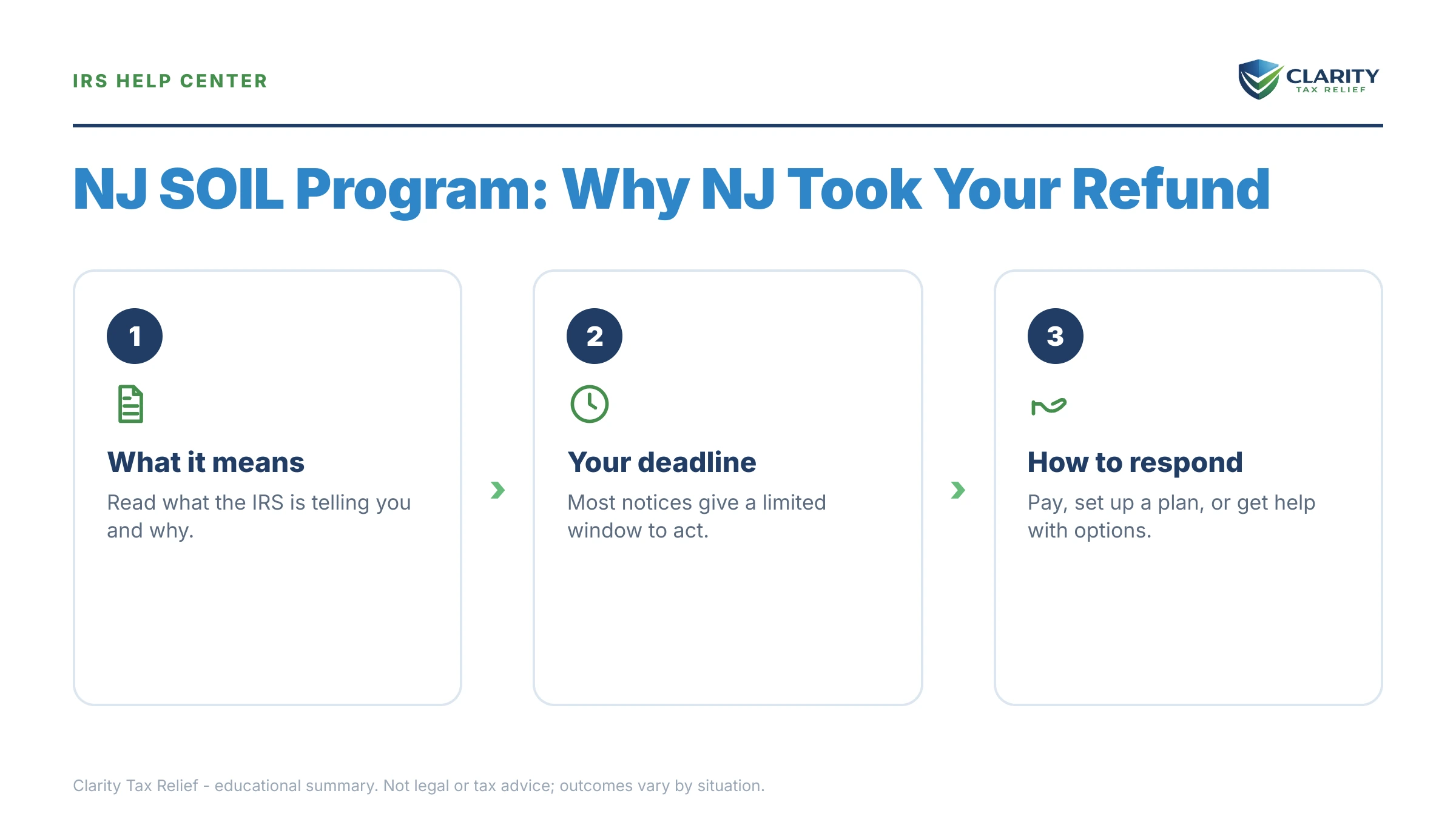
The short answer: the NJ SOIL program — Set-Off of Individual Liability — lets the New Jersey Division of Taxation intercept your state income tax refund and property tax relief payments like ANCHOR to pay debts you owe to state agencies, courts, child support, or the IRS. You dispute the offset with the agency that claimed the money, not the Division of Taxation.
You tracked your New Jersey refund for weeks, and instead of a deposit you got a letter saying your money went to an agency you may not have heard from in years. That sinking "wait, who took it?" feeling is normal — but a SOIL offset follows fixed rules, and every one of them has a counter-move you can make this week.
Two lines on that letter decide your entire path: which agency claimed your money, and the date you have to dispute by. The image below shows exactly what a SOIL notice looks like and where to look for both.
⏱ Your deadline: the dispute deadline is printed on your SOIL notice, and it controls. Miss it and the offset generally stands, with any further fight left to the claimant agency's discretion. Meanwhile, if the debt behind the offset is New Jersey tax, interest keeps accruing on the unpaid balance whether or not you respond.
Why the NJ SOIL program took your money
A SOIL notice means a government agency certified to the New Jersey Division of Taxation that you owe it money, and the Division applied your state payment to that debt before it ever reached you. SOIL is a matching system: agencies submit lists of debtors, and every refund, ANCHOR benefit, and Senior Freeze payment New Jersey issues gets screened against those lists first.
Here's the part most people miss: for most SOIL offsets, the Division of Taxation is only the middleman. It doesn't know whether you really owe the child support arrears, the unemployment overpayment, or the municipal court fine — it just executes the intercept. That's why disputes go to the claimant agency named on your notice, and why calling Taxation to argue about the debt itself goes nowhere.
If you work on 1099s, you're overrepresented in SOIL's net for two reasons. First, no employer withholds for you, so a missed quarter of estimates quietly becomes a certified state tax debt — how quarterly estimated taxes work explains the mechanics. Second, platform reporting means New Jersey and the IRS both see your gross receipts; even with the 1099-K $20,000 threshold back in place for federal forms, income you already reported on past returns created balances that don't go away.
What SOIL can intercept — and who can claim it
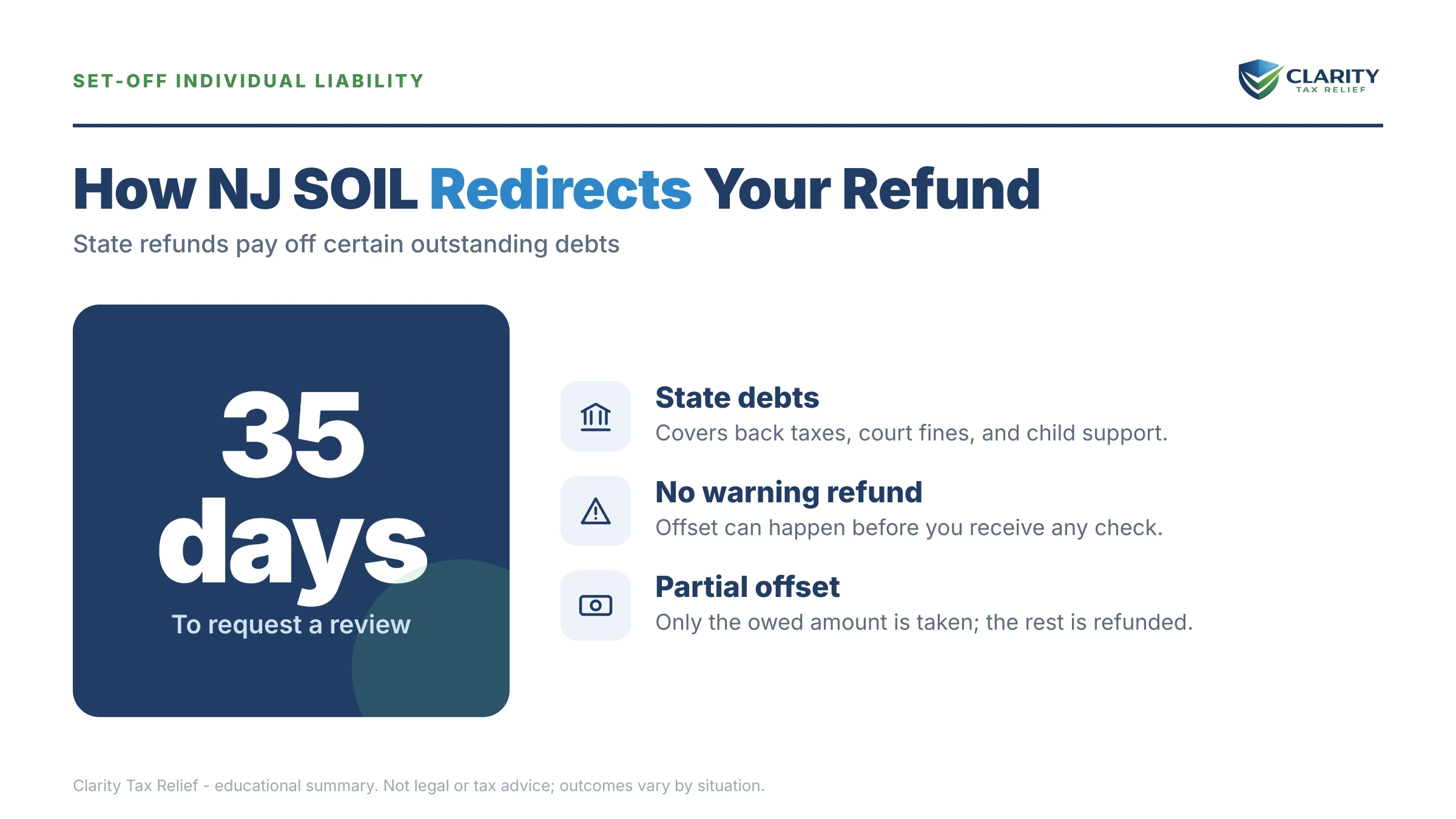
SOIL reaches any payment the State of New Jersey owes you personally: income tax refunds, ANCHOR property tax relief, Senior Freeze reimbursements, and, for certain debts, lottery winnings. It does not reach your federal refund — that runs through the separate Treasury Offset Program.
| Debt type | Who claims it | Where your dispute goes |
|---|---|---|
| NJ back income or business taxes | NJ Division of Taxation | Division of Taxation — the one case where it owns both roles |
| Child support arrears | County Probation Division | The probation office named on your notice |
| Unemployment or disability benefit overpayments | NJ Department of Labor and Workforce Development | NJDOL, in writing, with your claimant ID |
| Motor vehicle surcharges | NJ Motor Vehicle Commission | MVC's surcharge office |
| Court fines, fees, or restitution | Municipal or Superior Court | The specific court listed on the notice |
| Federal tax debt | IRS, through a reciprocal offset agreement | The IRS — see how the State Income Tax Levy Program works |
If the claimant is the IRS, your problem is a federal one wearing a New Jersey envelope — our guide to a state refund taken for IRS debt walks through that specific crossover.
What happens if you ignore a SOIL notice
A SOIL offset that goes unanswered repeats every year and signals the claimant agency that stronger tools are next. The sequence runs in this order:
- This year's money is gone. The refund and any ANCHOR or Senior Freeze payment are applied to the certified debt. If the debt is smaller than the payment, you get the difference; if several agencies have claims, priority debts like child support get paid first.
- The offset renews automatically. As long as the agency certifies a balance, every future refund and benefit payment is intercepted — you never see New Jersey money again until the debt clears.
- Interest compounds on tax debt. New Jersey charges interest at roughly three percentage points above the prime rate on unpaid tax, so a balance SOIL only nibbles at grows faster than the offsets shrink it.
- Taxation escalates to a judgment. For state tax debt, the Division can docket an NJ certificate of debt with the Superior Court — a judgment-strength filing, without a lawsuit, that attaches to your property and opens the door to wage execution and bank levies.
- Collection referral adds cost. Balances referred to the state's contract collection agency pick up a referral cost-recovery fee on top of tax, penalty, and interest.
- Other agencies escalate on their own tracks. Child support arrears can trigger license suspension; unpaid MVC surcharges can suspend your driving privileges; courts have their own enforcement.
SOIL itself never garnishes anything — it's passive. The danger is what the underlying debt does while you treat the offset as the whole punishment.
Holding a SOIL notice right now?
Send us a photo of it. An experienced tax professional will identify the claimant agency, whether the debt is even valid, and your cheapest way out — free and confidential, before the dispute deadline printed on your notice closes.
Your options after a SOIL offset
Every SOIL offset leaves you with four possible moves: dispute the debt, carve out a non-debtor spouse's share, pay or plan the balance, or stop feeding the machine. Which combination fits depends on whether the debt is real — and how big it is.
- Dispute the debt. Already paid, wrong person, wrong amount, or a case that was closed — put it in writing to the claimant agency with proof, before the notice deadline. If the agency agrees, the intercepted funds are released back to you.
- Claim a non-debtor spouse's share. If the refund was joint and the debt belongs to only one spouse, New Jersey can return the innocent spouse's portion based on each spouse's income and withholding. On the federal side, a spouse's separate liability raises a related but different fix — separation of liability relief — with its own rules.
- Pay the balance or set up a plan. The Division of Taxation and most claimant agencies accept installment arrangements. A plan you choose beats waiting for a decade of seized refunds, because interest outruns one offset a year.
- Stop generating refunds. A refund is an interest-free loan to Trenton that SOIL confiscates. Set your quarterly estimates to break even and redirect the difference to the debt on your own schedule.
The bands below are practical guidance, not official New Jersey cutoffs:
| Balance owed to NJ | Realistic path | What to watch |
|---|---|---|
| Under $2,500 | Pay in full, or let this year's offset plus one direct payment close it out | Interest accrues until payment posts — confirm a zero balance in writing |
| $2,500–$10,000 | Short installment plan with the Division of Taxation | Stay current on new quarterly estimates, or the plan defaults and offsets resume |
| $10,000–$50,000 | Formal payment plan; verify whether a certificate of debt is already docketed | A docketed COD is a public judgment — it affects financing and property sales |
| Over $50,000 | Full financial workup, judgment strategy, and coordination of NJ and IRS debts | Which government you pay first changes the total cost — sequence deliberately |
Owe both New Jersey and the IRS? The order you resolve them in matters — see state tax debt vs IRS for the sequencing logic, and the how to settle tax debt yourself pillar for the federal-side programs in one place.
Say you owe New Jersey $16,400: a worked example
Say you're a 1099 contractor who owes New Jersey $16,400 across two tax years — estimates you skipped when work was thin, plus penalties and interest. This year you filed expecting a $2,150 refund, and you qualified for a $1,750 ANCHOR benefit. This is a hypothetical, but the math is how it actually plays out:
- SOIL intercepts both payments: $2,150 + $1,750 = $3,900 applied. Your balance drops to $16,400 − $3,900 = $12,500.
- Interest keeps running at roughly three points above prime, so waiting for next year's offset means the balance barely moves — one $3,900 haircut a year against a compounding debt is the slowest possible payoff.
- A 48-month installment plan instead: $12,500 ÷ 48 ≈ $260/month before accruing interest. That stops the annual seizure of your ANCHOR benefit as the balance clears and keeps the debt off the certificate-of-debt track.
- Going forward, you set quarterlies to break even. The $2,150 you used to overpay becomes eight extra months of plan payments you control.
Same facts, but the $16,400 turns out to be your ex-spouse's unemployment overpayment attached to a joint return? Then the play is entirely different: a written dispute to NJDOL plus a non-debtor spouse claim — and no payment plan at all.
How to respond to a SOIL offset, step by step
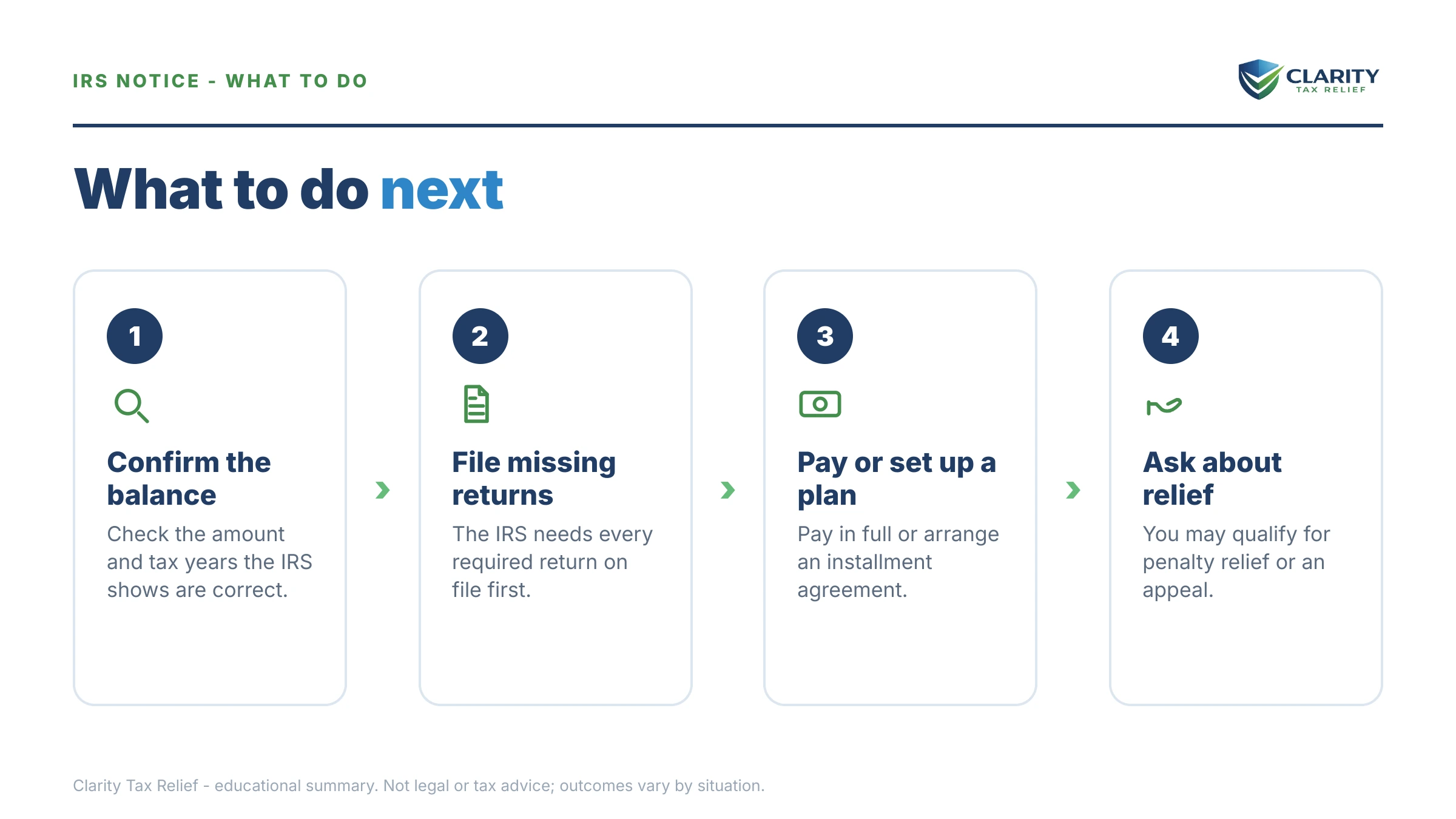
- Read the notice line by line. Identify the claimant agency, the amount applied, and the dispute deadline printed on the letter — those three items control everything that follows.
- Verify the debt against your records. Pull payment confirmations, court records, or account statements before assuming the claim is right — mixed-up accounts and already-paid debts show up in SOIL offsets.
- Dispute in writing with the claimant agency before the deadline. Send proof of payment or mistaken identity to the agency named on the notice — not the Division of Taxation — and keep copies of everything.
- Claim a non-debtor spouse's share if the refund was joint. Provide each spouse's income and withholding documents so New Jersey can return the portion of the refund that belongs to the spouse who doesn't owe.
- Resolve the remaining balance directly. Pay it or set up a payment plan with the claimant agency so future refunds and ANCHOR payments stop disappearing.
- Adjust your estimated payments going forward. Stop generating refunds the state will intercept — aim to break even and pay the debt on your own schedule.
When you can handle this yourself
Most SOIL offsets don't require professional help. If the debt is real, you recognize it, and the offset covers all or most of it, you're done — confirm the remaining balance with the claimant agency and pay it off. A single small state tax balance with a payment plan you can set up directly with the New Jersey Division of Taxation is a phone call and a form, not a case. The same is true on the federal side for small IRS balances you can pay through IRS.gov/payments.
Experienced help changes the outcome in a narrower set of situations: a debt you don't recognize or believe is identity confusion; a joint refund seized for one spouse's debt with real money at stake; multiple years of NJ and IRS debt that need to be sequenced; a certificate of debt already docketed against you; or self-employment income the state reconstructed higher than reality. In those cases, the dispute deadline on your notice is short, the paperwork is unforgiving, and a wrong first move is expensive to unwind.
Terms on your SOIL notice, decoded
- Set-off: applying money the state owes you against money you owe someone else — a bookkeeping seizure of your refund, not a levy on your bank account.
- Claimant agency: the government office that certified your debt to the Division of Taxation; it — not Taxation — decides whether your dispute wins.
- ANCHOR: New Jersey's property tax relief benefit for homeowners and renters; because the state pays it, it passes through the same offset screen as refunds.
- Certificate of Debt (COD): the Division of Taxation's judgment shortcut — a Superior Court filing with the force of a docketed judgment, no lawsuit required.
- Treasury Offset Program (TOP): the federal counterpart to SOIL, where IRS refunds can be taken for state debts — and state refunds for federal ones — through reciprocal agreements.
NJ SOIL program questions, answered
What is the NJ SOIL program?
SOIL stands for Set-Off of Individual Liability. It's the New Jersey Division of Taxation's program for intercepting state income tax refunds and property tax relief payments and applying them to debts you owe to state agencies, courts, child support, or the IRS. It runs automatically every year until the claimed debt is paid or successfully disputed, so one offset usually means future refunds are exposed too.
Why did SOIL take my ANCHOR benefit?
ANCHOR property tax relief payments run through the same offset screen as income tax refunds, so any debt certified to SOIL can absorb them. If your ANCHOR payment never arrived, check your mail for a SOIL notice naming the claimant agency and the amount applied. The dispute process is the same as for a seized refund: contact the agency listed on the notice, not the ANCHOR program.
How do I dispute a SOIL offset?
Contact the claimant agency named on your notice, in writing, before the deadline printed on the letter. The Division of Taxation only executes the offset — it can't rule on whether the underlying debt is valid. Send proof with your dispute: payment records, a case number showing the debt was resolved, or documentation that the debt belongs to someone else. Keep copies of everything you send.
My spouse owes the debt, not me — can I get my share of a joint refund back?
Often, yes. When a joint New Jersey refund is offset for a debt that belongs to only one spouse, the non-debtor spouse can ask for their share of the refund based on each spouse's income and withholding. Respond to the SOIL notice promptly and provide both spouses' income documents. This is New Jersey's version of the federal injured-spouse concept, though the state process is its own.
Will SOIL take my federal refund too?
No — SOIL only reaches New Jersey payments. But New Jersey tax debts can be certified to the federal Treasury Offset Program, which intercepts IRS refunds, and the IRS can separately grab your state refund through its own reciprocal program. So if you owe both governments, both refunds are realistically exposed — just through different programs with different notices.
Does a SOIL offset mean New Jersey will garnish my wages next?
Not automatically, but it's a warning shot. SOIL is a passive tool — it only takes money already headed your way. If the underlying debt is New Jersey back taxes and it stays unpaid, the Division of Taxation can docket a Certificate of Debt with the Superior Court, which functions as a judgment and opens the door to wage execution, bank levies, and liens. Resolving the balance before that filing is far cheaper.
The debt was already paid — can I get my money back?
Yes, if you act inside the dispute window. Send the claimant agency proof of payment — a canceled check, a receipt, or an account statement showing a zero balance — before the deadline on your notice. If the agency agrees, it releases the funds and the offset is refunded to you. If the deadline has already passed, you can still pursue the agency directly, but recovery gets slower.
How do I stop SOIL from taking next year's refund?
Resolve or dispute the underlying debt — SOIL renews as long as an agency certifies you owe. If the debt is valid, pay it or get on a payment plan. Meanwhile, if you're self-employed, stop overpaying: set your quarterly estimated payments so you break even instead of generating a refund the state will seize, and put the difference toward the debt on your own schedule.
Your next 24 hours
- Find two lines on your SOIL notice: the claimant agency (who took your money) and the dispute deadline. Write the deadline where you'll see it — it's the only clock that matters here.
- Gather your file: the notice itself, your latest New Jersey return, proof of any payments on the claimed debt, and — if you filed jointly — both spouses' income and withholding documents.
- Get a free case review. Whether the debt is wrong, half yours, or real but bigger than the offset, an experienced tax professional can map your cheapest path before the deadline on your notice passes and interest adds another layer — start with the 2-minute form or call (888) 825-7779.
This guide is general information, not tax or legal advice for your specific situation. Eligibility for IRS programs depends on individual facts and circumstances; no outcome is guaranteed.