
City Tax Relief Guides
Tax Relief Columbia: How to Resolve IRS and South Carolina Tax Debt in 2026
The short answer: tax relief in Columbia means resolving debt with the IRS, the South Carolina Department of Revenue (SCDOR), or both. The core options: an IRS payment plan (up to 72 months for balances under $50,000), Currently Not Collectible hardship status, an Offer in Compromise, and penalty abatement. An active levy can often be released once an agreement is in place.
If you searched "tax relief Columbia," odds are the letters have stopped being polite. Maybe your employer's payroll office got a levy order, or your checking account froze the same week rent was due. When you rent and live paycheck to paycheck, a levy isn't an abstraction — it's next month's housing.
Here's the map: identify which agency is collecting, confirm what you actually owe, and get into the one resolution your numbers support — because a levy is usually released once you're in an agreement, not before.
⏱ Your clock: if your most recent letter is an LT11 or Letter 1058, you have 30 days from its date to request a Collection Due Process hearing before the IRS can levy. Already levied? A bank levy holds funds for 21 days before they leave your account; a wage levy repeats every payday until it's released.
Why Columbia tax debt usually means two collectors
Columbia sits under two separate tax collectors: the IRS and the South Carolina Department of Revenue (SCDOR) — and SCDOR is headquartered in Columbia itself. Each agency keeps its own balance, sends its own notices, and enforces on its own schedule. Paying one does nothing for the other.
For federal debt, geography is irrelevant. Your case is handled by the IRS's centralized, automated collection system — the same one that mails notices to every zip code in the country. In 2026 that matters more than ever: the IRS workforce shrank roughly 27% in 2025, so reaching a human is harder, but the computers that issue levies never took a day off. Delay doesn't buy mercy; it buys the next notice.
One quick fork in the road: if you're in Columbia, Missouri, your state collector is the Missouri Department of Revenue instead — the state-side details in our Missouri back taxes guide apply to you, while everything federal on this page works the same.
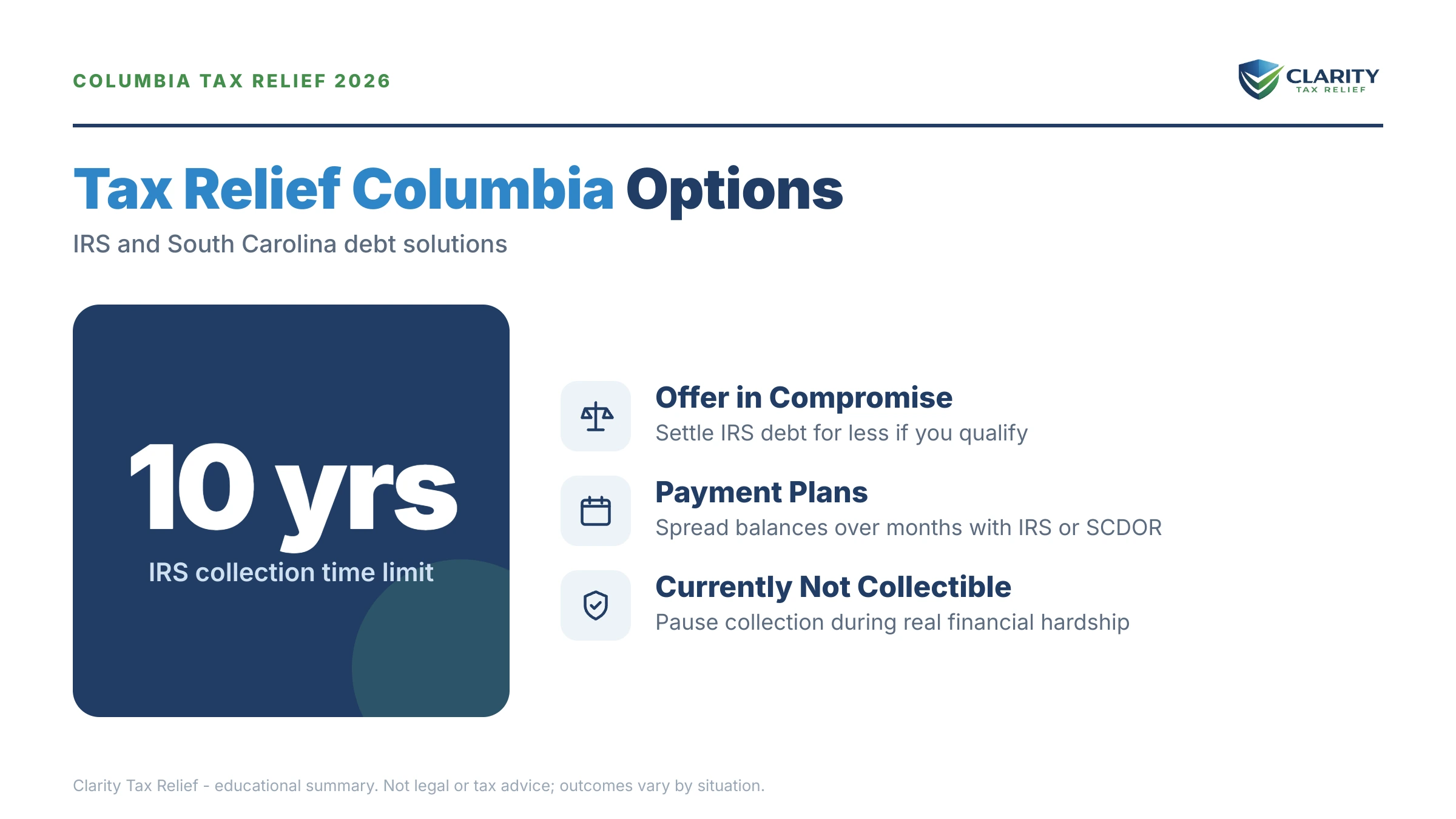
What happens if you ignore an IRS levy warning
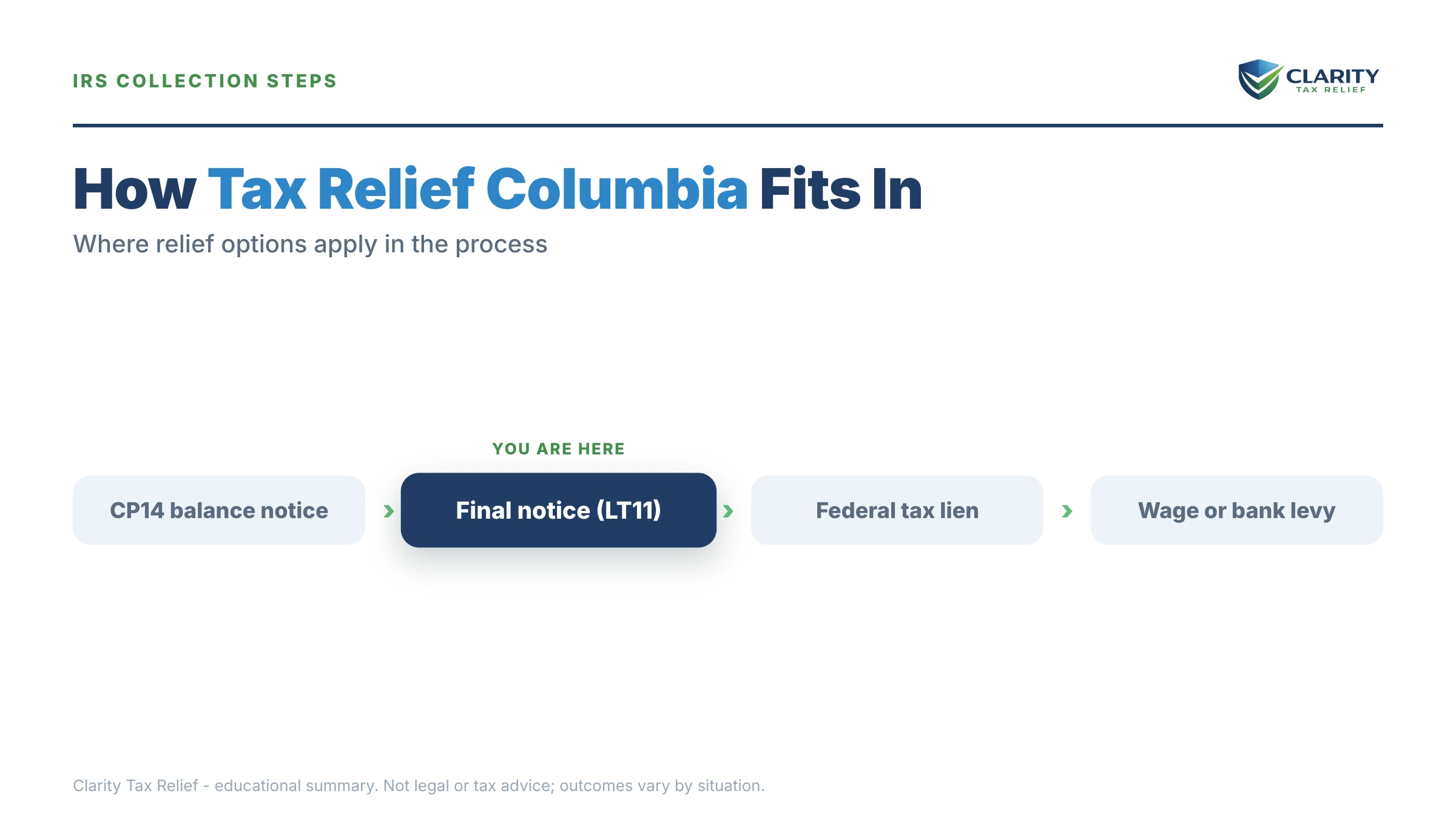
An IRS wage levy is continuous — it takes a slice of every paycheck until it's released, not just once. That's the endpoint of a fixed, automated notice sequence, and where you sit in it determines how much time you have:
- CP14 — the first bill. No enforcement yet, but interest and the late-payment penalty are already running.
- CP501 / CP503 — reminder notices. Still just bills; the balance grows monthly.
- CP504 — Notice of Intent to Levy under IRC §6331(d). The IRS can now take your South Carolina state tax refund, and a federal tax lien becomes a real possibility.
- LT11 / Letter 1058 — the final notice. It opens a 30-day window to request a Collection Due Process hearing (Form 12153). After 30 days, wage and bank levies are authorized.
- Active levy — a bank levy freezes funds for a 21-day hold before the money transfers; a wage levy hits every payday; Social Security can lose up to 15% through the Federal Payment Levy Program.
As a renter, the levy — not the lien — is your real exposure. There's no home equity for the IRS to sit on, so it goes after cash flow: your paycheck and your bank account. A wage levy leaves you only an exempt amount based on your filing status and dependents; you can estimate how much of your paycheck a levy would leave with our IRS Wage Garnishment Calculator. A filed tax lien no longer appears on consumer credit reports, but it is a public record — something to know before your next rental application or job screening.
One number worth checking against your balance: passport certification starts at $66,000 of seriously delinquent tax debt in 2026. A $41,800 balance is under that line today — but interest and penalties compound, and unaddressed balances climb toward it. For the full sequence with every notice explained, see the order of IRS collection letters.
Levy in motion in Columbia?
If your bank account was just frozen, the 21-day hold is your window to act before the money transfers — and if you're holding an LT11, the 30-day appeal clock is running. Send us the notice. An experienced tax professional will review it free and map your fastest release path.
Tax relief Columbia: your options compared
Every IRS resolution in 2026 runs through the same five doors: pay in full, a payment plan, Currently Not Collectible status, an Offer in Compromise, or penalty relief. Which door is open depends on your balance and your finances — the full do-it-yourself mechanics live in our guide to how to settle tax debt yourself; here's how they line up.
| Option | Key eligibility threshold | Best fit |
|---|---|---|
| Short-term payment plan | Can pay in full within 180 days | Small balances you can clear with a few paychecks |
| Guaranteed installment agreement | Balance ≤ $10,000, returns filed, payoff within 3 years | Small debts — approval is automatic if you meet the terms |
| Streamlined installment agreement | Balance ≤ $50,000; up to 72 months, set up online | Most Columbia readers — including a $41,800 balance |
| Currently Not Collectible | Allowable living expenses consume your income (shown on Form 433-F) | Genuine hardship — collection pauses, debt remains |
| Offer in Compromise | Assets + future income below the balance; means-tested | Cases the IRS genuinely can't collect in full |
| Penalty abatement (FTA / AEP) | Clean compliance the prior 3 years, or reasonable cause | First-time slips; AEP becomes automatic starting summer 2026 |
What each path costs and how long it takes matters just as much as whether you qualify:
| Option | IRS cost to set up | Typical timeline |
|---|---|---|
| Short-term plan (≤180 days) | $0 setup; interest and penalties continue | Active within days online |
| Long-term installment agreement | Setup fee (lower with direct debit; reduced or waived for low-income) | Days online; weeks by phone or mail |
| Currently Not Collectible | No fee; requires financial disclosure | Weeks — faster with a complete Form 433-F |
| Offer in Compromise | $205 fee + 20% down on lump-sum offers (both waived with low-income certification) | Months; auto-accepted if the IRS doesn't decide within 2 years, with narrow exceptions - a returned or rejected offer stops the clock, and time during court disputes does not count |
| Penalty abatement | Free to request | Varies; AEP applies automatically starting summer 2026 |
| Levy release | No fee; requires an agreement or a hardship showing | Bank levy: possible within the 21-day hold if you move fast |
Worked example: $41,800 in IRS debt, renting in Columbia
Say you owe the IRS $41,800 and rent near downtown Columbia — this is hypothetical, but the math is real. Because the balance is under $50,000, you can request a streamlined installment agreement online, no financial disclosure required. Spread over the maximum 72 months, that's $41,800 ÷ 72 ≈ $581 a month as a floor — interest and the 0.5% monthly failure-to-pay penalty keep accruing inside the plan, so paying more than the minimum shortens the total cost. Critically, an accepted agreement is generally what gets an active wage levy released.
Now suppose your finances are tighter: after IRS allowable living expenses (rent, utilities, transportation, health costs), you have $150 a month left and $2,000 in total assets. That changes the picture. A lump-sum Offer in Compromise is scored roughly as assets plus 12 months of remaining income: $2,000 + ($150 × 12) = $3,800 — the amount the IRS's own formula says it could ever collect. If that math truly holds up on paper, an offer near that figure is worth exploring; if your rent is low and your income solid, it isn't. The IRS accepted roughly 1 in 5 offers in FY2024, and every acceptance came down to documented numbers, not negotiation. And if zero is genuinely all you can pay, Currently Not Collectible pauses collection entirely while the 10-year collection statute keeps running in the background.
How to get tax relief in Columbia, step by step
The order you fix things in changes what you pay: compliance first, then penalties, then the balance.
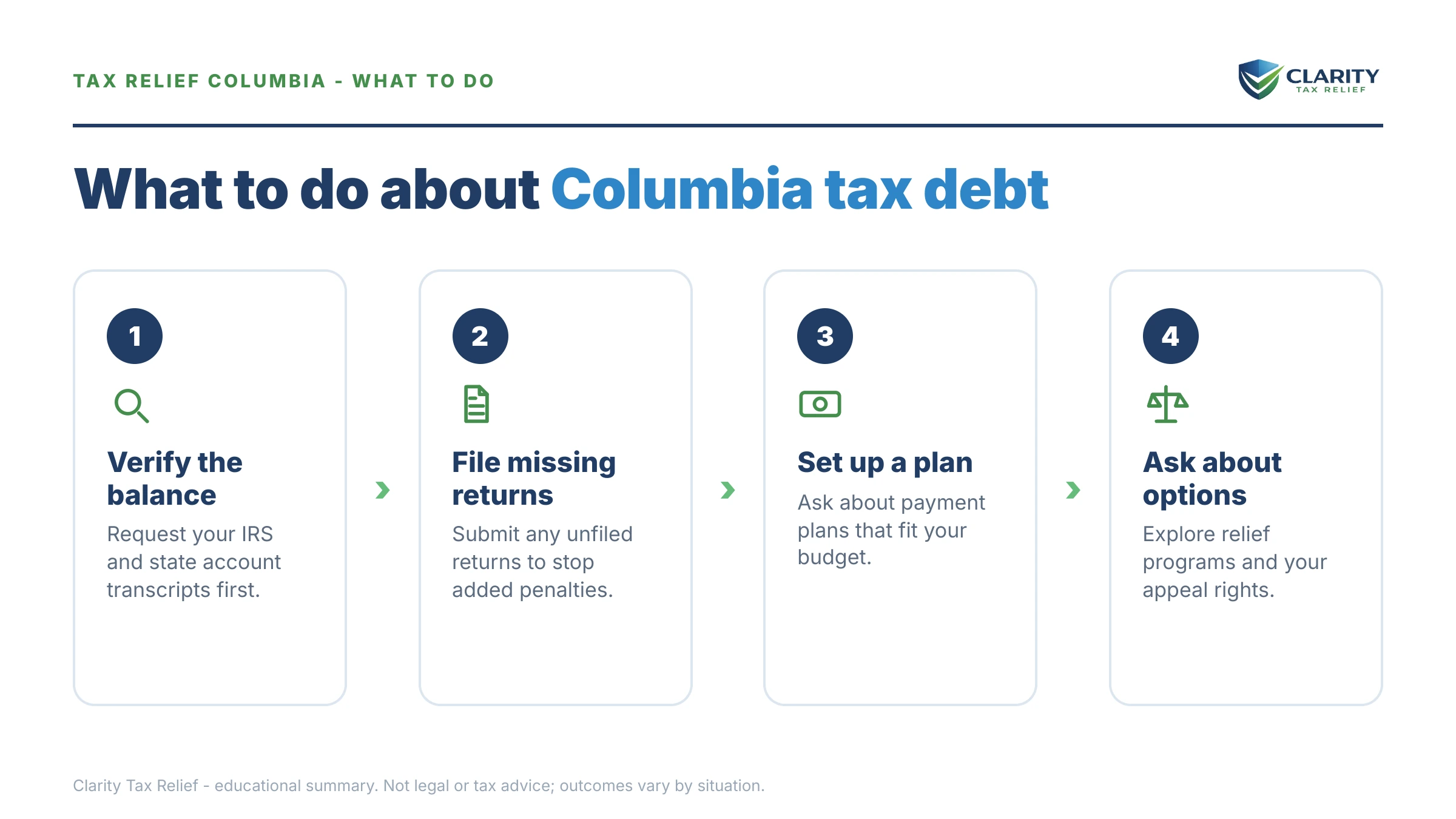
- Sort your letters by agency and date. Separate IRS notices from SCDOR notices, then find the most recent letter from each and note the notice name (top corner) and its date. An LT11 or Letter 1058 dated within the last 30 days means you still have Collection Due Process rights.
- Confirm the real balance. Log into your IRS online account to see every year with a balance, how it splits between tax, penalties, and interest, and whether a levy is pending. Don't rely on the letter alone — balances grow between notices.
- Get filing-compliant. The IRS will not approve a payment plan, hardship status, or offer while required returns are unfiled. File any missing years first, even if you can't pay a dollar of what they show.
- Match your numbers to one option. Under $50,000 and able to afford a monthly payment: streamlined installment agreement. Can't cover basic living costs: Currently Not Collectible. Assets and income far below the balance: explore an Offer in Compromise. Penalties driving the balance: request abatement.
- Act before the levy executes. Request the agreement, file Form 12153 if you're inside the 30-day window, or ask for a hardship release if money is already frozen. A bank levy's 21-day hold is your last window to get funds back before they transfer to the Treasury.
Step five is where the details matter most — our guides to the Form 12153 CDP hearing, how to stop IRS wage garnishment, and the IRS bank levy 21-day rule walk through each release path in depth.
When you can handle this yourself — and when help changes the outcome
If you owe under $50,000, agree with the balance, and no levy is active, you can usually set up an IRS payment plan yourself online in under an hour. Do it directly at the IRS payment plans page and pay at IRS.gov/payments — no firm in Columbia or anywhere else can get you a better streamlined agreement than the one the IRS's own system offers. A single first-time penalty on an otherwise clean record is also a solid DIY abatement request.
Experienced help earns its fee in a narrower set of situations: a levy already taking your paycheck or holding your bank funds, multiple unfiled years that have to be reconstructed before anything else can happen, debt to both the IRS and SCDOR at once, or Offer in Compromise math where the difference between a documented case and a hopeful one is acceptance versus a $205 lesson. If money is impossibly tight, the IRS's independent Taxpayer Advocate Service can intervene in hardship cases at no cost.
Choosing tax relief help in Columbia: local firm or national company?
IRS collection cases are worked by mail, phone, and fax — which means a Columbia zip code matters far less than credentials and a written flat fee. Columbia has capable CPAs, enrolled agents, and tax attorneys; national firms handle the same cases remotely. What separates good help from expensive disappointment is the same either way: a credentialed person (EA, CPA, or attorney) actually assigned to your case, a fee quoted in writing before you pay, and no promises about outcomes before anyone has seen your financials.
Vet anyone — including us — against the checklist in how to choose a tax relief company, and see realistic pricing in how much does tax relief cost. If you've had a poor experience with a big national brand, our Optima Tax Relief alternatives comparison shows what to look for the second time around. Columbia business owners with payroll or sales-tax debt have a different buying decision entirely — start with tax relief for small business.
Owe South Carolina too? SCDOR plays by its own rules
The SCDOR is a separate creditor with its own liens, levies, and payment plans — nothing you arrange with the IRS binds South Carolina. Don't map IRS numbers onto your state balance: the 72-month plan, the 10-year collection statute, and the OIC formula are federal rules, and SCDOR's programs, thresholds, and timelines are its own. Verify anything state-specific directly at dor.sc.gov or in writing from SCDOR.
Two practical points for Columbia readers carrying both debts. First, the IRS can intercept your South Carolina refund once a CP504 has issued, and refund offsets flow between the agencies — a state refund you're counting on may already be spoken for. Second, when both are collecting, most people stabilize whichever agency is actively levying first, then set terms with the other. The full state-side playbook is in South Carolina back taxes, and the sequencing decision is covered in state tax debt vs IRS.
Terms on your notices, decoded
- Levy vs. lien: a levy takes property (paychecks, bank funds); a lien is a public legal claim against everything you own — for a renter, the levy is the one that hurts.
- CDP hearing: the formal appeal (Form 12153) an LT11 or Letter 1058 entitles you to — filed within 30 days, it stops levy action while your case is heard.
- Continuous levy: a wage levy attaches to every future paycheck until released; a bank levy, by contrast, grabs only what's in the account the day it lands.
- CSED: the Collection Statute Expiration Date — the IRS generally gets 10 years from assessment to collect, though appeals, offers, and bankruptcy pause the clock.
- Reasonable Collection Potential (RCP): the IRS's formula — your assets plus a multiple of your remaining monthly income — that decides whether an Offer in Compromise gets accepted.
Tax relief Columbia: questions people ask
Is there local tax relief help in Columbia, SC?
Yes — Columbia has CPAs, enrolled agents, and tax attorneys, plus national firms that work cases remotely. Because IRS collection is centralized and handled by mail, phone, and fax, physical location rarely changes the outcome; credentials and written flat fees matter far more. The main exception is a revenue-officer case, where having representation that can appear in person sometimes helps.
Can the South Carolina Department of Revenue garnish my wages?
Yes. The SCDOR can levy wages and bank accounts for unpaid state taxes without first suing you, and South Carolina's general limits on wage garnishment for consumer debts do not protect you from the state's own tax collection. SCDOR also files state tax liens. If you owe South Carolina, contact SCDOR about a payment plan before a levy issues — its programs are separate from the IRS's.
How do I stop an IRS wage levy in Columbia?
The fastest reliable path is getting into a resolution: a wage levy is generally released once an installment agreement is accepted or you show economic hardship (Currently Not Collectible). A wage levy is continuous — it takes a slice of every paycheck until released — so waiting doesn't help. If you received an LT11 or Letter 1058 within the last 30 days, a timely Form 12153 Collection Due Process request can stop the levy before it starts.
Does the IRS have an office in Columbia?
Yes, the IRS operates a Taxpayer Assistance Center in Columbia, and visits are by appointment only. A TAC can take payments and answer account questions, but it cannot negotiate settlements on the spot. Most resolutions — payment plans, hardship status, offers — are handled online, by mail, or by phone, and with the IRS workforce down roughly 27% since 2025, appointments and phone lines are slower than the automated collection system that keeps escalating your case.
What if I owe both the IRS and South Carolina?
Resolve them in parallel, but don't assume one agreement covers both — the IRS and SCDOR are separate creditors with separate programs. Most people prioritize whichever agency is actively levying, then set up terms with the other. IRS rules like 72-month payment plans and the 10-year collection statute do not apply to SCDOR debt, so verify every state figure with SCDOR directly.
How much does tax relief cost in Columbia?
IRS fees themselves are modest: $0 for a short-term payment plan, a setup fee for long-term agreements (reduced with direct debit and for low-income taxpayers), and a $205 Offer in Compromise application fee that is waived with low-income certification. Professional representation typically runs from several hundred dollars for a simple payment plan to several thousand for an OIC or an active levy case — get a flat-fee quote in writing before paying anyone.
Can I settle my IRS debt for less while renting in Columbia?
Possibly — renters can actually be stronger Offer in Compromise candidates because there is no home equity inflating the IRS's collection math. Acceptance still depends entirely on your income, assets, and allowable expenses, and the IRS accepted roughly 1 in 5 offers in FY2024, so never assume you qualify until the financial math is actually run. An offer is a documented financial case, not a negotiation trick.
Your next 24 hours
- Find the notice name and date on your most recent IRS letter — top corner. LT11 or Letter 1058 means a 30-day appeal clock started on the printed date; CP504 means the final notice hasn't issued yet and you're ahead of the levy.
- Gather four things: your last filed tax return, every IRS and SCDOR letter you have, a recent pay stub, and a current bank statement — that's everything needed to size your options in one sitting.
- Get the free case review at the 2-minute form or (888) 825-7779. If a wage levy is active, do it before your next payday — every pay cycle you wait is another slice gone, and interest and penalties are accruing either way.
This guide is general information, not tax or legal advice for your specific situation. Eligibility for IRS programs depends on individual facts and circumstances; no outcome is guaranteed.