
Tax Relief by City
Tax Relief Anchorage: Your Options for IRS Back Taxes in 2026
The short answer: tax relief in Anchorage means resolving IRS debt — Alaska has no state income tax, so for most Anchorage residents the federal government is the only tax collector. Your real options in 2026 are a payment plan (up to 72 months), hardship status, penalty abatement, and — if your finances qualify — an Offer in Compromise.
You spent the year invoicing — contract jobs around Anchorage, maybe rotations on the Slope or a season on the water — and nobody withheld a dime. Now the 1099 totals are in, the balance is real, and IRS envelopes keep landing in your mailbox. The dread is normal; the problem is fixable, and this page is the map: what the IRS can actually do in Alaska, which program fits which situation, and the exact numbers on a $68,500 example.
⏱ The clock that matters: there's no single deadline printed on a tax debt itself — but the failure-to-pay penalty adds 0.5% of your balance every month, interest compounds daily, and each IRS notice you set aside moves you one automated step closer to a levy. The date on your most recent notice is the deadline that controls right now.
Why Anchorage tax debt is almost always an IRS problem
Alaska is one of the few states with no personal income tax, so tax debt in Anchorage is nearly always federal debt owed to the IRS. There is no state return to fall behind on, no state revenue department garnishing Anchorage paychecks over income tax, and — unusual even among no-income-tax states — no statewide sales tax and no Anchorage municipal sales tax either. Alaska's Department of Revenue collects corporate, fisheries, and resource taxes, which only touch you if you own certain businesses.
That simplifies your situation in one important way: everything routes through federal programs. You don't have to sequence a state settlement against an IRS settlement the way a taxpayer in California or New York does. One collector, one rulebook, one strategy.
But Alaska adds two twists the Lower 48 never deals with. First, the Permanent Fund Dividend is taxable federal income — yours and every family member's — and skipping it on a return is a common source of small balances that snowball. Second, the IRS runs a levy program that intercepts PFDs from Alaskans with unpaid federal tax debt, which means the state's annual payout can quietly become an IRS collection tool.
The third pattern is economic, not legal: Anchorage runs on seasonal and contract income — fishing, tourism, construction, oil-field services. Income arrives in lumps, quarterly estimated payments get skipped, and April brings a bill with no withholding behind it. If that's your story, you're the typical Anchorage tax-debt case, not the exception. Fishermen have their own wrinkles — crew shares, boat expenses — covered in our guide to commercial fisherman tax debt.
What happens if you ignore IRS debt in Anchorage
The IRS collection machine treats Anchorage exactly like the Lower 48: an automated notice sequence that ends in levy, whether or not a human ever reviews your file. The stages run in a fixed order:
- CP14 — the first bill. You typically have about 21 days from the notice date before the sequence moves on — but only 10 business days if your balance is $100,000 or more. Cheapest moment to act.
- CP501 / CP503 — reminder bills. Still no enforcement, but the balance grows every month they sit unanswered.
- CP504 — Notice of Intent to Levy under IRC §6331(d). In most states this threatens the state income-tax refund; Alaska has none to take, but this is the stage where a federal tax lien becomes a live risk and the file hardens.
- LT11 / Letter 1058 — the Final Notice of Intent to Levy. This starts a 30-day clock and your Collection Due Process rights, requested on Form 12153. Miss the window and the strongest appeal right you have goes with it.
- Enforcement — bank levies (a 21-day hold before the money leaves), levies on the companies that pay your invoices, a 15% cut of Social Security through the Federal Payment Levy Program, and PFD intercepts.
Two Anchorage-specific consequences deserve their own line. Your Permanent Fund Dividend is an easy, predictable target — the IRS knows exactly when it pays out. And once your debt is certified as "seriously delinquent" — $66,000 or more in 2026, with a lien filed or levy issued — the State Department can deny or revoke your passport over tax debt. In a state where flying is how you see family, work remote jobs, or leave at all, that threshold matters more here than almost anywhere.
Don't count on 2026's shrunken IRS to lose your file. The workforce was cut roughly 27% in 2025, so reaching a human is harder than ever — but the notices, liens, and levies are generated by systems that never got laid off.
Owe the IRS in Anchorage and the notices keep coming?
Every month you wait adds another 0.5% penalty plus interest, and the automated sequence keeps escalating. Get your IRS transcripts and options reviewed free by an experienced tax professional — before the next notice, not after.
Anchorage tax relief options in 2026, compared
The IRS has five real resolution programs, and eligibility for each is means-tested — your balance, income, and assets decide which door is open. Here's the full menu with the thresholds that matter:
| Option | Who typically qualifies | Cost & key facts |
|---|---|---|
| Short-term payment plan | You can pay in full within 180 days | $0 setup fee; interest and the 0.5%/month penalty keep accruing until paid |
| Streamlined installment agreement | Balance ≤ $50,000; up to 72 months; set up online, no financial disclosure | Setup fee applies (lower with direct debit, waivable for low income); accruals continue |
| Non-streamlined installment agreement | Balance over $50,000, or you need terms the online system won't give | Requires Form 433-F financial disclosure; payment negotiated from your real budget |
| Currently Not Collectible (CNC) | Allowable living expenses equal or exceed your income — paying anything is hardship | Collection pauses; debt and accruals remain; a lien can still be filed |
| Offer in Compromise (OIC) | Your assets plus future income genuinely can't cover the debt before it expires | $205 fee + 20% down on lump-sum offers (both waived with low-income certification); roughly 1 in 5 offers accepted in FY2024 |
| Penalty abatement (FTA / AEP) | Clean compliance history for the prior 3 years, or reasonable cause | Removes penalties, not tax; from summer 2026 the new Automatic Exemption from Penalty applies without a request |
Balances of $10,000 or less get the easiest path of all — a guaranteed installment agreement the IRS must accept if you meet the basic conditions. Above $50,000, the game changes: the IRS wants a full financial picture before agreeing to anything, and the strategy for an IRS payment plan over $50,000 is different from clicking through the online tool. If you're torn between paying over time and trying to settle, our comparison of an IRS payment plan vs offer in compromise walks the decision. And before you pay a penalty you might not owe, check whether first-time penalty abatement wipes it — for many one-time slips, it does.
If money is genuinely gone — a lost contract, an injury, a season that didn't happen — Currently Not Collectible status pauses collection entirely while you recover. The debt doesn't vanish, but the levies stop. The step-by-step mechanics of all of these, if you want to run the process without hiring anyone, live in our DIY pillar on how to settle tax debt yourself.
Say you owe $68,500: a worked example for an Anchorage contractor
Say you're a 1099 contractor in Anchorage who owes $68,500 across two tax years — a common result of two good seasons with no quarterly payments behind them. This is entirely hypothetical, but the math is real. First, the bleed: the failure-to-pay penalty alone is 0.5% of $68,500 — about $342 — added every month, before interest, which compounds daily on top.
Your balance trips two thresholds. It's over $50,000, so the streamlined online payment plan is off the table as-is. And it's over the $66,000 passport-certification line, so if the debt goes "seriously delinquent," your ability to renew a passport is at risk. That shapes three realistic paths:
Path A — pay down, then streamline. If you can scrape together $18,500 (equipment sale, a strong month, a family loan), the balance drops to $50,000 and you qualify for a streamlined 72-month direct-debit agreement: $50,000 ÷ 72 ≈ $695 per month. Interest continues to accrue, and while the failure-to-pay penalty drops to 0.25% per month while an approved installment agreement is in effect, as long as you filed your return on time, so the true payoff runs somewhat longer — but enforcement stops and the passport risk recedes.
Path B — full-balance agreement with financials. No lump sum available? You file Form 433-F showing income, allowable expenses, and assets, and negotiate a payment on the whole $68,500. The IRS applies its allowable-expense standards, not your actual lifestyle spending, so the payment it proposes can be higher than feels fair — this is where preparation of the 433-F genuinely changes the outcome.
Path C — Offer in Compromise, if the math works. The IRS accepts an offer only when your Reasonable Collection Potential — asset equity plus a multiple of monthly disposable income — is less than the balance. Suppose your truck and tools net $7,000 in realizable equity and your disposable income after allowable expenses is $300/month. A lump-sum offer values future income at 12 months: $7,000 + ($300 × 12) = an RCP of $10,600. If your numbers actually look like that, an offer near $10,600 is defensible — filed with a $205 fee and 20% down ($2,120) unless you qualify for the low-income waiver. But if your contracting income is strong, the same formula prices your offer near the full balance, and the roughly 1-in-5 acceptance rate says the IRS rejects most attempts. You can estimate your own offer with our Offer in Compromise Calculator before spending anything on the idea.
Check where you stand from Anchorage: your IRS transcript
Your IRS account transcript shows everything the notices don't — every balance, penalty, freeze, and pending action, updated as the IRS processes your account. With Anchorage four time zones from East Coast call centers and hold times at record lengths, pulling your own records online beats the phone every time; here's how to get your IRS transcript online in about ten minutes. These are the codes Anchorage taxpayers with balances see most:
| Code | What it means | What to do |
|---|---|---|
| 570 | Account hold — something is under review before processing continues | Wait for the matching notice; respond to it promptly rather than calling blind |
| 971 | A notice was issued to you | Match the date to the letter in your mailbox — that letter carries your deadline |
| 810 | Refund freeze, often identity or credit verification | Complete any verification requested immediately; freezes don't clear on their own |
| 826 | Your refund was applied to a balance from another year | Confirm which year got paid; expect this to repeat until the debt is resolved |
| 480 | Offer in Compromise pending | Keep making required filings and payments; collection is generally paused during review |
| 530 | Account placed in Currently Not Collectible status | Collection is paused — but file every year, because new balances can reactivate it |
| 582 | Federal tax lien indicator | A lien is on your account; get a resolution in place before selling or refinancing property |
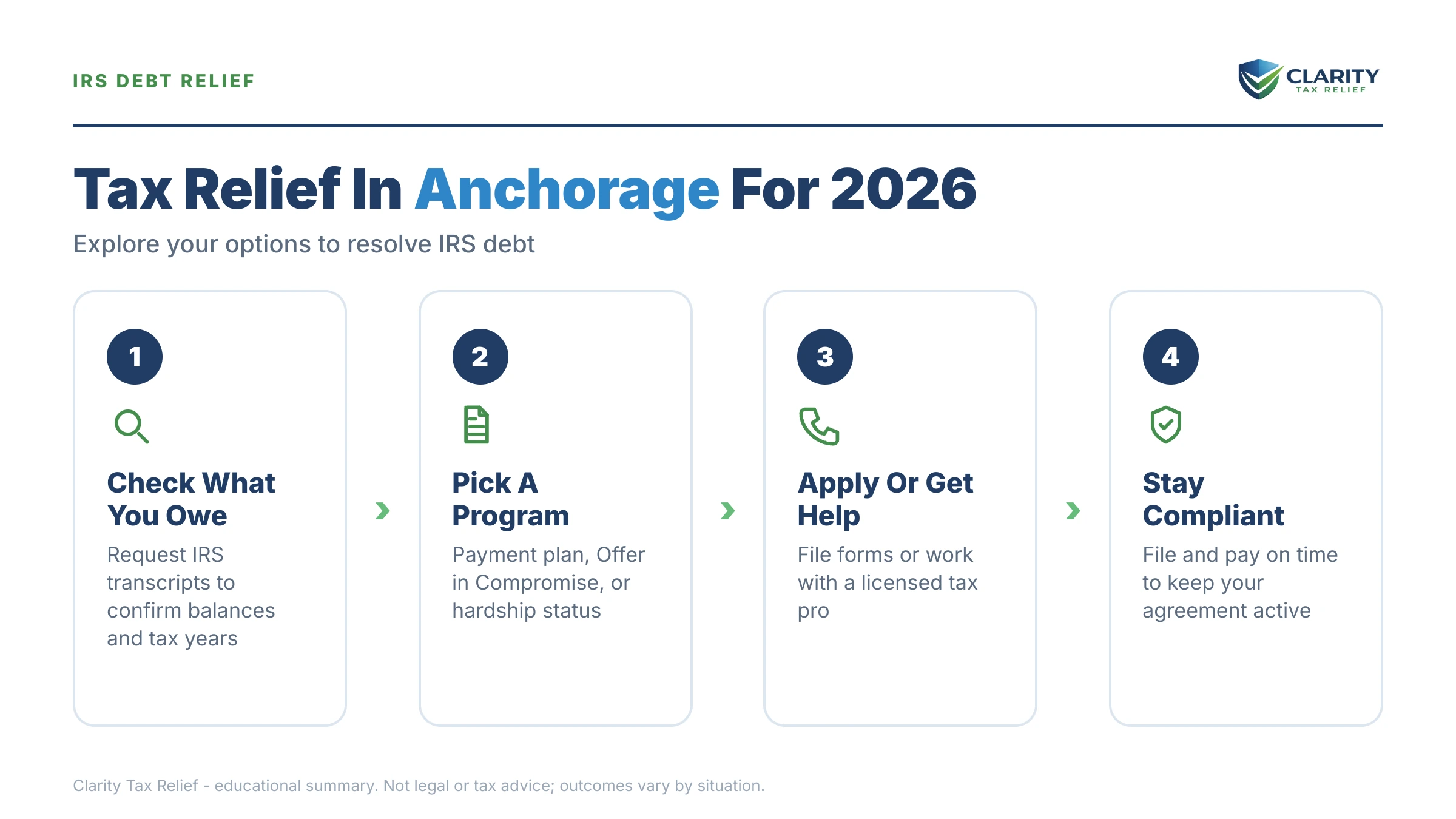
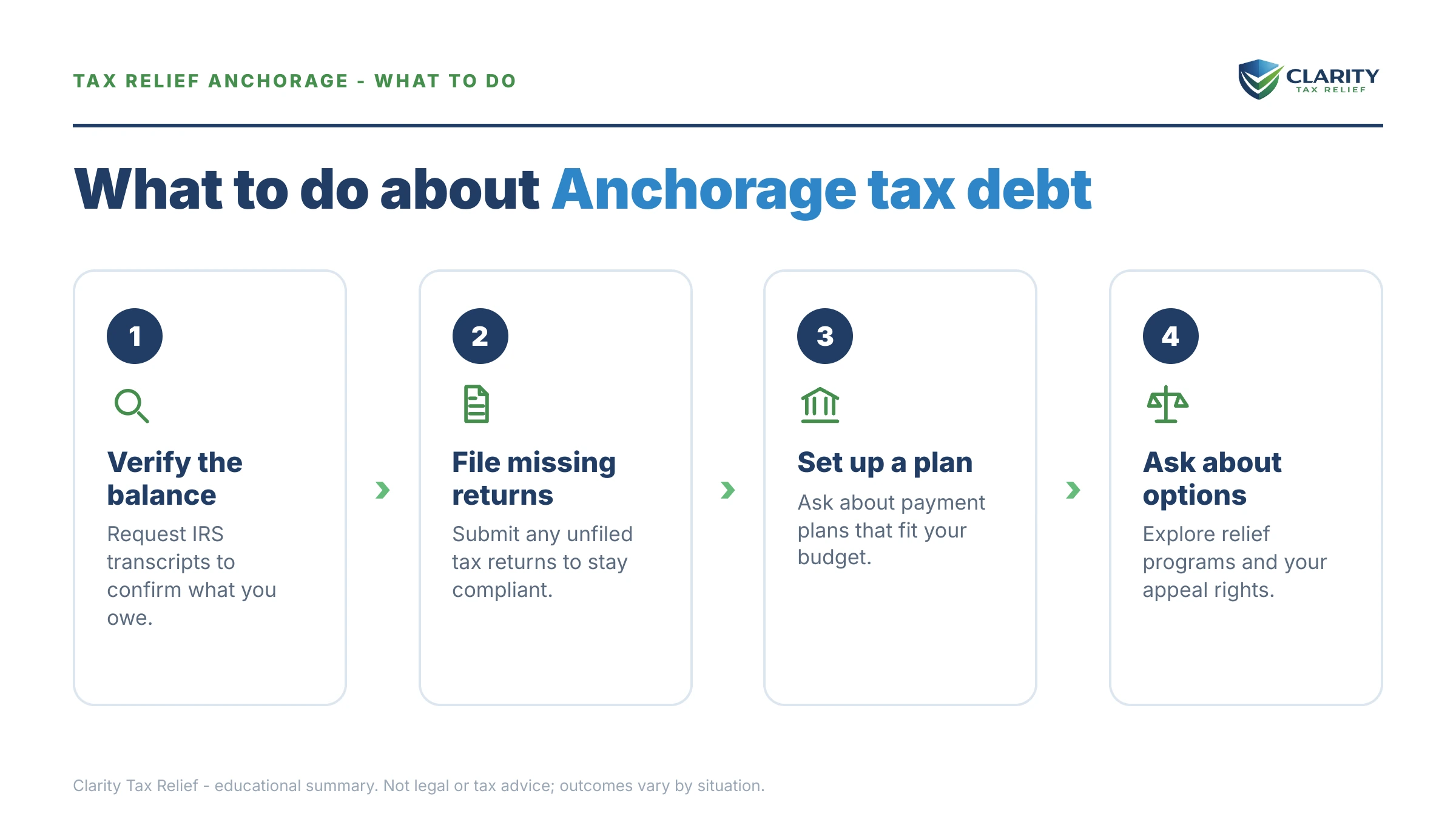
How to get tax relief in Anchorage, step by step
- Pull your IRS transcripts. Set up an IRS online account and download your account transcripts to confirm exactly what you owe, for which years, and what penalties have posted.
- File every missing return. The IRS will not approve any payment plan, hardship status, or offer until all required returns are filed — file the missing years first, even if you can't pay.
- Stop the penalty bleed. Pay whatever you can now, even partially. The 0.5% monthly failure-to-pay penalty is charged on the remaining balance, so every dollar paid shrinks next month's penalty.
- Match your finances to a program. Compare your income, allowable expenses, and assets against the options table above — payment plan, Currently Not Collectible, Offer in Compromise, or penalty abatement — and apply before the next notice escalates.
- Get a professional review for complex cases. If you owe more than $50,000, have multiple unfiled years, or a levy is already in motion, have an experienced tax professional review your transcripts before you commit to a plan.
When you can handle this yourself — and when help changes the outcome
Most Anchorage taxpayers with a single-year balance under $25,000 can resolve it themselves in an afternoon. If you agree with the amount, can pay within 180 days, or just need a monthly plan under the streamlined limits, set it up directly on the IRS payment plans page — no firm needed, and anyone who tells you otherwise is selling. For in-person questions, the IRS Taxpayer Assistance Center in Anchorage takes appointments (never walk-ins) — book through the IRS local office page. If the IRS itself is causing the problem — a levy despite an agreement, a hardship being ignored — the independent Taxpayer Advocate Service exists for exactly that.
Experienced help earns its fee in specific situations: a levy already in motion, multiple unfiled years that need reconstructing, a balance over $50,000 requiring negotiated financials, OIC math where the offer amount is genuinely arguable, or business and payroll debt where personal liability is in play. In those cases, the difference between a well-prepared 433-F and a rushed one is measured in hundreds of dollars a month, for years.
If you do hire someone, remember that this work is federal — there is no Anchorage-only expertise a national firm lacks, and no shortage of national firms happy to take Alaska clients. Vet them the same way you'd vet anyone: our how to choose a tax relief company checklist covers the credential, fee, and red-flag questions; if you're comparing the big brands, start with our Optima Tax Relief alternatives breakdown. Business owners with payroll or entity debt have a separate set of criteria — see tax relief for small business. And if your business situation touches Alaska's corporate, fisheries, or resource taxes, that piece belongs to the Alaska Department of Revenue Tax Division, not the IRS.
Terms you'll hear, decoded
- Levy: the actual seizure of money or property — a bank account, invoice payments, your PFD.
- Lien: a public legal claim against everything you own; it doesn't take anything, but it clouds titles and credit-adjacent decisions.
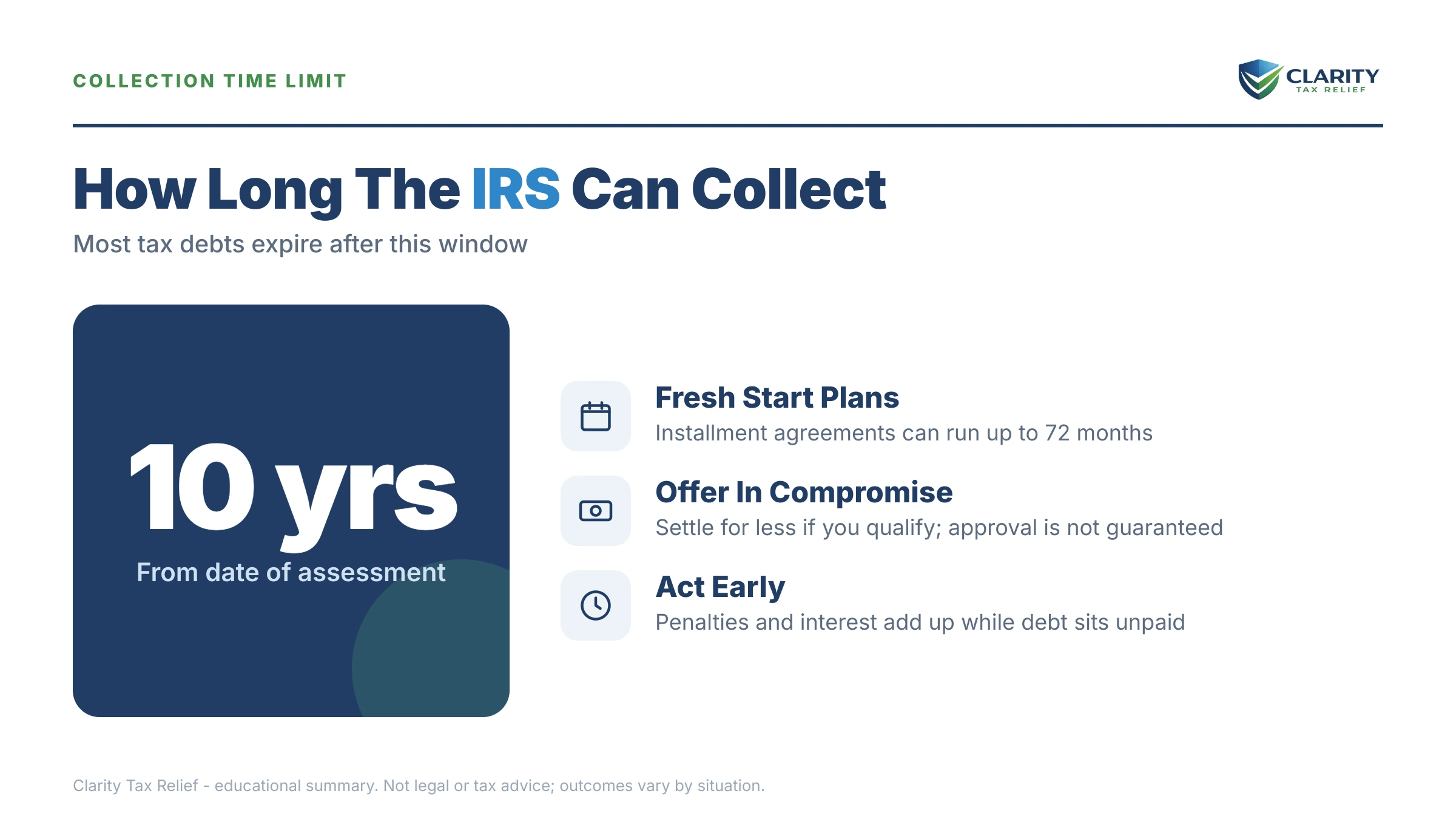
- CSED: the Collection Statute Expiration Date — the IRS generally gets 10 years from assessment to collect, paused by things like bankruptcy and pending offers.
- Seriously delinquent tax debt: $66,000+ (2026) with a lien filed or levy issued — the trigger for passport certification.
- Reasonable Collection Potential (RCP): the IRS's math for the most it could ever collect from you — the number an Offer in Compromise must beat.
Tax relief in Anchorage: your questions, answered
Does Alaska have a state income tax I could owe back taxes on?
No. Alaska has no state income tax on individuals and no statewide sales tax, so if you live in Anchorage, your personal tax debt is almost certainly federal — owed to the IRS. Alaska's Department of Revenue collects corporate, fisheries, and resource taxes, which only matter if you own certain businesses. Anchorage also has no municipal sales tax.
Can the IRS take my Alaska Permanent Fund Dividend for back taxes?
Yes. The IRS runs a levy program that intercepts Permanent Fund Dividends from Alaskans with unpaid federal tax debt, and the PFD is also taxable income you must report each year. If your dividend was taken, it was applied to your balance. Resolving the debt — a payment plan or hardship status — generally stops new levies, including future PFD intercepts.
Is there an IRS office in Anchorage?
Yes — the IRS operates a Taxpayer Assistance Center in Anchorage, but it works by appointment only; you can't walk in with a notice. With the IRS workforce cut roughly 27% in 2025, appointments and phone lines are slower than ever. Most collection problems are actually resolved online through your IRS account, by mail, or through an authorized representative who deals with the IRS for you.
Do I need a local Anchorage tax relief company, or can a national firm help?
Tax debt work is federal, so location matters far less than credentials. An enrolled agent, CPA, or tax attorney anywhere in the country can represent you before the IRS by filing Form 2848 — everything happens by phone, mail, and IRS e-services. What matters is vetting whoever you hire: flat, written fees, a credentialed person named on your case, and no upfront promises of settlement.
Can the IRS garnish my 1099 contractor income in Anchorage?
Yes, but differently than a W-2 paycheck. The IRS can levy the companies that pay you, seizing invoices and accounts receivable — each levy grabs what's owed to you at that moment, and it can keep issuing new ones. It can also levy your bank account, with a 21-day hold before the funds are sent. Contractors often feel levies faster because there's no employer-exempt amount protecting part of each check.
How much does tax relief cost in Anchorage?
IRS fees are modest: $0 for a short-term payment plan, a setup fee for installment agreements (reduced with direct debit and waivable for low income), and a $205 application fee for an Offer in Compromise. Professional fees vary with case complexity — a simple payment plan costs far less than an offer or a levy release. Be wary of any firm quoting a large fee before it has reviewed your IRS transcripts.
Does IRS debt ever expire?
Generally yes — the IRS has 10 years from the date a tax is assessed to collect, a deadline called the CSED. But the clock pauses during bankruptcy, a pending Offer in Compromise, and certain appeals, so real-world expiration often takes longer than 10 years. Trying to wait out the statute while ignoring notices usually means enduring levies and liens along the way.
Can my passport be taken because of tax debt?
If your debt becomes 'seriously delinquent' — $66,000 or more in 2026, with a lien filed or levy issued — the IRS certifies it to the State Department, which can deny a passport application or renewal and can revoke an existing passport. For Alaskans who fly for work or family, this bites harder than most enforcement tools. Entering a payment plan or other resolution reverses the certification.
Your next 24 hours
- Find your numbers. Log into your IRS online account (or pull out your most recent notice) and write down the exact balance, the tax years involved, and the date on the latest notice — that date is your working deadline.
- Gather three things. Your last filed return, this year's 1099s, and a rough monthly income-and-expense picture. Every resolution program starts with those numbers, and having them ready cuts weeks off the process.
- Get your options mapped free. Use the 2-minute form or call (888) 825-7779 and an experienced tax professional will match your Anchorage situation to the right program — before next month's 0.5% penalty and interest post to your balance.
This guide is general information, not tax or legal advice for your specific situation. Eligibility for IRS programs depends on individual facts and circumstances; no outcome is guaranteed.