
Tax Relief Companies
Tax Hardship Center Alternative: How to Compare Your Options in 2026
The short answer: the best Tax Hardship Center alternative depends on your case, not the brand. A local enrolled agent or CPA fits most straightforward balances, a tax attorney fits payroll or fraud issues, DIY through IRS.gov works under $50,000, and free help exists if income is tight. Compare flat fees in writing before hiring anyone.
You're probably here mid-comparison: a quote in your inbox, a follow-up call scheduled, and — if you're like many readers searching for a Tax Hardship Center alternative — a balance that landed on you at the worst possible time, maybe right after a divorce split one household budget into two. You don't need another pitch. You need a way to compare firms on the things that actually differ.
Here's the map: why people shop for alternatives, the five categories of alternatives and what each costs, the IRS programs every firm uses, and real math on a $27,500 balance so you can pressure-test any proposal you're handed.
⏱ The real clock: there's no deadline for switching firms — but your balance grows every month you stay in comparison mode. The failure-to-pay penalty adds 0.5% per month and interest compounds daily, whether or not you've picked anyone yet. If you're also holding an IRS notice, the date printed on that notice is a separate, harder deadline.
Why people search for a Tax Hardship Center alternative
Every legitimate tax relief company — Tax Hardship Center included — resolves debt through the same public IRS programs: payment plans, Offers in Compromise, hardship status, and penalty relief. No company has special access to the IRS, secret programs, or a back door. Every firm files the same forms under the same means-tested rules.
So when readers tell us why they're comparing, it's rarely about the programs. It's about the experience: an intake call that felt like a sales script instead of a diagnosis, a fee quoted before anyone looked at their finances, a minimum-debt threshold that didn't fit, or simply wanting a second opinion before spending money that's already stretched thin.
All of those are good reasons. And they point to what you should actually compare: who works your case (an enrolled agent, CPA, or tax attorney — or a "case manager" with no credential), what the total fee is in writing, and how honestly the firm qualifies you for a program before charging you. Our how to choose a tax relief company checklist covers the full vetting process; this page applies it to your specific comparison.
What ignoring your balance costs while you compare
The IRS collection sequence keeps advancing while you compare companies — the automated notice stream does not pause because you're shopping for help. Wherever you are in the sequence today, the next stage arrives with more enforcement power:
- CP14 — the first balance-due bill, with roughly 21 days to pay or arrange something before escalation begins (10 business days when the balance is $100,000 or more).
- CP501 / CP503 — reminder notices. Still just bills, but the balance grows monthly.
- CP504 — intent to levy your state tax refund under IRC §6331(d). Not the final notice, but the last calm one.
- LT11 / Letter 1058 — the final notice of intent to levy. It starts a 30-day clock and your Collection Due Process rights (requested via Form 12153).
- Levy — a bank levy freezes funds for a 21-day hold before they leave; a wage levy is continuous until released.
The 2026 twist: the IRS workforce was cut roughly 27% in 2025, so reaching a human is harder than ever — but the automated levy systems never stopped. Waiting for the IRS to slow down is not a strategy. Whichever alternative you choose, choose it before the next notice arrives, not after.
Comparing tax relief firms right now?
Bring us the quote you're holding — from Tax Hardship Center or anyone else. An experienced tax professional at Clarity will review your balance, your notices, and the program your finances actually support, free and pressure-free. Interest and the monthly late-payment penalty accrue while you compare, so get the diagnosis now and decide calmly.
Your alternatives to Tax Hardship Center, compared
A Tax Hardship Center alternative falls into one of five categories: another national firm, a local enrolled agent or CPA, a tax attorney, DIY through IRS.gov, or free help. Each fits a different case:
| Alternative | Best for | Cost structure | Watch out for |
|---|---|---|---|
| Another national tax relief firm | Multi-year, multi-program cases needing a full team (filing + penalties + resolution) | Flat or phased fees, quoted after a financial review | Sales-first intakes; fees quoted before anyone reviews your finances |
| Local enrolled agent or CPA | Straightforward balances, payment plans, penalty abatement, a face you can visit | Hourly or modest flat fees | Solo capacity; confirm collections experience, not just tax prep |
| Tax attorney | Payroll/trust-fund debt, fraud exposure, Tax Court, anything with criminal risk | Highest hourly rates in the industry | Overkill (and overpriced) for a routine payment plan |
| DIY through IRS.gov | Balances of $50,000 or less that you agree with, with steady income | IRS setup fees only — no professional fee | You're your own advocate if the case gets complicated |
| Free help (LITC / Taxpayer Advocate) | Low-income filers; cases stuck or causing hardship inside the IRS machine | Free (income caps apply for clinics) | Limited capacity — waitlists are common |
Whichever category you pick, demand the same four things: a named person with a real credential working your case, a Form 2848 power of attorney filed promptly so the IRS talks to your representative, a flat, written fee tied to a named program, and an honest answer about whether you qualify before money changes hands. Our tax relief company red flags checklist and the questions to ask a tax relief company guide give you the exact script — and if pricing is the sticking point, see how much does tax relief cost for what fee structures are normal.
The IRS programs every firm uses — and their eligibility thresholds
The IRS offers a handful of core resolution paths, and every company — from the biggest national brand to a solo enrolled agent — files the same forms to use them. If a firm's proposal doesn't map to one of these rows, ask what exactly you're paying for:
| Program | Who may qualify | Cost to apply | The catch |
|---|---|---|---|
| Short-term payment plan | You can pay in full within 180 days | $0 setup fee | Interest and penalties keep accruing until paid |
| Long-term installment agreement | Balances of $50,000 or less can be set up online for up to 72 months | Modest setup fee — reduced with direct debit | Refunds are offset to the debt; missed payments risk default |
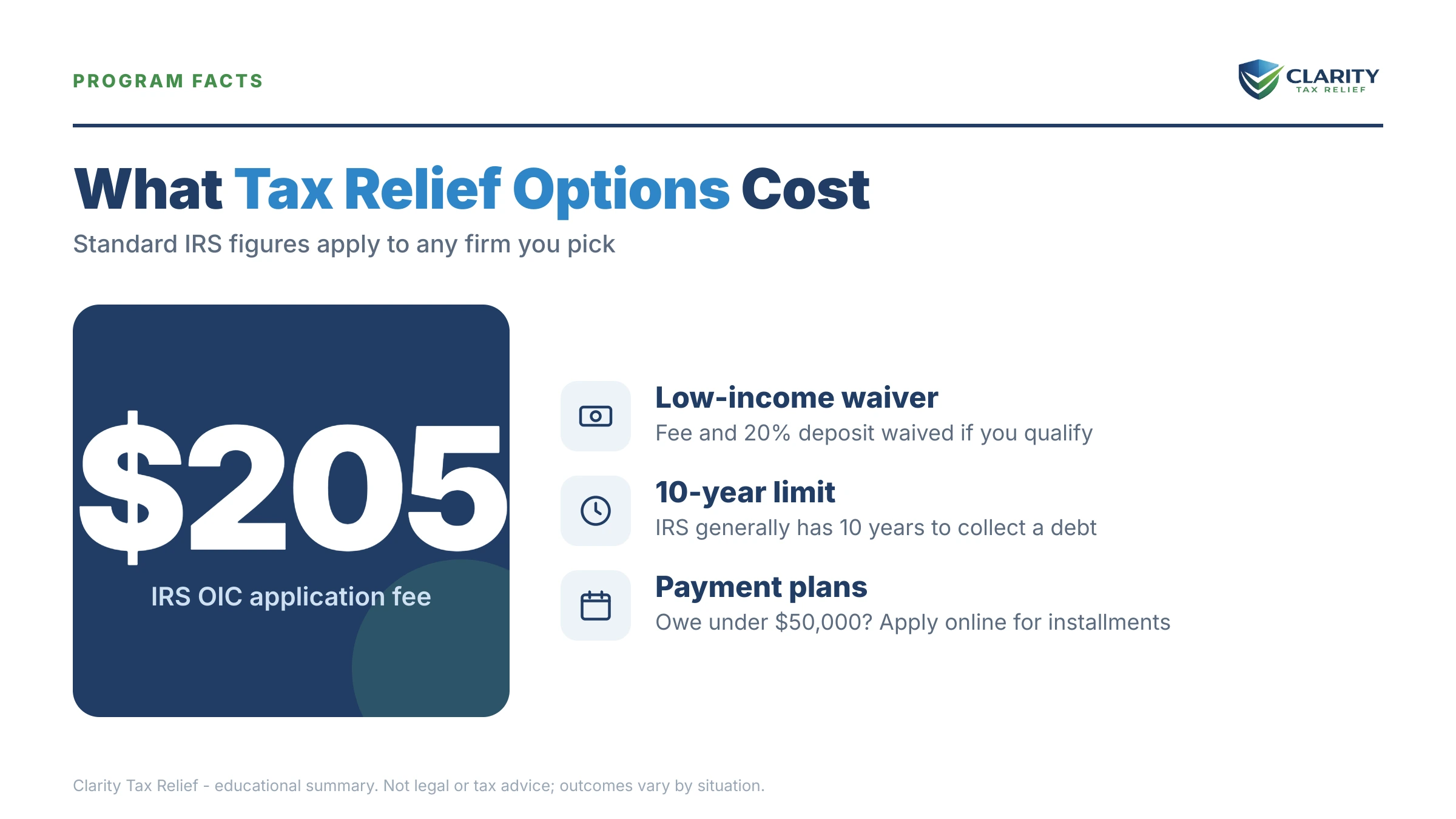
| Offer in Compromise (Forms 656 + 433) | Your Reasonable Collection Potential is below the balance | $205 fee + 20% down on lump-sum offers — both waived with low-income certification (AGI ≤ 250% of poverty) | The IRS accepted roughly 1 in 5 offers in FY2024; review takes months |
| Currently Not Collectible | Allowable living expenses meet or exceed your income | $0 | The debt remains and accrues; the IRS reviews your income periodically |
| Penalty relief (FTA / AEP) | Clean compliance in the prior 3 years | $0 | Removes penalties, not tax or interest; AEP becomes automatic starting summer 2026 |
Two of these deserve a note. Currently Not Collectible is the program that "hardship"-branded marketing is usually pointing at — the full financial test lives in our guide to how to qualify for CNC, and the honest overview of what the IRS hardship program actually is (and isn't) is worth reading before any firm sells you "hardship status." Also know that CNC isn't permanent: the IRS re-checks your income, and CNC status removed covers what happens when collection reactivates.
On penalty relief, watch for firms charging meaningful fees for First-Time Abatement requests in late 2026 — the IRS's Automatic Exemption from Penalty (AEP) begins applying qualifying relief automatically starting summer 2026, no request needed. A good alternative firm will tell you that; a bad one will bill you for it.
Say you owe $27,500 after a divorce: the math any firm should show you
A hypothetical $27,500 IRS balance has three realistic exits in 2026: a streamlined payment plan, an Offer in Compromise if the math supports one, or hardship status if it doesn't. Here's the arithmetic — run it before any consultation, and compare it to what you're quoted.
Path 1 — streamlined installment agreement. $27,500 is under the $50,000 online threshold, so no financial statement is required. Spread over 72 months, the principal alone is $27,500 ÷ 72 ≈ $382 a month — and because interest compounds daily and the 0.5% monthly failure-to-pay penalty continues inside the plan, the real total paid runs meaningfully higher. Paying more than the minimum, or paying off early, saves real money.
Path 2 — Offer in Compromise. Say your post-divorce income is $4,150 a month and your IRS-allowable living expenses (rent on the new place, the car, health costs) come to $4,000. That leaves $150 of monthly disposable income. For a lump-sum offer, the IRS multiplies that by 12 — $1,800 — then adds your net asset equity, say $2,600. Your Reasonable Collection Potential is roughly $4,400 against a $27,500 debt — the kind of gap where an offer may be genuinely worth pursuing. You'd prove it on Forms 656 and 433, and acceptance is never assured: roughly 1 in 5 offers were accepted in FY2024. You can pressure-test your own numbers first with our Offer in Compromise Calculator.
Path 3 — Currently Not Collectible. If those allowable expenses meet or exceed your income — common in the first year after a divorce, when one income now carries a whole household — CNC pauses collection entirely while your situation stabilizes. The debt doesn't vanish, but levies and garnishments stop.
One divorce-specific trap: if that $27,500 came from a jointly filed return, the IRS can collect the entire balance from either spouse, no matter what your decree says. See divorce and IRS debt: who pays for the decree problem and the innocent spouse and separation-of-liability paths that can actually move liability at the federal level. Any alternative firm you interview should raise this unprompted when you mention a divorce — if they don't, that tells you something.
What you owe changes which alternative makes sense
| Balance | Realistic options | Where an alternative firm earns its fee |
|---|---|---|
| Under $10,000 | Guaranteed installment agreement; short-term plan; DIY online | Rarely — unless a levy is active or years are unfiled |
| $10,000–$25,000 | Streamlined plan online; penalty abatement | Disputed balances; stacking penalty relief across years |
| $25,000–$50,000 | Streamlined plan (direct debit above $25k); OIC or CNC if the finances support it | OIC math and documentation; hardship cases like the example above |
| Over $50,000 | Non-streamlined agreement with full financial disclosure (Form 433-F) | Almost always — disclosure strategy drives the outcome |
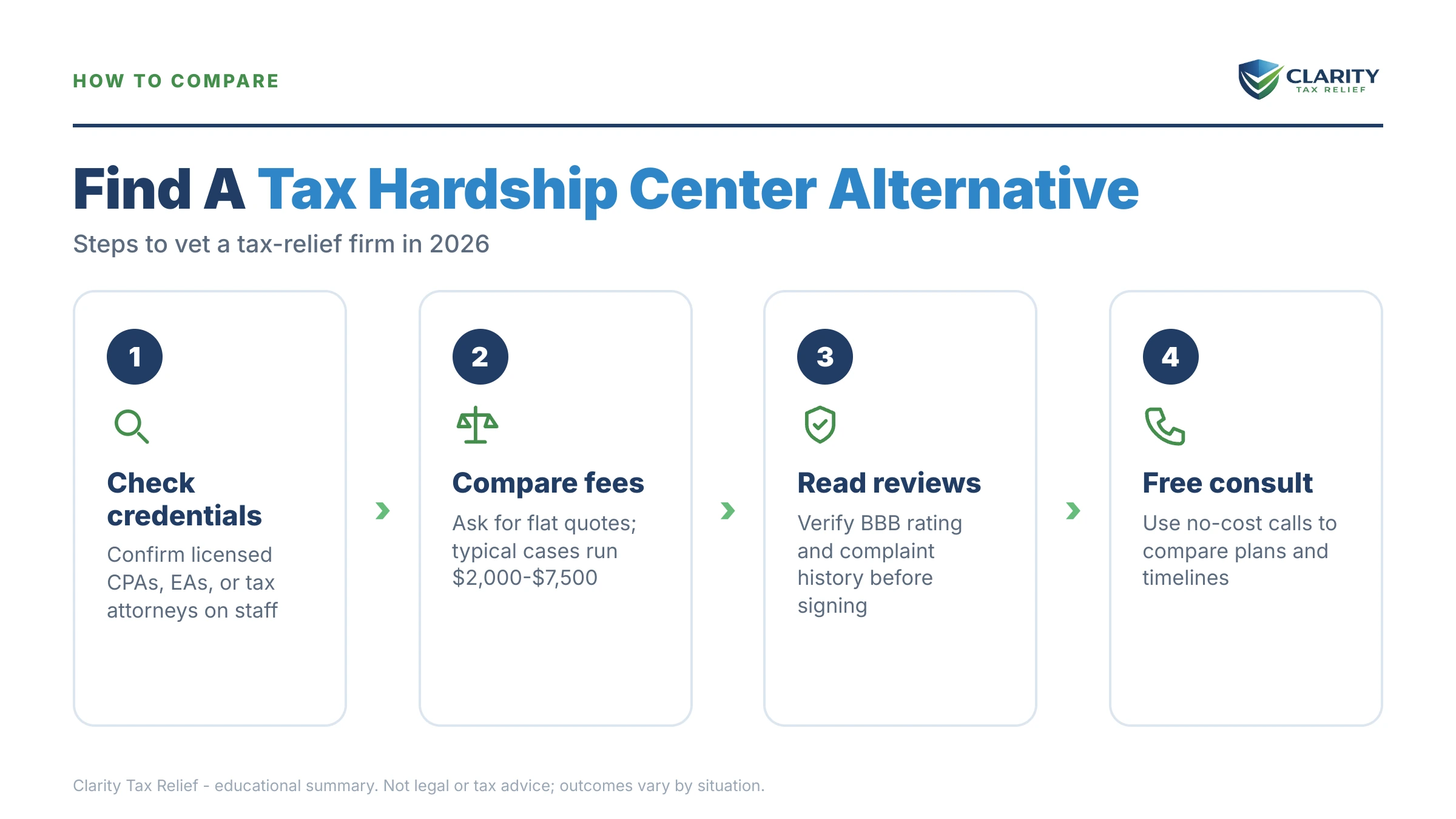
How to choose a Tax Hardship Center alternative, step by step
Choosing well takes about a week of diligence, not a month of agonizing:
- Verify your balance first — pull your IRS online account or your latest notice and note the total for each tax year, split between tax, penalties, and interest. Every firm's pitch starts with this number; you should know it before they do.
- Match your facts to a program — before any sales call, use the tables above to see whether you're a payment-plan case, a possible Offer in Compromise, or a hardship case. A firm's proposal should match the same math.
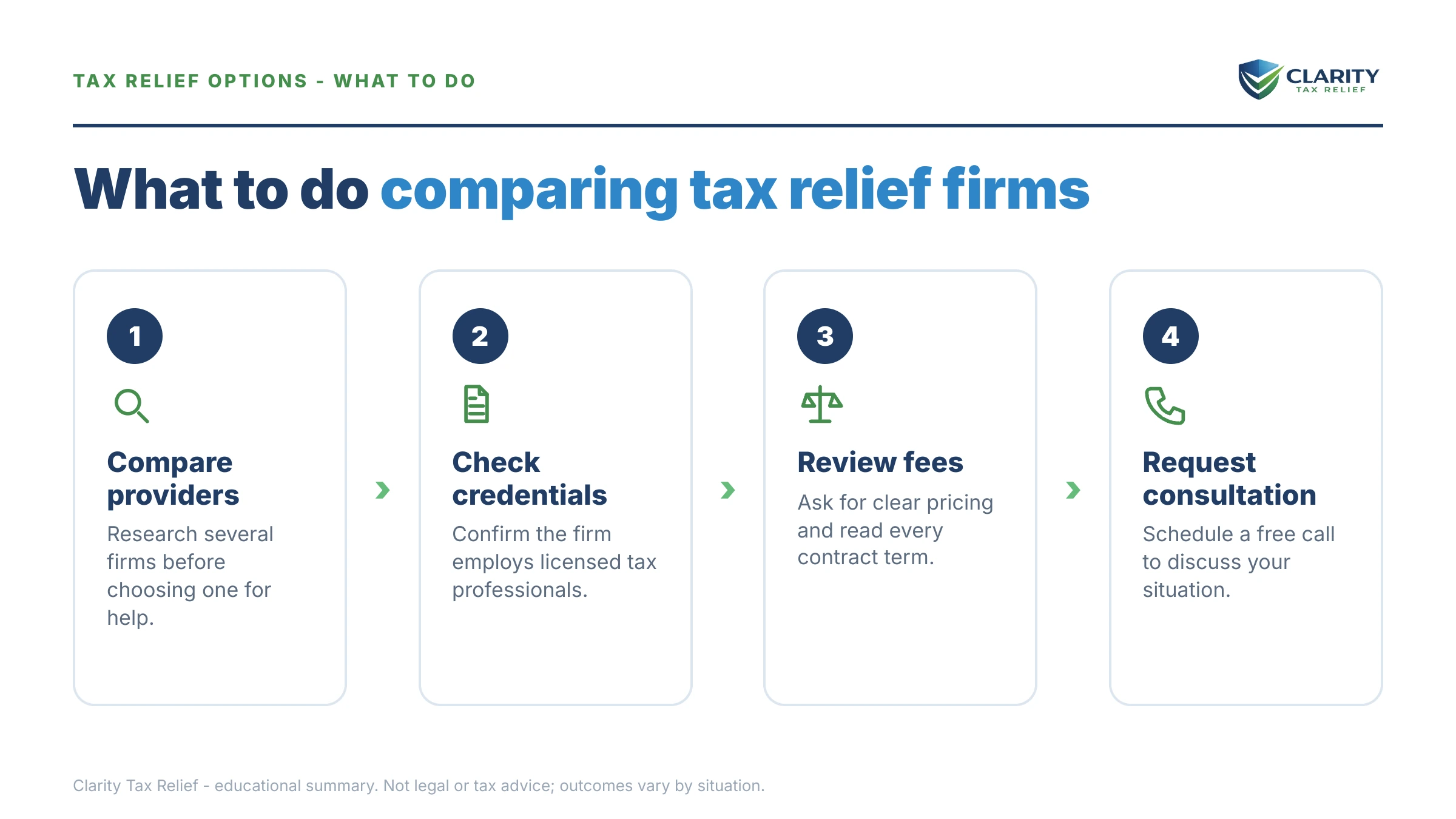
- Interview at least two alternatives with identical questions — who works the case and their credential, the total flat fee in writing, the program they'd pursue and why, the refund policy, and how often you'll get updates.
- Verify the person, not just the company — confirm the enrolled agent, CPA, or tax attorney assigned to you is in good standing, and check the firm's complaint history before you sign anything.
- Sign only a written flat-fee agreement — it should name the scope, the program being pursued, and the total cost. A promised outcome in a sales pitch is a red flag, not a benefit; eligibility is decided by the IRS, not the firm.
When you don't need Tax Hardship Center — or any company
If you owe under $25,000, agree with the balance, and have steady income, you can usually set up your own payment plan on the IRS payment plans page in a single sitting — no professional fee, no waiting on hold. A first notice you agree with, a balance you can clear within 180 days, or a single penalty on an otherwise clean record are all DIY cases; our how to settle tax debt yourself guide walks each one, and free help with IRS tax debt covers Low Income Taxpayer Clinics and the Taxpayer Advocate Service if money is genuinely tight.
Experienced help changes outcomes in a narrower set of situations: a levy already in motion, multiple years unfiled, business or payroll debt, joint-liability tangles from a divorce, or an Offer in Compromise where the difference between an accepted and rejected offer is how the financial disclosure is built. In those cases, the fee usually costs less than the mistake it prevents. Everywhere else, be suspicious of anyone who says you need them.
Terms tax relief companies use, decoded
- Investigation (or discovery) phase — the paid first stage where a firm pulls your IRS transcripts to see exactly what you owe; you can pull the same transcripts yourself for free.
- Resolution phase — the second, larger fee for actually filing the payment plan, offer, or hardship request the investigation recommended.
- Form 2848 — the power of attorney that lets a credentialed representative speak to the IRS for you; a serious firm files it within days.
- Reasonable Collection Potential (RCP) — the IRS's formula (disposable income plus asset equity) that decides whether an Offer in Compromise can be accepted.
- Currently Not Collectible (CNC) — hardship status that pauses collection when your allowable expenses consume your income; the debt itself remains.
- Flat fee vs. phased fee — one written all-in price versus separate charges per stage; either is fine, but the total must be in writing before you pay anything.
Tax Hardship Center alternative FAQs
Is Tax Hardship Center a legitimate company?
Searching for an alternative doesn't mean Tax Hardship Center is a scam — it's an established tax relief firm, and legitimate firms all work through the same public IRS programs. The real questions are fit and price: who will personally handle your case, what the total flat fee is in writing, and whether the firm honestly tells you which program your finances support before you pay anything.
What is the best alternative to Tax Hardship Center?
It depends on your case, not on brand names. A local enrolled agent or CPA fits most straightforward balances under $50,000; a tax attorney fits payroll debt, fraud exposure, or litigation; DIY through IRS.gov works if you owe $50,000 or less and agree with the balance; and a Low Income Taxpayer Clinic is free if your income is roughly at or below 250% of the federal poverty guidelines.
How much do tax relief companies charge?
Full representation at most national firms commonly runs from roughly $1,500 to $5,000 or more, priced by complexity — number of years, programs pursued, and whether returns need filing — not by your balance alone. Get the total fee in writing before paying. A firm that quotes a large fee before reviewing your finances, or promises a settlement to justify it, is selling, not diagnosing.
Can I resolve my tax debt without hiring any company?
Yes, and for many balances you should. If you owe $50,000 or less, you can set up a payment plan of up to 72 months online without submitting financial statements, and short-term plans of up to 180 days have no setup fee. Professional help earns its cost when a levy is in motion, multiple years are unfiled, or you're pursuing an Offer in Compromise where the math is contestable.
Do tax relief companies really settle tax debt for less?
Only through the Offer in Compromise program, and only when your finances genuinely qualify — the IRS accepted roughly 1 in 5 offers in FY2024. Acceptance is a math test against your income, expenses, and assets, not a negotiation skill. Any firm promising to settle for 'pennies on the dollar' before reviewing your finances is quoting a marketing script, not the IRS formula.
Does my divorce decree protect me from joint tax debt?
No. The IRS is not bound by your divorce decree — on a jointly filed return, both spouses remain fully liable for the entire balance no matter what the decree assigns. Your federal options are innocent spouse relief or separation of liability if you qualify; the decree itself only gives you a state-court claim against your ex, not a defense against IRS collection.
What should I ask before hiring a tax relief firm?
Five questions: Who will actually work my case, and is that person an enrolled agent, CPA, or tax attorney? What is the total flat fee, in writing? Which IRS program do my finances support, and why? What is your refund policy if I don't qualify for the program you're proposing? How often will I get updates? Hesitation on any of these is your answer.
Is there free help for IRS tax debt?
Yes, three kinds. Low Income Taxpayer Clinics represent taxpayers free of charge if income is roughly at or below 250% of the federal poverty guidelines; the Taxpayer Advocate Service helps free when a case is stuck or causing hardship; and IRS.gov lets you set up most payment plans yourself at no professional cost. Free help is real but capacity-limited, so start early.
Your next 24 hours
- Pull your real number. Log into your IRS online account (or grab your most recent notice) and write down the exact balance for each tax year — tax, penalties, and interest separately. Every comparison starts here.
- Build your comparison folder. Gather your last filed return, every IRS notice you've received, and one month of income and expense figures. Any serious firm — and any DIY option at IRS.gov/payments — will need exactly these.
- Get the free second opinion. Call (888) 825-7779 or use the 2-minute form and let an experienced tax professional compare the quote you're holding against the program your finances actually support. Interest and penalties accrue monthly whether or not you've chosen a firm — the diagnosis shouldn't wait for the decision.
This guide is general information, not tax or legal advice for your specific situation. Eligibility for IRS programs depends on individual facts and circumstances; no outcome is guaranteed. Clarity Tax Relief is not affiliated with Tax Hardship Center; company details and fees change — verify current terms directly with any firm you consider.