
Offer in Compromise
Offer in Compromise Payment Options in 2026: Lump Sum vs. Periodic Payments
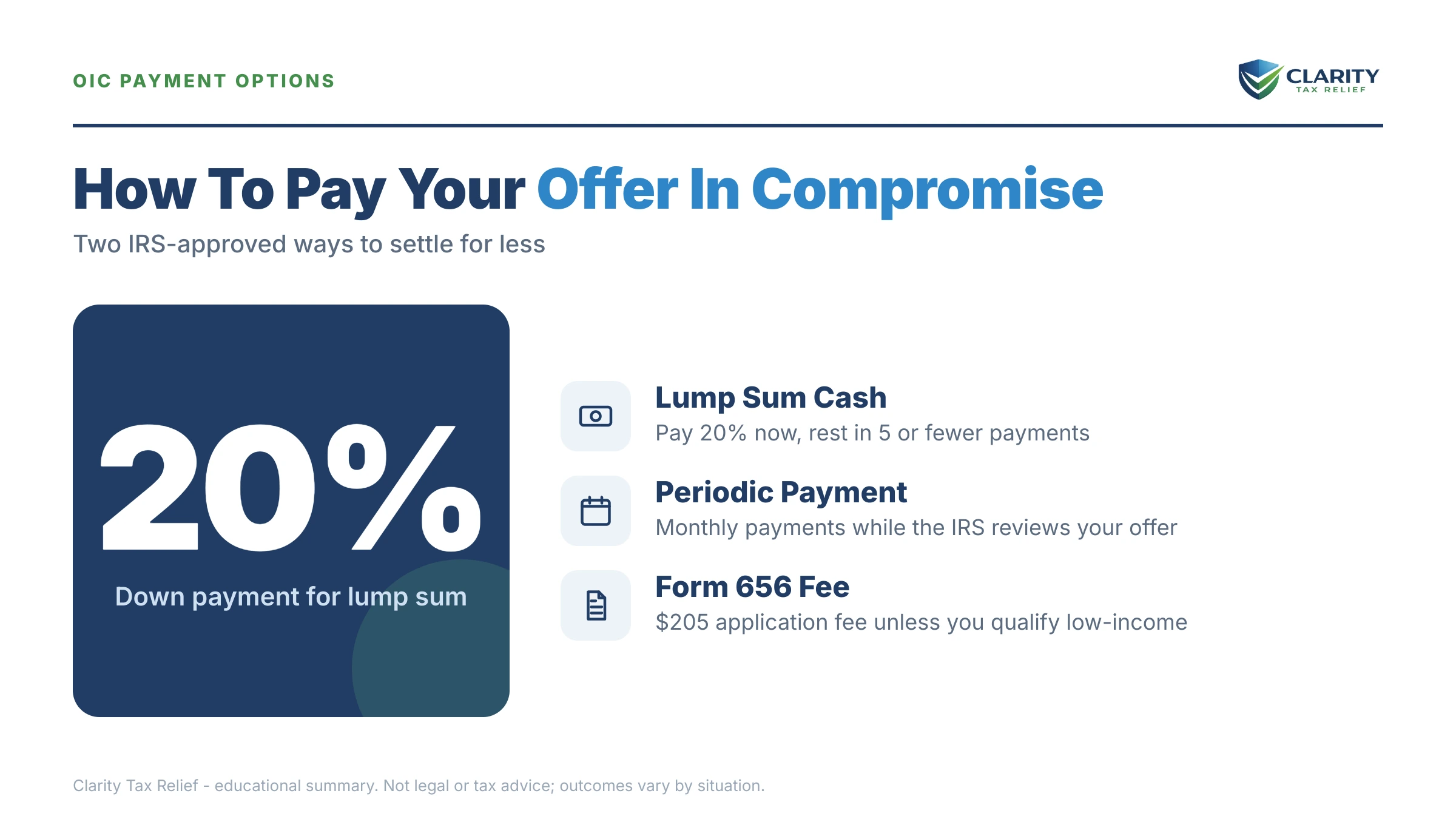
The short answer: the IRS offers two offer in compromise payment options — a lump-sum cash offer (20% down, balance within five months of acceptance) and a periodic payment offer, paid monthly over 6–24 months. Lump-sum offers are calculated with 12 months of your future income; periodic offers use 24, so lump sum usually means offering less.
You're partway through the offer paperwork for your tax debt, and one checkbox has stopped you cold: lump sum or periodic payment? It feels like a formality — it isn't. That single box changes how your minimum offer is calculated, what you must send the IRS today, and what happens if your cash flow hiccups mid-review.
The choice comes down to arithmetic you can do at your kitchen table, and this guide walks through it with real numbers. The image below shows you exactly what the payment-terms section of Form 656 looks like and where the two options appear, so you can follow along on your own copy.
⏱ Your ongoing clock: a periodic payment offer requires a payment every month while the IRS reviews it — and reviews commonly run several months to a year. Miss one and the IRS can return your offer with no appeal rights, keeping every dollar you've paid (it's applied to your tax debt). Interest keeps accruing on the full balance until an offer is accepted and paid.
How offer in compromise payment options change your offer amount
A lump-sum offer is calculated with 12 months of your future disposable income; a periodic payment offer uses 24 — so the payment option you choose literally changes the minimum the IRS will accept.
Here's why. Every offer is measured against your reasonable collection potential (RCP): the equity in what you own, plus a multiple of your monthly disposable income. The full mechanics live in our guide to how an offer in compromise works; what matters on this page is the multiplier.
Check the lump-sum box and the IRS projects your future income forward 12 months. Check the periodic box and it projects 24 months. Same debt, same bank account, same expenses — a different minimum offer, purely because of the box. (The details of that projection are in how the IRS calculates your future income.)
If you haven't run your own numbers yet, you can estimate both versions in a few minutes with our Offer in Compromise Calculator — it estimates, it doesn't promise, but it will show you whether the 12-versus-24 gap is worth planning around.
One honest caveat before any of this: per IRS data, the IRS accepted roughly 1 in 5 offers in FY2024. The payment option doesn't change your odds — the accuracy of your RCP math does. Choosing the right option only controls how much a qualifying offer costs you.
What happens if you pick wrong — or miss a payment
A missed payment on a pending periodic offer can get the entire offer sent back — with no right to appeal. The consequences of a payment-option mistake unfold in a specific order:
- At filing: if the required payment (the 20% or the first monthly installment) isn't attached and you didn't certify low-income, the offer is returned as unprocessable. No one ever reviews your numbers.
- During review (periodic offers): skip a monthly payment and the IRS typically sends one letter asking you to catch up. If you don't, the offer is returned — not rejected, returned — which means no appeal rights, and everything paid so far stays applied to the debt.
- After a return or rejection: collection restarts where it left off. Worse, the 10-year collection statute — which was paused while your offer was pending — resumes with the paused months added back on. A failed offer buys the IRS more time to collect. (A rejection, unlike a return, can be appealed within 30 days using Form 13711.)
- After acceptance: miss the five-month payoff on a lump-sum offer, fall off your periodic schedule, or break the five-year compliance rule, and the compromise defaults — the IRS can reinstate the full original balance, minus what you paid, plus accrued penalties and interest.
None of this is a reason to avoid an offer. It's a reason to choose the payment structure your actual cash flow can survive — before you sign.
Choosing between a lump-sum and periodic offer right now?
Every dollar you send with an offer is nonrefundable, and interest accrues on your full balance until it's resolved. Before you commit money to the wrong payment option, have an experienced tax professional run your numbers both ways — free, confidential, no pressure.
The two OIC payment options, side by side
Form 656 gives you exactly two payment structures, and you must pick one — you can't hedge. If you're not sure which section of the form you're looking at, the image in this guide shows where the payment-terms choice sits so you can locate it on your own copy.
| Feature | Lump-sum cash offer | Periodic payment offer |
|---|---|---|
| Sent with Form 656 | 20% of the offer amount (nonrefundable) + $205 fee | First monthly payment (nonrefundable) + $205 fee |
| Payments during IRS review | None required | Every month, without fail |
| Future-income multiplier | 12 months of disposable income | 24 months of disposable income |
| After acceptance | Balance in 5 or fewer payments within 5 months | Remaining monthly payments on your 6–24-month schedule |
| Typical result | Lower total offer; more cash needed up front | Higher total offer; smaller individual checks |
Lump-sum cash offer: five payments, not one
Despite the name, a lump-sum offer is paid in five or fewer installments — not a single check. You send 20% of the offer amount, nonrefundable, with your application, then pay the remaining 80% within five months after the IRS accepts.
The reward for fronting that cash is the 12-month multiplier — usually the lowest legal offer your finances support. The risk is liquidity: if you can't actually produce the balance within five months of acceptance, the compromise defaults and the original debt comes back.
One nuance worth knowing, especially if part of your balance is payroll-related: you can designate in writing which tax period or liability your required payment is applied to. If you don't, the IRS applies it in the government's best interest — which may not be yours.
Periodic payment offer: the 24-month installment route
A periodic offer is paid monthly, over 6 to 24 months counted from filing, with the first payment attached to Form 656. The defining obligation: you keep paying every month during review, and reviews are not quick — see how long an offer in compromise takes for realistic timelines. There's a statutory backstop: if the IRS doesn't decide within two years, the offer is deemed accepted by law — with narrow exceptions: a returned or rejected offer stops the clock, and time during court disputes does not count.
The trade-off is baked into the math: 24 months of future income instead of 12, so your minimum offer is higher. But if the 20% down payment plus a five-month payoff simply isn't raisable, periodic is how an offer stays possible at all. Every payment made during review counts toward your offer total — and none of it comes back if the offer fails (our guide to whether your OIC down payment is refundable covers exactly where that money goes).
Worked example: choosing a payment option on a $48,300 debt
Say you're a small-business owner who owes $48,300 — a mix of personal 1040 balances and a trust-fund assessment left over from your company's payroll trouble. This is hypothetical, with round numbers to show the mechanics.
Suppose your Form 433-A (OIC) shows $6,000 in net realizable equity (a work truck and a small bank cushion, valued at quick-sale prices) and $700 per month of disposable income after IRS allowable expenses. Your two offers calculate like this:
- Lump sum: $6,000 + ($700 × 12 = $8,400) = a $14,400 minimum offer. Due at filing: $2,880 (the 20%) plus the $205 fee. Due within five months of acceptance: $11,520, or about $2,304 per month for five months.
- Periodic: $6,000 + ($700 × 24 = $16,800) = a $22,800 minimum offer. Spread over 24 months, that's $950 per month starting the day you file and continuing straight through review.
Same person, same finances, same $48,300 debt — the two offers are $8,400 apart, which is exactly the twelve extra months of $700 the periodic multiplier adds. Here's the full cash-flow picture, assuming a ten-month review:
| Stage | Lump-sum offer ($14,400) | Periodic offer ($22,800) |
|---|---|---|
| With the application | $205 fee + $2,880 down (20%) | $205 fee + $950 first payment |
| During a 10-month review | $0 required | $950/month — about $9,500 |
| After acceptance | $11,520 in five or fewer payments within 5 months | Roughly $950/month through month 24 of the schedule |
| Total paid | $14,605 | $23,005 |
The lesson generalizes: if you can raise the front-loaded cash — from savings, family, or even a modest loan costing less than $8,400 — the lump-sum option almost always wins on total dollars. Periodic exists for the taxpayer whose disposable income is real but whose liquidity isn't.
Does an offer even fit your balance? Options by amount
An offer in compromise only makes sense when your reasonable collection potential is genuinely below what you owe — otherwise a payment plan is the honest answer. The full head-to-head is in payment plan vs. offer in compromise; here's the quick map by balance:
| What you owe | Realistic options | OIC payment-option note |
|---|---|---|
| Under $10,000 | A guaranteed installment agreement is usually simpler and often cheaper than an offer's fees and effort | An offer rarely pencils out here unless income and assets are genuinely minimal |
| $10,000–$25,000 | Streamlined payment plan set up online, penalty relief, or an OIC if your RCP sits well below the balance | If you do file, lump sum keeps the total lowest |
| $25,000–$50,000 | Head-to-head territory: a plan of up to 72 months versus an offer — compare total cost, not monthly cost | The $48,300 example above shows the math both ways |
| $50,000–$100,000 | Payment plan with financial disclosure, partial-pay agreement, hardship status, or an OIC | Periodic can bridge the gap when 20% cash isn't available |
| Over $100,000 | Expect assigned-collector scrutiny; offers remain possible but every asset gets examined | Have an experienced tax professional pressure-test the RCP and payment option before filing |
Two more comparisons matter at the margins. On $48,300, a 72-month plan runs roughly $671 per month before the interest and penalties that keep accruing — so a $14,400 lump-sum offer that qualifies is dramatically cheaper, while a $22,800 periodic offer at $950 per month is still far less in total. And if paying anything would break your household, an offer may be the wrong frame entirely — see CNC vs. offer in compromise before you commit nonrefundable money.
The low-income certification: skip the fee, the 20%, and review payments
If your adjusted gross income is at or below 250% of the federal poverty level for your household size, Form 656's low-income certification waives the $205 application fee, the 20% lump-sum down payment, and every monthly payment while the IRS reviews your offer.
That last piece is the sleeper benefit: a certified low-income taxpayer can file a periodic offer and pay nothing until acceptance. If there's any chance you qualify, check before writing a single check — the details and the current income table are in our guide to the OIC low-income certification.
Two limits: the certification is for individuals (including sole proprietors), not corporations or partnerships, and it waives the payments — not the offer itself. Your offer amount is still whatever your RCP math says it is.
Payroll and business debt: extra rules before you pick an option
If any of your balance traces to payroll taxes, confirm your footing before choosing a payment option — the offer program treats trust-fund money differently. An operating business must be current on its federal tax deposits before the IRS will seriously consider an offer, and it files the business financial statement, Form 433-B (OIC), instead of the individual version.
Three scenarios, three different paths:
- Business still operating, owes 941s: the IRS rarely compromises the trust-fund portion while the doors stay open. Read business offer in compromise payroll rules before spending anything on an application.
- Business closed, owner assessed personally: a Trust Fund Recovery Penalty on you individually can be included in a personal offer, using either payment option, with your personal RCP math.
- Entity-level offer for a going concern: possible but strict — the full picture is in our guide to a business offer in compromise.
If your situation mixes personal and trust-fund liability — like the $48,300 example above — the payment-designation move matters: directing your required payments toward the trust-fund portion in writing can reduce your personal exposure. That's a decision to make deliberately, not by default.
How to choose and set up your OIC payment option, step by step
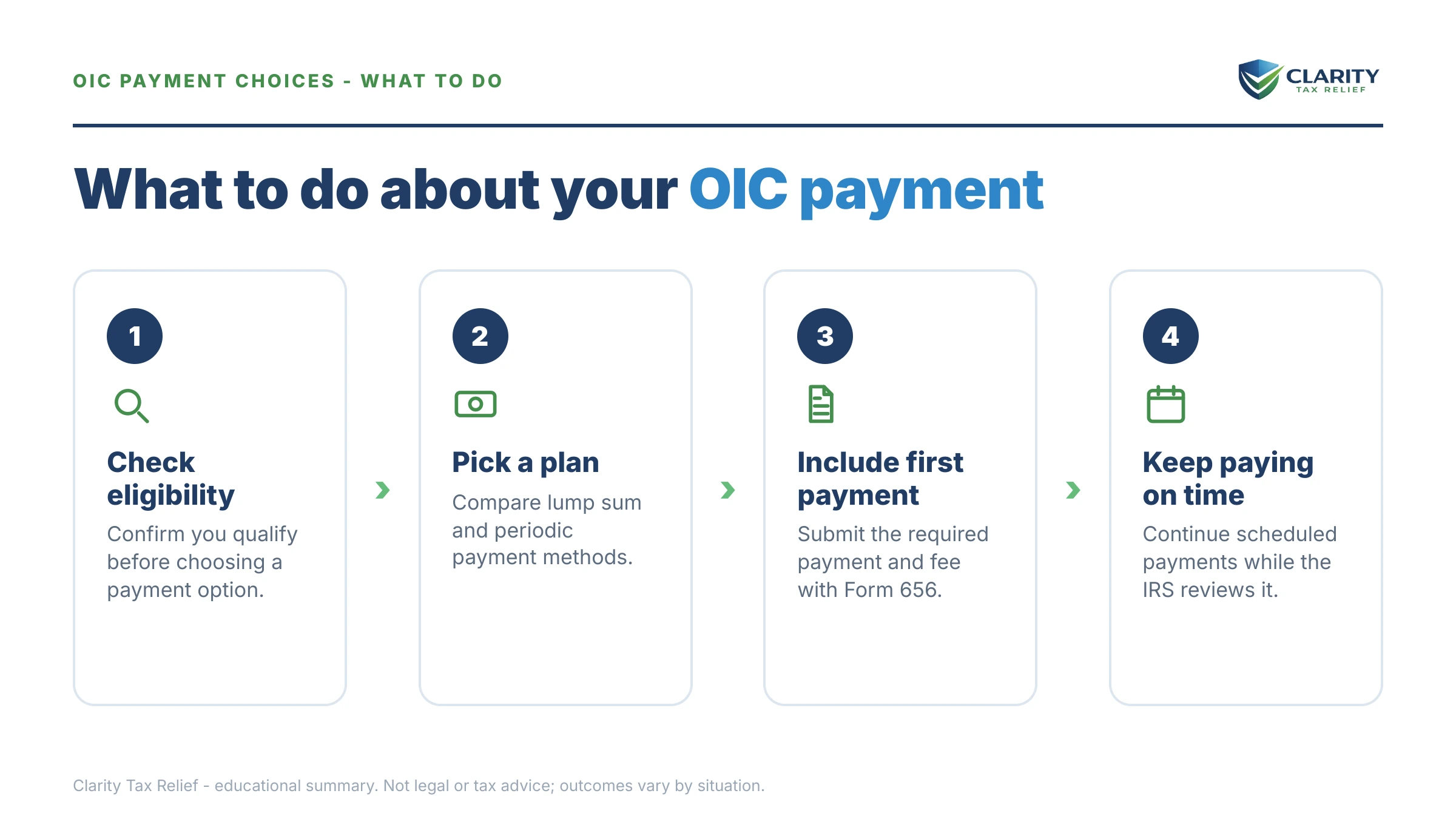
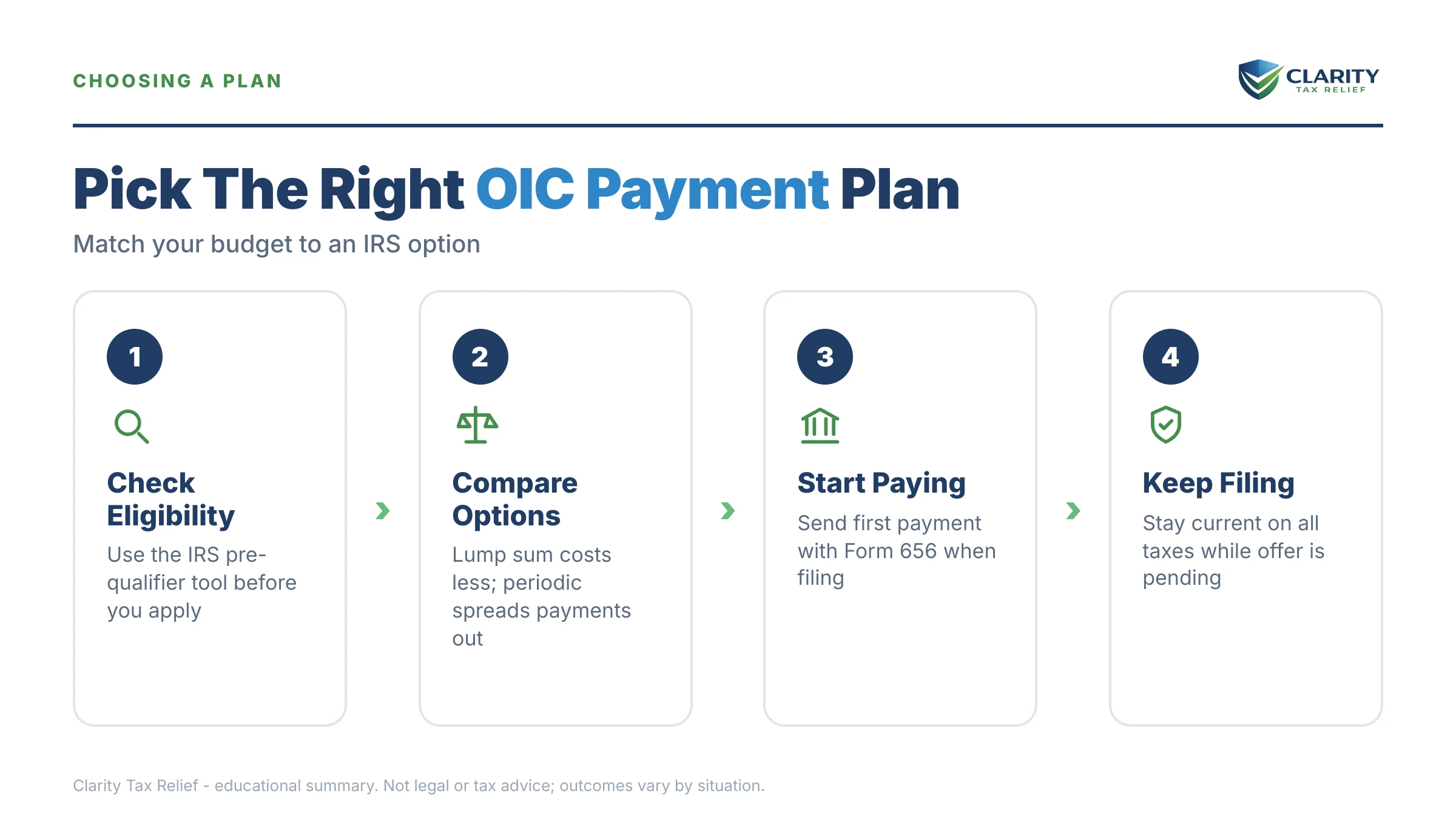
- Confirm you're a real OIC candidate. All required returns filed, current on this year's estimated taxes or federal deposits, and a reasonable collection potential below your balance — if any of these fail, fix them first.
- Run your offer math both ways. Calculate equity plus 12 months of disposable income (lump sum) and equity plus 24 months (periodic) so you can see exactly what each option would cost you.
- Match the option to your cash. Choose lump sum if you can fund 20% now and the balance within five months of acceptance; price out the monthly periodic schedule if you can't.
- Check the low-income certification before paying anything. If your AGI is at or below 250% of the federal poverty level, the fee, the down payment, and payments during review are all waived.
- File Form 656 with your financial statement and payment. Check exactly one payment-option box, attach Form 433-A (OIC), the $205 fee, and the required first payment unless you certified low-income.
- Keep the terms while the IRS reviews. Make every monthly payment on a periodic offer, stay current on this year's taxes under both options, and hold your five-month funds ready if you chose lump sum.
For line-by-line help on the paperwork itself, see the Form 656 walkthrough and the Form 433-A walkthrough.
When you can handle this yourself — and when help changes the outcome
Plenty of taxpayers choose and file their payment option without professional help, and honestly should. You're a good DIY candidate if your finances are simple — W-2 income, no business, modest assets — your RCP math clearly lands below your balance, and you can comfortably fund whichever option you pick. The forms are tedious but not tricky, and the payment-option decision itself is arithmetic, not judgment.
Experienced help changes outcomes in specific situations: self-employment or business income (where "disposable income" is genuinely contestable), payroll or trust-fund debt mixed into the balance, equity questions like a house or retirement account inflating your RCP, multiple unfiled years that must be cleaned up first, or a lump-sum-versus-periodic call that swings your offer by five figures. In those cases, the fee for help is usually smaller than the money a mispriced offer leaves on the table — or the nonrefundable payments a doomed offer burns.
If your own 20% math isn't clearly working, a free case review at (888) 825-7779 can pressure-test both payment options on your $48,300 — or whatever your number is — before you send the IRS money you can't get back.
Terms on Form 656, decoded
- Lump-sum cash offer: IRS shorthand for an offer paid in five or fewer payments within five months of acceptance — not literally one check.
- Periodic payment offer: an offer paid in monthly installments over 6 to 24 months, starting the month you file and continuing through review.
- Reasonable collection potential (RCP): the IRS's calculation of the most it could ever collect from you — asset equity plus a multiple of your future disposable income.
- TIPRA payment: the required money sent with your offer (the 20% or the first monthly installment), named for the 2005 law that created the requirement.
- Returned vs. rejected: a rejected offer can be appealed within 30 days (Form 13711); a returned offer cannot — it simply comes back, payments kept and applied.
- Five-year compliance rule: after acceptance, you must file and pay on time for five years, or the compromise defaults and the original debt is reinstated.
OIC payment option questions, answered
Which is better: a lump-sum or a periodic payment offer in compromise?
A lump-sum offer is usually cheaper because it is calculated with only 12 months of your future disposable income, while a periodic offer uses 24 months. On identical finances, the lump-sum route can cut thousands off your minimum offer. A periodic offer wins only when you cannot raise the 20% down payment plus the balance within five months of acceptance — you trade a higher total for smaller monthly checks.
Do I have to pay 20% down on an offer in compromise?
Only for a lump-sum cash offer: 20% of your offer amount is due with Form 656, plus the $205 application fee, and neither is refundable. If you qualify for the low-income certification — adjusted gross income at or below 250% of the federal poverty level — the fee, the 20% payment, and payments during review are all waived. Periodic offers skip the 20% rule but require your first monthly payment at filing.
Are OIC payments refundable if my offer is rejected?
No. The 20% down payment, the monthly payments on a periodic offer, and the $205 application fee are all nonrefundable. The money is not wasted — the IRS applies it to your underlying tax debt — but you cannot get it back, even if the offer is rejected or returned. That is why you should verify your offer math before filing, not after.
Can I change my OIC payment option after filing?
Sometimes, but not by simply asking. Offers are frequently amended during review — the offer examiner may request or accept an amended Form 656 with revised terms, and the payment structure can change at that point. Remember that switching between options changes the future-income multiplier (12 months versus 24), which changes your minimum acceptable offer, so re-run the math before amending anything.
What happens if I miss a monthly payment on a periodic payment offer?
The IRS can return your offer, and a returned offer carries no appeal rights — unlike a rejection, which you can appeal within 30 days. The IRS typically sends one letter asking you to catch up before returning the offer. Everything you have paid stays applied to your tax debt, collection can resume, and refiling means a new offer and a new application fee.
Does a lump-sum offer mean I pay the whole amount at once?
No — 'lump sum' is IRS shorthand for five or fewer payments. You pay 20% of the offer with your application, then the remaining 80% in up to five installments within five months after the IRS accepts the offer. On a $14,400 offer, that is $2,880 up front and roughly $2,304 per month for five months after acceptance.
How long do I have to pay after the IRS accepts my offer?
A lump-sum offer must be fully paid within five months of acceptance, in five or fewer payments. A periodic offer continues on the monthly schedule you proposed, with the full amount paid within 6 to 24 months of filing — and because you were already paying during review, much of it may be done by acceptance day. Missing post-acceptance payments can default the entire compromise and reinstate the original debt.
Who qualifies for the low-income OIC fee and down payment waiver?
Individuals (including sole proprietors) whose adjusted gross income is at or below 250% of the federal poverty level for their household size, based on the certification section of Form 656. Qualifying waives the $205 fee, the 20% lump-sum down payment, and all monthly payments while the IRS reviews the offer. Corporations, partnerships, and other entities cannot use the certification.
Can a business with payroll tax debt use these payment options?
The same two payment options appear on the business version of the offer, but the bar is much higher. An operating business must be current on its federal tax deposits, and the IRS rarely compromises the trust-fund portion of payroll debt while the business keeps running. Owners assessed personally through the Trust Fund Recovery Penalty can file individual offers on that liability, using either payment option.
Your next 24 hours
- Pull your exact balance by tax year from your IRS online account or your latest notices, and write down how much cash you could realistically raise within five months — that one number points to your payment option.
- Gather the offer inputs: your last filed return, three months of bank statements, income records, and (if payroll debt is involved) your deposit history — everything Form 433-A (OIC) will ask for.
- Get your numbers reviewed free before you commit nonrefundable money to either option — the 2-minute form or (888) 825-7779. Interest and penalties accrue on your full balance every month an offer isn't in place, so the math is worth running now, not next quarter.
Primary sources: the IRS's official Offer in Compromise page describes both payment options and current eligibility rules; the form itself and its booklet live at About Form 656, Offer in Compromise. If your offer stalls and you can't get answers, the independent Taxpayer Advocate Service can help.
This guide is general information, not tax or legal advice for your specific situation. Eligibility for IRS programs depends on individual facts and circumstances; no outcome is guaranteed.