
Tax Debt by Profession
Attorney Tax Debt: How Lawyers Resolve IRS Back Taxes in 2026
The short answer: attorney tax debt usually traces to 1099 and K-1 fee income with no withholding behind it. The IRS cannot levy client money in a properly maintained IOLTA account, but it can levy earned fees, receivables, bank accounts, and up to 15% of Social Security — and a balance over $66,000 can trigger passport certification.
You've never blown a client's statute of limitations — but your own quarterlies slipped, a contingency fee landed in one tax year instead of three, and now the IRS says you owe. If you searched "attorney tax debt," you're likely a practicing or retired lawyer with a balance built from self-employment income, and the discomfort of being the professional who fell behind is real. It's also irrelevant to the fix: this is a collection matter, not a character verdict, and lawyers have three case-specific issues — the trust account, the license, and the passport — that this guide covers before anything else.
One note on the search results: if you actually wanted to know whether to hire counsel, that's a different question — see do I need a tax attorney for back taxes. This page is for the lawyer who owes.
⏱ The clock on attorney tax debt: there is no single notice deadline until collection letters start, but the failure-to-pay penalty adds 0.5% every month and interest compounds daily on top of it. And once your assessed balance passes $66,000 (the 2026 threshold), the IRS can certify the debt to the State Department and block your passport renewal.
Why attorneys end up owing the IRS
Most attorney tax debt comes from income that arrives with zero withholding: 1099-NEC fees, of-counsel payments, referral fees, and partnership K-1 draws. Nothing was set aside, so the full income tax plus 15.3% self-employment tax comes due at filing — and if the quarterlies weren't paid, an underpayment penalty stacks on before the return is even late. The mechanics of that miss are covered in didn't pay estimated taxes penalty.
Contingency practice makes it worse. A fee that took three years to earn is taxed entirely in the year it's received, often pushing you into a higher bracket in a single spike year while the two lean years produced no cushion. Lawyers routinely owe from exactly one or two spike years, with the surrounding years clean.
Two more patterns show up in law-practice cases specifically. First, firms with staff fall behind on 941 back taxes, which carries personal exposure through the trust fund recovery penalty — the IRS can assess the withheld portion against any partner or manager who controlled which bills got paid, personally, even after the firm dissolves. Second, retired attorneys carry practice-year balances into retirement, where the debt collides with a fixed Social Security income. The worked example below runs that exact scenario at $76,400.
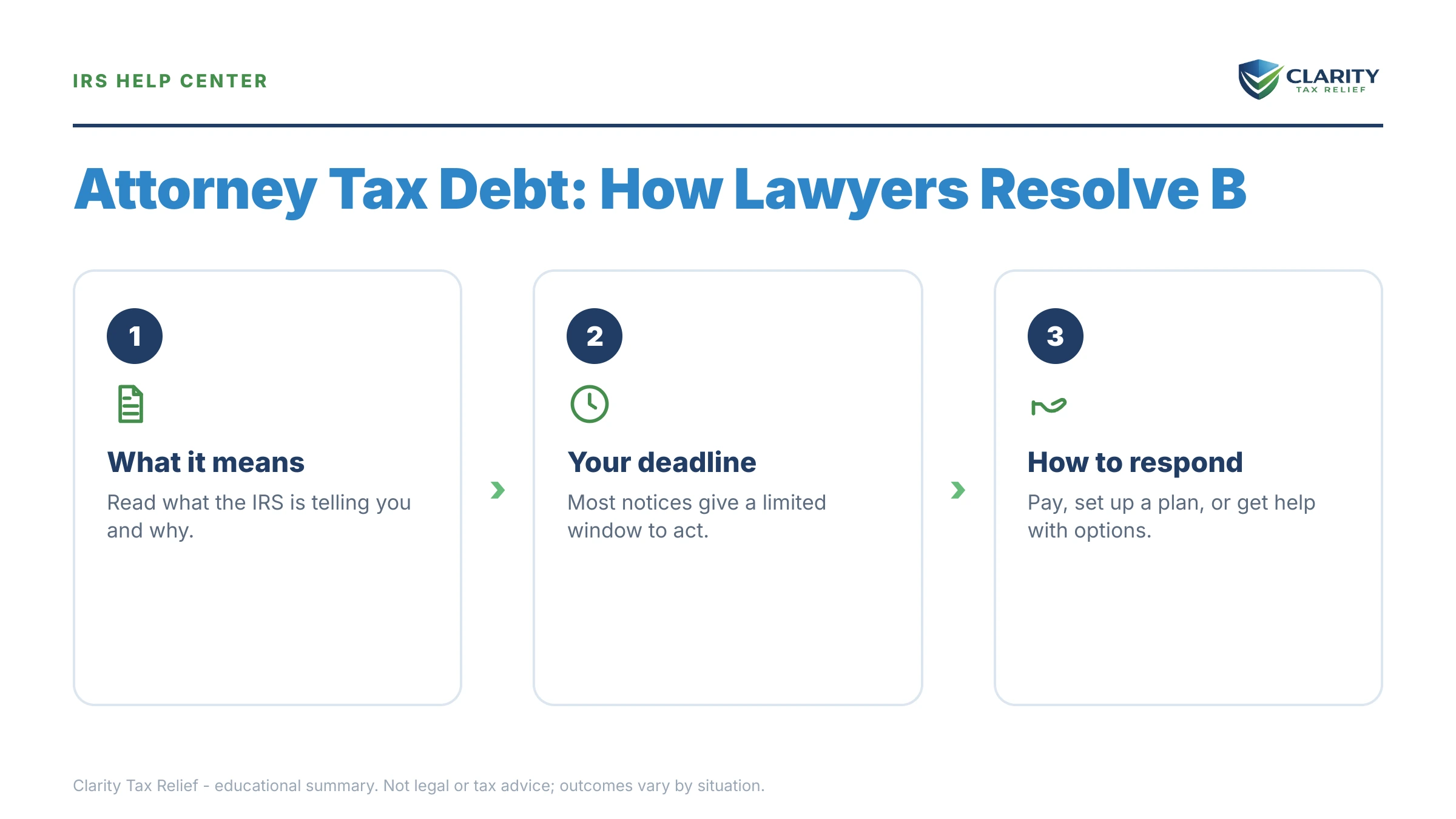
What the IRS can — and can't — reach in a law practice
A properly maintained IOLTA account is off-limits to an IRS levy because client funds are your clients' property, not yours. That protection is real, but it is fragile in exactly one way: commingling destroys it. Earned fees you left sitting in trust, or personal funds you parked there, belong to you — and what belongs to you is leviable. Sloppy trust accounting is also the fastest way to convert a routine collection case into bar scrutiny, so if you're behind on taxes, your trust ledger should be immaculate.
Everything on the earned side of the line is reachable. The IRS can serve a levy on a defendant's insurer for your fee share, on co-counsel holding your split, or on your firm's accounts receivable — an AR levy that hits mid-case can starve a small practice of cash within a billing cycle. Retired attorneys face the Federal Payment Levy Program instead, which takes 15 percent of Social Security automatically, month after month, until the debt is resolved.
| Asset or income stream | Can the IRS take it? | What matters |
|---|---|---|
| Client funds in IOLTA | Generally no | Client property isn't yours to levy — unless commingled with earned fees or personal money |
| Earned fees & receivables | Yes | Levy can be served on the payor, insurer, or co-counsel holding your share |
| Operating / personal bank accounts | Yes | Bank holds seized funds 21 days before sending them — a short window to act |
| Social Security benefits | Up to 15% | FPLP levy is continuous every month; released by an IA, CNC, or pending offer |
| Your law license | No (federal) | The IRS has no license power; some states act on state tax debt, and bars act on willful non-filing |
| Home, IRA, 401(k) | Possible, last resort | Reachable in law but rarely first moves; equity still counts against you in settlement math |
What happens if you ignore attorney tax debt
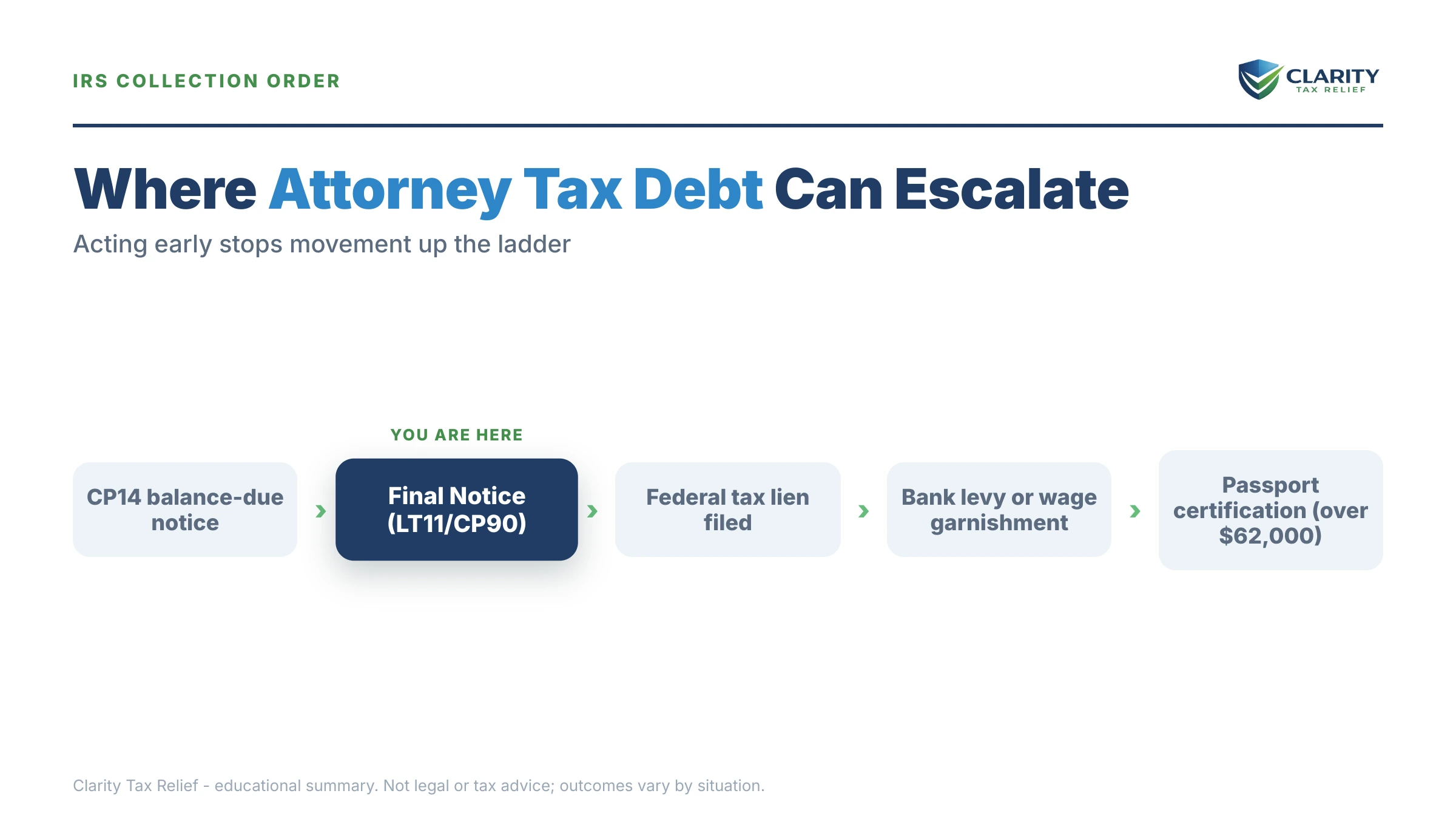
IRS collection is an automated sequence, and it escalates on schedule whether or not a human ever reads your file. In 2026, with the IRS workforce down roughly 27% from 2025 cuts, the humans who could pause things are harder to reach — but the notice stream, lien filings, and levies run on systems that never got smaller. Here is the order it unfolds in:
- CP14 — the first bill. Typically about 21 days to pay before the next notice queues. No enforcement yet; cheapest moment to act.
- CP501 / CP503 — reminders. Still just bills, but the balance grows monthly and the file moves toward enforcement.
- CP504 — intent to levy your state tax refund under IRC §6331(d). A federal tax lien — a public record any client, opposing counsel, or bar investigator can find — becomes a live risk.
- Passport certification — once the balance exceeds $66,000 with a lien filed or levy issued, the IRS can certify it as seriously delinquent; renewals can be denied. Details in passport revoked for tax debt.
- LT11 / Letter 1058 — the final notice. You get 30 days to request a Collection Due Process hearing on Form 12153. After that window, levies on fees, bank accounts, and Social Security can begin.
- Levy — a bank levy freezes funds with a 21-day hold before the money leaves; a levy on receivables or benefits keeps taking until released.
| Stage | Response window | What a lawyer stands to lose |
|---|---|---|
| CP14 first bill | Typically 21 days from the notice date | Nothing yet — only the cheap exit |
| CP501 / CP503 reminders | Pay-by date printed on each notice | Balance compounds; file advances |
| CP504 intent to levy | Date printed on the notice | State refund; lien becomes public record |
| LT11 / Letter 1058 final notice | 30 days to file Form 12153 | CDP appeal rights if the window passes |
| Active levy | 21-day bank hold; fee/benefit levies continue | Fees, accounts, 15% of Social Security |
Behind on taxes as an attorney?
Every month adds another 0.5% penalty plus compounding interest, and above $66,000 your passport is in play. Get your attorney tax-debt case reviewed free by an experienced tax professional — before a lien becomes a public record.
Your options for resolving attorney tax debt
Every IRS resolution program is means-tested against your income and assets — the full DIY playbook lives in our guide to how to settle tax debt yourself; here is how each option maps onto a lawyer's finances. The threshold that matters most is $50,000: at or below it, a streamlined installment agreement can be set up online over up to 72 months with no financial disclosure. Above it — where a $76,400 balance sits — the IRS wants a Form 433-F showing your income, assets, and allowable expenses, which changes the negotiation entirely (see IRS payment plan over $50,000).
| Option | Who qualifies | Cost and catch |
|---|---|---|
| Short-term plan (180 days) | Can full-pay within 180 days | $0 setup; interest and penalties still accrue |
| Streamlined installment agreement | Balance ≤ $50,000, all returns filed | Up to 72 months, set up online, no financials; accrual continues |
| Non-streamlined installment agreement | Balance over $50,000 | Form 433-F required; IRS may push for asset use before approving |
| Partial-pay installment agreement | 433-F shows you can't full-pay before the collection statute runs | Pay what the math supports; remainder can expire at CSED; periodic re-review |
| Currently Not Collectible | Allowable expenses meet or exceed income | Collection pauses, FPLP levy releases; debt and interest remain, lien likely |
| Offer in Compromise | Asset equity + future income below the balance | $205 fee, 20% down on lump-sum offers (both waived if AGI ≤ 250% of poverty); ~1 in 5 accepted FY2024 |
| First-time penalty abatement | Clean compliance the prior 3 years | Removes penalties, not tax; from summer 2026, AEP applies automatically without a request |
One credibility note for this audience: any pitch promising to settle attorney tax debt for "pennies on the dollar" is the marketing version of an ethics violation. Offers are accepted when the IRS's own collection math says the balance is uncollectible — and for a lawyer with current earnings or real asset equity, it usually doesn't.
A worked example: $76,400 in attorney tax debt on a Social Security income
Say you owe $76,400 — a hypothetical retired solo practitioner whose final three practice years produced 1099 fee income with no quarterlies paid, now living on a $2,850 monthly Social Security benefit plus a $600 monthly IRA draw. Assume roughly $60,000 is tax and $16,400 is accumulated penalties and interest. Here's how the options actually price out:
- Do nothing: the failure-to-pay penalty alone runs 0.5% × $60,000 ≈ $300 a month, interest compounds on top, FPLP can take 15% × $2,850 ≈ $427 from each benefit check, and at $76,400 the passport certification threshold ($66,000) is already crossed. You can estimate your own accrual with our IRS Penalty & Interest Calculator.
- Full-pay installment agreement: $76,400 ÷ 72 ≈ $1,061 a month before ongoing interest — far beyond a $3,450 monthly income. Paying down $26,400 to reach the $50,000 streamlined line ($50,000 ÷ 72 ≈ $695/month) only works if there's a liquid asset to tap.
- Partial-pay agreement: if the Form 433-F shows $3,450 income against $3,300 in allowable expenses, disposable income is about $150 a month. Over, say, seven remaining years on the collection statute that pays roughly $12,600 — and the rest can expire when the CSED runs, though appeals, an offer, or bankruptcy pause that clock.
- CNC: if expenses equal or exceed income, collection pauses entirely and the Social Security levy is released — the path detailed in IRS hardship on Social Security.
- Offer in Compromise: a lump-sum offer is priced around asset equity plus about 12 months of that $150 disposable income ($1,800). With modest assets, an offer in the low five figures can genuinely resolve $76,400; with $55,000 sitting in the IRA, that equity counts and the math likely fails. Means-tested, not negotiated on sympathy.
Notice what drives the answer: not the $76,400, but the 433-F. Same balance, different asset picture, completely different best move — which is why running the financial math before calling the IRS matters so much above $50,000.
How to respond to attorney tax debt, step by step
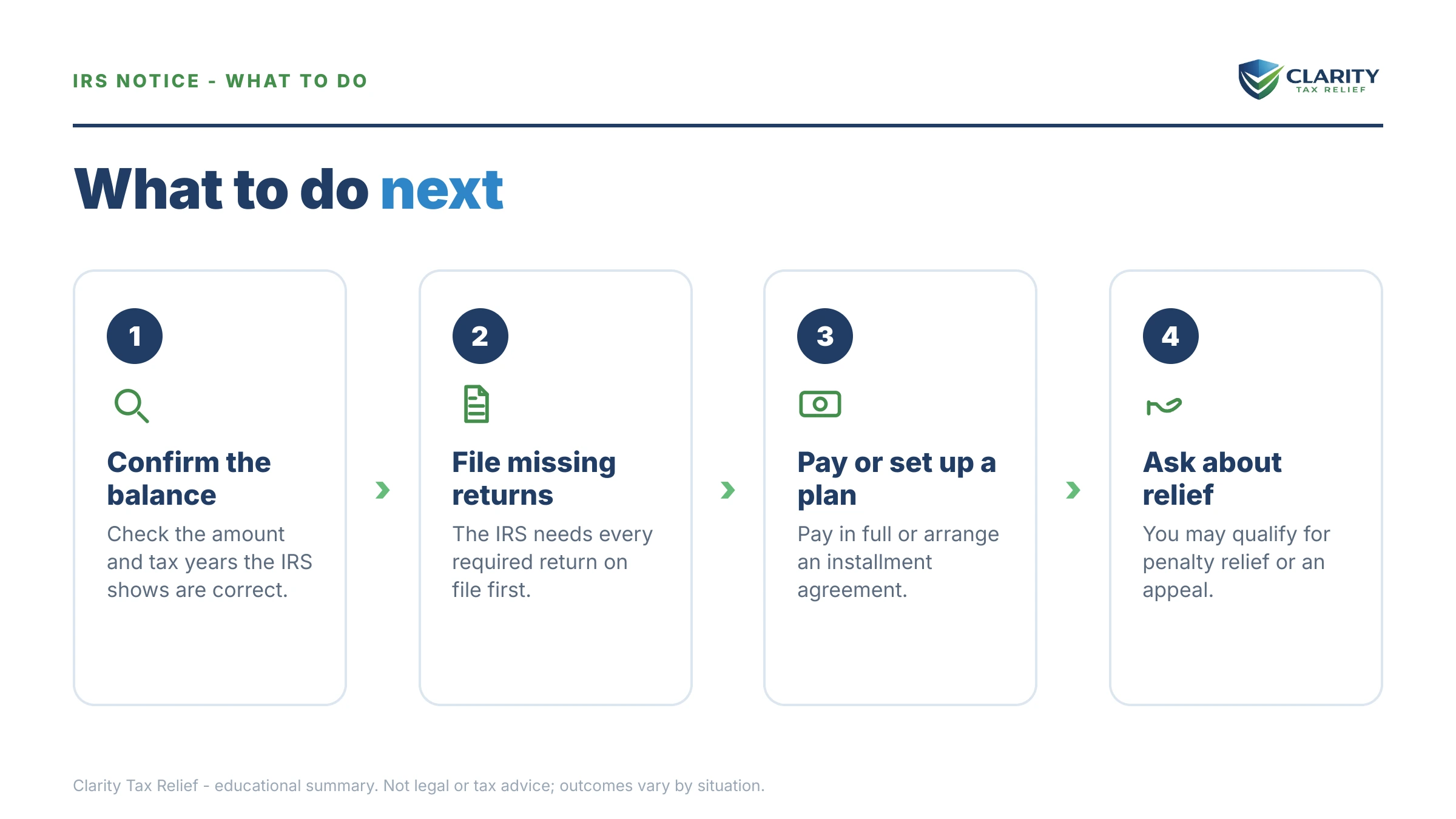
- Pull your IRS account transcripts. Get transcripts for every year through your IRS online account to confirm what is assessed, which years are unfiled, and how long the IRS has left to collect each balance.
- File every unfiled return first. The IRS will not approve a payment plan, hardship status, or offer while returns are missing — and filing stops the 5%-per-month failure-to-file penalty, which is ten times the failure-to-pay rate.
- Verify the balance and the penalty breakdown. Match each notice against your records; a contingency fee reported in the wrong year or a misapplied estimated payment can overstate what you actually owe.
- Run the payment math against your real income. Compare what full payment over 72 months would cost against what your Form 433-F disposable-income calculation actually supports before agreeing to anything.
- Request penalty relief before locking in a number. First-time abatement or reasonable-cause relief can shrink the balance you are about to finance — ask before you sign, not after.
- Set up your resolution before the next notice escalates. An installment agreement, partial-pay plan, CNC status, or filed offer stops levies on fees and Social Security and heads off passport certification.
Payment plans can be set up directly at the IRS payment plans page, and any direct payment goes through IRS.gov/payments — never through anyone asking for gift cards or wire transfers.
Will tax debt affect your law license or bar standing?
Owing the IRS is not, by itself, a disciplinary offense in most states — bars generally act on willful conduct, not inability to pay. Willful failure to file returns, tax fraud, and trust-account misuse are what generate bar complaints; a lawyer who filed every return and simply can't pay the balance is in a categorically safer position. That's one more reason step two above — file everything, even years you can't pay — is non-negotiable for attorneys specifically.
The exposure that sneaks up on people is visibility, not discipline. A filed Notice of Federal Tax Lien is a public record: opposing counsel, malpractice underwriters, lenders, and clients running due diligence can all find it. And on the state side, several agencies do reach licenses over state tax debt — California's FTB runs a license-suspension program, for example — so if you owe both, the state balance may deserve first attention even though it's smaller. State rules vary; check your own bar's and revenue agency's rules rather than assuming the federal pattern applies.
If your worry runs past collections — years of willful non-filing, or trust-account activity you wouldn't want examined — that is the narrow situation where a tax attorney's privilege matters more than an EA's or CPA's collection skill. The differences are laid out in tax attorney vs. CPA vs. enrolled agent.
When you can handle this yourself — and when help changes the outcome
You can very likely resolve this without hiring anyone if the balance is at or below $50,000, every return is filed, and you agree with the numbers: the streamlined agreement is an online form, and a 180-day short-term plan costs nothing to set up. A first notice on a single spike year you agree with is a self-service problem, and there's no shame — and no lost value — in solving it that way.
Experienced help changes outcomes in specific situations: a levy already served on a fee source or bank account (the 21-day hold is short and the release paperwork is unforgiving), multiple unfiled years that need reconstructing from 1099s and bank records, firm payroll debt with trust fund recovery penalty exposure among partners, a balance over $50,000 where the 433-F presentation decides whether you get a $1,061 payment or a $150 one, and any OIC where retirement-asset valuation drives the offer amount. In those cases the fee usually costs less than the mistake it prevents.
If your balance is north of $50,000 or a levy notice has already arrived, a free review with an experienced tax professional will tell you in one call which of these paths your 433-F actually supports — request it here or call (888) 825-7779.
Terms in attorney tax-debt cases, decoded
- IOLTA — the pooled interest-bearing trust account holding client funds; client money in it is not levy-able because it isn't your property.
- FPLP — the Federal Payment Levy Program, the automated system that takes up to 15% of federal payments such as Social Security benefits.
- CSED — the Collection Statute Expiration Date, 10 years from assessment, after which the IRS can no longer collect; appeals, offers, and bankruptcy pause the clock.
- PPIA — a partial-pay installment agreement, sized to your disposable income rather than the balance, with the remainder able to expire at the CSED.
- RCP — Reasonable Collection Potential, the IRS formula (asset equity plus future income) that decides whether an Offer in Compromise is accepted.
- Seriously delinquent tax debt — an assessed balance over $66,000 (2026) with a lien or levy in place, which the IRS can certify to the State Department against your passport.
Attorney tax debt questions, answered
Can the IRS levy my IOLTA or client trust account?
Generally no — client funds in a properly maintained IOLTA account are your clients' property, not yours, and a levy only reaches property you own. The exception is commingling: earned fees you left sitting in the trust account, or personal money you parked there, are yours and are reachable. Clean trust accounting is what preserves the protection, so document which funds belong to which client now, before any levy lands.
Will IRS tax debt affect my law license?
Owing the IRS, by itself, is not a disciplinary offense in most states — bars generally act on willful conduct like failing to file returns or tax fraud, not on inability to pay. The bigger practical exposure is the federal tax lien, which is a public record anyone can find, and state-level programs: some states, including California through the FTB, can suspend professional licenses over state tax debt. Filing every return on time is the single best license protection.
Can the IRS take my Social Security if I'm a retired attorney?
Yes — through the Federal Payment Levy Program the IRS can take up to 15% of each Social Security benefit payment, and unlike a bank levy it continues automatically every month until the debt is resolved or released. On a $2,850 monthly benefit that is about $427 per month. Getting into an installment agreement, hardship (CNC) status, or a pending offer stops the FPLP levy.
Can the IRS garnish my contingency fees or receivables?
Yes. Once a fee is earned, it is your property — the IRS can serve a levy on the paying party, on co-counsel holding your share, or on your firm's accounts receivable. A levy on fees owed to you as a contractor or of-counsel is typically a one-time grab of what is payable on the levy date, but the IRS can re-issue it, and an AR levy can choke a small practice's cash flow quickly.
Does owing more than $66,000 really affect my passport?
Yes. When your assessed balance exceeds $66,000 (the 2026 inflation-adjusted threshold) and the IRS has filed a lien or issued a levy notice, it can certify the debt as seriously delinquent to the State Department, which can deny a renewal or revoke the passport. Debt in a current installment agreement, an accepted or pending Offer in Compromise, or a timely CDP hearing is not certified — which is a strong reason to get into a program rather than wait.
Are my own tax records protected by attorney-client privilege?
No. Privilege protects your clients' confidences, not your own financial and tax records — your returns, 1099s, bank statements, and books are all fair game in an IRS exam or collection case. Where privilege does matter is at the boundary: the IRS is not entitled to client confidences when it reviews your trust-account records, and an experienced representative can help you produce what is required without overproducing.
Can an attorney settle tax debt with an Offer in Compromise?
Yes, if the math works — an OIC is means-tested, not profession-tested. The IRS accepted roughly 1 in 5 offers in FY2024, and acceptance turns on Reasonable Collection Potential: your asset equity plus what your future income can pay. A retired attorney living on Social Security with modest assets can be a genuine candidate; a practicing attorney with strong current earnings or significant home and retirement equity usually is not, because RCP exceeds the balance.
What if my law firm owes payroll taxes too?
Treat the payroll debt as the priority — the withheld (trust-fund) portion of unpaid 941 taxes can be assessed against you personally through the Trust Fund Recovery Penalty, and it follows you even if the firm closes. Anyone who controlled which bills got paid — a partner, managing attorney, or office manager who signs checks — can be a responsible person. Resolve current deposits first, then the arrears; personal income tax debt can wait a step behind payroll.
Do I need to hire a tax attorney if I already am one?
Usually not — most attorney tax-debt cases are collection matters, not legal disputes, and enrolled agents and CPAs handle collection cases every day at lower cost. A tax attorney adds real value in two situations: potential criminal exposure (willful non-filing, trust-account misuse) where you need attorney-client privilege, and Tax Court litigation. For payment plans, hardship status, and offers, what matters is collection experience, not the credential.
Your next 24 hours
- Find your real number. Log into your IRS online account (or pull the most recent notice) and write down the total balance per year, the notice date, and whether any notice says "intent to levy."
- Gather the file. Your last filed return, every 1099 and K-1 from the debt years, your Social Security award letter or current income records, and all IRS letters — that's the entire 433-F picture in one folder.
- Get the free case review. An experienced tax professional will map your balance against the options above — including trust-account and license considerations — free and confidentially: start with the 2-minute form or call (888) 825-7779. The balance grows by roughly half a percent plus interest every month you wait; nothing else on this list gets cheaper later.
If the IRS system leaves you stuck — a levy causing hardship, a case bouncing between units — the independent Taxpayer Advocate Service exists for exactly that.
This guide is general information, not tax or legal advice for your specific situation. Eligibility for IRS programs depends on individual facts and circumstances; no outcome is guaranteed.