
Tax Debt Resolution
Large Tax Debt Help in 2026: What Changes When You Owe $50,000, $66,000, or $100,000+
The short answer: large tax debt help comes down to three thresholds. Above $50,000, you lose the online streamlined payment plan and must disclose your finances. Above $66,000, the IRS can certify your debt for passport denial. Above $100,000, a revenue officer may take over your case. Every band still has a workable path.
You've stopped opening the envelopes one at a time — they arrive for two different tax years now, and the totals at the bottom have grown into a number that doesn't fit your paycheck, your savings, or any plan you can see. That paralysis is normal, and it's also the most expensive thing in this situation. A large balance is not a different kind of problem; it's the same problem with different rules — and once you know which threshold you're standing on, the next move gets specific fast.
⏱ The real clock: a large tax debt has no single deadline — it has a compounding one. The failure-to-pay penalty adds 0.5% of the balance every month, interest compounds daily on top, and each unanswered notice moves you one automated step closer to a lien filing and levy. The date printed on your most recent notice is the window that matters right now.
Why owing more than $50,000 changes how the IRS treats you
The IRS handles a $76,400 debt fundamentally differently than a $20,000 one — three thresholds at $50,000, $66,000, and $100,000 change what you qualify for and who is looking at your file.
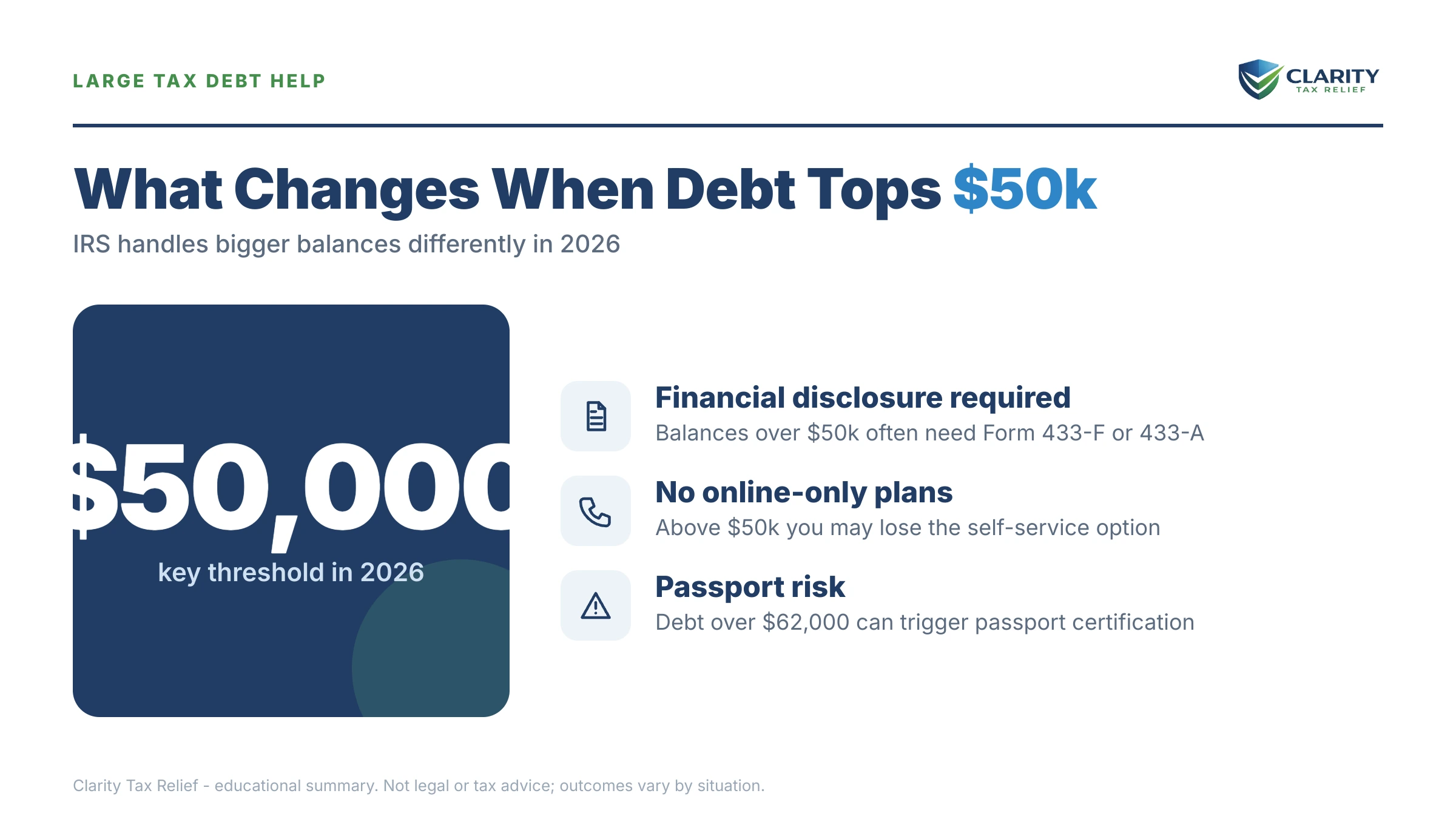
At $50,000 and below, resolution is nearly self-service: you can set up a direct-debit streamlined installment agreement online, spread over up to 72 months, with no financial disclosure. Cross $50,000 and that door closes. You now need a non-streamlined agreement, which means handing the IRS a collection information statement — Form 433-F, or the longer Form 433-A — listing your income, expenses, accounts, and equity. See our guide to the IRS payment plan over $50,000 for what that disclosure involves.
At $66,000 — the 2026 inflation-adjusted threshold — your debt can be certified as "seriously delinquent" once a lien has been filed or a levy issued. The IRS sends notice CP508C, and the State Department can deny your passport renewal or revoke the passport you hold. Full details are in our guide to having a passport revoked for tax debt.
At $100,000 and up, the odds rise sharply that your case leaves the automated system and lands on a revenue officer's desk — a human collector with authority to demand financials, summon records, and recommend seizures. Even your very first bill moves faster up here: the interest-free pay-by window on a CP14 shrinks from about 21 days to 10 business days at $100,000+. Our IRS payment plan over $100k guide covers that territory specifically.
How do balances get this big? Usually not one bad year — two or three years of self-employment income with no withholding, an underreported business or platform income adjustment, a retirement withdrawal, or a windfall like gambling winnings that arrived without taxes taken out (see casino winnings tax debt for that specific trap). Whatever built the number, the thresholds below decide your options now.
| Balance | What changes | What it means for you |
|---|---|---|
| Up to $10,000 | Guaranteed installment agreement available | The IRS must accept a qualifying 3-year payment plan |
| Up to $50,000 | Streamlined plan, set up online | Up to 72 months, direct debit, no financial disclosure |
| Over $50,000 | Non-streamlined agreement required | Form 433-F or 433-A financials; IRS sets the payment |
| Over $66,000 | Passport certification threshold (2026) | CP508C possible once a lien is filed or levy issued |
| Over $100,000 | Likely revenue officer assignment | Human collector, asset review; CP14 window shrinks to 10 business days |
What happens if you ignore a large tax debt
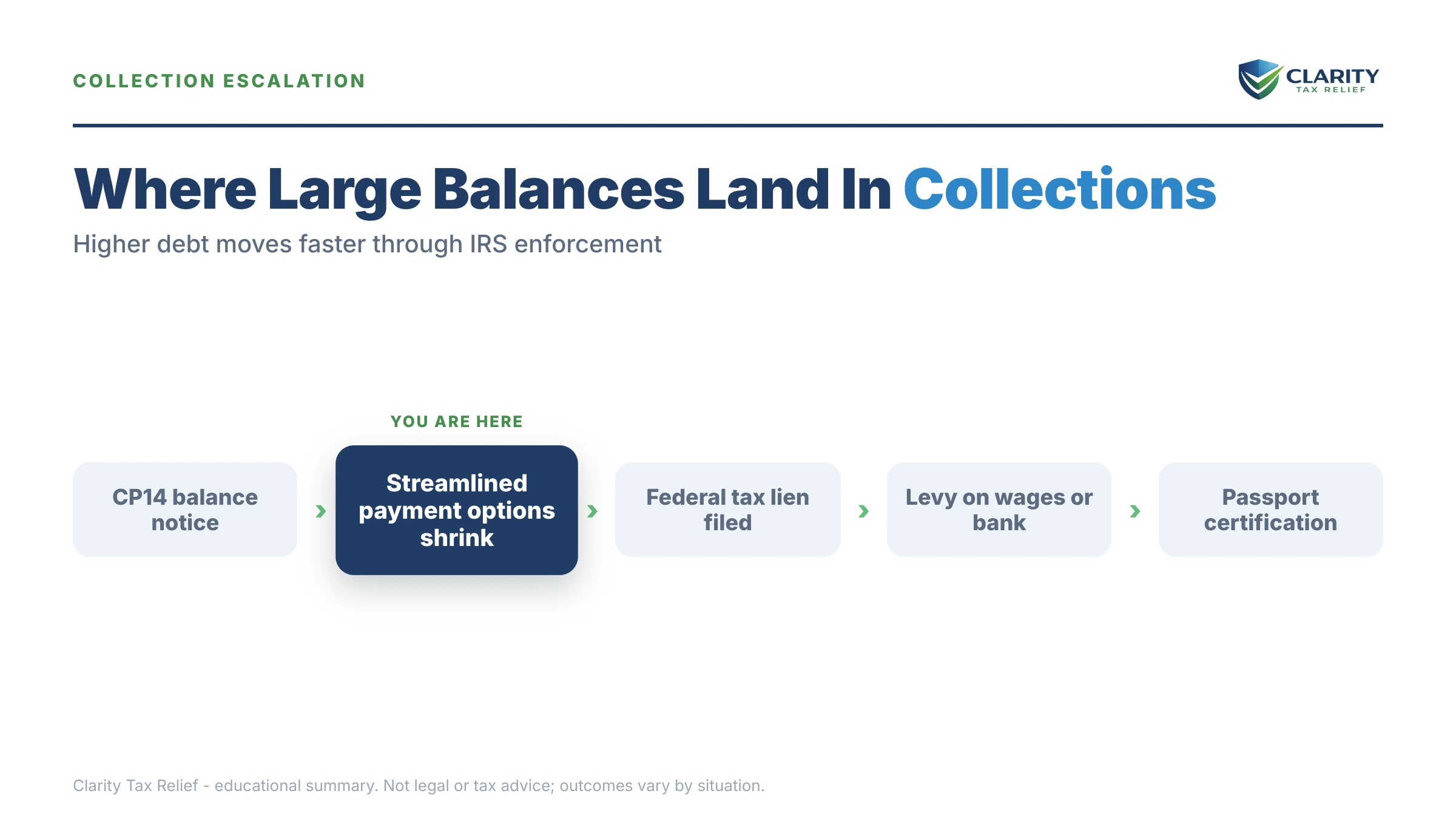
An unresolved large tax debt escalates through an automated notice sequence that ends in a federal tax lien, bank levies, and continuous wage garnishment. The sequence runs in a fixed order — and on a six-figure balance, the IRS has more incentive to run it to the end:
- CP14 — the first bill for each year you owe. No enforcement yet, but the failure-to-pay penalty and daily interest are already running.
- CP501 / CP503 — reminder notices. Still just bills; the balance grows every month they go unanswered.
- CP504 — Notice of Intent to Levy under IRC §6331(d). The IRS can now seize your state tax refund. This is not the final notice, but it's the last cheap exit.
- Letter 3172 — a Notice of Federal Tax Lien has been filed, attaching to your home, vehicles, and everything else you own. At balances above $66,000, this is also what opens the door to passport certification via CP508C.
- LT11 / Letter 1058 — Final Notice of Intent to Levy. A 30-day clock starts, and it's your window to demand a Collection Due Process hearing with Form 12153. After it closes, the IRS can levy bank accounts (funds are held 21 days before they leave), garnish wages continuously until the debt is resolved, and take up to 15% of Social Security through the Federal Payment Levy Program.
- Revenue officer assignment — on large balances, a field collector may take over at any point in this sequence, sometimes announced by a Letter 725-B revenue officer visit. From there, deadlines are set person-to-person, and missing them has immediate consequences.
Don't count on 2026 staffing chaos to slow this down. The IRS workforce shrank roughly 27% in 2025 — but every step above except the revenue officer is generated by software that never stopped running. The cuts mean it's harder to reach a human to fix a problem, not that the machine forgets you.
| Notice | What it means | Your window |
|---|---|---|
| CP14 | First bill; no enforcement yet | ~21 days (10 business days at $100,000+) |
| CP501 / CP503 | Reminders; balance compounding monthly | Pay-by date printed on each notice |
| CP504 | Intent to levy your state refund (§6331(d)) | Date printed on the notice; not the final notice |
| Letter 3172 | Federal tax lien filed; public record | Hearing-request deadline printed on the letter |
| CP508C | Passport certification (over $66,000, seriously delinquent) | Resolve the debt to reverse certification |
| LT11 / Letter 1058 | Final notice; levies can follow | 30 days to request a CDP hearing (Form 12153) |
Owe more than $50,000 and the notices keep coming?
Get your balance, your thresholds, and your realistic options reviewed free — before another month of penalties and interest posts and the automated sequence takes another step. An experienced tax professional will map your specific numbers, confidentially and without pressure.
Large tax debt help: your realistic options in 2026
Every large tax debt has at least one workable resolution: a payment plan sized to your finances, a partial-pay agreement, hardship status, penalty relief, or — when the math supports it — an Offer in Compromise. The general mechanics of each program are covered in our guide to how to settle tax debt yourself; what follows is how each one behaves specifically at large balances.
- Short-term payment plan — up to 180 extra days to pay in full, $0 setup fee. Realistic only if a sale, bonus, or loan is genuinely coming; at higher balances you may need to arrange it by phone rather than online.
- Streamlined installment agreement — the no-disclosure 72-month plan, but only at $50,000 or below. On a larger balance, the key strategic question is whether you can pay down under that line (more in the worked example below).
- Non-streamlined installment agreement — the standard path above $50,000. You submit financials, and the IRS calculates your payment using its allowable living expense standards — not your actual budget. Our Form 433-A walkthrough shows exactly what gets counted. Presenting those numbers well is where large-balance cases are won or lost.
- Partial-pay installment agreement (PPIA) — if honest financials show you can't full-pay before the collection statute expires, the IRS can accept a monthly payment that never retires the debt; whatever remains at the CSED falls off. Expect periodic financial reviews and, usually, a lien. See the partial-pay installment agreement guide.
- Currently Not Collectible (CNC) — if paying anything would leave you unable to cover basic living expenses, collection pauses entirely. The debt keeps growing and refunds get kept, but levies stop while the 10-year clock keeps running.
- Offer in Compromise (OIC) — settling for less than the balance, when the IRS's collectability math supports it. There's a $205 application fee and a 20% down payment on lump-sum offers (both waived with low-income certification, generally AGI at or below 250% of the poverty line). The IRS accepted roughly 1 in 5 offers in FY2024 — real, but never automatic, and eligibility is entirely means-tested.
- Penalty relief — First-Time Penalty Abatement can remove a year's penalties if your prior three years were clean, and starting summer 2026 the new Automatic Exemption from Penalty (AEP) applies qualifying relief without a request. On a $76,400 balance, penalties can be a five-figure slice — worth attacking separately from the tax itself.
| Option | Who it fits | The catch |
|---|---|---|
| Short-term plan (180 days) | Money is genuinely coming; $0 setup | Interest and penalties keep accruing until paid |
| Streamlined IA | Balance ≤ $50,000 with direct debit | Over $50k, you must pay down to qualify |
| Non-streamlined IA | Over $50,000, can full-pay over time | Form 433 financials; IRS sets the payment; lien likely |
| Partial-pay IA | Can't full-pay before the CSED | Periodic reviews; payment can rise if income does |
| Currently Not Collectible | Payment would prevent basic living expenses | Debt keeps growing; refunds offset; status is reviewed |
| Offer in Compromise | Assets + future income below the balance | $205 fee, 20% down (lump sum); ~1 in 5 accepted FY2024 |
| Penalty relief (FTA / AEP) | Clean 3-year history, or automatic AEP from summer 2026 | Removes penalties, not the tax or most interest |
One more lever people forget: the balance itself may be wrong. If a year was assessed from a substitute return, a missed cost basis, or duplicated income, amending a return to reduce tax debt can shrink the number you're negotiating over — sometimes below a threshold that changes everything else. If you're weighing monthly payments against settling, our comparison of an IRS payment plan vs offer in compromise breaks down the decision.
A worked example: a married couple who owes $76,400
Say you and your spouse owe $76,400 across two years, mostly from self-employment income that had no withholding. Here's how the three main paths actually price out — every figure below is hypothetical:
Path 1 — pay down to streamlined. You can pull together $26,500 from savings and a family loan. That drops the balance to $49,900 — under the $50,000 line — so you set up a direct-debit streamlined plan online with no financial disclosure: $49,900 ÷ 72 months ≈ $693/month, plus accruing interest (the failure-to-pay penalty typically drops to 0.25% per month while an installment agreement is active). Bonus: staying under $66,000 in certified debt keeps the passport issue off the table entirely.
Path 2 — non-streamlined agreement on the full $76,400. No lump sum available, so you file Form 433-A. Your joint income is $11,000/month and the IRS's allowable expense standards permit $9,600 — leaving $1,400/month of "ability to pay." At $1,400/month, the tax full-pays in roughly 55 months ($1,400 × 55 = $77,000) plus accrual. Note the IRS's number, not your actual budget, sets that payment — which is why how the 433-A is prepared matters so much.
Path 3 — Offer in Compromise. The IRS computes your Reasonable Collection Potential (RCP): net equity in what you own, plus your monthly disposable income multiplied out (12 months for a lump-sum offer). Suppose you rent, your cars are financed with $12,000 of combined quick-sale equity, and disposable income is $600/month: RCP = $12,000 + ($600 × 12) = $19,200 — an offer near that figure could resolve the full $76,400 if the numbers hold up under IRS scrutiny. But flip one fact — say you own a home with $80,000 of reachable equity — and RCP exceeds the debt, and an OIC is off the table no matter how large the balance feels. You can rough out your own numbers with our Offer in Compromise Calculator before spending anything to pursue it.
Married, self-employed, or several years behind: what changes
On a joint return, both spouses are liable for 100% of the balance — the IRS can collect the entire debt from either of you, regardless of who earned the income. If the debt traces to income or errors one spouse hid from the other, innocent spouse relief can sever the injured party's liability; and filing separately going forward keeps future refunds and income out of reach of joint-year debt.
If you're self-employed, no agreement survives without current-year compliance: the IRS requires you to start making quarterly estimated payments before it will approve a plan, because it won't finance a hole that's still deepening. Business sellers with multistate exposure have an added layer — our Amazon FBA seller taxes guide covers how platform and state debts stack on top of the federal balance.
Multiple years also means multiple clocks. Each year's assessment carries its own 10-year collection statute (CSED), so a strategy that makes sense for a 2019 balance expiring soon can be exactly wrong for a fresh 2025 assessment. On large multi-year debts, sequencing which year gets paid first is a real, dollars-saving decision.
How to respond to a large tax debt, step by step
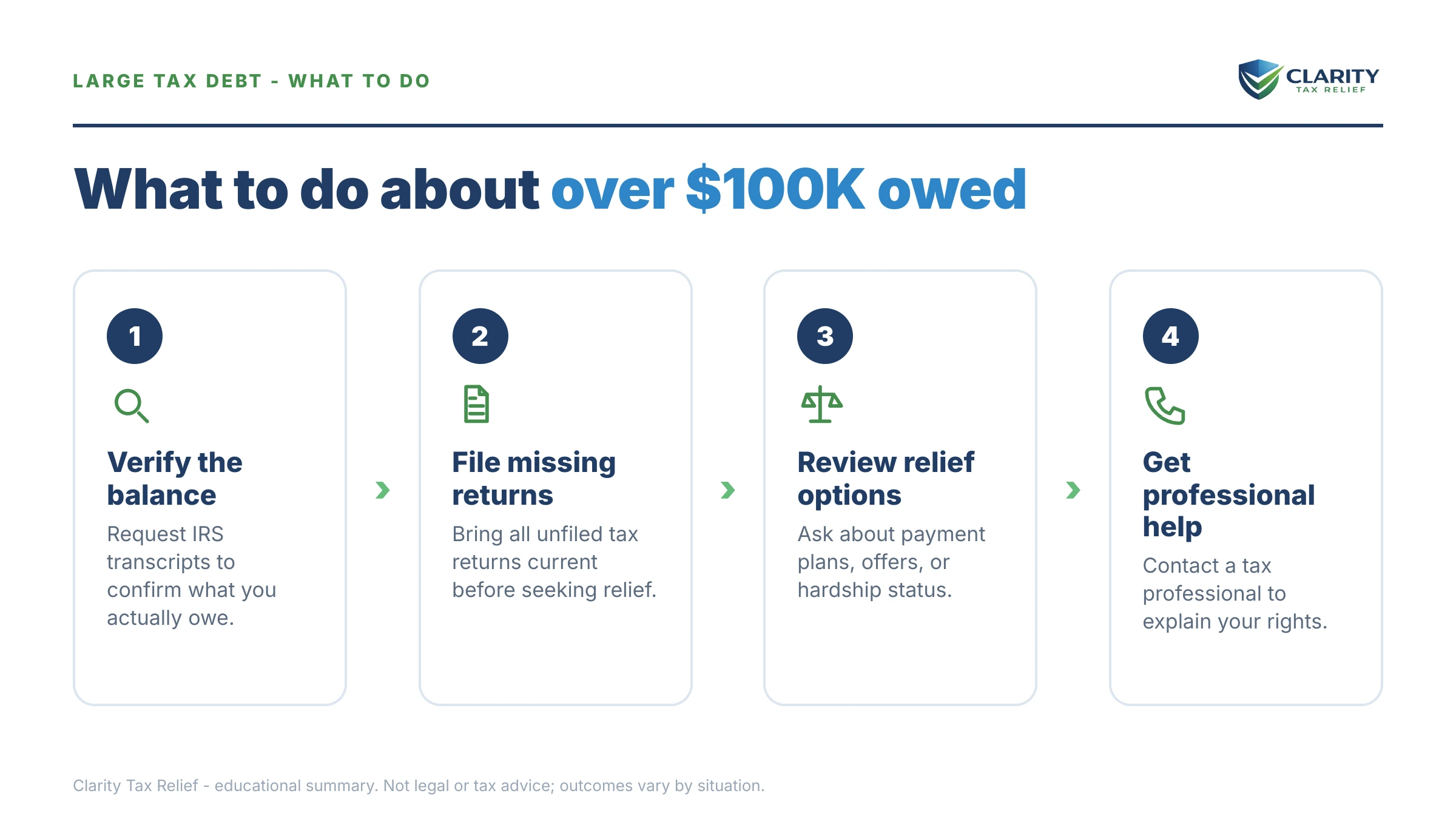
- Confirm the true total — pull your IRS account transcripts for every year you owe; interest compounds daily, so the number on your last notice is already stale.
- Get compliant first — file every unfiled return and start current-year withholding or estimated payments; the IRS will not approve any agreement while you are still falling behind.
- Fix what's wrong — if part of the assessed balance is inflated — a missed deduction, a substitute return, duplicated income — correct it before you negotiate, not after.
- Run the threshold math — decide whether paying the balance below $50,000 unlocks a streamlined plan and keeps you clear of the $66,000 passport certification line.
- Set up the resolution before the final notice — choose the installment agreement, partial-pay agreement, hardship status, or Offer in Compromise that fits — and if an LT11 arrives, protect your appeal rights with Form 12153 within 30 days.
When you can handle this yourself — and when help changes the outcome
You can resolve a large tax debt yourself when your returns are all filed, the assessed amount is right, and no levy is in motion. If you can pay the balance below $50,000 and set up a streamlined plan online, that's a 30-minute task at the IRS payment plans page — no professional needed. Straightforward penalty abatement requests are similarly DIY-friendly, and if money is tight, real no-cost options exist — see our rundown of free help with IRS tax debt, including Low Income Taxpayer Clinics and the Taxpayer Advocate Service when the system itself is causing the harm.
Experienced help earns its cost in the situations where the numbers are negotiated rather than automatic: a Form 433-A that will set your payment for the next five years, a partial-pay or Offer in Compromise where RCP math decides tens of thousands of dollars, a revenue officer already assigned, a levy or garnishment in motion, multiple unfiled years, or business and payroll debt layered on top. In those cases, how your finances are presented — which expenses count, how equity is valued, which year gets addressed first — is the outcome. Whatever you decide, be honest about which side of that line you're on; on a $76,400 balance, the gap between a well-built resolution and a default one is rarely small.
Terms on your notices, decoded
- Streamlined installment agreement — the no-financial-disclosure payment plan available only at $50,000 or below, set up online over up to 72 months.
- Collection information statement (Form 433-F / 433-A) — the financial disclosure the IRS requires above $50,000 to decide what you can pay each month.
- Seriously delinquent tax debt — a balance over $66,000 (2026) with a lien filed or levy issued; the status that triggers passport certification on CP508C.
- CSED — Collection Statute Expiration Date; the point 10 years after assessment when the IRS's right to collect that year's debt ends, subject to pauses.
- Reasonable Collection Potential (RCP) — the IRS's formula (asset equity plus multiplied disposable income) that decides whether an Offer in Compromise can be accepted.
- Revenue officer — a human IRS field collector assigned to larger cases, with authority to demand financials, set deadlines, and recommend seizures.
Large tax debt questions, answered
What does the IRS consider a large tax debt?
The practical lines are $50,000, $66,000, and $100,000. Above $50,000 you can no longer set up a streamlined payment plan online and must disclose your finances on Form 433-F or 433-A. Above $66,000 — the 2026 threshold — your debt can be certified as seriously delinquent, which lets the State Department deny or revoke your passport. Above $100,000, your case is more likely to be assigned to a revenue officer for personal handling.
Can I get an IRS payment plan if I owe more than $50,000?
Yes — but not the automatic online kind. Above $50,000 you need a non-streamlined installment agreement, which means submitting a collection information statement (Form 433-F or 433-A) so the IRS can verify what you can actually pay each month. One legitimate workaround: paying the balance down below $50,000 restores eligibility for a streamlined 72-month direct-debit plan with no financial disclosure.
Will the IRS take my passport over a large tax debt?
It can, once your debt is certified as seriously delinquent — over $66,000 in 2026 with a lien filed or levy issued. The IRS sends notice CP508C, and the State Department can then deny a new passport or revoke your current one. Entering an installment agreement or an accepted Offer in Compromise reverses the certification.
Can a large tax debt be settled for less than I owe?
Sometimes — through an Offer in Compromise, but only when the IRS's own math shows it cannot collect the full balance before the collection statute expires. The IRS accepted roughly 1 in 5 offers in FY2024, and acceptance turns on your equity and disposable income, not the size of the debt. A large debt paired with genuinely low collectability can actually be a stronger OIC candidate than a small one.
Does a large IRS debt ever expire?
Yes. The IRS generally has 10 years from the date each balance was assessed to collect it — the Collection Statute Expiration Date, or CSED. But the clock pauses during an Offer in Compromise, bankruptcy, and certain appeals, so a debt rarely expires exactly 10 years after the tax year. Waiting it out also means living under lien and levy exposure the entire time.
Will the IRS file a tax lien if I owe a lot?
Very likely, if the balance stays unresolved. A Notice of Federal Tax Lien — Letter 3172 tells you one was filed — attaches to everything you own, including your home, and complicates selling or refinancing. On larger balances, entering a direct-debit installment agreement early is often the best way to reduce the odds of a lien filing or to pursue withdrawal later.
My spouse ran up the tax debt — am I stuck with it?
If you filed jointly, you are both fully liable for the entire balance — the IRS can collect all of it from either spouse. But innocent spouse relief may remove your share if the debt comes from your spouse's unreported income or errors you didn't know about, and filing separately going forward protects your future refunds and income from the joint-year debt.
With IRS staffing cuts, will a large debt just slip through the cracks?
No. The IRS workforce shrank roughly 27% in 2025, but liens, levy notices, and passport certifications are generated by automated systems that never stopped running. Staffing cuts mostly mean it's harder to reach a human to fix your case — which makes acting before the automated deadlines more important, not less.
Your next 24 hours
- Find your position on the map. Pull out your most recent notice and find two things: the notice type (CP14, CP504, Letter 3172, LT11) and the total balance — that pair tells you which threshold you're standing on and how much time the sequence has left.
- Gather three items. Your last two filed returns, every IRS notice you've received, and a rough monthly income-and-expense picture for your household — that's everything needed to price out each option above.
- Get the numbers reviewed free. Interest and penalties post again next month whether or not you act — send us what you've gathered through the 2-minute form or call (888) 825-7779, and an experienced tax professional will map your $50k/$66k/$100k position and the resolution that fits it, at no cost.
This guide is general information, not tax or legal advice for your specific situation. Eligibility for IRS programs depends on individual facts and circumstances; no outcome is guaranteed.