
IRS Forms
Form 433-A Collection Information Statement: What It Reveals and How to File It Safely (2026)
The short answer: the Form 433-A Collection Information Statement is the IRS's full financial disclosure form for wage earners and self-employed individuals. Signed under penalty of perjury, it lists your income, expenses, and every asset — and the IRS uses those numbers to set your monthly payment, approve hardship status, or price an Offer in Compromise.
A revenue officer — or a letter with a response date printed on it — just told you to complete Form 433-A, and now you're staring at pages that want both paychecks, every bank account, both cars, and your retirement balances. Handing the government a map of everything you own feels dangerous. Here's the part that should steady you: the form is arithmetic, and you can run that arithmetic before the IRS does — which means you can know what answer the form will produce before you ever sign it.
This guide covers when the 433-A is actually required, what the IRS calculates from each section, and the situations where filling it out is a mistake you can legally avoid. The image below shows exactly what the form looks like and where the IRS focuses its math first.
⏱ Your deadline: the response date printed on the letter — or the date your revenue officer set in writing. There is no universal statutory window for Form 433-A; the requester's deadline controls. Miss it and the IRS can decide your case using its own records, summons your financial documents, or resume enforced collection — while penalties and interest keep accruing every month.

Why the IRS is asking you for Form 433-A
The IRS asks for Form 433-A when it will not approve a resolution without proof of your finances — most often a revenue-officer case, a balance too large for a streamlined plan, a hardship claim, or a partial-payment agreement.
In practice, the request arrives one of a few ways. A revenue officer assigned to your account demands it, often after a Letter 725-B revenue officer visit. An ACS letter like the LT24 notice asks for a "completed Form 433" to support a payment proposal. An Appeals officer requests it when you propose a collection alternative at a CDP hearing on Form 12153. Or you volunteer it, because the resolution you want — hardship status or a partial-pay plan — can't be granted without it.
For where a request letter fits in the broader IRS mail sequence, our decoder on why you got a letter from the IRS maps the whole stream. This page stays on the form itself, because the form — not the letter — is what decides your monthly payment.
| Who's asking | Your deadline | What you risk if it passes |
|---|---|---|
| Revenue officer (often after a Letter 725-B visit) | The date the officer sets in writing | A summons for your records; levy and lien action move forward without your input |
| ACS letter (LT24 / LT27) | The response date printed on the letter | Your proposed payment plan is denied; the account returns to the enforcement notice stream |
| Appeals officer at a CDP hearing (Form 12153) | The date in your hearing appointment letter | Collection alternatives are decided on IRS records alone and the levy can be sustained |
| OIC examiner reviewing Form 656 | The date in the additional-information letter | Your offer is returned — not rejected — which means no appeal rights, and collection resumes |
Which Form 433 do you actually need?
The IRS uses four different Collection Information Statements, and submitting the wrong one restarts the clock. Form 433-A is the long individual version — required whenever a revenue officer works your case — while the shorter 433-F handles most phone and mail cases.
| Form | Who it covers | When the IRS requires it |
|---|---|---|
| Form 433-A | Individuals — wage earners and the self-employed | Revenue-officer cases, larger or partial-pay installment agreements, hardship claims on field cases |
| Form 433-A (OIC) | Individuals applying to settle for less | Filed with Form 656 as part of every individual Offer in Compromise package |
| Form 433-B | Businesses — corporations, partnerships, LLCs | Business balances and payroll tax cases; often requested alongside a 433-A from the owner |
| Form 433-F | Individuals — condensed two-page version | ACS phone cases and letters like LT24/LT27; typical for smaller balances handled by mail |
If your case is still in the automated system, you may be able to use the shorter form — our guide to Form 433-F and how to fill it out covers that path. If you're self-employed with a separate legal entity, expect to prepare a 433-B for the business on top of your personal 433-A.
What the Form 433-A Collection Information Statement tells the IRS
Form 433-A produces two numbers the IRS cares about: your monthly disposable income and the net equity in your assets — together, they define the minimum the IRS believes it can collect from you.
The form works in layers. Sections 1 through 4 identify you, your household, your employer, and every asset: bank accounts, investments, retirement plans, life insurance with cash value, real estate, and vehicles. Section 5 is the monthly income and expense statement — the heart of the form. Self-employed filers also complete Sections 6 and 7, covering business assets, accounts receivable, and business income and expenses.
Here's the piece most people miss: the IRS does not accept your actual living expenses — it caps most categories at its Collection Financial Standards. Food, clothing, and miscellaneous costs get a national standard amount regardless of what you really spend. Housing, utilities, and transportation are capped by county or region. Only certain items — current tax withholding, health insurance, court-ordered payments, out-of-pocket medical costs — are generally allowed at actual amounts. Our breakdown of the IRS allowable living expenses standards shows how each category works.
Whatever remains after allowed expenses is your monthly disposable income — the figure the IRS treats as your payment capacity. On the asset side, the IRS typically values property at a discounted "quick sale value" (often around 80% of market value) and subtracts loans against it to find your reachable equity.
For an Offer in Compromise, these same inputs feed the offer formula: your Reasonable Collection Potential is roughly your net asset equity plus 12 months of disposable income for a lump-sum offer (24 months for a periodic offer). You can estimate where your own numbers land with our Offer in Compromise Calculator before deciding whether the offer route is even worth pursuing.
One more thing the form tells the IRS, whether you like it or not: where everything is. Your employer's name and address. Every bank's routing details. Every account. That's the levy playbook — which is why the timing and strategy around submission matter as much as the numbers themselves.
What happens if you ignore a Form 433-A request
Refusing to provide a requested Collection Information Statement doesn't stall your case — it removes you from it. The sequence that follows plays out in a predictable order:
- The deadline passes. The revenue officer or ACS notes that you failed to provide financial information. Your file now reads as non-cooperative.
- Your resolution options close. Any pending installment agreement, hardship request, or collection alternative is denied or returned for lack of financial verification. You can't get a payment the IRS can't calculate.
- The IRS builds its own picture. W-2s, 1099s, bank interest reporting, and property records already tell the IRS most of what the form asks — minus your expenses. A financial picture built without your expenses always looks better for the IRS than the real one.
- The summons stage. On revenue-officer cases, the IRS can issue an administrative summons compelling you — or your bank and employer directly — to produce the records you didn't provide.
- Enforcement resumes. With your rights notices already issued, levies on wages and bank accounts, and a federal tax lien, move forward — aimed using whatever the IRS found on its own.
In 2026, with IRS staffing down sharply after a roughly 27% workforce cut, the human parts of this sequence move slower — but the automated parts don't. Silence gets treated as refusal, and refusal gets routed to enforcement systems that never stopped running.
Been told to hand the IRS a complete map of your finances?
Before you sign a Form 433-A under penalty of perjury, have an experienced tax professional run your numbers and check whether you need the form at all — free, before the response date on your request passes.
Your options — and when Form 433-A is required for each
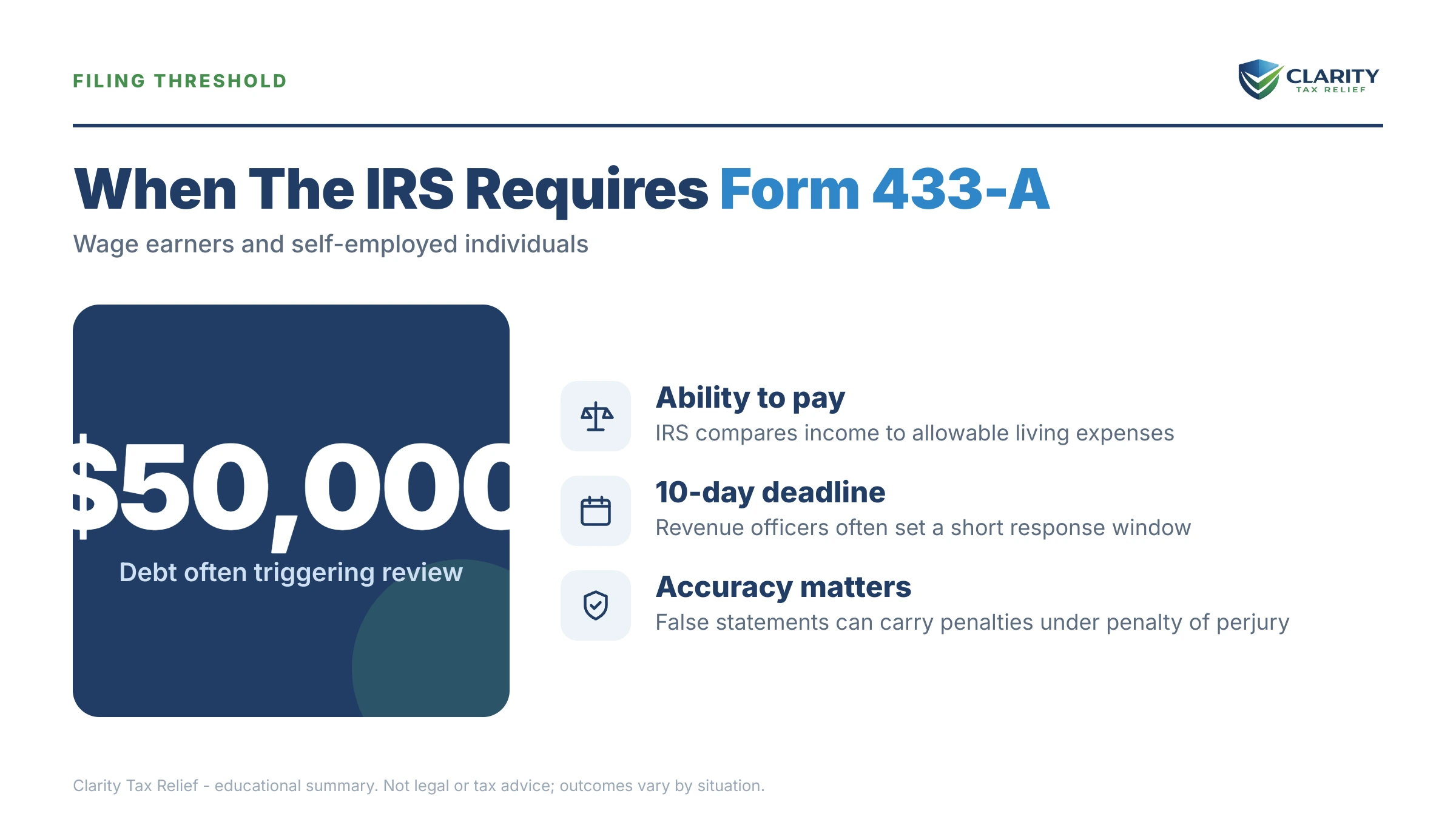
Not every IRS resolution requires financial disclosure — and the ones that don't are often cheaper and faster. If you owe $50,000 or less and can pay within 72 months, you can usually skip the Collection Information Statement entirely with a streamlined online agreement.
| Option | Typical eligibility | Financial statement needed? |
|---|---|---|
| Short-term payment plan | Any balance you can pay within 180 days; $0 setup fee | No |
| Streamlined installment agreement | Balance of $50,000 or less, paid within 72 months | No — set up online without disclosure |
| Non-streamlined installment agreement | Balance above $50,000, or terms outside streamlined limits | Yes — 433-F, or 433-A if a revenue officer is assigned |
| Partial payment installment agreement | Payment won't fully cover the debt before the 10-year collection deadline | Yes — full 433-A with substantiation, reviewed periodically |
| Currently Not Collectible | Allowable expenses equal or exceed income | Yes — 433-F for ACS cases, 433-A for field cases |
| Offer in Compromise | Reasonable Collection Potential below the balance owed | Yes — Form 433-A (OIC) filed with Form 656 |
Each row is its own strategy. A streamlined installment agreement trades a possibly-higher payment for zero disclosure. A partial payment installment agreement can legally leave part of the debt unpaid when the collection statute expires — but demands the most scrutinized 433-A of all, with follow-up reviews. Currently Not Collectible status pauses collection during genuine hardship, though penalties and interest keep accruing and refunds get kept. And once your balance crosses the streamlined line, our guide to an IRS payment plan over $50,000 explains what the financial review looks like at that level.
The Offer in Compromise deserves its own caution: the IRS accepted roughly 1 in 5 offers in FY2024, and acceptance turns entirely on the 433-A (OIC) math — not on how much hardship you feel. The Form 656 walkthrough covers the application itself; the financial statement is where offers are won or lost.
A worked example: $19,700, married filing jointly
Say you and your spouse owe $19,700 across two years of underwithholding, both of you on W-2 jobs. This is hypothetical, but the arithmetic is exactly what the IRS runs.
Path 1 — no 433-A at all. Your balance is under $50,000, so — as long as all your required returns are filed and you're not in default on a prior agreement — you can request a streamlined plan online. $19,700 ÷ 72 months ≈ $274 per month as the baseline (interest and the late-payment penalty continue accruing, so paying more than the minimum shortens the real payoff). No financial disclosure. No asset list. Set up in an afternoon.
Path 2 — a revenue officer demands the 433-A. Now the form's math controls. Suppose your combined gross monthly income is $7,400. Your allowable expenses under the IRS standards come to $6,850 — say $1,400 in tax withholding, $2,300 for housing and utilities at your county's cap, $1,700 under the national standard for food, clothing, and miscellaneous, $1,100 for two vehicles, and $350 for health costs. Disposable income: $7,400 − $6,850 = $550 per month. That's the payment the IRS will expect — roughly double the streamlined amount — and if the form shows $8,200 in savings, expect pressure to apply a chunk of it up front.
Path 3 — the hardship flip. Change one variable: one spouse's hours get cut and income drops to $6,600. Now allowable expenses exceed income by $250 a month. The same form that would have demanded $550 now supports Currently Not Collectible status — collection paused, no payment required, though the debt keeps growing and refunds are kept.
Path 4 — the offer check. Would an OIC work at the original numbers? Rough Reasonable Collection Potential: $550 × 12 = $6,600 in future income, plus $8,200 savings, plus about $4,500 in vehicle equity at quick-sale value ≈ $19,300 — nearly the full $19,700 owed. The IRS won't accept materially less than it can collect, so an offer here spends the $205 application fee and months of review to save almost nothing.
Same couple, same debt — four different outcomes, all decided by whether and how the Collection Information Statement gets filed. That's why you run the numbers first.
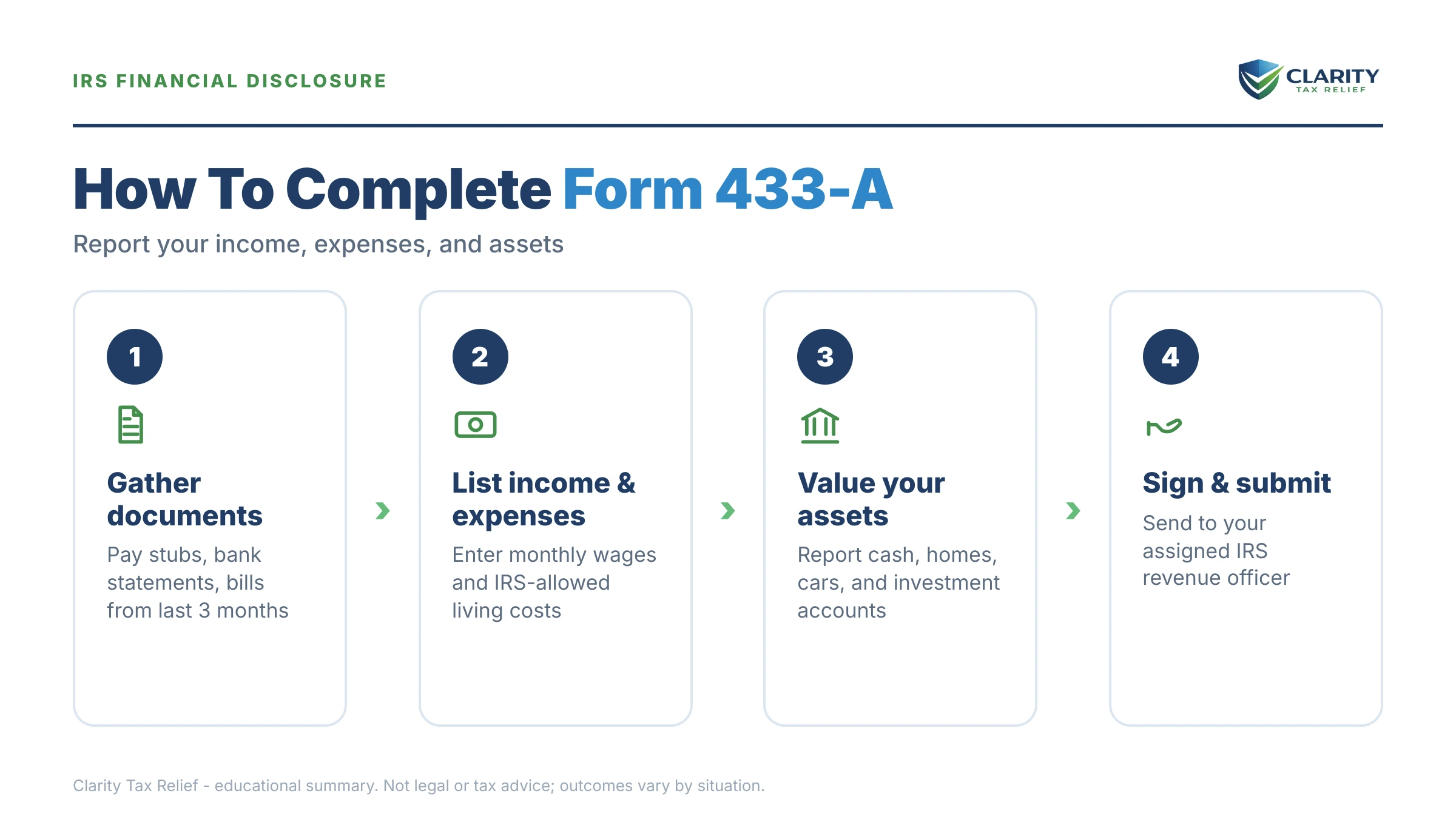
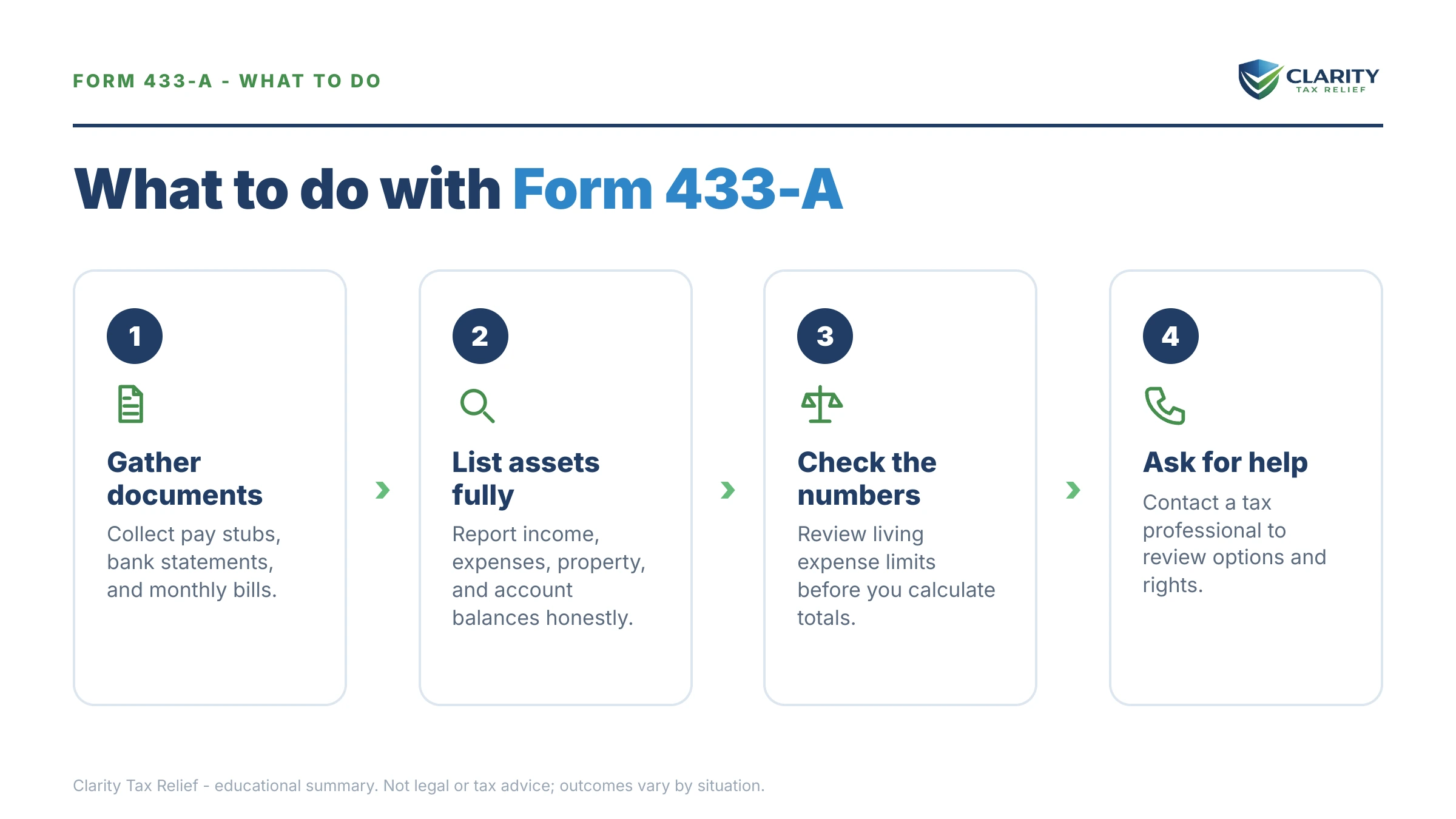
How to respond to a Form 433-A request, step by step
- Confirm which version the IRS wants — Reread the letter (or ask the revenue officer) whether the request is for Form 433-A, Form 433-F, or Form 433-A (OIC) — they are not interchangeable.
- Check whether you can avoid the form entirely — If you owe $50,000 or less, a streamlined payment plan may resolve the balance with no financial disclosure at all.
- Gather three months of documentation — Pull recent pay stubs, statements for every bank and investment account, and proof of your major monthly expenses.
- Run your numbers before the IRS does — Total your income and allowable expenses to see what payment, hardship status, or offer the form will support — before you sign anything.
- Complete every line, sign, and attach proof — Blank fields and missing substantiation stall cases; write "N/A" where a section genuinely doesn't apply.
- Submit by the response date and keep a full copy — Send it the way the requester specified, and keep the copy so any later update starts from the same numbers.
For the line-by-line detail — section by section, box by box — our full Form 433-A instructions walkthrough covers every entry, and the current form and official instructions are on the IRS's About Form 433-A page.
When you can handle Form 433-A yourself — and when help changes the outcome
Plenty of people can complete this form without paying anyone. If your balance is under $50,000, your first move shouldn't even be the 433-A — it should be checking whether a streamlined plan makes the form unnecessary. If a simple ACS case wants a 433-F, your income is one or two W-2s, and your expenses sit comfortably under the IRS standards, filling it out carefully yourself is a reasonable choice.
Experienced help changes the outcome in specific situations. When a revenue officer is assigned, every conversation and document goes into the case file — a Form 2848 power of attorney lets a professional handle that contact so you never answer a question cold. When your real expenses exceed the standards, someone who knows which exceptions the IRS actually grants — actual-expense categories, conditional-expense arguments, the full-pay exception — can be the difference between a $550 payment and a $300 one. When you're self-employed, Sections 6 and 7 expose accounts receivable the IRS can levy, and income averaging decisions cut both ways. And when the form doubles as an OIC or partial-pay application, small valuation choices move the result by thousands.
The most expensive 433-A mistake is submitting numbers you didn't test first — because once the IRS has your signed statement, every negotiation starts from it.
Terms on Form 433-A, decoded
- Collection Information Statement (CIS): the IRS's umbrella term for the Form 433 series — a sworn snapshot of your finances used to decide what you can pay.
- Allowable living expenses: the capped expense amounts the IRS permits, set by its published Collection Financial Standards rather than your actual spending.
- Monthly disposable income: gross income minus allowable expenses — the figure the IRS treats as your payment capacity.
- Quick sale value: the discounted value (typically around 80% of market value) the IRS assigns to assets when calculating the equity it could reach.
- Reasonable Collection Potential (RCP): asset equity plus a multiple of disposable income — the minimum the IRS will accept in an Offer in Compromise.
- Penalty of perjury declaration: the signature block making every statement on the form a sworn statement, with legal consequences for knowing falsehoods.
One state-specific note: these are federal rules. State agencies use their own financial statements with their own expense standards — California's FTB, for example, has its own form and applies its own collection rules under a 20-year collection statute, so never assume your IRS numbers transfer.
If your draft 433-A is showing more disposable income than your household can actually spare, have an experienced tax professional pressure-test it before you sign — that review is free, and it happens before the IRS ever sees a number.
Form 433-A questions, answered
What is Form 433-A used for?
Form 433-A is the Collection Information Statement the IRS uses to measure what you can pay toward a tax debt. Revenue officers and IRS specialists use it to set installment agreement amounts, approve or deny Currently Not Collectible status, and evaluate partial-payment plans. The numbers you report — income, expenses, and asset equity — become the basis for every collection decision on your account.
What is the difference between Form 433-A and Form 433-F?
Form 433-F is the short, two-page version used by the IRS's Automated Collection System when you resolve a balance by phone or in response to letters like the LT24. Form 433-A is the long version — six-plus pages with full asset detail — required by revenue officers and for partial-payment agreements. If a revenue officer is assigned to your case, expect the 433-A.
Do I need Form 433-A or Form 433-A (OIC) for an Offer in Compromise?
An Offer in Compromise requires Form 433-A (OIC), a separate version built around the offer formula, filed together with Form 656. The standard 433-A will not work for an offer. If you already completed a standard 433-A for a revenue officer, you still have to prepare the OIC version — though the underlying documents are largely the same.
Do I have to fill out Form 433-A to get an IRS payment plan?
Not always. If you owe $50,000 or less and can pay within 72 months, a streamlined installment agreement generally requires no financial statement at all — you can set it up online. Financial disclosure typically enters the picture above $50,000, when you ask for a payment lower than full-pay allows, or when a revenue officer is handling the case.
What documents do I need to attach to Form 433-A?
Expect to substantiate every major line: typically your most recent pay stubs, roughly three months of statements for every bank and investment account, proof of monthly expenses like mortgage or rent and insurance, and current statements for loans and retirement accounts. Self-employed filers also need a recent profit-and-loss statement. Missing documentation is a leading reason requests get rejected or delayed.
Can the IRS use my Form 433-A against me to levy?
Yes — the form lists your employer, bank accounts, and assets, which is exactly the information a levy requires. That is not a reason to refuse (refusal leads to summonses and enforcement anyway), but it is a reason to have a resolution strategy in place before you submit, so the account moves toward an agreement instead of enforcement.
What happens if I leave assets off Form 433-A?
Form 433-A is signed under penalty of perjury, so knowingly omitting assets or income is a serious matter — it can sink a payment plan or offer, and deliberate concealment can create criminal exposure. The IRS cross-checks your form against W-2s, 1099s, bank reporting, and property records. Honest presentation with correct valuations protects you; hiding things does not.
Does my spouse's income count on Form 433-A if only I owe the tax?
Household income and expenses generally go on the form even when only one spouse owes, because the IRS needs the full picture to figure out your share of shared expenses. When your spouse is not liable, the IRS generally prorates household expenses based on each spouse's share of income rather than taking your spouse's earnings for the debt. Community-property states can change this analysis.
What if my real expenses are higher than the IRS standards allow?
The IRS caps most living expenses at its Collection Financial Standards, but exceptions exist. Necessary expenses like court-ordered payments, health costs, and secured debt payments are generally allowed at actual amounts, and higher-than-standard expenses can sometimes be accepted when the debt will still be fully paid within the agreement period. Document everything and make the case explicitly — the IRS won't volunteer the exception.
Your next 24 hours
- Find your deadline. Pull out the letter (or your revenue officer's written request) and circle the response date. That single date controls everything else.
- Start the document pile. Gather your last three months of pay stubs and bank statements, your most recent tax return, and your major monthly bills — the same stack works whether you end up filing a 433-A, a 433-F, or nothing at all.
- Get the free review before you sign anything. Use the 2-minute form or call (888) 825-7779 and an experienced tax professional will run your numbers, tell you which version — if any — your case actually requires, and what payment the math supports, before the response date on your request passes.
If the balance behind the request grew from payment options you weren't shown, the IRS's own payment plans page lists the programs directly — the 433-A only enters the picture when those simpler routes don't fit.
This guide is general information, not tax or legal advice for your specific situation. Eligibility for IRS programs depends on individual facts and circumstances; no outcome is guaranteed.