
IRS Notices
IRS CP51A Notice: The IRS Computed Your Tax and You Owe (2026)
The short answer: a CP51A notice means the IRS calculated the tax on your Form 1040 — usually because you asked it to figure the tax for you — and its computation shows a balance due. Verify the math and the payments credited to your account, then pay or set up a payment arrangement by the date printed on the notice.
You handed the math to the IRS — your preparer suggested it, or the 1040 instructions said you qualified — and the answer came back as a bill. Between payroll runs and vendor invoices, a five-figure personal tax balance is the last number you needed this week. Here's the map: the computation is checkable, this is the earliest stage of collection, and every payment option is still open.
Before anything else, find two things on the letter: the IRS's computation summary and the pay-by date. The image below shows exactly what a CP51A looks like and where each of those sits on the page.
⏱ Your deadline: the "pay by" date printed on the front of your CP51A controls. Interest and the 0.5% monthly failure-to-pay penalty keep accruing after that date, and the IRS's automated collection stream queues the next notice in the sequence whether or not a human ever reviews your account.
Why you got a CP51A notice
A CP51A is issued when the IRS computes the tax on your Form 1040 and the result is a balance due. Three situations produce it:
- You elected to have the IRS figure your tax. The Form 1040 instructions let certain filers leave the tax-computation lines blank and have the IRS do the math — and, for some filers, figure certain credits too. The CP51A is the IRS reporting its answer.
- The IRS completed a computation your return required. If your return arrived without the computation finished, the IRS finishes it and bills or refunds the difference.
- The payments on record didn't cover the computed tax. The IRS applies whatever withholding and estimated payments are posted to your account. If a payment is missing or misapplied, the balance on the notice overstates what you actually owe — more on that below.
This is different from the math-error notices. A CP11 notice says the IRS corrected a mistake on your return and you owe; a CP12 notice says a correction changed your refund. A CP51A isn't framed as your mistake at all — it's the IRS finishing a computation. Functionally, though, you should treat all three the same way: verify before you pay. And if you're still working out why the IRS is writing to you at all, our guide to why you got a letter from the IRS maps every major notice family; this page covers only the CP51A.
One thing a CP51A is not: an audit. Nobody is questioning your deductions or asking for receipts. It's a bill built from a computation — and computations can be checked.
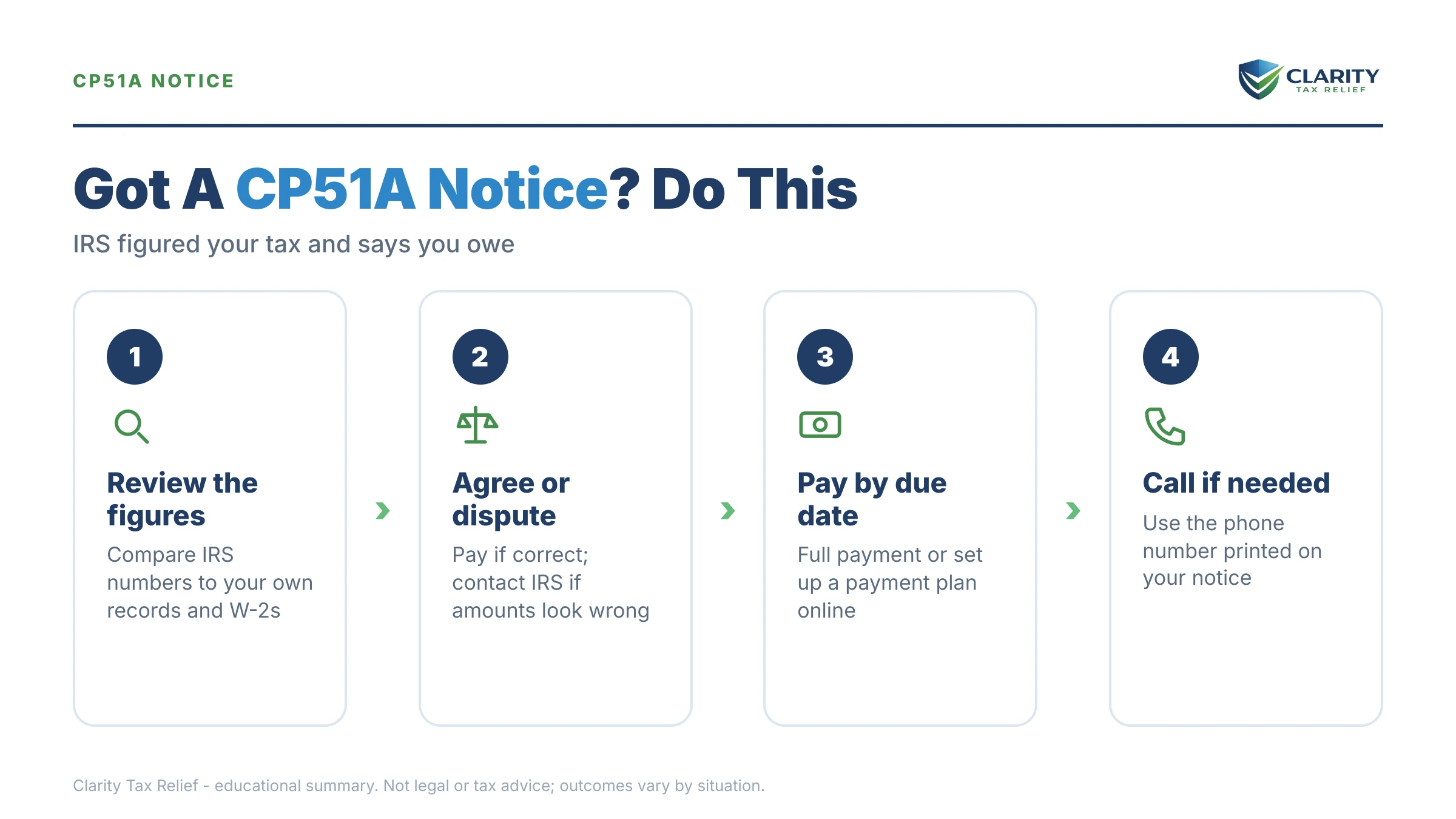
CP51A vs. CP51B vs. CP51C: which letter did you get?
The final letter in the CP51 series tells you the result of the IRS's computation: A means you owe, B means a refund, C means the account came out even. Only the A version puts a clock on you.
| Notice | What the IRS's computation found | What you need to do |
|---|---|---|
| CP51A | Balance due — the computed tax exceeds your payments and credits | Verify the math, then pay or arrange payment by the printed date |
| CP51B | Overpayment — the computation produced a refund | Verify the figures; no payment required |
| CP51C | Even — no balance due and no refund | Keep it with your tax records; no action needed |
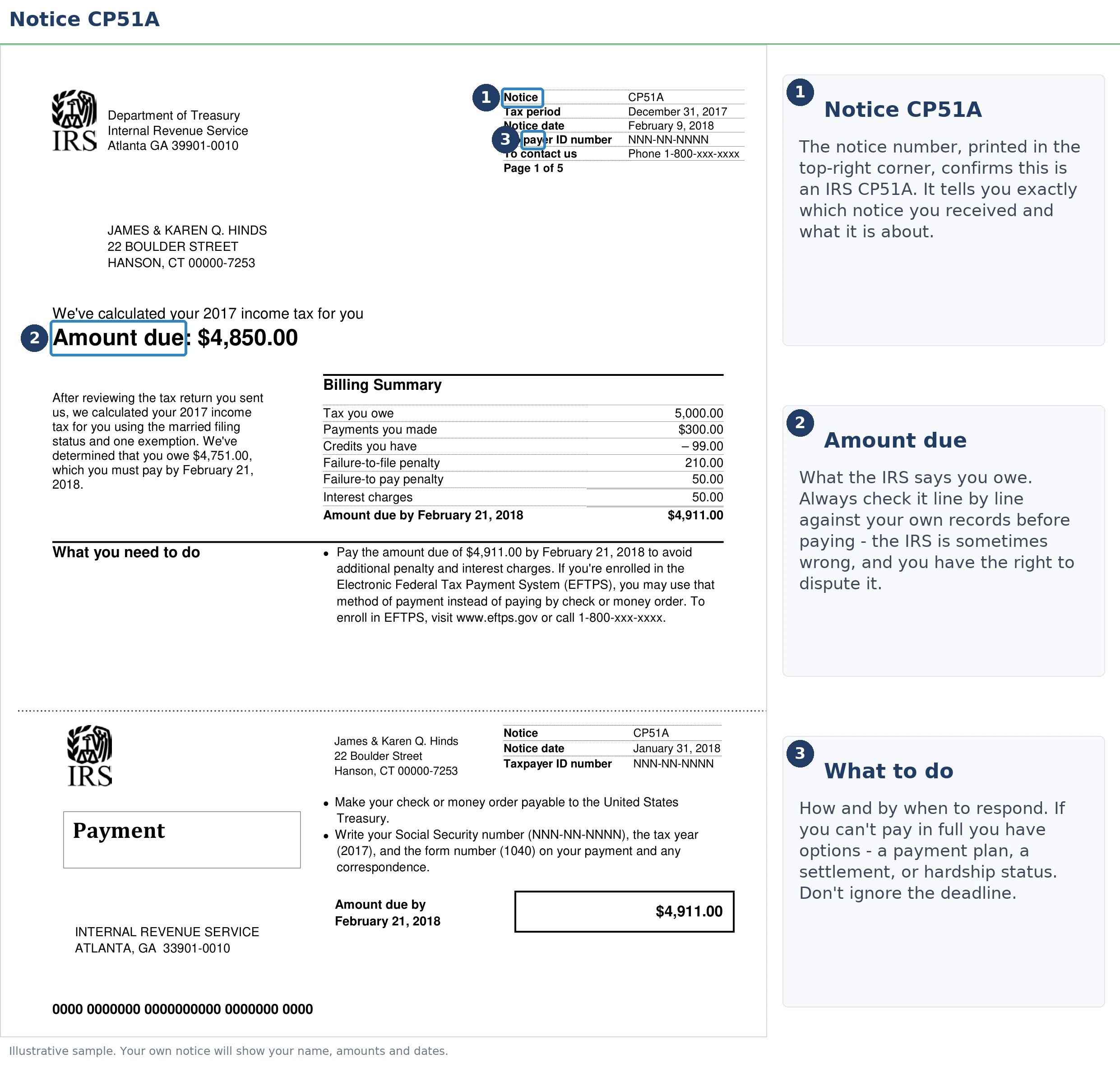
First: check the IRS's math before you pay
A CP51A balance is only as accurate as the payments posted to your account — misapplied estimated payments are the most common reason the number looks too high. Spend twenty minutes verifying before any money moves:
- Compare the notice to your filed return. Same tax year? Do the income, deduction, and credit figures match what you submitted? The notice breaks the balance into tax, penalties, and interest — check each piece.
- Pull your payment history in your IRS online account. Confirm every quarterly estimated payment and all withholding posted to the correct year.
- Business-owner trap: if you pay quarterlies from a business account, a payment can post under your EIN instead of your SSN — or land in the wrong tax year entirely. The CP51A computation won't see it, so the notice bills you for money you already sent.
- Check the credits. If the IRS figured your tax, confirm it applied every credit you're entitled to. A missed credit inflates the balance just like a missed payment.
If anything is off, call the toll-free number printed on the notice with your return and payment confirmations in hand. If you can't resolve it by phone, respond in writing with documentation and keep copies of everything. Don't pay a balance you don't owe on the theory the IRS will catch its own error later.
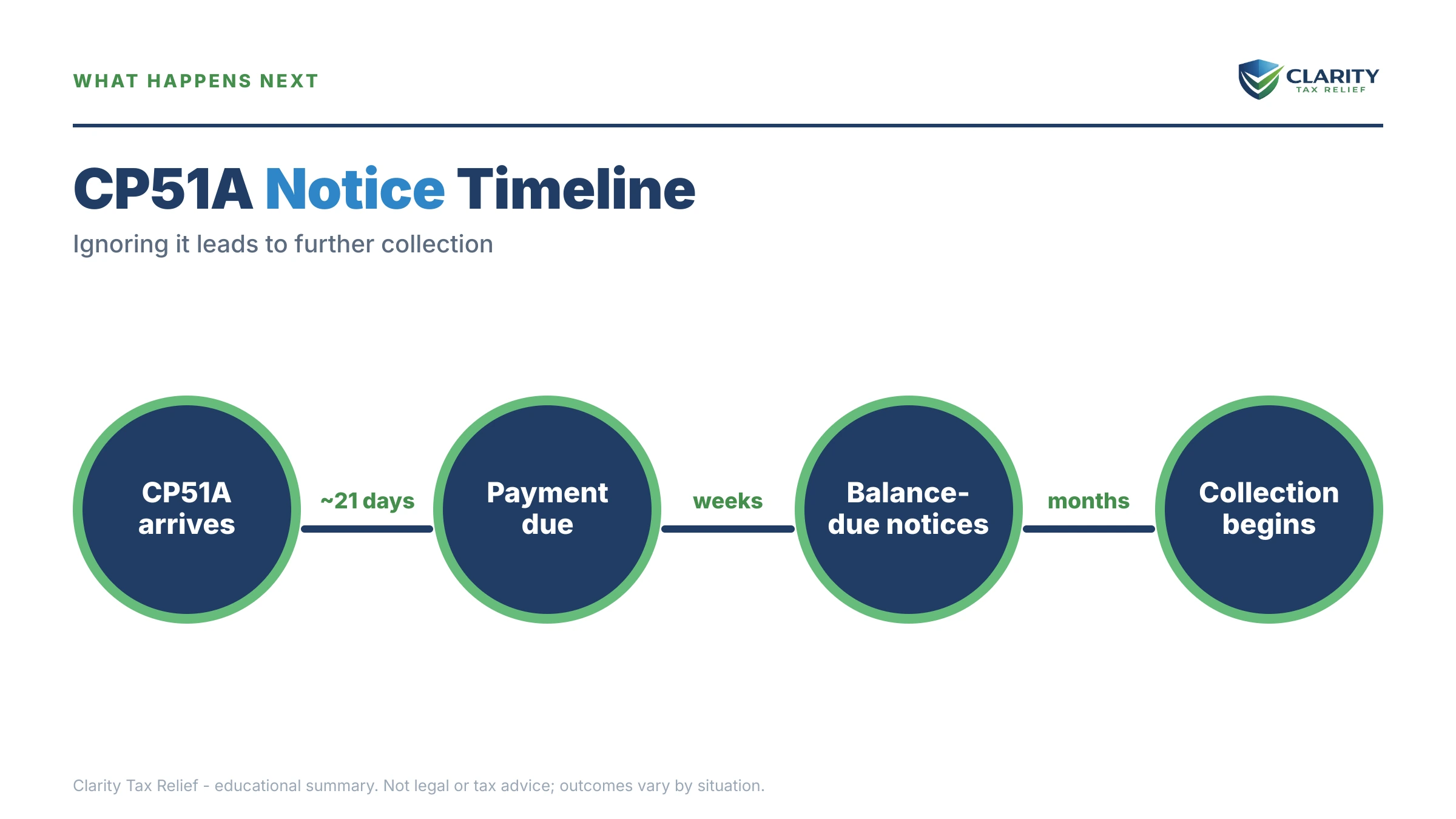
What happens if you ignore a CP51A
An unpaid CP51A feeds the same automated collection sequence as any IRS bill: reminders, then a levy warning, then a final notice with real enforcement power behind it. Nothing about the sequence requires a human decision — and with the IRS workforce down roughly 27% since 2025, the automated notices are often the only part of the agency still running on schedule.
- CP51A — the bill from the IRS's computation. You are here. No enforcement yet; every option is open.
- CP501 and CP503 — reminder notices. Still just bills, but interest and the failure-to-pay penalty compound the balance every month.
- CP504 — Notice of Intent to Levy under IRC §6331(d). The IRS can now seize your state tax refund, and a federal tax lien becomes a realistic threat. This is not the final notice, despite the alarming language.
- LT11 / Letter 1058 — Final Notice of Intent to Levy. This starts a 30-day clock and your Collection Due Process rights (requested on Form 12153). After the 30 days, the IRS can levy bank accounts and garnish wages.
At every stage the balance is bigger and the options are narrower. The CP51A stage — before any lien or levy authority exists — is the cheapest point in the entire sequence to resolve this.
Holding a CP51A right now?
Your CP51A prints a pay-by date on its front page — get the notice reviewed free before that date passes. An experienced tax professional will check the IRS's computation and your payment history, then map your options. A photo of the notice is enough to start. No pressure, no obligation.
Your CP51A payment options if you can't pay in full
Balances of $50,000 or less — including a $31,200 CP51A — generally qualify for an IRS installment agreement of up to 72 months, set up online without detailed financial disclosure. The notice itself presents two choices: pay or call. The real menu is longer.
| Option | Who qualifies | Cost and terms |
|---|---|---|
| Pay in full | Anyone | Stops the failure-to-pay penalty, interest accrual, and the notice sequence immediately |
| Short-term payment plan | Individuals who can pay within 180 days | $0 setup fee; interest and the 0.5%/month penalty continue until paid |
| Guaranteed installment agreement | Balance of $10,000 or less, recent compliance clean | Approval is required by statute if conditions are met; up to 36 months |
| Streamlined installment agreement | Balance of $50,000 or less | Up to 72 months, set up online; setup fee applies (lower with direct debit); accrual continues |
| Currently Not Collectible | Paying would prevent basic living expenses, shown through financial disclosure | Collection pauses; the debt and interest remain, and the IRS reviews your finances periodically |
| Offer in Compromise | Assets and future income genuinely can't cover the balance | $205 fee plus 20% down on a lump-sum offer (both waived with low-income certification); the IRS accepted roughly 1 in 5 offers in FY2024 |
| First-time penalty abatement | Clean compliance history for the prior 3 years | Can remove the failure-to-pay penalty; being replaced by the Automatic Exemption from Penalty (AEP) starting summer 2026, which applies with no request needed |
Two notes on that table. First, an Offer in Compromise is real but means-tested — the IRS runs the math on your assets and income, and most applicants don't qualify, so treat any pitch promising a settlement as a red flag. Second, penalty relief stacks with everything else: you can be on a payment plan and have the penalty removed.
A worked example: say your CP51A shows $31,200
Say you run a design-build company with a two-person payroll, you asked the IRS to figure your personal tax, and the CP51A shows $31,200. Here's how the decision actually runs — this is a hypothetical, not a client case:
- Check the payments first. If two $6,000 quarterlies posted under your EIN instead of your SSN, your real balance is $19,200 — a phone call with payment confirmations fixes that before you commit to any plan sized to the wrong number.
- Short-term plan: paying $31,200 within 180 days means roughly $5,200 a month for six months. No setup fee — realistic only if receivables are actually landing.
- Streamlined 72-month plan: $31,200 ÷ 72 ≈ $434 a month before accruals. But the 0.5% failure-to-pay penalty alone is about $156 in the first month, plus daily-compounding interest — so paying only the minimum stretches the true cost well past $31,200. Pay faster than the minimum whenever cash flow allows, and you can estimate how the accruals grow on your own numbers with our IRS penalty and interest calculator.
- Offer in Compromise: only in play if your assets and future income show the IRS could never collect $31,200 — unusual for an owner of an operating business with equity and receivables.
- The one hard rule: never cover a personal 1040 balance with money withheld from employee paychecks. Diverted payroll deposits create Trust Fund Recovery Penalty exposure — personal liability that is far harder to resolve than the CP51A you started with.
For a deeper look at strategy in this balance range, see our guide for people who owe the IRS $30,000.
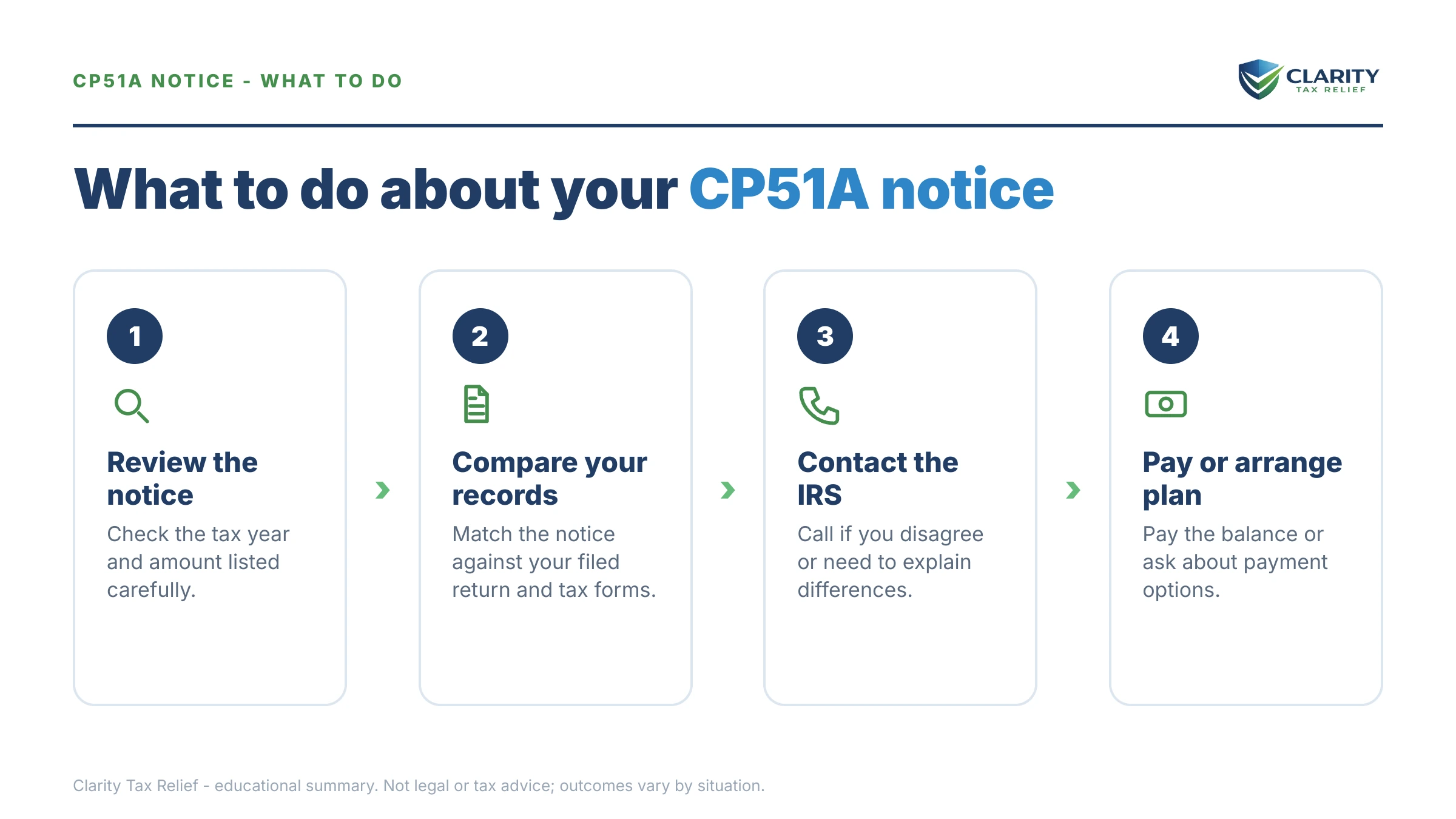
How to respond to a CP51A, step by step
- Compare the notice to your return — pull your filed Form 1040 and check the IRS's computation line by line against what you submitted — income, deductions, credits, and withholding.
- Verify your payments — log into your IRS online account and confirm every estimated payment and withholding amount was credited to the right tax year and the right ID number.
- Call if the math is wrong — use the toll-free number on the notice with your return and payment proof in hand, and ask the IRS to correct misapplied payments or missed credits.
- Pay or set up a plan by the pay-by date — if the balance is right, pay at IRS.gov/payments or set up a short-term plan or installment agreement before the printed deadline.
- Request penalty relief — if your compliance history is clean for the prior three years, ask about first-time abatement of the failure-to-pay penalty once the tax itself is resolved.
When you can handle a CP51A yourself — and when to get help
You can handle a CP51A on your own when you agree with the computation and the payment plan is simple. Specifically:
- The IRS's figures match your return, your payments all posted correctly, and you can pay in full or within 180 days.
- The balance is under $50,000, this is one tax year, and a streamlined plan set up online at IRS.gov payment plans fits your budget.
Experienced help changes outcomes in a narrower set of situations: the computation looks wrong and involves payments split across an EIN and SSN or multiple years; you owe for several years or have unfiled returns underneath this one; you're carrying payroll tax debt alongside the personal balance; you're weighing an Offer in Compromise, where the eligibility math decides everything; or the sequence has already moved past reminders to a CP504 or LT11. In those cases, the order you fix things in — returns first, then penalties, then the balance — changes what you ultimately pay, and a review before you commit to anything costs nothing: start with the two-minute form.
Terms on your CP51A, decoded
- IRS-figured tax: an option in the Form 1040 instructions letting eligible filers have the IRS compute their tax — and certain credits — instead of doing it themselves.
- Notice date vs. pay-by date: the notice date starts the clock; the pay-by date is what interest on the printed balance is computed to. Pay later and the payoff amount is recalculated upward.
- Failure-to-pay penalty: 0.5% of the unpaid tax per month, up to a 25% maximum — separate from interest and removable through abatement in the right circumstances.
- Statutory interest: interest the law requires on unpaid tax, set quarterly and compounding daily; it generally can't be waived just because you're on a plan.
- Assessment: the formal recording of the tax on the IRS's books — the event that starts the 10-year collection statute (CSED) on this balance.
CP51A questions, answered
What is a CP51A notice from the IRS?
A CP51A tells you the IRS computed the tax on your Form 1040 and the calculation left a balance due. It typically arrives after you asked the IRS to figure your tax for you, an option the Form 1040 instructions allow for certain filers. The notice shows the IRS's figures, any payments credited to your account, and the amount to pay by the printed date.
Is a CP51A notice serious?
It's a bill, not an enforcement action — nothing is being levied or garnished at this stage. But it starts the same collection sequence as any IRS balance due: ignore it and reminder notices follow, then intent-to-levy notices with real enforcement power. Interest and a monthly late-payment penalty accrue until the balance is resolved.
What is the difference between CP51A, CP51B, and CP51C?
All three report that the IRS computed the tax on your return; the letter tells you the result. CP51A means the computation shows you owe money. CP51B means it produced a refund, and CP51C means the account came out even or the change didn't affect your balance. Only the CP51A requires payment or a payment arrangement by the printed date.
What if I disagree with the amount on my CP51A?
Call the toll-free number printed on the notice and have your return, the notice, and proof of payments in front of you. Common errors include estimated payments applied to the wrong tax year or the wrong ID number, and credits the computation missed. If the IRS agrees, it corrects the account; if you still can't resolve it, respond in writing with documentation and keep copies.
What if I can't pay my CP51A balance in full?
Set up a payment arrangement before the pay-by date instead of ignoring the notice. A short-term plan gives up to 180 days with no setup fee, and balances of $50,000 or less generally qualify for a streamlined installment agreement of up to 72 months set up online. Hardship status and an Offer in Compromise exist for cases where the finances genuinely can't cover the debt.
Is a CP51A an audit?
No — an audit questions the accuracy of what you reported; a CP51A is the IRS completing a tax computation and billing the result. No one is examining your deductions or asking for receipts. That said, you should still verify the computation line by line, because notices in this series can miss payments or credits.
How long do I have to pay a CP51A notice?
Your deadline is the pay-by date printed on the notice — use that date, not a generic rule of thumb. Paying or arranging payment by then stops the notice sequence from escalating, though interest and the 0.5% monthly failure-to-pay penalty accrue until the balance is paid. If the date has already passed, act anyway; options only narrow as later notices arrive.
The IRS's own explainer for this notice is at Understanding your CP51A notice.
Your next 24 hours
- Find the pay-by date and the computation summary on the front of your CP51A — those two boxes are your deadline and the math you're checking.
- Gather three things: your filed Form 1040 for the year on the notice, confirmations for every estimated payment you made, and the notice itself.
- Get a free case review before the pay-by date passes — the 2-minute form or (888) 825-7779. Ten minutes now beats a CP501 in the mailbox next month.
This guide is general information, not tax or legal advice for your specific situation. Eligibility for IRS programs depends on individual facts and circumstances; no outcome is guaranteed.