
IRS Notices
CP3219A Statutory Notice of Deficiency: What It Means and Your 90-Day Deadline (2026)
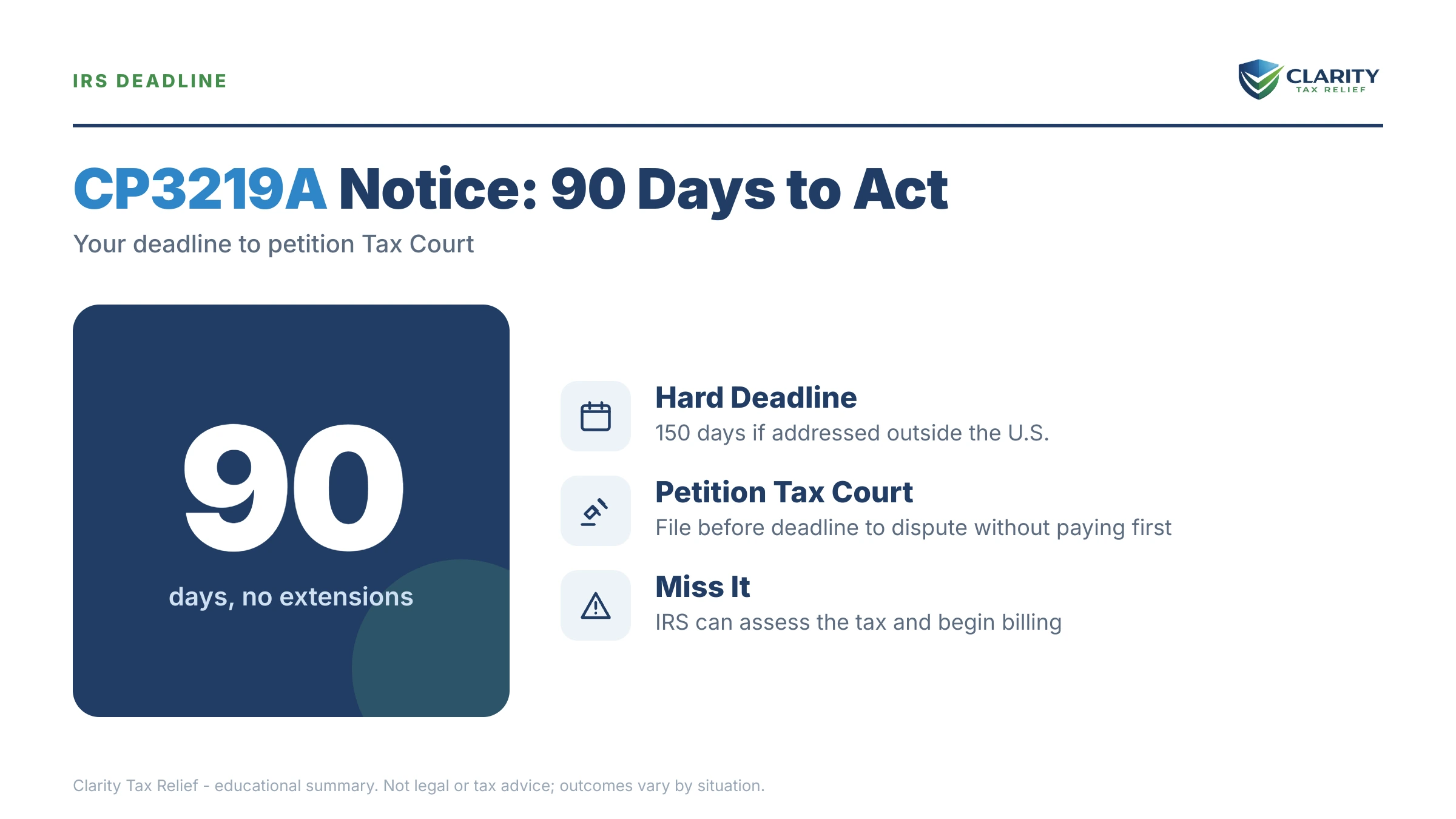
The short answer: a CP3219A statutory notice of deficiency is the IRS's formal, legal proposal to assess additional tax — and it starts a hard 90-day clock. You have 90 days from the date on the notice to petition the U.S. Tax Court. That deadline is set by law, and the IRS cannot extend it.
You signed for a certified envelope, and inside is a page headed "Notice of Deficiency" — with a dollar figure, a penalty, and the name of a federal court printed on it. That court reference isn't a threat. It's the strongest right you get in the entire IRS process: the chance to dispute this tax before paying a dime of it.
Unlike almost every other IRS letter, the CP3219A runs on one controlling date, not a vague "please respond." The image below shows exactly what a CP3219A looks like and where to find the date that decides everything else on this page.
⏱ Your deadline: you have 90 days from the date on a CP3219A to file a petition with the U.S. Tax Court — 150 days if the notice was addressed to you outside the United States. The exact last day to petition is printed on page one of your notice. The IRS has no authority to extend it.

Why you got a CP3219A statutory notice of deficiency
A CP3219A is issued when the IRS's records show income your tax return doesn't — most often after a CP2000 notice went unanswered or unresolved. The Automated Underreporter (AUR) system matched the W-2s, 1099s, and brokerage forms filed under your Social Security number against your return, proposed a change, got no resolution, and escalated to this formal notice.
That history matters. If you never saw the CP2000 — you moved, it went to an old address, it got lost in a stack of mail — the CP3219A may be the first you're hearing about any of this. The IRS only has to mail the notice to your last known address; it counts even if you never physically received it.
Inside the envelope you'll find the tax year, the proposed deficiency, any penalty (usually the 20% accuracy-related penalty), an explanation of each change, and Form 5564 — a waiver you sign only if you agree. The general reasons IRS letters go out are covered in our guide to why you got a letter from the IRS; what makes this one different is the court right attached to it.
Two close cousins are worth ruling out. If you never filed a return at all, the non-filer version is the CP3219N, built from a substitute return. If you just finished a full audit, the deficiency notice is typically Letter 531 notice of deficiency instead. All three carry the same 90-day Tax Court right.
Why the 90-day letter is different from every other IRS notice
A CP3219A is the only routine IRS notice that gives you the right to dispute a tax in court before paying it. While the 90 days run — and for as long as any Tax Court case stays open — the IRS is legally barred from assessing or collecting the proposed amount.
Compare that to a math-error correction like a CP11 notice, where the IRS changes your return and bills you immediately with no court window at all. Deficiency procedure is the exception, not the rule — which is exactly why letting it lapse is so costly.
Three mechanics trip people up, so get them straight now:
- The clock runs from the mailing date, not the day you opened it. A CP3219A that sat at your old address for three weeks did not gain you three weeks.
- Sending documents does not pause the clock. You can — and often should — mail proof to the IRS, but the petition deadline keeps running while they review it.
- If day 90 lands on a weekend or legal holiday, the deadline rolls to the next business day — but that's the only give in the schedule.
Worked example: how a $16,400 deficiency happens to a W-2 employee
Deficiency notices built by computer matching routinely overstate what you actually owe, because the IRS can only see gross amounts — not your cost basis or deductions. Here's a clearly hypothetical example of how that plays out.
Say you're single, earning $85,000 at a W-2 job. Two years ago you sold company shares through a brokerage; the 1099-B reported $52,000 in proceeds with no cost basis, and the sale never made it onto your return. The CP2000 went to an old apartment. Now a CP3219A arrives proposing:
- Additional tax on the full $52,000, treated as gain: roughly $12,600
- Accuracy-related penalty (20% of the understatement): $2,520
- Interest accrued since the original return's due date: roughly $1,280
- Total proposed: about $16,400
Here's the part the notice can't know: you paid $47,000 for those shares. Your real gain was $5,000, not $52,000. Documented correctly, the additional tax drops to roughly $1,100 — and because the understatement no longer clears the substantial-understatement threshold, the 20% penalty typically falls away with it. A $16,400 bill becomes something under $1,300 — in this hypothetical; your corrected bill depends entirely on what your records actually show, and if your documented basis is lower the remaining tax and penalty will be higher.
That swing is why "the IRS sent a formal legal notice" never means "the IRS is right." It means the IRS ran the math on incomplete data and the law now requires you to answer within 90 days. You can estimate how penalties and interest compound on any balance with our IRS Penalty & Interest Calculator.
What happens if you ignore a CP3219A
If you don't respond within 90 days, the IRS assesses the full proposed tax, penalty, and interest — and your file moves into the collection machine. The sequence from there is automated and runs in stages:
- Day 90 passes — your Tax Court right expires permanently. The IRS "defaults" the notice and assesses the deficiency exactly as proposed, wrong numbers included.
- A bill arrives — typically a CP14 notice or CP22E showing the assessed balance, with about 21 days to pay before reminders begin. The 0.5%-per-month failure-to-pay penalty now runs on top of interest.
- Reminder notices (CP501/CP503) — the balance grows monthly while the file works toward enforcement.
- CP504 — intent to levy — the IRS can seize your state tax refund after 30 days, and a federal tax lien becomes a live possibility.
- LT11 / Letter 1058 — final notice — after another 30-day window, the IRS gains levy authority over your wages and bank accounts. A wage levy is continuous until released; a bank levy holds funds for 21 days before they're gone.
One more door closes quietly: because you received a deficiency notice and had your chance to contest it, you generally cannot re-argue whether you owe the tax at a later collection hearing. The 90 days is the front door, and in 2026 — with IRS staffing down roughly 27% but the automated notice stream fully intact — nobody at the agency will chase you to use it.
| Stage | What happens | Your window |
|---|---|---|
| CP2000 / CP2501 proposal | IRS proposes changes from document matching | Typically 30 days to respond |
| CP3219A mailed | Formal deficiency; assessment legally barred | 90 days to petition (150 if abroad) |
| Day 91: default assessment | Full tax, penalty, and interest posted to your account | Tax Court right is gone |
| CP14 / CP22E bill | First bill on the assessed balance | About 21 days before reminders start |
| CP501 / CP503 reminders | Balance grows with interest and penalties | Weeks between notices |
| CP504 intent to levy | State tax refund can be seized; lien risk rises | 30 days |
| LT11 / Letter 1058 final notice | Wage and bank levy authority; CDP hearing rights | 30 days |
Holding a CP3219A with the clock running?
Send us a photo of it. An experienced tax professional will check the IRS's math, tell you whether signing, documenting, or petitioning is the cheaper path, and map your exact days remaining — free, before the 90-day petition deadline decides for you.
Your options during the 90 days
You have three paths while the window is open: agree and sign Form 5564, correct the record with documentation, or petition the U.S. Tax Court. They are not mutually exclusive — many people send documents and file a protective petition.
Path 1 — agree in full. If you've checked the notice against your own records and the IRS is completely right, sign and return Form 5564. The IRS assesses the balance, and you pay it or set up an IRS payment plan online — a short-term plan gives up to 180 days with no setup fee, and balances up to $50,000 can go on monthly plans as long as 72 months. Know what signing costs you: Form 5564 waives your Tax Court right for that amount. Never sign it just to make the letter stop.
Path 2 — disagree with documentation. If the notice is partly or fully wrong — missing basis, a 1099 that isn't yours, income already reported elsewhere on the return — send a written explanation with proof to the address on the notice, the same way you would when disagreeing with a CP2000. The IRS can revise the deficiency or, by mutual written agreement, rescind the notice entirely. But treat any promise as unofficial until you have it in writing: the petition deadline stands unless the notice is formally rescinded or corrected.
Path 3 — petition the Tax Court. The filing fee is $60 (waivable for hardship), the petition can be filed electronically through the Tax Court's website, and disputes of $50,000 or less per year qualify for the informal small-tax-case procedure built for self-represented people. Filing keeps the assessment bar in place, and in practice most petitioned cases are routed to IRS Appeals and settle without anyone seeing a courtroom. Our guide to the 90 day letter and Tax Court petition walks through the filing itself.
| Path | How you do it | Cost / what it protects |
|---|---|---|
| Agree in full | Sign and return Form 5564; pay or arrange a plan | Free; ends penalties from disputing — but waives Tax Court rights |
| Disagree with documentation | Send written proof to the address on the notice | Free; IRS may revise or rescind — the 90-day clock keeps running |
| Petition the U.S. Tax Court | File by day 90 (day 150 if abroad), online or by mail | $60 fee (waivable); assessment stays barred; S-case rules if ≤ $50,000 per year |
How to respond to a CP3219A, step by step
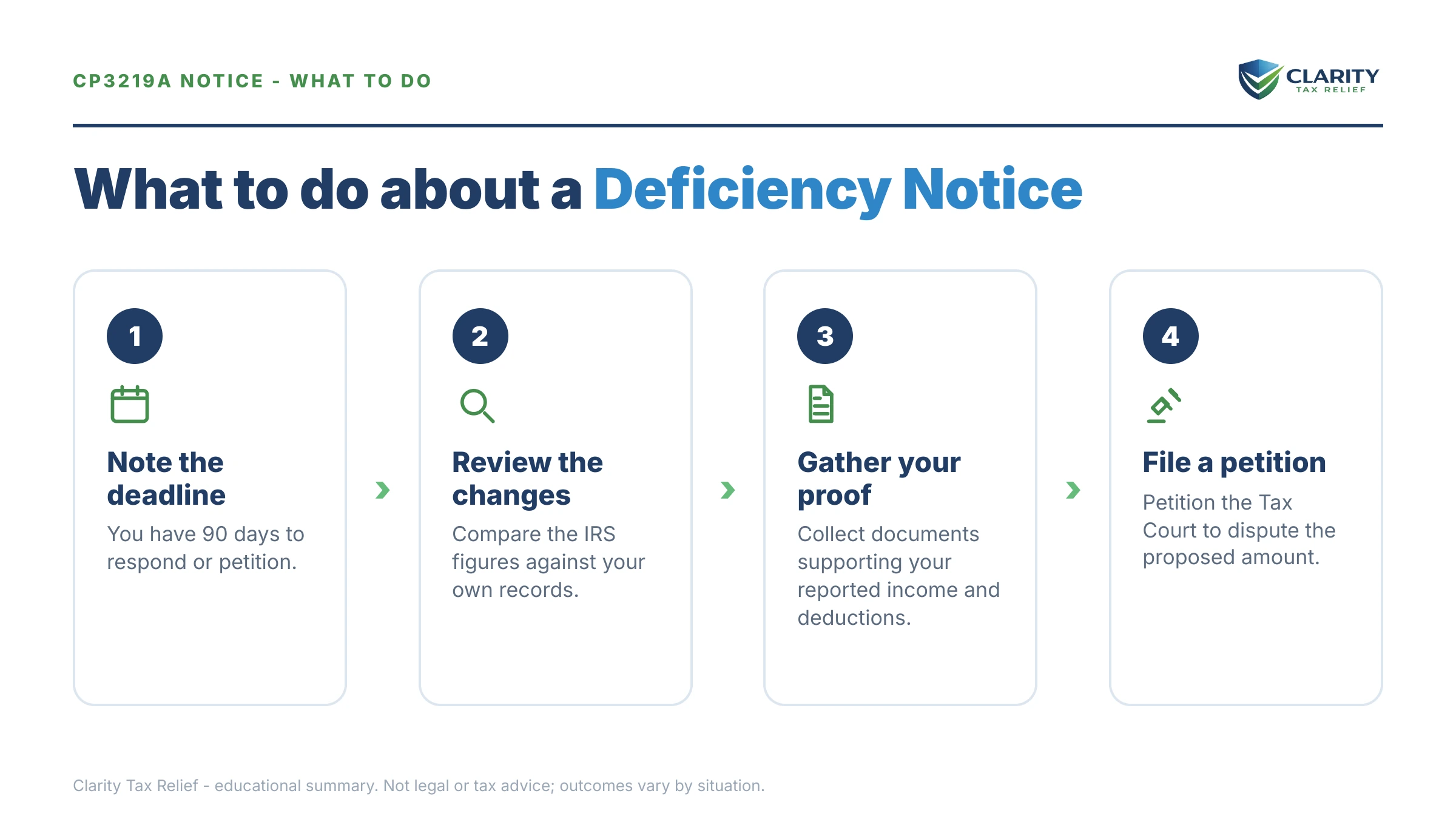
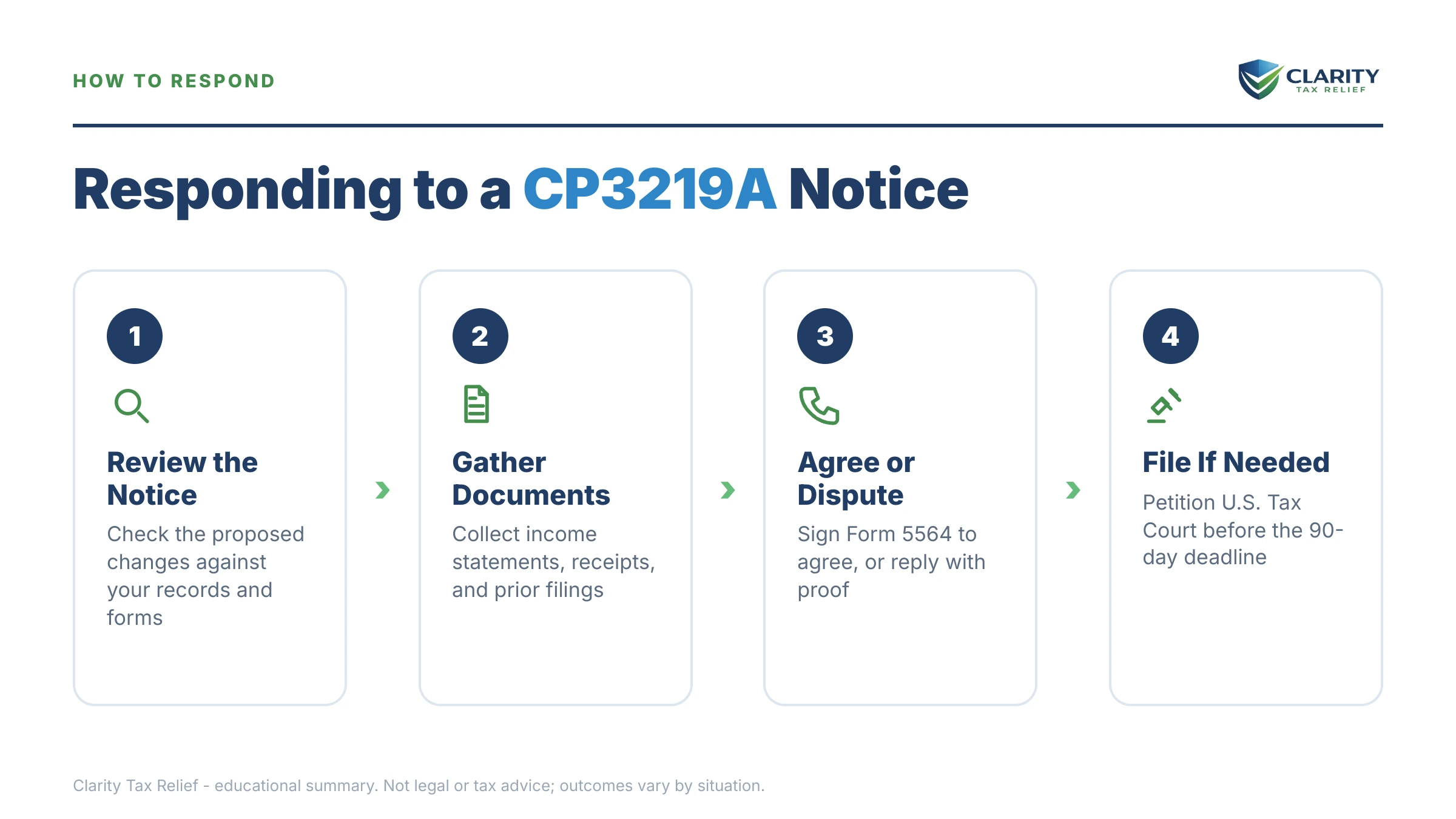
- Find your petition deadline. Locate the last day to file a petition with the United States Tax Court printed on page one of the notice and calendar it in more than one place.
- Pull the records for that tax year. Gather the return you filed, every W-2 and 1099 you received, and any basis, expense, or payment records that explain the mismatch.
- Check the IRS's math line by line. Compare each item in the notice's explanation of changes against your documents — deficiencies built by computer matching are frequently overstated.
- Pick your path. Sign and return Form 5564 only if the notice is fully correct; send documentation to the address on the notice if any part is wrong.
- File a Tax Court petition before day 90 if any dispute remains. Documentation does not pause the clock — the $60 petition is the only step that preserves your right to dispute the tax before paying it.
- Resolve any balance you genuinely owe. Pay at IRS.gov/payments or set up a payment plan once the correct amount is assessed, so penalties and interest stop growing on the rest.
Petitions are filed with the court itself, not the IRS — see the U.S. Tax Court's website for the electronic filing system and forms. A petition mailed on time counts as filed on time, so keep your certified-mail receipt.
What if the 90 days already passed
Missing the 90-day deadline ends your Tax Court rights, but it does not end your options — an assessed deficiency can still be corrected or resolved. The tools just change, and each has narrower conditions:
- Audit reconsideration — you ask the IRS to re-examine the assessment using documents it never considered, like the missing cost basis in the example above. It's free and works well for AUR-generated assessments, but it's discretionary, and collection can continue while it's reviewed unless you request a hold.
- Offer in compromise based on doubt as to liability — filed on Form 656-L with no application fee, this argues the assessed amount itself is wrong, not that you can't pay it. It's a genuine dispute channel, not a discount program.
- Pay, then claim a refund — pay the disputed amount and file Form 1040-X (or a formal refund claim) to get it back. This preserves a court path through the refund process, but strict refund deadlines apply, so don't sit on it.
- Collection alternatives — if the number is right but unaffordable: an installment agreement, Currently Not Collectible status for genuine hardship, or — where your assets and income truly can't cover the debt — a collectibility-based offer in compromise. Eligibility for each is means-tested on your actual finances.
| Option | When it fits | Cost / key limit |
|---|---|---|
| Audit reconsideration | You have documents the IRS never considered | Free; discretionary; collection may continue during review |
| OIC — doubt as to liability (Form 656-L) | You dispute that the assessed amount is correct | No application fee; requires a written basis for the dispute |
| Pay and claim a refund (Form 1040-X) | You can pay now and want the dispute preserved | Payment required first; strict refund deadlines apply |
| Installment agreement | The amount is right but you can't pay at once | Up to 72 months online for balances ≤ $50,000; interest continues |
| Currently Not Collectible | Any payment would create genuine hardship | Free; collection pauses but the debt and interest remain |
When you can handle a CP3219A yourself
Many CP3219A cases are simple enough to resolve without professional help — the small-tax-case procedure exists precisely for self-represented taxpayers. You can likely go it alone if:
- You checked the notice and the IRS is right, and you can pay in full or within 180 days — sign Form 5564 and pay or set up the short-term plan yourself.
- The fix is one clean document — a 1099 that belongs to someone else, income already reported on another line, or a single basis statement — and you have weeks of runway left on the clock.
- The disputed amount is small and you're comfortable filing a $60 S-case petition on your own as a backstop.
Experienced help tends to change the outcome when the deficiency is large or spans multiple years, when the income involves self-employment or business records that need reconstructing, when the accuracy-related penalty is worth contesting on its own, when the deadline is days away — or when it already passed and you're choosing between reconsideration, a liability offer, and a refund claim. Those paths have different odds and different sequencing, and picking the wrong one first can foreclose the better one.
If your deficiency runs into five figures or your petition date is close, a free CP3219A review at the 2-minute form or (888) 825-7779 can tell you in one call which path is cheapest before day 90 makes the choice for you.
Terms on your CP3219A, decoded
- Deficiency — the gap between the tax the IRS says you owe for the year and the tax shown on your return.
- Statutory notice / 90-day letter — nicknames for this same document; "statutory" because federal law (IRC §6212) requires it before the IRS can assess most additional tax.
- Petition — the short filing that opens a Tax Court case and legally blocks assessment while the case is pending.
- Form 5564 — the waiver enclosed with the notice; signing it agrees to the deficiency and lets the IRS assess immediately.
- Assessment — the formal recording of a tax debt on your IRS account; collection can only begin after it.
- Last known address — the address on your most recent return or update; a notice mailed there is legally valid even if you never received it.
The IRS's own plain-language page on this notice is at Understanding your CP3219A notice.
CP3219A questions, answered
What is a CP3219A statutory notice of deficiency?
It's the IRS's formal legal determination that you owe additional tax for a specific year, usually issued after a CP2000 went unanswered or unresolved. It is sometimes called the 90-day letter because it opens a 90-day window to petition the U.S. Tax Court before the IRS can assess the tax. It arrives by certified mail and includes the proposed amount, any penalty, and Form 5564.
Can I get an extension on the 90-day deadline?
No. The 90-day window is set by statute, and the IRS has no authority to extend it — not even if you're actively mailing them documents. The only built-in exception is the 150-day window for taxpayers whose notice was addressed to them outside the United States. If the 90th day falls on a weekend or legal holiday, the deadline moves to the next business day.
Do I have to go to Tax Court if I get a CP3219A?
No. Most CP3219A cases resolve without a trial: you can sign Form 5564 if the IRS is right, or send documentation if it's wrong and the IRS may revise the notice. But filing a petition is the only action that legally preserves your right to dispute the tax before paying it — and most petitioned cases settle with IRS Appeals long before a courtroom.
What happens if I ignore a CP3219A?
After day 90, the IRS assesses the full proposed tax, penalty, and interest, and your file moves to collections. You'll receive a bill (typically a CP14 or CP22E), then escalating notices ending in levy authority over wages and bank accounts. You also permanently lose the right to dispute the tax in Tax Court before paying it.
Does sending documents to the IRS stop the 90-day clock?
No — this is the most expensive misunderstanding about the CP3219A. You can and should send documentation if the notice is wrong, but the petition deadline keeps running while the IRS reviews it. If day 90 is approaching and you haven't received a corrected or rescinded notice in writing, file the Tax Court petition to protect your rights.
How much does it cost to petition the U.S. Tax Court?
The filing fee is $60, and you can request a waiver if you can't afford it. Disputes of $50,000 or less per tax year qualify for the simplified small tax case (S case) procedure, which uses informal rules designed for people representing themselves. You can file the petition electronically through the Tax Court's website.
What is Form 5564 and should I sign it?
Form 5564 is the waiver included with your CP3219A. Signing it means you agree with the full deficiency and allow the IRS to assess it immediately — and you give up your right to Tax Court for that amount. Sign it only if you've checked the math against your own records and the IRS is completely right. If any part is wrong, don't sign; respond with documentation or petition instead.
Is a CP3219A an audit?
Not usually. Most CP3219A notices come from the Automated Underreporter program, which matches W-2s and 1099s against your return by computer — no human examined your books. A deficiency notice issued after a full audit is typically Letter 531 instead. The distinction matters because document-matching errors, like missing cost basis, are often easy to correct.
Can I set up a payment plan after a CP3219A?
Yes. If you agree with the tax, you can sign Form 5564 and set up an installment agreement once the balance is assessed — online for balances up to $50,000, spread over as long as 72 months. Interest and the late-payment penalty continue to accrue on any unpaid balance, so pay what you can up front.
What's the difference between CP3219A and CP3219N?
Both are statutory notices of deficiency with the same 90-day Tax Court deadline. A CP3219A is issued when you filed a return and the IRS proposes changes to it; a CP3219N is issued when you never filed and the IRS built a substitute return from third-party records. The CP3219N response often includes filing your own return, which usually lowers the bill.
Your next 24 hours
- Find the controlling date. Locate the "last day to file a petition with the United States Tax Court" printed on page one of your CP3219A and write it down in at least two places you'll see.
- Gather your proof. Pull the return for that year, every W-2 and 1099 you received, and any brokerage, basis, or expense records that explain the income the IRS says is missing.
- Get the notice reviewed free before that date. Use the 2-minute form or call (888) 825-7779 — a wrong deficiency is far cheaper to fix inside the 90-day window than after it becomes an assessed, collectible debt.
This guide is general information, not tax or legal advice for your specific situation. Eligibility for IRS programs depends on individual facts and circumstances; no outcome is guaranteed.