
IRS Notices
IRS CP21E Notice: Audit Changes and a Balance Due — What to Do in 2026
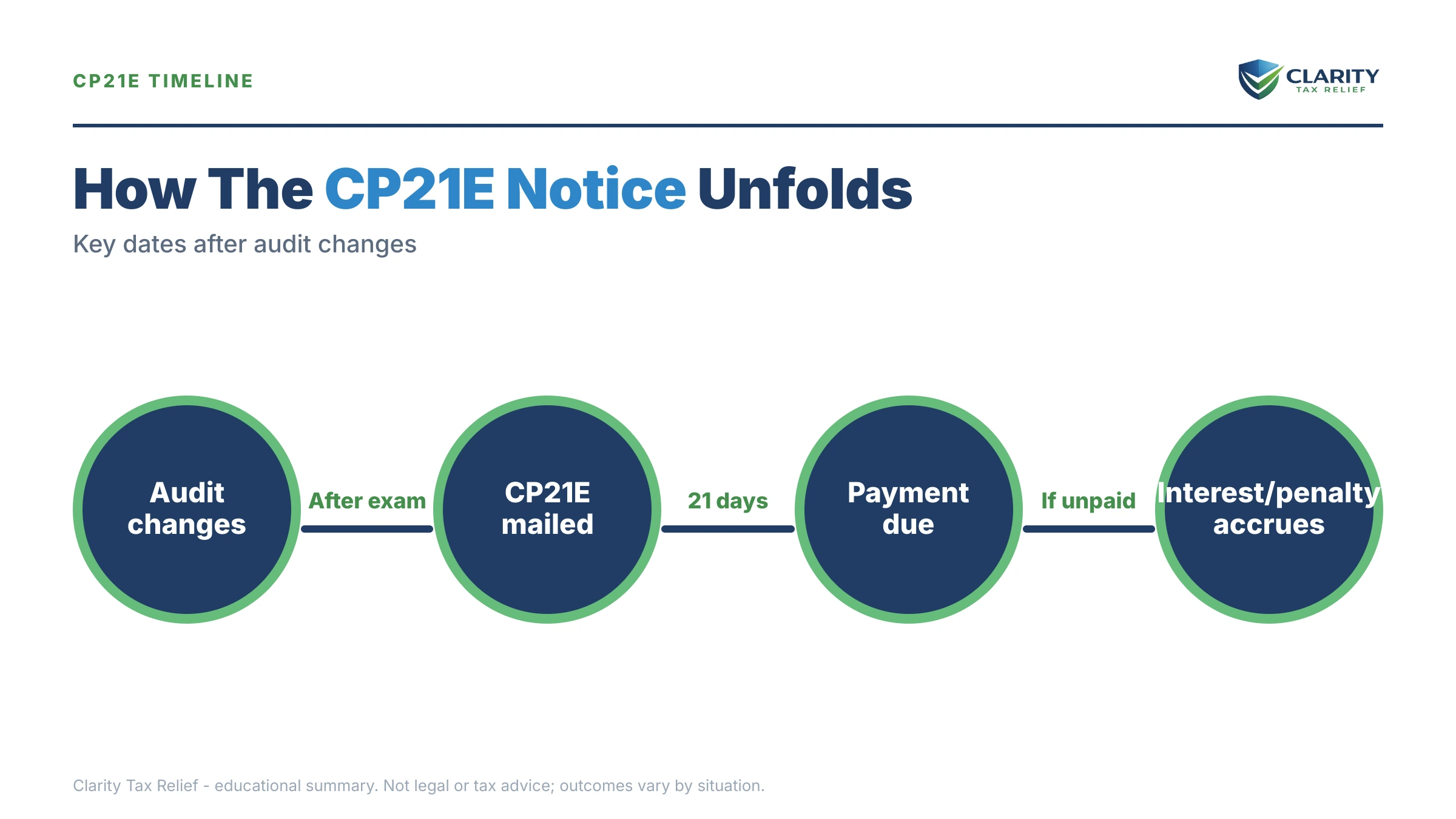
The short answer: a CP21E notice means the IRS changed your tax return after an audit and you now owe the total printed on the notice — additional tax, penalties, and interest combined. The debt is already assessed, so pay or set up a payment arrangement by the notice's pay-by date, typically about three weeks out.
The audit itself ended weeks or months ago. You signed the examiner's report — or the window to fight it quietly expired — and you assumed the hard part was over. Then the CP21E arrived: the actual bill, with penalties layered on and interest backdated to the year the return was originally due. If you're also trying to close on a refinance, the timing feels like a punch. It's fixable, and the order you act in matters more than the amount.
The image below shows exactly what a CP21E looks like and where to find the two numbers that control everything — the pay-by date and the penalty-and-interest breakdown.
⏱ Your deadline: the pay-by date printed on your CP21E — typically about 21 days from the notice date. After that date, interest keeps compounding daily, the 0.5% monthly failure-to-pay penalty keeps running, and the IRS's automated system queues the next notice in the collection sequence.
Why you got a CP21E notice
A CP21E notice means the IRS finished an audit of your return, made changes, and formally assessed additional tax you now owe. It reaches your mailbox by one of two roads:
- You agreed with the audit results — you signed the examination report (Form 4549) or otherwise consented to the changes, and the CP21E is the bill that follows the paperwork.
- The audit closed without you — you never responded to the examiner's letters or to the Notice of Deficiency, the 90-day window to petition Tax Court passed, and the IRS assessed the changes by default.
Which road you took matters enormously, because it decides whether your best move is paying or disputing. The total on the notice is almost always larger than the figure on your audit report, for two reasons: interest runs from the original due date of the audited return — not from when the audit ended — and the examiner may have added penalties, most commonly the 20% accuracy-related penalty for negligence or a substantial understatement. If you want to see how much of your balance is penalty and interest rather than tax, you can estimate it with our Penalty & Interest Calculator.
One thing a CP21E is not: a routine correction. If you're wondering why the IRS sends letters at all and how to triage them, our guide to why did I get a letter from the IRS covers the whole landscape. This page is about the audit-bill variant specifically.
CP21E vs CP22E, CP21A, and CP11: which changes notice do you have?
The IRS uses different notice numbers for different kinds of return changes, and the fix is different for each. Check the top-right corner of your letter:
A CP22E notice is the closest twin — it also bills you for audit changes, and the difference between the two is mostly which internal processing path the adjustment took. Respond to both the same way. A CP21A notice bills you for changes you requested, usually from an amended return — no audit involved. A CP11 notice is a math-error correction with a balance due, and a CP12 notice is a math-error correction that changed your refund. Math-error notices can often be reversed with a single phone call or letter; a CP21E cannot, because an examiner already reviewed the return and the tax is assessed.
What happens if you ignore a CP21E
An unpaid CP21E enters the same automated collection stream as any other assessed IRS balance, and that stream ends in levy power. The sequence is machine-driven — in 2026, with the IRS workforce down roughly 27% from 2025 cuts, humans are harder to reach than ever, but the notice-and-levy automation never stopped running. Here is the order of what arrives:
- CP21E — the audit bill. You are here. No enforcement yet, but penalties and interest are accruing monthly.
- CP501 / CP503 — reminder bills. Still just paper, but each one arrives with a bigger total.
- CP504 — Notice of Intent to Levy. The IRS can now seize your state tax refund under IRC §6331(d), and a Notice of Federal Tax Lien becomes a realistic next move — not a scare line.
- LT11 / Letter 1058 — Final Notice of Intent to Levy. A 30-day clock starts on your Collection Due Process rights. After it runs, wages and bank accounts are levy-eligible.
| Notice stage | Response window | What you lose if it passes |
|---|---|---|
| CP21E (audit bill) | Pay-by date on the notice — typically ~21 days | The cheapest resolution window, before more penalties and lien risk |
| CP501 / CP503 (reminders) | Date printed on each notice | Nothing formal yet — but the balance grows monthly and lien odds rise |
| CP504 (intent to levy) | 30 days | Your state tax refund — seizable under IRC §6331(d) |
| LT11 / Letter 1058 (final notice) | 30 days | Your Collection Due Process hearing rights (Form 12153); wages and bank accounts become levy-eligible |
For a homeowner, the lien is the stage that hurts most. Once a Notice of Federal Tax Lien is recorded, it attaches to your house, shows up in every title search, and turns a routine refinance into a negotiation — see our guide on refinancing with an IRS lien. Acting at the CP21E stage is how you keep the lien from ever existing.
Holding a CP21E right now?
Send us a photo of it before the pay-by date passes. An experienced tax professional will check whether the assessment matches your audit report, whether the penalties can be challenged, and which payment path protects your finances — free, confidential, no pressure.
Can't pay the CP21E amount? Your real options
Balances under $50,000 — including audit assessments in the low five figures — generally qualify for a streamlined payment plan of up to 72 months with no detailed financial disclosure. The notice presents two choices, pay or else; the IRS actually runs several programs, and which fits depends on your balance and your finances:
| Audit balance | Realistic options | What to know |
|---|---|---|
| Under $10,000 | Full pay, 180-day short-term plan, guaranteed installment agreement | The guaranteed installment agreement is essentially automatic if your returns are filed and you can pay within 3 years |
| $10,000 – $25,000 | Streamlined installment agreement, up to 72 months | Online setup, no financial statement; a lien filing is generally avoidable |
| $25,001 – $50,000 | Streamlined agreement — direct debit required | On direct debit, the IRS typically does not file a Notice of Federal Tax Lien — critical before a refinance |
| Over $50,000 | Non-streamlined agreement (Form 433-F financials), Offer in Compromise, Currently Not Collectible | Financial disclosure required; once unpaid debt passes $66,000 in 2026, passport certification becomes possible |
Beyond payment plans, three more levers exist. Penalty relief: the failure-to-pay penalty may qualify for first-time abatement if your prior three years were clean — and starting summer 2026, the new Automatic Exemption from Penalty (AEP) applies that relief automatically, no request needed. The accuracy-related penalty is different: it requires a reasonable-cause showing, and it's often the most contestable dollar on the notice. Hardship: if paying anything would leave you unable to cover necessary living expenses, Currently Not Collectible status pauses collection while the debt sits (and interest continues). Settlement: an Offer in Compromise can resolve the debt for less than the balance, but only when the IRS's own math shows your income and assets can't cover it — the application fee is $205 (waived with low-income certification), and the IRS accepted roughly 1 in 5 offers in FY2024. It's a genuine program, not a shortcut.
If you don't agree with the audit changes
A CP21E is assessed tax, so ordinary "I disagree" letters won't undo it — but three real dispute paths remain. Audit reconsideration asks the IRS to re-open the exam, and it's built for people who never participated in the audit or who have documents the examiner never saw. An Offer in Compromise based on doubt as to liability (Form 656-L) disputes whether you legally owe the amount at all, with no fee and no financial disclosure. Or you can pay the balance and file a claim for refund, which preserves your right to fight in court. None of these pause interest, so start whichever fits immediately.
One edge case worth naming: if the audited return was a joint return, both spouses are fully liable for the CP21E balance — even after a divorce. When the audit adjustments trace entirely to one spouse's income or deductions, innocent spouse relief may separate the liability, but it must be requested; it never happens automatically.
Worked example: a $31,200 audit bill four months before a refinance
Say you owe $31,200 on a CP21E and you're planning a cash-out refinance in about four months. Two paths, with the math shown:
Path A — set up a direct-debit streamlined agreement this week. At $31,200, direct debit is required (you're in the $25,001–$50,000 band). The minimum payment is roughly $31,200 ÷ 72 = about $434 per month. Once the agreement is approved, the failure-to-pay penalty rate is cut in half — from 0.5% to 0.25% per month, about $78 instead of $156 on this balance — while interest continues compounding daily at the federal rate, which adjusts quarterly. Because you're on a streamlined direct-debit plan, the IRS typically does not file a lien, so your title search stays clean. At closing, you pay the remaining balance from proceeds — there's no prepayment penalty; the plan simply ends.
Path B — wait for the refinance money and ignore the notices. Four months of the full 0.5% penalty adds about $31,200 × 0.005 × 4 = $624, plus several hundred dollars more in daily-compounding interest. Worse, four months of silence likely puts you at the CP504 stage, where a Notice of Federal Tax Lien becomes a real possibility. If a lien records before closing, the refinance stalls until you obtain a lien subordination via Form 14134 — a certificate process that takes weeks and requires your lender's cooperation.
Path A costs a few payments of $434 and protects the closing. Path B risks the entire deal to save four months of payments. This is a hypothetical illustration — your numbers will differ — but the structure of the decision is the same for most homeowners holding this notice.
How to respond to a CP21E, step by step
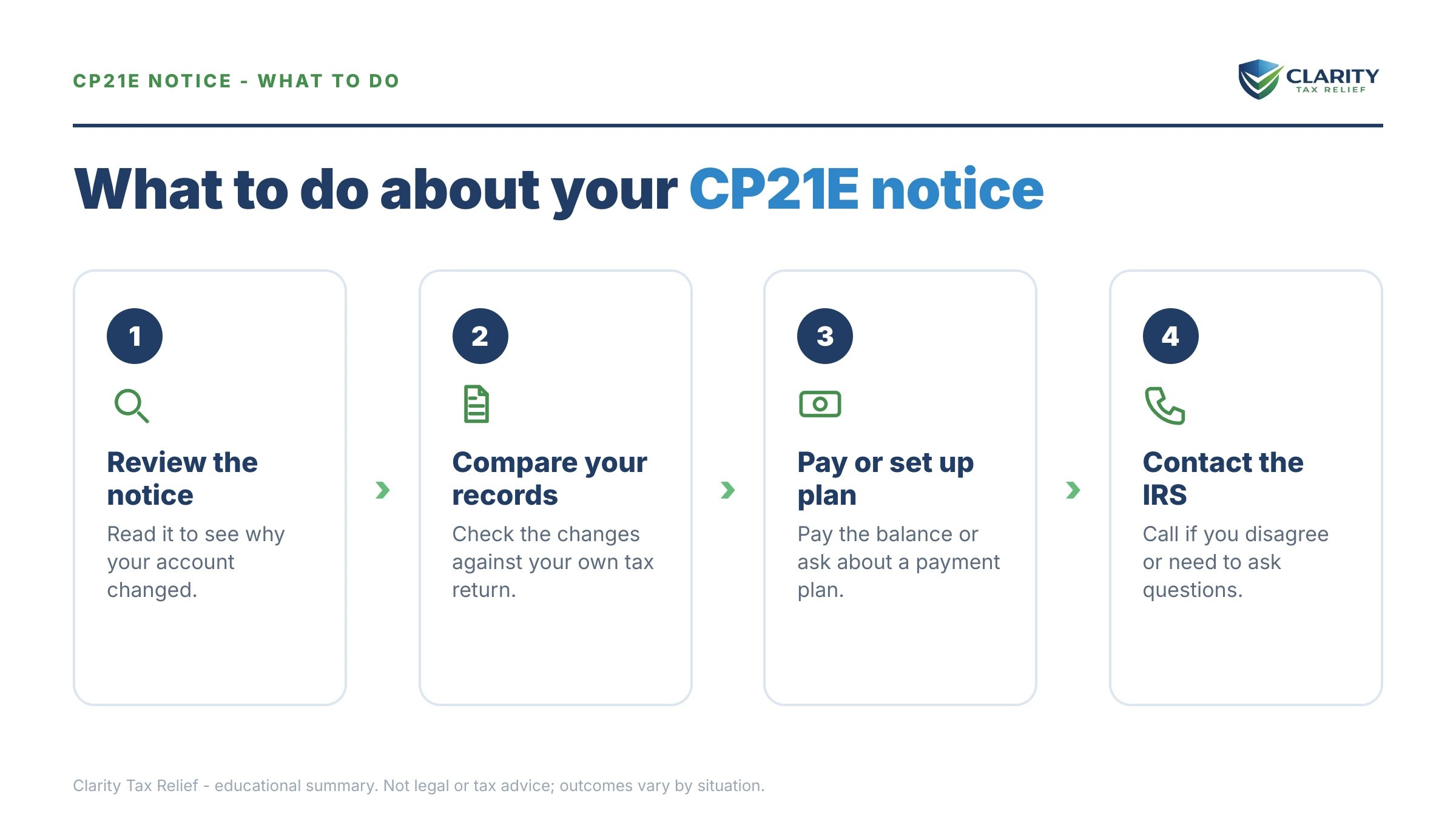
- Match the notice to your audit report. Pull out the examination report (Form 4549) or the Notice of Deficiency and confirm the tax on the CP21E matches the audit changes; flag any year or amount that doesn't line up.
- Verify the balance in your IRS online account. Log in at IRS.gov and confirm the assessment, the penalty breakdown, and that any payments you've already made posted to the right tax year.
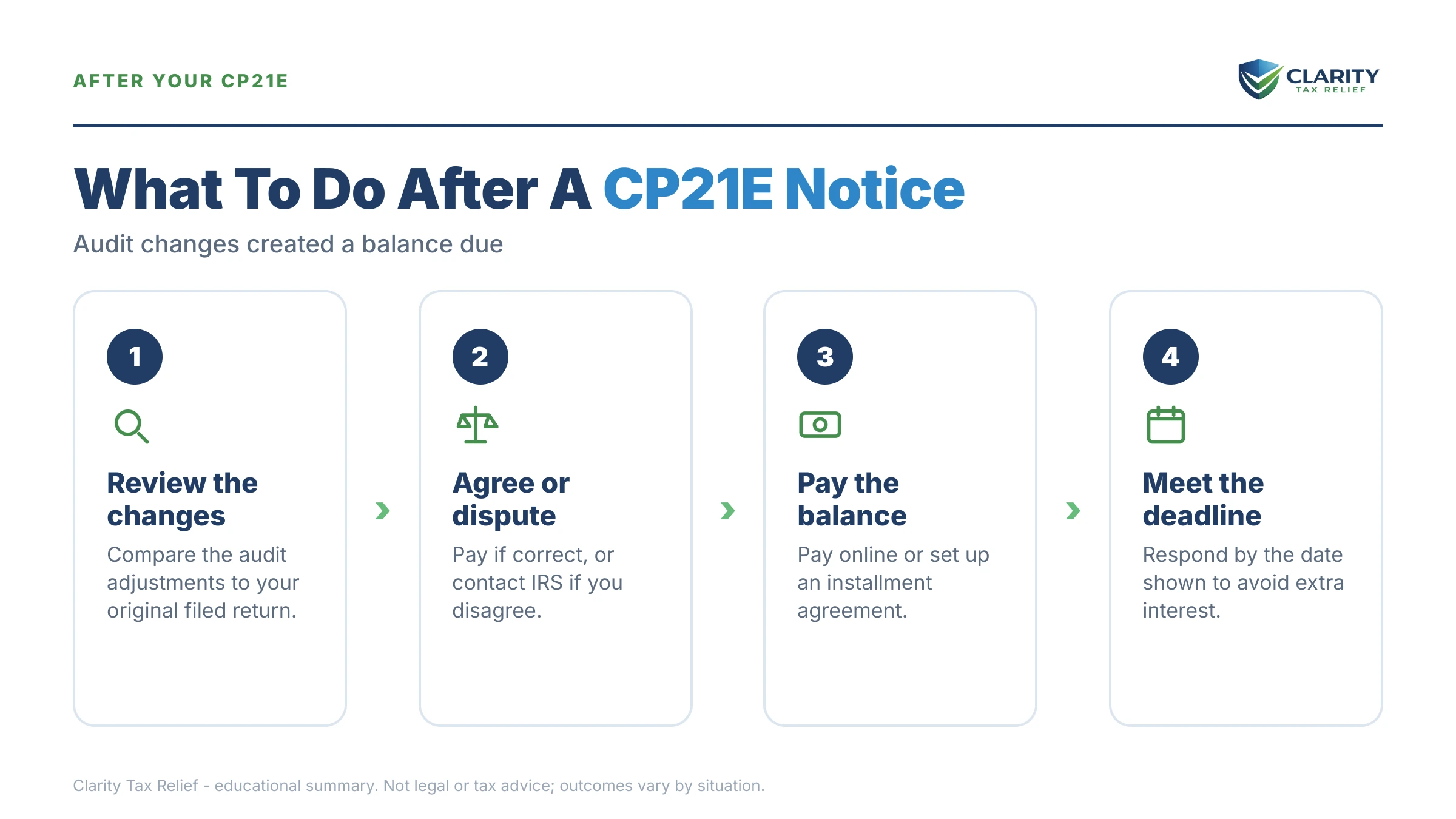
- Decide whether you agree with the audit changes. If you never participated in the audit or have documents the examiner never saw, start audit reconsideration before you pay; if you agree, move straight to payment.
- Pay or set up a payment plan by the printed date. Pay in full at IRS.gov/payments, or apply online for a payment plan — balances under $50,000 generally qualify for up to 72 months without detailed financial disclosure (details on the IRS payment plans page; the paper route is Form 9465).
- Request penalty relief in writing. If circumstances beyond your control caused the underlying problem, request abatement — the accuracy-related penalty requires a reasonable-cause showing, not first-time abatement.
- Keep every confirmation. Save the plan acceptance letter, payment confirmations, and notice copies — your refinance underwriter and any future dispute will need them.
When you can handle a CP21E yourself — and when help changes the outcome
Plenty of CP21E situations don't need professional help. If you participated in the audit, agree with the changes, and can pay in full or within 180 days — or set up a simple online plan for a single year's balance — do it yourself and keep the confirmation. That is the whole fix, and no one should charge you for it.
Experienced help earns its cost in specific situations: the audit closed without your participation and a reconsideration case needs to be built from records; the accuracy-related penalty is a five-figure line item with a genuine reasonable-cause argument behind it; multiple years were audited and the balances need sequencing; the changes hit a Schedule C or rental activity where reconstruction of records changes the tax itself; the balance exceeds $50,000 and financial disclosure strategy matters; or a refinance or sale is on the calendar and a lien filing must be prevented, not undone. In those cases, the order and framing of the requests routinely change what you end up paying — and honest triage of which bucket you're in is exactly what a free review is for.
Terms on your CP21E, decoded
- Assessment — the formal recording of tax on the IRS's books; once assessed, the amount is legally collectible and accrues interest.
- Accuracy-related penalty — a 20% add-on for negligence or substantial understatement of tax, commonly included in audit balances.
- Statutory interest — interest the law requires from the return's original due date; the IRS generally cannot waive it except where its own error or delay caused it.
- Notice of Federal Tax Lien — the public filing that attaches the government's claim to your property, including your home, and appears in title searches.
- Audit reconsideration — the process for asking the IRS to re-open closed audit changes when you have new information or never had a chance to respond.
- CSED — the Collection Statute Expiration Date: the IRS generally has 10 years from assessment to collect, though certain events pause the clock.
The IRS's own one-page explainer is at Understanding your CP21E notice. If the IRS's process itself is causing you harm — a payment posted wrong, a hardship being ignored — the Taxpayer Advocate Service is an independent, free avenue inside the agency.
CP21E questions, answered
What is a CP21E notice from the IRS?
A CP21E notice tells you the IRS changed your tax return because of a recent audit and you owe money as a result. The notice shows the tax year, the adjusted amounts, and a total that combines additional tax, penalties, and interest. It is a bill, not a proposal — the tax has already been assessed, so the next step is paying, arranging payments, or pursuing reconsideration.
Can I still dispute the audit results after getting a CP21E?
Yes, but through different channels than during the audit. Audit reconsideration lets the IRS re-examine the changes if you have new documentation or never got the chance to respond. An Offer in Compromise based on doubt as to liability (Form 656-L) disputes whether you legally owe the amount. You can also pay the balance and file a claim for refund. None of these pause interest, so act quickly.
How long do I have to pay a CP21E notice?
Your deadline is the pay-by date printed on the notice, typically about three weeks after the notice date. Missing it doesn't trigger a levy immediately — reminder notices come first — but interest compounds daily and the 0.5% monthly failure-to-pay penalty keeps running. Setting up a payment plan by the deadline stops the collection sequence even if you can't pay in full.
Will a CP21E stop me from refinancing my house?
Not by itself. A CP21E creates an assessed tax debt, but no public lien exists until the IRS files a Notice of Federal Tax Lien — which usually happens only after later notices go unanswered. Underwriters generally want the debt either paid or in a documented payment plan. Setting up a direct-debit installment agreement quickly is the standard way homeowners keep a refinance on track.
What is the difference between a CP21E and a CP22E?
Both notices bill you for changes made after an IRS audit; the difference is mostly internal — which processing path the adjustment took through IRS systems. From your side, treat them identically: verify the numbers against your audit report, then pay or arrange payments by the printed date. The escalation sequence and your resolution options are the same for both notices.
Does the CP21E amount include penalties and interest?
Yes. The total on a CP21E combines the additional tax from the audit, any penalties the examiner assessed — often the 20% accuracy-related penalty — and interest calculated from the original due date of the return, not from the audit or notice date. That backdated interest is why the bill is usually larger than the figure on your audit report.
What if I can't afford to pay my CP21E at all?
You still have options. If your income barely covers necessary living expenses, Currently Not Collectible status pauses IRS collection while the debt sits. If your assets and income genuinely can't cover the balance, an Offer in Compromise may settle it for less — though the IRS accepted only about 1 in 5 offers in FY2024. A partial-pay installment agreement is a middle path between the two.
Is a CP21E the same as a CP21A?
No. A CP21A bills you after the IRS made changes you asked for — typically from an amended return — while a CP21E bills you for changes an auditor made. The distinction matters because CP21E balances often carry audit penalties and longer interest accrual, and disputing them requires audit-specific remedies like reconsideration rather than a simple correction letter.
Your next 24 hours
- Find two things on your CP21E: the pay-by date near the top, and the box that breaks the total into tax, penalties, and interest. Those two items determine your clock and your leverage.
- Gather three documents: the CP21E itself, your audit report (Form 4549) or Notice of Deficiency, and your filed return for the audited year.
- Get a free case review before the printed date. Use the 2-minute form or call (888) 825-7779 — an experienced tax professional will confirm whether the assessment is right, whether the penalties can be challenged, and which payment setup keeps a lien off your home.
This guide is general information, not tax or legal advice for your specific situation. Eligibility for IRS programs depends on individual facts and circumstances; no outcome is guaranteed.