
State Back Taxes
West Virginia Back Taxes: How to Resolve What You Owe in 2026
The short answer: West Virginia back taxes are collected by the West Virginia Tax Division, which can record liens, garnish wages, and intercept both your state and federal refunds. Most balances get resolved by filing any missing returns first, then setting up an installment payment agreement — and acting early keeps penalties and interest from compounding.
The letter is from Charleston, not from the IRS, and that's what makes it confusing — the return address says something like "Tax Division" or "State Tax Department," and the balance is one you didn't know existed until you opened the envelope. Take a breath. State balances like this are resolved every day, usually with an arrangement you can actually afford. This page is the full map: how West Virginia collects, what each option costs, and what to do this week.
One naming note before anything else: West Virginia renamed its tax agency the West Virginia Tax Division (under the Department of Revenue) — older letters and search results may say "West Virginia State Tax Department." It's the same agency with the same collection powers, so don't let the name mismatch make you suspect a scam on that basis alone.
⏱ Your real clock: there is no single statutory deadline for West Virginia back taxes — the controlling dates are the ones printed on your assessment and demand notices, including the appeal deadline on any Notice of Assessment. Interest and penalties accrue monthly on the unpaid balance, so every month of waiting raises the payoff amount.
Why you owe West Virginia back taxes
Most West Virginia back-tax balances start with one of four events: under-withheld W-2 pay, an unfiled state return, a federal change the IRS reported to the state, or self-employment income with no estimated payments made to West Virginia.
Under-withholding is the most common cause for W-2 workers. A raise, a second job, or a withholding certificate filled out years ago can leave your West Virginia withholding short of your actual liability — and a shortfall of a few hundred dollars per year quietly compounds into thousands across two or three filing seasons.
The second driver is unfiled returns. If you skip filing, the Tax Division can build an estimated assessment from IRS and employer data — with no deductions or credits in your favor — and bill you for it.
Third: federal changes flow downhill. West Virginia and the IRS share information, so a CP2000 adjustment or audit change at the federal level typically produces a matching West Virginia assessment later. The state expects you to report federal changes by amending your West Virginia return; if you don't, the state's bill arrives with penalties attached.
Fourth: 1099 and business income. No one withholds West Virginia tax from contractor pay, and businesses that collect the state's 6% consumer sales and service tax hold that money in trust — falling behind on it draws faster, harder enforcement than an income-tax balance ever does.
What happens if you ignore West Virginia back taxes
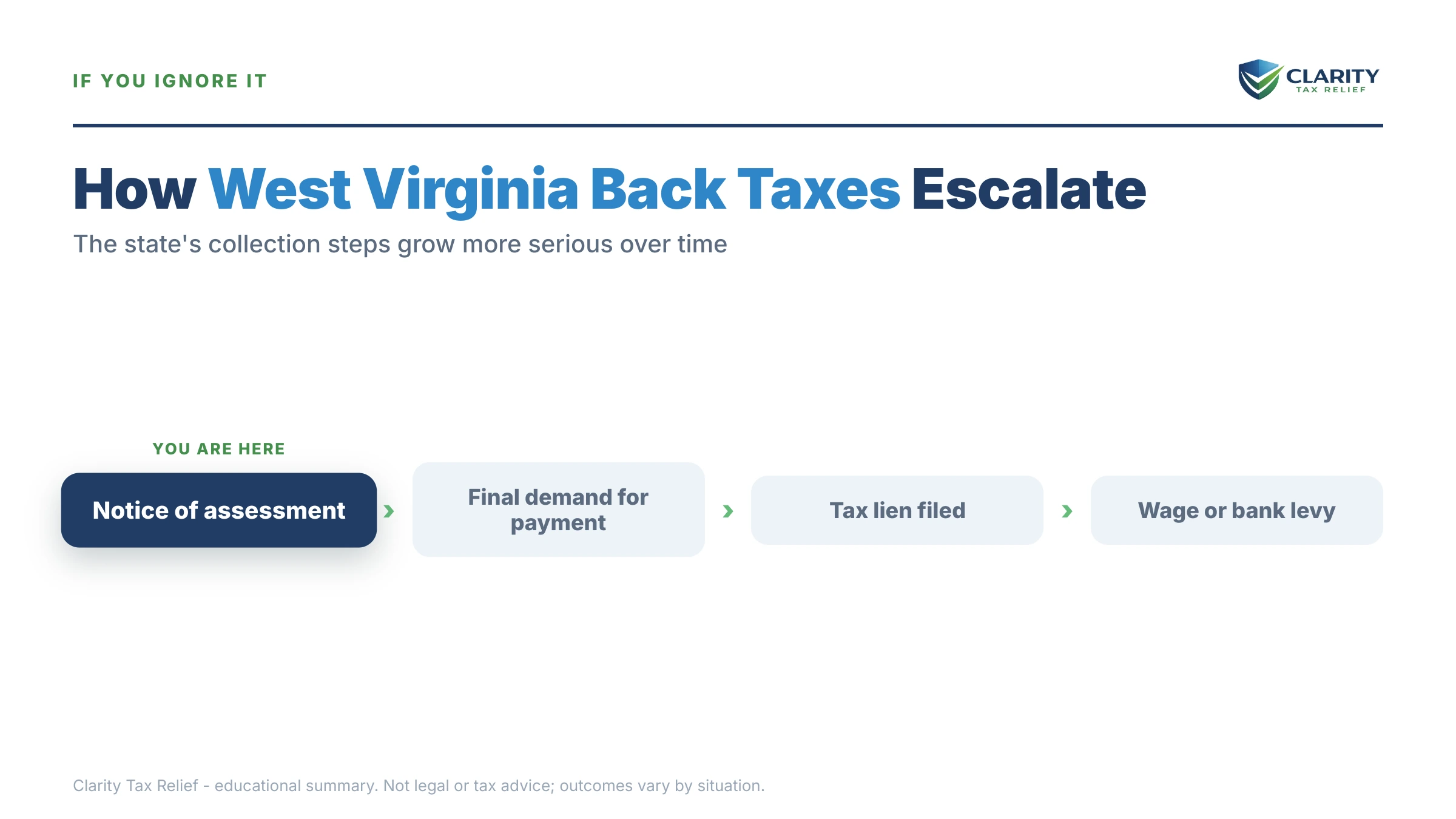
Unpaid West Virginia taxes grow every month through interest and penalties while the Tax Division's collection sequence moves from assessment notice to recorded lien to wage garnishment. The stages run in this order:
- Notice of Assessment / balance-due billing — the state tells you what it says you owe. If you don't pay or appeal by the deadline printed on the notice, the amount becomes final and collectible.
- Demand letters and collections contact — the account moves to the Tax Division's compliance and collections staff while interest and penalties keep compounding.
- State tax lien recorded with the county clerk — a public record that attaches to real estate you own in that county. It surfaces in every title search and can stall a sale or refinance until released.
- Refund interception — West Virginia keeps your state refunds and can ask the U.S. Treasury to redirect your federal refund to the state through the Treasury Offset Program.
- Wage garnishment and bank attachment — active enforcement against your paycheck and accounts once demands go unanswered.
- Business-level consequences — for sales tax and other business taxes, the state can move against your business registration, and responsible individuals can be pursued personally for trust taxes the business collected but never remitted.
Notice what's not on that list: any stage where the debt quietly goes away. The cheapest moment to resolve a West Virginia balance is before the lien stage — after a lien records, you're negotiating with a public judgment against your property instead of a letter in a drawer.
Holding a West Virginia Tax Division notice right now?
Send us a photo of it. An experienced tax professional will confirm what stage your account is in, whether the assessment is even correct, and which arrangement fits your budget — free, confidential, no pressure, before interest adds another month to the balance.
Your options for resolving West Virginia back taxes
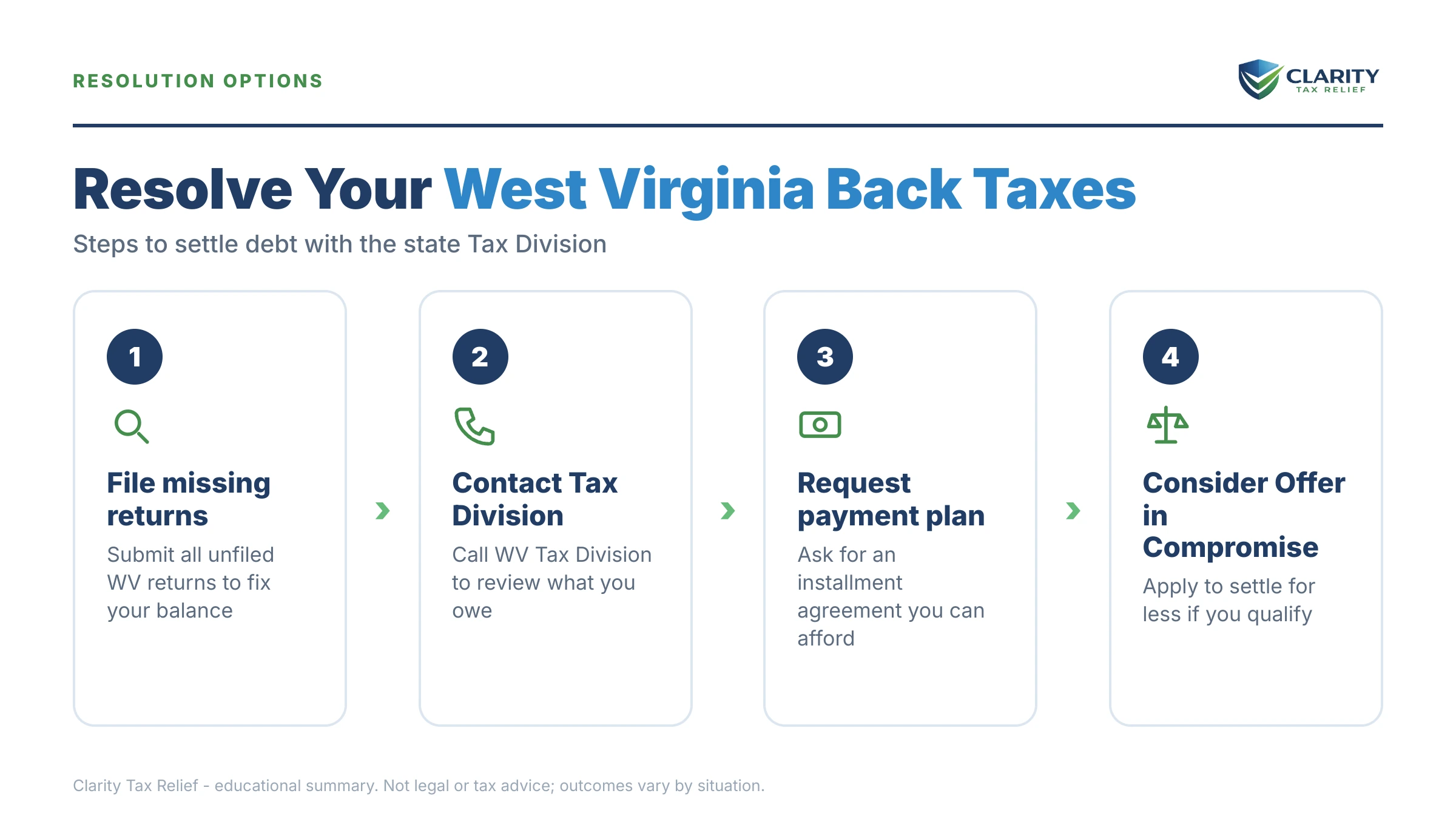
West Virginia offers payment plans, penalty waivers for reasonable cause, hardship deferral, and appeal rights — but no standardized settle-for-less program like the IRS Offer in Compromise. Here's the full menu and who each option genuinely fits:
| Option | Generally fits when | What to know |
|---|---|---|
| Pay in full | You can raise the money without real hardship | Stops interest and penalty accrual immediately; the cheapest total cost by far |
| Installment payment agreement | You can't pay in full but can commit to a monthly amount | All required returns must be filed first; interest continues; state refunds are still applied to the balance |
| Penalty waiver (reasonable cause) | Illness, disaster, or circumstances beyond your control caused the lapse | Reduces penalties, not tax or interest; request in writing with documentation |
| Hardship / deferred collection | Paying anything would leave you unable to cover basic living costs | Requires financial disclosure; pauses enforcement, not the debt or the interest |
| Appeal to the WV Office of Tax Appeals | You dispute the assessment itself | Must be filed by the deadline printed on your assessment; miss it and the amount becomes final |
| Compromise (discretionary) | Rare cases where the liability is doubtful or collection is realistically impossible | No published program or acceptance formulas; raised directly with the Tax Division, usually with professional help |
Two practical notes on the payment plan, since it's where most readers land. First, the Tax Division expects every required return filed before it finalizes an agreement — negotiating with unfiled years outstanding wastes everyone's time. Second, a plan is a promise: default on it and you skip straight back to the enforcement track, often at a later stage than where you left off. Pick a monthly number you can sustain in a bad month, not just a good one.
On the "settle it for less" question: some companies advertise West Virginia settlements the way they advertise IRS ones. The state has no equivalent published program. Compromise authority exists but is discretionary and rare — if a salesperson quotes you a settlement percentage for a West Virginia debt before anyone has reviewed your finances, that's a red flag, not an offer.
Owe $7,400 to West Virginia? Here's what that actually looks like
A hypothetical, with the math shown. Say you're a single W-2 employee in Morgantown who owes West Virginia $7,400 across two tax years — $3,600 from 2023 and $3,800 from 2024, both from under-withholding after a raise outpaced the withholding certificate you filled out when you were hired.
Your realistic paths:
- Pay in full: if savings can absorb it, this ends accrual today. Every month you wait, interest at the state's current statutory rate — the notice shows the figure being applied to your account — plus any late-payment penalty gets added on top of the $7,400.
- 12-month plan: roughly $617/month in principal, plus accruing interest. Painful but short.
- 24-month plan: roughly $309/month in principal. This is the sweet spot for many single-income households — meaningful progress without wrecking rent.
- 36-month plan: roughly $206/month in principal, but you pay the most total interest of the three because the balance sits longer.
Two more moves that change the total: ask in writing whether your facts support a reasonable-cause penalty waiver (a documented medical event, disaster, or similar), and fix your West Virginia withholding with your employer this week — otherwise April 2027 adds a third year to the pile while you're still paying off the first two. Ask that both years be wrapped into one agreement so you're not juggling two due dates.
| Balance | Realistic West Virginia path | If you also owe the IRS |
|---|---|---|
| Under $2,500 | Pay in full or a short monthly plan; ask about a penalty waiver | IRS short-term plan gives up to 180 days with $0 setup fee |
| $2,500–$10,000 | Installment agreement after all returns are filed (the $7,400 example above) | Guaranteed installment agreement territory at or under $10,000 with all returns filed |
| $10,000–$50,000 | Payment plan, possibly with financial review; lien filing becomes a real risk | Streamlined installment agreement: up to 72 months at or under $50,000 |
| Over $50,000 | Expect financial disclosure, lien filing, and dedicated collection attention | Full financial disclosure required; professional representation usually changes the outcome |
If you also owe the IRS: running both tracks at once
Many West Virginians behind with the state are behind with the IRS for the same underlying reason, and the two debts behave very differently. The general playbook for juggling a state balance alongside a federal one is the same one we walk through in our Virginia back taxes guide — here's the West Virginia–specific comparison:
| Question | West Virginia Tax Division | IRS |
|---|---|---|
| Payment plans | Installment agreements via MyTaxes or collections staff; terms depend on balance and finances | Short-term up to 180 days; online plans up to 72 months at or under $50,000 |
| Settling for less | Discretionary only; no published program | Offer in Compromise — formal program; roughly 1 in 5 offers accepted in FY2024 |
| Your refunds | Keeps state refunds; can request a federal refund offset through TOP | Keeps federal refunds; can seize your WV refund through the State Income Tax Levy Program |
| Collection window | Set by state law; a recorded lien can extend reach — confirm your specific dates | 10 years from assessment (the CSED), pausable by appeals, an OIC, or bankruptcy |
| Passport consequences | None — passports are federal | Certifies seriously delinquent debt over $66,000 (2026) for passport denial or revocation |
The federal side has its own gravity. The IRS failure-to-pay penalty runs 0.5% per month, plus compounding interest — you can estimate what the federal balance is adding each month with our IRS penalty and interest calculator. Federal options include Currently Not Collectible status when paying anything would be a hardship, first-time penalty abatement if your prior three years were clean (and note that starting summer 2026, the IRS's new Automatic Exemption from Penalty applies qualifying relief automatically, with no request needed), and — where the math genuinely supports it — an offer in compromise on the federal balance only.
Which government first? Usually neither in isolation — see state tax debt vs. IRS: which to resolve first for the full decision framework. The short version: file everything with both, then set arrangements with both, sized so that neither payment causes you to default on the other. And don't count on 2026's IRS staffing cuts to buy you time on either side — humans are harder to reach, but the automated systems that intercept refunds and issue levies never stopped running.
Situations that change the answer
You're self-employed or paid on 1099
No one withholds West Virginia tax from contractor pay, so a profitable year can produce simultaneous state and federal balances. The resolution sequence is the same — file, then arrange payments — but the prevention step is different: start making West Virginia estimated payments alongside your federal quarterlies, or the debt rebuilds every April while you're paying off the old one.
You own a business in West Virginia
Sales tax collected from customers is trust money — the state treats an unpaid 6% consumer sales and service tax balance far more aggressively than a personal income-tax debt, and responsible individuals can be pursued personally even if the business closes. Business balances also put your registration with the state at risk. If that's your situation, start with our guide to sales tax debt help and get representation before speaking with a collector.
You have multiple unfiled years
If the Tax Division has already assessed estimated amounts for years you never filed, those numbers are almost always higher than reality — they include no deductions, no credits, and often no withholding. Filing accurate returns typically shrinks the balance before any negotiation begins. If your records are gone, they can be rebuilt from IRS wage transcripts and bank data; see haven't filed taxes in 3 years and filing back taxes with no records.
You dispute the amount
West Virginia gives you a formal route: a petition to the West Virginia Office of Tax Appeals, an independent forum, filed by the deadline printed on your Notice of Assessment. That deadline is the single most important date on the letter — once it passes, the assessment is final and your dispute options shrink to correction requests and refund claims. If the state's numbers don't match your W-2s or your filed return, gather the documents now, not after the window closes.
Money is genuinely tight
If a payment plan would leave you unable to cover rent, utilities, and food, say so — with documentation. The state can defer collection based on demonstrated hardship, and on the federal side Currently Not Collectible status exists for exactly this situation. Hardship status pauses enforcement, not interest, so treat it as breathing room while your income recovers, not a resolution.
How to resolve West Virginia back taxes, step by step
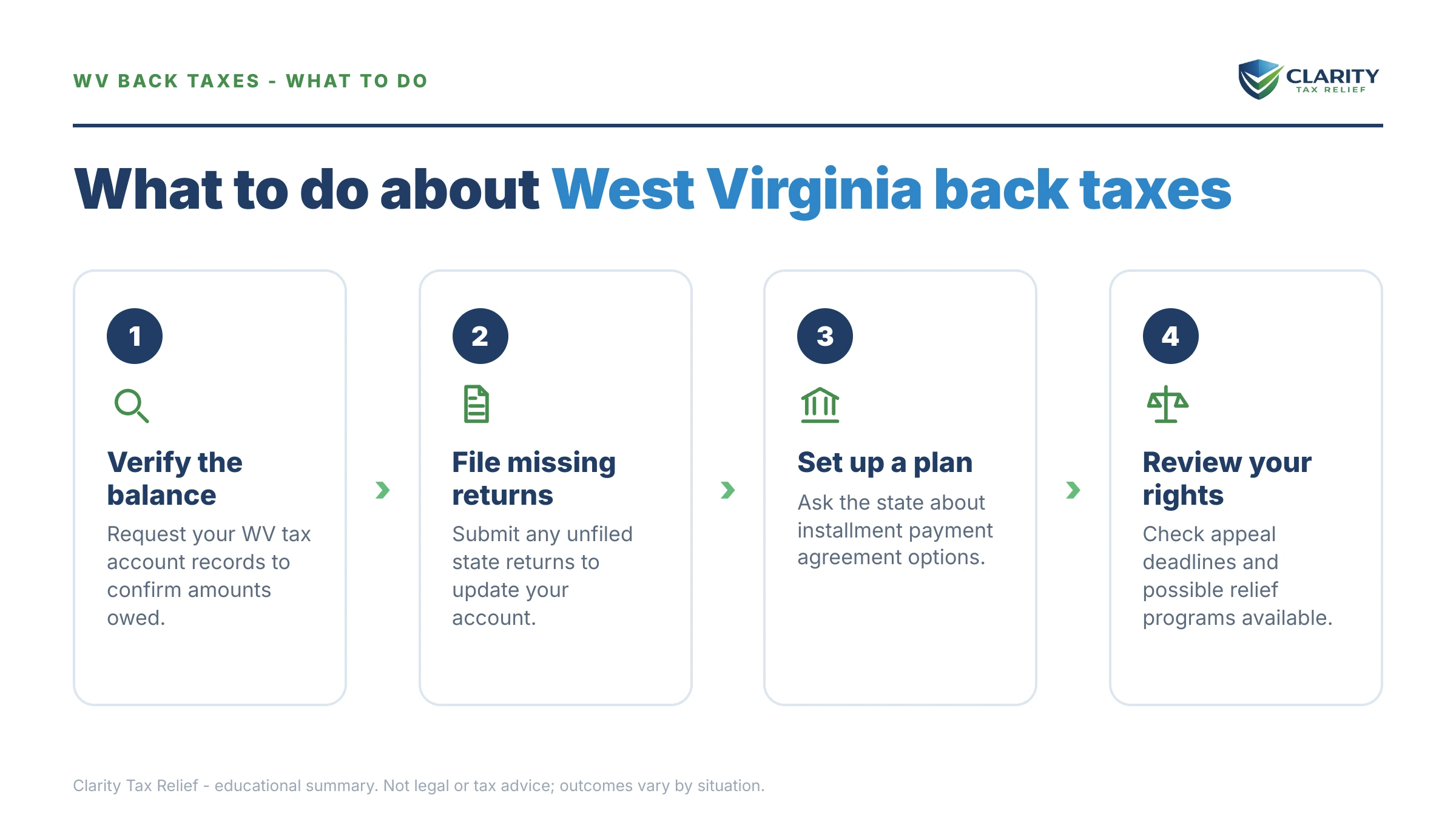
- Pull your records: gather every Tax Division letter, confirm the balance and tax years on your state account, and pull your IRS transcripts so you know whether a federal balance is sitting behind the state one.
- File every missing return: submit any unfiled West Virginia and federal returns before negotiating — accurate returns usually replace inflated estimated assessments, and the state won't finalize an agreement over unfiled years.
- Verify the assessment: check the tax years, income figures, and withholding on each notice, and if the amount is wrong, appeal to the West Virginia Office of Tax Appeals by the deadline printed on your assessment.
- Set up your arrangement: pay in full if you can, or request an installment payment agreement through MyTaxes or the Tax Division's collections staff before demand letters turn into liens and garnishment.
- Request penalty relief and fix the cause: ask about a reasonable-cause penalty waiver in writing, then correct your withholding or estimated payments so the same balance doesn't rebuild next April.
When you can handle this yourself
Plenty of West Virginia back-tax cases don't need professional help, and it would be dishonest to pretend otherwise. Handle it yourself when: it's a single tax year, you agree with the number, all your returns are filed, and you can pay in full or set up a straightforward monthly plan directly with the Tax Division. That's a phone call and a bank draft, not a case.
Experienced help changes outcomes in specific situations: a lien has recorded or garnishment has started; you have multiple unfiled years with both the state and the IRS; the debt involves business trust taxes with personal-liability exposure; you're inside an appeal window and the assessment is wrong; or the combined state-plus-federal balance is large enough that the order you resolve things in — returns, penalties, then balances, sequenced between two governments — materially changes what you pay. Residents of the capital area can also see our local guide to tax relief in Charleston, WV.
If your West Virginia balance sits on top of an IRS one — or a lien has already been recorded — a free case review at (888) 825-7779 or the 2-minute form can map both debts before you commit to a monthly payment you can't sustain.
Terms on West Virginia tax notices, decoded
- Notice of Assessment — the state's formal statement of what it says you owe; the deadline printed on it controls your right to appeal before the amount becomes final.
- Tax lien — a public claim recorded with the county clerk against property you own, securing the debt; it isn't a seizure, but it clouds title until released.
- MyTaxes — the West Virginia Tax Division's online account system, where you can view balances, file, pay, and request arrangements.
- Office of Tax Appeals — the independent West Virginia forum that hears disputes over assessments, separate from the Tax Division that issued them.
- Trust taxes — money a business collects on the state's behalf (like sales tax); because it was never the business's money, individuals responsible for it can be pursued personally.
- Offset — a government keeping a refund you were owed and applying it to a tax debt instead — West Virginia can reach federal refunds this way, and the IRS can reach West Virginia refunds.
West Virginia back taxes: questions people ask
Does West Virginia offer a payment plan for back taxes?
Yes. The West Virginia Tax Division sets up installment payment agreements for taxpayers who cannot pay in full, and you can request one through its online MyTaxes system or by contacting its collections staff directly. You must be current on all required filings first, and interest keeps accruing until the balance is paid. Miss payments and the agreement can default, putting you back on the enforcement track.
How long can West Virginia collect back taxes?
West Virginia sets its own collection limits — the IRS's 10-year rule does not apply to state debt. The clock depends on when the tax was assessed, and a recorded state tax lien can extend the state's reach against your property. Because the dates on your specific assessments control, confirm your timeline with the Tax Division or an experienced tax professional rather than assuming the debt will simply age off.
Will West Virginia take my federal tax refund for state back taxes?
It can. States can submit finalized income-tax debts to the Treasury Offset Program, which redirects federal refunds to the state before you ever see the money. You would receive an offset notice showing where the refund went. An installment agreement resolves the debt over time, but refunds are typically still applied to the balance until it is paid off.
Can the IRS take my West Virginia state refund?
Yes. Through the State Income Tax Levy Program, the IRS intercepts state refunds to pay federal back taxes — and unlike most levies, it can do this with less advance notice, sending a CP92 notice after the refund is taken. If both governments are owed, your refunds are usually the first money each one grabs, which is why relying on future refunds to catch up rarely works.
Does West Virginia settle tax debt for less than the full amount?
Not through a standardized public program like the IRS Offer in Compromise. Compromise of a West Virginia liability is possible only in limited circumstances at the state's discretion, and there are no published acceptance formulas. Be skeptical of any company promising to settle West Virginia debt for a specific fraction — the realistic outcomes for most WV balances are a payment plan, penalty relief, or a corrected assessment after filing accurate returns.
What happens if I never filed West Virginia returns?
The Tax Division can assess tax for you using data from the IRS and employers, and those estimated assessments usually overstate what you actually owe because they include no deductions, credits, or accurate withholding figures. Filing your real returns typically replaces the inflated numbers with correct ones. File every missing year before negotiating a payment plan — the state generally will not finalize an agreement while returns are outstanding.
Can West Virginia garnish my wages for back taxes?
Yes. Once an assessment is final and demands go unanswered, the state can move against wages and bank accounts, and a recorded tax lien attaches to property you own in the county where it is filed. Garnishment is late-stage collection, not the first step — which means the letters arriving now are the cheap window to set up an arrangement before enforcement starts.
Should I pay West Virginia or the IRS first?
Neither in isolation — file all missing returns with both first, then put an arrangement in place on each balance. States are often faster to intercept refunds and record liens, while the IRS balance grows through its 0.5% monthly failure-to-pay penalty plus interest. If money is tight, an experienced tax professional can sequence the two so a payment to one doesn't trigger default or enforcement by the other.
Do West Virginia back taxes affect my credit score?
Not directly — the major credit bureaus removed tax liens from consumer credit reports in 2018, so the debt itself will not show as a score-lowering line item. But a recorded West Virginia tax lien is still a public record that surfaces in title searches and lender due diligence, and it can block a home sale or refinance until the state releases it.
Your next 24 hours
- Find the controlling dates and amounts. On your newest letter, locate the notice date, the appeal or response deadline, and the balance broken out by tax year — then verify the figures against the West Virginia Tax Division's records at tax.wv.gov.
- Gather your paperwork. Your last two federal and state returns, every Tax Division notice you've received, and a recent pay stub — that's everything needed to evaluate a payment plan, penalty waiver, or hardship claim. If a federal balance exists too, note it; the IRS's own plan options are at IRS.gov payment plans and payment methods at IRS.gov/payments.
- Get a free case review. Use the 2-minute form or call (888) 825-7779. An experienced tax professional will read your West Virginia notices, check whether the assessment is even correct, and map the arrangement that fits — before another month of interest and penalties gets added to the balance.
This guide is general information, not tax or legal advice for your specific situation. Eligibility for IRS programs depends on individual facts and circumstances; no outcome is guaranteed.