
Tax Relief by City
Tax Relief Charleston WV: Every Real Option for IRS and State Tax Debt (2026)
The short answer: tax relief in Charleston, WV runs on two tracks — IRS programs (payment plans up to 72 months, Currently Not Collectible status, penalty abatement, and the Offer in Compromise) plus a separate arrangement with the West Virginia Tax Division, headquartered downtown. Most Charleston taxpayers owing under $50,000 can set up a streamlined IRS payment plan online.
If you're searching for tax relief in Charleston, WV, you're probably staring at a balance you can't pay in one check — and maybe a refinance or home-equity plan you're afraid a tax problem will kill. Both problems are fixable, usually faster than you expect. Charleston has one wrinkle most cities don't: the state's tax collector is headquartered here, and it collects on its own track, separate from the IRS.
This guide maps both tracks — what the IRS can do, what the West Virginia Tax Division can do, which resolution options fit which balances, and exactly how to keep a tax lien from derailing a Kanawha County closing.
⏱ The clock that matters: there's no single statutory deadline on a tax balance itself — but the IRS failure-to-pay penalty adds 0.5% of your balance every month, and interest compounds daily on top. If you're holding a specific IRS or state notice, the response date printed on it controls; find that date first.
Why Charleston, WV taxpayers end up needing tax relief
Most tax debt in Charleston comes from income nobody withheld on — not from cheating. Self-employment and 1099 work (contractors, healthcare travelers, gig drivers, side businesses along the Kanawha Valley) generate tax bills four times a year that W-2 jobs never do. One missed quarter compounds into a balance, and a balance compounds into notices.
The second Charleston-specific reality: you can owe two governments at once. West Virginia has its own personal income tax, and the West Virginia Tax Division — the state agency headquartered in downtown Charleston — assesses and collects it independently. Resolving your IRS balance does nothing for a state balance, and vice versa. Plenty of Charleston taxpayers fix one and get blindsided by the other. If your state balance is the bigger problem, start with our full guide to West Virginia back taxes.
Third: searches for local tax help surface a wall of national-brand ads. Some of those firms do good work; some sell fear. Before you sign anything, read how to choose a tax relief company — and if you've already been quoted a big fee by a heavy advertiser, compare notes with our Optima Tax Relief alternatives breakdown.
What happens if you ignore IRS or West Virginia tax debt
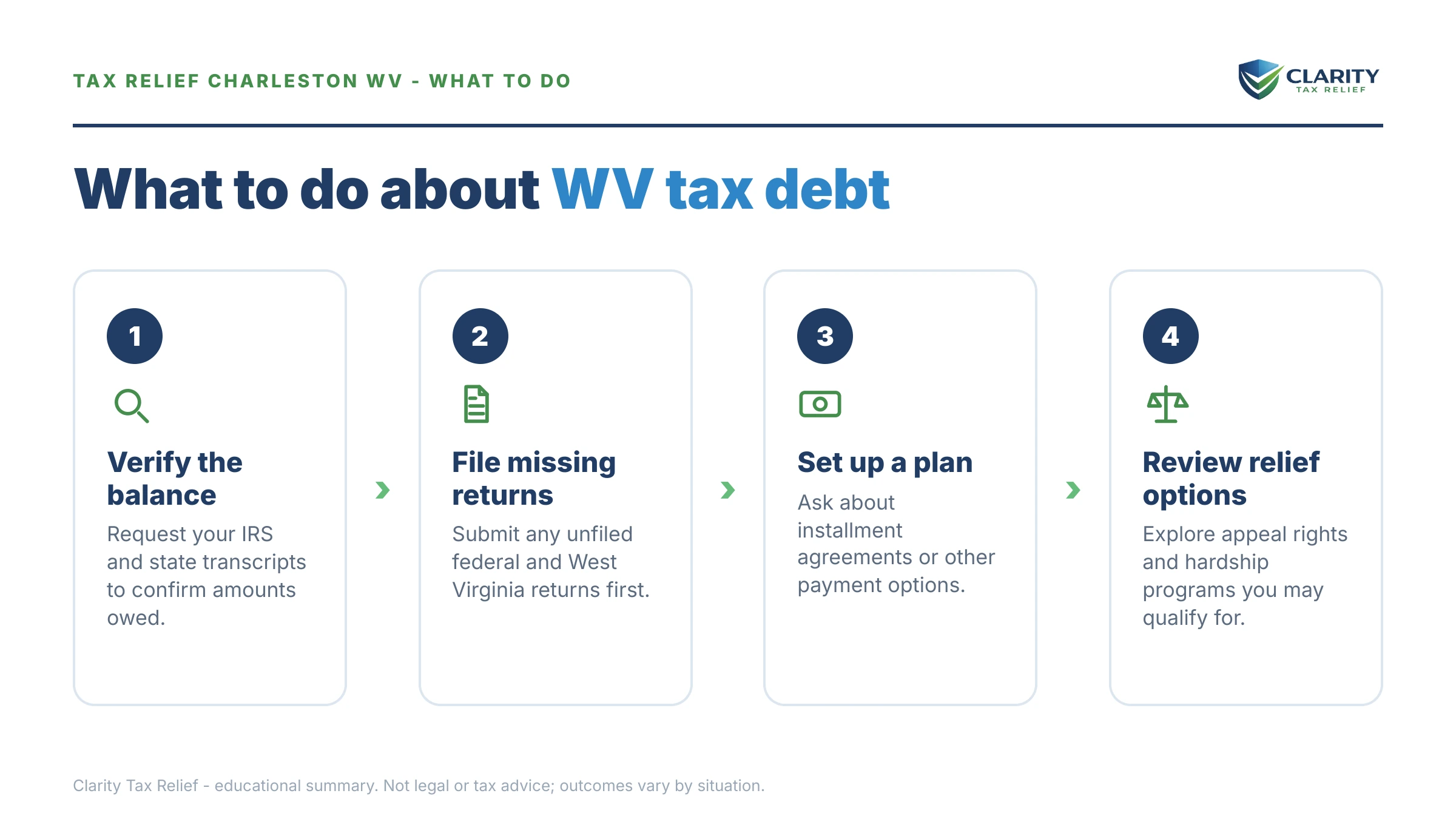
Unpaid federal tax debt escalates through an automated notice sequence that ends in liens and levies. Nothing about living in a smaller market slows it down — the notices are generated by computer, and the 2026 IRS workforce cuts (roughly 27% in 2025) made humans harder to reach without pausing a single automated action. The sequence runs:
- CP14 — the first bill. No enforcement yet; the cheapest moment to act.
- CP501 / CP503 — reminder bills. Penalties and interest keep stacking each month.
- CP504 — intent to levy your state refund. The IRS can now take your West Virginia refund through the State Income Tax Levy Program, and a Notice of Federal Tax Lien becomes a live risk — the filing that shows up in a title search when you refinance.
- LT11 / Letter 1058 — the final notice of intent to levy. This starts a 30-day clock and your Collection Due Process rights (requested on Form 12153). After those 30 days, the IRS can garnish wages and levy bank accounts.
- Levy stage — a bank levy freezes funds for 21 days before they're sent to the IRS; a wage levy is continuous until released; Social Security can be levied up to 15%. Balances over $66,000 (the 2026 threshold) can also trigger passport certification.
The state track runs in parallel and doesn't wait for the IRS. The West Virginia Tax Division moves from assessment to demand, then to a recorded state tax lien, then to enforced collection — wage garnishment, bank levy, and offset of your state refund. The state's stages aren't printed on a tidy federal timeline, which is exactly why a state balance shouldn't sit unanswered.
Owe the IRS or the State of West Virginia from Charleston?
Every month you wait, penalties and interest add to the balance — and if a refinance is in your plans, a lien filing can land at the worst possible moment. Get your IRS transcripts and state exposure reviewed free by an experienced tax professional. No pressure, no obligation.
Tax relief options for Charleston taxpayers: what you may qualify for
The IRS runs five real resolution programs, and eligibility is decided by math — your balance, income, and assets — not by anyone's sales pitch. Here's the 2026 landscape:
| Option | Who typically qualifies | Cost & the catch |
|---|---|---|
| Short-term payment plan | Anyone who can pay in full within 180 days | $0 setup fee; interest and penalties still accrue until paid |
| Guaranteed installment agreement | Balance of $10,000 or less, returns filed, payable in 3 years | Approval is required by law if criteria are met; setup fee applies |
| Streamlined installment agreement | Up to $25,000 — or up to $50,000 with direct debit — over up to 72 months | No detailed financial disclosure; interest keeps running the whole term |
| Currently Not Collectible | Paying anything would leave you unable to cover basic living expenses | Free; pauses collection but the debt (and interest) remains, reviewed periodically |
| Offer in Compromise | Assets plus future income genuinely can't cover the debt | $205 fee + 20% down on lump-sum offers (both waived with low-income certification); roughly 1 in 5 offers accepted in FY2024 |
| Penalty abatement (FTA / AEP) | Clean compliance for the prior 3 years, or a reasonable-cause event | Free; removes penalties, not the underlying tax or interest |
A few notes that matter more in practice than the table can show. The streamlined installment agreement is the workhorse for most Charleston balances — set up online in under an hour, no financial statement required at these thresholds. Currently Not Collectible status is the right answer when income genuinely can't stretch, but it's a pause, not forgiveness.
Be honest with yourself about the Offer in Compromise if you own a home. The IRS calculates your Reasonable Collection Potential from your assets — home equity counts. A Charleston homeowner with enough equity to refinance almost always has an RCP above a moderate tax balance, which makes an OIC a nonstarter. Anyone who quotes you an OIC fee without asking about your equity first is selling, not advising.
Penalty relief is the quiet win most people miss. First-time penalty abatement can wipe penalties for one year if your prior three years were clean — and starting in summer 2026, the IRS's new Automatic Exemption from Penalty (AEP) begins applying similar relief automatically, with no request needed. Check whether penalties on your balance qualify before you pay a dollar of them.
For the mechanics of requesting each of these yourself, the full walkthrough lives in our guide on how to settle tax debt yourself.
The West Virginia side
None of the IRS programs above bind the West Virginia Tax Division. The state offers its own payment plans on request, may consider penalty waivers for reasonable cause in writing, and handles hardship or settlement requests case by case — it does not publish a standardized settlement program the way the IRS publishes the OIC. Here's how the two collectors compare:
| Question | IRS | WV Tax Division |
|---|---|---|
| What it collects | Federal income and self-employment tax, federal penalties | WV personal income tax, sales/use tax, state business taxes |
| Where a lien lands | Notice of Federal Tax Lien recorded against Kanawha County property | State tax lien, also recorded at the county level |
| Payment plans | Online for balances up to $50,000, up to 72 months | Available on request directly through the Tax Division |
| Settlement for less | Offer in Compromise — means-tested, ~1 in 5 accepted in FY2024 | No published equivalent; requests handled case by case |
| Your refund at risk | Keeps federal refunds; can levy your WV refund via SITLP | Offsets state refunds against state balances |
A Charleston example: $16,400 owed and a refinance on the line
Say you owe the IRS $16,400 from two years of underpaid 1099 income, and you're planning to refinance your South Hills home this fall. Here's the actual math, clearly hypothetical:
- Minimum plan: $16,400 falls under the $25,000 streamlined threshold, so a 72-month agreement pencils out to $16,400 ÷ 72 ≈ $228/month before interest. Once the agreement is approved, the failure-to-pay penalty drops from 0.5% to 0.25% per month — about $41/month at the start instead of $82 — with daily-compounding interest on top.
- Faster payoff: at $350/month you're done in roughly four to four-and-a-half years; at $500/month, about three years — and every extra dollar early cuts the interest that accrues for the whole term. You can estimate your own penalty and interest buildup with our IRS Penalty & Interest Calculator.
- The lien question: at this balance on a direct-debit streamlined agreement, the IRS generally does not file a Notice of Federal Tax Lien — which means your title search stays clean and your refinance proceeds normally. That's the single biggest reason to set the plan up before the CP504 stage, not after.
- If a lien already exists: the refinance isn't dead. The IRS can agree to tax lien subordination (Form 14134) so the new mortgage takes priority and the loan can close, and once you're on a direct-debit plan with the balance under $25,000, a withdrawal request on Form 12277 may remove the filed notice entirely. The full playbook is in can I refinance with an IRS lien.
- Why not an OIC: if that refinance implies, say, $60,000 of home equity, your Reasonable Collection Potential already exceeds $16,400 several times over. The IRS won't accept less than it can collect from your equity — so an offer would cost you the $205 fee and months of waiting for a near-certain rejection.
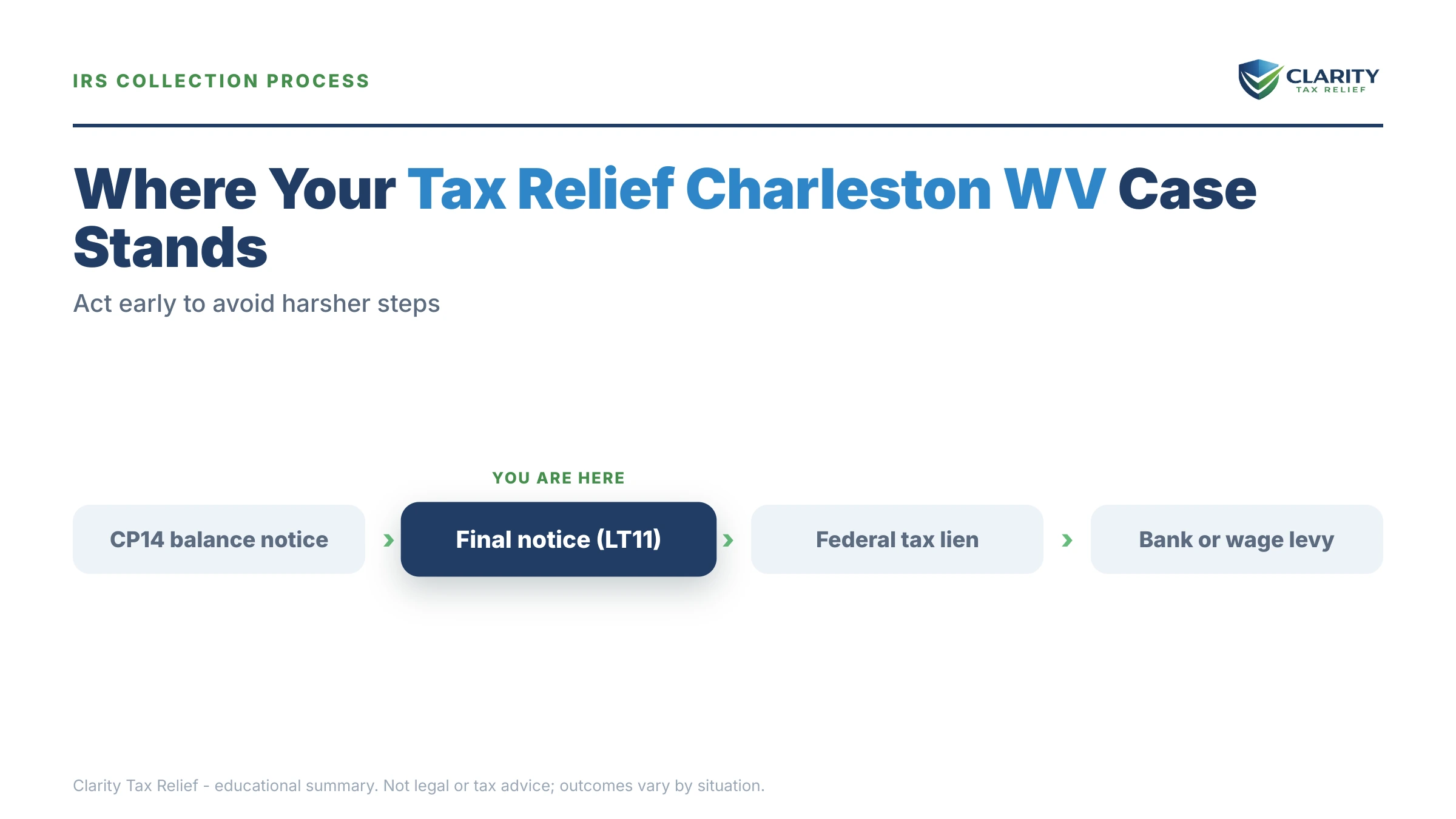
How to respond, step by step
- Pull your IRS account records. Create or log in to your IRS online account to see every year with a balance, your penalty breakdown, and whether a federal tax lien has been filed.
- Confirm any West Virginia balance. Contact the West Virginia Tax Division to verify what the state says you owe — state and federal debts are tracked and collected separately.
- File anything unfiled. Submit any missing returns first; the failure-to-file penalty is ten times the failure-to-pay penalty (though in months where both apply, the failure-to-file portion drops to 4.5 percent, for 5 percent combined), and no resolution program gets approved with open unfiled years.
- Set up your resolution before enforcement starts. Choose the option from the table above that matches your balance and finances, and put it in place — a payment plan you start today stops the escalation sequence.
- Protect your refinance. Check Kanawha County records for lien filings and, if one exists, request subordination or withdrawal early so your closing date does not slip.
When you can handle this yourself — and when help changes the outcome
Plenty of Charleston tax problems don't need a professional. If you owe under $10,000 with all returns filed, the guaranteed installment agreement is yours by law. If you can pay within 180 days, the short-term plan costs nothing to set up. If you got one notice, agree with the number, and can arrange payment online, do it yourself — the setup takes an evening, and our DIY hub walks you through every screen.
Experienced help earns its fee when the stakes or complexity jump: a lien already filed while a refinance clock is running, a wage or bank levy in motion, multiple unfiled years to reconstruct, both the IRS and the WV Tax Division collecting at once, or OIC math worth verifying before you spend a year on an application. Business owners with payroll or sales-tax exposure are a different category entirely — start with tax relief for small business, because trust-fund debt carries personal liability that ordinary income-tax debt does not.
Terms you'll hear, decoded
- Lien vs. levy: a lien is a recorded claim against your property that clouds your title; a levy is the actual seizure of wages, bank funds, or refunds.
- Notice of Federal Tax Lien (NFTL): the public filing — recorded against Kanawha County property for Charleston homeowners — that lenders find in a title search.
- Subordination: the IRS agreeing (via Form 14134) to let a new mortgage jump ahead of its lien so a refinance can close; the lien itself stays.
- CSED: the Collection Statute Expiration Date — the IRS generally has 10 years from assessment to collect, though appeals, offers, and bankruptcy pause that clock.
- Streamlined installment agreement: a payment plan approved without a full financial statement — up to $25,000, or $50,000 with direct debit, over up to 72 months.
Tax relief Charleston WV: your questions answered
Is there a local IRS office in Charleston, West Virginia?
Yes — the IRS operates a Taxpayer Assistance Center in Charleston, but it works by appointment only (call 844-545-5640 to schedule). Staff there can help with account questions, transcripts, and identity verification. They cannot negotiate settlements or accept an Offer in Compromise at the counter; those go through the IRS's centralized units regardless of where you live.
Will a tax lien stop my refinance in Charleston, WV?
Not automatically, but most lenders will not close until the lien is addressed. The IRS can subordinate its lien with Form 14134 so the new mortgage takes priority, and balances paid down below $25,000 on a direct-debit payment plan may qualify for lien withdrawal. Start the paperwork early — subordination decisions typically take weeks, not days.
Can the West Virginia Tax Division garnish my wages?
Yes. The state can garnish wages, levy bank accounts, and file liens against Kanawha County property for unpaid state taxes, entirely separate from anything the IRS does. Setting up a state payment plan generally stops enforced collection. Because the state and the IRS do not coordinate, you need a separate arrangement with each agency you owe.
Does West Virginia have an offer in compromise program like the IRS?
West Virginia does not advertise a standardized settlement program the way the IRS publishes its Offer in Compromise. The Tax Division handles hardship and settlement requests case by case, and payment plans are the most common resolution. If your state balance is genuinely uncollectible, an experienced tax professional can present that case directly to the Tax Division.
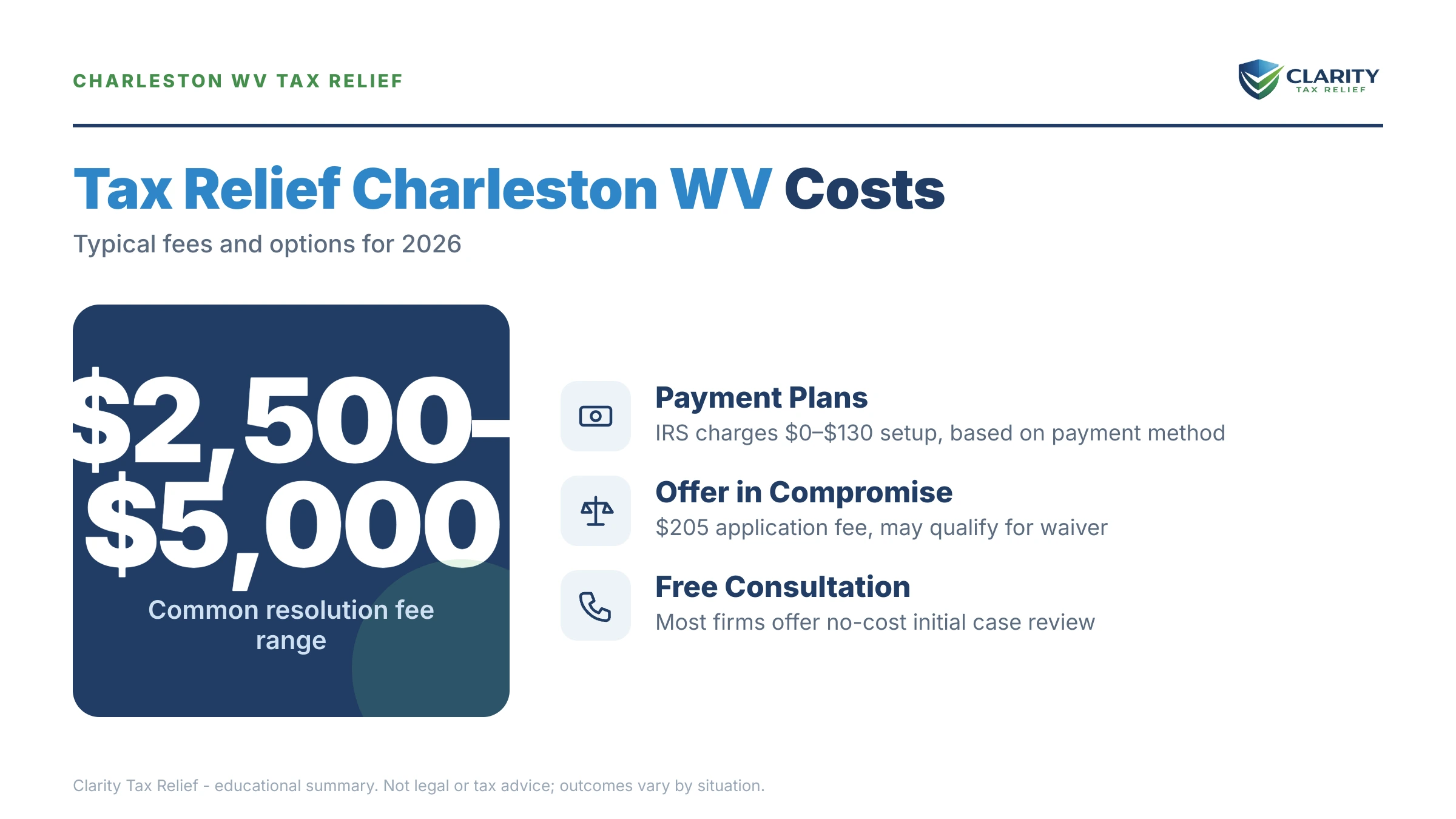
How much does tax relief cost in Charleston, WV?
The IRS's own programs are inexpensive: a short-term payment plan has a $0 setup fee, online installment agreements carry modest setup fees, and an Offer in Compromise costs a $205 application fee (waived with low-income certification). Professional representation is a separate cost that varies by case complexity — get flat-fee quotes in writing and compare before hiring anyone.
Can the IRS take my West Virginia state tax refund?
Yes. Through the State Income Tax Levy Program, the IRS can levy your West Virginia refund and apply it to your federal balance after sending a CP504 notice. Even on a payment plan, the IRS typically keeps federal and state refunds and applies them to what you owe, so do not count on refund money while a balance is open.
Do national tax relief companies work for Charleston, WV taxpayers?
Yes — tax resolution is federal work handled remotely, so a Charleston taxpayer has the same access to enrolled agents, CPAs, and tax attorneys as someone in a big city. What matters is credentials and fee transparency, not geography. Be cautious with any firm that promises a specific settlement before reviewing your IRS transcripts; no honest professional can promise an outcome upfront.
Your next 24 hours
- Find your real numbers. Log in (or sign up) at IRS.gov and note the balance for each year — then dig out any IRS or West Virginia notices and circle the response date printed on each one.
- Gather three things: your most recent tax return, a rough picture of your monthly income and expenses, and — if a refinance is in play — your latest mortgage statement.
- Get a free case review. Call (888) 825-7779 or use the 2-minute form and an experienced tax professional will map your IRS and West Virginia options — before another month of penalties and interest posts, and before a lien filing complicates your closing.
For self-service, the primary sources are the IRS's payment plans and installment agreements page, the West Virginia Tax Division, and — if the IRS system itself is causing you harm — the independent Taxpayer Advocate Service.
This guide is general information, not tax or legal advice for your specific situation. Eligibility for IRS programs depends on individual facts and circumstances; no outcome is guaranteed.