
Tax Relief by City
Tax Relief Sioux Falls: Your Real Options for IRS Back Taxes in 2026
The short answer: tax relief in Sioux Falls means federal IRS programs — South Dakota has no state income tax, so your back-tax debt is almost always owed to the IRS, not Pierre. Real options include installment agreements, Currently Not Collectible status, penalty abatement, and — when your finances genuinely qualify — an Offer in Compromise.
If you're searching "tax relief Sioux Falls," odds are the problem has been building quietly — unfiled 1099 years, an IRS letter or two you couldn't open all the way, and a balance you can only guess at. Here's the part that surprises most people: because South Dakota collects no personal income tax, there's exactly one creditor to deal with, and its programs are written down, means-tested, and usable. This page maps all of them.
⏱ The real clock: on every unfiled year, the failure-to-file penalty grows at 5% per month, capping at 25% of the unpaid tax — and interest compounds daily on the whole balance. If an IRS notice is already in your hand, the response date printed on that notice is the deadline that controls.
Why Sioux Falls back-tax problems are almost always IRS problems
South Dakota is one of the few states with no personal income tax, so a back-tax debt in Sioux Falls is federal in nearly every case. There's no state return to fall behind on, no state income-tax collector to negotiate with, and no second agency doubling your paperwork. That simplifies your situation more than you'd think — one debt, one agency, one defined set of programs.
It also explains why so many Sioux Falls tax debts start the same way. The metro runs heavy on 1099 work — delivery and rideshare drivers, construction subs, salon booth renters, freelancers serving the health systems and banks — and 1099 income arrives with zero tax withheld. Self-employment tax alone runs 15.3% before income tax, and every 1099-NEC and 1099-K your payers issued went to the IRS too. When returns don't get filed, the IRS's matching systems notice, even if it takes a couple of years.
The one exception: business owners. If you run a shop, restaurant, or contracting outfit, you can also owe the South Dakota Department of Revenue sales, use, or contractor's excise tax — covered in its own section below. For everyone else, the fix runs entirely through the IRS.
What happens if you ignore IRS back taxes in South Dakota
The IRS escalates unfiled years and unpaid balances on an automated track that ends in wage and bank levies — and nothing in South Dakota law slows that track down. For someone with unfiled returns, the sequence usually looks like this:
- CP59 and follow-up non-filer notices — the IRS's matching system flags a year with 1099s on file and no return. These are requests, not enforcement — the cheapest stage to fix everything.
- CP516 / CP518 — escalating demands to file. Ignore these and the IRS stops asking.
- Substitute for Return (SFR) — the IRS files for you using the raw 1099 totals: no mileage, no expenses, no deductions. The substitute return almost always assesses more than you'd owe on an accurate return, and a 90-day deficiency notice locks it in if you don't respond.
- Balance-due notices (CP14 → CP501 → CP503 → CP504) — once tax is assessed, the billing sequence begins. The CP504 threatens to levy your state tax refund — a lever that's mostly empty in South Dakota, since there's no state income-tax refund to seize. Don't mistake that for safety; the next letter has real teeth everywhere.
- LT11 / Letter 1058 — Final Notice of Intent to Levy — the LT11 starts a 30-day clock and your Collection Due Process rights (requested on Form 12153). After 30 days the IRS can garnish your paycheck — whether your employer is Sanford, Avera, a bank downtown, or a gig app — and levy your bank accounts. A bank levy freezes funds for 21 days before the money leaves; a wage levy is continuous until released.
Two more consequences arrive quietly at higher balances: a federal tax lien can attach to your home or vehicle titles, and once your assessed debt passes $66,000 (the 2026 threshold), the IRS can certify you to the State Department for passport denial. And don't count on 2026 staffing cuts to save you — the IRS workforce shrank roughly 27% in 2025, but these notices and levies are generated by automated systems that never took a day off. The humans got harder to reach; the machine kept collecting.
Behind on filings in Sioux Falls?
Unfiled years and a growing IRS balance don't resolve themselves — penalties and interest accrue every month you wait, and the notice sequence keeps advancing. Get your situation reviewed free by an experienced tax professional: what you actually owe, which program fits, and what to do first.
Tax relief options in Sioux Falls: what actually works in 2026
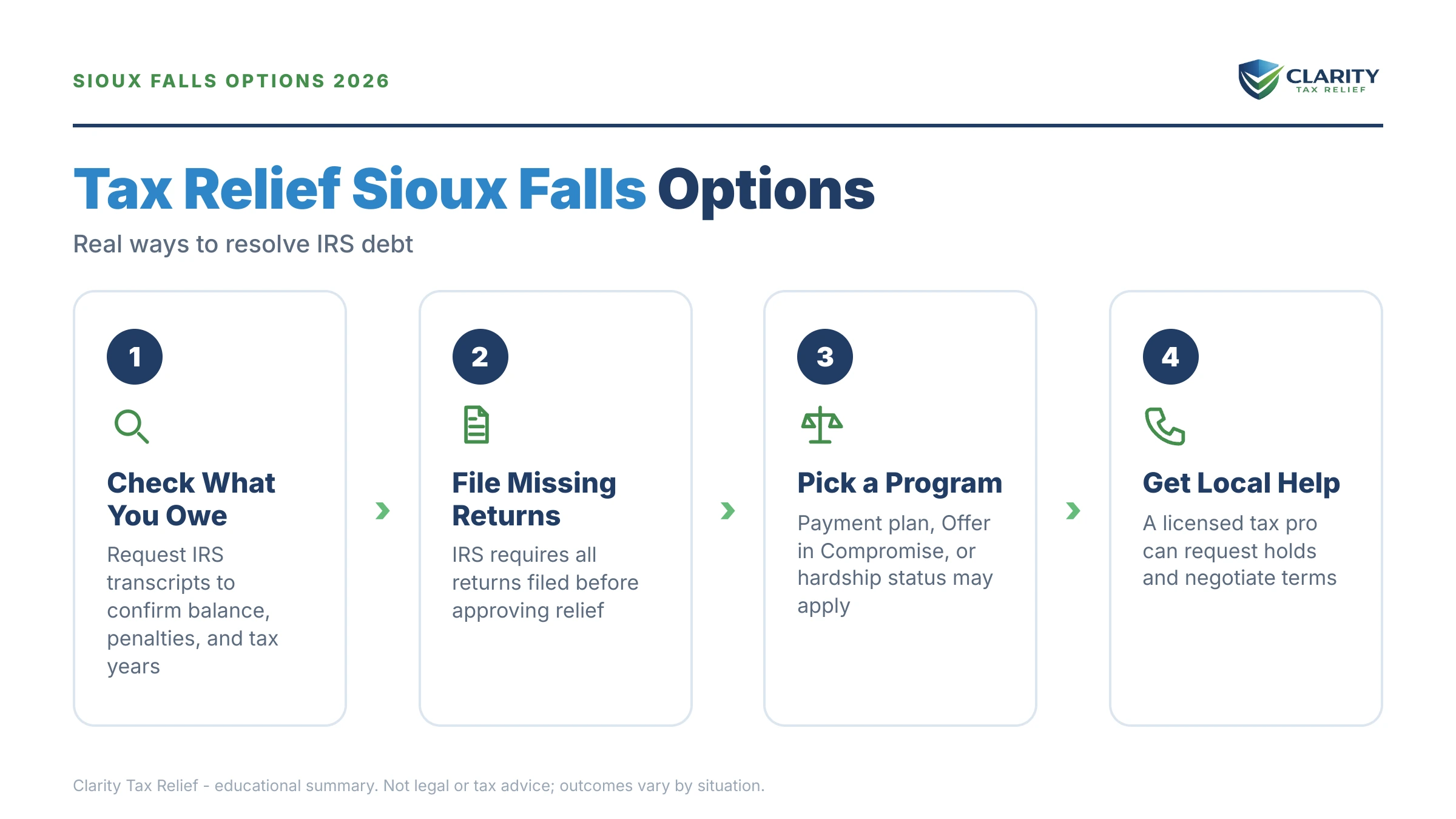
Every legitimate tax relief program available to a Sioux Falls taxpayer is an IRS program with published eligibility rules — nothing here requires a company to "unlock" it. For the full how-to on each program, see our guide to how to settle tax debt yourself; here's how they line up:
| Option | Best for | Eligibility basics |
|---|---|---|
| Short-term payment plan | Balances you can clear within 180 days | $0 setup fee; interest and penalties keep accruing |
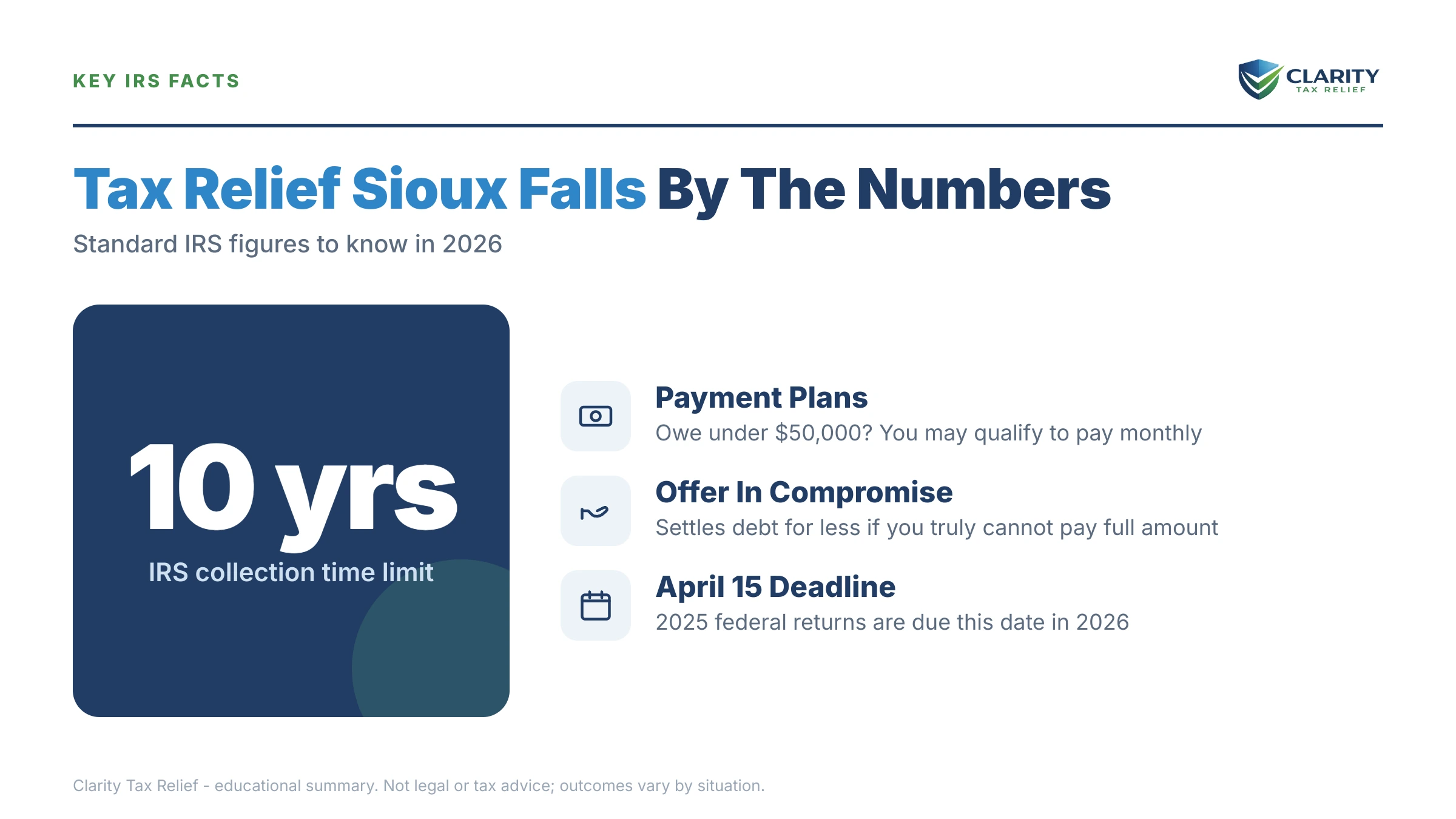
| Guaranteed installment agreement | Balances of $10,000 or less | Approval is required by law if you meet the filing and payoff conditions |
| Streamlined installment agreement | Balances up to $25,000 ($50,000 with direct debit) | Up to 72 months, set up online, no detailed financial disclosure |
| Currently Not Collectible | Genuine hardship — paying would leave you unable to cover basics | Financial disclosure (Form 433-F) against IRS allowable-expense standards |
| Offer in Compromise | Debts your assets and income truly can't cover | Means-tested; $205 fee and 20% down (both waived with low-income certification); roughly 1 in 5 offers accepted in FY2024 |
| First-time penalty abatement | Removing penalties on a first slip | Clean compliance for the 3 prior years; being replaced by the automatic AEP starting summer 2026 |
Two rules cut across all of them. First, you must be filed before the IRS will approve almost anything — unfiled years block payment plans, offers, and hardship status alike, which is why filing comes first in the step-by-step plan below. Second, interest and the failure-to-pay penalty keep running on every option except full payment; relief manages the debt, it doesn't freeze it.
What tax relief costs in Sioux Falls — and how long each option takes
An Offer in Compromise costs $205 to file; a short-term IRS payment plan costs nothing at all. The bigger cost variable is professional help, which for a typical Sioux Falls case runs from a few hundred dollars for a simple plan setup to a few thousand for a multi-year unfiled case or an OIC — our tax relief cost guide breaks down fair pricing in detail.
| Option | IRS fees | Typical timeline |
|---|---|---|
| Short-term plan (≤180 days) | $0 | Same day, online |
| Installment agreement | Setup fee applies; lowest with online direct debit, reduced or waived for low-income taxpayers | Same day online for balances up to $50,000 |
| Currently Not Collectible | $0 | After the IRS reviews your financial statement; status is revisited if income rises |
| Offer in Compromise | $205 + 20% down on lump-sum offers (both waived if AGI ≤ 250% of the poverty level) | Commonly many months; auto-accepted by law if the IRS doesn't decide within 2 years, with narrow exceptions — a returned or rejected offer stops the clock, and time during court disputes does not count |
| Penalty abatement | $0 | Often resolved by phone or letter; AEP becomes automatic starting summer 2026 |
| Filing back returns | $0 to the IRS (preparation costs vary) | Weeks to prepare; stops the failure-to-file penalty the day you file |
A worked example: $19,700 behind after three unfiled gig years
Say you've driven and delivered around Sioux Falls on 1099s for three years and never filed. Your accurate returns — mileage and expenses included — show $16,400 in combined self-employment and income tax. Because nothing was filed, the failure-to-file penalty maxed out at 25% on each year, adding roughly $4,100; failure-to-pay penalties and daily interest push the total to about $19,700 by the time you catch up in 2026. (You can rough out your own penalty math with our IRS penalty & interest calculator — it estimates, it doesn't promise.)
Here's how the options play out at that number:
- Streamlined installment agreement: $19,700 ÷ 72 months ≈ $274/month minimum. Interest and the 0.5%/month failure-to-pay penalty keep accruing, so paying more than the minimum shortens the payoff and cuts the total cost.
- First-time penalty abatement: if the three years before your first missed year were clean, FTA could remove the penalties on that oldest year — potentially over $1,000 back — and reasonable-cause arguments may reach the later years.
- Offer in Compromise: only if the math works. If IRS allowable-expense standards show almost nothing left after rent, food, and transportation, and you have no meaningful equity, your reasonable collection potential could sit far below $19,700 — that's the profile where an offer is worth pursuing. If your income comfortably supports $274/month, expect the IRS to say no and point you to a plan.
- Currently Not Collectible: if gig income has cratered and any payment would break your budget, CNC pauses collection entirely while the balance sits (and the 10-year collection clock keeps running).
The single most important move in this scenario isn't picking a program — it's filing. Filing accurate returns replaces the IRS's deduction-free numbers with yours, stops the 5%-per-month penalty, and unlocks every option above.
How to respond to IRS back taxes in Sioux Falls, step by step
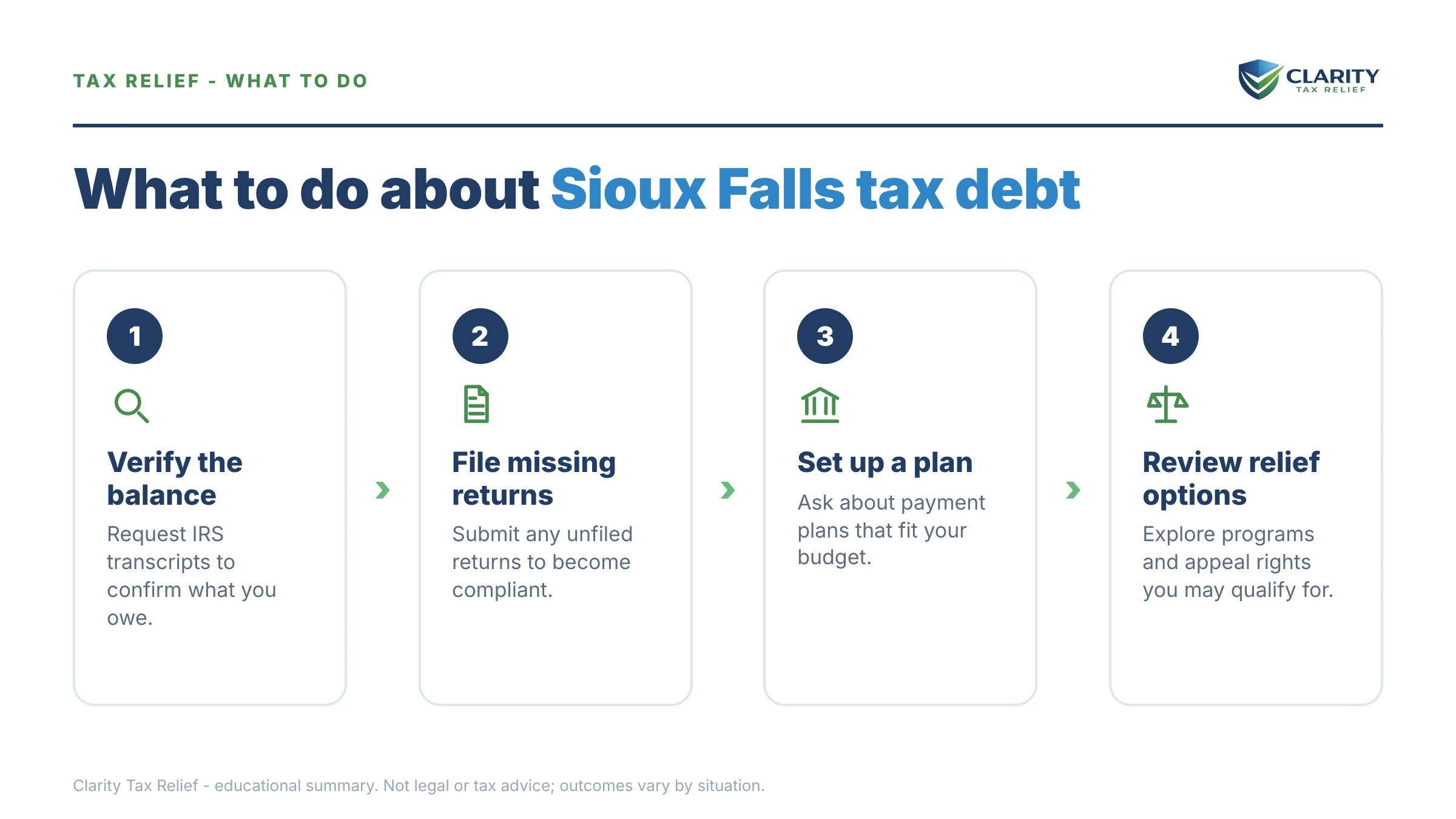
- Pull your IRS transcripts. Open an IRS online account and download your wage and income transcripts for each unfiled year so your returns match the 1099s the IRS already has.
- File every missing return. Filing stops the 5%-per-month failure-to-file penalty from growing and replaces any substitute return the IRS filed with its inflated numbers.
- Verify the real balance. Once the returns post, check your online account for the true total of tax, penalties, and interest — that number drives which program fits.
- Pick your resolution program. Match your balance and budget to a payment plan, Currently Not Collectible status, or an Offer in Compromise using the options table above.
- Request penalty relief. Ask for first-time abatement on any qualifying year and watch for the IRS's automatic penalty exemption rolling out in summer 2026.
- Get a free case review if anything is complicated. Multiple unfiled years, business income, or a levy already in motion are the situations where an experienced tax professional changes the outcome.
When you can handle this yourself — and when help changes the outcome
Plenty of Sioux Falls tax problems don't need a professional at all. If you're filed, you agree with the balance, and you owe an amount you can clear within 180 days or fit under the $50,000 online-plan ceiling, you can set everything up yourself in an afternoon on IRS.gov — no firm required, no fee beyond the IRS's own.
Experienced help earns its cost in specific situations: three or more unfiled years (like the example above, where return quality directly sets the debt), a substitute return already assessed against you, self-employment or business income that complicates the financial disclosure, an LT11 with the 30-day clock running, a levy already hitting your pay or bank account, or an Offer in Compromise — where the reasonable-collection-potential math decides everything and a badly built offer wastes months. If your situation includes payroll or sales tax from a business, see our buyer's guide to tax relief for small business — those cases follow different rules entirely.
If your three unfiled years sound familiar, our deep dive on what happens when you haven't filed taxes in 3 years — and the gig-specific guide for DoorDash driver tax debt — cover the filing side in detail. And if the numbers are pressing on you now, a free review with an experienced tax professional at Clarity or (888) 825-7779 can tell you in one call whether your case is a DIY afternoon or a represented resolution.
Choosing a tax relief company in Sioux Falls
Sioux Falls has no shortage of national firms advertising to it, and the quality gap between them is enormous. Because IRS work is federal and handled remotely through a Form 2848 power of attorney, a firm's zip code matters far less than three things: a credentialed professional (enrolled agent, CPA, or attorney) actually assigned to your case, a flat fee quoted in writing before you pay, and a realistic assessment — not a promised settlement — at the consultation stage. Anyone who "guarantees" a settlement before seeing your transcripts is selling, not evaluating.
Our guide to choosing a tax relief company walks through the full checklist, and if you're comparing the big advertisers, start with our Optima Tax Relief alternatives breakdown — the pricing-model and credential questions in it apply to every firm you'll find.
South Dakota state taxes: what the Department of Revenue can and can't do
The South Dakota Department of Revenue collects no personal income tax, so wage earners and gig workers in Sioux Falls will almost never owe the state anything on their earnings. Where the DOR does matter is business tax: sales and use tax on retail and service businesses, and the contractor's excise tax on construction work. Those are trust-style taxes the state treats seriously, and a business that collected sales tax from customers and didn't remit it should address the DOR promptly.
Don't map IRS rules onto the state — South Dakota has its own statutes, timelines, and procedures. For anything DOR-related, go straight to the source at the South Dakota Department of Revenue rather than guessing from federal rules. For your IRS balance, the official self-service starting points are IRS.gov/payments and the IRS payment plans page; if the IRS system itself is causing you harm — a levy despite an approved plan, for example — the independent Taxpayer Advocate Service exists for exactly that.
Tax relief in Sioux Falls: your questions, answered
Is there state income tax relief in South Dakota?
No, because South Dakota has no state income tax to relieve. If you live in Sioux Falls and owe back taxes, the debt is almost always federal, and every fix runs through IRS programs like installment agreements, Offers in Compromise, and penalty abatement. The exception is business owners, who can owe the South Dakota Department of Revenue sales, use, or contractor's excise tax.
Do I need a local Sioux Falls tax relief company, or can a national firm help?
IRS collection cases are federal, so location doesn't change the outcome — everything is handled by phone, mail, and the IRS's online systems through a Form 2848 power of attorney. What matters is whether the firm puts a credentialed professional (an enrolled agent, CPA, or attorney) on your case and quotes a flat fee in writing. A national firm with the right credentials can represent a Sioux Falls taxpayer exactly as well as someone downtown.
How much does tax relief cost in Sioux Falls?
Professional representation typically runs from several hundred dollars for a simple payment-plan setup to several thousand for an Offer in Compromise or a multi-year unfiled-return case. IRS fees are separate: $0 for a short-term plan, a modest setup fee for installment agreements, and a $205 application fee for an OIC — waived entirely if you qualify for the low-income certification. Get any professional fee quoted flat and in writing before you sign.
Can the IRS garnish wages in South Dakota?
Yes. Federal wage levies apply in every state, and South Dakota's lack of a state income tax offers no protection from the IRS. Before garnishing, the IRS must send a final notice — usually an LT11 — and give you 30 days to request a Collection Due Process hearing. Once a wage levy starts, it is continuous until the IRS releases it, so acting inside that 30-day window matters.
I haven't filed taxes in three years — am I in criminal trouble?
Almost certainly not. Ordinary non-filing is handled as a civil matter, and voluntarily filing before the IRS forces the issue is exactly what the system is designed to reward. The real risk of waiting is a substitute for return, where the IRS files for you with no deductions and assesses a bill far larger than what you'd owe on accurate returns.
Can I settle my IRS debt for less than I owe?
Sometimes — through an Offer in Compromise, but it's means-tested, not a discount program. The IRS accepted roughly 1 in 5 offers in FY2024, and acceptance turns on whether your assets and future income genuinely can't cover the balance before the 10-year collection statute runs out. If your income comfortably covers a monthly payment, expect the IRS to steer you to a payment plan instead.
Will the IRS know about my DoorDash or Uber income if I never filed?
Yes. Every 1099-NEC and 1099-K issued to you was also sent to the IRS, and its systems match those forms against filed returns automatically. That's how non-filers get CP59 notices and substitute returns years later. Filing accurate returns — with your mileage and expense deductions included — is how you shrink the number the IRS already has on file.
Your next 24 hours
- Find your latest IRS letter — note the notice code in the top corner, the amount, and any response date printed on it. No letters yet? That's a head start, not a reprieve: the matching system catches up.
- Gather your paper trail — every 1099 you can find, bank statements for the unfiled years, your last filed return, and a rough monthly budget. That's everything a resolution plan is built from.
- Get the free case review — call (888) 825-7779 or use the 2-minute form. An experienced tax professional will pull your IRS records, confirm what you actually owe across all years, and map the cheapest path out — before another month of penalties and interest posts.
This guide is general information, not tax or legal advice for your specific situation. Eligibility for IRS programs depends on individual facts and circumstances; no outcome is guaranteed.