
City Guides
Tax Relief Richmond: Real Options for IRS and Virginia Tax Debt in 2026
The short answer: tax relief Richmond residents actually qualify for comes from real government programs, not marketing: IRS payment plans of up to 72 months, Currently Not Collectible hardship status, penalty abatement, and the Offer in Compromise. If you owe under $50,000, you can usually set up an IRS plan online — and Virginia Tax debt is resolved separately.
The Social Security deposit lands on schedule every month — and lately, so do the IRS envelopes at your Richmond address. If a balance left over from an IRA withdrawal or an under-withheld pension has grown into a number you can't cover on a fixed income, the dread each time you open the mailbox is understandable. But the fix is more mechanical than it feels: the IRS runs on programs and arithmetic, and at least four of those programs are realistic for someone in exactly your position.
⏱ The real clock: there is no single deadline on tax debt itself — but interest plus a 0.5% monthly late-payment penalty accrue on an unpaid IRS balance every month, and the automated notice sequence keeps escalating toward levies whether or not anyone at the IRS reads your file. Every month of waiting makes every option below more expensive.
Why Richmond tax debt is a two-front problem
Richmond taxpayers answer to two separate collectors: the IRS and the Virginia Department of Taxation — which is headquartered right here in Richmond. That's not just trivia. It means a state balance in this city gets processed by the agency's home office, and it means resolving your IRS debt does nothing for a Virginia balance, or the reverse.
For retirees, the debt usually starts quietly. Nobody withholds tax from an IRA withdrawal unless you ask. Pension withholding set up years ago often doesn't match today's tax brackets. Selling a longtime home in Church Hill or Bon Air can trigger capital gains. A part-time 1099 gig has no withholding at all. The tax was legally due all along — it just never came out of the checks.
If your letters are coming from Virginia Tax rather than the IRS, start with our guide to Virginia back taxes — the state's rules, forms, and timelines are its own. This page covers both fronts, with the IRS first because its enforcement tools reach further.
What happens if you ignore IRS debt in Richmond
Unpaid IRS debt follows an automated notice sequence that ends in levies — including up to 15% of a Social Security check. The order is fixed, and each stage removes options the previous one still offered:
- CP14 — the first bill. You typically have about 21 days from the notice date before the system escalates (10 business days if the balance is $100,000 or more). No enforcement yet; every option is still open.
- CP501 / CP503 — reminder notices. Still bills, but the balance grows monthly and the file moves toward enforcement.
- CP504 — Notice of Intent to Levy. The IRS can now seize your Virginia state tax refund, and a federal tax lien becomes a real possibility.
- LT11 / Letter 1058 — the final notice. A 30-day clock starts, along with your Collection Due Process appeal rights. After it runs, levies can begin.
- Levy — a bank levy freezes funds for 21 days before they leave your account. A Social Security levy under the Federal Payment Levy Program takes up to 15% of your monthly benefit, and it repeats every month until the debt is resolved or released.
The Social Security levy is the stage that matters most for a Richmond retiree, because there's no employer to negotiate with and no next paycheck to rebuild from. Our guides on whether the IRS can garnish Social Security and the 15% Social Security levy cover how it starts and how it's released.
One 2026 reality check: the IRS workforce shrank roughly 27% in 2025, so reaching a human is harder than ever — but the notices and levies above are generated by computers that never got cut. Silence from the IRS is not the same as safety.
Owe the IRS or Virginia Tax on a fixed income?
Send us your letters. An experienced tax professional will map exactly where you are in the collection sequence and which program fits your budget — free and confidential, before interest and penalties add another month to the bill.
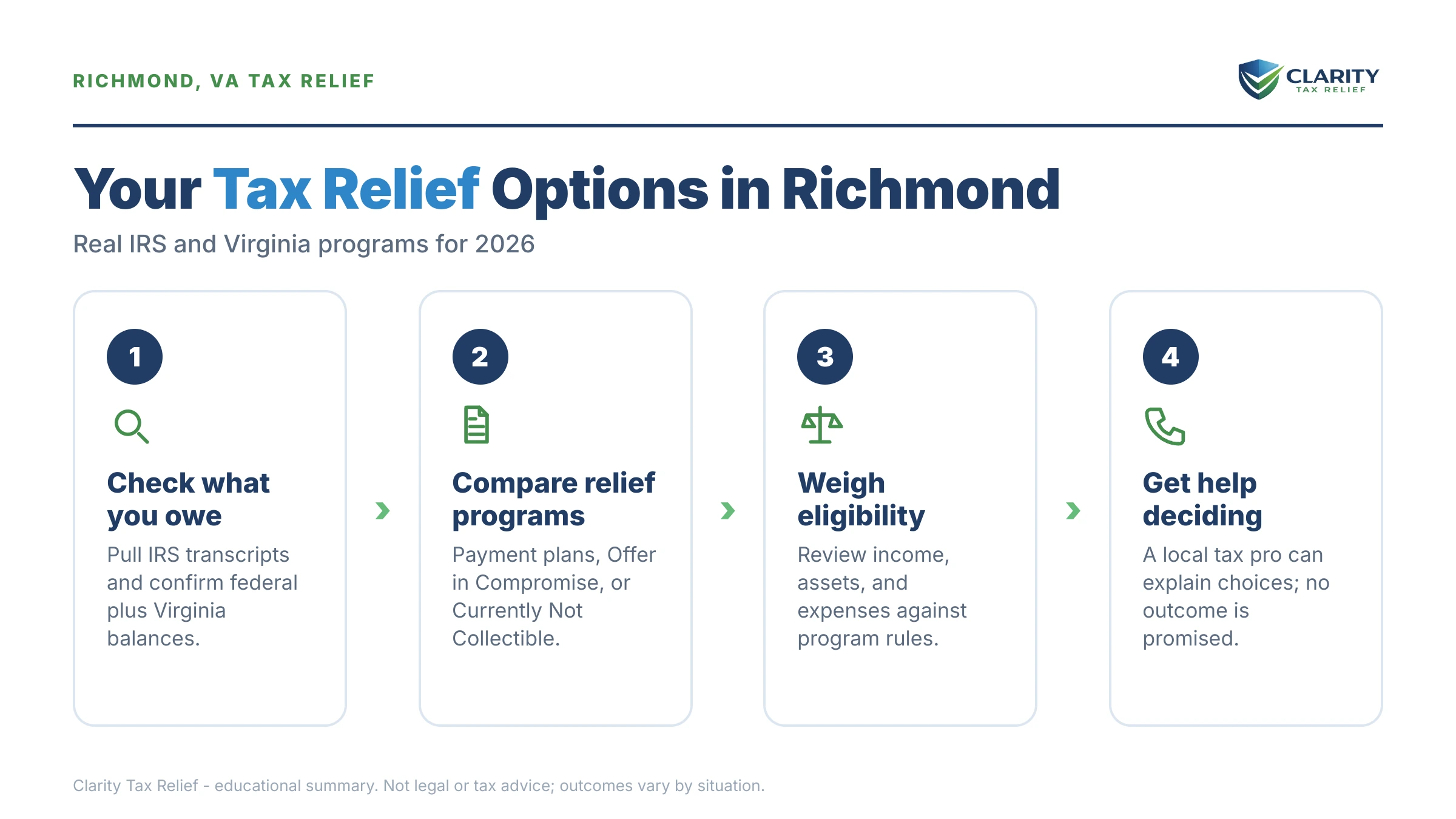
Tax relief Richmond residents actually qualify for
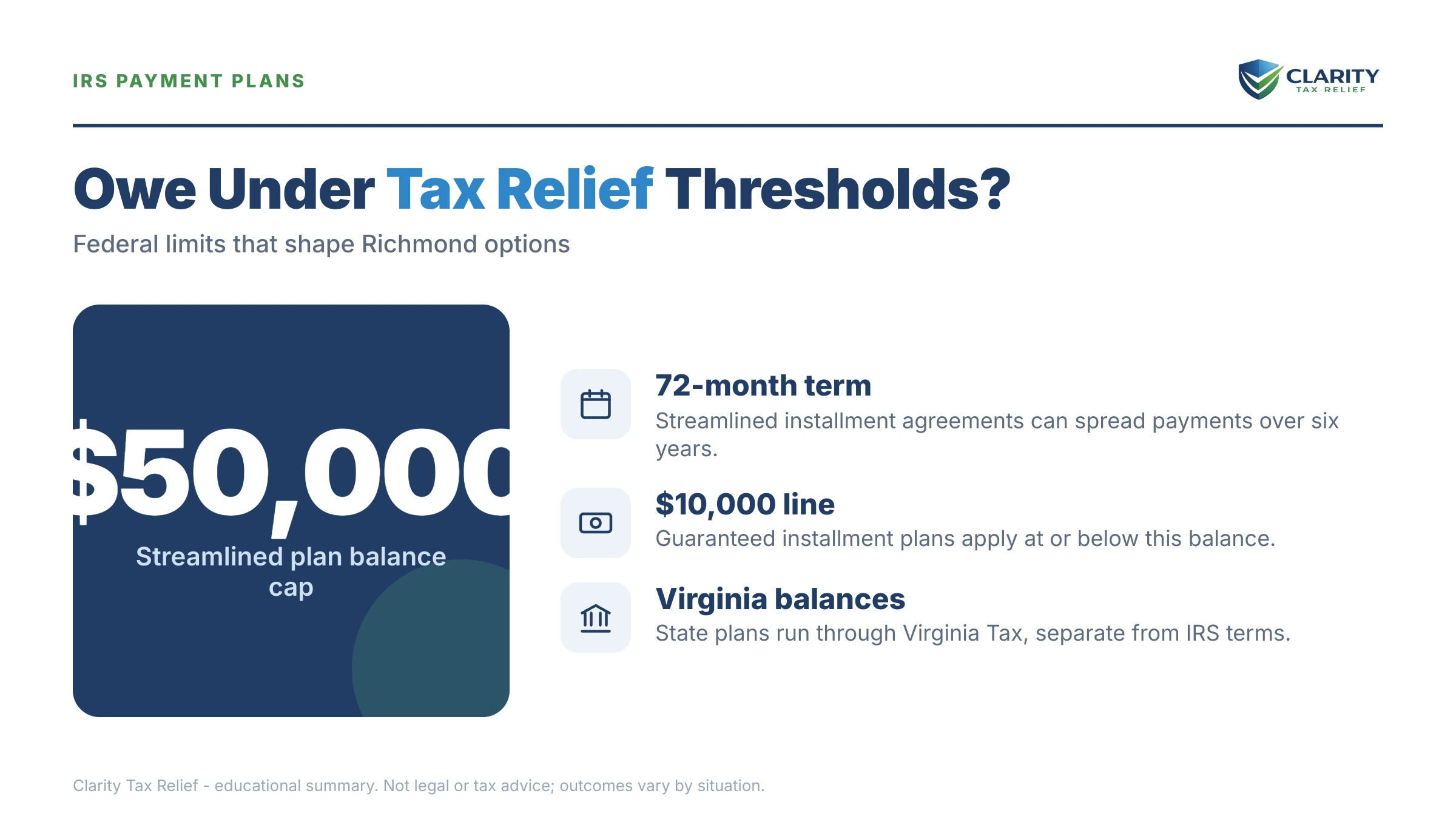
Most Richmond taxpayers who owe the IRS under $50,000 can qualify for a payment plan of up to 72 months without a detailed financial disclosure. That's the baseline. From there, the right program depends on what your income actually leaves over each month:
- Short-term payment plan — up to 180 extra days to pay in full, with no setup fee. Best when a maturing CD or a home sale is about to close the gap.
- Streamlined installment agreement — balances of $25,000 or less (up to $50,000 with direct debit) qualify for a monthly plan without a full financial statement. See how a streamlined installment agreement works. Balances of $10,000 or less can qualify for the IRS's guaranteed installment agreement.
- Currently Not Collectible (CNC) — if your Social Security and allowable living expenses leave nothing to pay, collection pauses entirely: no levies, no payment. The debt remains and the 10-year collection clock keeps running. Our guide to IRS hardship on Social Security walks through the fixed-income version of this test.
- Offer in Compromise (OIC) — settling for less than the balance when your assets and future income genuinely can't cover it. The IRS accepted roughly 1 in 5 offers in FY2024, so it's real but means-tested — the math below shows how the number is set.
- Penalty abatement — first-time penalty abatement removes penalties if your prior three years were clean, and reasonable cause applies for illness, disaster, or similar events. Starting summer 2026, the IRS's new Automatic Exemption from Penalty (AEP) applies qualifying relief automatically, with no request needed.
- Virginia Tax resolution — the state runs its own payment plans and its own offer process, on its own forms. A federal agreement never covers a Virginia balance.
| Option | Best for | Key eligibility threshold |
|---|---|---|
| Short-term plan (180 days) | Money arriving soon | Can pay in full within 180 days |
| Guaranteed installment agreement | Small balances | Owe $10,000 or less |
| Streamlined installment agreement | Steady income, mid-size balance | ≤ $25,000 (≤ $50,000 with direct debit); up to 72 months online |
| Currently Not Collectible | Fixed income covers only essentials | Allowable living expenses equal or exceed income |
| Offer in Compromise | No realistic way to ever pay in full | Assets + future income below the balance owed |
| Penalty abatement (FTA / AEP) | First slip after clean history | Clean compliance in the prior 3 years |
| Virginia Tax payment plan | State balance only | Set directly with the Virginia Department of Taxation |
What each option costs and how long it takes
Setting up IRS relief yourself costs between $0 and $205 in government fees — everything above that is professional help, which is optional. Here is the honest cost picture, so you can spot inflated quotes before signing anything (our guide to how much tax relief costs breaks down professional pricing in detail):
| Option | Government cost | Typical timeline |
|---|---|---|
| Short-term payment plan | $0 setup fee | Active within days; paid off within 180 days |
| Long-term installment agreement | Modest setup fee — lowest with direct debit; reduced or reimbursed for low-income taxpayers | Active within days to weeks; up to 72 months to pay |
| Currently Not Collectible | $0 | Weeks to place; the IRS reviews your finances periodically |
| Penalty abatement (FTA / AEP) | $0 | Often granted on a single phone call; AEP applies automatically starting summer 2026 |
| Offer in Compromise | $205 application fee — waived with low-income certification, along with the 20% down payment | Commonly several months to over a year; auto-accepted if the IRS doesn't decide within 2 years, with narrow exceptions — a returned or rejected offer stops the clock, and time during court disputes does not count |
| Professional representation | Flat fee, varies with complexity | Depends on the resolution pursued |
Worked example: resolving $19,700 on Social Security income
Say you're retired in Henrico County, your only income is $2,150 a month in Social Security, and the IRS says you owe $19,700 from two years of IRA withdrawals with no withholding. This is hypothetical, but the arithmetic is exactly how the IRS would run it:
- Payment plan: at $19,700 you're under the $25,000 streamlined threshold, so a 72-month plan is available online with no financial statement. The floor payment is $19,700 ÷ 72 ≈ $274 a month — and because interest keeps accruing (the late-payment penalty drops to 0.25% monthly while a plan is active), the real payoff runs higher. On a $2,150 budget, that may simply not fit.
- Currently Not Collectible: if rent, utilities, food, Medicare premiums, and out-of-pocket medical costs consume the full $2,150 under the IRS's allowable-expense standards, you can qualify for CNC. You pay $0, levies stop, and the 10-year collection statute keeps running toward expiration.
- Offer in Compromise: suppose you rent (no home equity), hold $2,500 in savings, and the expense standards leave $150 a month of disposable income. Your Reasonable Collection Potential for a lump-sum offer is roughly $2,500 in assets + ($150 × 12 months) = $1,800 in future income — an offer around $4,300. On roughly $25,800 a year, a single filer is likely under the low-income certification line (AGI at or below 250% of the poverty level), which waives the $205 fee, the 20% down payment, and payments during review.
Reasonable Collection Potential — assets plus what the IRS believes it could collect from your future income — is the entire game in an offer. You can estimate your own number with our Offer in Compromise Calculator before deciding whether the offer route is worth pursuing. And if your situation looks like this example, our guide for people who are retired and owe back taxes goes deeper on the fixed-income playbook.
IRS vs. Virginia Tax: two collectors, two rulebooks
The IRS collects for 10 years from the date a tax is assessed; Virginia sets its own collection rules, and no federal timeline or threshold carries over to a state balance. If you owe both, treat them as two separate cases:
| Question | IRS (federal) | Virginia Tax (state) |
|---|---|---|
| Who they are | Federal income tax collector | Virginia Department of Taxation, headquartered in Richmond |
| Payment plans | Online for balances ≤ $50,000, up to 72 months | Its own plans, arranged directly with the agency |
| Settling for less | Offer in Compromise (Form 656) | A separate state offer process with its own forms and standards |
| Social Security | Can levy up to 15% of benefits via the Federal Payment Levy Program | Doesn't tax Social Security benefits at all |
| Collection window | 10 years from assessment (the CSED), pausable by appeals, offers, or bankruptcy | State-specific — never assume the federal 10-year rule applies; confirm with Virginia Tax |
One practical note on order: because Virginia can intercept your state refund and the IRS can seize it too once a CP504 issues, resolving whichever agency is furthest along in enforcement first usually protects the most.
How to get tax relief in Richmond, step by step
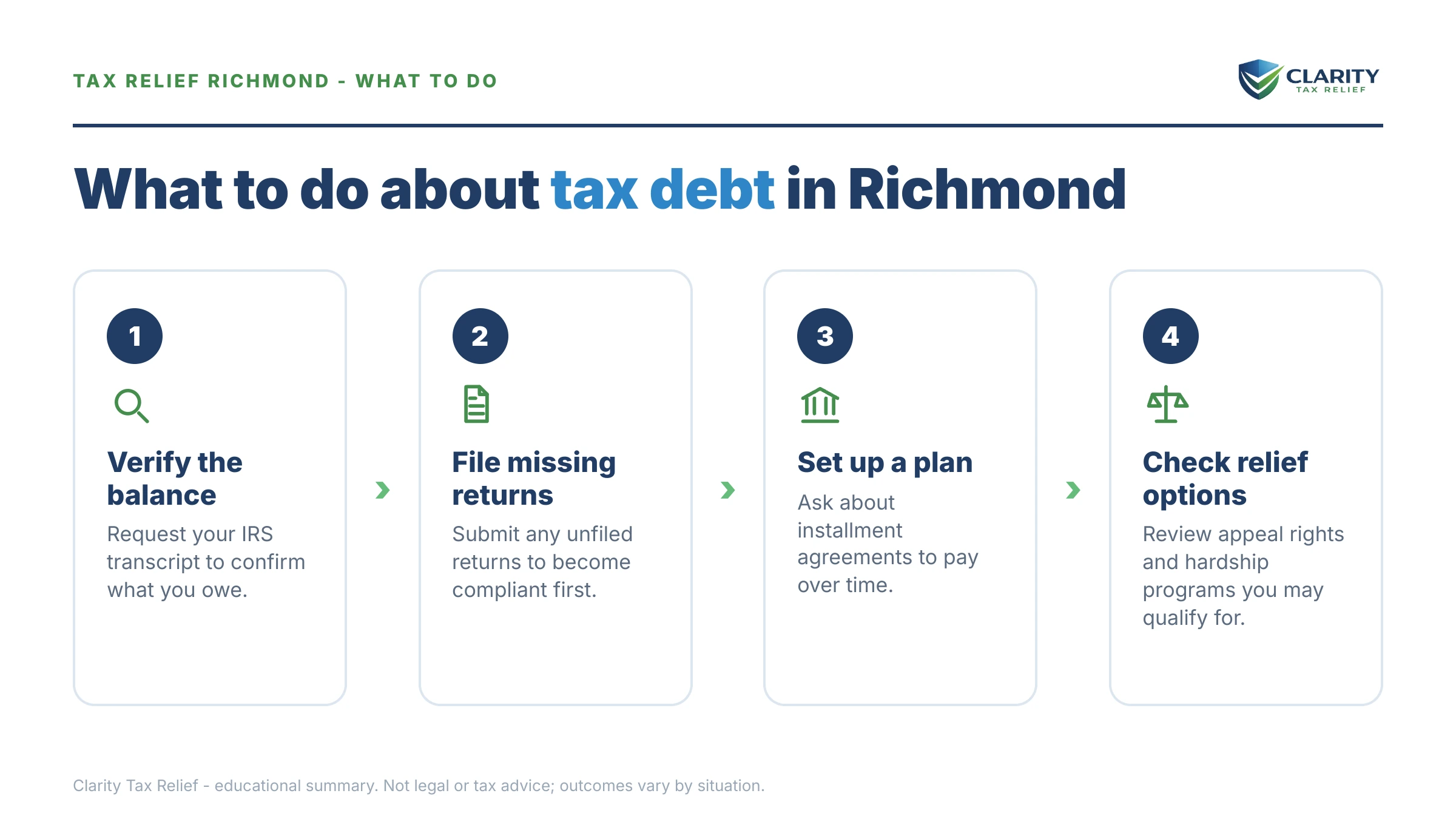
- Pull your IRS account records. Set up an IRS online account to confirm exactly what you owe, which tax years are open, and how much of the balance is penalty versus tax.
- Check for a separate Virginia Tax balance. Contact the Virginia Department of Taxation to confirm whether you owe the state too — Virginia debt is collected separately under its own rules and is never included in an IRS resolution.
- Request penalty relief first. If your prior three years are clean, ask for first-time abatement before negotiating the balance — shrinking the penalties shrinks the number you have to resolve.
- Match your finances to one program. Run your income and allowable expenses through the Form 433-F framework to see whether a payment plan, Currently Not Collectible status, or an Offer in Compromise genuinely fits your numbers.
- Get help if enforcement is in motion. If a levy notice has arrived, your Social Security is being reduced, or you owe for multiple years, have an experienced tax professional review your case before you commit to anything.
When you can handle this yourself — and when to hire help
You can resolve most balances under $25,000 yourself if you agree with the amount and your income is stable. Setting up a streamlined plan online takes an afternoon, first-time abatement is often a single phone call, and our DIY pillar on how to settle tax debt yourself walks through every program without a fee.
Experienced help changes outcomes in specific situations: a levy already hitting your bank account or Social Security, multiple unfiled years that must be sequenced before any agreement, an Offer in Compromise where the RCP math decides thousands of dollars, or parallel IRS and Virginia Tax cases that have to be coordinated. In those cases representation isn't a luxury — it's leverage you don't have alone.
If you do hire, hire carefully. Richmond gets the same national tax-relief advertising as everywhere else, and some of it overpromises. Use our how to choose a tax relief company checklist, and if you're comparing the big advertisers, start with our Optima Tax Relief alternatives breakdown. Any firm promising a specific settlement before seeing your financials is guessing — the IRS decides eligibility, not the salesperson.
Free and low-cost tax help in Richmond
Richmond is home to the Community Tax Law Project, one of the oldest low income taxpayer clinics in the country — it represents qualifying taxpayers in IRS disputes for free or a nominal fee, generally when income is at or below roughly 250% of the federal poverty level. For a retiree on Social Security alone, that threshold is often within reach.
Three more resources worth knowing: the Taxpayer Advocate Service can intervene when an IRS action or delay causes financial hardship; the IRS runs a Taxpayer Assistance Center in Richmond for in-person account help, by appointment only (call 844-545-5640 to schedule); and every IRS payment and payment-plan application lives at IRS.gov/payments — never pay a balance through anyone else's portal. For state balances, the Virginia Department of Taxation's official site is tax.virginia.gov.
Terms you'll hear, decoded
- Offer in Compromise (OIC): the IRS program for settling a tax debt for less than the full balance when your finances show you could never pay it all.
- Currently Not Collectible (CNC): a hardship status that pauses IRS collection — no levies, no required payment — while the debt technically remains.
- CSED: the Collection Statute Expiration Date — the end of the IRS's 10-year window to collect, though appeals, offers, and bankruptcy pause the clock.
- FPLP: the Federal Payment Levy Program, which lets the IRS take up to 15% of federal payments like Social Security benefits.
- RCP: Reasonable Collection Potential — the asset-plus-future-income formula the IRS uses to price an acceptable offer.
- Fresh Start: a marketing umbrella for the ordinary IRS programs above — not a separate application, and not new forgiveness.
Richmond tax relief questions, answered
Can the IRS take my Social Security check in Richmond?
Yes — the IRS can take up to 15% of your monthly Social Security benefit through the Federal Payment Levy Program, and the deduction continues every month until the debt is resolved or the levy is released. It only happens after the full notice sequence runs, so responding before the final notice usually prevents it. SSI payments are exempt from this program.
Does Virginia tax Social Security benefits?
No — Virginia does not tax Social Security benefits, so those checks won't create a state income tax balance. Pension and IRA withdrawals are generally taxable in Virginia, though, and can leave you owing the Virginia Department of Taxation. And the state exemption doesn't stop the IRS: federal debt can still reach up to 15% of your benefit through a levy.
How much does tax relief cost in Richmond?
Doing it yourself costs almost nothing: an IRS short-term plan has a $0 setup fee, long-term plans charge a modest fee that's lowest with direct debit, and an Offer in Compromise costs $205 — waived entirely if you qualify for low-income certification. Professional representation is typically quoted as a flat fee that scales with complexity; get the quote in writing before paying anyone.
Do I need a local Richmond tax attorney, or can a national firm help?
IRS resolution is federal, so an enrolled agent, CPA, or tax attorney anywhere in the country can represent you — nearly all of the work happens by phone, mail, and IRS systems rather than in person. Local knowledge matters more for Virginia Department of Taxation issues or if you simply want to meet face to face. What matters most is that a credentialed professional actually works your case under a written flat-fee agreement.
Does Virginia have its own offer in compromise?
Yes — the Virginia Department of Taxation runs its own offer-in-compromise process with forms and standards separate from the IRS program. An accepted federal offer does not settle a Virginia balance, and a state settlement does not touch IRS debt; if you owe both, each needs its own resolution. Start with whichever agency's enforcement is furthest along.
Is there free tax debt help in Richmond?
Yes. Richmond is home to the Community Tax Law Project, one of the country's oldest low-income taxpayer clinics, which represents qualifying taxpayers in IRS disputes for free or a small fee — eligibility generally requires income at or below roughly 250% of the federal poverty level. The Taxpayer Advocate Service can also step in when an IRS action or delay is causing you financial hardship.
Will the IRS settle my tax debt for less than I owe?
Only when the math supports it — the IRS accepted roughly 1 in 5 offers in FY2024. Acceptance turns on your Reasonable Collection Potential: your assets plus your future disposable income, not how compelling your letter is. A retiree with no home equity and little monthly surplus can be a genuine candidate; someone whose savings or equity exceeds the balance will be told to pay instead.
Your next 24 hours
- Find your most recent IRS letter and note the notice number in the top corner and the date — together they tell you exactly where you are in the collection sequence and how much time the current stage allows.
- Gather three things: your last filed tax return, every IRS and Virginia Tax letter you've received, and a simple list of your monthly income and essential expenses. That's everything any program decision needs.
- Get a free case review — call (888) 825-7779 or use the 2-minute form. Whether you're facing the IRS, Virginia Tax, or both, an experienced tax professional can match your numbers to the right program now, while interest and penalties are still the only thing accruing.
This guide is general information, not tax or legal advice for your specific situation. Eligibility for IRS programs depends on individual facts and circumstances; no outcome is guaranteed.