
City Guides
Tax Relief in Milwaukee: Every Real Option for IRS and Wisconsin Tax Debt (2026)
The short answer: tax relief in Milwaukee usually means resolving debt with two separate agencies — the IRS and the Wisconsin Department of Revenue — through payment plans of up to 72 months, an Offer in Compromise, hardship status, or penalty abatement. The right option depends on how much you owe, your income, and which agency is escalating first.
You searched "tax relief Milwaukee" because a balance you can't write a check for is sitting in a letter on your table — maybe from the IRS, maybe from the Wisconsin Department of Revenue, maybe both in the same month. That's the part nobody warns you about: two collectors, two sets of rules, one paycheck. The good news is that every piece of this is fixable through defined programs with published thresholds, and this guide maps all of them.
⏱ The real clock: there is no single deadline on tax debt itself — but the IRS failure-to-pay penalty adds 0.5% of your balance every month, interest compounds daily on top, and each unanswered notice moves you one stage closer to a levy. The Wisconsin DOR runs its own separate collection clock at the same time.
Why tax debt in Milwaukee is a two-agency problem
Most Milwaukee tax-debt cases involve two separate collectors — the IRS and the Wisconsin Department of Revenue — and resolving one does nothing to stop the other. Wisconsin has a state income tax, the IRS and state revenue agencies share return data, and an underpaid federal return very often produces an underpaid Wisconsin return for the same year.
One piece of good news that surprises out-of-state readers: Wisconsin municipalities, including Milwaukee, do not levy a local income tax. There is no third income-tax collector. Your income-tax problem is federal, state, or both — property taxes are billed locally through an entirely separate system.
The two agencies also intersect in one painful way. If you ignore an IRS balance long enough, the IRS can seize your Wisconsin state refund through the State Income Tax Levy Program — that's exactly what a CP504 notice warns about. Meanwhile, the DOR intercepts state refunds for its own balances. The refund you were counting on next spring may already be spoken for by one agency or the other.
For the state side in depth — how DOR collection works, its programs, and how to contact it — see our full guide to Wisconsin back taxes. This page focuses on the complete option set and how to sequence a case that touches both agencies.
What happens if you do nothing
Ignored tax debt in Milwaukee escalates on two automated tracks at once, and neither track waits for the other. On the federal side, the sequence runs in a fixed order:
- First bill (CP14) — the IRS states the balance. No enforcement yet, but penalties and interest are already running.
- Reminder notices (CP501 / CP503) — still just bills. The balance grows every month you wait.
- CP504 — Notice of Intent to Levy — after this window (typically 30 days), the IRS can take your Wisconsin state refund under IRC §6331(d). A federal tax lien becomes a real possibility.
- LT11 / Letter 1058 — Final Notice — starts a 30-day clock and your Collection Due Process rights (requested on Form 12153). After it passes, the IRS can garnish wages and levy bank accounts.
- Active levy — a bank levy freezes funds with a 21-day hold before the money is sent; a wage levy is continuous until released; Social Security can lose up to 15% through the Federal Payment Levy Program. Once your certified balance passes $66,000 (the 2026 threshold), your passport can be denied or revoked.
Don't count on IRS understaffing to save you. The IRS workforce was cut roughly 27% in 2025, per TIGTA reports — which makes a human harder to reach — but the notices, liens, and levies above are issued by automated systems that never stopped running.
The Wisconsin DOR escalates on its own parallel track: a bill, then a delinquent account with added collection costs, then enforced collection — the DOR can attach wages, levy bank accounts, and intercept your state refund. Wisconsin's stages, timelines, and appeal windows are its own; when a DOR letter gives you a response date, that date controls, and the agency itself (revenue.wi.gov, linked below) is the authority on its process.
Owe the IRS or the Wisconsin DOR — or both?
Get your Milwaukee case reviewed free before another month of penalties and interest posts. An experienced tax professional will pull your balances, map both agencies, and tell you exactly which option fits — no pressure, no obligation.
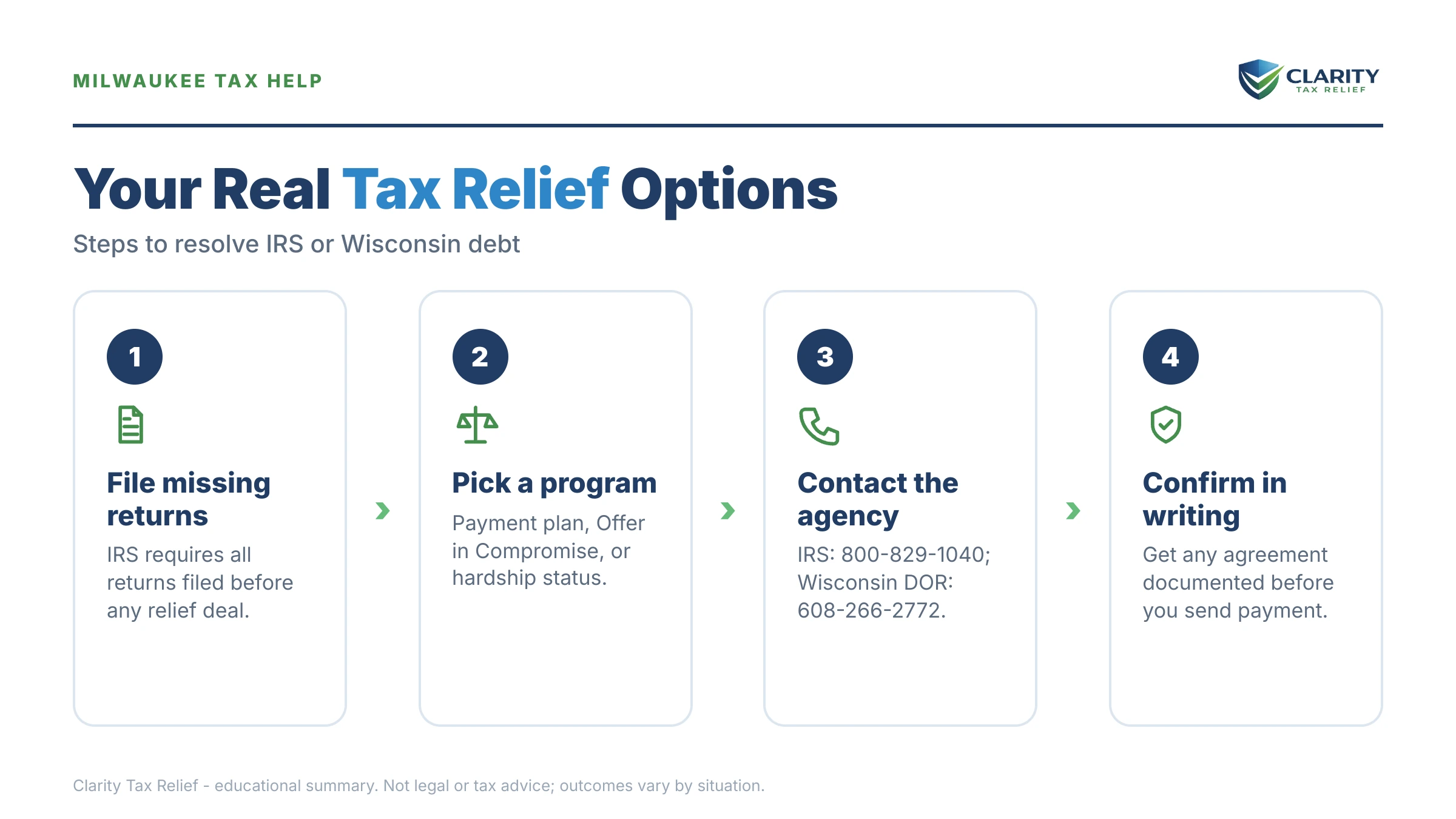
Your options: every tax relief program available to Milwaukee taxpayers
The IRS offers five main resolution paths, each with a published eligibility threshold — and the Wisconsin DOR maintains its own separate payment arrangements. Here is the full menu:
| Option | Who qualifies | Cost & notes |
|---|---|---|
| Short-term IRS payment plan | You can pay in full within 180 days | $0 setup fee; penalties and interest continue until paid |
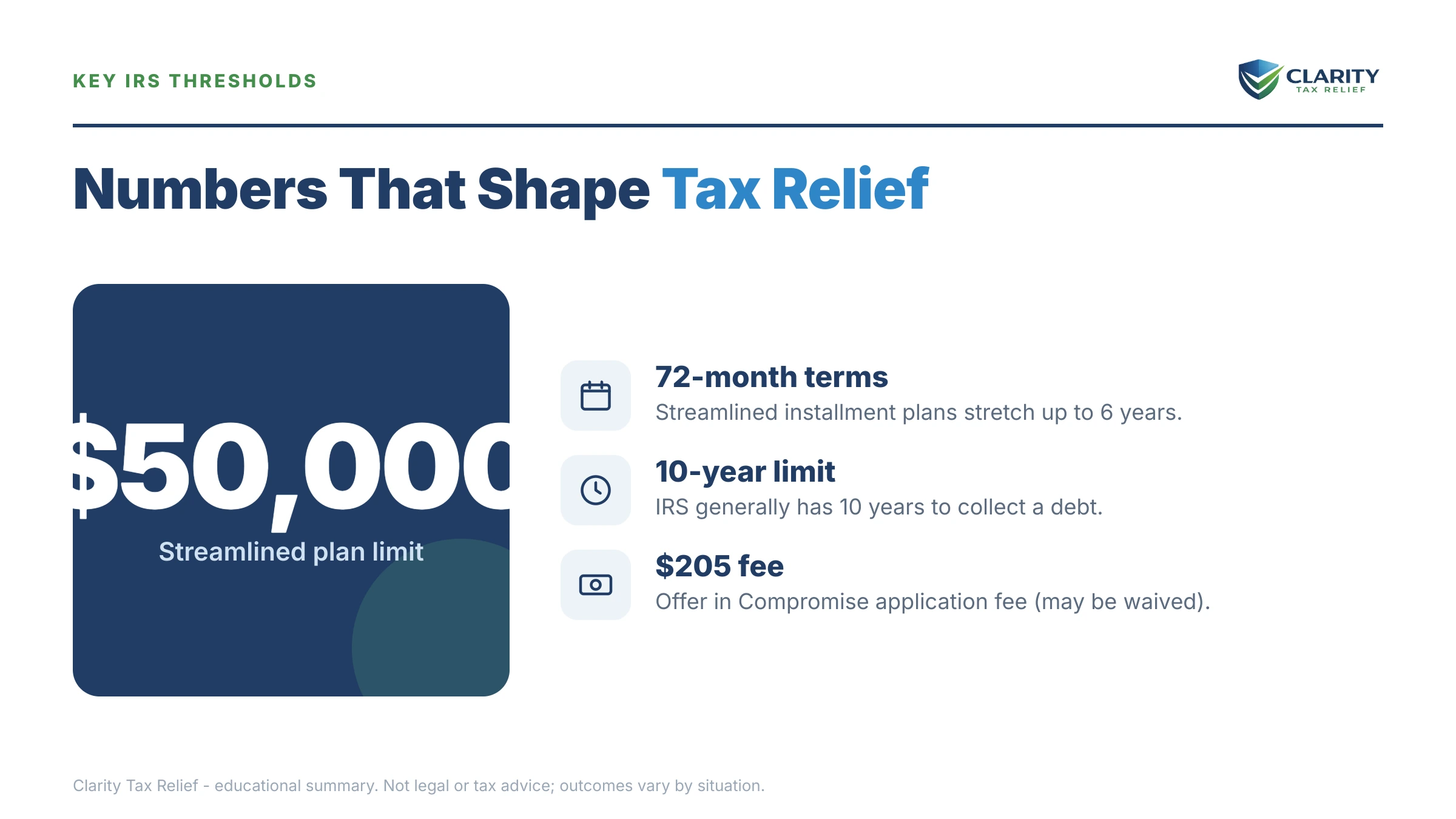
| Streamlined installment agreement | Individuals owing $50,000 or less; up to 72 months, set up online | Setup fee varies (lower with direct debit); interest and late-payment penalty continue |
| Guaranteed installment agreement | Owe $10,000 or less, can pay within 3 years, clean recent filing history | Approval is required by statute when the conditions are met |
| Offer in Compromise | Assets plus future income genuinely cannot cover the balance | $205 application fee; 20% down on lump-sum offers — both waived with low-income certification (AGI ≤ 250% of poverty) |
| Currently Not Collectible | Income covers only basic living expenses under IRS standards | $0; collection pauses, but the balance keeps growing and refunds are kept |
| Penalty abatement (FTA / AEP) | Clean compliance for the prior 3 years (FTA); AEP applies automatically starting summer 2026 | Removes penalties, not the tax or interest |
| Wisconsin DOR payment arrangement | State balances; terms set by the DOR | Arranged directly with the DOR — completely separate from any IRS agreement |
Payment plans are the workhorse. Balances of $50,000 or less can be arranged online without mailing a single form — our walkthrough on how to set up an IRS payment plan online covers it screen by screen. Enforcement stops once the agreement is active, though interest and a reduced late-payment penalty keep accruing.
The Offer in Compromise is real but means-tested: per IRS data, the IRS accepted roughly 1 in 5 offers in FY2024, and acceptance turns entirely on whether your assets and future income can cover the debt — see how an offer in compromise actually works before anyone charges you to file one. One structural safeguard worth knowing: if the IRS doesn't decide your offer within 2 years, it's accepted automatically — with narrow exceptions: a returned or rejected offer stops the clock, and time during court disputes does not count.
Currently Not Collectible pauses collection when paying anything would leave you unable to cover rent, food, and transportation under IRS standards — the details are in our guide to Currently Not Collectible status. Penalty relief can shrink the balance itself: first-time penalty abatement removes penalties if your prior 3 years were clean, and starting summer 2026 the new Automatic Exemption from Penalty (AEP) applies similar relief automatically, with no request needed.
If you want to run this process without hiring anyone, our complete DIY pillar on how to settle tax debt yourself walks through every program above in full — this page stays focused on the Milwaukee-specific picture.
A worked example: a Milwaukee W-2 employee who owes $11,300
Say you owe the IRS $11,300 — a single W-2 employee on the north side whose withholding came up short for two years running. Here's the honest math on each path, all figures hypothetical:
- Cost of waiting: the failure-to-pay penalty alone is 0.5% × $11,300 = about $56 added every month, with daily-compounding interest on top. Doing nothing for a year costs roughly $700 in penalties before interest. You can estimate your own accrual with our Penalty & Interest Calculator.
- Short-term plan (180 days): $11,300 ÷ 6 ≈ $1,884/month. Brutal on a single income, but the setup fee is $0 and total accruals stay small because the balance dies fast.
- Streamlined 72-month plan: the arithmetic floor is $11,300 ÷ 72 ≈ $157/month — but at that pace, accruing interest and penalty consume a large share of each payment. Something closer to $250–$300/month retires the debt years sooner and much cheaper.
- The under-$10,000 tactic: pay $1,301 up front to bring the balance to $9,999, and you're in guaranteed installment agreement territory — if you can pay within 3 years and your recent filing history is clean, the IRS must approve the plan.
- Offer in Compromise: probably not a fit here, and an honest reviewer will say so. With a steady paycheck and even $200–$300 of monthly room in the budget, the IRS's own math says it can collect $11,300 in full over time — so it has no reason to accept less.
- Penalty abatement: the quiet win. If the prior 3 years were clean, first-time abatement can strip the accumulated penalties off the balance — often worth several hundred dollars or more on a debt this age — and it stacks with any payment plan.
Now add a $1,400 Wisconsin DOR balance for the same years — common when federal withholding was short. The state piece needs its own arrangement, and your state refund will be intercepted (by one agency or the other) until both balances are resolved.
The deadlines that matter — and the rights each one protects
Every IRS enforcement step is preceded by a notice with a fixed response window, and each window protects a specific right. This table is the map:
| Notice or event | Your window | What is at stake |
|---|---|---|
| CP504 — intent to levy state refund | Typically 30 days from the notice date | The IRS can seize your Wisconsin state refund under §6331(d) |
| LT11 / Letter 1058 — final notice | 30 days to request a Collection Due Process hearing (Form 12153) | Miss it and the IRS can levy wages and bank accounts — and you lose the CDP path to Tax Court review |
| Bank levy issued | 21-day hold before your bank sends the funds | Your last window to prove hardship or error before the money leaves |
| Balance certified at $66,000+ (2026) | Until certification is reversed | The State Department can deny or revoke your passport |
| 10 years after assessment (CSED) | The collection statute expires | The IRS generally loses the right to collect — but appeals, offers, and bankruptcy pause the clock |
Wisconsin DOR letters carry their own response dates and appeal rights, on the state's own timelines — the date printed on your DOR letter is the one that controls, so read it before anything else.
How to get tax relief in Milwaukee, step by step
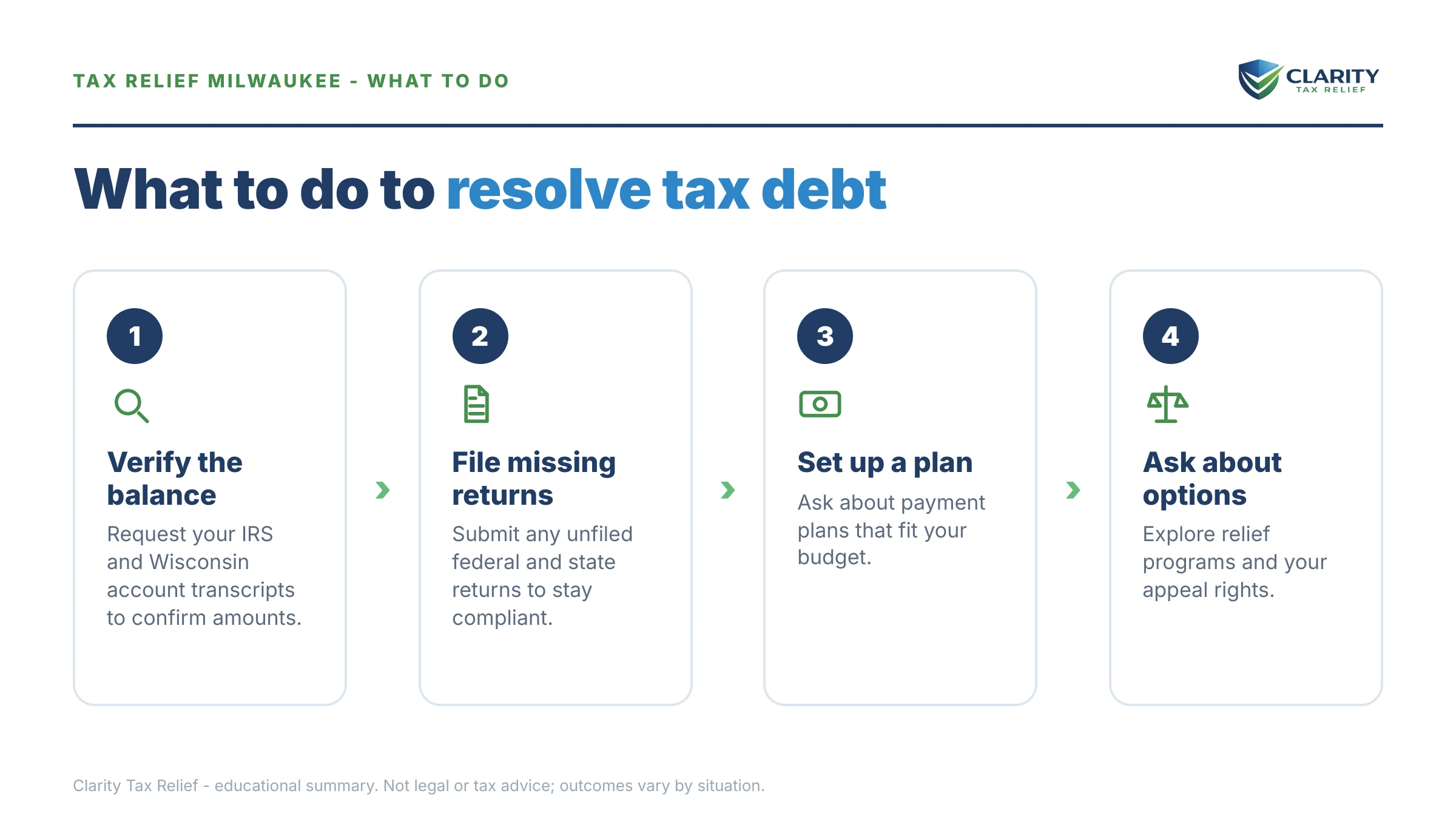
- Pull your records from both agencies. Create or log into your IRS online account to see exact balances by year, and gather every letter you have received from the Wisconsin Department of Revenue.
- Confirm every required return is filed. The IRS will not approve a payment plan or an offer while returns are missing, and unfiled years hide the true size of the problem — federal and state.
- Match your numbers to a resolution. Compare what you owe against your real monthly budget to pick a payment plan, hardship status, an offer, or penalty relief — the table above shows the thresholds.
- Set it up before enforcement starts. Individual IRS balances of $50,000 or less can usually be arranged online in under an hour; once an agreement is active, levies stop.
- Close out the second agency. Whichever agency you resolved first, contact the other and put an arrangement in place — an open state balance can undo the stability you just bought on the federal side.
How to choose tax relief in Milwaukee: local office vs. national firm
IRS representation is federal law practice, so an enrolled agent, CPA, or tax attorney can represent a Milwaukee taxpayer from anywhere in the country — a downtown office adds nothing to a federal case. What actually separates good help from expensive disappointment:
- Who works the file. Ask whether a credentialed professional — not a salesperson — will review your transcripts and sign the power of attorney (Form 2848).
- How the fee works. A flat fee quoted in writing after a real case review beats an open-ended retainer. Anyone quoting a settlement figure — or promising the IRS will take pennies on the dollar — before seeing your financials is selling a script, not a result. That phrase is the oldest scam in this industry.
- State experience. Because most Milwaukee cases include a Wisconsin DOR balance, ask specifically how the firm handles state collections. A firm that only works federal cases leaves half your problem open.
Our full buyer's checklist on how to choose a tax relief company lists the exact questions to ask, and if you've been quoted by a heavily-advertised national brand, the comparison of Optima Tax Relief alternatives shows what to check before signing. Business owners — a bar on Brady Street, a contractor in West Allis — face different rules (payroll debt, trust-fund exposure) and should start with our guide to tax relief for small business.
When you can handle this yourself — and when help changes the outcome
Plenty of Milwaukee tax problems don't need a professional at all. Handle it yourself if:
- You agree with the balance and can pay it within 180 days — the short-term plan is free to set up and takes minutes online.
- You owe one year, under $50,000, and just need a monthly plan — the streamlined agreement is designed for exactly this.
- Your only issue is a penalty and your prior 3 years were clean — first-time abatement is a phone call or a letter.
Experienced help genuinely changes outcomes when the stakes or complexity jump: a levy or wage attachment already in motion (federal or DOR), multiple unfiled years across both agencies, business or payroll tax debt, an Offer in Compromise where the financial-disclosure math decides everything, or two agencies escalating at once and you don't know which fire to put out first. In those cases, the order you fix things in — returns, penalties, then the balance, then the second agency — changes the total you pay.
Terms on your letters, decoded
- Lien: a legal claim against your property securing the debt — it doesn't take anything, but it clouds title and complicates selling or refinancing.
- Levy: the actual taking — wages, bank funds, or your state refund. Liens claim; levies collect.
- CSED: the Collection Statute Expiration Date — the IRS generally has 10 years from assessment to collect, though appeals, offers, and bankruptcy pause the clock.
- CDP rights: your Collection Due Process right to a hearing (and Tax Court review) before levy, triggered by the LT11/Letter 1058 and requested on Form 12153 within 30 days.
- SITLP: the State Income Tax Levy Program — the mechanism the IRS uses to take a Wisconsin state refund for a federal debt.
Tax relief Milwaukee: your questions, answered
Do I need a local Milwaukee tax relief office, or can a national firm handle my case?
IRS representation is federal, so an enrolled agent, CPA, or tax attorney can represent you before the IRS from anywhere in the country — a downtown Milwaukee office adds nothing to a federal case. What matters is who actually works your file, whether the fee is flat and quoted in writing, and whether the firm also has experience with Wisconsin Department of Revenue collections, since most Milwaukee cases involve both agencies.
Can the Wisconsin Department of Revenue garnish my wages?
Yes. The Wisconsin Department of Revenue has its own collection powers, including wage attachment and bank levies, and it uses them independently of anything the IRS does. A federal payment plan does not stop state collection. If you owe Wisconsin, contact the DOR directly or through a representative to arrange payment before its collection process escalates.
Can the IRS take my Wisconsin state tax refund?
Yes. Under the State Income Tax Levy Program, the IRS can seize your Wisconsin refund and apply it to your federal balance — this is exactly what a CP504 notice warns about. It typically happens automatically once the CP504 window passes, with no further warning. If you count on your state refund each spring, that is one more reason to get a resolution in place first.
Does Milwaukee have a city income tax I could owe back taxes on?
No. Wisconsin municipalities, including Milwaukee, do not levy a local income tax, so income-tax debt in Milwaukee means the IRS, the Wisconsin Department of Revenue, or both. Property taxes are billed and collected locally through a separate system and follow different rules — a tax relief plan for income-tax debt does not cover them.
How much does tax relief cost in Milwaukee?
The IRS side can be nearly free if you do it yourself: a short-term payment plan has a $0 setup fee, and an Offer in Compromise carries a $205 application fee that is waived with low-income certification. Professional representation is typically a flat fee quoted after a case review, and it varies with complexity — one year of W-2 debt costs far less to resolve than multiple unfiled years or business payroll debt.
Should I resolve my IRS debt or my Wisconsin DOR debt first?
Start with whichever agency is closest to enforcement — a final notice of intent to levy from either one outranks a first bill from the other. In practice, many Milwaukee taxpayers find the state moves through its collection stages faster than the understaffed IRS, while the IRS balance grows larger. A complete plan budgets for both at once, because neither agency will pause for the other.
What if I owe the IRS and genuinely cannot afford any monthly payment?
Ask for Currently Not Collectible status. If your income only covers basic living expenses under IRS standards, collection is paused — no levies, no garnishment — though penalties and interest keep accruing and your future refunds are applied to the debt. If your finances are unlikely to recover, an Offer in Compromise may fit; low-income certification (AGI at or below 250% of the poverty level) waives the fee and down payment.
Will the IRS really settle my tax debt for less than I owe?
Sometimes — but it is means-tested math, not a negotiation. The IRS accepted roughly 1 in 5 offers in FY2024, and acceptance depends on whether your assets and future income genuinely cannot cover the balance before the collection statute runs. A steady W-2 paycheck with room in the budget usually means the IRS expects payment in full over time, so be wary of anyone who promises a settlement before reviewing your finances.
Your next 24 hours
- Find the newest letter from each agency — IRS and Wisconsin DOR — and note the notice date, the amount, and any response deadline printed on it. Those dates decide which fire is closest.
- Gather three things: your last filed federal and Wisconsin returns, every tax letter you've received, and a recent pay stub. That's everything needed to size your options.
- Get a free case review. Call (888) 825-7779 or use the 2-minute form — an experienced tax professional will map both your IRS and Wisconsin balances against the programs above while the penalties are still small and every option is still open.
Primary sources: the IRS's official payment plans and installment agreements page and its payments hub; the Wisconsin Department of Revenue for state balances, arrangements, and appeal procedures; and the Taxpayer Advocate Service, an independent IRS organization that helps when normal channels fail — it can also point Wisconsin taxpayers to Low Income Taxpayer Clinics offering free or low-cost representation.
This guide is general information, not tax or legal advice for your specific situation. Eligibility for IRS programs depends on individual facts and circumstances; no outcome is guaranteed.