
City Tax Relief Guides
Tax Relief in Baltimore: Every Real IRS & Maryland Option (2026)
The short answer: tax relief in Baltimore means matching your debt to a real program: IRS payment plans (up to 72 months online for balances under $50,000), an Offer in Compromise, hardship status, or penalty abatement — plus a separate resolution with the Comptroller of Maryland for state and Baltimore City local income tax.
You own a home in Baltimore, a refinance finally makes sense, and there's one thing the loan officer will find in week one: a tax balance you haven't dealt with yet. If you're searching for tax relief in Baltimore, you've probably already noticed the ads all sound the same and none of them explain what actually happens next.
Here's what's different about your situation from most guides you'll find: Baltimore taxpayers can owe two collectors at once — the IRS and the Comptroller of Maryland — and if you're refinancing, the order you resolve things in decides whether your closing date survives. This page maps both, with real numbers.
⏱ Your real clock: there's no single deadline on a tax balance — the cost is monthly accrual. The IRS failure-to-pay penalty adds 0.5% of your balance every month, plus compounding interest, until you're inside a resolution. On $16,400, that's roughly $82 a month in penalty alone — and if a lien gets recorded before your refinance, the paperwork to clear it takes weeks.
Tax relief in Baltimore: two agencies, two sets of rules
Baltimore taxpayers answer to two collectors: the IRS for federal income tax, and the Comptroller of Maryland for state income tax — including Baltimore City's local income tax, which is filed on your Maryland return and collected by the state, not the city.
That structure matters because a resolution with one agency does nothing for the other. An IRS installment agreement doesn't pause a Comptroller wage attachment, and a Maryland payment plan doesn't stop IRS notices. Most people who "resolved their taxes" and still got a levy fixed only one side.
The two systems also don't share rules. The IRS collection statute is 10 years from assessment; Maryland's collection window runs on its own state rules, so never assume a federal timeline applies to a Comptroller balance. If you owe Annapolis and Washington at once, our guide to state tax debt vs IRS walks through which to prioritize, and the Maryland back taxes guide covers the Comptroller's side in full.
One practical note for 2026: the IRS workforce was cut roughly 27% in 2025, and the agency is genuinely hard to reach by phone. But its collection notices, liens, and levies are generated by automated systems that never stopped running. Waiting for a human to notice your case is not a strategy.
What happens if you do nothing
An ignored federal tax balance moves through an automated notice sequence that ends in liens and levies — no human decision required. Each stage removes options the previous stage still allowed:
- CP14 — first bill. The cheapest moment to act. You typically have about 21 days before the sequence advances (10 business days if the balance is $100,000 or more).
- CP501 / CP503 — reminders. Still just bills, but penalties and interest are compounding monthly.
- CP504 — intent to levy your state refund. The IRS can now take your Maryland refund, and a federal tax lien becomes a live risk.
- LT11 / Letter 1058 — final notice. A 30-day clock starts on your Collection Due Process rights. After it runs, the IRS can levy bank accounts and garnish wages.
- Enforcement. Bank levies (a 21-day hold before funds leave), continuous wage levies, and — critically for a homeowner — a Notice of Federal Tax Lien recorded in the local circuit court land records, exactly where your refinance lender's title search looks.
Maryland runs its own parallel track. Once a Comptroller assessment is final, the state's toolkit includes intercepting your Maryland refund, attaching wages, and holding certain state renewals until the balance is addressed. The state doesn't wait for the IRS, and vice versa.
For a homeowner, the recorded lien is the stage that changes everything — it converts a private debt into a public record that sits ahead of your new loan unless it's paid, subordinated, or withdrawn.
Tax balance colliding with a refinance timeline?
Get your IRS transcripts and Maryland notices reviewed free before the lender orders the title search. An experienced tax professional will map exactly where you stand with both agencies and which resolution keeps your closing on track — no pressure, no obligation.
Your Baltimore tax relief options, compared
Every IRS resolution program is federal, which means a Baltimore taxpayer has exactly the same menu as anyone in the country: payment plans up to 72 months, hardship status, penalty abatement, and the Offer in Compromise. The full do-it-yourself playbook lives in our guide to how to settle tax debt yourself; here's the short version, matched to real eligibility lines.
| Option | Who typically qualifies | What it does |
|---|---|---|
| Short-term IRS payment plan | Anyone who can pay in full within 180 days | Buys time with $0 setup fee; collection notices stop while you pay |
| Streamlined installment agreement | Balance ≤ $50,000; set up online for up to 72 months, usually without financial disclosure | Monthly payment; enforcement stops while you stay current |
| Currently Not Collectible (CNC) | Paying anything would leave you unable to cover basic living expenses (shown on Form 433-F) | Pauses IRS collection; the debt remains and interest keeps accruing |
| Offer in Compromise | Means-tested: income and assets show the IRS can't collect in full; roughly 1 in 5 offers accepted in FY2024 | Settles the debt for the amount the IRS calculates it could realistically collect |
| First-time penalty abatement / AEP | Clean compliance history in the prior 3 years; from summer 2026, the Automatic Exemption from Penalty applies some relief with no request | Removes penalties (not tax or interest), shrinking the balance you resolve |
| Comptroller of Maryland payment plan or offer | Maryland/Baltimore City income tax balances — separate application, state terms | Resolves the state side; does not touch the IRS balance |
Cost and speed differ sharply between these — and if a refinance is on your calendar, the third column below is the one to read first.
| Option | Typical cost & speed | Effect on a refinance |
|---|---|---|
| Pay in full | No fees; immediate | Cleanest — the balance is gone before underwriting begins |
| Short-term plan (≤180 days) | $0 setup; active in minutes online | Works if the balance clears before closing; interest keeps accruing until then |
| Streamlined installment agreement | Modest online setup fee; active within days | Many lenders accept a documented agreement with an on-time payment history; the payment counts in your debt-to-income ratio |
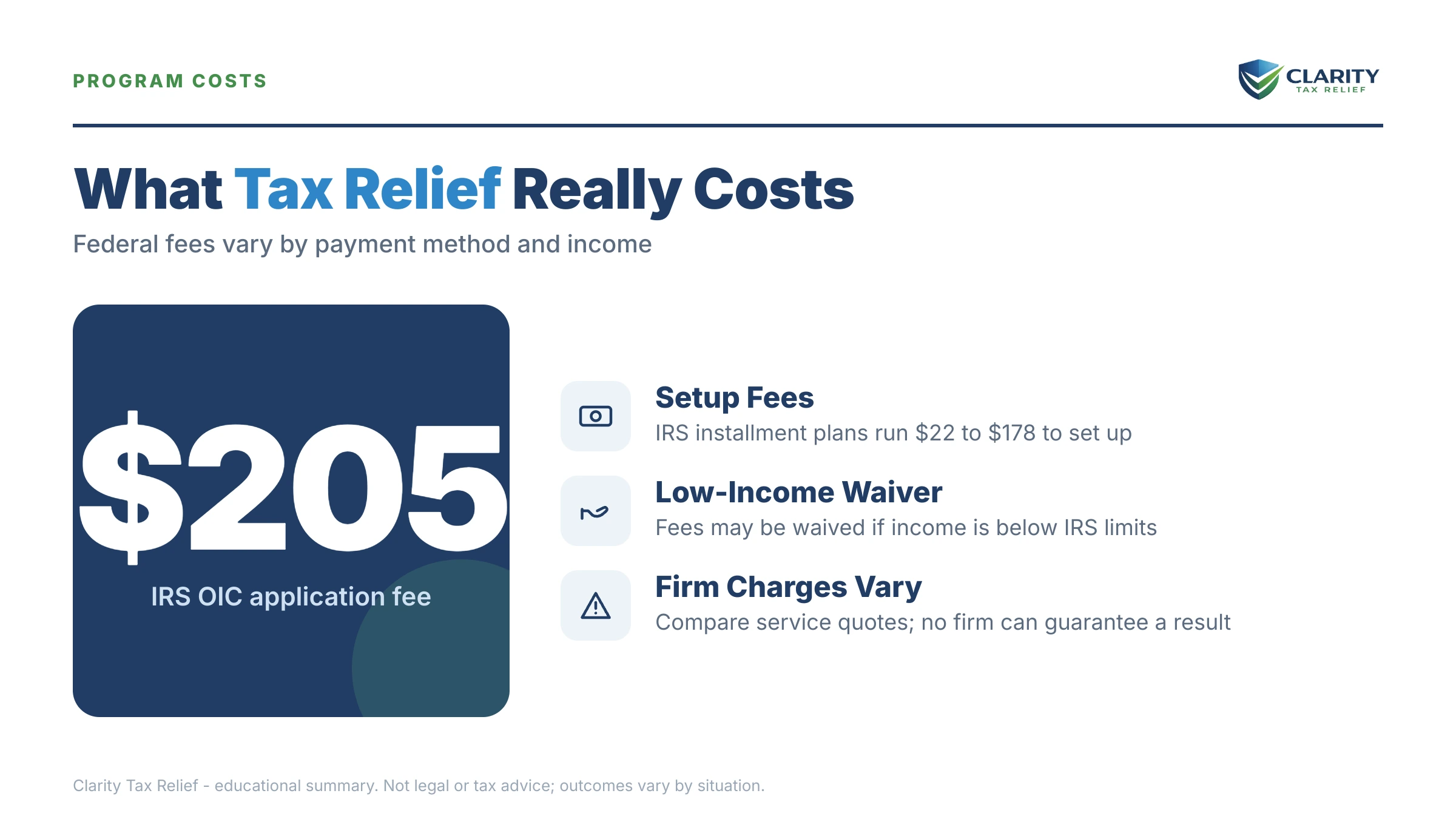
| Offer in Compromise | $205 fee + 20% down on lump-sum offers (waived with low-income certification); decisions commonly take many months, capped at 2 years — with narrow exceptions: a returned or rejected offer stops the clock, and time during court disputes does not count | Usually too slow for a near-term refinance — the debt stays on record while the offer is pending |
| Currently Not Collectible | Free; requires full financial disclosure | Debt remains, and a lien filing becomes more likely — a complication a title search will surface |
| Penalty abatement | Free to request; often resolved by one call or letter | Shrinks the payoff figure your closing has to cover |
Say you owe $16,400 and want to refinance this year: the math
A $16,400 IRS balance costs roughly $82 a month in failure-to-pay penalty alone, before compounding interest, every month it sits unresolved. Here's how the realistic paths compare — this is a hypothetical, but the arithmetic is real:
Do nothing: at 0.5% per month, penalties add roughly $984 in a year, plus interest on the whole growing balance — and each ignored notice moves you closer to a recorded lien that stalls the refinance entirely.
Streamlined installment agreement: $16,400 is well under the $50,000 online ceiling, so you can set this up yourself in one sitting. Spread over the maximum 72 months, the floor is about $228 a month ($16,400 ÷ 72). Two things improve the picture: once an agreement is active, the failure-to-pay penalty rate drops to 0.25% per month, and if you can pay around $500 a month instead, you're clear in roughly three years with far less total interest. You can estimate your own accrual with our Penalty & Interest Calculator.
The refinance overlay: if no lien has been recorded, many lenders can approve the loan with the agreement documented and the $228–$500 payment counted in your debt-to-income ratio — see can I refinance with an IRS lien for how underwriters treat each scenario. If a lien has been recorded, plan for one of three fixes before funding: pay the balance from closing proceeds, request tax lien subordination with Form 14134 so the new mortgage jumps ahead of the lien, or pursue withdrawal where you qualify. All three take weeks of lead time.
The Offer in Compromise reality check: here's the honest part most Baltimore ads skip. If you have enough home equity to make a refinance attractive, that equity counts in the IRS's collection math — which usually means the IRS calculates it can collect $16,400 in full, and an offer isn't a realistic fit. Offers work when income and assets genuinely fall short of the debt, not as a discount program for people who can pay.
Penalty relief on top: if the prior three years were clean, first-time abatement can strip the penalties already assessed — on a balance this size, often several hundred to over a thousand dollars off the payoff figure, at no cost to request.
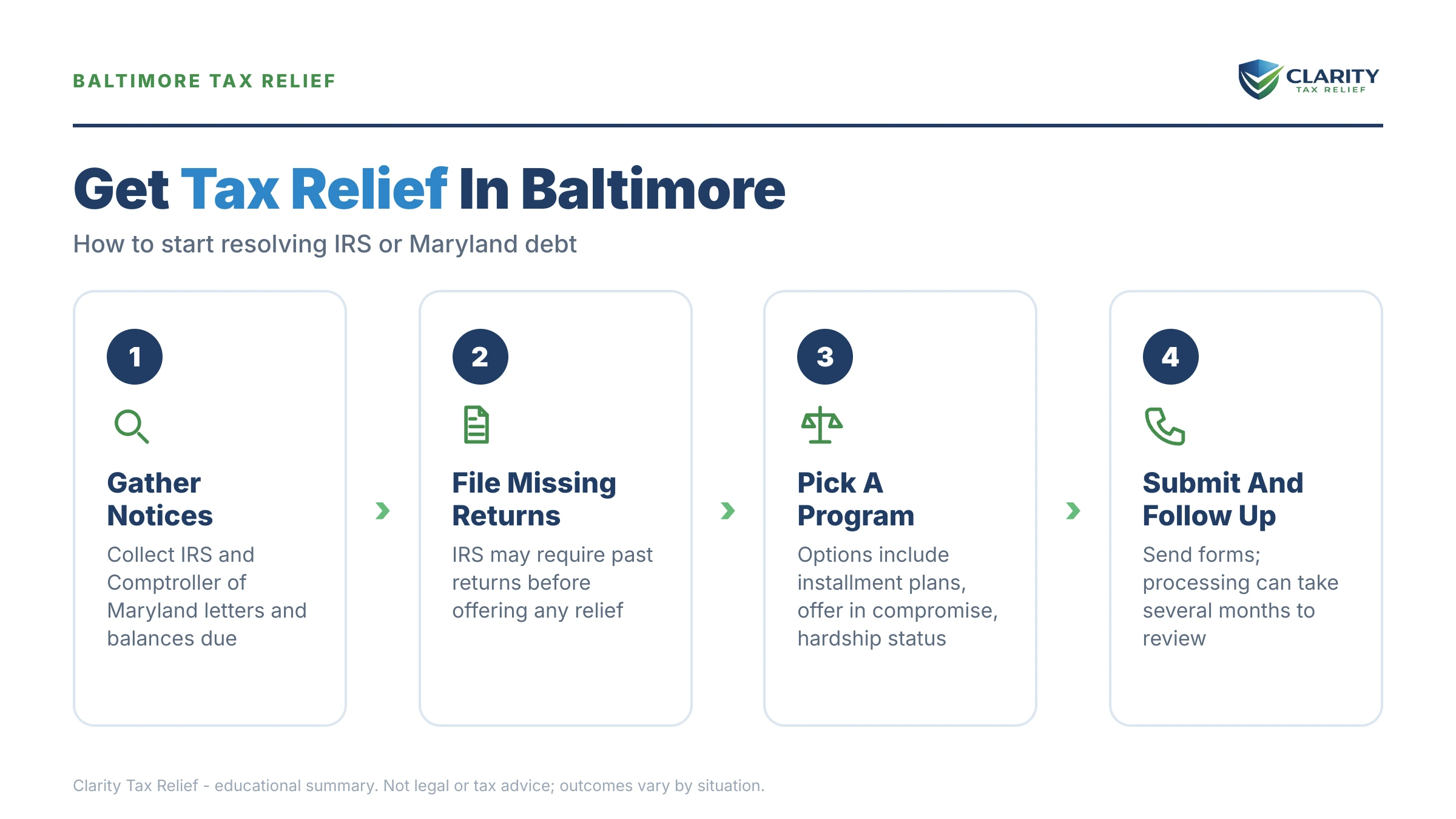
How to start resolving your Baltimore tax debt, step by step
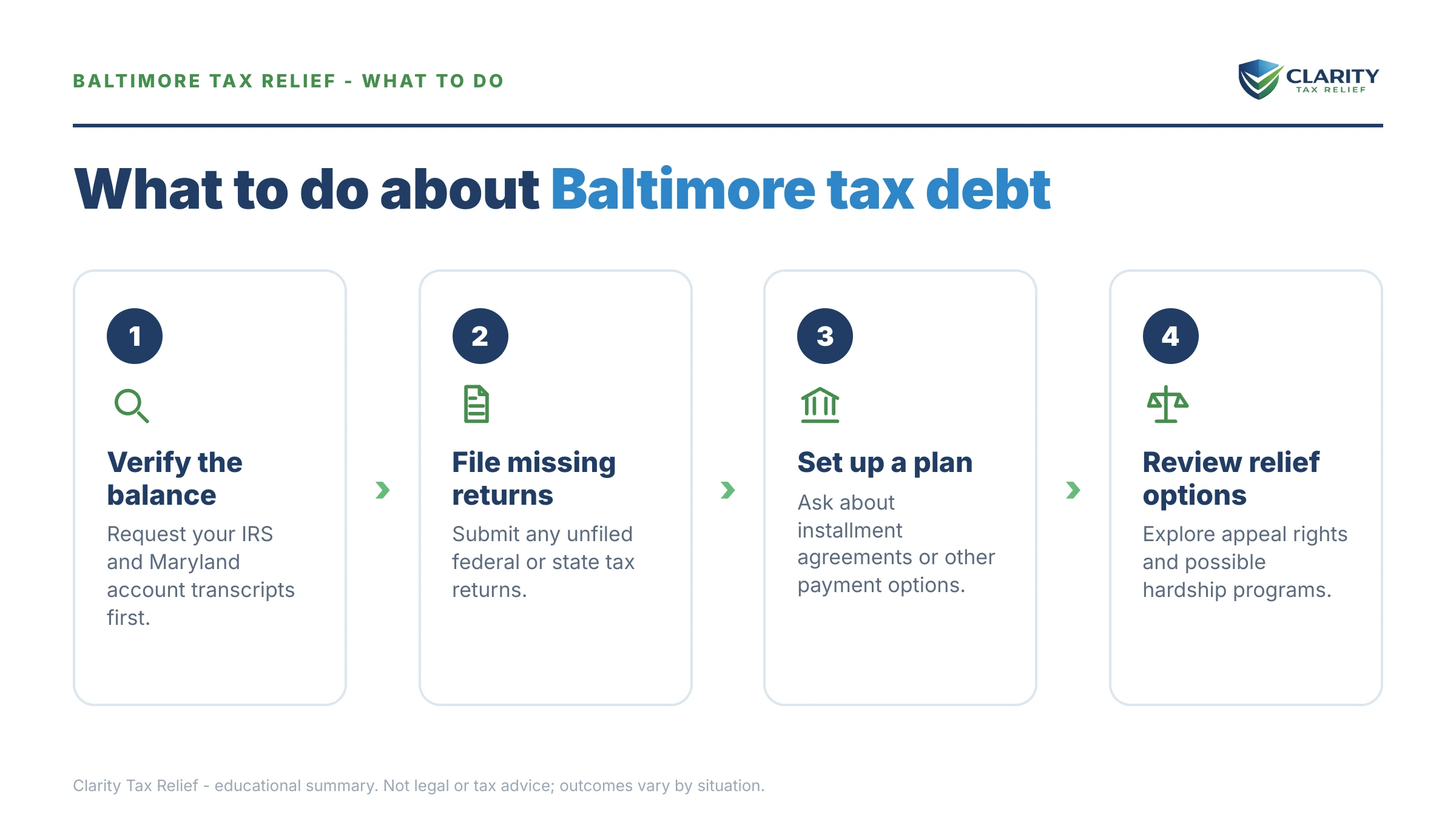
- Pull your numbers. Log into your IRS online account for exact balances and transcripts, and set every Comptroller of Maryland notice beside them — you need the amount and tax year for each debt before anything else.
- File anything unfiled. The IRS won't approve a payment plan while returns are missing, and unfiled years hide your true balance.
- Match your numbers to a program. Use the comparison table above — at $16,400 with steady income, a streamlined installment agreement is the usual fit; genuine hardship or low income points toward Currently Not Collectible status or an offer.
- Set it up before enforcement starts. IRS payment plans can be opened online in minutes; a Maryland plan goes through the Comptroller separately. An active agreement stops the notice sequence.
- Ask for penalty relief. First-time abatement can remove penalties if your prior three years are clean — and starting summer 2026, the IRS's Automatic Exemption from Penalty applies some relief automatically, with no request needed.
When you can handle this yourself — and when help changes the outcome
You can set up most IRS payment plans yourself, online, in under an hour — and for many Baltimore taxpayers that's the right answer. If you agree with the balance, it's under $50,000, all your returns are filed, and no lien or levy is in motion, you don't need to pay anyone: follow the steps above and keep the confirmation.
Experienced help earns its fee in specific situations: a levy already in motion, multiple unfiled years, IRS and Comptroller debt stacking at once, business or payroll tax, offer-in-compromise math, or — the case this page is built around — a recorded lien standing between you and a closing date, where the sequencing and subordination paperwork have to be right the first time. Business owners with 941 or entity debt should start with our tax relief for small business guide, which covers a different rulebook entirely.
If you do hire a firm, remember there is nothing a "Baltimore office" can do that a credentialed professional anywhere can't — IRS representation runs on Form 2848, phone, and e-services. Vet on credentials and pricing instead: our checklist on how to choose a tax relief company lists the questions that separate real practitioners from sales floors.
Free and low-cost tax help in Baltimore
Baltimore taxpayers with modest incomes can get free representation in IRS disputes through a low income taxpayer clinic — clinics serve the Baltimore area and take qualifying cases for free or a nominal fee. For filing help, VITA sites prepare returns at no cost during filing season.
When an IRS process stalls or is causing genuine hardship — a levy that leaves you unable to pay rent, a payment that vanished — the Taxpayer Advocate Service is an independent office inside the IRS that can intervene, free.
For the state side, current payment arrangements and contact channels are on the Comptroller of Maryland's website, and IRS plan terms and online setup live at the official IRS payment plans page. The IRS also maintains a Taxpayer Assistance Center in downtown Baltimore — appointment only, so check irs.gov before going.
Tax relief Baltimore: your questions answered
Do I need a Baltimore-based tax relief company?
No. IRS collection cases are handled by phone, mail, and the IRS's electronic systems, so an experienced tax professional anywhere in the country can represent you once you sign Form 2848. What matters is the credential (enrolled agent, CPA, or attorney), transparent flat pricing, and whether the firm reviews your IRS transcripts before quoting a plan. A local office mostly matters for in-person audits, which are rare in collection cases.
Who collects back taxes in Baltimore — the IRS or Maryland?
Both can. Federal income tax debt belongs to the IRS. Maryland state income tax — including Baltimore City's local income tax, which is filed on the same Maryland return — is collected by the Comptroller of Maryland. Each agency runs its own notices, its own payment plans, and its own enforcement, so fully resolving your situation often means two separate agreements, not one.
Can the Comptroller of Maryland garnish my wages or take my refund?
Yes. Once a Maryland assessment is final, the Comptroller can intercept your state tax refund, attach wages, and hold certain state renewals until the balance is addressed. Maryland's collection timelines are its own — don't assume the IRS's 10-year collection rule applies to a state balance. A Comptroller notice needs its own response, separate from anything you set up with the IRS.
Will an IRS debt stop me from refinancing my Baltimore home?
Not automatically. If no federal tax lien has been recorded, many lenders can approve a refinance with a documented IRS installment agreement, counting the monthly payment in your debt-to-income ratio. If a lien has already been recorded in the land records, it generally must be paid at closing, subordinated using Form 14134, or withdrawn before the loan funds — and that paperwork takes weeks, so start well before you apply.
Can I settle my tax debt for less than I owe?
Sometimes, through an Offer in Compromise — but it's means-tested math, not negotiation. The IRS accepted roughly 1 in 5 offers in FY2024, and approval depends on whether your income and assets show the IRS could never collect the full balance. The application fee is $205, with 20% down on lump-sum offers; both are waived if your AGI is at or below 250% of the federal poverty level. Maryland runs its own separate offer program through the Comptroller.
How much does tax relief cost in Baltimore?
Doing it yourself costs almost nothing: the IRS charges no setup fee for short-term payment plans and a modest fee for online installment agreements, and an Offer in Compromise application is $205. Professional representation typically runs from a few hundred dollars for a straightforward payment plan to several thousand for an offer or a multi-year case. Be wary of any firm that quotes a settlement figure before reviewing your IRS transcripts.
Is there free tax debt help in Baltimore?
Yes. Low Income Taxpayer Clinics serving the Baltimore area represent qualifying taxpayers in IRS disputes for free or a nominal fee, and the Taxpayer Advocate Service can step in when IRS processes stall or cause hardship. If your income is modest, check those options before paying anyone. They handle IRS matters; a Comptroller of Maryland balance still needs its own arrangement with the state.
Does Baltimore City have its own tax collector?
Only for property taxes. Baltimore City bills and collects its own property taxes, and long-unpaid property tax can eventually push a home toward the city's tax sale process — a separate problem from income tax. Your local income tax is not collected by the city: it's filed on your Maryland return and collected by the Comptroller of Maryland. An income tax problem in Baltimore is an IRS and/or Comptroller problem, never a City Hall one.
Your next 24 hours
- Find your exact balances. Log into your IRS online account and write down the balance-due figure for each year, then set every Comptroller of Maryland notice beside them.
- Gather three things: your most recent filed return, every IRS and Maryland notice you've received, and a month of pay stubs or income records.
- Get a free case review — call (888) 825-7779 or use the 2-minute form at the top of this page — before another month of penalties and interest posts, and before your lender's title search finds the problem for you.
This guide is general information, not tax or legal advice for your specific situation. Eligibility for IRS programs depends on individual facts and circumstances; no outcome is guaranteed.