
City Guides
Tax Relief in Bakersfield: Your 2026 Guide to IRS and FTB Options
The short answer: tax relief in Bakersfield usually means resolving two separate debts — one with the IRS, one with California's Franchise Tax Board. The IRS offers payment plans up to 72 months, hardship status, and settlement programs; the FTB runs its own versions and can collect for 20 years. Both charge interest until you act.
If you searched "tax relief Bakersfield," you're probably staring at two piles: an IRS notice on one side of the kitchen table and an FTB letter on the other, wondering which one bites first. Maybe the balance came from a 1099 side job in the oilfields or the fields off Highway 99, or a W-2 that under-withheld while your spouse's contract income piled up untaxed.
Here's the good news: at almost every dollar amount, there's a defined program with a defined threshold — and this guide maps your balance to the right one, for both agencies.
⏱ The real clock: a "tax relief" search has no single printed deadline — but interest and a monthly late-payment penalty accrue on both your IRS and FTB balances every month you wait, and the FTB can collect for 20 years. Whatever program fits you, this is the cheapest month to start it.
Why Bakersfield tax debt is usually a two-agency problem
Most Bakersfield taxpayers who owe back taxes owe two agencies at once: the IRS and California's Franchise Tax Board (FTB). California taxes the same income the IRS does, the two agencies share return data, and when the IRS adjusts a federal return upward, the FTB routinely follows with its own bill for the same year. Fixing only the federal side leaves the state side growing quietly.
Kern County's economy makes this worse than it is in most cities. A large share of local income arrives with no withholding at all: 1099 pay for oilfield service contractors, farm labor and ag-support work, owner-operator trucking along the 99 and I-5, and construction subs. Miss the quarterly estimated payments and you owe both governments in April — plus self-employment tax on the federal side.
Business owners can face a third and fourth collector too: the CDTFA for sales tax and the EDD for state payroll tax, both of which pursue owners personally for trust-fund portions. If that's you, start with our tax relief for small business guide after this one.
| Feature | IRS | California FTB |
|---|---|---|
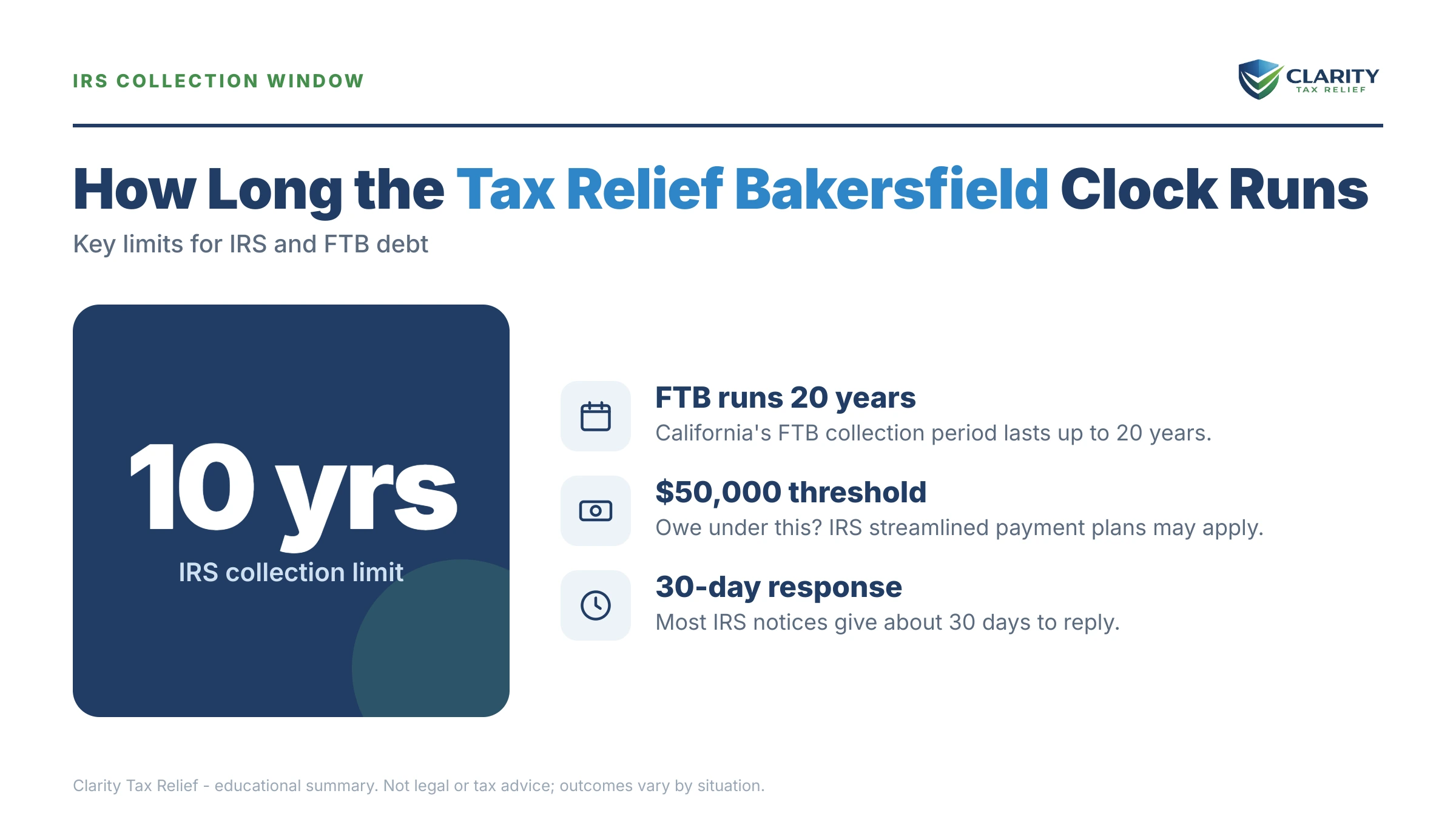
| Collection window | 10 years from assessment (pausable by appeals, offers, bankruptcy) | 20 years under R&TC §19255 |
| Pre-levy warning | LT11/Letter 1058 final notice with a 30-day appeal right (Form 12153) | Its own intent-to-levy notice — see our FTB intent to levy guide |
| Wage garnishment | Continuous levy until released | Earnings withholding order issued administratively, no court needed |
| Payment plans | Online setup up to $50,000 over up to 72 months | Separate FTB payment plan with its own criteria |
| Settlement | Offer in Compromise ($205 fee, means-tested) | Separate FTB offer program with its own review |
What happens if you ignore IRS and FTB collection
The IRS collection sequence runs CP14 → CP501/CP503 → CP504 → LT11, and the final notice starts a 30-day clock before wage or bank levies can begin. The whole sequence is automated — and in 2026, with the IRS workforce cut roughly 27% last year, the humans who could pause it are harder to reach while the notice machine runs on schedule. Here's the order it escalates in:
- CP14 — the first bill. You typically have about 21 days from the notice date before the sequence moves on.
- CP501 / CP503 — reminders. No new enforcement power, but penalties and interest compound while they arrive.
- CP504 — intent to levy your state refund under IRC §6331(d). For a Bakersfield household, that means your California refund can be seized, and a federal tax lien becomes a live risk.
- LT11 / Letter 1058 — the final notice. You have 30 days to request a Collection Due Process hearing on Form 12153; after that, wage and bank levies are on the table.
- Levy — a bank levy freezes funds for a 21-day hold before the money leaves; a wage levy is continuous until released.
The FTB runs a shorter, blunter ladder: a demand notice, an intent-to-levy notice, then an earnings withholding order to your employer or a levy on your bank — all administrative, no courtroom. Practitioners widely consider the FTB the faster mover of the two, and its 20-year collection statute means an old state balance doesn't quietly age out the way many people assume. If your paycheck is already short, our FTB wage garnishment guide covers the release paths.
Owe the IRS, the FTB, or both in Bakersfield?
Interest and penalties are accruing on both balances every month, and the two agencies escalate on their own schedules. Send us your notices — an experienced tax professional will map both accounts and your realistic options, free and confidential.
Tax relief options for Bakersfield taxpayers: programs, thresholds, and costs
Every legitimate tax relief outcome in Bakersfield comes from a specific program with a specific eligibility test — there is no generic "relief" the IRS or FTB hands out. The full DIY mechanics live in our guide to how to settle tax debt yourself; here is the map, matched to thresholds:
| Option | Typical eligibility | Cost to set up | What it does |
|---|---|---|---|
| IRS short-term plan | Can pay in full within 180 days | $0 | Stops the notice sequence while you pay |
| Guaranteed installment agreement | Owe $10,000 or less, all returns filed, full pay within 3 years | Setup fee (lower with direct debit) | The IRS must accept — no negotiation needed |
| Streamlined installment agreement | ≤ $25,000 (or ≤ $50,000 with direct debit), up to 72 months | Online setup fee | Monthly plan without full financial disclosure |
| Currently Not Collectible | Paying would leave you unable to cover basic living costs | $0 | Pauses IRS collection; debt and interest remain |
| Offer in Compromise | Assets plus future income genuinely can't cover the debt | $205 fee + 20% down (both waived with low-income certification) | Settles for less; the IRS accepted roughly 1 in 5 offers in FY2024 |
| Penalty abatement | Clean compliance for the prior 3 years (first-time abate), or reasonable cause | $0 | Removes penalties; being replaced by automatic AEP starting summer 2026 |
| FTB payment plan | State balance; the FTB applies its own criteria | Varies | Monthly plan on the California side — separate from any IRS deal |
Three honesty notes before you pick a lane. First, an Offer in Compromise is real but means-tested — the IRS accepted roughly 1 in 5 offers in FY2024, and a household with steady W-2 income and home equity usually doesn't qualify; anyone promising otherwise is selling, not advising. Second, every plan and pause still accrues interest; "relief" changes the terms, not the meter. Third, the FTB side is always a separate application — an IRS agreement does not bind California, a mistake we see on Bakersfield accounts constantly. If you owe both, our FTB vs. IRS: which first guide walks the sequencing decision.
A worked example: a Bakersfield couple who owes $4,800
Say you and your spouse file jointly, one of you has a W-2 job in town, the other picked up $18,000 of 1099 oilfield contract work, nobody paid quarterlies, and the return shows $4,800 due to the IRS. This is clearly hypothetical, but the math is exact:
- The meter: the failure-to-pay penalty runs 0.5% per month — $4,800 × 0.5% = $24 the first month, shrinking as the balance falls — plus interest that compounds daily at a rate the IRS sets quarterly.
- Option A — 180-day short-term plan: $4,800 ÷ 6 = $800/month, $0 setup fee. You'd pay roughly a hundred dollars-and-change in accrued penalty and interest total, then it's done.
- Option B — guaranteed installment agreement: because the balance is under $10,000 and (once filed) all returns are in, the IRS must accept a plan that pays it off within 3 years: $4,800 ÷ 36 ≈ $134/month, plus a setup fee and several hundred dollars more in accrual over the longer stretch.
- Not on the menu: an Offer in Compromise. With steady household income, $4,800 is collectible, and the IRS's own math would say so.
Remember that a joint return means joint liability — the IRS can pursue either spouse for the whole $4,800, regardless of whose 1099 caused it. You can estimate the accrual on your own numbers with our IRS penalty and interest calculator. And if the same 1099 income triggered a California bill, that smaller FTB balance needs its own plan on its own track. Full details on the under-$10k federal option are in our guaranteed installment agreement guide.
How to resolve Bakersfield tax debt, step by step
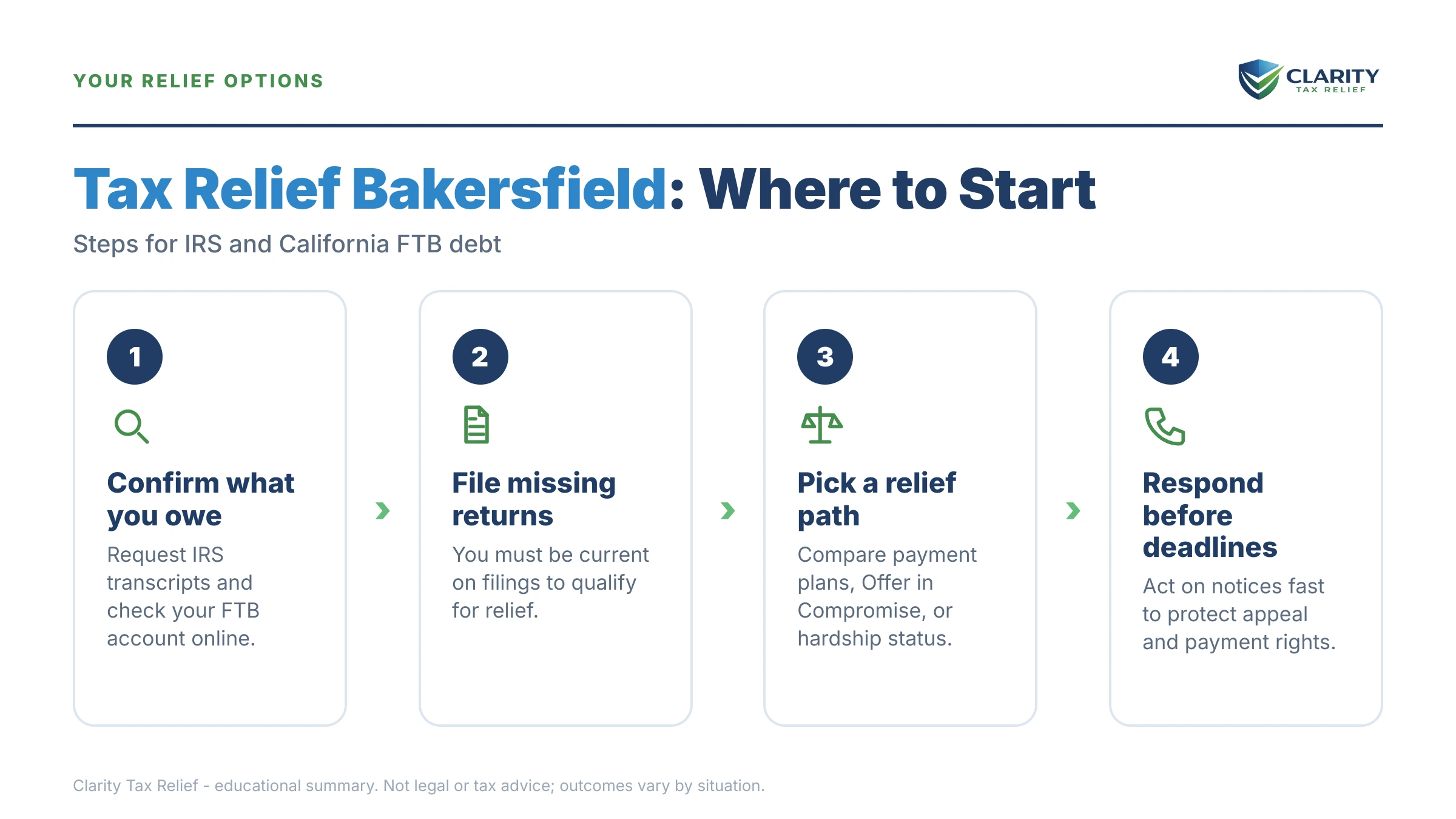
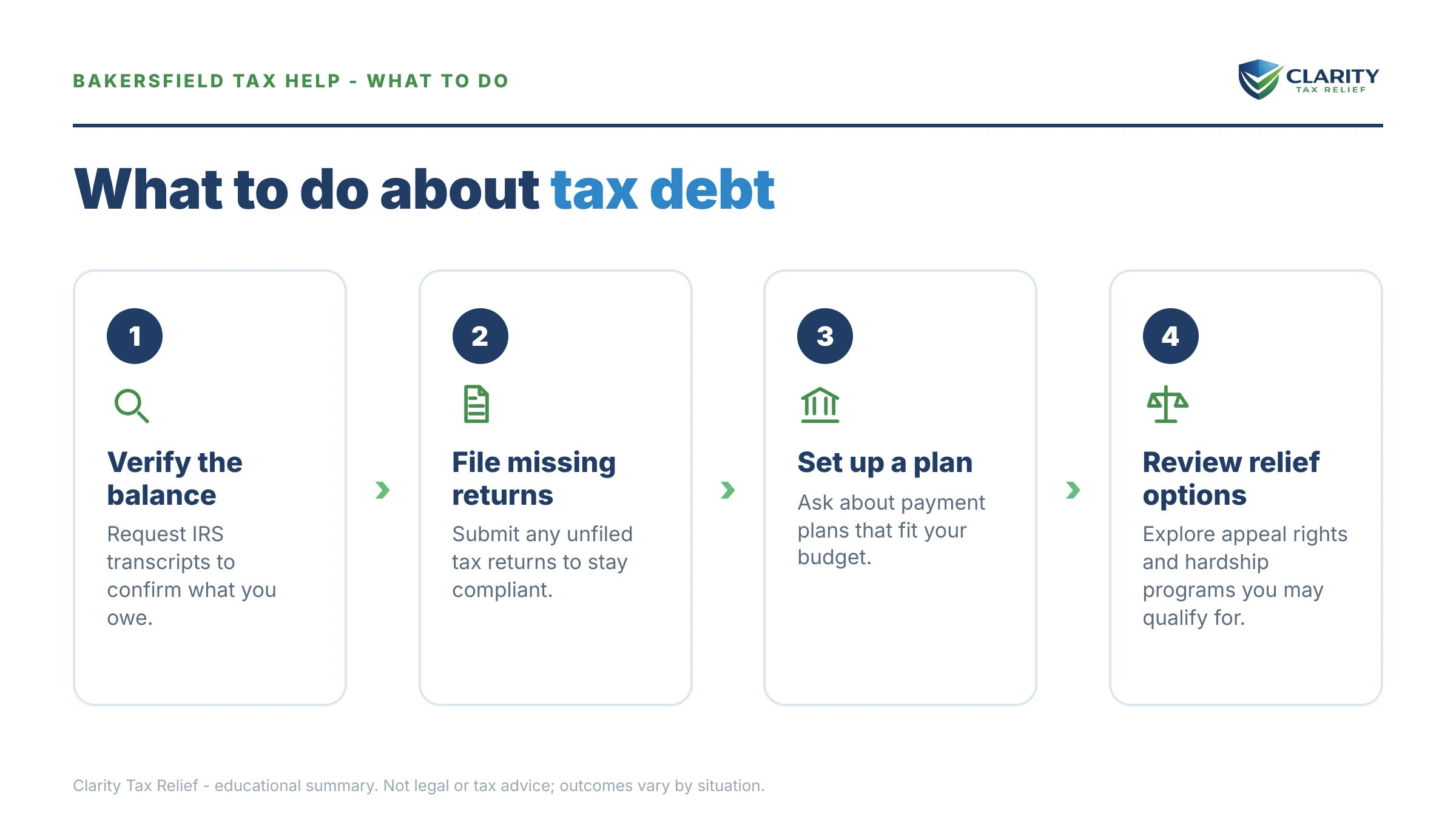
- Pull your IRS and FTB records. Create an IRS online account and an FTB MyFTB account so you can see the exact balance, tax years, and notice status at both agencies before you decide anything.
- File every missing return. Both agencies require filing compliance before they approve a payment plan, hardship status, or settlement — unfiled years block every program.
- Match your IRS balance to a program. Under $10,000 with returns filed, a guaranteed installment agreement usually fits; larger balances point to a streamlined plan, hardship status, or — when the math supports it — an Offer in Compromise.
- Set up the California side separately. An IRS agreement does nothing to stop FTB collection. Arrange an FTB payment plan or hardship claim on its own track, using the FTB's own criteria.
- Request penalty relief before you finish. Ask about IRS first-time abatement — or the Automatic Exemption from Penalty rolling out in summer 2026 — and reasonable-cause relief with the FTB, so you stop paying penalties you may not owe.
On step 5: if your prior three years were clean, first-time penalty abatement can strip penalties from one year entirely — and starting summer 2026, the IRS's new Automatic Exemption from Penalty (AEP) applies similar relief automatically, no request letter needed. Don't let anyone charge you to "negotiate" relief you'd receive by rule.
Choosing tax relief help in Bakersfield: local office vs. national firm
Where your representative's office sits matters far less than whether they can legally represent you and whether they know California's agencies. IRS and FTB resolution work happens by phone, mail, and secure upload with centralized units — nobody negotiates your case across a desk on Truxtun Avenue. What actually separates good help from expensive disappointment:
- Credentials on the power of attorney. Only enrolled agents, CPAs, and attorneys can represent you before the IRS. A "consultant" or "case manager" cannot.
- California-specific experience. A firm that has never filed an FTB payment plan or answered a CDTFA notice will resolve half your problem and leave the harsher half running.
- Flat, written fees tied to defined work — not a percentage of "savings," and never a big retainer before anyone has pulled your transcripts.
- No settlement promises. Any pitch built on settling "for a fraction" before reviewing your finances is the classic mill script — eligibility is means-tested, and nobody can promise an outcome the IRS's own formula controls.
Our full vetting checklist is in how to choose a tax relief company — use it on us too. That's how confident we are in the comparison.
When you can handle this yourself
An honest threshold: below $10,000, if you agree with the balance and every return is filed, you likely don't need to pay anyone. The IRS's online payment plan takes about 20 minutes to set up, the guaranteed installment agreement rules mean acceptance isn't in doubt, and the FTB's plan application is similarly self-serve. Our Bakersfield couple above could reasonably do the whole thing at the kitchen table.
Experienced help changes outcomes in specific situations: a wage garnishment or bank levy already in motion (hours matter, and release requests have to be built correctly the first time), multiple unfiled years at either agency, a balance you dispute, business payroll or sales tax where you can be held personally liable, or genuine hardship cases where the financial disclosure forms decide everything. In those cases, the fee usually costs less than the mistakes it prevents.
Terms on your IRS and FTB letters, decoded
- FTB — the Franchise Tax Board, California's income tax collector; despite the name, it bills individuals, not just businesses.
- Lien vs. levy — a lien is a legal claim against your property that protects the government's position; a levy is the actual taking of wages, bank funds, or a refund.
- CSED — the collection statute expiration date, when the IRS's 10-year window closes; certain events (appeals, offers, bankruptcy) pause the clock. California's window is 20 years.
- CDP rights — Collection Due Process: your right, after an IRS final notice, to a formal appeal (Form 12153) that pauses levy action while it's heard.
- Earnings withholding order — the FTB's version of a wage garnishment, sent straight to your employer without a court order.
Bakersfield tax relief questions, answered
Is there an IRS office in Bakersfield?
Yes — the IRS lists a Taxpayer Assistance Center serving Bakersfield, but it works by appointment only and handles basic account questions, not negotiations. You cannot walk in and settle a debt there. Most resolution work — payment plans, hardship status, offers — happens online, by mail, or by phone with the IRS's centralized units, which is why where your representative sits matters far less than their credentials.
Do I need a local Bakersfield tax relief company, or can I use a national firm?
Either can work, because IRS and FTB resolution is done remotely — by secure document upload, mail, and phone with centralized units, not across a desk. What matters is that the person signing your power of attorney is an enrolled agent, CPA, or attorney, that they have real California FTB experience, and that fees are flat and in writing. A weak local firm is worse than a strong remote one, and vice versa.
How long can California collect back taxes from a Bakersfield resident?
The FTB generally has 20 years from assessment to collect under R&TC §19255 — twice the IRS's 10-year window. That means a state balance from the early 2010s can still be actively collected today. Waiting out the FTB is rarely a realistic strategy; a payment plan or documented hardship status is almost always cheaper than two decades of accruing interest and collection fees.
Should I pay the IRS or the FTB first if I owe both?
It depends on who is closer to enforcement — a garnishment or levy in motion always jumps the line. All else equal, many practitioners prioritize the FTB because it typically moves to wage garnishment faster and can collect for 20 years, while the IRS's sequence gives you more notices and formal appeal rights before a levy. The right answer comes from comparing both account records side by side.
How much does tax relief cost in Bakersfield?
For a simple case — one or two years, a balance under $10,000, no garnishment — you may pay nothing beyond the IRS's plan setup fee, because you can arrange it yourself online. Professional representation for combined IRS-and-FTB cases commonly runs from several hundred dollars for a single filing to a few thousand for full resolution work. Get any fee flat and in writing before you sign, and be wary of anyone quoting a price before pulling your records.
We owe less than $5,000 — do we actually need a tax relief company?
Usually not. Below $10,000, if you agree with the balance and have filed every return, the IRS's guaranteed installment agreement means you can set up a plan online in about 20 minutes, and the FTB offers its own plans. Where help earns its fee at this size is when something else is wrong: unfiled years, a disputed amount, a garnishment already in motion, or business payroll or sales tax mixed in.
Can the FTB garnish wages in Bakersfield without going to court?
Yes. The FTB can issue an earnings withholding order to your employer administratively — no lawsuit or court judgment required — and the order stays in place until the debt is paid or released. If your pay is already being garnished, a payment plan or documented hardship claim is the fastest realistic route to reducing or releasing it, not waiting for the order to lapse on its own.
Your next 24 hours
- Find the total and the tax year on each letter. Every IRS and FTB notice prints the amount, the year, and the notice type in the top section — write down all three for each agency so you know exactly what you're solving.
- Gather three things: your most recent tax return, every notice from both agencies, and a rough monthly income-and-expense picture for your household. That's everything any program decision needs.
- Get the free case review. Both balances accrue interest and penalties every month they sit, and the FTB's 20-year window means waiting has no upside. Use the 2-minute form or call (888) 825-7779 — an experienced tax professional will tell you honestly whether this is a do-it-yourself case or one where representation changes the outcome.
Primary sources: the IRS's official payment plans and installment agreements page, the California Franchise Tax Board for state balances and plans, and the independent Taxpayer Advocate Service if an IRS delay or error is causing you harm.
This guide is general information, not tax or legal advice for your specific situation. Eligibility for IRS programs depends on individual facts and circumstances; no outcome is guaranteed.