
Tax Relief Companies
Stop IRS Debt Alternative: How to Compare Your Options in 2026
The short answer: the best Stop IRS Debt alternative depends on your case, not the company's marketing. Your realistic options are another national firm, a local enrolled agent or CPA, a tax attorney, free help like a Low Income Taxpayer Clinic, or handling it yourself through IRS.gov. Match the helper to your debt size, complexity, and fee structure.
You've probably seen Stop IRS Debt's ads or sat through a sales call, and something made you pause long enough to search for an alternative before signing. That instinct is worth trusting — comparison shopping is exactly what the tax-relief industry hopes you won't do. This guide maps every real alternative, what each one costs, and the three questions that separate a firm worth hiring from an expensive mistake.
One thing this page is not: a takedown of any company. Stop IRS Debt is one of many national tax resolution firms, and every firm on the market — including Clarity — should be held to the same test you'll find below.
⏱ The real clock: there is no application deadline for choosing help — but the 0.5% monthly failure-to-pay penalty and daily-compounding interest run on your balance every week you spend comparing companies. On a $27,500 balance, that's roughly $137 in penalty alone each month, before interest.
Why people search for a Stop IRS Debt alternative
Most people comparing tax relief companies are really checking three things: who actually works the case, what the total fee is, and whether the promised outcome is realistic. Those three answers vary enormously across the industry — far more than the websites do.
The common triggers we hear: a quote that felt high or vague, a salesperson who promised a settlement before seeing any IRS records, pressure to pay in full on the first call, or simply not being able to find out whether an enrolled agent, CPA, or attorney would handle the file. A firm that quotes an outcome before pulling your IRS transcripts is guessing — the balance, the years involved, and the penalties on file change everything.
If you want the full evaluation framework, our guide on how to choose a tax relief company covers it in depth, and the tax relief company red flags checklist covers the warning signs. The short version: credentials in writing, a total flat fee in writing, and a transcript review before any promises.
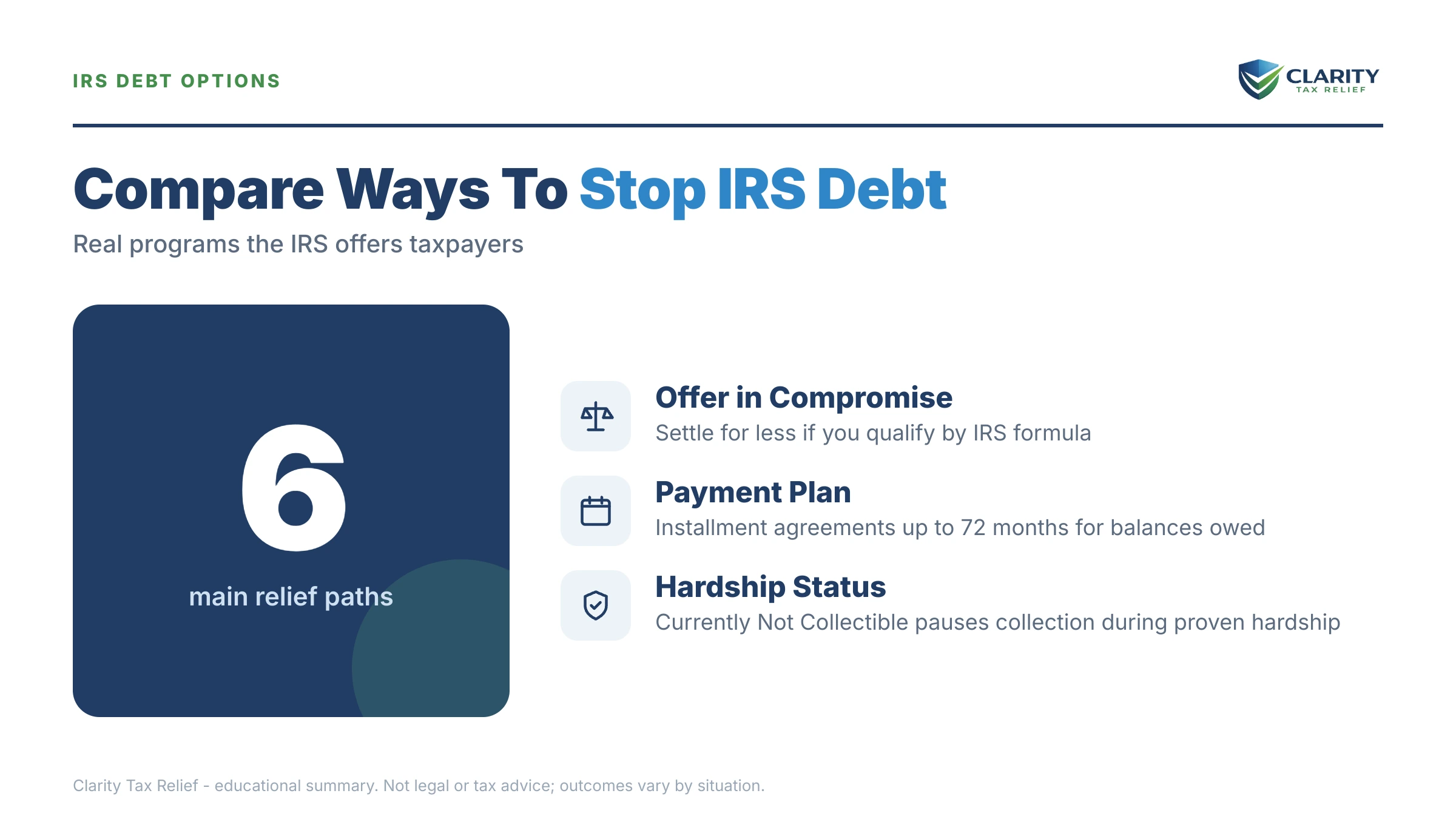
What happens to your IRS debt while you compare companies
The IRS collection machine does not pause while you interview firms. Every stage below is generated automatically, and in 2026 — with the IRS workforce cut roughly 27% in 2025 — the humans are harder to reach while the automated notices, liens, and levies never stopped.
- First bill (CP14) and reminders (CP501/CP503) — no enforcement yet, but penalties and interest post monthly.
- CP504 — Notice of Intent to Levy — the IRS can seize your state tax refund, and a federal tax lien becomes a live risk.
- LT11 / Letter 1058 — Final Notice — a 30-day clock starts on your Collection Due Process rights (requested via Form 12153). After it runs, wage garnishment and bank levies become legal.
- Levy and lien enforcement — a bank levy freezes funds for 21 days before they're sent to the Treasury; a wage levy continues every paycheck until released.
Two more clocks to know. If any return is unfiled, the failure-to-file penalty runs at 5% per month — ten times the failure-to-pay rate, though in months where both penalties apply, the failure-to-file portion drops to 4.5% (5% combined) — so filing always comes first, hired help or not. And for larger debts, the IRS can certify seriously delinquent balances of $66,000 or more (the 2026 threshold) to the State Department, which can deny or revoke your passport. At $27,500 you're under that line — one reason acting now, while the debt is mid-sized, keeps more options open.
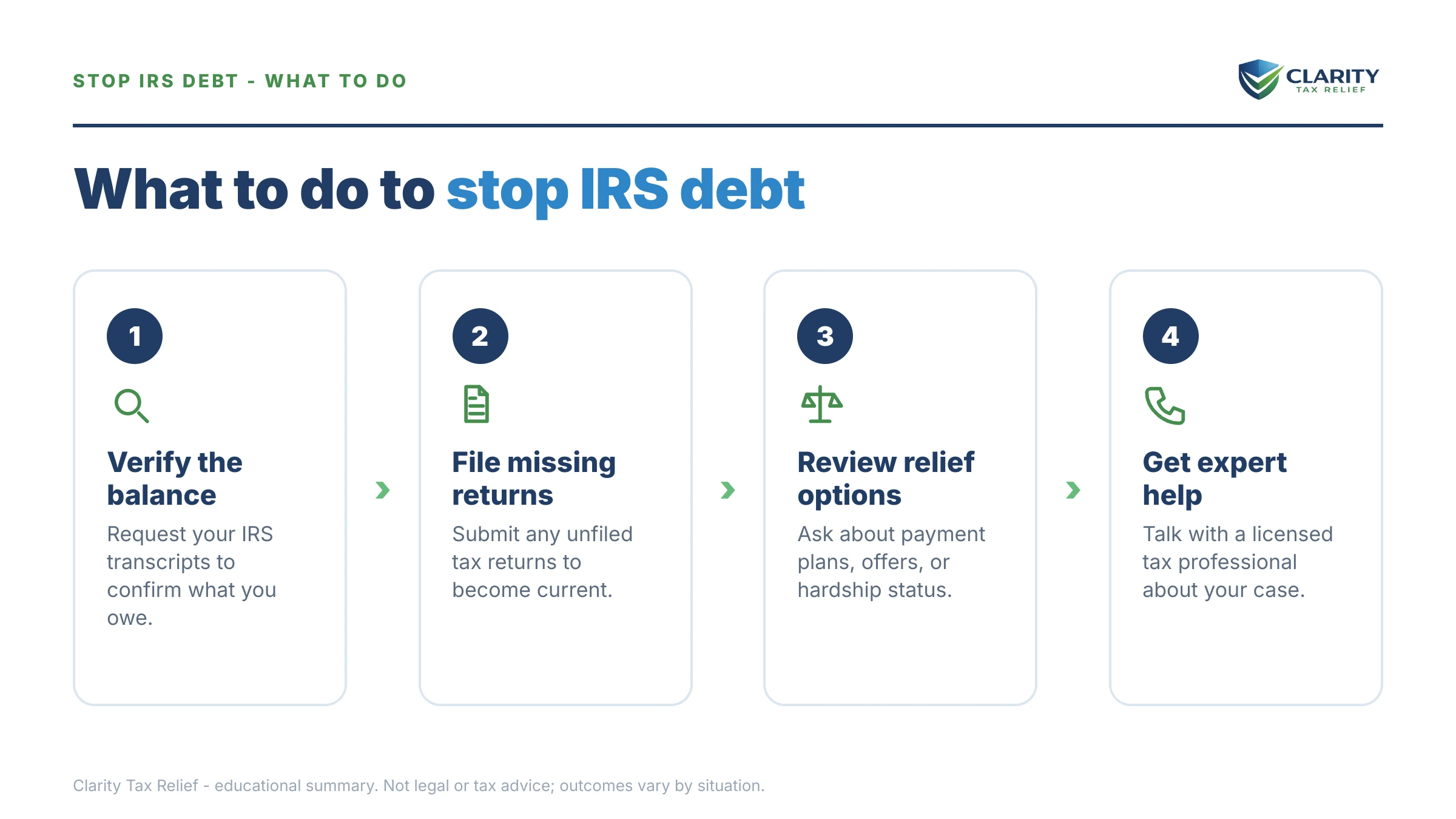
Comparing tax relief companies with a live IRS balance?
Bring us any quote you're holding. An experienced tax professional will review your case free, tell you honestly what it actually needs — including when the answer is "you can do this yourself" — and put our fee in writing before you decide. Interest is accruing either way; the review costs nothing.
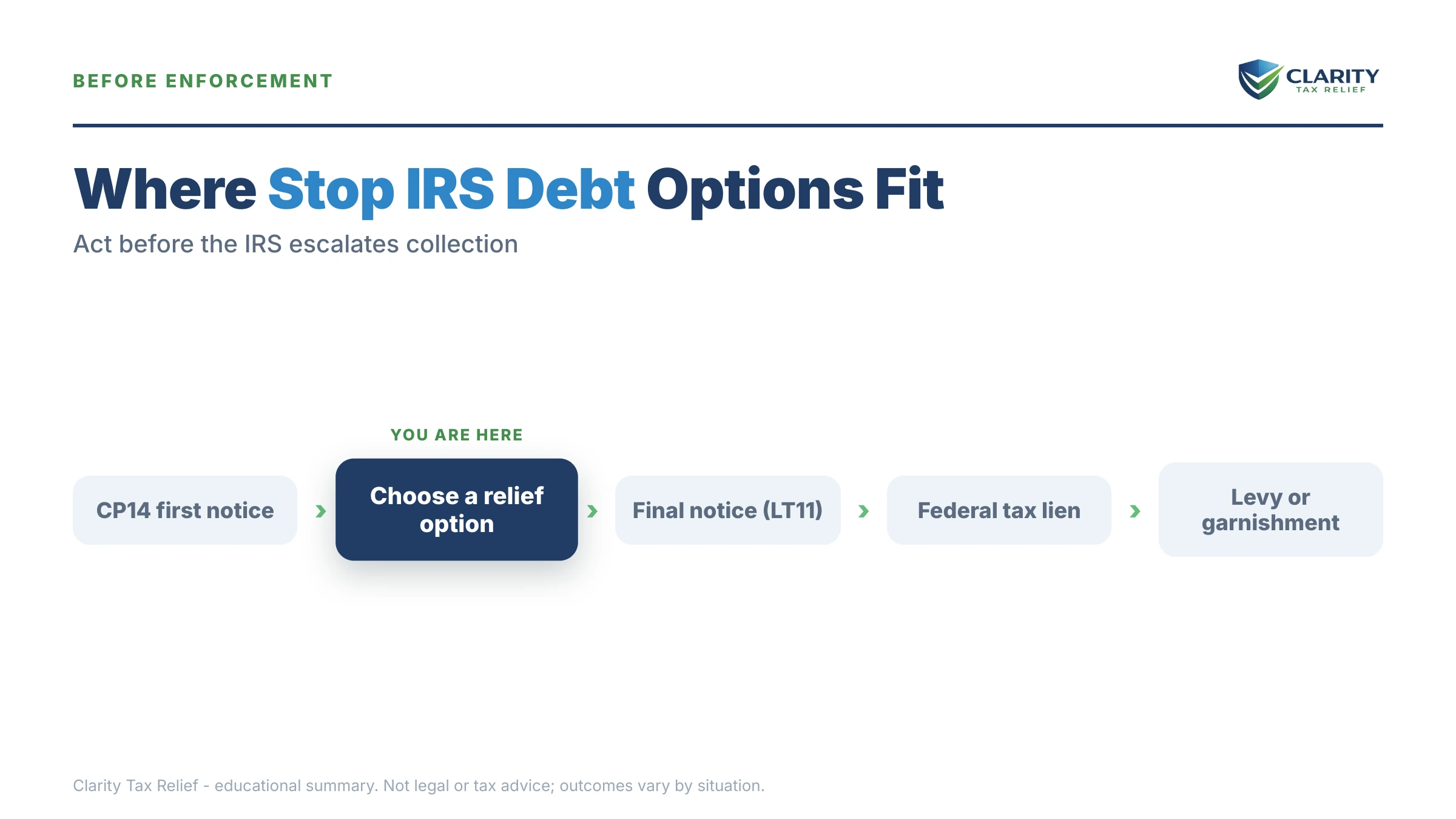
Your alternatives to Stop IRS Debt, compared
Every alternative falls into one of five categories, and each has a real cost profile and a real best-fit case. What tax relief costs across the industry is covered in detail in our how much does tax relief cost guide; the table below is the summary view.
| Alternative | Typical cost | Typical timeline | Best fit |
|---|---|---|---|
| DIY through IRS.gov | $0 for short-term plans; modest IRS setup fee for long-term plans | Online payment plan can be set up the same day | Balance under $50,000, all returns filed, no levy in motion |
| Free help (LITC / Taxpayer Advocate) | $0 | Weeks to months; intake and eligibility screening required | Lower-income taxpayers; cases where the IRS system itself is failing you |
| Local enrolled agent or CPA | Often hourly or per-project; varies widely by market | Depends on availability — solo practitioners book up in season | Moderate complexity plus an ongoing filing relationship |
| Tax attorney | Generally the highest hourly rates of any option | Case-driven; litigation timelines run long | Criminal exposure, Tax Court, or attorney-client privilege needs |
| National tax relief firm (including Clarity) | Flat fee scaled to case complexity, commonly $1,500–$7,500+ | Simple plans in weeks; full offers can take months to over a year | Levies in motion, multiple years, joint-liability issues, offer math |
Another national firm. If you liked the full-service model but not the specific pitch, the industry has plenty of firms. Demand the same three things from each: named credentialed staff, a written total fee, and a transcript review before any outcome talk. Our questions to ask a tax relief company list gives you the exact script for those calls.
A local enrolled agent or CPA. Same representation rights before the IRS, often lower overhead. The tradeoff is capacity — a solo practitioner juggling filing season may not move as fast as a firm with dedicated resolution staff when a levy is already in motion.
A tax attorney. Overkill for most balance-due cases, essential for a few: potential fraud referrals, Tax Court petitions, or anything you need kept privileged.
Free help. If your income is modest, a Low Income Taxpayer Clinic may represent you at no charge, and every free avenue — clinics, the Taxpayer Advocate Service, IRS self-service — is mapped in our guide to free help with IRS tax debt.
Yourself. For a surprising share of cases, no company is the right company. The section below on handling it yourself explains exactly when.
The IRS programs any good alternative must match you to
Every legitimate tax relief outcome — from any firm, any attorney, or your own laptop — ends in one of the same IRS programs; a helper only changes how well you're matched and represented. That's the single most clarifying fact in this comparison: you are not shopping for secret programs, you are shopping for competence and honesty in applying public ones.
| Program | Key 2026 eligibility | Setup cost |
|---|---|---|
| Short-term payment plan | Can pay in full within 180 days | $0; interest and penalties continue |
| Guaranteed installment agreement | Balance of $10,000 or less (official program name) | Modest IRS setup fee, lower with direct debit |
| Streamlined installment agreement | Up to $50,000; up to 72 months, set up online | Modest IRS setup fee, lower with direct debit |
| Currently Not Collectible | Form 433-F shows paying would cause genuine hardship | $0; debt remains and interest accrues |
| Offer in Compromise (Form 656) | Assets plus future income fall short of the balance | $205 fee + 20% down on lump-sum offers; both waived with low-income certification (AGI ≤ 250% of poverty) |
| Penalty abatement (First-Time Abate / AEP) | Clean compliance the prior 3 years; AEP becomes automatic starting summer 2026 | $0 |
The Offer in Compromise is where sales pitches diverge furthest from reality. The IRS decides offers using Reasonable Collection Potential — your asset equity plus a multiple of your monthly disposable income — and accepted roughly 1 in 5 offers in FY2024. You can estimate your own numbers with our Offer in Compromise Calculator before any company runs them for you, and our guide to whether the IRS ever forgives tax debt explains what real forgiveness looks like. If a firm leads with settlement talk before financial analysis, you may be looking at an offer in compromise mill — the business model the FTC has been shutting down.
A worked example: $27,500 in joint tax debt after a divorce
Say you owe $27,500 from two jointly filed returns, and most of the shortfall traces to your ex's under-withheld 1099 income. This is hypothetical, but it's the exact scenario where the choice of alternative matters most. Three paths:
Path 1 — streamlined installment agreement. At $27,500 you're under the $50,000 online threshold, so a 72-month plan works out to roughly $382 a month ($27,500 ÷ 72) before the interest and 0.5% monthly penalty that keep accruing — actual payments run somewhat higher so the balance full-pays within the term. Pay it in 36 months instead (about $764/month) and you cut years of accrual. You could set this up yourself today.
Path 2 — split the liability first. Because the returns were joint, the IRS can collect the entire $27,500 from you alone, regardless of what the divorce decree says — divorce and IRS debt: who pays explains why the decree doesn't bind the IRS. But innocent spouse relief and separation of liability exist precisely for this: if the understatement is attributable to your ex and you meet the tests, part of the debt can come off your account entirely. That could be worth more than any payment-plan negotiation — and it's the screen a volume sales floor is least likely to run.
Path 3 — Offer in Compromise, if the math holds. Suppose post-divorce your finances are thin: $2,500 of asset equity and $180/month of disposable income after IRS allowable expenses. A lump-sum offer prices at equity plus 12 months of disposable income — $2,500 + $2,160 = about $4,660. That's a realistic offer only if those numbers survive IRS scrutiny; with stronger income, the same case prices out of the program entirely.
The lesson for comparison shopping: the right alternative isn't the one with the best ad. It's whichever helper actually checks Path 2 before selling you Path 1 or Path 3.
How to choose a Stop IRS Debt alternative, step by step
- Pull your real IRS numbers. Log into your IRS online account and confirm the balance, tax years, and any notices before you take a single sales call.
- Flag the facts that change the plan. Joint returns from a marriage, unfiled years, 1099 income, or a levy in motion each point to a different resolution — and a different kind of helper.
- Get two written quotes. Ask each alternative for the total flat fee, exactly what it covers, and who — by name and credential — will work your case.
- Ask the outcome question. Have each firm state a realistic outcome range for your facts; anyone promising a settlement before seeing your transcripts is selling, not advising.
- Choose and act before the next notice. Set up the payment plan, hardship claim, or offer within days, not months — the IRS notice stream keeps moving while you deliberate.
When the best alternative is no company at all
A meaningful share of the people comparing tax relief firms don't need one. You can likely handle this yourself if all of these are true: your returns are filed, your balance is under $50,000, and no levy or final notice is in play. The IRS payment plans page sets up short- and long-term agreements online, all payment methods live at IRS.gov/payments, and a first-time penalty abatement is often a single phone call if your prior three years are clean. Our step-by-step guide to how to settle tax debt yourself walks the whole DIY path.
Experienced help changes outcomes in specific situations: a wage or bank levy already in motion, multiple unfiled years that need reconstructing, business or payroll tax debt, joint-liability and innocent-spouse claims like the example above, or offer math that has to survive IRS scrutiny. And when the problem is the IRS itself — lost payments, endless processing loops — the free Taxpayer Advocate Service exists for exactly that, no company required.
Terms tax relief websites use, decoded
Every firm's marketing — Stop IRS Debt's, ours, everyone's — leans on the same vocabulary. Here's what it actually means:
- Fresh Start program: not a special program you apply to — a 2011–2012 set of changes that loosened payment-plan and offer thresholds; firms use the name as a hook.
- Investigation phase: the paid first step where a firm pulls your IRS transcripts and account records to see what you actually owe — legitimate work, but ask what it costs and what you get.
- Offer in Compromise: the IRS program (Form 656) for settling for less than the full balance when your finances genuinely can't cover it.
- Reasonable Collection Potential (RCP): the IRS formula — asset equity plus future disposable income — that sets the minimum acceptable offer.
- Power of Attorney (Form 2848): the form that lets a credentialed professional speak to the IRS for you; only attorneys, CPAs, and enrolled agents can represent you under it.
- CSED: the Collection Statute Expiration Date — the IRS generally has 10 years from assessment to collect, though offers, appeals, and bankruptcy pause the clock.
Stop IRS Debt alternative questions, answered
What is the best alternative to Stop IRS Debt?
There is no single best alternative — the right one depends on your debt size and case type. Under $10,000 with all returns filed, DIY through IRS.gov usually beats any paid firm. Complex cases — joint liability after divorce, unfiled years, possible Offer in Compromise — favor a firm or local practitioner that names its enrolled agents, CPAs, or attorneys in writing and charges a defined flat fee.
Can I resolve IRS debt myself instead of hiring any tax relief company?
Yes, and for simple cases you probably should. The IRS lets you set up a short-term plan (up to 180 days, no setup fee) or a long-term installment agreement online for balances up to $50,000 without ever speaking to a company. Paid help earns its fee when a levy is in motion, returns are unfiled, joint liability needs to be split, or settlement math is involved.
How much should a Stop IRS Debt alternative charge?
Most reputable firms charge flat fees that scale with complexity — commonly a few hundred dollars for an investigation phase and roughly $1,500 to $7,500 or more for full resolution work, depending on whether your case is a simple payment plan or a full Offer in Compromise. Get the total fee in writing before paying anything; open-ended or hourly billing is where surprise costs live.
Do I need a tax attorney instead of a tax relief company?
Usually not. Enrolled agents and CPAs hold the same IRS representation rights as attorneys for collections, audits, and appeals. An attorney becomes the right alternative when there is potential criminal exposure, you are headed to Tax Court, or you need attorney-client privilege. For a standard back-tax balance, case experience matters more than the license type.
What free alternatives to tax relief companies exist?
Low Income Taxpayer Clinics represent qualifying taxpayers in IRS disputes at no charge, the Taxpayer Advocate Service steps in when the IRS system itself is causing harm, and IRS.gov handles payment plans directly with no company involved. LITC income limits are generally tied to federal poverty guidelines, so higher earners typically need paid help or the DIY route.
How do I know if a tax relief company is legitimate?
Legitimate firms name their credentialed staff (enrolled agents, CPAs, attorneys), quote a defined flat fee before you pay, and never promise a specific settlement before reviewing your IRS transcripts. Walk away from anyone who guarantees "pennies on the dollar" — that pitch is the classic scam signal — claims everyone qualifies for the Fresh Start program, or demands full payment before pulling your records.
Does divorce change which tax debt option I should use?
Significantly. If the balance comes from jointly filed returns, the IRS can collect all of it from either ex-spouse, no matter what the divorce decree says. That opens doors many companies never check: innocent spouse relief and separation of liability can remove part of the debt entirely — often worth more than any payment-plan negotiation. Make sure any firm you hire screens for them first.
Can the IRS really settle tax debt for less than I owe?
Yes, through the Offer in Compromise program — but only when your assets and future income genuinely cannot cover the debt before the collection statute runs out. The IRS accepted roughly 1 in 5 offers in FY2024, and the ones that succeed are built on real financial math, not marketing. Anyone who promises acceptance before reviewing your finances is selling, not advising.
Your next 24 hours
- Pull your real balance. Log into your IRS online account and write down the exact amount, the tax years, and the most recent notice on file — never negotiate (or comparison shop) from a number a salesperson gave you.
- Gather three things: your last filed return, every IRS notice you've received, and a rough monthly income-and-expense picture. Every alternative on this page will need them.
- Get one free, no-pressure read on your case. Use the 2-minute form at claritytaxrelief.com/#consult or call (888) 825-7779 — we'll tell you which alternative your facts actually call for, even when it isn't us, while penalties and interest are still small.
This guide is general information, not tax or legal advice for your specific situation. Eligibility for IRS programs depends on individual facts and circumstances; no outcome is guaranteed.