
Offer in Compromise
Are OIC Public Record? The IRS's 1-Year Public Inspection File, Explained (2026)
The short answer: accepted offers in compromise are public record — but only for one year, and only barely. Under IRC §6103(k)(1), the IRS opens a one-page summary of each accepted offer for public inspection for 12 months. Rejected and withdrawn offers are never public, and nothing appears online, in court records, or on your credit report.
So, are OIC public record in any way that could actually hurt you? For almost everyone, no. You're weighing an offer in compromise because a levy is bearing down on your account — and the last thing you need is your landlord, your boss, or a future apartment screening discovering you settled with the IRS. That fear is understandable, and it's also the most overestimated part of the entire OIC process.
What actually goes public is a single acceptance summary, held in a paper-era IRS file that requires a written request to see and that empties out after one year. The image below shows what that record looks like and where the handful of public details sit — most people are surprised by how little is in it.
⏱ The real clock: an accepted offer in compromise stays open to public inspection for exactly one year from the acceptance date — then it comes out of the file. Rejected, withdrawn, and returned offers never enter the file at all. Meanwhile, if a levy is already in motion on your account, that clock keeps running whether or not you file an offer.
Why accepted offers become public at all
Congress requires the IRS to open accepted offers in compromise to public inspection under IRC §6103(k)(1) — an anti-corruption safeguard, not a shaming tool. The logic is simple: when the government agrees to accept less than a citizen legally owes, the public has a right to verify the deal wasn't a favor to somebody connected. The disclosure exists to police the IRS, not you.
The document that goes into the file is a copy of the offer acceptance report — Form 7249 — which summarizes the deal in a few lines: who settled, where they live (city and state), how much tax was owed, and the terms the IRS accepted. Everything behind that summary stays sealed under the same §6103 confidentiality rules that protect every tax return in America.
One more thing worth knowing before you weigh this against the offer in compromise acceptance rate 2026 data: the IRS accepted roughly 1 in 5 offers in FY2024. The other four out of five applicants — rejected, withdrawn, or returned — never appeared in any public file at all.
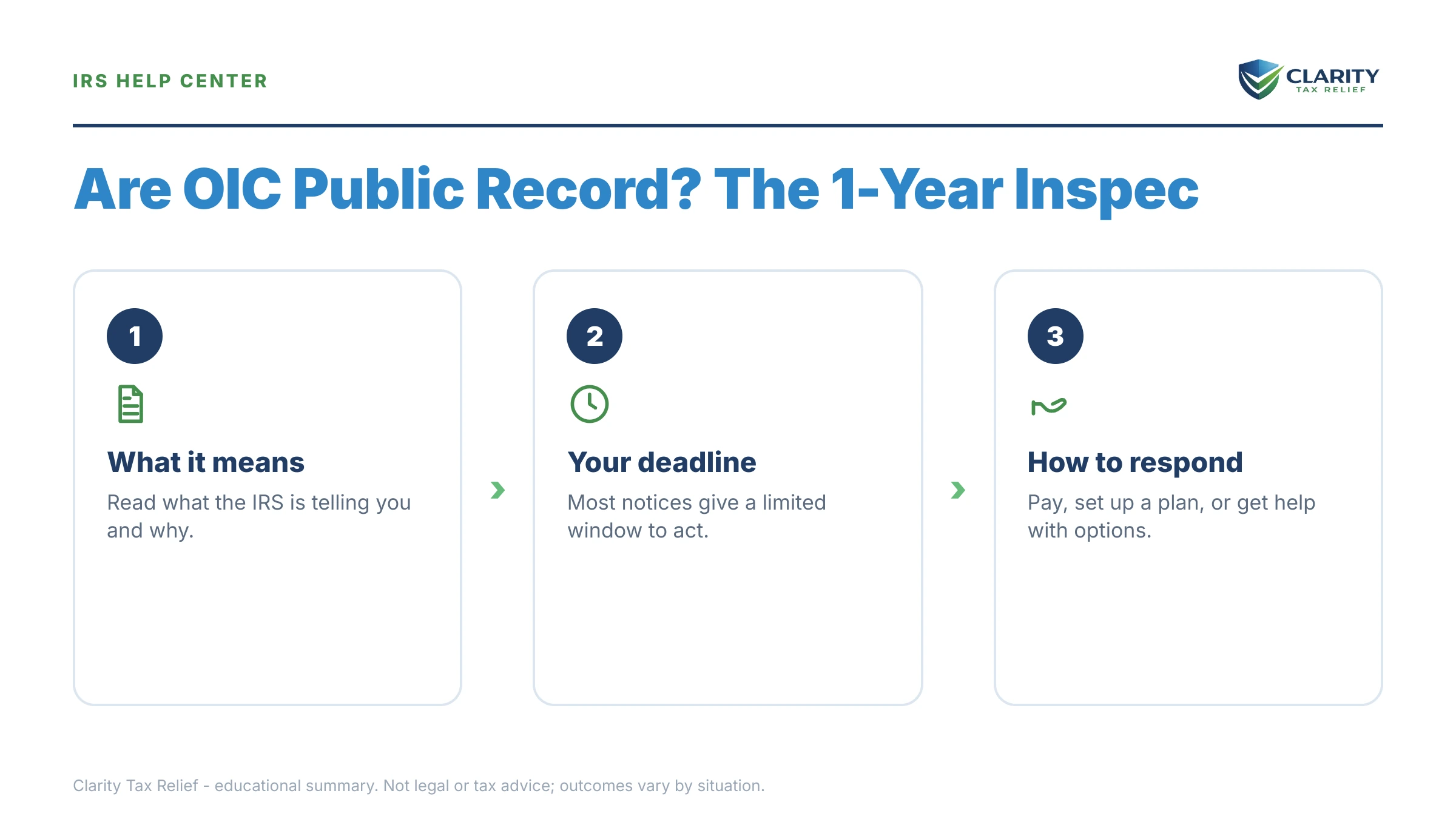
What's in the public inspection file — and what never is
The public inspection file contains four data points about an accepted offer: name, city and state, the liability amount, and the offer terms. It does not contain your financial disclosures, and it never contains anything about an offer that wasn't accepted.
Here is the full breakdown, because the confidential column is where your real worries live:
| Detail | Public or confidential | Where it lives, and for how long |
|---|---|---|
| Your name and city/state | Public — accepted offers only | IRS inspection file, 1 year from acceptance |
| Amount of tax liability | Public — accepted offers only | IRS inspection file, 1 year from acceptance |
| Accepted offer amount and payment terms | Public — accepted offers only | IRS inspection file, 1 year from acceptance |
| Form 433-A(OIC) financials — pay stubs, rent, bank statements | Confidential, always | IRS case file, protected by IRC §6103 |
| A rejected, withdrawn, or returned offer | Confidential — never enters the file | IRS records only, permanently |
| Transcript codes 480/481/482 marking your offer's status | Confidential | Your IRS transcript — visible only to you and your representative |
| Notice of Federal Tax Lien, if one is filed | Public — a separate record entirely | County recorder's office, until released |
Notice the last row. If anything about a tax debt ever surfaces in a tenant screening or a title search, it's a recorded lien — not the offer. That's why does OIC remove tax lien is the question that deserves more of your attention than the inspection file, and why a tax lien public record search is what a determined screener would actually run.
Are OIC public record after the first year?
No — the IRS removes an accepted offer from the public inspection file one year after the acceptance date, and after that it is not inspectable by anyone. There is no archive a member of the public can request, no database it migrates to, and no search engine that ever indexed it.
Even during the one-year window, "public" is doing very light work. To see your record, someone would have to know you settled, know roughly when, and mail a written request to the IRS asking to inspect the file for your specific offer. The files are not online. They are not searchable by name across the country. They are not sold to data brokers, credit bureaus, or the background-check databases employers and landlords use.
Compare that to the records people actually fear. Bankruptcy is a federal court filing — permanently searchable on the court's public docket. A state tax warrant in New York is a civil judgment on the public record. A federal tax lien sits at the county recorder until released. Against that lineup, the OIC inspection file is the most private "public record" in the collection system. (And since 2018, none of these — lien included — appears on your credit report, though liens remain findable through public-records searches.)
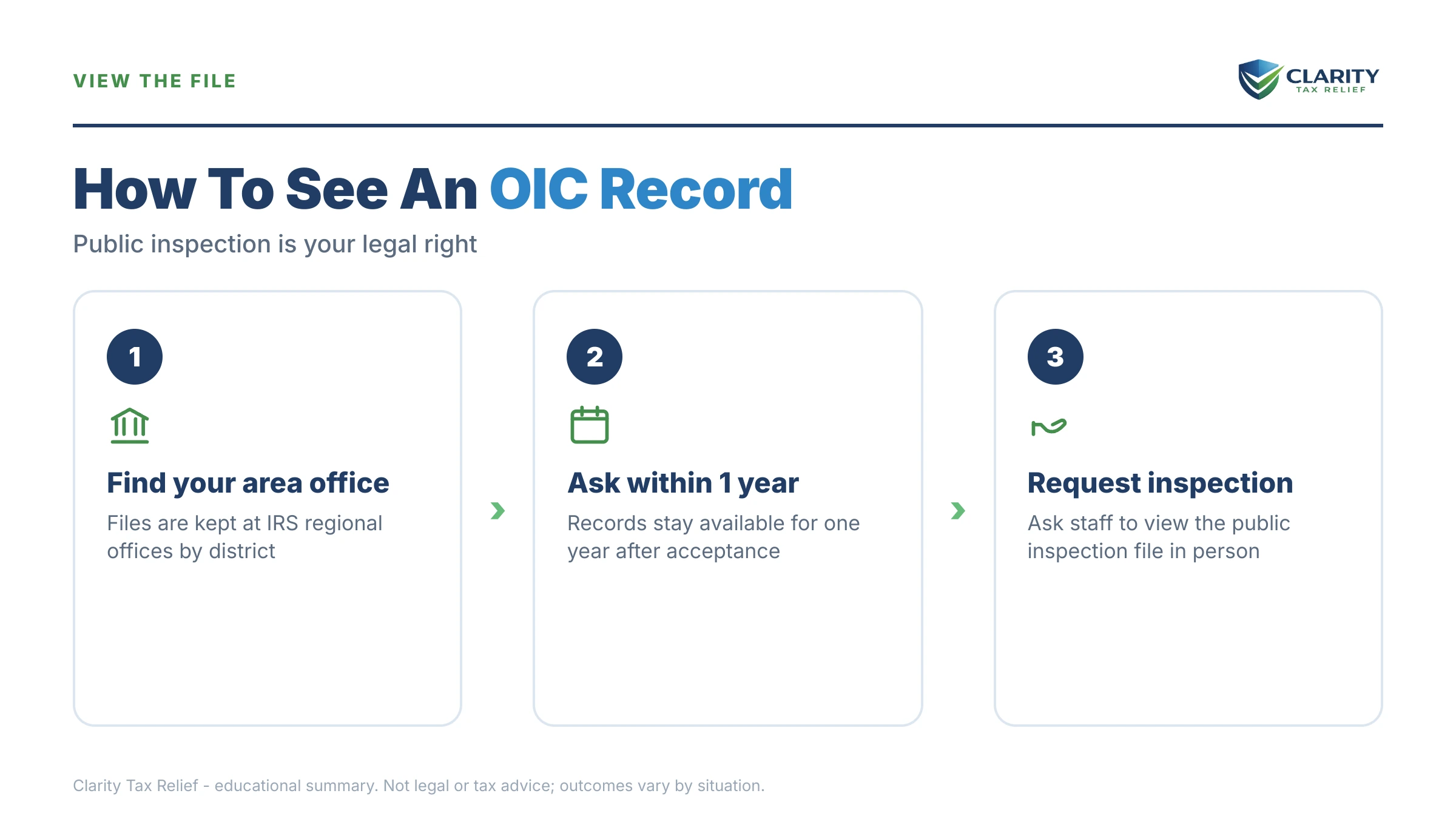
What happens if privacy fear keeps you from acting
The expensive mistake isn't filing an offer that becomes briefly inspectable — it's stalling while a levy proceeds. If you've received a final notice of intent to levy and do nothing, the sequence runs on autopilot:
- Bank levy — the IRS freezes the funds in your account, holds them for 21 days, then takes them. For a renter, that can be next month's rent gone in one sweep.
- Wage levy — unlike a bank levy, a wage garnishment is continuous. It attaches to every paycheck until the debt is paid or the levy is released.
- Refund and federal payment offsets — your state refund can be seized, and up to 15% of Social Security benefits can be taken through the Federal Payment Levy Program.
- The balance keeps compounding — the 0.5%-per-month failure-to-pay penalty plus interest accrue the whole time you're deciding.
Here's the part the privacy worry gets exactly backwards: a processable offer in compromise generally pauses IRS levy action while it's pending — and a pending offer is completely confidential. You'll see transcript code 480 post when the offer is logged. Filing an offer doesn't expose you; it's one of the few moves that can stand between your paycheck and a levy while remaining invisible to everyone but you and the IRS.
Facing a levy and worried what an offer exposes?
If a bank levy has already hit, the 21-day hold is the clock that matters — not the inspection file. Get your levy and your offer options reviewed free by an experienced tax professional before those funds leave: call (888) 825-7779 or use the 2-minute form.
Your options compared: cost, timeline, and public footprint
Every IRS resolution path leaves a different paper trail, and the OIC's one-year file is among the smallest. (For the full mechanics of offers — the forms, the math, the review process — see how does an offer in compromise work; this table focuses on what each path costs and what it exposes.)
| Option | Upfront cost | Typical timeline | Public record created |
|---|---|---|---|
| Offer in compromise | $205 fee + 20% down on lump-sum offers (both waived with low-income certification) | Often 6–12+ months for a decision; auto-accepted if the IRS doesn't decide within 2 years | One-page summary in the inspection file for 1 year — accepted offers only; a tax lien may be filed while pending |
| Short-term payment plan (up to 180 days) | $0 setup | Set up online, usually same day | None — payment plans are not public |
| Installment agreement (up to 72 months, balances ≤ $50,000 online) | Setup fee varies by method | Usually immediate approval online | None from the agreement itself |
| Currently Not Collectible status | $0 | After a financial review | Nothing from CNC itself, though the IRS may file a lien |
| Bankruptcy (Chapter 7 or 13) | Court filing fees + attorney costs | Months (Ch. 7) to 3–5 years (Ch. 13) | Permanent, searchable federal court docket |
| Pay in full | The balance | Immediate | None |
If public exposure is a deciding factor for you, notice that bankruptcy — the path some people reach for instead of an offer — is the only option on this list that creates a permanent public record. That trade-off is exactly what bankruptcy or offer in compromise walks through in detail.
A worked example: $4,800 owed, a levy pending, and what actually goes public
Say you owe $4,800, you rent, and a final notice of intent to levy just arrived. Here's how the offer math — and the privacy math — plays out. The IRS values an offer against your reasonable collection potential: asset equity plus a multiple of your monthly disposable income.
Assets first. Your car is worth $4,000 with a $2,500 loan against it; after the IRS's quick-sale discount and its standard vehicle allowance, countable equity is roughly $0. Your checking account holds $600, and after the standard bank-account allowance, that's roughly $0 too. As a renter, you have no home equity to count.
Future income next. You bring in $3,100 a month and your allowable living expenses under the IRS standards run $2,960 — leaving $140 a month of disposable income. For a lump-sum offer, the IRS multiplies that by 12: $140 × 12 = $1,680. Add $0 in assets, and your reasonable collection potential — the floor for an acceptable offer — is about $1,680 on a $4,800 debt. You can run your own numbers with our Offer in Compromise Calculator to estimate where you'd land.
Now the privacy side. If that $1,680 offer is accepted, the public inspection file would show four things for one year: your name, your city and state, the $4,800 liability, and the $1,680 terms. Nobody would see your rent, your paycheck, or your bank balance. If it's rejected, nothing goes public — and you can contest the rejection through Form 13711 OIC appeal, still entirely confidentially.
And the honest comparison: at $4,800, you're also under the $10,000 ceiling for a guaranteed installment agreement — roughly $67 a month over 72 months before accruing interest and penalties, or about $800 a month to clear it within a 180-day short-term plan. Neither creates any public record, ever. Whether the offer is worth pursuing comes down to how fragile that $140 monthly margin really is — not the inspection file.
How to protect your privacy through the OIC process, step by step
- Confirm nothing is public yet. A pending or rejected offer is confidential tax information — only an acceptance opens the one-year inspection file.
- Check your transcript for code 480. It confirms the IRS logged your offer as pending, which generally pauses levy action while the offer is reviewed.
- Weigh the lien before you file. A Notice of Federal Tax Lien at the county recorder is the record people can actually find — ask how your offer affects lien filing and release.
- Attach the low-income certification if you qualify. AGI at or below 250% of the poverty line waives the $205 fee, the 20% down payment, and payments during review.
- Calendar the one-year window if your offer is accepted. The summary leaves the public file 12 months after the acceptance date — after that, it is not inspectable at all.
On step 4: the renter in our example, at $3,100 a month, may well fall under the 250%-of-poverty threshold depending on household size — see OIC low income certification for the exact cutoffs. On the money side of a lump-sum offer, OIC down payment refundable covers what happens to your 20% if the offer isn't accepted.
When you can handle this yourself
You don't need professional help to manage the privacy question — the law does that for you. If your worry was only "will people see this," this article is the answer: pending and rejected offers are invisible, and an accepted one sits in a written-request-only file for a single year.
You can also reasonably go it alone if your balance is small enough to clear within 180 days, or if a simple online installment agreement solves the problem — those paths involve no financial disclosure and no public trace. The IRS's own offer in compromise page includes a pre-qualifier tool that gives you a first read on eligibility for free.
Experienced help changes outcomes in a narrower set of situations: a levy already in motion (the sequencing of a levy release against an offer filing matters), offer math complicated by recently spent or transferred assets — what the IRS calls dissipated assets OIC add-backs — multiple unfiled years that make your offer non-processable on arrival, or business income that turns the expense standards into a fight. If your case is a hardship case and money is truly tight, the Taxpayer Advocate Service is a free, independent resource worth knowing about.
Terms on this page, decoded
- Public inspection file — the IRS's collection of accepted-offer summaries, viewable by written request for one year per offer.
- Form 7249 — the Offer Acceptance Report; the one-page summary that actually goes into the file.
- IRC §6103 — the confidentiality statute protecting your tax information; subsection (k)(1) carves out the narrow accepted-offer exception.
- Notice of Federal Tax Lien (NFTL) — the IRS's recorded claim against your property, filed at the county recorder and genuinely public until released.
- Code 480 — the transcript code marking your offer as pending; visible only on your own IRS transcript.
- Reasonable Collection Potential (RCP) — the IRS's calculation of the most it could ever collect from you; the benchmark your offer must meet.
OIC public record questions, answered
Are offers in compromise public record?
Only accepted offers are public, and only for one year after acceptance. The IRS keeps a one-page summary — your name, city and state, the tax owed, and the offer terms — available for inspection under IRC §6103(k)(1). Rejected and withdrawn offers never become public, and the file is removed 12 months after the acceptance date.
Will an offer in compromise show up on a background check?
Almost never. The public inspection file is not online, not indexed by search engines, and not sold to the databases background-check companies use. A screener would have to mail a written request to the IRS during the one-year window to see it. The record a background check could surface is a Notice of Federal Tax Lien filed at the county recorder — a separate document from the offer itself.
Does an OIC appear on my credit report?
No. The three credit bureaus removed all tax liens from credit reports in 2018, and accepted offers were never reported to them in the first place. Neither the offer, the inspection file, nor a federal tax lien appears in your credit score today. Lenders can still find a recorded lien through a public-records search, which is why mortgage underwriters sometimes ask about tax debt.
Can my employer or landlord find out I filed an OIC?
Not from the filing itself — a pending offer is confidential tax information protected by IRC §6103. If the offer is accepted, they could theoretically send a written request to the IRS within the one-year window, but the file isn't searchable and virtually no employer or landlord does this. The realistic exposure is a county-recorded tax lien, which standard tenant and employment screenings can surface.
Are rejected or withdrawn offers in compromise public?
No — never. Only accepted offers enter the public inspection file. If the IRS rejects your offer, you withdraw it, or it's returned as non-processable, the entire application including your Form 433-A(OIC) financials stays confidential permanently. That means there is no privacy downside to applying and being turned down; the roughly 4-in-5 offers the IRS declined in FY2024 left no public trace.
How would someone actually look up an accepted offer?
They would have to submit a written request to the IRS asking to inspect the file for a specific taxpayer, during the one-year window after acceptance. What they'd receive is limited to the acceptance summary — name, location, liability, and offer terms — never your bank statements, pay stubs, or the financial disclosures behind the offer. There is no website, database, or search tool for accepted offers.
Is the tax lien connected to my OIC public record?
Yes — a Notice of Federal Tax Lien is recorded at your county recorder's office and is fully public until it's released. The IRS may file one while your offer is pending to protect its claim. Once you complete your offer terms, the lien is released, and you can request a copy of the release for your records. The lien, not the inspection file, is what people actually find.
Your next 24 hours
- Find the date on your levy notice. If you're holding a final notice of intent to levy, the response window printed on it — not the inspection file — is the deadline governing your case.
- Gather three things: your last filed return, the levy notice, and a month of income and rent/expense figures. That's everything needed to run your offer math and check the low-income certification.
- Get a free case review. An experienced tax professional can tell you in one call whether an offer, a payment plan, or a hardship pause fits your numbers — and how to move before the levy does. Call (888) 825-7779 or use the 2-minute form.
This guide is general information, not tax or legal advice for your specific situation. Eligibility for IRS programs depends on individual facts and circumstances; no outcome is guaranteed.