
IRS Settlement Programs
Offer in Compromise Acceptance Rate 2026: What the Real Numbers Mean for Your Case
The short answer: the IRS accepted roughly 1 in 5 offers in compromise in FY2024 — about a 20% acceptance rate — and nothing in 2026 has changed the formula behind that number. Offers succeed when they match the IRS's Reasonable Collection Potential math. Most rejections happen because the applicant never ran that math first.
You've heard the ads promising settlement, and now you're trying to find out the real offer in compromise acceptance rate for 2026 before you send the IRS a $205 fee and a chunk of your savings on a maybe. Smart instinct — because the honest answer isn't a coin flip or a lottery. It's a formula, and you can run it before you spend a dollar.
This page covers the 2026-specific picture: what the acceptance rate actually is, how the IRS's roughly 27% workforce cut is changing offer reviews this year, and the exact math that sorts the accepted 20% from the rejected 80%. If you need the full program mechanics first, start with how an offer in compromise actually works, then come back here for the odds.
⏱ The clock that actually matters: there's no filing deadline for an offer in compromise — but penalties and interest keep accruing on your balance every month while you research and prepare. And once the IRS receives your offer, the law gives it 2 years to decide; if it doesn't, your offer is automatically deemed accepted.

What the offer in compromise acceptance rate looks like in 2026
The IRS accepted roughly 1 in 5 offers in compromise in FY2024, the most recent full year of published data — about a 20% acceptance rate. That figure is the honest baseline for anyone filing in 2026, and it hasn't been meaningfully moved by anything the IRS announced this year.
What has changed in 2026 is the machinery around that number. The IRS workforce was cut roughly 27% in 2025, which means fewer offer examiners, slower reviews, and longer waits for a decision. The acceptance standard did not loosen — the same formula decides every offer — but the 2-year deemed-acceptance clock now matters more than it has in years, because more offers are sitting in queues longer.
Here's the part the headline rate hides: the 20% figure blends two very different groups. Offers built on the IRS's own collection formula — where the taxpayer genuinely cannot pay the balance and offered the right amount — succeed at a much higher clip. Offers filed on hope, or filed by settlement mills that submit everyone regardless of eligibility, drag the average down. Your personal odds aren't 20%; they're closer to 0% or well above it, depending on one calculation.
For the historical data behind the headline rate — how acceptance has trended over the past decade — see our companion breakdown of the offer in compromise acceptance rate with the full IRS numbers.
Why roughly 4 out of 5 offers get rejected
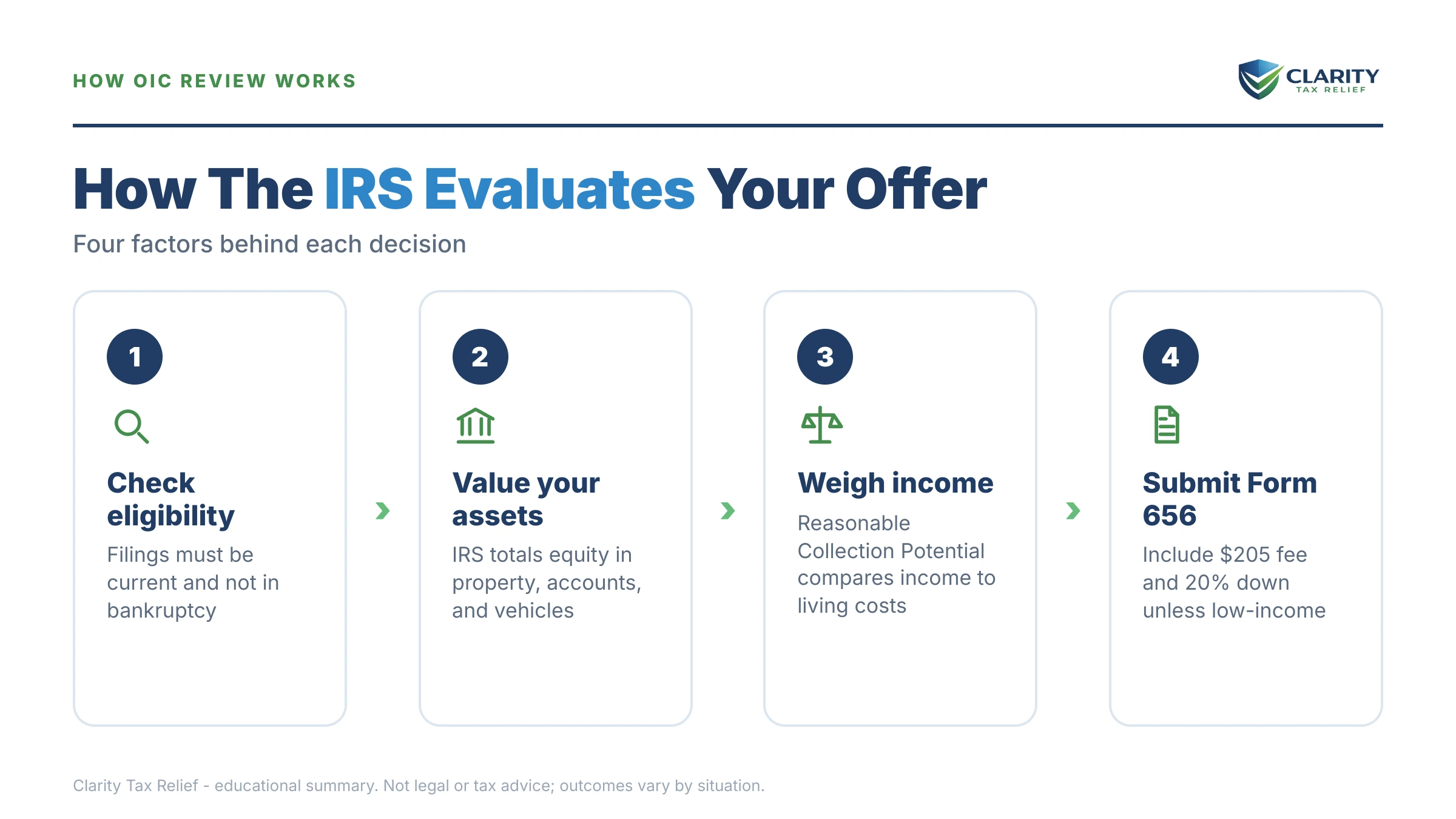
Most offers in compromise fail because the offer amount comes in below the IRS's Reasonable Collection Potential — the agency's calculation of the most it could ever collect from you. The formula is public and mechanical: your net equity in assets (valued at quick-sale prices, typically a discount from market value) plus your monthly disposable income multiplied by 12 for a lump-sum offer or 24 for a periodic offer. If that total meets or exceeds your balance, the IRS's position is simple — you can pay, so there's nothing to compromise. Our guide to Reasonable Collection Potential walks through each input line by line.
You can estimate your own number in a few minutes with our Offer in Compromise Calculator — it estimates where your RCP likely lands before you commit anything.
Beyond the core math, the same handful of mistakes account for most of the remaining rejections and returns:
- Incomplete packages. Form 656 plus Form 433-A (OIC) demands documentation for every number. Missing bank statements or unverified expenses get an offer returned — with no appeal rights.
- Compliance failures. An unfiled return or a missed estimated payment while the offer is pending kicks it back, no matter how good the math was.
- Dissipated assets. If you sold, spent, or transferred assets after the tax debt arose, the IRS can add their value back into your RCP as if you still had them — see dissipated assets in an OIC.
- Undervalued equity. Home equity, retirement accounts, and business assets counted lower than the IRS's own valuation rules produce is a fast rejection.
None of these are bad luck. Every one is checkable before you file — which is exactly what the accepted 20% did.
What filing a doomed offer actually costs you
A rejected offer in compromise doesn't just fail — it leaves you owing more than when you started. Here's the sequence when an offer that never had the math goes in anyway:
- Filing. The $205 application fee and, for a lump-sum offer, a nonrefundable 20% down payment leave your account. Active collection generally pauses — but so does the 10-year collection statute, giving the IRS more total time to collect.
- Review. The offer sits with an examiner for months — longer in 2026 with staffing down roughly 27%. Interest accrues on the full balance the entire time.
- Rejection. The down payment and any periodic payments are kept and applied to your balance, not refunded — the details are in our guide to whether the OIC down payment is refundable. Your balance is now larger than the day you filed, minus only what you paid in.
- Appeal or back to collections. You can appeal to the IRS Independent Office of Appeals with Form 13711 by the deadline printed on your rejection letter — or the file returns to automated collection with the statute clock extended by every month your offer was pending.
The lesson isn't "don't file an offer." It's don't file an offer the formula says will fail — because the IRS's automated systems will collect the accrued difference either way. If you've already been rejected, start with OIC rejected — now what.
Thinking about filing an offer this year?
Before you spend $205 plus 20% of an offer on math that hasn't been checked, let an experienced tax professional run your Reasonable Collection Potential for free. You'll know in one call whether an offer is realistic — or whether a different program fits your numbers better.
An OIC vs. your other options: what each costs and how long it takes
An offer in compromise is the most demanding IRS program to qualify for — and often not the cheapest path even when you do. Compare before you commit:
| Option | Upfront cost | Typical timeline | Best fit |
|---|---|---|---|
| OIC — lump sum | $205 fee + 20% of your offer (both waived with Low-Income Certification) | Many months to decide; deemed accepted if no decision in 2 years | Your RCP is clearly below your balance and you can raise the cash |
| OIC — periodic payments | $205 fee + your proposed monthly payment, every month during review | Same review window; payments continue throughout | RCP is below your balance but you can't fund a lump sum — see OIC payment options |
| Short-term payment plan | $0 setup | Up to 180 days to pay in full | You can clear the balance within about six months |
| Long-term installment agreement | Setup fee (reduced for direct debit) | Up to 72 months online for balances of $50,000 or less | Your RCP covers the debt — where most taxpayers realistically land |
| Currently Not Collectible | $0 | Until your finances improve; the IRS reviews periodically | Paying anything would leave you unable to cover basic living expenses |
| Penalty relief | $0 | Weeks to a few months | Penalties from a first slip or reasonable cause — and starting summer 2026, the Automatic Exemption from Penalty applies without any request |
Interest and penalties keep accruing under every option except full payment — no program freezes the meter. If you're weighing the two most common paths against each other, see payment plan vs. offer in compromise.
What's realistic at your balance
The size of your debt changes which options are even on the table — and whether an offer's cost and effort make sense at all.
| Balance | Payment-plan reality | When an OIC beats it |
|---|---|---|
| Under $10,000 | Guaranteed installment agreement territory — near-automatic approval | Rarely worth the fee and months of review unless you're in genuine hardship with no assets |
| $10,000–$25,000 | Streamlined agreement, no detailed financials required | When income barely covers allowable living expenses and asset equity is thin |
| $25,001–$50,000 | Streamlined up to 72 months, direct debit usually required at the top of the band | When equity plus 12–24 months of disposable income falls clearly short of the balance |
| Over $50,000 | Full financial disclosure required; larger balances get assigned scrutiny | Still viable when the RCP math works — and note the passport certification risk once debt passes $66,000 in 2026 |
A worked example: a married couple who owes $23,800
Say you and your spouse filed jointly and owe $23,800 across two tax years. (This is a hypothetical to show the math — every real case turns on its own numbers. For the broader playbook at this balance, see I owe the IRS $25,000.)
Your household brings in $6,100 a month. Under the IRS's allowable living expense standards, your permitted expenses total $5,920 — leaving $180 a month in disposable income. Your countable assets: $1,700 in savings and $1,500 of equity in a paid-off second car after the vehicle allowance, for $3,200 in net realizable equity.
The lump-sum RCP math:
- Future income: $180 × 12 months = $2,160
- Asset equity: $3,200
- Reasonable Collection Potential: $2,160 + $3,200 = $5,360
A $5,360 offer on a $23,800 debt is one the formula supports — this couple is a genuine OIC candidate. Filing costs them the $205 fee plus a 20% down payment of $1,072, with the remaining $4,288 due within five months of acceptance. If their AGI fell at or below 250% of the poverty guidelines, the Low-Income Certification would waive both the fee and the down payment.
Now flip one variable. Same couple, same $23,800 debt — but a raise pushes disposable income to $1,750 a month. The math becomes $1,750 × 12 = $21,000, plus $3,200 in equity = $24,200 in RCP. That's more than the balance, so the IRS will reject any offer: by its formula, they can pay in full. Their realistic path is a streamlined installment agreement — roughly $331 a month over 72 months ($23,800 ÷ 72), a bit higher in practice because interest and the late-payment penalty keep accruing until it's paid.
One raise moved this couple from a $5,360 settlement candidate to a full-pay case. That's the entire acceptance rate story in miniature: the 20% who succeed look like the first version of this couple, and most of the 80% who fail look like the second version but filed anyway.
How to improve your offer in compromise acceptance odds, step by step
Every step below is something the accepted minority did before filing — and most of the rejected majority skipped. For a deeper dive into each failure point, see how to get an OIC accepted.
- Pull your IRS account records — log into your IRS online account and confirm the exact balance and tax years before doing any math — offers built on guessed numbers get returned.
- Run the Reasonable Collection Potential math first — add your net asset equity at quick-sale value to 12 months of disposable income (24 for a periodic offer). If the total meets or beats your balance, stop — an offer below that number will be rejected.
- Check the Low-Income Certification — if your AGI is at or below 250% of the federal poverty guidelines, certify on Form 656 — it waives the $205 fee, the 20% down payment, and payments during review.
- Pick your payment structure deliberately — choose lump sum (20% down, balance within five months of acceptance, 12-month income multiplier) or periodic (monthly payments throughout review, 24-month multiplier) based on your cash — the choice changes your required offer amount.
- File a complete, documented Form 656 package — submit Form 656 with Form 433-A (OIC) and proof behind every number — pay stubs, bank statements, statements for each asset. Incomplete packages get returned without appeal rights.
- Stay compliant while it's pending — file every return and make every required estimated payment during review. Falling out of compliance is one of the fastest ways an otherwise-good offer gets kicked back.
When you can handle this yourself — and when help changes the outcome
Plenty of people don't need professional help with an offer. If you're a W-2 household with straightforward finances, no home equity to argue about, and the pre-qualifier math clearly works, the Form 656 booklet is designed to be self-completed — and if a payment plan fits your numbers better, setting one up online takes minutes and costs far less than any professional fee.
Experienced help earns its cost in specific situations: self-employment or business income (the future-income calculation gets genuinely contested), home or retirement equity the IRS values differently than you do, assets sold or spent since the debt arose (the dissipated-asset add-back can sink an otherwise-solid offer), a prior rejection you're appealing, or multiple unfiled years that must be cleaned up before any offer is processable. In those cases the difference between an accepted and rejected offer is usually how the inputs were documented and argued — not the form itself.
Terms on the offer paperwork, decoded
- Reasonable Collection Potential (RCP): the IRS's calculation of the most it could ever collect from you — asset equity plus a multiple of monthly disposable income — and the number every offer is measured against.
- Doubt as to collectibility: the legal basis for most offers — you're not disputing that you owe the tax, only that the IRS can ever collect all of it.
- Quick-sale value: the discounted value the IRS assigns your assets, reflecting what they'd fetch in a fast sale rather than full market price.
- Deemed acceptance: the statutory rule that an offer the IRS fails to decide within 2 years is automatically accepted.
- Low-Income Certification: the Form 656 checkbox for households with AGI at or below 250% of the federal poverty guidelines — it waives the fee, the down payment, and payments during review.
- Returned vs. rejected: a returned offer was never fully considered (incomplete, non-compliant) and carries no appeal rights; a rejected offer was evaluated and can be appealed with Form 13711.
Offer in compromise acceptance rate: your questions answered
What is the IRS offer in compromise acceptance rate in 2026?
The most recent full-year IRS data shows roughly 1 in 5 offers accepted — about a 20% rate in FY2024 — and the formula driving that number is unchanged for 2026. The rate isn't a lottery. Offers priced at or above the IRS's Reasonable Collection Potential calculation succeed far more often than the headline suggests; offers filed without running that math first make up most of the rejections.
Why does the IRS reject most offers in compromise?
The single biggest reason is that the offer amount comes in below the IRS's Reasonable Collection Potential — the sum of your net asset equity plus 12 or 24 months of disposable income. Other common killers: missing documentation, unfiled returns or missed estimated payments while the offer is pending, and assets the IRS adds back because you sold or spent them after the debt arose.
Does the IRS have a deadline to decide my offer?
Yes — by law, if the IRS doesn't make a decision within 2 years of receiving your offer, it's automatically deemed accepted. That rule matters more in 2026 than it has in years, because the IRS workforce was cut roughly 27% in 2025 and offer reviews are moving slower. Don't count on winning by timeout, though: the IRS can reject or return an offer at any point inside that window.
How much does it cost to apply for an offer in compromise?
The application fee is $205, and a lump-sum offer requires a nonrefundable down payment of 20% of the amount you're offering, sent with Form 656. A periodic-payment offer skips the 20% but requires you to keep making your proposed monthly payments the entire time the IRS reviews it. Both structures also cost time: reviews commonly run many months.
Can I get the offer in compromise fee waived?
Yes, if you meet the Low-Income Certification on Form 656 — adjusted gross income at or below 250% of the federal poverty guidelines for your household size. Certification waives the $205 fee, the 20% down payment, and the monthly payments during review. For a household that qualifies, applying costs nothing up front, which changes the risk math completely.
What happens to my money if my offer is rejected?
The IRS keeps it — the 20% down payment and any periodic payments made during review are applied to your tax balance, not returned to you. Only the $205 fee is refunded in limited situations, such as when an offer is returned unprocessed rather than rejected. That's why running the Reasonable Collection Potential math before you file is the whole game.
Can I appeal if my offer in compromise is rejected?
Yes. A rejection letter comes with appeal rights — you request review by the IRS Independent Office of Appeals using Form 13711, filed by the deadline printed on your rejection letter, generally 30 days from its date. Appeals officers can and do reverse rejections, especially when the dispute is over how an asset was valued or which expenses were allowed. A returned offer, unlike a rejected one, carries no appeal right.
Do the 2026 IRS staffing cuts make offers easier to get accepted?
No — the acceptance standard hasn't loosened at all; the same Reasonable Collection Potential formula decides every offer. What the roughly 27% workforce cut has changed is speed: reviews take longer, phone follow-up is harder, and the 2-year deemed-acceptance clock is more relevant than it used to be. A weak offer still gets rejected — it just wastes more months doing it.
Your next 24 hours
- Confirm your exact balance. Log into your IRS online account and write down the total owed and which tax years it covers — the RCP math starts there, and it must be right.
- Gather the numbers the formula needs: your last filed return, two months of pay stubs and bank statements, and rough values for your vehicles, savings, and home equity.
- Get the math checked free. Interest and penalties accrue every month you wait on a decision — send us your numbers through the 2-minute form or call (888) 825-7779, and an experienced tax professional will tell you whether an offer is realistic for your case before you spend anything.
The primary sources, if you want them: the IRS's official Offer in Compromise page (including its free pre-qualifier tool), its payment plans and installment agreements page, and the Taxpayer Advocate Service for cases stuck in review.
This guide is general information, not tax or legal advice for your specific situation. Eligibility for IRS programs depends on individual facts and circumstances; no outcome is guaranteed.