
IRS Notices
IRS LT14 Notice: What It Means and What to Do (2026)
The short answer: an LT14 notice means the IRS's collection unit shows an unpaid tax balance on your account and wants you to call the number on the letter by the printed response date. It is not a levy — but it's one of the last letters before the IRS's final levy notice, the LT11.
Friday's payroll cleared, the vendors got paid, and the IRS balance kept sliding to the bottom of the stack — until a letter arrived saying the IRS has been trying to reach you. That's how an LT14 usually lands for a business owner: not the first notice, but the first one that asks for a phone call. The good news is that at this stage you still get to pick the resolution, and every realistic option is below.
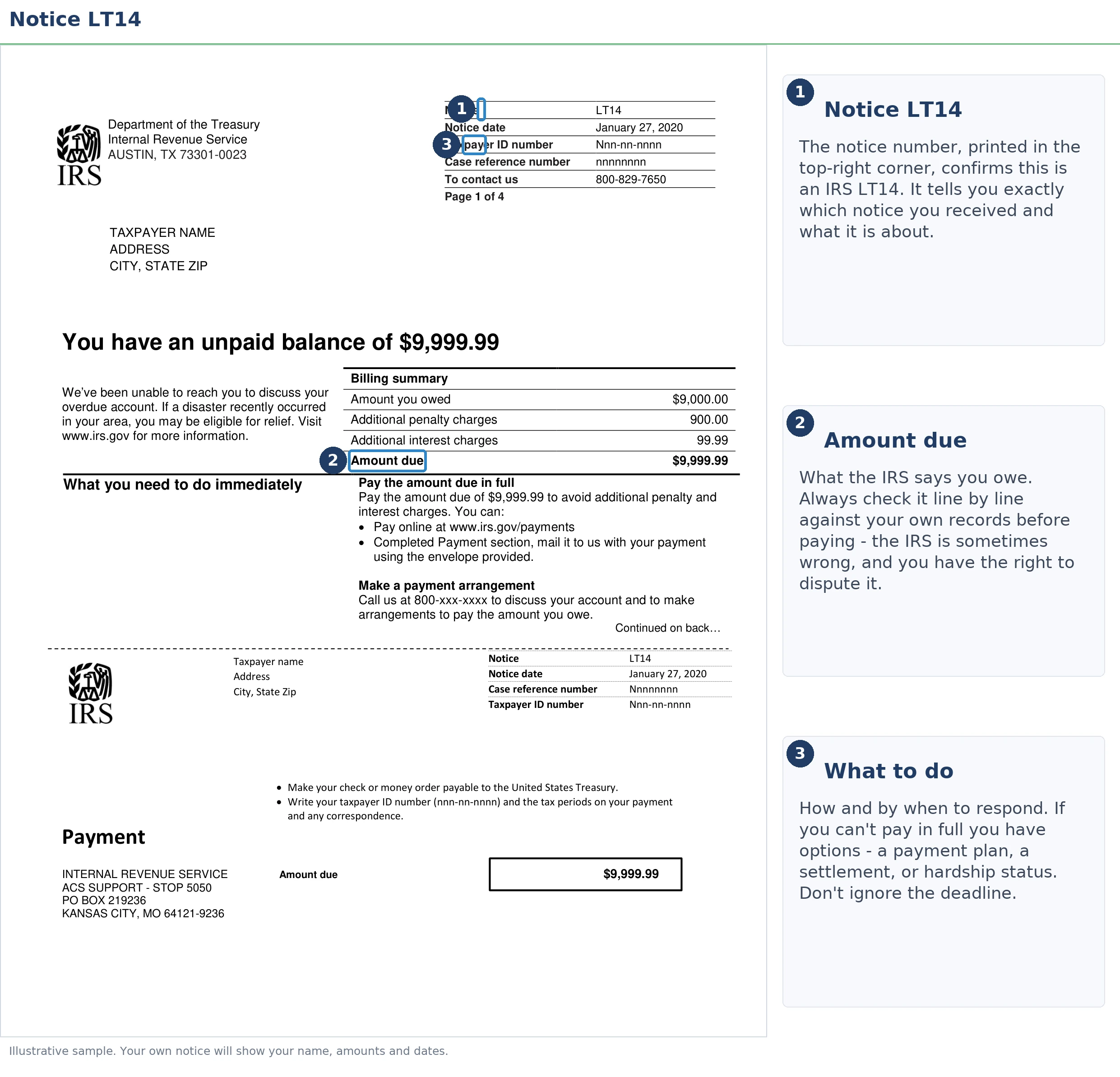
Two lines on the letter control everything — the response date and the total balance. The image below shows you exactly what an LT14 looks like and where those figures sit on the page.
⏱ Your deadline: the response date printed on your LT14 — the letter sets its own short window. Missing it doesn't trigger a seizure that day, but it moves your account toward the LT11 final levy notice, and interest plus the 0.5% monthly failure-to-pay penalty keep compounding on the full balance until you act.
Why you got an LT14 notice
An LT14 notice means your unpaid tax account has moved into the IRS Automated Collection System (ACS) — the centralized unit with the authority to issue levies — and the IRS wants you to make contact. The "LT" prefix is the tell: unlike the CP-series bills mailed from IRS processing campuses, LT letters come from ACS, the arm of the IRS that actually enforces.
You typically see an LT14 when earlier bills went unanswered, mail wasn't reaching you, or a prior arrangement fell apart and the account cycled back into active collection. The letter lists the tax periods, the total balance with penalties and interest, and a phone number with a response date. (For the broader map of how IRS letters fit together, see why did I get a letter from the IRS.)
It helps to know what an LT14 is not. It's not an audit, and it's not itself a levy or a demand for financial statements. Those jobs belong to its ACS siblings: the LT16 notice pushes on overdue taxes and unfiled returns, the LT19 notice is a straight payment demand, and the LT24 notice asks for a completed Form 433 financial statement. The LT14's job is simpler: get you on the phone before enforcement starts.
What happens if you ignore an LT14
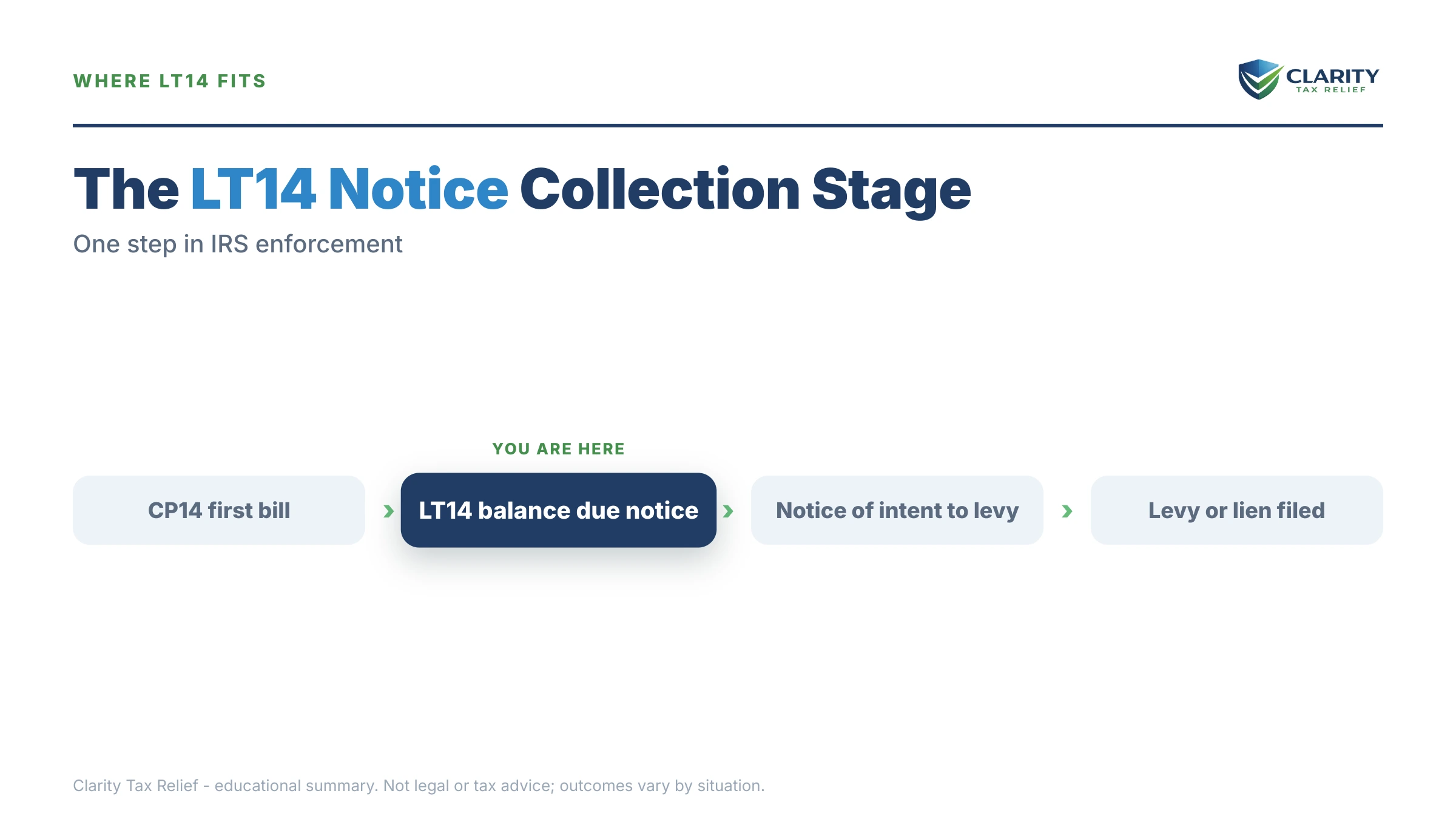
Ignoring an LT14 moves your account toward the LT11 — the final notice that lets the IRS levy wages and bank accounts 30 days after it's issued. There's no fixed interval between ACS letters, but the sequence itself is automated and doesn't stall just because IRS phone lines are understaffed in 2026. The order looks like this:
- LT14 — you are here. A contact request about your balance. No new enforcement power, but your account is already inside the collection unit.
- Follow-up ACS demands. Letters like the LT16 or LT19 harden the tone. A federal tax lien can be filed at any point in this stretch, and if your assessed debt reaches $66,000 (the 2026 threshold), passport certification becomes possible.
- LT11 notice or Letter 1058 — the final notice. This starts a 30-day clock and your Collection Due Process rights, requested on Form 12153. Miss that window and you lose your strongest appeal right (details in our Form 12153 CDP hearing guide).
- Levy. A bank levy freezes funds for a 21-day hold before they're sent to the IRS. A wage levy is continuous until released. For a business owner, the IRS can also levy accounts receivable — a letter to your customers directing your money to the Treasury.
Every stage of that sequence is more expensive and less flexible than the one before it. The LT14 stage is the last point where the conversation happens entirely on your schedule.
Holding an LT14 right now?
The IRS is asking you to call — but what you say on that call sets your terms. Get your LT14 reviewed free before the response date on your letter passes. An experienced tax professional will confirm the balance, map your options, and handle ACS for you if you want.
Your options if you can't pay the LT14 in full
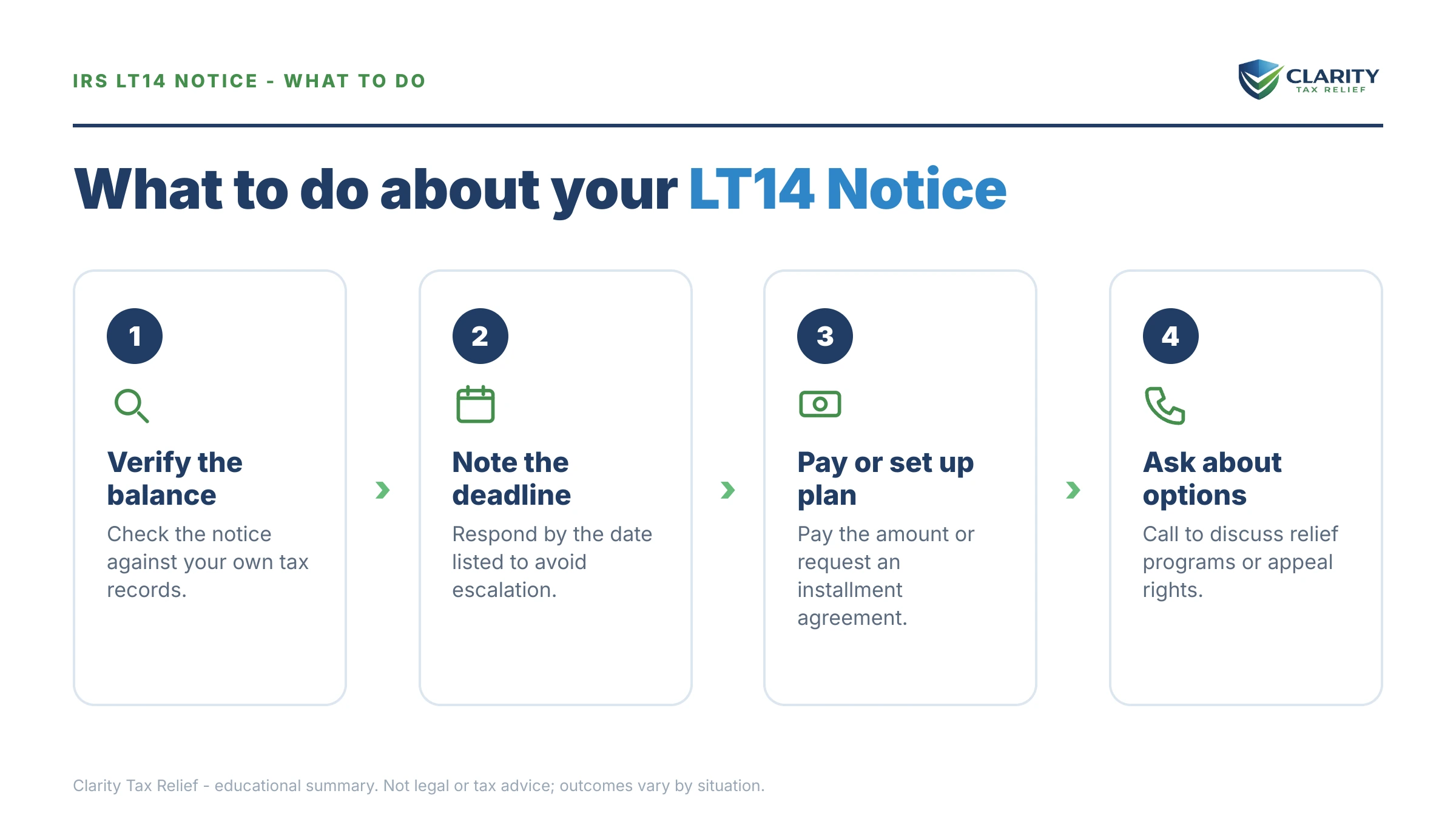
Most LT14 balances under $50,000 qualify for a payment plan of up to 72 months — often without submitting a financial statement, and often set up online without ever making the phone call the letter requests. The letter presents two choices, pay or call; the tax code offers more:
- Short-term payment plan — up to 180 days to pay in full, $0 setup fee. Interest and penalties continue, but the escalation stops.
- Installment agreement — a monthly plan matched to your balance band (table below). Once it's active, the failure-to-pay penalty rate is cut in half.
- Currently Not Collectible status — if paying anything would leave you unable to cover basic living or operating expenses, collection can be paused. See how the hardship test works in IRS currently not collectible.
- Offer in Compromise — settling for less than you owe when your assets and income genuinely can't cover the debt. It's real but selective: the IRS accepted roughly 1 in 5 offers in FY2024, the application fee is $205, and lump-sum offers require 20% down (all waived with low-income certification, AGI at or below 250% of the poverty level).
- Penalty relief — first-time penalty abatement can remove penalties if your prior three years were clean, and starting summer 2026 the IRS's Automatic Exemption from Penalty (AEP) applies similar relief automatically, no request needed.
| Balance on your LT14 | Fastest realistic option | What the IRS requires |
|---|---|---|
| $10,000 or less | Guaranteed installment agreement | No financial disclosure; recent filing compliance |
| $10,001–$25,000 | Streamlined installment agreement, up to 72 months | No financial statement; stay current going forward |
| $25,001–$50,000 | Streamlined plan up to 72 months, set up online | Direct debit typically required; no full financials |
| Over $50,000 | Non-streamlined plan, OIC, or CNC | Form 433-F income, expense, and asset disclosure |
What resolving a $36,900 LT14 balance actually looks like
Say you owe $36,900 — you run a six-person shop, the balance built up across two lean years, and the LT14 just arrived. Because $36,900 is under the $50,000 line, you can set up a 72-month plan online. The base math: $36,900 ÷ 72 ≈ $513 a month, with the actual payment somewhat higher because interest keeps accruing on the unpaid balance.
The penalty math is why acting now matters. At the standard 0.5% monthly failure-to-pay rate, $36,900 generates about $184 in new penalty every month you wait. Once an installment agreement is active, that rate is cut in half — roughly $92 a month at the start, shrinking as the balance falls. You can estimate your own accrual with our Penalty & Interest Calculator.
Two variations on the same numbers. If cash flow allows $1,025 a month, the debt clears in roughly 36 months and you cut the accrual window in half. And if you're wondering about settling instead: an Offer in Compromise on $36,900 only works if the IRS's math shows it could never collect that much — and for an operating business, equity in trucks, equipment, and receivables counts against you. Most owners with a working business and $36,900 in debt resolve it through a plan, not a settlement.
If your LT14 involves payroll (Form 941) taxes
Payroll tax debt changes everything about an LT14: the trust-fund portion — the tax withheld from employees' paychecks — can be assessed against you personally through the Trust Fund Recovery Penalty, no matter what entity you operate under. ACS treats employment tax balances as a priority, and unresolved 941 debt is the most common route from automated letters to a revenue officer at your door.
Before the IRS will agree to any resolution on a payroll balance, you must be current on this quarter's deposits — the IRS will not finance ongoing non-compliance. If part of your LT14 balance is employment tax, start with our guides to 941 back taxes and the trust fund recovery penalty before you call anyone, because what you say about who ran payroll and signed checks can determine who gets assessed personally.
One more edge case worth naming: if you dispute the balance itself — a payment that didn't post, a return the IRS adjusted, a year that isn't yours — the LT14 stage is the right time to raise it. Pull your transcripts, gather proof, and put the dispute in writing rather than paying a number you don't agree with.
How to respond to an LT14, step by step
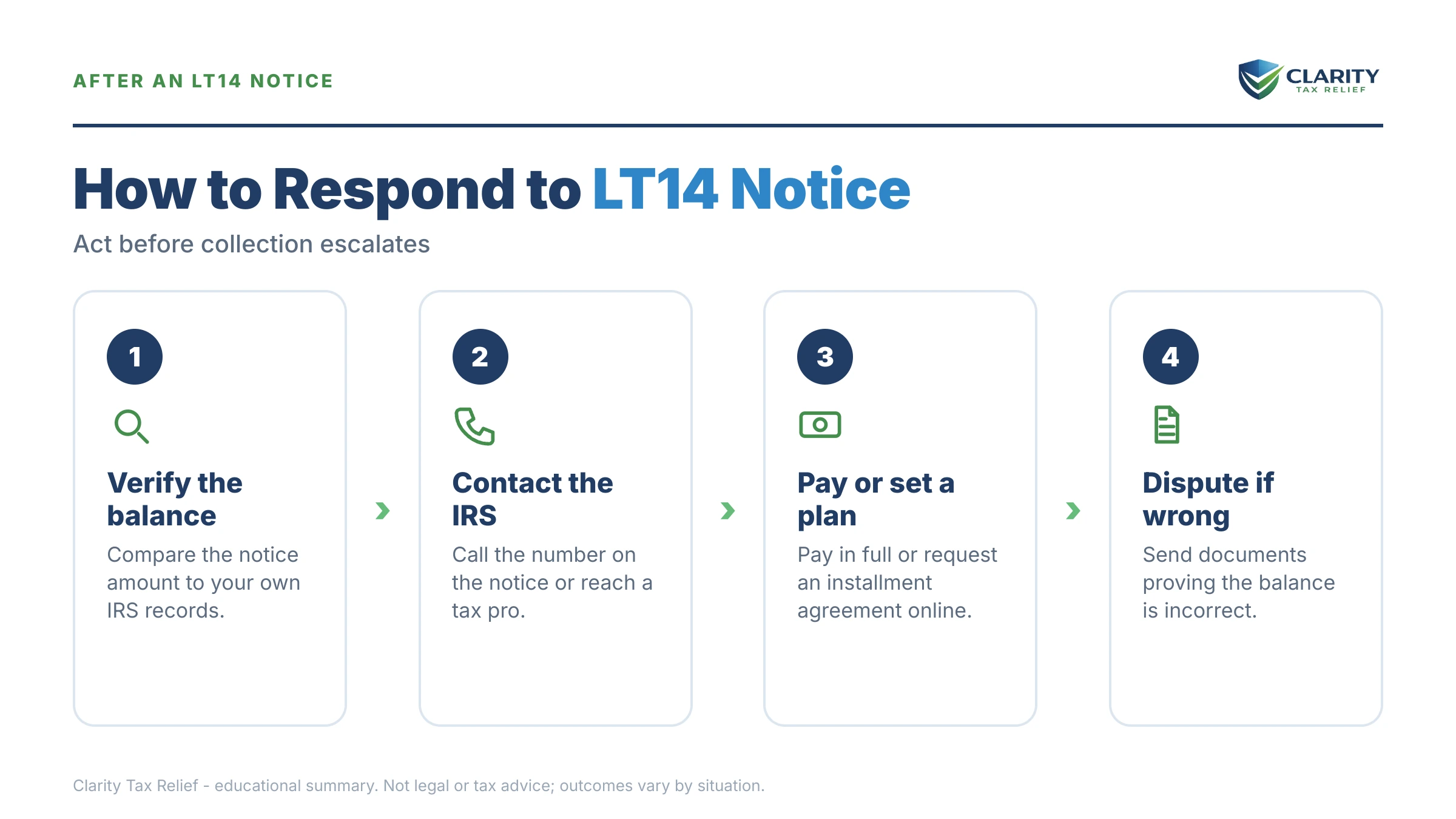
- Pull your IRS records. Log into your IRS online account or request account transcripts to confirm the balance, the tax years, and whether any payments haven't posted. Don't take the letter's number on faith — verify it.
- Confirm every required return is filed. The IRS generally won't finalize a payment plan or hardship status while returns are missing. If you have unfiled years, file them first — even if you can't pay what they show.
- Choose your resolution before you contact anyone. Decide whether you're aiming for a payment plan, hardship status, or a settlement before you speak to ACS. What you say on that call becomes part of your collection file.
- Respond by the date on the letter. Set up a payment plan online, call the number printed on the LT14, or have an experienced tax professional contact ACS for you under a Form 2848 power of attorney.
- Get confirmation and calendar everything. Save written confirmation of any agreement, set reminders for every payment, and keep the LT14 with your tax records in case the account is mishandled later.
The IRS's own resources for the do-it-yourself path: full payment options live at IRS.gov/payments, and plan setup is at the IRS payment plans and installment agreements page. If collection action is creating a genuine hardship the IRS won't address, the Taxpayer Advocate Service is an independent office that can intervene.
When you can handle an LT14 yourself
You probably don't need professional help if the balance is under about $25,000, every return is filed, you agree with the amount, and you can commit to a monthly payment. In that situation, an online streamlined plan set up before the response date resolves the LT14 completely — no phone call, no fee to anyone.
Experienced help changes outcomes in specific situations: the balance includes 941 payroll taxes with personal-liability exposure, you have unfiled years that need to land before any agreement, you owe over $50,000 and full financial disclosure is coming, you dispute the amount, or you've already received a CP504 or LT11 and the enforcement clock is genuinely running. In those cases the order of operations — returns first, penalties second, balance last — often changes what you ultimately pay.
Terms on your LT14, decoded
- ACS (Automated Collection System): the centralized IRS unit behind all LT-series letters — it works by mail and phone, and it can issue levies once the final notice stage is reached.
- Levy vs. lien: a levy takes property (wages, bank funds, receivables); a lien is a legal claim against everything you own that secures the debt without taking anything.
- Final notice of intent to levy: the LT11 or Letter 1058 — the legally required warning that must precede a wage or bank levy.
- CDP (Collection Due Process): your right to a formal appeals hearing, requested on Form 12153 within 30 days of the final notice, which pauses levy action while it's pending.
- CSED: the collection statute expiration date — the IRS generally has 10 years from assessment to collect, though appeals, offers, and bankruptcy pause the clock.
- Trust fund taxes: the portion of payroll taxes withheld from employees' pay — the part the IRS can assess against responsible individuals personally.
| Notice | What it means | Enforcement power at this stage |
|---|---|---|
| LT14 | ACS wants you to call about your unpaid balance | None new — a contact request with a response date |
| LT16 / LT19 | Demands to address overdue taxes, returns, or payment | No levy yet; lien filing possible at any point |
| LT11 / Letter 1058 | Final notice of intent to levy | Starts a 30-day clock; CDP rights via Form 12153 |
| After the 30 days | Levy authority is active | Bank levy (21-day hold), continuous wage levy, receivables levy |
LT14 questions, answered
Is an LT14 notice serious?
Yes — more serious than the CP-series bills that came before it. An LT14 means your account is in the IRS Automated Collection System, the unit that issues levies, and it's typically one or two letters away from a final notice of intent to levy. Nothing can be seized based on the LT14 alone, but the window to resolve things on your terms is closing.
How long do I have to respond to an LT14?
Respond by the date printed on your letter — the LT14 states its own response window, and it is short. There is no fixed statutory deadline attached to an LT14 itself, but interest and the 0.5% monthly failure-to-pay penalty keep accruing, and ignoring the letter moves your account toward the LT11 final notice, which starts a hard 30-day clock.
Can the IRS levy my bank account after an LT14?
Not based on the LT14 alone. Before levying wages or bank accounts, the IRS must send a final notice of intent to levy — usually LT11 or Letter 1058 — and give you 30 days to respond or request a Collection Due Process hearing. If a CP504 was already sent, your state tax refund can be taken, but a full levy still requires that final notice.
What is the difference between an LT14 and an LT11?
The LT14 asks you to contact the IRS about an unpaid balance; the LT11 is the final notice of intent to levy. The LT11 starts a 30-day clock, after which the IRS can garnish wages and levy bank accounts, and it carries formal Collection Due Process appeal rights the LT14 does not. If you respond at the LT14 stage, you may never see an LT11.
Should I call the phone number on the LT14?
Yes, the number on a genuine LT14 connects to the IRS Automated Collection System — but know what you'll ask for before you dial. The ACS representative will ask about your income, bank accounts, and employer, and that information can later be used to levy. If your balance is large or involves payroll taxes, consider having an experienced tax professional make the call under a power of attorney (Form 2848).
What if I can't pay the amount on my LT14?
You don't have to pay in full to stop the escalation. Balances up to $50,000 usually qualify for a payment plan of up to 72 months that can be set up online; genuine hardship can qualify for Currently Not Collectible status; and if your assets and income truly can't cover the debt, an Offer in Compromise may fit. Penalty abatement can also shrink the balance itself.
Does an LT14 mean a revenue officer has my case?
No. LT-series letters come from the Automated Collection System — a centralized, computer-driven unit — not from a local revenue officer. A revenue officer assignment is usually announced with Letter 725-B and typically involves larger balances or payroll tax debt. That said, ignoring ACS letters on a business payroll balance is one of the fastest ways to end up with a revenue officer.
Your next 24 hours
- Find two things on your LT14: the response date and the total balance, both near the top of the first page. Write the date somewhere you'll see it.
- Gather your paperwork: the LT14 itself, your most recent filed return, a rough monthly income-and-expense picture — and if you run payroll, your recent 941 filings and deposit records.
- Get a free case review before the response date passes: send a photo of your LT14 through the 2-minute form or call (888) 825-7779. An experienced tax professional will confirm where you stand and which option costs you least.
This guide is general information, not tax or legal advice for your specific situation. Eligibility for IRS programs depends on individual facts and circumstances; no outcome is guaranteed.