
IRS Payment Plans
IRS Installment Agreement Request Letter: Sample, What to Include, and When to Use One (2026)
The short answer: an IRS installment agreement request letter is a written request for a monthly payment plan on back taxes. Most people don't need one — the IRS Online Payment Agreement or Form 9465 is faster — but a letter works when you're responding to a notice, proposing non-standard terms, or can't use the online tools.
You've added up the balance — maybe from a Schedule C year that outran your quarterly payments — and now you're staring at a blank page wondering what you're supposed to say to the IRS. Here's the good news: the IRS accepts payment-plan requests in plain English, and the request itself triggers real legal protections the moment it's pending. This page gives you the exact words.
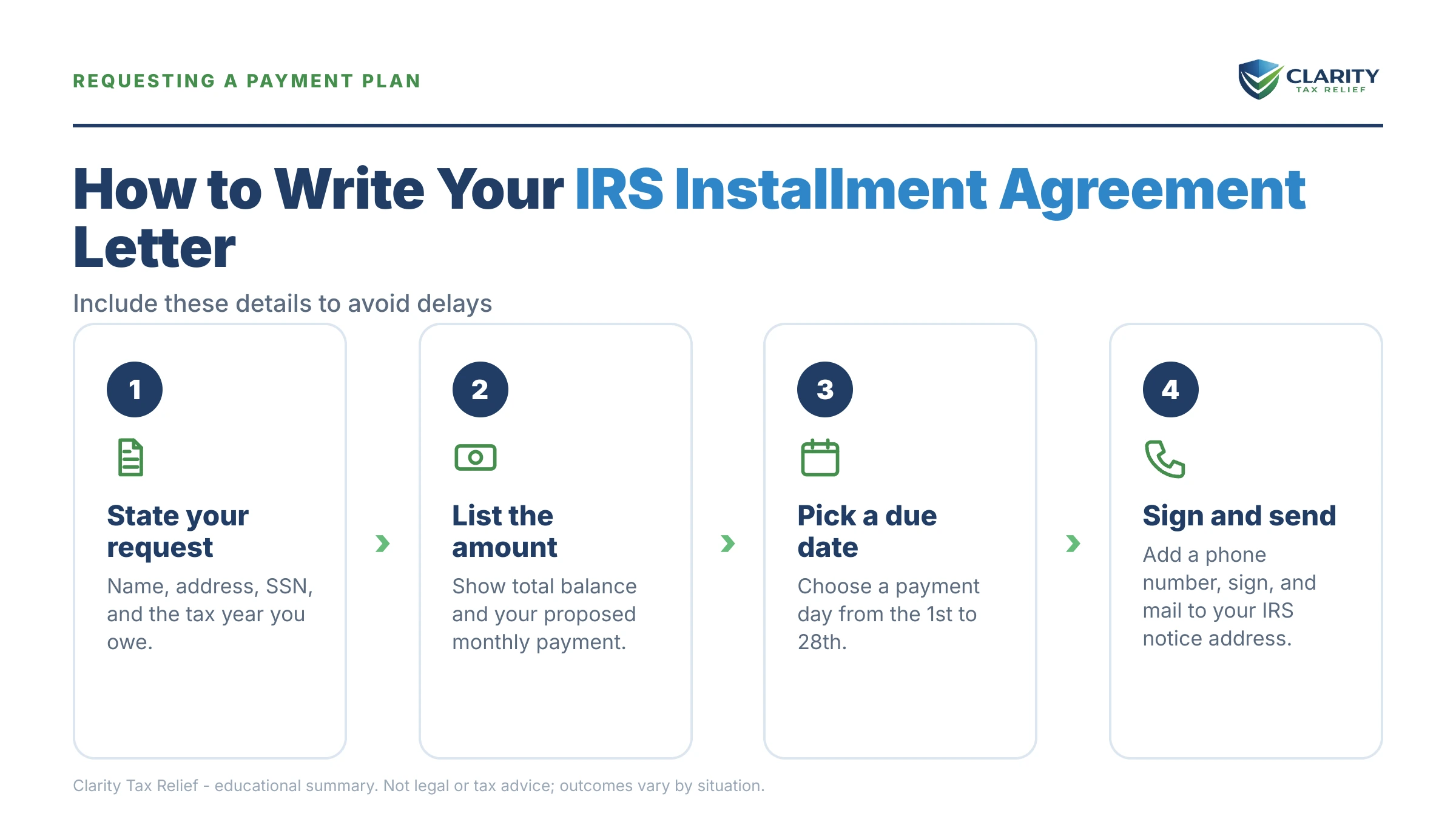
One thing to know before you write a single sentence: a mailed installment agreement request letter has the same legal effect as Form 9465 or an online request — all three create a "pending" installment agreement that generally blocks IRS levies while the request is under review. The sample letter further down this page, and the image that accompanies it, show you exactly what a finished, complete request looks like and where every detail belongs.
⏱ The clock that matters: there's no filing deadline for requesting an installment agreement — but every month you wait adds a 0.5% failure-to-pay penalty plus daily-compounding interest to your balance. And if a collection notice prompted your search, the response date printed on that notice is the deadline that controls.
Do you actually need an IRS installment agreement request letter?
Most taxpayers who owe $50,000 or less never need to write a letter at all — the IRS Online Payment Agreement approves the same monthly plan in minutes, usually with the lowest fee. If that's you, our walkthrough on how to set up an IRS payment plan online covers the whole process, and you can stop reading here.
A written letter earns its postage in five specific situations:
- You're responding to a mailed notice and want a paper trail showing exactly when you asked, in case the request and the next automated notice cross in the mail.
- You can't get through online identity verification (ID.me failures, no U.S. credit file, recently moved) and can't reach a human by phone.
- You're proposing terms the online tool won't accept — a payment below the 72-month floor, a start date months out, or a partial payment installment agreement that pays less than the full debt before the collection statute expires.
- The balance isn't a simple 1040 balance — many business accounts can't use the individual online tool, so the request goes in writing or by phone.
- A revenue officer asked for a written proposal. Once a human is assigned to your case, everything goes to that person, in writing.
The letter's official sibling is Form 9465, the IRS's fill-in-the-blank version of the same request — our Form 9465 walkthrough covers it line by line. Many practitioners actually send both: the form for processing, a short cover letter for context. Either way, the legal effect is identical.
What happens if you don't request a payment plan
An unpaid IRS balance moves through the collection sequence automatically — your silence, not a human decision, is what advances it. In 2026, with the IRS workforce down roughly 27% from 2025 cuts, the humans are harder to reach but the automated notices never paused. Here's the sequence a request letter interrupts:
- First bill (CP14). You have about 21 days from the notice date to pay or arrange payment before the system escalates — 10 business days if the balance is $100,000 or more.
- Reminder notices (CP501, CP503). Still just bills — but the balance grows every month they sit.
- CP504 — intent to levy your state refund. Under IRC §6331(d), the IRS can now take your state tax refund, and a federal tax lien becomes a live possibility.
- LT11 / Letter 1058 — final notice of intent to levy. A 30-day clock starts, along with your Collection Due Process appeal rights.
- Levy. Bank accounts (funds held 21 days before they leave) and wages (a continuous levy until released). For a sole proprietor, accounts receivable are reachable too.
Here's the part that makes acting today worth it: a pending installment agreement request generally blocks levy under IRC §6331(k) — at any stage of that sequence. Mailing a complete request doesn't just buy time; it legally suspends the IRS's ability to seize while the request is under review.
Owe back taxes and not sure what to send?
Whether a letter, Form 9465, or the online tool fits your balance depends on your numbers — and interest is accruing while you decide. An experienced tax professional will review your situation and map the right request, free.
Every way to request an IRS payment plan, compared
A letter is the slowest of four request methods — pick it because you need it, not because it feels formal. Fees and processing speed differ meaningfully; the full fee tiers (and how to reduce them) are in our guide to the IRS payment plan setup fee.
| Method | Setup cost | Typical speed | Best for |
|---|---|---|---|
| Online Payment Agreement | Lowest fee tier; lower still with direct debit ($0 for a 180-day short-term plan) | Usually approved instantly | Balances of $50,000 or less with online ID verification |
| Form 9465 (mailed or attached to your return) | Higher paper-application fee; reduced for low-income taxpayers | Typically weeks to a few months | Paper filers and anyone locked out of the online tool |
| Written request letter | Same fee as a paper request once approved | Typically weeks to a few months | Notice responses, non-standard terms, revenue-officer cases |
| Phone (number on your notice) | Fee depends on the payment method you choose | Same call — if you can reach an agent | Simple balances when hold times cooperate |
Whichever method you use, the type of agreement you can get is set by your combined balance. The thresholds decide whether the IRS takes your word for the payment or demands full financial disclosure:
| Agreement type | Balance threshold | Financial disclosure required? |
|---|---|---|
| Short-term payment plan | Any balance you can pay in full within 180 days | No — and no setup fee |
| Guaranteed installment agreement | $10,000 or less in income tax (excluding penalties and interest); individuals only | No |
| Streamlined installment agreement | $25,000 or less ($50,000 with direct debit) | No |
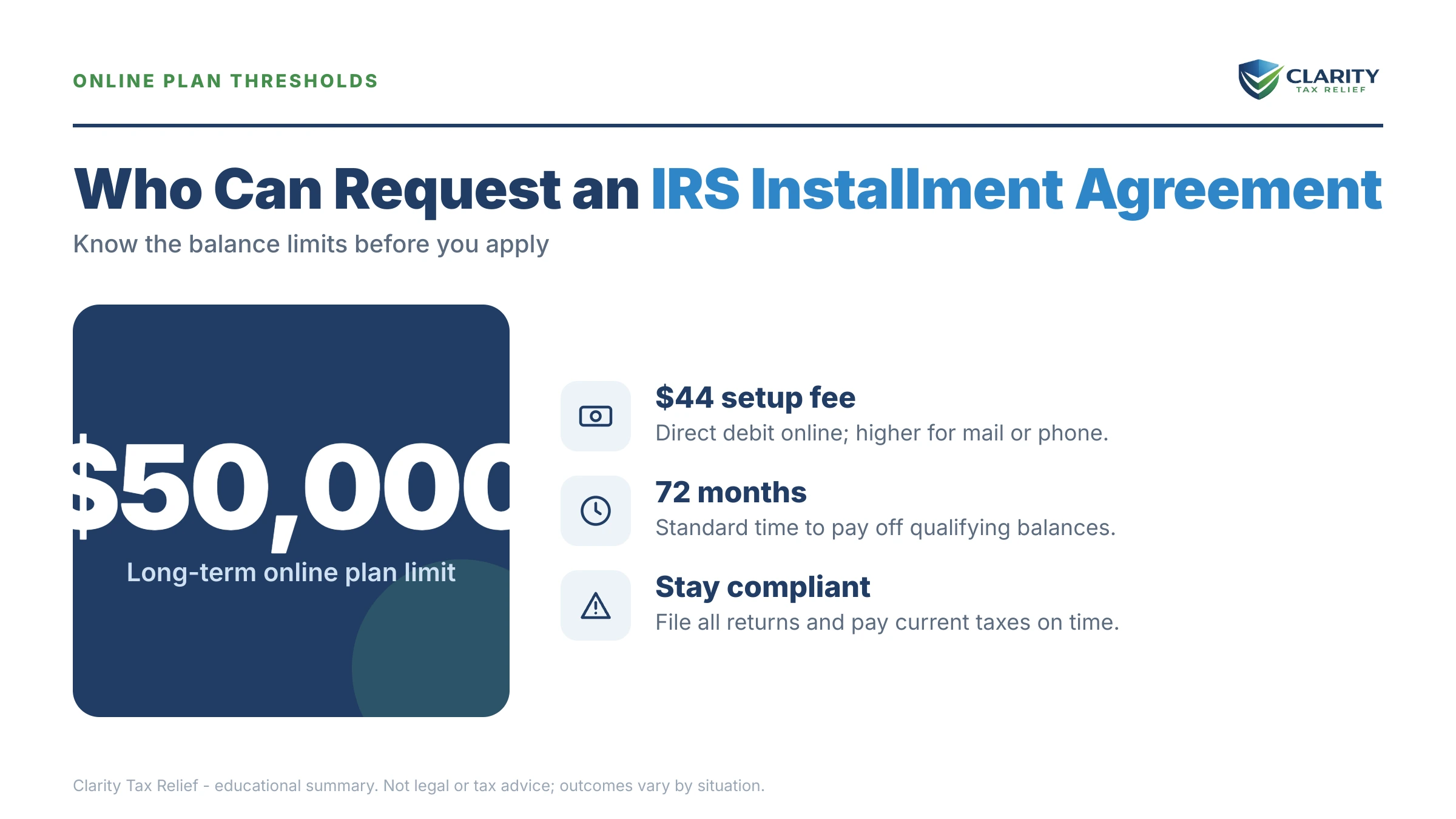
| Online long-term plan | $50,000 or less combined, up to 72 months | No |
| Non-streamlined agreement | Over $50,000 — see IRS payment plan over $50,000 | Yes — Form 433-F |
| Partial-pay installment agreement | Any balance; pays less than the full debt before the CSED | Yes — Form 433-F, reviewed periodically |
Two practical notes on the table. First, "combined" means all years added together — a $18,000 year plus a $9,000 year is a $27,000 request, which clears the streamlined bar only with direct debit. Second, choosing direct debit does more than unlock the higher threshold: it cuts the setup fee and nearly eliminates missed-payment defaults. Our comparison of the direct debit installment agreement covers the tradeoffs.
How to write an IRS installment agreement request letter, step by step
A complete request needs nine pieces of information and one signature — miss the tax years or the payment date and the letter bounces around the IRS for weeks before anyone can act on it.
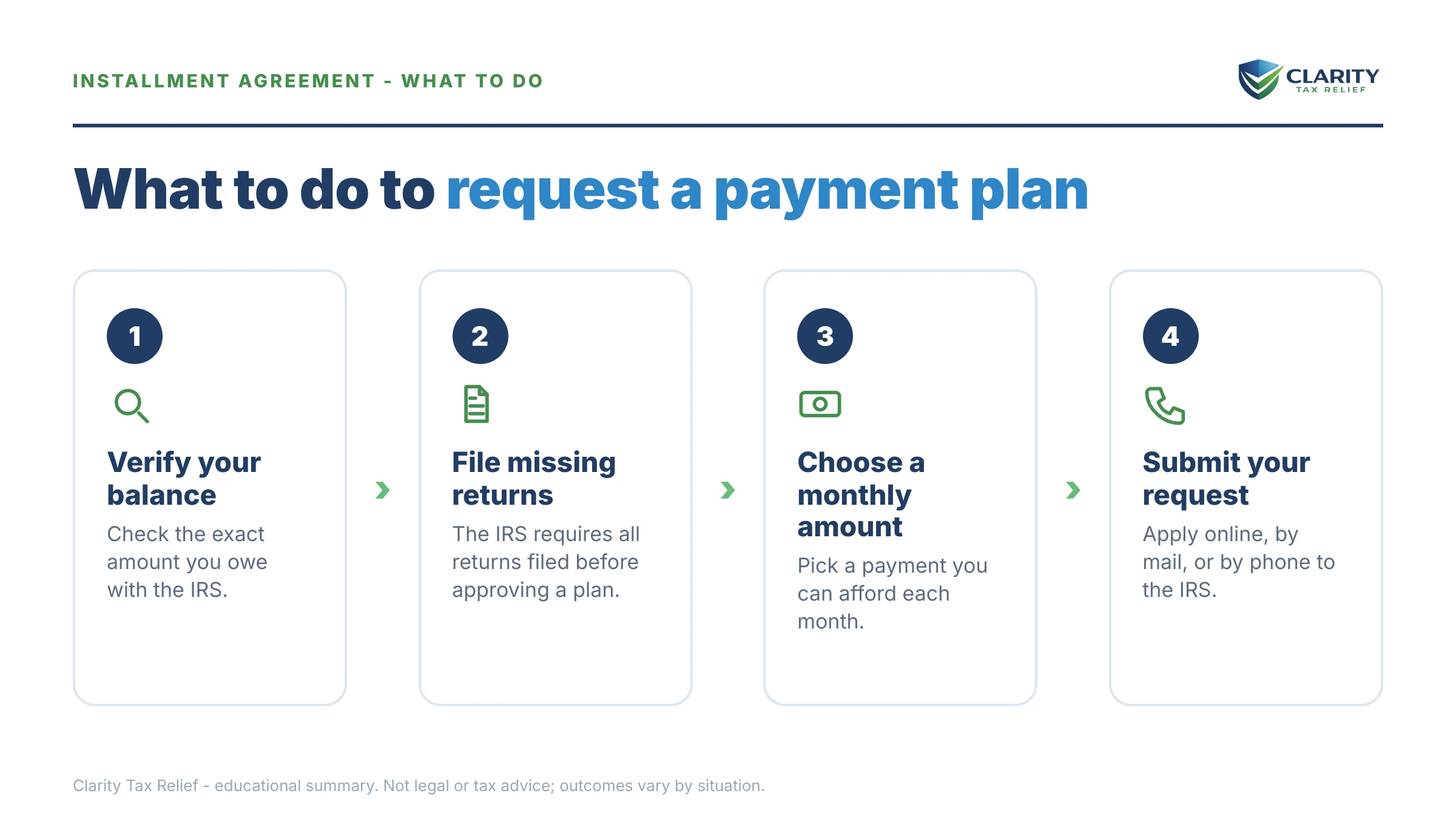
- Get compliant first. File every required return before you mail anything — an unfiled year is the number-one reason installment agreement requests are rejected.
- Set your monthly number. Divide your total balance by 72 if you owe $50,000 or less; that's the floor the IRS will generally accept without financial disclosure. Propose more if you can.
- Draft the letter. Include every element in the checklist table above — tax years, balance, proposed payment, a payment date between the 1st and 28th, and your signature — and attach a copy of your most recent notice.
- Mail it certified. Send the letter to the address on your latest notice (or the Form 9465 address for your state), and keep the certified-mail receipt and a copy of everything.
- Keep paying while you wait. Voluntary payments during the pending period shrink the balance interest is charged on and demonstrate good faith — send them with your SSN and tax year noted.
- Watch the mail for the IRS response. Approval usually arrives as an acceptance letter (with Form 433-D if you chose direct debit); a rejection starts a 30-day window to appeal through the Collection Appeals Program.
Here's the checklist the steps refer to — every element the IRS needs to say yes without writing back for more:
| Include this | Why the IRS needs it |
|---|---|
| Full legal name and current mailing address | Matches the request to your account and gets the response to the right mailbox |
| SSN (or EIN for a business balance) | The account identifier — without it, nothing can be processed |
| Tax form and every year you owe for | Tells the IRS which balances to fold into one agreement |
| Total balance per your records or notice | Confirms you and the IRS are talking about the same debt |
| Proposed monthly payment amount | The core of the request — the number the IRS accepts or counters |
| Payment date between the 1st and 28th | The IRS won't schedule payments on the 29th–31st |
| Payment method (bank routing and account number for direct debit) | Direct debit lowers the fee, raises the streamlined threshold, and prevents accidental default |
| Daytime phone number | Lets a processor resolve small issues by phone instead of by mail |
| Signature and date — both spouses if the debt is on a joint return | An unsigned request isn't a request |
| Copy of your most recent IRS notice | Routes the letter to the unit already holding your file |
Sample IRS installment agreement request letter (copy and adapt)
The template below is complete — swap the bracketed items for your own details and remove anything that doesn't apply. Keep it to one page; processors act on facts, not narrative.
[Your full name]
[Street address]
[City, State ZIP]
SSN: [XXX-XX-XXXX]
[Date]Internal Revenue Service
[Address from your most recent notice, or the Form 9465 address for your state]Re: Installment Agreement Request — Form 1040, Tax Year(s) [2024 and 2025]
Notice: [CP14 dated Month DD, 2026 — if applicable]To Whom It May Concern:
I am requesting a monthly installment agreement for my unpaid federal income tax. My records and your notice show a combined balance of $[amount] for the tax year(s) listed above.
I propose to pay $[amount] per month, beginning [Month DD, 2026], with each payment due on the [15th] of the month. I request direct debit from the following account: [Bank name], routing number [XXXXXXXXX], account number [XXXXXXXX].
All of my required federal tax returns have been filed, and I am current on my 2026 estimated tax payments. Please apply payments to the oldest tax period first.
If you need additional information, please contact me at [daytime phone]. Thank you for your consideration.
Sincerely,
[Signature]
[Printed name]
[Spouse's signature and printed name, if a joint liability]Enclosure: Copy of Notice [CP14]
Three drafting notes. Don't volunteer financial documentation unless your balance is over $50,000 or you're proposing less than the 72-month floor — unsolicited paperwork slows processing. Don't explain why you owe; this isn't a penalty-abatement request, and the story doesn't change the outcome. And never mail your only copy — keep the letter, the enclosure, and the certified-mail receipt together.
Worked example: requesting a plan on $23,800 of self-employment tax
A $23,800 balance divides to about $331 a month over 72 months — and because it's under the $25,000 streamlined threshold, no financial disclosure is required at all.
Say you're a sole proprietor whose 2025 Schedule C came in strong, but the quarterly estimates didn't keep up, leaving $23,800 in combined income and self-employment tax, penalties, and interest. Here's the math your letter is built on:
- The floor: $23,800 ÷ 72 = $330.56 — call it $331/month. The IRS will generally accept this without asking about your finances.
- The penalty savings: before approval, the failure-to-pay penalty runs 0.5% monthly — about $119/month on this balance. Once the agreement is in effect, the rate drops to 0.25% — roughly $60/month. Getting approved literally halves the penalty bleed.
- The smarter proposal: at $500/month, the principal clears in roughly 48 months instead of 72, which means about two fewer years of daily-compounding interest at the federal underpayment rate. Our guide to the installment agreement interest rate shows what paying over time really costs, and you can estimate your own accrual with our Penalty & Interest Calculator.
The self-employed trap hiding in this example: an installment agreement requires you to stay current on this year's taxes. Skip a 2026 quarterly estimated payment, and the new balance that posts next spring can default the agreement you just fought for. Build the quarterlies into your monthly budget alongside the $331 — they're effectively part of the payment.
Where to mail your letter — and what happens after you send it
Mail your installment agreement request letter to the address printed on your most recent IRS notice — not a generic service center address you found online. The notice address routes your letter to the office already holding your account. No notice? Use the Form 9465 mailing address for your state, listed in the form's official instructions (linked below). Assigned revenue officer? Everything goes directly to that officer.
Once the letter is in the IRS's hands, three things happen:
- Your request goes "pending." Levies are generally barred while the request is pending, for 30 days after any rejection, and during a timely appeal. One honest tradeoff: the 10-year collection statute (CSED) is paused while the request is pending plus 30 days — so a request letter isn't a stalling tactic; the clock you'd be running out stops too.
- Approval arrives by mail. Expect an acceptance letter; if you chose direct debit, the IRS may send Form 433-D to finalize the bank authorization. After that, a CP521 notice arrives before each payment as your monthly statement.
- Rejection comes with a reason and a right. The written rejection states why — unfiled returns, a payment the IRS thinks is too low, or a defaulted prior agreement — and you have 30 days to appeal through the Collection Appeals Program. Often, fixing the stated defect and re-requesting is faster than appealing.
How long is the wait? Mailed requests typically take weeks to a few months in 2026 — paper is worked by hand, and there are far fewer hands. That's a reason to send the letter certified and keep paying voluntarily, not a reason to skip the request: the pending-status protection starts when your request is received, not when it's approved.
When you can handle this yourself — and when help changes the outcome
Be honest with yourself here, because most payment-plan requests genuinely don't need professional help. Handle it yourself when: you owe $50,000 or less on filed returns, you agree with the balance, and you can afford the 72-month floor — the online tool or the sample letter above is all you need. The guaranteed installment agreement is even simpler — it's for individuals with an income-tax balance of $10,000 or less (excluding penalties and interest) who have filed all required returns, have filed and paid on time for the past 5 years with no installment agreement in that period, and can pay in full within 3 years; meet those conditions, and the rules essentially require the IRS to say yes.
Experienced help changes outcomes in the harder versions of this problem: a balance over $50,000, where how Form 433-F presents your income and allowable expenses determines your payment for years; a partial-pay proposal, where the math must survive periodic IRS review; multiple unfiled years that have to be filed before any agreement is possible; business or payroll tax balances, which follow different rules entirely; or a levy already in motion, where sequencing the request against the levy release matters. In those cases the question isn't whether you can write the letter — it's whether the letter asks for the right thing.
If your balance spans several years, includes business tax, or you're not sure the 72-month payment is actually affordable, have an experienced tax professional pressure-test the proposal before you mail it — the free case review takes minutes, or call (888) 825-7779.
Terms on your paperwork, decoded
- Pending installment agreement — the legal status your request enters the moment the IRS receives it, during which levies are generally barred.
- Streamlined agreement — a plan approved on your proposed payment alone, with no financial disclosure, for balances of $25,000 or less ($50,000 with direct debit).
- Direct debit installment agreement (DDIA) — automatic monthly withdrawal from your bank account; lower fee, higher threshold, near-zero default risk.
- Form 433-D — the confirmation form the IRS sends to finalize an approved agreement, including your direct-debit authorization.
- CP521 — the monthly statement the IRS mails before each installment payment is due.
- CSED (Collection Statute Expiration Date) — the end of the IRS's 10-year window to collect, which pauses while your request is pending.
Installment agreement request letter FAQs
Do I have to write a letter to request an IRS installment agreement?
No — a letter is one of four accepted methods, and usually the slowest. If you owe $50,000 or less combined, the IRS Online Payment Agreement approves the same plan in minutes with the lowest setup fee. A letter makes sense when you can't verify your identity online, you're proposing terms outside the standard rules, or a revenue officer asked for a written proposal.
What should an IRS installment agreement request letter include?
Nine things: your name and address, your SSN or EIN, the tax form and every year you owe for, the total balance, your proposed monthly payment, a payment date between the 1st and 28th, your payment method, a daytime phone number, and your signature. If the debt is on a joint return, both spouses should sign. Attach a copy of the most recent notice so the letter routes to the right unit.
Where do I mail an installment agreement request letter?
Mail it to the address printed on your most recent IRS balance-due notice — that routes it to the office already handling your account. If you don't have a notice, use the Form 9465 mailing address for your state listed in the form's instructions. If a revenue officer has been assigned to your case, send the request directly to that officer. Use certified mail and keep a stamped copy.
Can the IRS levy me while my installment agreement request is pending?
Generally no. Under IRC §6331(k), the IRS cannot levy while an installment agreement request is pending, for 30 days after a rejection, or while a timely appeal of that rejection is under review. That protection applies whether you requested the plan online, by Form 9465, or by letter. It does not automatically release a levy that was already in place before you asked.
How long does the IRS take to approve a mailed installment agreement request?
Expect weeks to a few months for a mailed letter or Form 9465 — paper requests are worked by hand, and the IRS workforce shrank roughly 27% in 2025. An online request for a balance of $50,000 or less is typically approved instantly. Keep making voluntary payments while you wait; they reduce the balance interest is charged on and show good faith.
Does an installment agreement stop penalties and interest?
No. Interest keeps compounding daily on the unpaid balance, and the failure-to-pay penalty continues — though it drops from 0.5% to 0.25% per month once an installment agreement is in effect. That's why proposing more than the minimum payment saves real money. Penalty abatement is a separate request you can make alongside the agreement if you qualify.
What monthly payment should I propose in my letter?
For a combined balance of $50,000 or less, divide the total by 72 — that's the floor the IRS will generally accept without financial disclosure. On $23,800, that's about $331 a month. Propose more if you can afford it, because interest accrues the whole time. Proposing less than the 72-month floor means submitting Form 433-F so the IRS can verify you can't pay more.
Can one letter cover multiple tax years?
Yes — list every year you owe for, and the IRS will fold them into a single agreement covering the combined balance. Two cautions: the combined total is what's measured against the $25,000 and $50,000 thresholds, and every required return must already be filed. An unfiled year anywhere in your history is the most common reason a request gets rejected.
What happens if the IRS rejects my installment agreement request?
You'll get a written rejection stating the reason — most often an unfiled return, a proposed payment below what your finances support, or a defaulted prior agreement. You have 30 days to appeal through the Collection Appeals Program, and the IRS cannot levy while a timely appeal is pending. Fixing the stated problem and re-requesting is often faster than appealing.
Your next 24 hours
- Confirm your exact balance. Pull the total from your most recent IRS notice or your IRS online account — every year, tax plus penalties plus interest — because your letter has to name the same numbers the IRS sees.
- Gather your four inputs. Last year's return, the notice (if you have one), your bank routing and account numbers for direct debit, and a realistic monthly number you can sustain alongside this year's quarterly estimates.
- Get the request pressure-tested before you mail it. A free case review — the 2-minute form or (888) 825-7779 — confirms whether a letter, Form 9465, or the online tool gets you approved fastest, while the failure-to-pay penalty is still accruing at 0.5% a month instead of the 0.25% an approved agreement earns you.
Official resources: the IRS's payment plans and installment agreements page covers current eligibility and fees, the About Form 9465 page hosts the form and the state-by-state mailing addresses, and IRS.gov/payments is where voluntary payments go while your request is pending.
This guide is general information, not tax or legal advice for your specific situation. Eligibility for IRS programs depends on individual facts and circumstances; no outcome is guaranteed.