
IRS Audits
IRS Audit Reconsideration Letter: How to Write One That Reopens Your Audit (2026)
The short answer: an IRS audit reconsideration letter asks the IRS to reopen a closed audit and remove tax you can now disprove. There is no official form and no fee — you send a signed letter, a copy of your audit report (Form 4549), and documentation the examiner never saw, to the office that ran the audit.
The audit is over, the numbers are final, and the bill in front of you is built on evidence nobody ever looked at — maybe the letters went to an old address, maybe the records you mailed were never counted. That closed door has a specific key, and it's a letter, not a lawsuit.
This guide covers the letter itself: who qualifies to send one, exactly what goes in the envelope, where it goes, and what the IRS does with it. For the program from end to end — history, IRS review criteria, and outcome data — see our full guide to IRS audit reconsideration. Farther down, the image shows you exactly what the audit report you'll be responding to looks like and where to find the figures you're disputing.
⏱ The real clock: there is no statutory deadline for an audit reconsideration letter — but the balance isn't waiting. Interest compounds daily, a 0.5%-per-month failure-to-pay penalty accrues on the assessed tax, and each ignored notice moves the account one step closer to levy. The request also only works while the tax is unpaid; pay in full and you're into refund-claim territory, which has hard deadlines.
Why you'd write an IRS audit reconsideration letter
An audit reconsideration letter is the IRS's administrative do-over for a closed exam: no required form, no filing fee, and no court appearance. The IRS describes the process in Publication 3598, and it exists because a large share of audit assessments — especially mail audits — close by default, without the taxpayer ever presenting their side.
The IRS will generally consider reopening a closed audit in four situations:
- You have new information the examiner never considered — records you've since found, reconstructed, or obtained from a third party.
- You never received the audit notices — you moved, the mail failed, and the exam closed without you.
- You disagree with the assessment and can document why the adjustments are wrong.
- The IRS filed a return for you. A substitute for return uses zero deductions, zero cost basis, and the worst filing status — filing your real return is the reconsideration request in these cases.
Just as important is who can't use it. Reconsideration is off the table if you already paid the assessment in full (you'd file a refund claim instead — more below), if you signed a closing agreement (Form 906) or compromised the debt, or if the U.S. Tax Court or another court has already ruled on the same issue. And timing matters at the front end too: if you're still inside the 90-day window on a CP3219A notice of deficiency, petitioning Tax Court preserves far stronger rights than waiting for assessment — reconsideration is the tool for after that window has closed. If your exam is still open and you just received the examiner's report, the 30-day protest route in our guide to IRS audit appeal rights comes first.
New information is the single eligibility test the IRS applies most strictly — resubmitting the exact records the auditor already rejected is the most common reason requests are denied. (For background on exam windows and how many years the IRS can even reach, see how far back can the IRS audit.)
What happens if you ignore the audit bill instead
An unpaid audit assessment moves through the same automated collection pipeline as any other tax debt — the system never pauses to ask whether the audit got it right. Once the exam closes, the additional tax posts to your account and the notice sequence begins:
- Assessment posts — a CP22E notice (audit changes, balance due) arrives. This is a bill, with penalties and interest already included. It's also the cheapest moment to send your reconsideration letter.
- Reminder notices — CP501 and CP503 follow. Still just bills, but the failure-to-pay penalty is adding 0.5% of the tax each month, plus daily compounding interest.
- CP504 — Notice of Intent to Levy — the IRS can now seize your state tax refund, and a federal tax lien becomes a realistic next step.
- LT11 / Letter 1058 — Final Notice — this starts a 30-day clock. Requesting a Collection Due Process hearing on Form 12153 within those 30 days blocks levies while your dispute is heard — and you can raise the audit's correctness there if you never had a prior chance to.
- Levy — after the 30 days pass: bank accounts (funds held 21 days before they leave), wages, and — critically for retirees — up to 15% of each Social Security payment through the Federal Payment Levy Program. If you live on that check, read can the IRS garnish Social Security before this stage arrives.
Here's the same sequence with your reconsideration timing mapped onto it:
| Stage | What the IRS can do | Your reconsideration move |
|---|---|---|
| CP22E (audit bill) | Bill only — no enforcement yet | Send the letter now; ask for a collection hold in it |
| CP501 / CP503 reminders | Balance grows monthly | Letter still lands on a quiet account — send it |
| CP504 | Seize your state refund; lien risk rises | Send the letter and call to request the hold explicitly |
| LT11 / Letter 1058 | 30 days until levy authority | File Form 12153 within 30 days and pursue reconsideration |
| Active levy | Bank (21-day hold), wages, 15% of Social Security | Reconsideration still possible; pair it with a levy-release request |
One more clock runs underneath all of this: interest never stops during the review, on whatever portion of the assessment survives. You can estimate how fast a disputed balance grows while you wait with our IRS Penalty & Interest Calculator.
Staring at an audit bill you know is wrong?
Interest and a monthly late-payment penalty are accruing on the full assessed amount while you decide. Send us your audit report and we'll tell you — free — whether a reconsideration letter can reopen it and what evidence will carry it.
Your options after a closed audit, compared
The reconsideration letter is usually the cheapest way to challenge a closed audit — but it is not the only way, and picking the wrong lane wastes months. Here's the full menu:
| Option | When it fits | Cost to request | Key limitation |
|---|---|---|---|
| Audit reconsideration letter | Balance unpaid + new evidence, missed notices, or an SFR | Free | Discretionary — the IRS can decline; collection hold not guaranteed |
| Appeals conference | Reconsideration partially or fully denied | Free | Limited to the issues and evidence in your request |
| OIC — doubt as to liability (Form 656-L) | You dispute that you legally owe the amount | No application fee | Must offer some amount; can't run alongside reconsideration on the same issue |
| Pay, then claim a refund (Form 1040-X / Form 843) | Already paid in full, or you want a path to court | Full payment first | Hard deadline — generally 3 years from filing or 2 years from payment |
| Payment plan or hardship status | The audit was actually right and you just can't pay | Setup fee varies; $0 for 180-day short-term plans | Resolves the debt, not the dispute — interest continues |
The refund-claim lane deserves one caution: it's the route with real deadlines. If any part of the assessment is already paid and you're weighing that path, our Form 843 walkthrough explains what qualifies. And if the IRS denies reconsideration outright, a doubt-as-to-liability offer — covered in OIC: doubt as to liability — puts the same dispute in front of a different set of eyes. Reconsideration costs nothing and forfeits nothing: a denial leaves every one of these other doors open.
What to include in your audit reconsideration letter
A complete reconsideration package contains four things: a signed letter, the audit report, the new evidence, and — where it helps — a Form 12661 for each disputed issue. The image below shows what a complete package looks like and where each piece fits.
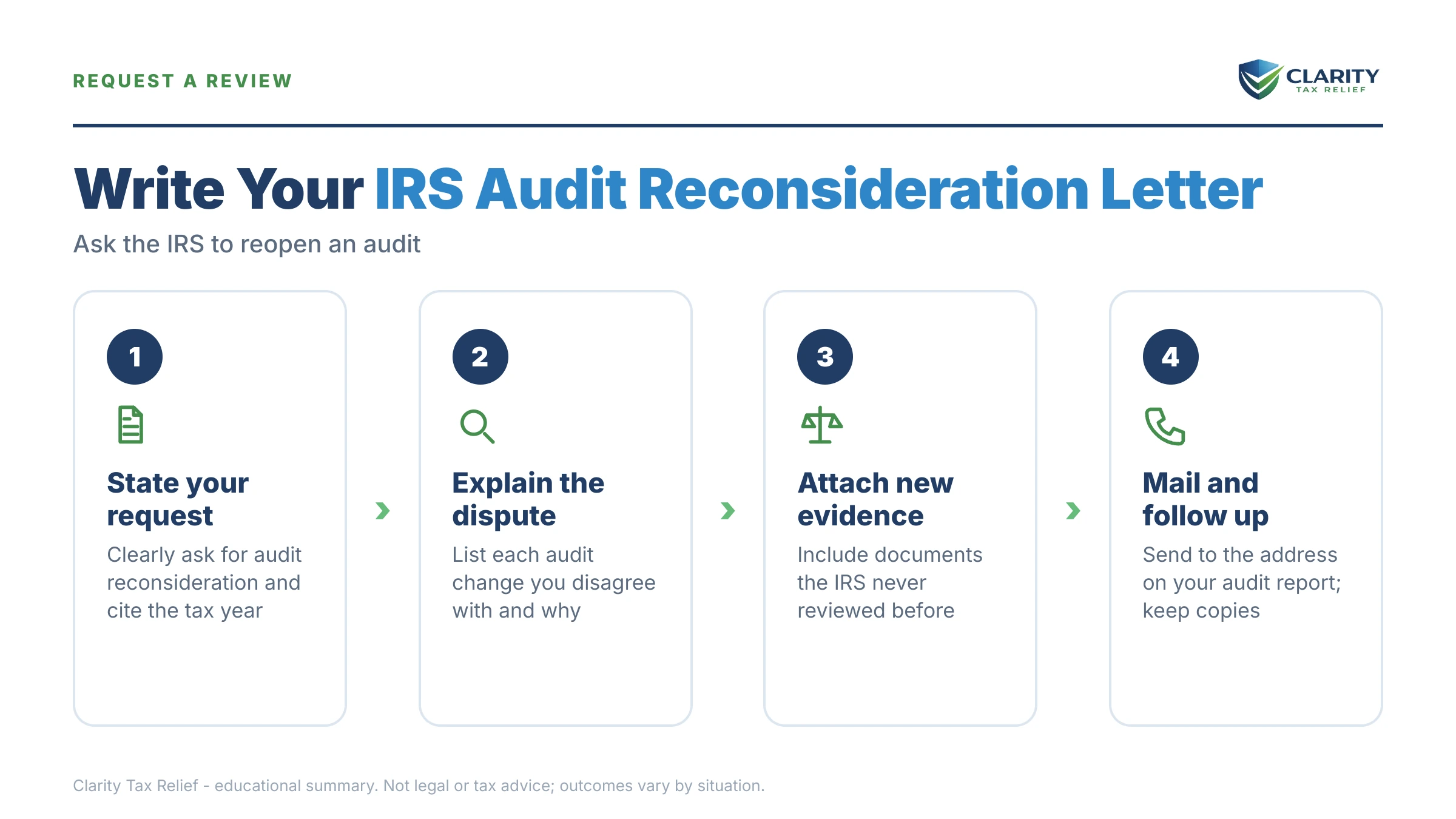
The letter itself doesn't need legal language. It needs precision. Identify yourself (name, address, taxpayer identification number), name the tax year, state plainly that you are requesting audit reconsideration, and then take the disputed adjustments one at a time: the item, the dollar amount the IRS added, and the exact attached document that disproves it. Close by asking the IRS to hold collection activity while the request is pending, and sign it.
| Item | Why the IRS needs it |
|---|---|
| Signed letter stating the request | There's no official form — the letter is the request, and it must name the year and each disputed adjustment |
| Copy of Form 4549 (audit report) | Tells the reviewer which exam you're disputing and which adjustments to re-examine |
| New documentation (copies, never originals) | The legal basis for reopening — evidence not previously considered |
| Form 12661 (optional, one per issue) | Puts each dispute in the issue/position/evidence format reviewers process fastest |
| Your signed original return (SFR cases only) | Replaces the IRS's substitute figures with your actual ones |
| Form 2848 (if a professional represents you) | Authorizes the IRS to work the case with your representative directly |
Every document must be a copy — the IRS will not return originals. If your records were lost or never existed on paper, don't give up before you start: bank and broker archives, county records, pharmacy printouts, and third-party statements can rebuild a file. Our guide to being audited with no receipts covers reconstruction techniques that work in reconsideration too.
How to write and send an IRS audit reconsideration letter, step by step
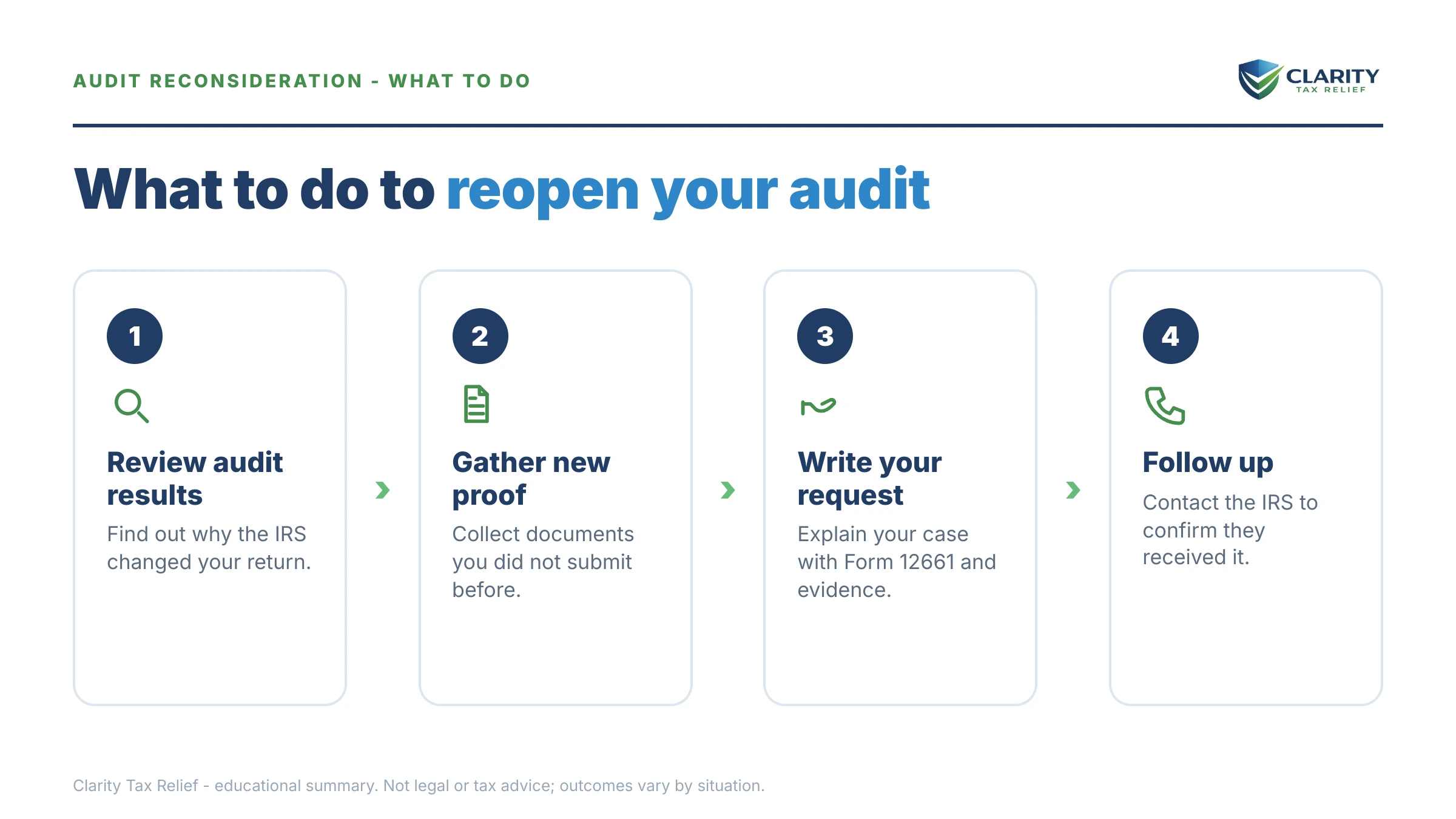
- Confirm the assessment is unpaid and pull your paperwork. Check your IRS online account or account transcript for the assessed amount, and locate your audit report (Form 4549). If you can't find the report, call the number on your most recent notice and request a copy — the review stalls without it.
- Gather the evidence the examiner never saw. Collect copies — never originals — of every document that supports each disputed item: broker statements, receipts, canceled checks, logs, corrected 1099s. New information is the price of admission; resubmitting records the auditor already rejected leads to denial.
- Write the letter. State your name, address, taxpayer identification number, the tax year, and that you are requesting audit reconsideration. Then list each adjustment you dispute, the dollar amount, and exactly which attached document disproves it. Close by asking the IRS to hold collection while the request is pending.
- Attach the audit report and, optionally, Form 12661. Include a copy of Form 4549 and, if it helps you organize, one Form 12661 (Disputed Issue Verification) per disputed issue. If the IRS filed a substitute return for you, attach your signed original return — that filing is the request.
- Mail the package by certified mail. Send it to the IRS office that conducted the audit — the address is on your examination letters — with return receipt requested, and keep a complete copy of the entire package.
- Calendar a follow-up. If you receive no acknowledgment after about a month, call the number on your notice to confirm the request was received and ask whether collection has been held.
What happens after you mail the letter
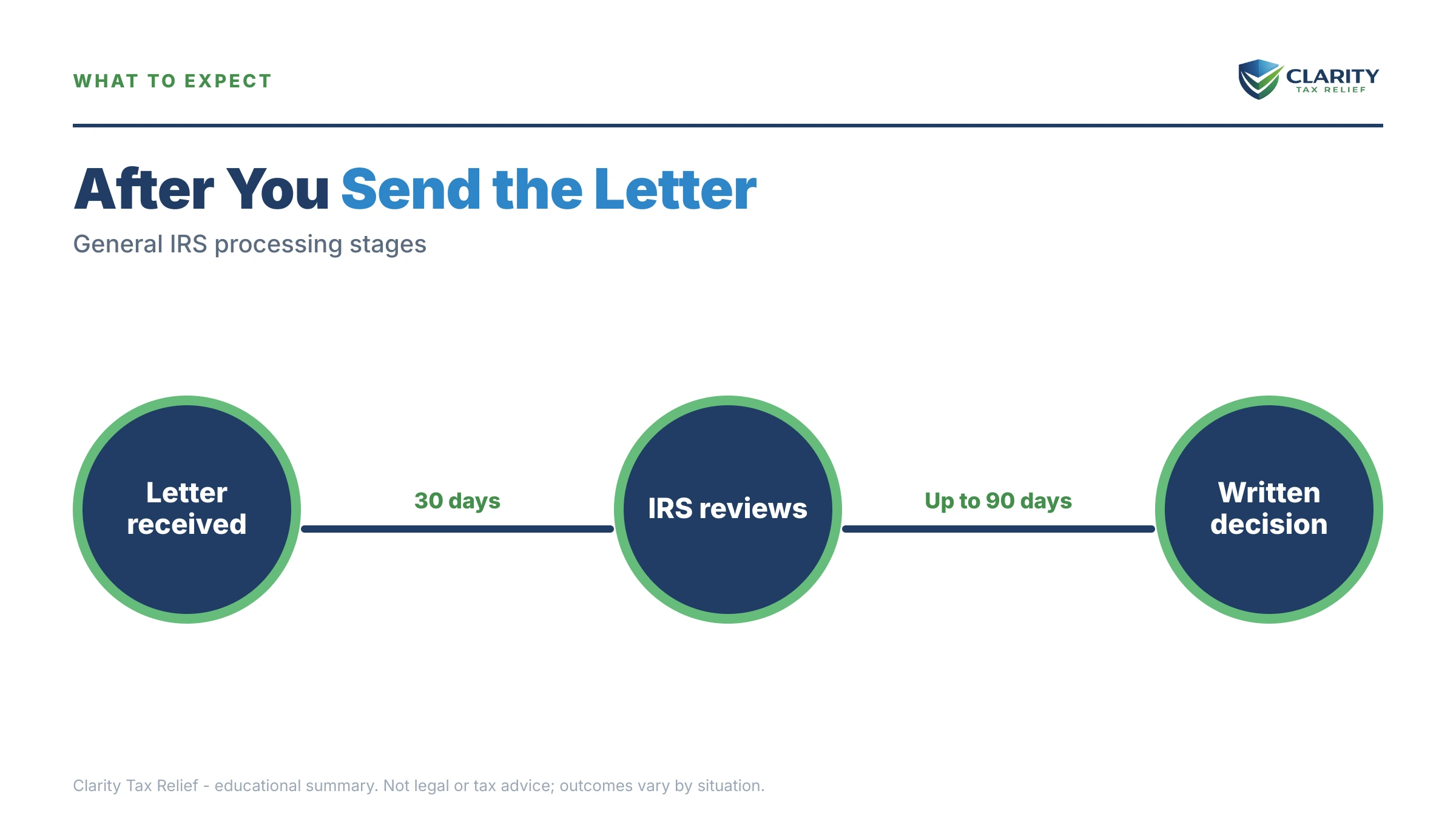
The IRS reviews a reconsideration request against one question: does the new documentation change the audit's result? There is no statutory response deadline on the IRS's side, so expect the review to take months — and in 2026, with the IRS workforce down roughly 27% from the 2025 cuts, correspondence queues are longer than the automated collection stream that runs beside them. That mismatch is exactly why the collection-hold request in your letter matters.
Three outcomes are possible:
- Full acceptance — the IRS abates the disputed tax and recalculates the penalties and interest built on it. You'll see the reduction on your account transcript and receive an adjusted balance (or zero balance) notice.
- Partial acceptance — some items are allowed, others aren't. You can accept the new number, or continue the fight on the remaining items only.
- Denial — usually because the evidence wasn't genuinely new or didn't address the adjustment. The determination letter explains your next-step rights.
After a denial or partial denial, you can request a conference with the IRS Independent Office of Appeals, file a doubt-as-to-liability offer, or pay the remaining balance and pursue a formal refund claim — the one path that ultimately leads to court. Nothing about a denied reconsideration worsens your position; the assessment simply stands as it did before. If the review drags on with no movement and collection pressure resumes, the Taxpayer Advocate Service can intervene when IRS delay is causing harm.
A worked example: unwinding a $27,500 audit assessment on a fixed income
Say you're retired, living mostly on Social Security, and two years ago you sold stock you inherited from your sister — $92,000 in proceeds, reported by the broker on a 1099-B with no cost basis shown. A mail audit questioned the sale, but the letters went to the house you'd already sold. The exam closed by default, treating the entire $92,000 as gain, and the resulting bill looks like this:
- Additional tax assessed: $21,420 (the full proceeds taxed as gain, which also dragged more of your Social Security into taxable income)
- 20% accuracy-related penalty: $21,420 × 0.20 = $4,284
- Accrued interest by the time the CP504 arrives: roughly $1,796
- Total: $27,500
Left alone, that balance grows by about $107 a month in failure-to-pay penalty ($21,420 × 0.5%) plus compounding interest — and a 72-month payment plan would run roughly $382 a month before accruals, a brutal number against a fixed income. But the assessment rests on a single missing fact: inherited assets get a stepped-up basis. The date-of-death brokerage statement shows the shares were worth $79,400 when your sister died.
The reconsideration letter attaches that statement and the 1099-B, and the math rebuilds itself: actual gain is $92,000 − $79,400 = $12,600, producing additional tax of roughly $1,890 at capital-gains rates. The accuracy penalty recomputes on the smaller tax (about $378), interest shrinks proportionally, and in round numbers about $25,000 of the $27,500 assessment is abated — from one letter, one attachment, and zero fees. This is hypothetical, and every case turns on its documents; but it's a faithful picture of why missing-basis and missed-mail audits are among the strongest reconsideration cases the IRS sees.
When you can handle this yourself — and when help changes the outcome
Many audit reconsideration letters are genuinely do-it-yourself projects. If your case is one clean issue with one clean document — a basis statement, a corrected 1099, proof a dependent lived with you — write the letter, attach the evidence, mail it certified, and save your money. The same is true for most substitute-for-return cases: preparing and filing the real return is the whole job.
Experienced help earns its cost in a different set of situations: when a levy is already in motion or an LT11 clock is running alongside the review, when the audit spans multiple years or the records must be reconstructed from scratch, when the disputed issues involve business income or a bank deposit method audit where the IRS inferred income from deposits, or when a first request was already denied and the next move is Appeals or a doubt-as-to-liability offer. In those cases the sequencing — what to file, in what order, while keeping collection off your back — changes what you end up paying, not just how fast.
Not sure which camp you're in? Send us the audit report and the evidence you think reopens it — an experienced tax professional will tell you in one free call whether it's a mail-it-yourself letter or a case worth building: the 2-minute form or (888) 825-7779.
Terms on your audit paperwork, decoded
- Form 4549 — the "Income Tax Examination Changes" report: the line-by-line list of what the audit added, and the document your letter responds to.
- Assessment — the moment the audit's tax officially posts to your account; it's what makes the debt collectible and what reconsideration asks to undo.
- Abatement — the IRS's removal of assessed tax, penalty, or interest; a successful reconsideration ends in abatement.
- Substitute for return (SFR) — a return the IRS builds for a non-filer using only reported income, with no deductions or basis.
- Accuracy-related penalty — the 20% penalty stacked on audit adjustments; it shrinks automatically when the underlying tax is abated.
- CSED — the collection statute expiration date: the IRS has 10 years from assessment to collect, with pauses for certain events — details in the 10-year collection statute (CSED).
Primary sources worth bookmarking: the IRS's own overview in Publication 3598, The Audit Reconsideration Process; payment options at IRS.gov/payments if part of the assessment stands; and the Taxpayer Advocate Service if IRS delay on your request starts causing real harm.
Audit reconsideration letter questions, answered
Is there a deadline to send an IRS audit reconsideration letter?
No — audit reconsideration has no statutory deadline, which makes it one of the few IRS remedies you can't technically miss. The practical limits still bite: the balance must be unpaid when you ask, collection notices keep advancing while you prepare, and the IRS only has 10 years from assessment to collect, so a very old assessment may be better left to expire. Send it as soon as your documentation is ready.
Does an audit reconsideration letter stop IRS collection?
Not automatically. The IRS will often pause active collection on the disputed amount while it reviews your request, but you should ask for the hold in the letter itself — and interest and the failure-to-pay penalty keep accruing either way. If a final notice of intent to levy arrives while you wait, request a Collection Due Process hearing within 30 days to keep levies off the table.
Where do I send an audit reconsideration letter?
Send it to the IRS office that conducted the audit — the address appears on your audit report or examination letters. If you can't find it, use the address on your most recent balance-due notice, and the IRS will route it. Always mail the package by certified mail with return receipt, and keep a complete copy of everything you send.
What counts as new information for audit reconsideration?
Documents the examiner never considered: broker statements proving cost basis, canceled checks, receipts, mileage or appointment logs, third-party letters, or a corrected 1099 or W-2. Re-sending the same records the auditor already rejected almost guarantees denial. If you never participated in the audit at all, everything you submit is new by definition — that's the strongest reconsideration posture.
How long does IRS audit reconsideration take?
There is no fixed timeline — expect months, not weeks, and longer during 2026's reduced-staffing environment. You should receive an acknowledgment letter first, then a determination accepting your documentation in full, in part, or not at all. If you hear nothing for an extended stretch, call the number on your notice or contact the Taxpayer Advocate Service.
Can I request audit reconsideration if the IRS filed a return for me?
Yes — a substitute-for-return assessment is one of the most common reconsideration cases, and often the easiest to win. The IRS's substitute return uses no deductions, no basis, and the least favorable filing status, so filing your actual original return serves as the reconsideration request and frequently cuts the balance dramatically.
What if I already paid the audit assessment?
Audit reconsideration is generally only available while the tax is unpaid. If you've fully paid, you pursue a formal refund claim instead — usually Form 1040-X or Form 843 — generally within three years of filing the return or two years of the payment, whichever is later. Miss that window and the money is very hard to recover.
What happens if my audit reconsideration request is denied?
You still have routes. You can ask for a conference with the IRS Independent Office of Appeals, submit an Offer in Compromise based on doubt as to liability (Form 656-L, which carries no application fee), or pay the balance and file a formal refund claim to preserve court rights. A partial acceptance can also be appealed on just the items the IRS refused.
Do I need Form 12661 for audit reconsideration?
No — Form 12661, Disputed Issue Verification, is optional. There is no required form for audit reconsideration at all; a signed letter works. That said, filling out a 12661 for each disputed adjustment forces you to state the issue, your position, and your evidence in the format IRS reviewers are used to, which can speed the review.
Can the IRS levy my Social Security while my reconsideration is pending?
It can if the account has already passed the final-notice stage — the Federal Payment Levy Program can take up to 15% of each Social Security payment. A pending reconsideration often persuades the IRS to hold collection, but you have to ask. If a levy is already biting into a check you live on, an economic-hardship release is a separate, faster remedy to pursue in parallel.
Your next 24 hours
- Find your audit report. Locate Form 4549 (or your CP22E) and circle each adjustment you dispute and its dollar amount — that list is the skeleton of your letter. Can't find it? Note the phone number on your most recent notice; requesting a copy is step one.
- Gather the evidence. Pull the return for the audited year plus every document the examiner never saw — broker statements, receipts, canceled checks, a corrected 1099 — and make copies of each.
- Get the package reviewed free. Interest and the monthly late-payment penalty are accruing on the full assessment while it sits unchallenged. Send us the report and your evidence via the 2-minute form or call (888) 825-7779, and an experienced tax professional will tell you whether your letter is ready to mail — or what's missing before it is.
This guide is general information, not tax or legal advice for your specific situation. Eligibility for IRS programs depends on individual facts and circumstances; no outcome is guaranteed.