
IRS Forms
Instructions for Form 5329: Who Must File, What Each Part Taxes, and How to Claim an Exception (2026)
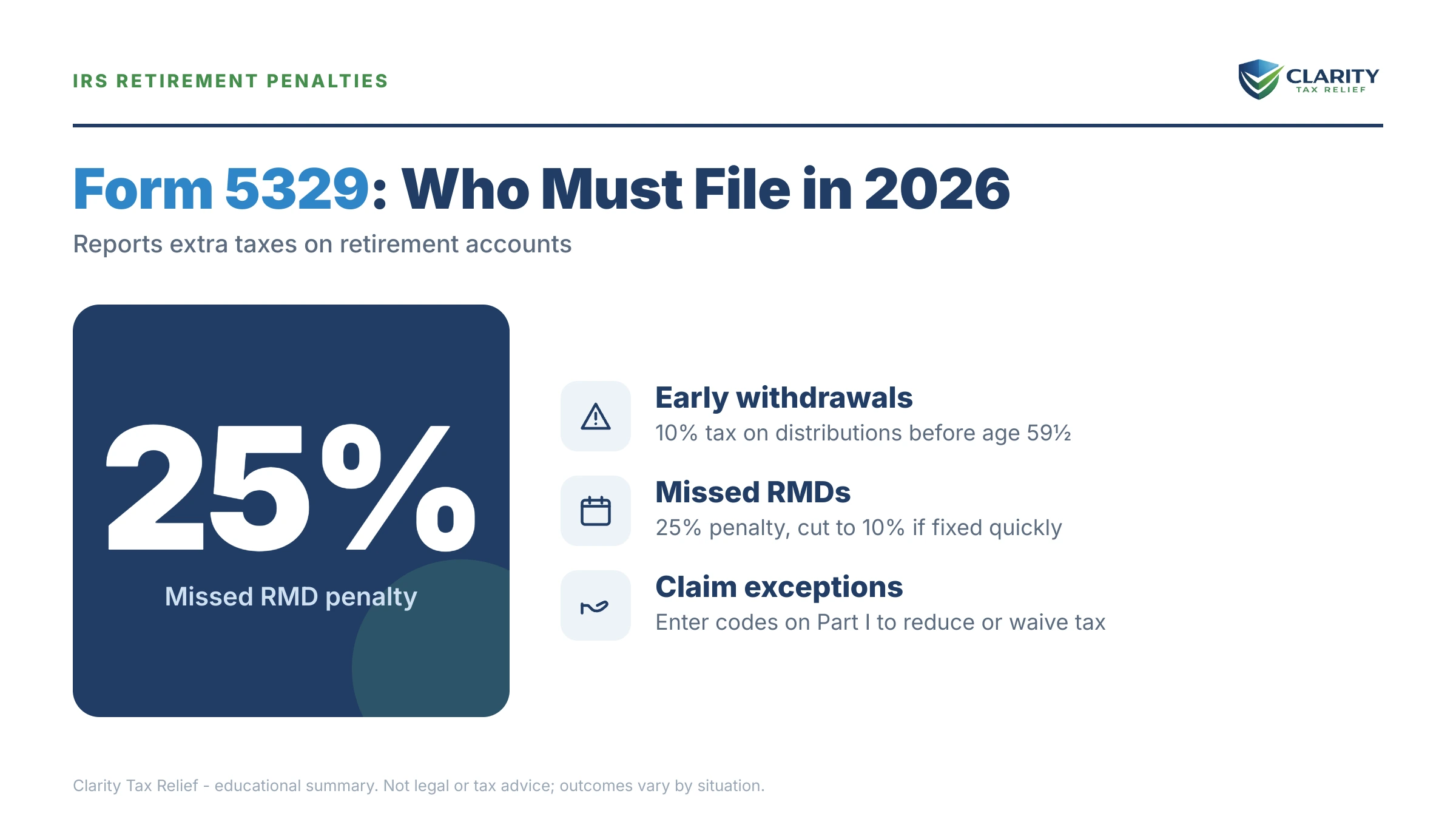
The short answer: the instructions for Form 5329 cover three taxes: 10% on early distributions from IRAs and retirement plans, 6% per year on excess contributions, and 25% (10% if corrected in time) on missed required minimum distributions. File it to claim any exception your 1099-R does not show.
The IRS's instructions for Form 5329 run nine parts and two dozen exception codes, and this guide turns them into plain English: who must file, what each part taxes, the exception number to enter on line 2, the 2025 dollar caps, what a real cash-out costs, what happens if the form never gets filed, and how to pay what is left. Figures come from the 2025 instructions (for returns filed in 2026), last updated by the IRS on April 30, 2026, and were checked November 4, 2026.
The severance ran out, the 401(k) check kept the rent paid, and now a Form 1099-R is sitting on the table telling you that decision has a second bill attached. The math on Form 5329 is knowable. The exceptions are specific and written into the form itself, and the expensive outcomes mostly happen to people who never file it at all.
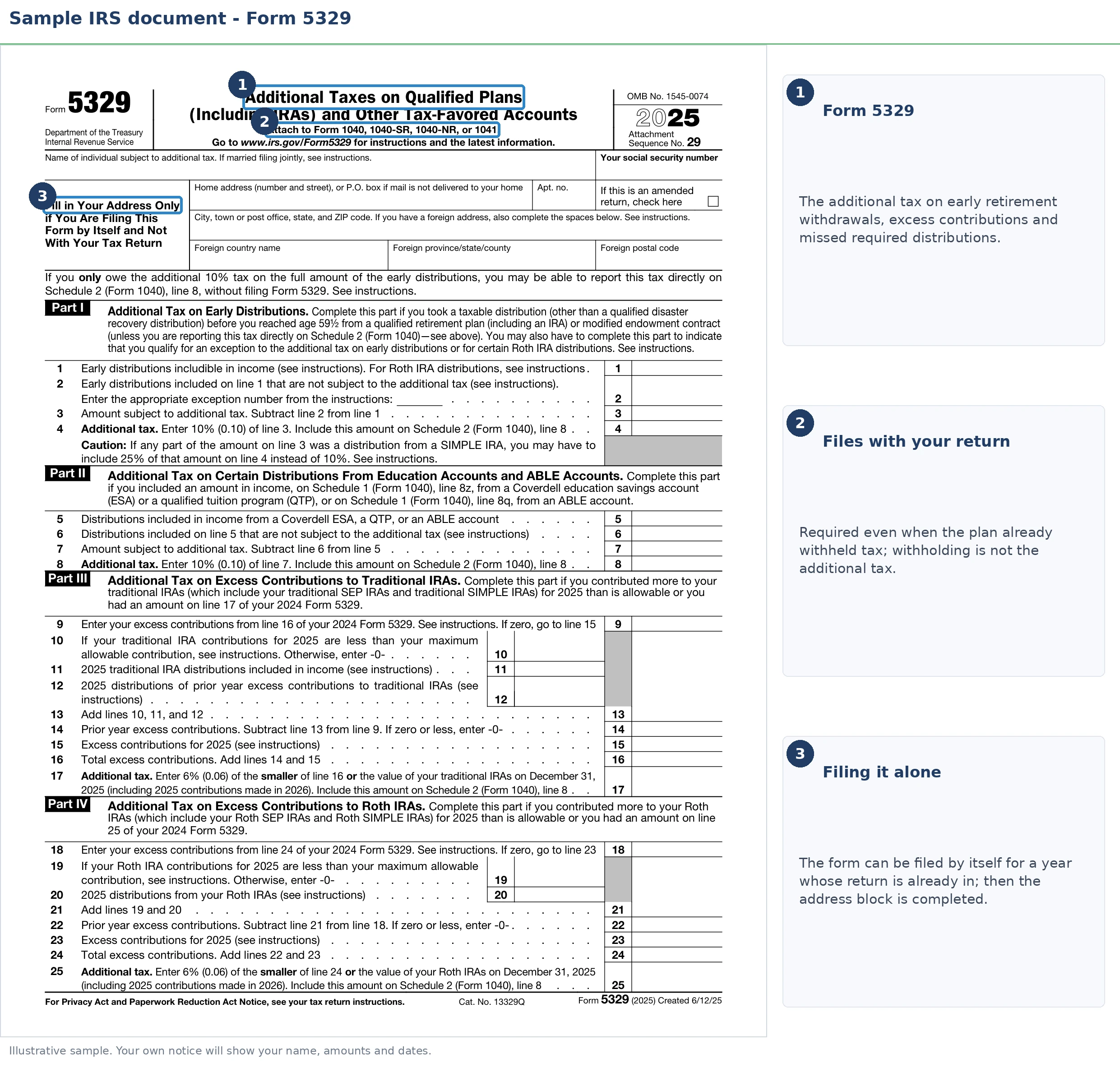
If you cashed out a retirement account early, most of what you need is in the first table, the exceptions list, and the worked example below. The image below shows what Form 5329 looks like and where each of the three taxes lands on it, so give it a glance before you touch the form.
⏱ Your deadline: Form 5329 has no due date of its own. The IRS says it must be filed by the due date, including extensions, of your income tax return. Two clocks run without it: the 6% excess-contribution tax repeats every year the excess stays in the account, and once a balance is assessed, penalties and interest accrue monthly until it's paid.
Who must file Form 5329, according to the instructions?
The instructions for Form 5329 say you must file it if any of these apply to you for 2025:
- You took an early distribution from a qualified retirement plan (including an IRA) and owe the 10% additional tax, unless every Form 1099-R correctly shows code 1 in box 7 and you owe the tax on the full amount.
- You took an early distribution you believe qualifies for an exception, but box 7 of your 1099-R does not show it, or the exception does not cover the whole distribution.
- You took a Roth IRA distribution that triggers the tax (for example, a Form 8606 line 25c amount above zero or a recapture amount).
- You took taxable distributions from a Coverdell ESA, a 529 plan (QTP), or an ABLE account.
- Your 2025 contributions to IRAs, Coverdell ESAs, Archer MSAs, HSAs, or ABLE accounts exceeded the limit, or you owed tax on an excess contribution in 2024 that is still in the account.
- You did not receive the required minimum distribution from a qualified plan or IRA.
Two shortcuts the instructions allow. If your 1099-R shows code 1 and you agree the full 10% applies, you can report the tax directly on Schedule 2 (Form 1040), line 8, without the form. And if you rolled over every distribution you received during the year, you do not need to file Form 5329 at all.
Here's the part that surprises almost everyone. The 20% your plan withheld does not cover the 10% additional tax. Mandatory withholding on a workplace-plan cash-out is a down payment on ordinary income tax only. The 10% is a separate charge, computed on Form 5329, and for most people in a real tax bracket the withholding doesn't even cover the income tax, let alone the extra 10%.
What do Parts I through IX of Form 5329 tax?
Form 5329 collects three distinct taxes across nine parts: 10% on early distributions, 6% per year on excess contributions, and 25% on missed required minimum distributions. Each part pulls its numbers from a different source. The image below shows the form's layout so you can see which part applies to you.
| Part | What it taxes | The rate | Where the numbers come from |
|---|---|---|---|
| Part I | Early distributions from IRAs, qualified plans, and modified endowment contracts | 10% of the taxable amount; 25% for a SIMPLE IRA distribution within 2 years of first participating | Form 1099-R: Box 1 (gross), Box 2a (taxable amount), Box 7 (distribution code) |
| Part II | Certain distributions from Coverdell ESAs, 529 plans (QTPs), and ABLE accounts | 10% of the taxable portion | Form 1099-Q and your own records; see Publication 970 |
| Parts III and IV | Excess contributions to traditional IRAs (III) and Roth IRAs (IV) | 6% per year of the excess, repeating until removed | Your contribution records and Form 5498 |
| Parts V, VI, VII and VIII | Excess contributions to Coverdell ESAs (V), Archer MSAs (VI), HSAs (VII), and ABLE accounts (VIII) | 6% per year of the excess, repeating until removed | Form 8889 for HSAs, Form 8853 for Archer MSAs, plus your contribution records |
| Part IX | Excess accumulation: a required minimum distribution you did not take from a qualified plan or IRA | 25% of the shortfall; 10% if corrected within the correction window; waivable for reasonable cause | Your custodian's RMD statement and year-end balances; see Publication 590-B |
So a laid-off worker's 401(k) cash-out, a retiree's forgotten RMD, and an over-funded HSA all land on the same form, in different parts, at different rates. If your issue is HSA excess contributions, the mechanics interact with your regular HSA reporting on Form 8889. If it's a missed RMD, the waiver process has its own playbook in our guide to the missed RMD penalty waiver. The IRS defines the correction window for Part IX as ending on the earliest of the date a deficiency notice for the tax is mailed, the date the tax is assessed, or the last day of the second taxable year after the year the tax is imposed.
Which exception codes can get you out of the 10%, and where do they go?
The instructions for Form 5329 list 23 numbered exceptions for line 2 of Part I, and you enter 99 if more than one applies. This matters most when your 1099-R shows code 1 (no known exception). The payer only reports what it knows, and it doesn't know about your medical bills or disability. Form 5329 is where you overrule the payer's code and claim the exception yourself.
| No. | Exception | Applies to | What to know |
|---|---|---|---|
| 01 | Separation from service at age 55 or later (50 for qualified public safety employees and private-sector firefighters), or after 25 years of service, whichever is earlier | Qualified plans only, never IRAs | The test is the year you separated; rolling the money to an IRA forfeits it |
| 02 | Substantially equal periodic payments over your life expectancy | IRAs and qualified plans | Breaking the schedule early triggers the tax retroactively |
| 03 | Total and permanent disability | IRAs and qualified plans | Keep the medical determination |
| 04 | Death (distributions to a beneficiary) | IRAs and qualified plans | Income tax still applies; the 10% does not |
| 05 | Unreimbursed medical expenses minus 7.5% of your AGI | IRAs and qualified plans | Only the portion above the floor is exempt; no itemizing required |
| 06 | Payments to an alternate payee under a qualified domestic relations order | Qualified plans only | Divorce transfers from a workplace plan |
| 07 | Health insurance premiums while unemployed | IRAs only | Does nothing for a 401(k) cash-out |
| 08 | Qualified higher education expenses | IRAs only | For you, a spouse, child or grandchild |
| 09 | First home purchase, up to $10,000 | IRAs only | Lifetime limit |
| 10 | Distribution due to an IRS levy on the account | IRAs and qualified plans | See can the IRS take your IRA |
| 11 | Qualified reservist distributions (active duty of at least 180 days) | IRAs and qualified plans | Keep the orders |
| 12 | Distributions incorrectly coded 1, J or S when you were 59½ or older | IRAs and qualified plans | Fixes a payer coding error |
| 19 | Qualified birth or adoption distribution, up to $5,000, within 1 year of the event | IRAs and qualified plans | Per child |
| 20 | Distribution after a physician certifies a terminal illness (death expected within 84 months) | IRAs and qualified plans | Cites Notice 2024-02 |
| 22 | Distribution to a victim of domestic abuse, within 1 year, up to the lesser of $10,000 (indexed) or 50% of the account | IRAs and qualified plans | Cites Notice 2024-55 |
| 23 | Emergency personal expense distribution, up to $1,000, once per calendar year | IRAs and qualified plans | Cites Notice 2024-55; repayable within 3 years |
| 99 | More than one exception applies | Any | Enter 99 on line 2 |
Exceptions 13 through 18 and 21 cover narrower cases: section 457 plan distributions, certain pre-1986 separations, section 404(k) dividends, pre-August 1982 annuity investment, federal phased retirement, permissible withdrawals from automatic contribution arrangements, and corrective distributions of income on excess contributions. The full list is in the 2025 instructions linked below.
Two traps in this list catch laid-off workers constantly:
- Exception 01 doesn't help you at 48. The age test is about the year you separated, whatever your need for the money. It applies only to workplace plans like 401(k)s and 403(b)s, and rolling a 401(k) into an IRA forfeits it.
- Exception 07, health insurance while unemployed, applies to IRAs only. It does nothing for a 401(k), and job loss by itself is no exception for a workplace-plan cash-out.
What does a $42,000 401(k) cash-out cost?
A $42,000 401(k) cash-out at 48 can cost roughly $13,440 in federal tax, about $5,040 more than the plan withheld. Here's the math, using a clearly hypothetical scenario.
Say you're 48, laid off in March, and you cashed out a $42,000 401(k) to cover rent. The plan withheld the mandatory 20% ($8,400) and deposited $33,600. It felt like the taxes were handled. Now run the actual numbers, assuming the distribution stacks on top of your severance and unemployment into the 22% bracket:
- Ordinary income tax: 22% × $42,000 = $9,240
- Additional tax on Form 5329, Part I: 10% × $42,000 = $4,200
- Total federal cost: $13,440
- Already withheld: $8,400
- Still owed at filing: roughly $5,040, before any state income tax and before any underpayment penalty
Now the exception check. Exception 01? No, you were 48 when you separated. Unemployment alone? No, exception 07 is IRA-only. Suppose you paid $6,000 in unreimbursed medical bills that year and your AGI was $58,000. The amount above the 7.5% floor ($6,000 minus $4,350 = $1,650) escapes the 10% under exception 05, trimming the Form 5329 tax by $165. Small, but it's the kind of line item most self-preparers never claim, and it requires filing the form.
If this scenario is your scenario, the follow-on question, how to handle a 401(k) withdrawal tax bill you can't pay, has its own full guide.
What happens if you skip Form 5329 and ignore the 1099-R?
An unreported 1099-R doesn't disappear. The IRS's document-matching computers compare every payer form against your return, often a year or more after you file. When the match fails, a fixed sequence starts, and each stage costs more than the last:
- The mismatch is flagged. The Automated Underreporter program sees a 1099-R with no matching income or additional tax on your return. No human has looked at your file yet, and none needs to.
- CP2000 notice. The IRS proposes the extra income tax, the 10% additional tax, interest back to the original due date, and often an accuracy-related penalty. The IRS says to reply by the date listed on the notice, and this is your best window to claim an exception you skipped.
- CP3219A, the statutory notice of deficiency. If you don't respond, this 90-day letter is your last chance to dispute the amount before assessment, by petitioning Tax Court.
- Assessment and the CP14 notice. The proposed tax becomes a legal debt and the first bill arrives, with the due date printed on the notice before the reminder sequence begins.
- The collection ladder. CP501 and CP503 reminders, then CP504 (the IRS can take your state refund), then LT11, the final notice that opens a 30-day window before wage garnishment and bank levies become legal, and your last chance to request a Collection Due Process hearing.
There's a quieter cost, too. For the excise taxes Form 5329 reports, the statute of limitations generally doesn't start until the form is filed. An unfiled 5329 can leave that year open to the IRS indefinitely. Filing it, even years late, is what starts the clock in your favor.
Cashed out a retirement account and the bill is bigger than the withholding covered?
Whether you're staring at a fresh 1099-R or a CP2000 for a withdrawal from two years ago, get it reviewed free before interest and penalties add another layer. An experienced tax professional at Clarity Tax Relief will check every exception you can claim and map the cheapest way to handle the balance.
How do you file Form 5329, step by step?
- Gather your paperwork. Pull every Form 1099-R you received, a copy of your return, and any records that support an exception: medical bills, a disability determination, or the date you separated from the employer.
- Check Box 7 on each 1099-R. The distribution code tells you what the payer reported to the IRS. Code 1 means early distribution with no known exception, the code Form 5329 most often exists to correct.
- Complete the part that matches your situation. Early distributions go in Part I with the exception number on line 2; excess contributions go in Parts III through VIII by account type; a missed RMD goes in Part IX.
- Attach the form to your return, or file it alone. Form 5329 rides with Form 1040 and its tax flows to Schedule 2. If you are not required to file a return, the IRS says you can file Form 5329 by itself with your address on page 1 and your signature on page 3, but a standalone 5329 cannot be e-filed. For a year you already filed, the usual route is Form 1040-X with Form 5329 attached.
- Fix the underlying problem. Withdraw an excess contribution (plus its earnings) so the 6% stops repeating, or take the missed RMD now and request a waiver on the form.
- Pay what you can and arrange the rest. Pay online at IRS.gov/payments, or set up a payment plan before the balance moves into the IRS collection notice stream.
What if you owe on Form 5329 and can't pay?
The IRS accepted roughly 1 in 5 Offers in Compromise in FY2024. Put plainly, most Form 5329 balances get resolved through payment arrangements, and settlements are the exception. Here's the realistic menu, from simplest to hardest:
- Pay in full by the return deadline. Cheapest option; stops the failure-to-pay penalty before it starts.
- Short-term payment plan. Up to 180 days, $0 setup fee online. Interest and the 0.5%/month late-payment penalty continue, but collection doesn't start.
- Installment agreement. For balances up to $50,000 you can set up a plan online for a $29 fee by direct debit; balances of $10,000 or less generally qualify for a guaranteed installment agreement. Our guide to setting up an IRS payment plan online walks through it. On the hypothetical $5,040 shortfall above, even a modest monthly payment keeps the debt out of the levy pipeline entirely.
- Currently Not Collectible status. If you're still out of work and paying anything would leave you unable to cover basic living expenses, collection can be paused. The debt (and interest) remains, but levies stop. Start with our guide for people who lost a job and can't pay the IRS.
- Offer in Compromise. Settling for less than the full balance when your assets and income can't cover it. There's a $205 application fee and, for lump-sum offers, 20% down, both waived with low-income certification (AGI at or below 250% of the poverty level). Real, means-tested, and slow. Never a marketing promise.
- Penalty relief, with a big caveat. The 10% itself is an additional tax, so abatement can't touch it. The failure-to-file and failure-to-pay penalties stacked on an old unreported distribution are abatable, through first-time abatement, which still covers 2025 returns processed before the IRS starts its new Automatic Exemption from Penalty, or through that exemption once it applies. You can estimate how much of your balance is penalties and interest versus tax with our IRS Penalty & Interest Calculator.
- Respond to the CP2000 instead of paying it blind. If the IRS already proposed the tax and you agree with the income but missed an exception, a corrected Form 5329 in your response can shrink the bill before it's assessed. If you agree with everything but can't pay, see CP2000: agree but can't pay.
When can you handle Form 5329 yourself?
Most straightforward Form 5329 situations are do-it-yourself. Handle it on your own when:
- Your 1099-R shows code 1, you agree the 10% applies, and you can pay the balance in full or within 180 days;
- You're claiming a single, well-documented exception (medical bills above the floor, a disability determination, a beneficiary distribution) and tax software will carry the numbers to Schedule 2;
- You caught an excess contribution early and just need to report one year of the 6% while the custodian processes the corrective withdrawal;
- You missed one RMD, took it as soon as you noticed, and are filing the waiver request with a short reasonable-cause statement.
Red flags that mean experienced help changes the outcome:
- A CP2000 already assessed for multiple years of unreported distributions.
- A cash-out you can't pay on top of other tax debt.
- A disputed exception where the payer's code contradicts your facts.
- A 72(t) payment schedule that broke.
- Excess contributions that compounded for several years across account types.
In those cases, the order you fix things in (exceptions first, then penalties, then the payment arrangement) often changes the total you pay more than any single form does.
What do the terms on Form 5329 and your 1099-R mean?
- Additional tax: the law's term for the 10%. It's a tax and no penalty, which is why penalty abatement can't remove it while statutory exceptions can.
- Distribution code (Box 7): the one- or two-character code your payer used to describe the withdrawal to the IRS; Form 5329 is how you correct or override it.
- Gross distribution vs. taxable amount: Box 1 is everything that left the account; Box 2a is the portion that counts as income, the number the additional tax is figured on.
- Excess contribution: money put into an IRA, HSA, or similar account beyond that year's legal limit; it draws the 6% excise every year it stays in.
- Required minimum distribution (RMD): the amount the law forces out of most retirement accounts each year past a certain age; the shortfall (and only the shortfall) is what gets taxed.
- Correction window: the period, defined in the Form 5329 instructions, during which fixing a missed RMD cuts the excise tax from 25% to 10%. It ends at the earliest of a deficiency notice, assessment, or the end of the second tax year after the year of the shortfall.
The bottom line on Form 5329
If a 1099-R shows an early withdrawal, the 10% is owed unless an exception applies, and Form 5329 is the only place to claim one. The 20% your plan withheld won't cover it. File the form with your return, fix any excess contribution or missed RMD so the tax stops repeating, and arrange payment before the CP2000 letters start.
Your next 24 hours
- Find three boxes on your 1099-R: Box 1 (gross distribution), Box 2a (taxable amount), and Box 7 (distribution code). Those three numbers determine everything Form 5329 will say.
- Gather your supporting records: last year's return, the 1099-R, and anything backing a possible exception, such as medical bills for the year, a disability determination, or your separation paperwork.
- Get a free case review. If the balance is more than you can pay, or a CP2000 already arrived, an experienced tax professional can check every exception and set up the right arrangement before interest and penalties add another layer. Use the 2-minute form or call (888) 825-7779.
Primary sources: the IRS's 2025 Instructions for Form 5329 (the who-must-file rules, the nine parts, the line 2 exception numbers and the correction-window definition), About Form 5329, the IRS's exceptions to tax on early distributions table (the $1,000 and $10,000 caps), and Publication 590-B for IRA distribution and RMD rules. All checked November 4, 2026.
Instructions for Form 5329: common questions
Do I have to file Form 5329 if my 401(k) already withheld 20%?
Usually, yes. The 20% your plan withheld is a prepayment of ordinary income tax only. It does not include or satisfy the 10% additional tax on early distributions. If your 1099-R shows code 1 and no exception applies, you can enter the 10% directly on Schedule 2 (Form 1040), line 8, without the form, but you must file Form 5329 itself any time you claim an exception the payer did not code.
What exception number do I put on line 2 of Form 5329?
The 2025 instructions assign a two-digit number to each exception: 01 for separation from service at 55 or later from a workplace plan, 02 for substantially equal periodic payments, 03 for disability, 04 for death, 05 for medical expenses above 7.5% of AGI, 09 for a first home up to $10,000, 10 for an IRS levy, 22 for domestic abuse victims, and 23 for a $1,000 emergency expense. Enter 99 if more than one applies. Only the portion of the distribution the exception covers goes on line 2.
Is the 10% early-withdrawal tax a penalty the IRS can abate?
No. It is an additional tax under the law, so first-time abatement and reasonable-cause relief cannot remove it. Only the statutory exceptions on Form 5329 can. Abatement still matters, though: the failure-to-file and failure-to-pay penalties that stack on top of an unreported distribution are penalties, and those can often be reduced or removed.
What is the penalty for missing a required minimum distribution?
Under current law, the excise tax in Part IX is 25% of the amount you should have withdrawn but didn't, and it drops to 10% if you correct the shortfall within the correction window described in the Form 5329 instructions. The IRS can also waive it entirely for reasonable cause. You request the waiver on Form 5329 itself with a brief explanation and proof you have since taken the distribution.
Can I file Form 5329 by itself without a tax return?
Yes, if you are not required to file an income tax return for the year. The instructions say to file Form 5329 by itself with your address on page 1 and your signature and date on page 3, and that a standalone Form 5329 cannot be filed electronically. If you already filed a return for that year and need to add the form, the usual route is Form 1040-X with Form 5329 attached.
Does the emergency personal expense exception apply to a 401(k)?
Yes. The IRS lists the emergency personal expense distribution for both qualified plans and IRAs, limited to one distribution per calendar year of up to the lesser of $1,000 or your vested balance over $1,000, for distributions made after December 31, 2023. You claim it with exception number 23 on line 2 of Form 5329, the distribution is still taxable income, and you may repay it within three years.
Which tax year do the current Form 5329 instructions cover?
The instructions on IRS.gov as of November 2026 are the 2025 instructions, for tax year 2025 returns filed in 2026, and the IRS last updated that page on April 30, 2026. They cite Notice 2024-55 for the domestic abuse and emergency expense exceptions and Notice 2024-02 for the terminal illness exception. For an earlier year, use the prior-year instructions for that year, since dollar caps and exception numbers change.
This guide is general information, not tax or legal advice for your specific situation. Eligibility for IRS programs depends on individual facts and circumstances; no outcome is guaranteed.