
Tax Debt Situations
On Disability and Owe the IRS: What They Can Take and Your Options in 2026
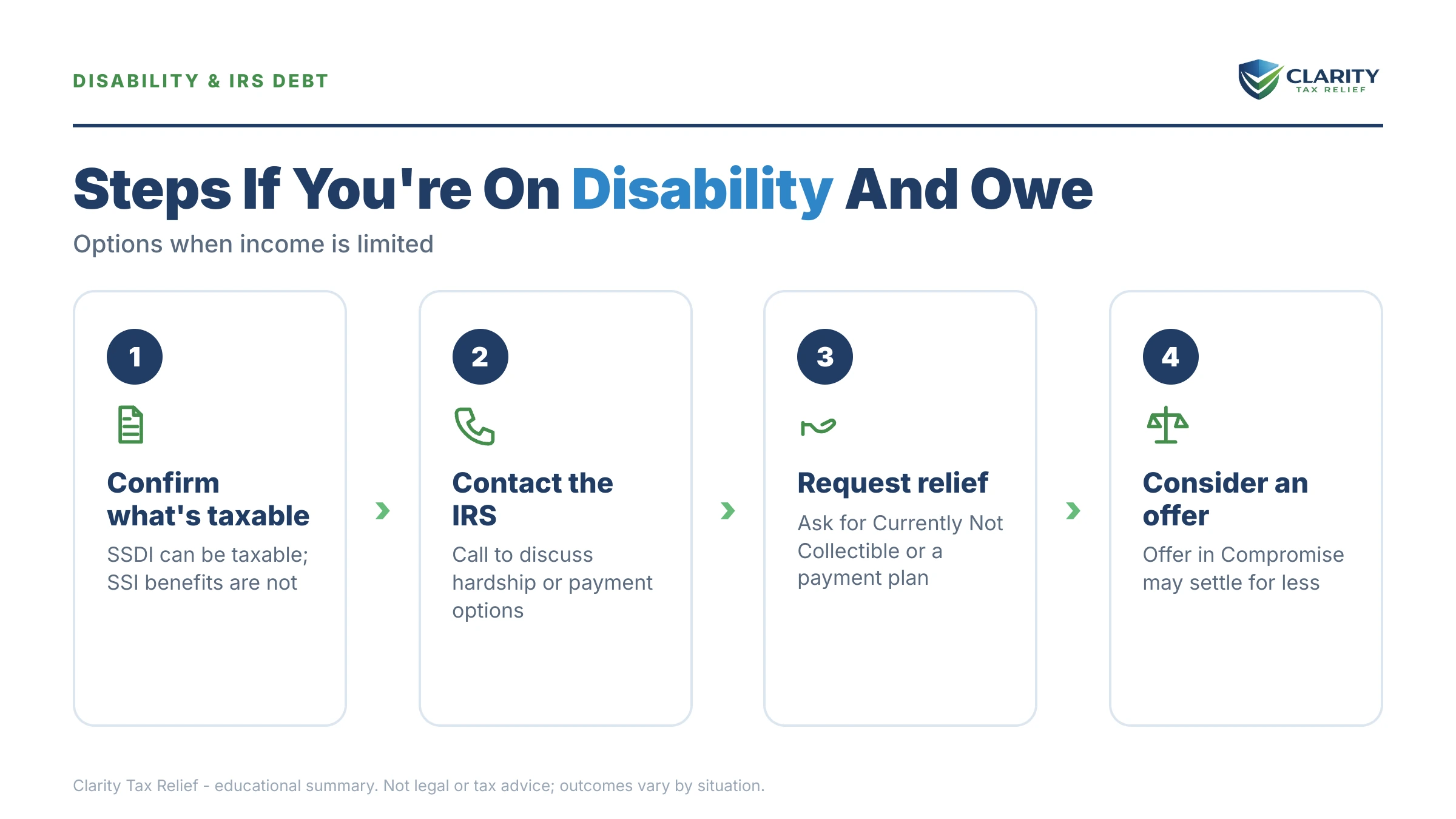
The short answer: if you're on disability and owe the IRS, the agency can levy up to 15% of a monthly SSDI check through the Federal Payment Levy Program — but SSI can't be levied at all, and VA disability compensation is generally protected. Many disability-only households resolve the debt through hardship (CNC) status or a low-income Offer in Compromise.
The check that lands each month barely covers rent, groceries, and prescriptions — and now IRS letters keep arriving about tax years from when you were still healthy enough to work. Here's what those letters never explain: the IRS measures ability to pay, and on disability-only income that math usually works in your favor. This guide maps exactly which benefits the IRS can and can't touch, and the programs built for situations like yours.
⏱ The clock that's actually running: there's no single response deadline on a disability tax debt — but once a Social Security levy starts, the IRS takes up to 15% of every monthly SSDI payment until the debt is resolved, and interest plus a 0.5%-per-month failure-to-pay penalty keep growing the whole time. If a levy notice like a CP91 or LT11 is already in your hands, the date printed on it controls.
What the IRS can take when you're on disability
The IRS can levy up to 15% of a monthly SSDI payment through the Federal Payment Levy Program, but it cannot levy SSI at all. That single distinction decides how much leverage the IRS actually has over your household — and it's why the first thing to do is identify exactly which benefit you receive.
The protection follows the source of the money, not the money itself. A benefit that can't be levied at the source can still be reached once it's sitting in your checking account, which is the trap most disability recipients don't see coming.
| Income or asset | Can the IRS levy it? | How it happens |
|---|---|---|
| SSDI (Social Security Disability Insurance) | Yes — up to 15% per month | Federal Payment Levy Program, after a final notice (usually CP91); continues monthly until resolved |
| SSI (Supplemental Security Income) | No | Needs-based payments are excluded from the FPLP entirely |
| VA disability compensation | Generally no | Not part of the FPLP; see our guide on whether the IRS can take VA disability |
| Private or employer long-term disability payments | Yes | Insurer-paid benefits aren't on the levy-exempt list and can be levied through the payer, though this is less common |
| Money already in your bank account | Yes — regardless of where it came from | Bank levy; the bank holds funds 21 days before sending them, your window to request a release |
| Tax refunds (federal and often state) | Yes — automatically | Refund offset every year until the balance is paid, even while you're in a hardship status |
One more nuance on that bank-account row: benefit money loses its source protection once deposited. If your SSI or VA compensation accumulates in savings, a bank levy can reach it even though the monthly payment itself is untouchable — details in our can the IRS garnish SSDI guide.
Why you owe the IRS while your income is a disability check
Most disability-era tax debt was created in the working years before the disability began. Three patterns account for nearly all of it:
Self-employment years with no withholding. If you worked as a 1099 contractor, nobody withheld anything — and self-employment tax alone runs 15.3% on top of income tax. Missed quarterly payments during your last working years compound into large assessed balances just as your income collapses.
Taxable SSDI back pay. A lump-sum disability award covering two or three years of back benefits can push your combined income over the $25,000 single / $32,000 joint thresholds that make SSDI partially taxable — creating a new tax bill in the very year you finally got approved. The lump-sum election on your return can attribute that back pay to the earlier years it covers and often shrinks the bill; if yours wasn't calculated that way, an amendment may be worth reviewing.
Retirement withdrawals during the approval gap. Many people drain a 401(k) or IRA while waiting for benefits. The income tax on those withdrawals is real — though if you were already totally and permanently disabled when you withdrew, the 10% early-withdrawal addition may not apply, which is another amendment-worthy check.
What happens if you ignore the debt
The IRS collection sequence runs on automation, and it does not pause because your income is a disability benefit. Each stage arrives with more enforcement power than the last:
- CP14 — the first bill. No enforcement yet, but penalties and interest are already compounding.
- CP501 / CP503 — reminder notices while the balance grows and refund offsets begin taking any federal refund automatically.
- CP504 — intent to levy your state tax refund, and the point where a federal tax lien becomes a realistic possibility.
- LT11 / Letter 1058 — the final notice of intent to levy. It starts a 30-day clock and your Collection Due Process rights (requested with Form 12153). After 30 days, bank accounts are fair game.
- CP91 — the final notice specific to Social Security recipients. Miss its printed deadline and the FPLP begins taking up to 15% of every SSDI payment — read our CP91 Social Security levy guide if this one is in your hands.
- CP508C — once the certified balance passes $66,000 (the 2026 threshold), the IRS can certify you to the State Department, blocking passport renewal. Our passport revoked for tax debt guide covers reversal.
Don't count on 2026 staffing chaos to save you. The IRS workforce shrank roughly 27% in 2025, and humans are genuinely hard to reach — but the notices, offsets, and the 15% SSDI levy are all generated by systems that never got laid off. Here's why an understaffed IRS doesn't mean you don't owe.
On disability with an IRS balance you can't pay?
A 15% levy on your SSDI runs every single month until someone stops it — and interest is compounding either way. An experienced tax professional will review your notices and benefit situation free, and tell you whether hardship status or a low-income offer fits your numbers. No pressure, no obligation.
On disability and owe the IRS more than you can pay? Your realistic options
Disability-only income opens doors most taxpayers don't have: a $0-cost hardship status, a fee-waived settlement path, and — in some cases — simply outlasting the collection statute. The general playbook for each program lives in our guide to how to settle tax debt yourself; here's how each one applies specifically when your income is a benefit check.
| Option | Who may qualify | Cost and trade-off |
|---|---|---|
| Currently Not Collectible (CNC) | Allowable living expenses equal or exceed income on Form 433-F; disability-only households often meet this | $0 to request; levies stop, but the debt remains, interest accrues, and refunds are offset yearly |
| Low-income Offer in Compromise | AGI at or below 250% of the federal poverty level; offer must match your Reasonable Collection Potential | $205 fee, 20% down payment, and payments during review are all waived; roughly 1 in 5 offers were accepted in FY2024 |
| Short-term payment plan | Can pay the full balance within 180 days | $0 setup; interest and penalties continue until paid |
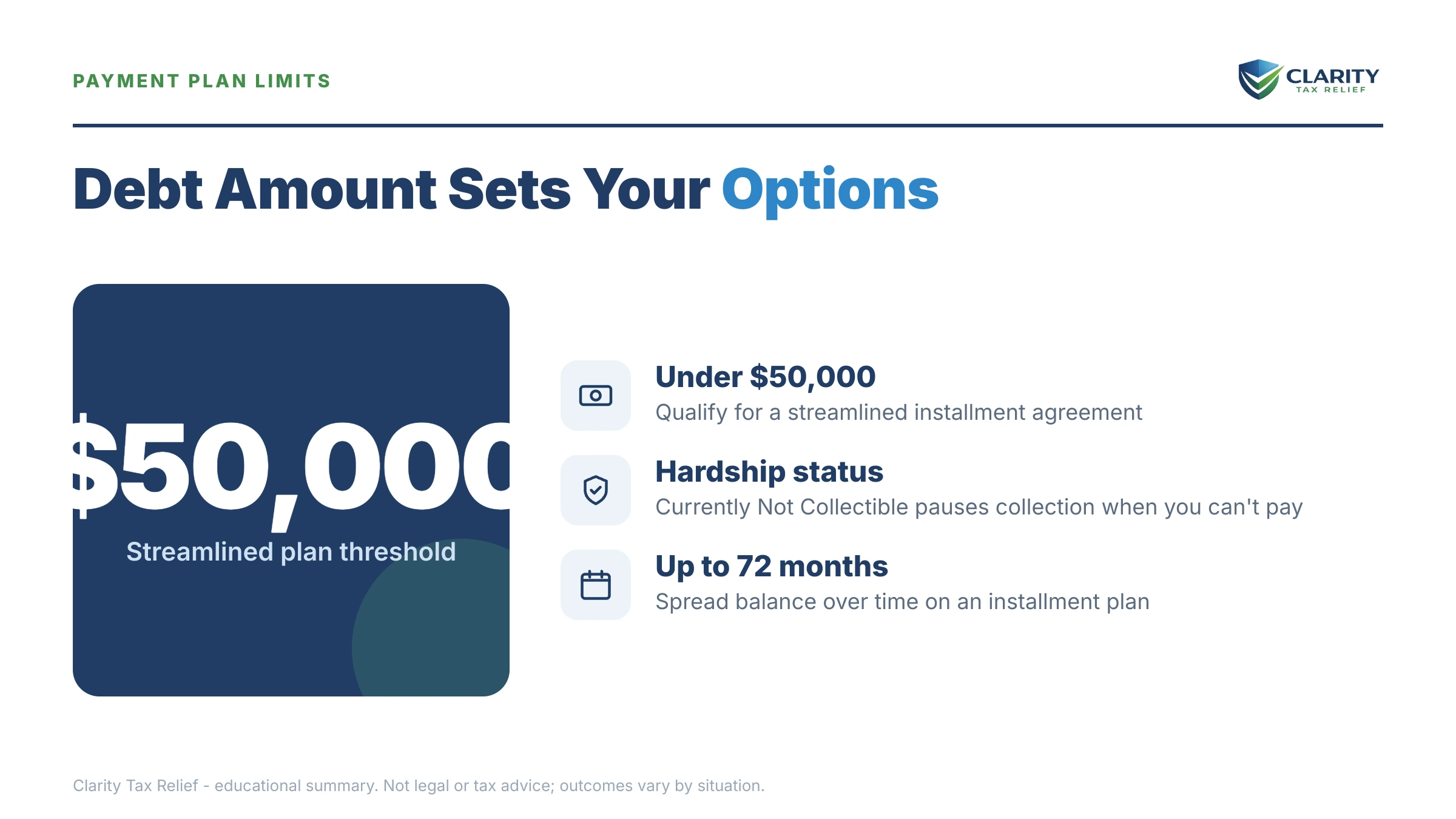
| Streamlined installment agreement | Balance of $50,000 or less; up to 72 months, set up online | Setup fee applies; not available on larger balances without first paying down |
| Non-streamlined / partial-pay installment agreement | Any balance; requires Form 433-F financial disclosure | Payment set by your actual budget; a partial-pay plan may never fully repay before the statute expires |
| Penalty relief (FTA / AEP) | Clean compliance for the prior 3 years; the new Automatic Exemption from Penalty (AEP) begins applying automatically in summer 2026 | Removes penalties, not the underlying tax or interest |
CNC is the workhorse for disability cases. The IRS compares your income against allowable living expenses — housing, utilities, food, transportation, and crucially your out-of-pocket medical costs, which on disability are often substantial. When expenses meet or exceed income, collection is coded inactive. The full test is in how to qualify for CNC. Two honest caveats: interest keeps accruing, and your refund is still taken every year.
The low-income OIC is where disability finances shine. An offer is judged on Reasonable Collection Potential — reachable assets plus future collectible income. Fixed benefit income with expenses that consume it produces little or no future-income component, so a modest offer can be mathematically defensible. And the OIC low-income certification removes the $205 fee, the 20% down payment, and all payments during review. If the IRS doesn't decide within 2 years, the offer is accepted by law — with narrow exceptions: a returned or rejected offer stops the clock, and time during court disputes does not count. But it is means-tested and documented line by line — never assume approval.
The quiet third path: the 10-year statute. IRS debt generally expires 10 years after assessment, and time in CNC counts toward that clock. For a household that will remain on fixed benefits, CNC-until-expiration is often the realistic endgame — the mechanics are in our guide to how long the IRS can collect back taxes, and you can estimate your own expiration date with our CSED Calculator. Beware the tolling traps: a pending offer, bankruptcy, or appeal pauses the clock.
A worked example: $92,700 from your 1099 years, now on SSDI
Say you built decks as a 1099 contractor until a spinal injury ended the work, and the IRS assessed $92,700 across your last three working years — self-employment tax, income tax, penalties, and interest. Today your only income is $1,940/month in SSDI, you have $1,800 in the bank, and a twelve-year-old truck. This is hypothetical, but the arithmetic is exactly how the IRS would run it:
- If you do nothing: the FPLP levy takes 15% × $1,940 = $291 a month — about $3,492 a year, which is under 4% of the balance while interest alone typically adds more than that annually. The levy could run for years and the debt would still grow. And at $92,700 you're above the $66,000 passport-certification threshold, so a CP508C is on the table too.
- CNC: $1,940 in income against rent, utilities, food, and out-of-pocket medical that consume all of it means the Form 433-F math supports hardship status. Levies stop, the passport certification is generally avoided, and the 10-year clock keeps running. Cost: $0. Trade-off: annual refund offsets and a likely lien filing at this balance.
- Low-income OIC: annual income of roughly $23,300 sits well below 250% of the federal poverty level for a one-person household, so the certification applies — no fee, no 20% down, no payments during review. Reachable assets of perhaps a few hundred dollars after the bank-balance allowance, a truck below the vehicle threshold, and $0 in future collectible income can support a genuinely small offer. Acceptance is never assured — the IRS accepted roughly 1 in 5 offers in FY2024 — but this fact pattern is what the program exists for.
The strategic difference: CNC parks the debt; an accepted offer ends it — including the passport problem — permanently. Which one wins depends on your assets, your CSED dates, and whether your benefits could ever increase.
How to respond when you're on disability and owe the IRS, step by step
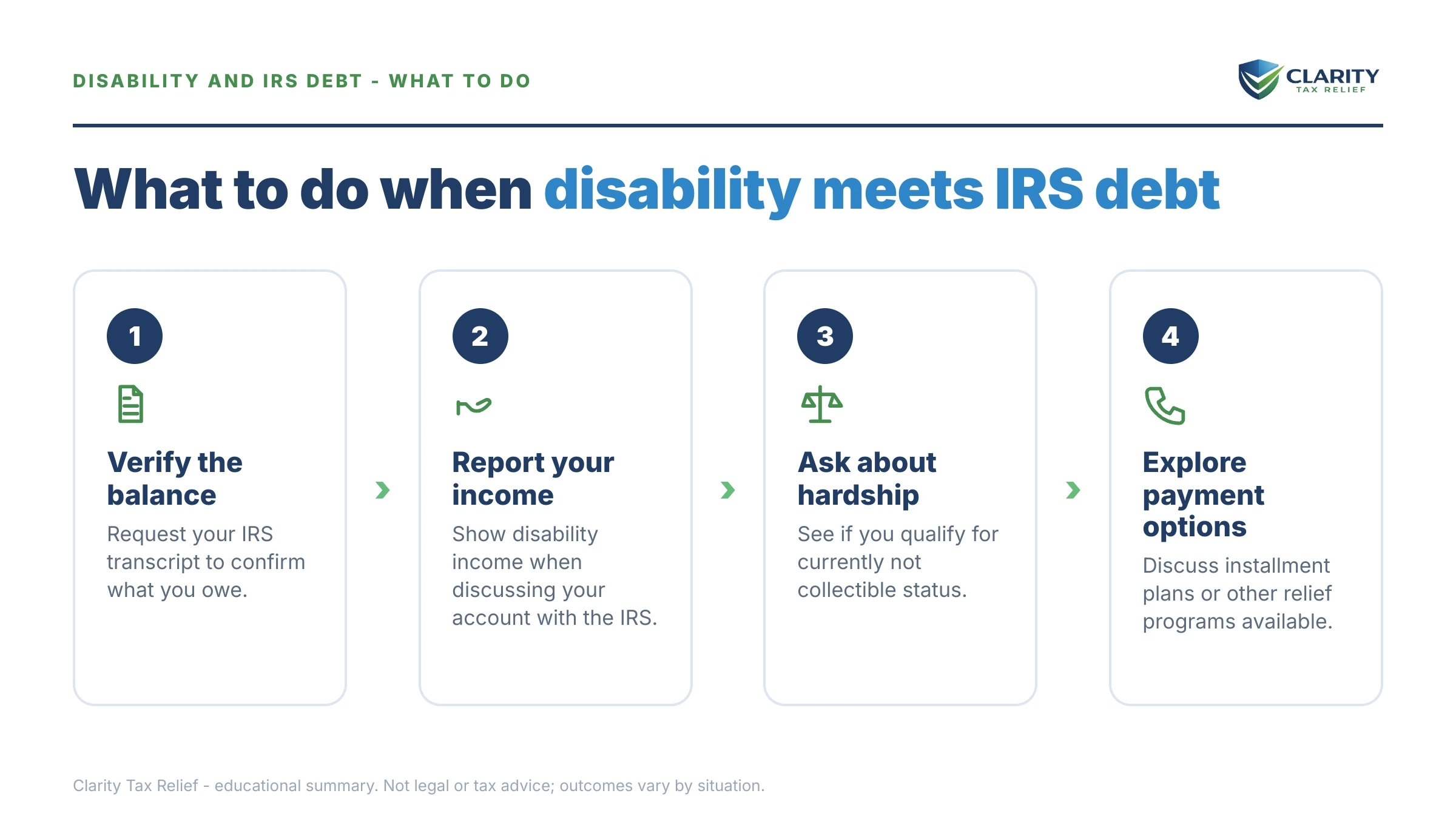
- Pull your IRS balance and transcripts. Set up an online account at IRS.gov to confirm the total owed, which tax years it covers, and whether a final levy notice has already been issued.
- File any missing returns. Every resolution program — CNC, a payment plan, or an Offer in Compromise — requires you to be current on filing first.
- Complete a Form 433-F financial snapshot. List your benefit income, housing, utilities, food, and out-of-pocket medical costs — this one form drives both hardship status and offer eligibility.
- Request your resolution before a final notice lands. Ask for Currently Not Collectible status, file a low-income Offer in Compromise, or set up a payment plan — any of these stops the levy sequence.
- Answer any levy notice by its printed deadline. An LT11 or CP91 names its own response date; requesting a Collection Due Process hearing with Form 12153 within an LT11's 30-day window preserves your appeal rights.
Transcript codes that matter on a disability collection case
Your IRS account transcript is where you verify that a requested status actually posted — never assume a phone promise took effect. These are the codes disability cases live and die by:
| Code | What it means | What to do |
|---|---|---|
| 530 | Account placed in Currently Not Collectible status | Confirm it posted after your CNC request; if it's missing, the levy sequence is still live |
| 480 | Offer in Compromise pending | Collection pauses while it's reviewed — but so does the 10-year clock; keep filing on time |
| 971 | A notice was issued | Match the date to the letter in your mail pile; a 971 near a levy code often marks the final notice |
| 276 / 196 | Failure-to-pay penalty and interest posted | Penalty portions are abatement candidates — check FTA eligibility, and AEP applies automatically starting summer 2026 |
| 898 | Refund offset to another agency | Confirms your refund went to a non-IRS debt (student loans, state debt) — a different fix than the IRS balance |
When you can handle this yourself — and when help changes the outcome
Plenty of disability tax situations don't need professional help. If your balance is small enough to pay within 180 days, if you agree with a first notice, or if your finances are simple — one benefit check, rent, no assets — a CNC request is a phone call and a Form 433-F you can complete yourself. Free resources exist too: the Taxpayer Advocate Service takes hardship cases, Low Income Taxpayer Clinics represent qualifying taxpayers at no charge, and payment plans can be set up directly at IRS.gov/payments. If you're pursuing an offer alone, start from the IRS's official Offer in Compromise page.
Experienced help earns its cost in specific situations: a levy already hitting your SSDI or bank account, a balance like $92,700 that sits above every streamlined threshold, OIC math complicated by home equity or a spouse's income, multiple unfiled 1099 years that need reconstructing, or a passport certification you need reversed. In those cases, the order and packaging of the fix — returns first, penalties next, then the resolution — changes what you ultimately pay.
Terms on your notices, decoded
- FPLP (Federal Payment Levy Program): the automated system that takes up to 15% of certain federal payments, including SSDI, month after month.
- Levy vs. offset: a levy seizes money from a source like a benefit or bank account; an offset keeps a refund you were owed — offsets continue even in hardship status.
- CNC (Currently Not Collectible): a hardship code that pauses active collection; the debt still exists and still accrues interest.
- CSED (Collection Statute Expiration Date): the date, 10 years after assessment, when the IRS generally loses the right to collect — pausable by offers, bankruptcy, and appeals.
- Low-income certification: the OIC provision for AGI at or below 250% of the federal poverty level that waives the fee, down payment, and payments during review.
- RCP (Reasonable Collection Potential): the IRS's calculation of the most it could ever collect from you — the floor any offer must meet.
Disability and IRS debt: your questions answered
Can the IRS take my SSDI check?
Yes — through the Federal Payment Levy Program, the IRS can take up to 15% of each monthly SSDI payment, and the levy repeats every month until the debt is resolved or the account is placed in hardship status. It only starts after a final notice, usually a CP91, which gives you a window to respond first. Requesting Currently Not Collectible status or another resolution before that deadline prevents the levy entirely.
Can the IRS garnish SSI?
No. Supplemental Security Income is a needs-based payment and is excluded from the Federal Payment Levy Program, so your monthly SSI check cannot be levied for federal tax debt. Two cautions: any tax refund you are owed can still be offset, and money that has already been deposited into a bank account can still be reached by a bank levy.
Will the IRS forgive my tax debt because I'm disabled?
Not automatically — there is no disability-based forgiveness program, and the balance does not disappear when you are approved for benefits. What disability changes is the math: fixed benefit income often meets the financial tests for Currently Not Collectible status or a low-income Offer in Compromise, and the 10-year collection statute keeps running in the background. Eligibility is means-tested and depends on your full financial picture.
Is disability back pay taxable?
It depends on the benefit. SSDI back pay can be taxable if your combined income exceeds $25,000 (single) or $32,000 (married filing jointly), though the lump-sum election lets you attribute the back pay to the earlier years it covers, which often lowers the tax. SSI and VA disability compensation are not taxable at all.
Can the IRS levy my bank account if my only income is disability?
Yes. Once benefits are deposited into a bank account, the IRS can reach the balance with a bank levy — the bank holds the funds for 21 days before sending them, which is your window to request a release. If losing that money would leave you unable to pay basic living expenses, an economic-hardship release is possible, but you have to ask for it.
Do I qualify for Currently Not Collectible status on disability income?
You may qualify if your allowable living expenses — housing, utilities, food, transportation, and out-of-pocket medical costs — equal or exceed your monthly income on a Form 433-F review. Households living only on SSDI or SSI frequently meet that test. CNC pauses levies, but the debt remains, interest keeps accruing, and any tax refund is still offset each year.
Does IRS debt expire if I stay on disability?
IRS debt generally becomes uncollectible 10 years after assessment — the Collection Statute Expiration Date, or CSED. Time spent in Currently Not Collectible status does not pause that clock, which is why CNC can quietly carry a disability-only household all the way to expiration. But an Offer in Compromise, bankruptcy, or a collection appeal pauses it, so the real date on your account may be later.
Can the IRS take VA disability benefits?
VA disability compensation is generally protected — it is not included in the Federal Payment Levy Program that reaches SSDI. The practical exposure is indirect: once VA benefits sit in a bank account, a bank levy can reach the balance, and tax refunds can still be offset. See our full guide on whether the IRS can take VA disability for the details.
Your next 24 hours
- Sort your mail pile and find the most recent notice. Look for the notice code in the top corner — a CP504, LT11, or CP91 means the levy stage is close and its printed date is your real deadline.
- Gather three things: your benefit award letter (SSDI, SSI, or VA), your most recent tax return, and a rough list of monthly expenses including out-of-pocket medical costs. That's everything a hardship or offer review needs.
- Get a free case review. Call (888) 825-7779 or use the 2-minute form — an experienced tax professional will tell you which benefit protections apply to you and whether CNC or a low-income offer fits your numbers, before interest adds another month to the balance.
This guide is general information, not tax or legal advice for your specific situation. Eligibility for IRS programs depends on individual facts and circumstances; no outcome is guaranteed.